1
Project Report
Project Tittle :
ROLE OF CLIMATE SMART AGRICULTURE (CSA), IN ADDRESSING
THE CHALLENGES OF FOOD SECURITY AND CLIMATE CHANGE.
Prepared By:
AKHIL S
Final year
Bsc(Hons) Agriculture, KAU
Abstract
In this project report we are evaluating the critical role of Climate-Smart
Agriculture (CSA) in addressing the challenges of food security and climate
change in India. While accounting India's vulnerability to climate variability and its
large population, adopting CSA practices is crucial for sustainable agricultural
development. This report will provides a comprehensive overview about the the
various aspects of CSA along with the implementation and impact of CSA in India,
highlighting the potential of CSA to enhance productivity, resilience, and
mitigation to climate change.
Introduction
With over 80 percent of its land dedicated to agriculture and relying heavily on
monsoon rainfall, India is especially vulnerable to the adverse impacts of climate
change. Increasing temperatures, altered rainfall patterns, and more extreme
weather events are affecting crop yields, water availability, and agricultural
productivity. At the same time, India must ensure food security for its growing
population. Conventional agricultural practices are also contributing to
greenhouse gas emissions and accelerating climate change.
2
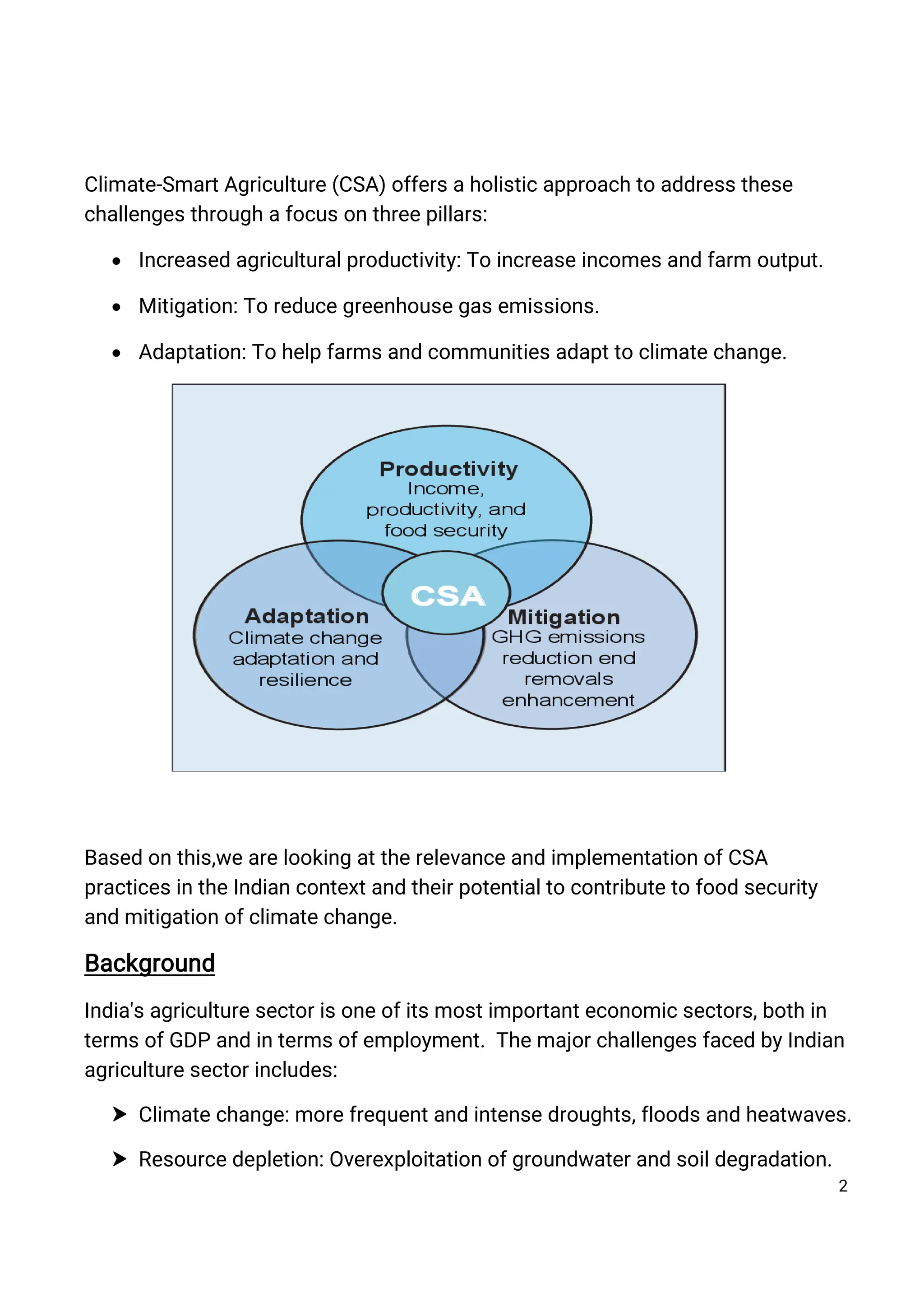
Climate-Smart Agriculture (CSA) offers a holistic approach to address these
challenges through a focus on three pillars:
 Increased agricultural productivity: To increase incomes and farm output.
 Mitigation: To reduce greenhouse gas emissions.
 Adaptation: To help farms and communities adapt to climate change.
Based on this,we are looking at the relevance and implementation of CSA
practices in the Indian context and their potential to contribute to food security
and mitigation of climate change.
Background
India's agriculture sector is one of its most important economic sectors, both in
terms of GDP and in terms of employment. The major challenges faced by Indian
agriculture sector includes:
 Climate change: more frequent and intense droughts, floods and heatwaves.
 Resource depletion: Overexploitation of groundwater and soil degradation.
3
 Fragmention of land holding: a large proportion of farmers have small
landholdings which limit their ability to invest in new technologies.
 Market access: limited access to markets and to fair prices for agricultural
products
 Greenhouse gas emission: Rice cultivation, livestock and fertilizer are major
contributors to the national GHG inventory.
The Indian Government has also realised the significance of CSA and taken up
several initiatives to promote sustainable agriculture such as National Mission for
Sustainable Agriculture (NMSA),National Innovations in Climate Resilient
Agriculture(NICRA),Paramparagat Krishi Vikas Yojana (PKVY) and Pradhan Mantri
Krishi Sinchayee Yojana (PMKSY).
Objectives
This project aimed to:
1. Assess the current state of CSA implementation in India.
2. Identification and assessment of promising CSA practices for different
agro-ecological zones.
3. Assess the contribution of CSA to food security and mitigation of
climate change
Methodology
This project employed a mixed-methods approach, including:
 Literature Review: Existing literatures on CSA, climate change and food
security in India.
 Consultation with experts : Guidence from professors and subject
specialist.
4
Key CSA Practices
CSA includes a variety of practices designed for different situations. Some
examples are:
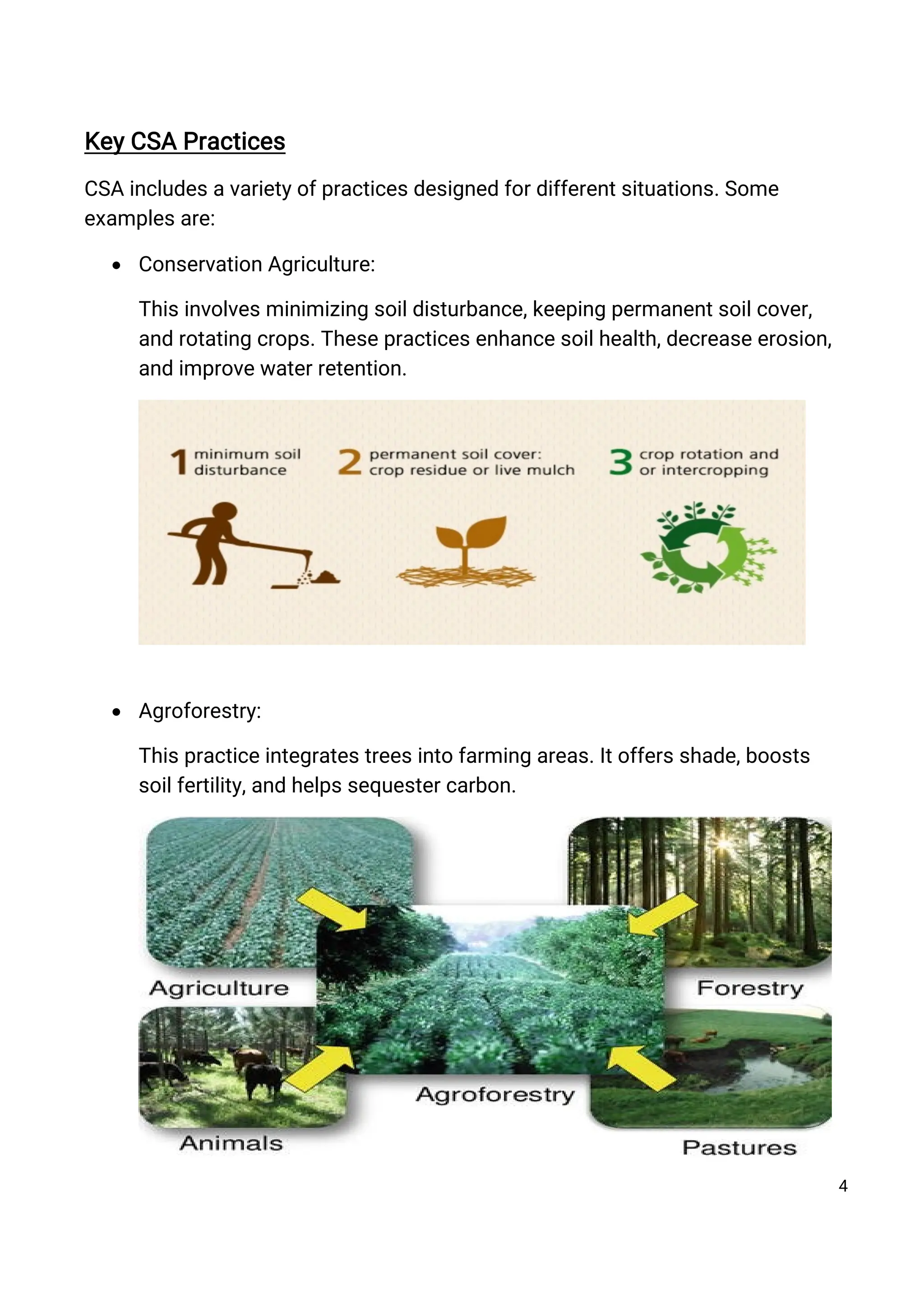
 Conservation Agriculture:
This involves minimizing soil disturbance, keeping permanent soil cover,
and rotating crops. These practices enhance soil health, decrease erosion,
and improve water retention.
 Agroforestry:
This practice integrates trees into farming areas. It offers shade, boosts
soil fertility, and helps sequester carbon.
5
 Improved Water Management:
This includes using efficient irrigation systems, harvesting rainwater, and
growing drought-resistant crops. These methods help conserve water and
increase resilience to water shortages.
 Climate-Smart Livestock Management:
This focuses on enhancing feed quality, managing manure effectively, and
choosing breeds that can withstand climate challenges. These strategies
lower livestock emissions and improve productivity.
6
 Precision Agriculture:
This approach utilizes technology such as GPS, sensors, and drones to
optimize the use of inputs. It helps reduce waste and lessen environmental
impact.
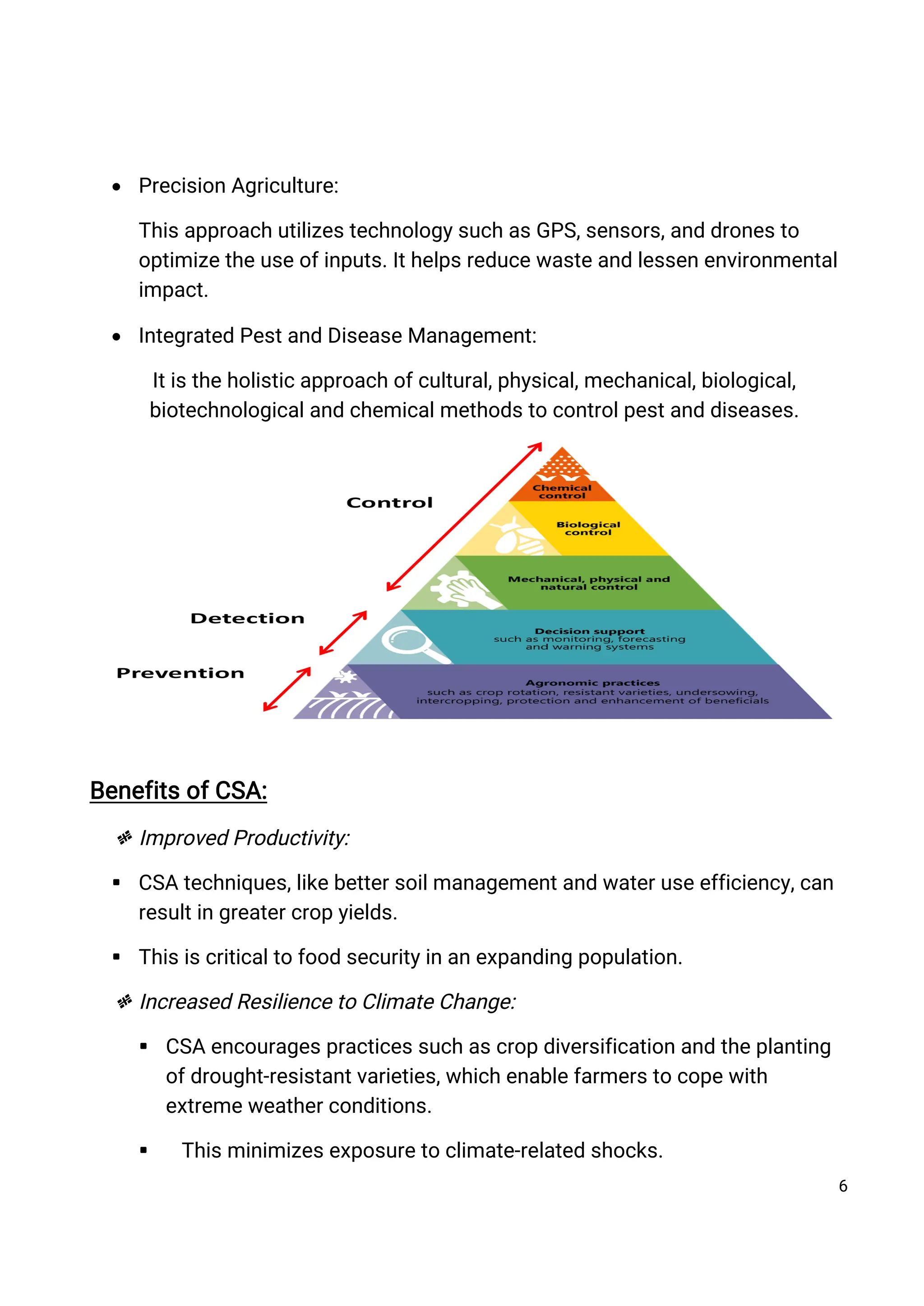
 Integrated Pest and Disease Management:
It is the holistic approach of cultural, physical, mechanical, biological,
biotechnological and chemical methods to control pest and diseases.
Benefits of CSA:
 Improved Productivity:
 CSA techniques, like better soil management and water use efficiency, can
result in greater crop yields.
 This is critical to food security in an expanding population.
 Increased Resilience to Climate Change:
 CSA encourages practices such as crop diversification and the planting
of drought-resistant varieties, which enable farmers to cope with
extreme weather conditions.
 This minimizes exposure to climate-related shocks.
7
 Decreased Greenhouse Gas (GHG) Emissions:
 CSA practices, including sustainable land management and minimal
tillage, can reduce climate change by minimizing GHG emissions from
agriculture.
 Soil Health Improved:
 CSA prioritizes soil health, resulting in improved water retention, nutrient
cycling, and overall soil fertility.
 Promotion of Smallholder Farmers:
 The majority of Indian farmers are smallholders. CSA practices can
empower them through offering sustainable and economically viable
solutions.
 Biodiversity Conservation:
 CSA practices favor ecosystems, and ensure the conservation of
biodiversity.
8
Challenges of CSA in India
 Lack of Awareness and Knowledge:
 Farmers might not be aware of CSA practices or their advantages.
 Limited training and information access can be a limiting factor in
adoption.
 Financial Constraints:
 The adoption of new practices and technologies is usually at a cost,
which may be prohibitive for poor farmers.
 Credit and financial assistance are essential.
 Inadequate Infrastructure:
 Inadequate irrigation systems, storage facilities, and market linkages
can hinder the efficient application of CSA.
 Policy and Institutional Gaps:
 Weak institutional support and inconsistent policies can be a hindrance
to scaling up CSA practices.
 Variability of climate:
 Weather pattern variability, and the rising frequency of extreme weather
events, complicates planning and execution of CSA.
 Agricultural Heterogeneity:
 India boasts an enormous diversity of agriculture systems, and what is
appropriate in one location, may not be so elsewhere. This makes it
challenging to adopt broad based CSA practices.
9
Steps to Promote Adoption
* Enhancing extension services to equip farmers with information and
training.
* Enhancing access to finance, e.g., subsidies and credit.
* Enhancing infrastructure, e.g., irrigation and storage facilities.
* Establishing supportive policies and institutional frameworks.
* Encouraging localised solutions, which are specific to the particular
requirements of various regions.
By tackling these issues and taking advantage of the benefits of CSA, India
can develop a more sustainable and resilient agricultural industry.
Results
The project yielded the following key results:
i. Beneficial impact on productivity: CSA practices showed potential to
improve crop yields and livestock productivity, particularly in rainfed areas.
ii. Increased resilience:CSA adoption enhanced the resilience of agricultural
systems to climate shocks and reduced crop losses in the face of droughts
and floods.
iii. Mitigation potential: CSA practices, including conservation agriculture and
agroforestry, enhanced carbon sequestration and reduced GHG emissions.
iv. Socio-economic outcomes: CSA adoption improved smallholder farmers’
livelihoods through increased incomes and reduced input costs.
10
v. Residual barriers to adoption: CSA adoption was hindered by lack of
awareness, limited access to resources and insufficient extension services.
vi. Contextual variation: CSA practices were more or less effective in different
agro-ecological zones, highlighting the importance of context-specific
solutions.
vii. Policy gaps: Policies and programmes need to be strengthened to
effectively promote and scale up CSA
viii. Water management: Water management was one of the most important
elements in CSA implementation.
Policy Recommendations
* Integrate CSA principles into all agricultural policies and programs.
* Financial incentives and subsidies for farmers adopting CSA practices.
* Strengthen capacity building and training programmes for farmers and
extension workers.
* Demonstration farms and knowledge centres to highlight good practice CSA.
* Promote public-private partnerships to scale up CSA initiatives.
* Improve monitoring and evaluation systems for CSA interventions.
* Increase research funding into region specific CSA implementation.
* Develop strong water management plans, and infrastructure.
11
How CSA addresses the challenges of food security and Climate change
Climate-Smart Agriculture (CSA) is an approach that aims to address the
challenges of food security and climate change by promoting agricultural
practices with following benefits:
 Adaptation Benefits
1.Improved crop and animal varieties: Develops and uses varieties tolerant to
heat, drought, flooding, and other climate-related stresses.
2. Soil conservation and health: Practices like no-till or reduced tillage, cover
crops, and crop rotation improve soil health and reduce erosion.
3. Water harvesting and management: Efficient use of water through rainwater
harvesting, drip irrigation, and mulching.
4. Agroforestry and conservation agriculture: Integrates trees into farming
systems, reducing soil erosion and improving biodiversity.
 Mitigation Benefits
1. Carbon sequestration: Practices like agroforestry, conservation agriculture, and
soil carbon management help sequester carbon.
2. Reduced synthetic fertilizer use: Promotes use of organic amendments,
reducing greenhouse gas emissions.
3. Improved livestock management: Efficient feed use, manure management, and
breeding practices reduce emissions.
4. Renewable energy: Encourages use of solar, wind, and biogas energy in
agriculture.
12
 Food Security Benefits
1. Increased crop yields: Improved varieties, soil health, and water management
lead to higher yields.
2. Improved food quality: Promotes production of nutrient-rich foods, enhancing
dietary diversity.
3. Reduced post-harvest losses: Improved storage and handling practices reduce
food waste.
4. Enhanced livelihoods: Increases farmers' incomes, improving their livelihoods
and resilience.
 Climate Change Resilience
1. Climate risk management: Helps farmers anticipate and manage climate-
related risks.
2. Climate-resilient agriculture: Promotes practices that enhance agricultural
resilience to climate change.
3. Ecosystem-based adaptation: Conserves and restores ecosystems that provide
essential services to agriculture.
4. Supportive policies and institutions: Fosters an enabling environment for CSA
adoption and scaling.
By adopting Climate-Smart Agriculture practices, farmers can improve their
productivity, resilience, and livelihoods while reducing greenhouse gas emissions
and promoting sustainable agriculture.
13
Conclusion:
Climate-Smart Agriculture (CSA) provides an opportunity to respond to the twin
challenges of food security and climate change in India. Through CSA practices,
India can improve agricultural productivity, increase resilience to climate risks,
and reduce greenhouse gas emissions. Scaling up CSA requires a multi-pronged
approach involving:
* Strengthening extension services to disseminate information and to provide
technical support to farmers
* Enhancing smallholder access to finance, inputs and markets.
* Developing and promoting climate-resilient crop varieties and livestock breeds.
* Support research and development to identify and tailor CSA practices to local
conditions.
* Strengthening policy frameworks and institutional mechanisms to support CSA
implementation;
* Promoting farmer participation and community-based approaches.
* Increased focus on water management infrastructure.
14
Reference
1. Kumar, P., Singh, S. K., Kumar, A. "Climate Smart Agriculture in India:
Challenges and Opportunities".2018.Routledge, Taylor & Francis Group, New Delhi.
2. Rao, K. P. C., Singh, G., Kumar, K."Climate Resilient Agriculture: Strategies and
Practices for Indian Farmers".2020.National Centre for Agricultural Economics
and Policy Research, New Delhi.
3. Sharma, K. L., Chander, G., Kumar, S. "Climate Smart Agriculture: A New
Paradigm for Indian Agriculture".2019.Indian Society of Agronomy, New Delhi.
4. Gupta, R. K., Kumar, V., Singh, R. "Climate Smart Agriculture for Smallholder
Farmers in India".2019.Academic Foundation, New Delhi.
5. Food and Agriculture Organization of the United Nations. "Climate Smart
Agriculture Sourcebook".2017. FAO, Rome.

Role of Climate Smart Agriculture(CSA) in addressing challenges of Food security and Climate change.

  • 1.
    1 Project Report Project Tittle: ROLE OF CLIMATE SMART AGRICULTURE (CSA), IN ADDRESSING THE CHALLENGES OF FOOD SECURITY AND CLIMATE CHANGE. Prepared By: AKHIL S Final year Bsc(Hons) Agriculture, KAU Abstract In this project report we are evaluating the critical role of Climate-Smart Agriculture (CSA) in addressing the challenges of food security and climate change in India. While accounting India's vulnerability to climate variability and its large population, adopting CSA practices is crucial for sustainable agricultural development. This report will provides a comprehensive overview about the the various aspects of CSA along with the implementation and impact of CSA in India, highlighting the potential of CSA to enhance productivity, resilience, and mitigation to climate change. Introduction With over 80 percent of its land dedicated to agriculture and relying heavily on monsoon rainfall, India is especially vulnerable to the adverse impacts of climate change. Increasing temperatures, altered rainfall patterns, and more extreme weather events are affecting crop yields, water availability, and agricultural productivity. At the same time, India must ensure food security for its growing population. Conventional agricultural practices are also contributing to greenhouse gas emissions and accelerating climate change.
  • 2.
    2 Climate-Smart Agriculture (CSA)offers a holistic approach to address these challenges through a focus on three pillars:  Increased agricultural productivity: To increase incomes and farm output.  Mitigation: To reduce greenhouse gas emissions.  Adaptation: To help farms and communities adapt to climate change. Based on this,we are looking at the relevance and implementation of CSA practices in the Indian context and their potential to contribute to food security and mitigation of climate change. Background India's agriculture sector is one of its most important economic sectors, both in terms of GDP and in terms of employment. The major challenges faced by Indian agriculture sector includes:  Climate change: more frequent and intense droughts, floods and heatwaves.  Resource depletion: Overexploitation of groundwater and soil degradation.
  • 3.
    3  Fragmention ofland holding: a large proportion of farmers have small landholdings which limit their ability to invest in new technologies.  Market access: limited access to markets and to fair prices for agricultural products  Greenhouse gas emission: Rice cultivation, livestock and fertilizer are major contributors to the national GHG inventory. The Indian Government has also realised the significance of CSA and taken up several initiatives to promote sustainable agriculture such as National Mission for Sustainable Agriculture (NMSA),National Innovations in Climate Resilient Agriculture(NICRA),Paramparagat Krishi Vikas Yojana (PKVY) and Pradhan Mantri Krishi Sinchayee Yojana (PMKSY). Objectives This project aimed to: 1. Assess the current state of CSA implementation in India. 2. Identification and assessment of promising CSA practices for different agro-ecological zones. 3. Assess the contribution of CSA to food security and mitigation of climate change Methodology This project employed a mixed-methods approach, including:  Literature Review: Existing literatures on CSA, climate change and food security in India.  Consultation with experts : Guidence from professors and subject specialist.
  • 4.
    4 Key CSA Practices CSAincludes a variety of practices designed for different situations. Some examples are:  Conservation Agriculture: This involves minimizing soil disturbance, keeping permanent soil cover, and rotating crops. These practices enhance soil health, decrease erosion, and improve water retention.  Agroforestry: This practice integrates trees into farming areas. It offers shade, boosts soil fertility, and helps sequester carbon.
  • 5.
    5  Improved WaterManagement: This includes using efficient irrigation systems, harvesting rainwater, and growing drought-resistant crops. These methods help conserve water and increase resilience to water shortages.  Climate-Smart Livestock Management: This focuses on enhancing feed quality, managing manure effectively, and choosing breeds that can withstand climate challenges. These strategies lower livestock emissions and improve productivity.
  • 6.
    6  Precision Agriculture: Thisapproach utilizes technology such as GPS, sensors, and drones to optimize the use of inputs. It helps reduce waste and lessen environmental impact.  Integrated Pest and Disease Management: It is the holistic approach of cultural, physical, mechanical, biological, biotechnological and chemical methods to control pest and diseases. Benefits of CSA:  Improved Productivity:  CSA techniques, like better soil management and water use efficiency, can result in greater crop yields.  This is critical to food security in an expanding population.  Increased Resilience to Climate Change:  CSA encourages practices such as crop diversification and the planting of drought-resistant varieties, which enable farmers to cope with extreme weather conditions.  This minimizes exposure to climate-related shocks.
  • 7.
    7  Decreased GreenhouseGas (GHG) Emissions:  CSA practices, including sustainable land management and minimal tillage, can reduce climate change by minimizing GHG emissions from agriculture.  Soil Health Improved:  CSA prioritizes soil health, resulting in improved water retention, nutrient cycling, and overall soil fertility.  Promotion of Smallholder Farmers:  The majority of Indian farmers are smallholders. CSA practices can empower them through offering sustainable and economically viable solutions.  Biodiversity Conservation:  CSA practices favor ecosystems, and ensure the conservation of biodiversity.
  • 8.
    8 Challenges of CSAin India  Lack of Awareness and Knowledge:  Farmers might not be aware of CSA practices or their advantages.  Limited training and information access can be a limiting factor in adoption.  Financial Constraints:  The adoption of new practices and technologies is usually at a cost, which may be prohibitive for poor farmers.  Credit and financial assistance are essential.  Inadequate Infrastructure:  Inadequate irrigation systems, storage facilities, and market linkages can hinder the efficient application of CSA.  Policy and Institutional Gaps:  Weak institutional support and inconsistent policies can be a hindrance to scaling up CSA practices.  Variability of climate:  Weather pattern variability, and the rising frequency of extreme weather events, complicates planning and execution of CSA.  Agricultural Heterogeneity:  India boasts an enormous diversity of agriculture systems, and what is appropriate in one location, may not be so elsewhere. This makes it challenging to adopt broad based CSA practices.
  • 9.
    9 Steps to PromoteAdoption * Enhancing extension services to equip farmers with information and training. * Enhancing access to finance, e.g., subsidies and credit. * Enhancing infrastructure, e.g., irrigation and storage facilities. * Establishing supportive policies and institutional frameworks. * Encouraging localised solutions, which are specific to the particular requirements of various regions. By tackling these issues and taking advantage of the benefits of CSA, India can develop a more sustainable and resilient agricultural industry. Results The project yielded the following key results: i. Beneficial impact on productivity: CSA practices showed potential to improve crop yields and livestock productivity, particularly in rainfed areas. ii. Increased resilience:CSA adoption enhanced the resilience of agricultural systems to climate shocks and reduced crop losses in the face of droughts and floods. iii. Mitigation potential: CSA practices, including conservation agriculture and agroforestry, enhanced carbon sequestration and reduced GHG emissions. iv. Socio-economic outcomes: CSA adoption improved smallholder farmers’ livelihoods through increased incomes and reduced input costs.
  • 10.
    10 v. Residual barriersto adoption: CSA adoption was hindered by lack of awareness, limited access to resources and insufficient extension services. vi. Contextual variation: CSA practices were more or less effective in different agro-ecological zones, highlighting the importance of context-specific solutions. vii. Policy gaps: Policies and programmes need to be strengthened to effectively promote and scale up CSA viii. Water management: Water management was one of the most important elements in CSA implementation. Policy Recommendations * Integrate CSA principles into all agricultural policies and programs. * Financial incentives and subsidies for farmers adopting CSA practices. * Strengthen capacity building and training programmes for farmers and extension workers. * Demonstration farms and knowledge centres to highlight good practice CSA. * Promote public-private partnerships to scale up CSA initiatives. * Improve monitoring and evaluation systems for CSA interventions. * Increase research funding into region specific CSA implementation. * Develop strong water management plans, and infrastructure.
  • 11.
    11 How CSA addressesthe challenges of food security and Climate change Climate-Smart Agriculture (CSA) is an approach that aims to address the challenges of food security and climate change by promoting agricultural practices with following benefits:  Adaptation Benefits 1.Improved crop and animal varieties: Develops and uses varieties tolerant to heat, drought, flooding, and other climate-related stresses. 2. Soil conservation and health: Practices like no-till or reduced tillage, cover crops, and crop rotation improve soil health and reduce erosion. 3. Water harvesting and management: Efficient use of water through rainwater harvesting, drip irrigation, and mulching. 4. Agroforestry and conservation agriculture: Integrates trees into farming systems, reducing soil erosion and improving biodiversity.  Mitigation Benefits 1. Carbon sequestration: Practices like agroforestry, conservation agriculture, and soil carbon management help sequester carbon. 2. Reduced synthetic fertilizer use: Promotes use of organic amendments, reducing greenhouse gas emissions. 3. Improved livestock management: Efficient feed use, manure management, and breeding practices reduce emissions. 4. Renewable energy: Encourages use of solar, wind, and biogas energy in agriculture.
  • 12.
    12  Food SecurityBenefits 1. Increased crop yields: Improved varieties, soil health, and water management lead to higher yields. 2. Improved food quality: Promotes production of nutrient-rich foods, enhancing dietary diversity. 3. Reduced post-harvest losses: Improved storage and handling practices reduce food waste. 4. Enhanced livelihoods: Increases farmers' incomes, improving their livelihoods and resilience.  Climate Change Resilience 1. Climate risk management: Helps farmers anticipate and manage climate- related risks. 2. Climate-resilient agriculture: Promotes practices that enhance agricultural resilience to climate change. 3. Ecosystem-based adaptation: Conserves and restores ecosystems that provide essential services to agriculture. 4. Supportive policies and institutions: Fosters an enabling environment for CSA adoption and scaling. By adopting Climate-Smart Agriculture practices, farmers can improve their productivity, resilience, and livelihoods while reducing greenhouse gas emissions and promoting sustainable agriculture.
  • 13.
    13 Conclusion: Climate-Smart Agriculture (CSA)provides an opportunity to respond to the twin challenges of food security and climate change in India. Through CSA practices, India can improve agricultural productivity, increase resilience to climate risks, and reduce greenhouse gas emissions. Scaling up CSA requires a multi-pronged approach involving: * Strengthening extension services to disseminate information and to provide technical support to farmers * Enhancing smallholder access to finance, inputs and markets. * Developing and promoting climate-resilient crop varieties and livestock breeds. * Support research and development to identify and tailor CSA practices to local conditions. * Strengthening policy frameworks and institutional mechanisms to support CSA implementation; * Promoting farmer participation and community-based approaches. * Increased focus on water management infrastructure.
  • 14.
    14 Reference 1. Kumar, P.,Singh, S. K., Kumar, A. "Climate Smart Agriculture in India: Challenges and Opportunities".2018.Routledge, Taylor & Francis Group, New Delhi. 2. Rao, K. P. C., Singh, G., Kumar, K."Climate Resilient Agriculture: Strategies and Practices for Indian Farmers".2020.National Centre for Agricultural Economics and Policy Research, New Delhi. 3. Sharma, K. L., Chander, G., Kumar, S. "Climate Smart Agriculture: A New Paradigm for Indian Agriculture".2019.Indian Society of Agronomy, New Delhi. 4. Gupta, R. K., Kumar, V., Singh, R. "Climate Smart Agriculture for Smallholder Farmers in India".2019.Academic Foundation, New Delhi. 5. Food and Agriculture Organization of the United Nations. "Climate Smart Agriculture Sourcebook".2017. FAO, Rome.