Prepared by:
Karima Yesmin
ID: 1501014
SEC: B
BIR-2015
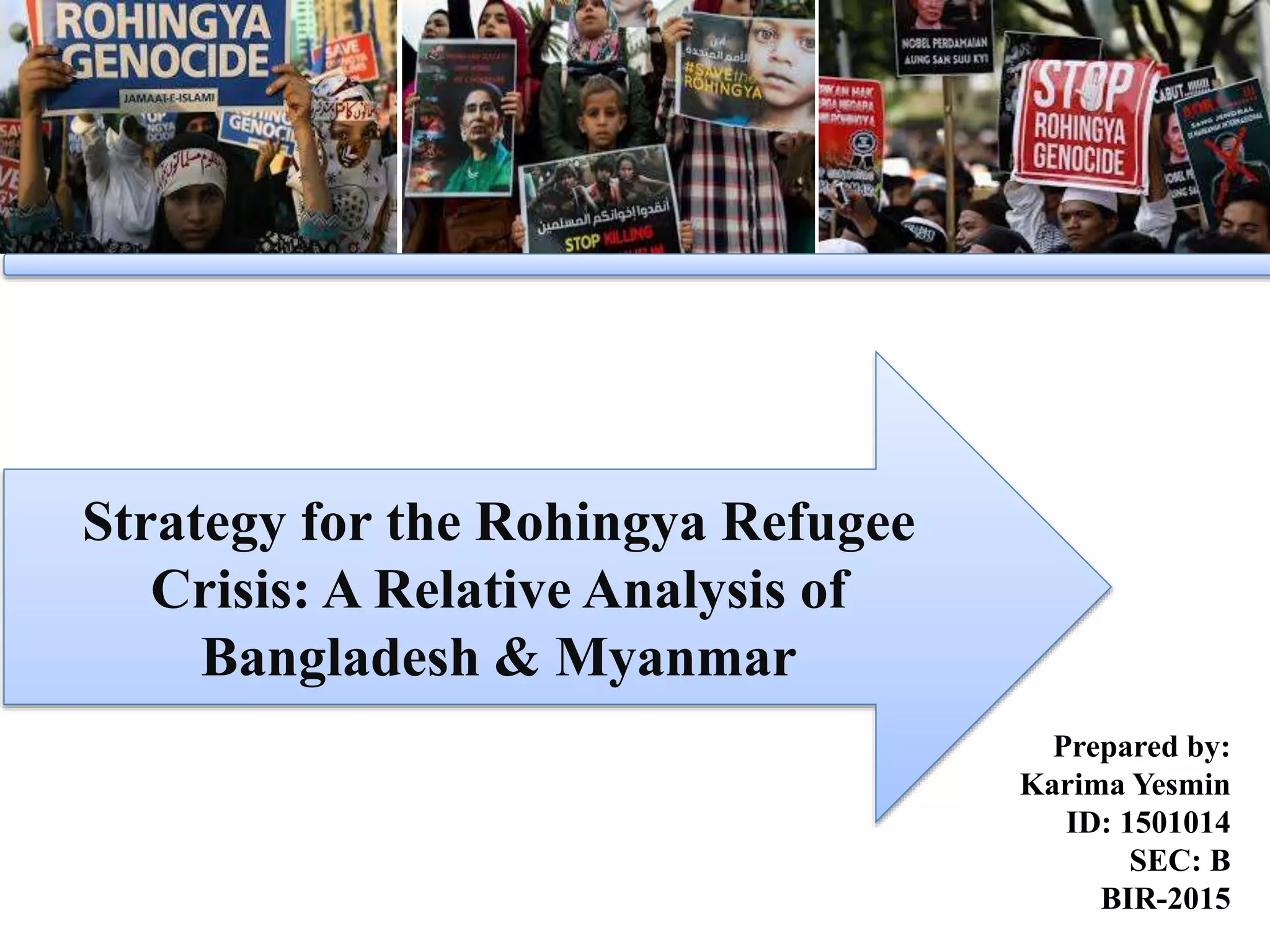
Strategy for the Rohingya Refugee
Crisis: A Relative Analysis of
Bangladesh & Myanmar
Outline
• Historical Background
• Role of International Community
• Challenges
• Regional Initiatives
• Strategies
• Recommendations
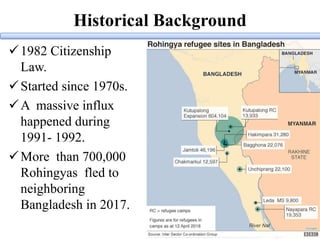
Historical Background
1982 Citizenship
Law.
Started since 1970s.
A massive influx
happened during
1991- 1992.
More than 700,000
Rohingyas fled to
neighboring
Bangladesh in 2017.
Role of International Community
• International community has failed to
intervene in Myanmar.
• Myanmar is not in an area of particular interest
of many global powers.
• States in Southeast Asia also made some little
efforts to provide the protection of refugees.
Challenges
• Majority of the refugees are unregistered.
• Multi dimensional problems as follows-
Transnational Security Threats
Human Trafficking
Environmental Security
Health Security
• Hampers economic and trade relations
Regional Initiatives
India
Strongly supports the government of Myanmar
on Rohingaya issue.
Has strong economic and strategic interests in
Myanmar.
China
A vocal supporter of the Myanmar government.
Has vital geopolitical interests in Myanmar.
Strategies
 Repatriation- Both countries had agreed on a "joint working
group" for the repatriation of Rohingya refugees who had fled to
Bangladesh on 2 October 2017.
 Bilateral Agreement - Bangladesh’s home minister visited
Myanmar on 24-27 October 2017. Both countries had agreed on a
repatriation deal for Rohingya refugees on 15 Januray 2018, which
would aim to complete the process of repatriation within two years.
Cont..
 Memorandum of Understanding (MOU)- UNHCR and UNDP also
signed a Memorandum of Understanding (MOU) with Myanmar
to support the creation of conditions for the return of refugees
from Bangladesh.
 A durable solution- Under the agreement, UNHCR will
provide assistance with the voluntary repatriation and
resettlement program.
Five-Point Proposal
• Myanmar must completely stop the violence and the
practice of ethnic cleansing in the Rakhine State.
• Secretary General of the United Nations should
immediately send a Fact-Finding Mission to
Myanmar.
• All civilians irrespective of religion and ethnicity
must be protected in Myanmar.
• Ensure sustainable return of all forcibly displaced
Rohingyas from Bangladesh to Myanmar.
• The recommendations of Kofi Annan Commission
Report must be immediately implemented.
Recommendations
 To resolve the crisis, there are needed to be an
amendment to the Myanmar Constitution.
 Both states are needed to require entering into long-
term diplomatic discussions.
 The issue must be referred to an international
tribunal.
 The international community should to arrive at a
durable solution to deal with the current Rohingya
crisis.
 “Safe Zones" must be created inside Myanmar under
UN supervision.

Rohingya refugee crisis

  • 1.
    Prepared by: Karima Yesmin ID:1501014 SEC: B BIR-2015 Strategy for the Rohingya Refugee Crisis: A Relative Analysis of Bangladesh & Myanmar
  • 2.
    Outline • Historical Background •Role of International Community • Challenges • Regional Initiatives • Strategies • Recommendations
  • 3.
    Historical Background 1982 Citizenship Law. Startedsince 1970s. A massive influx happened during 1991- 1992. More than 700,000 Rohingyas fled to neighboring Bangladesh in 2017.
  • 4.
    Role of InternationalCommunity • International community has failed to intervene in Myanmar. • Myanmar is not in an area of particular interest of many global powers. • States in Southeast Asia also made some little efforts to provide the protection of refugees.
  • 5.
    Challenges • Majority ofthe refugees are unregistered. • Multi dimensional problems as follows- Transnational Security Threats Human Trafficking Environmental Security Health Security • Hampers economic and trade relations
  • 6.
    Regional Initiatives India Strongly supportsthe government of Myanmar on Rohingaya issue. Has strong economic and strategic interests in Myanmar. China A vocal supporter of the Myanmar government. Has vital geopolitical interests in Myanmar.
  • 7.
    Strategies  Repatriation- Bothcountries had agreed on a "joint working group" for the repatriation of Rohingya refugees who had fled to Bangladesh on 2 October 2017.  Bilateral Agreement - Bangladesh’s home minister visited Myanmar on 24-27 October 2017. Both countries had agreed on a repatriation deal for Rohingya refugees on 15 Januray 2018, which would aim to complete the process of repatriation within two years.
  • 8.
    Cont..  Memorandum ofUnderstanding (MOU)- UNHCR and UNDP also signed a Memorandum of Understanding (MOU) with Myanmar to support the creation of conditions for the return of refugees from Bangladesh.  A durable solution- Under the agreement, UNHCR will provide assistance with the voluntary repatriation and resettlement program.
  • 9.
    Five-Point Proposal • Myanmarmust completely stop the violence and the practice of ethnic cleansing in the Rakhine State. • Secretary General of the United Nations should immediately send a Fact-Finding Mission to Myanmar. • All civilians irrespective of religion and ethnicity must be protected in Myanmar. • Ensure sustainable return of all forcibly displaced Rohingyas from Bangladesh to Myanmar. • The recommendations of Kofi Annan Commission Report must be immediately implemented.
  • 10.
    Recommendations  To resolvethe crisis, there are needed to be an amendment to the Myanmar Constitution.  Both states are needed to require entering into long- term diplomatic discussions.  The issue must be referred to an international tribunal.  The international community should to arrive at a durable solution to deal with the current Rohingya crisis.  “Safe Zones" must be created inside Myanmar under UN supervision.