Research article
Design and fabrication of a new tactile
probe for measuring the modulus of elasticity
of soft tissues
Hamid Roham, Siamak Najarian and Seyed Mohsen Hosseini
Artificial Tactile Sensing and Robotic Surgery Lab, Department of Biomechanics, Faculty of Biomedical Engineering,
Amirkabir University of Technology, Tehran, Iran, and
Javad Dargahi
Department of Mechanical and Industrial Engineering, Concordia University, Quebec, Canada
Abstract
Purpose – The paper aims to discuss the design, fabrication, communication, testing, and simulation of a new tactile probe called Elastirob used to
measure the modulus of elasticity of biological soft tissues and soft materials.
Design/methodology/approach – Both finite element modeling and experimental approaches were used in this analysis. Elastirob, with the ability to
apply different rates of strain on testing specimens, is accompanied by a tactile display called TacPlay. This display is a custom-designed user-friendly
interface and is able to evaluate the elasticity in each part of the stress-strain curve.
Findings – A new device is being constructed that can measure the modulus of elasticity of a sensed object. The results of Elastirob applied on two
specimens are reported and compared by the results of experiments obtained by an industrial testing machine. Acceptable validations of Elastirob were
achieved from the comparisons.
Research limitations/implications – The designed system can be miniaturized to be used in minimally invasive surgeries in the future.
Practical implications – Elastirob determines the elasticity by drawing the stress-strain curve and then calculating its slope. The combination of
the force sensing resistor, microcontroller and stepper motor provides Elastirob with the ability to apply different rates of strain on testing
specimens.
Originality/value – It can be employed in both in vivo and in vitro tests for measuring stiffness of touch objects. For the first time, a device has been
designed and tested which is a few orders of magnitude smaller than its industrial counterparts and has considerably lower weight.
Keywords Elasticity, Robotics, Tactile sensors, Medical equipment, Histology
Paper type Research paper
1. Introduction
Various properties of biological tissues have been a subject of
interest in various medical applications, based on the fact that
these properties contain a lot of useful information including
age, gender, and whether the organ is healthy or not. Among
these properties are Young’s modulus (or stiffness), Poisson’s
ratio, and viscosity. Perhaps, the most important parameter
among them is Young’s modulus, because of its dependence
upon the composition of the tissue. Consequently, changes in
soft tissue stiffness may be related to an abnormal
pathological complication. Examples include breast, liver
and prostate cancers (Plewes et al., 2000; Samani et al., 2003;
Galea, 2004).
There are different methods to investigate the elasticity of
soft tissues. Gao et al. (1996) surveyed some of the previous
work done in the related field of biomechanics and
measurement techniques. In the first part of their review,
they considered elastography as a merger of several related
fields of study: tissue elastic constant (biomechanics), tissue
contrast differences, tissue motion by using imaging systems
(X-ray, ultrasound and magnetic resonance imaging), and
vibrating targets by using coherent radiation (laser, sonar and
ultrasound) (Gao et al., 1996). In recent years, atomic force
microscopy (AFM) has been successfully applied to local
elasticity measurements especially in biological fields.
However, inevitable use of a cantilever results in difficultiesThe current issue and full text archive of this journal is available at
www.emeraldinsight.com/0260-2288.htm
Sensor Review
27/4 (2007) 317–323
q Emerald Group Publishing Limited [ISSN 0260-2288]
[DOI 10.1108/02602280710821452]
The authors gratefully acknowledge the Center of Excellence in
Biomedical Engineering of Iran, for their help in conducting this
project. The authors also thank the Institute for Robotics and Intelligent
Systems and Natural Sciences and Engineering Research Council of
Canada for providing the financial support for this project.
317
in measurements and in sample preparation. Furthermore,
the high cost of AFM systems prevents their widespread
industrial and clinical use (Vinckier and Semenza, 1998). In
addition to aforementioned methods, tactile sensing
technology is another approach with which the
measurement of soft tissue elasticity is possible. This
technology tries to imitate the sense of touch which is of
crucial importance in the field of minimally invasive surgery
(MIS) and robotic surgery. Lee and Nicholls (1999) and Lee
(2000) examined the state-of-the-art of tactile sensing in its
mechatronic aspects. After that Eltaib and Hewit (2003)
reviewed the tactile sensing technology for minimal access
surgery. They addressed the technology from different
viewpoints including tactile sensing, tactile data processing,
and tactile display. Dargahi and Najarian (2004, 2005)
accomplished two comprehensive surveys on this field of
research. At first, they reviewed the human tactile perception
as a standard for this technology and secondly, they evaluated
the advances in tactile sensors and its impact on robotics
applications.
2. Tactile elasticity measurements background
Various tactile sensors have been reported to measure the
elasticity of living tissues from the cellular levels (Miyazaki et al.,
2000) to organs (Kusaka et al., 2000). In Murayama et al.
(2004), Young’s modulus of zona pellucida of bovine ovum was
calculated using micro-tactile sensor (MTS) fabricated using
piezoelectric (PZT) material. The sensor consists of a needle-
shaped transduction point made by using a micro-electrode
puller and mounted on a micro-manipulator platform. In Uchio
et al. (2002), the stiffness of the cartilage of the human femoral
condyles via an ultrasonic tactile sensor under arthroscopic
control was measured. The tactile sensor was useful for
determining the intraoperative stiffness of healthy and diseased
human cartilage in all grades. In Shikida et al. (2003) and
Hasegava et al. (2004), a new type of tactile sensor that can
detect both the contact force and hardness of an object along
with its fabrication process is developed. In Murayama and
Omata (2004), characteristics of local elasticity are evaluated by
a new type of MTS, based on simple ultrasonic contact sensing.
Its high sensitivity is appropriate for micro-scale measurement.
In Omata et al. (2004) and Murayama et al. (2005), a novel
tactile sensor system is presented which is specifically designed
to detect and quantify, in real time, tissue characteristics in a
manner analogous to the human hand. It is suggested that this
sensor may prove useful in applications involving robotics in the
biomedical field and can be incorporated in the next generation
of virtual operating systems. This sensor, then, is modified not
only to measure elasticity with high sensitivity but also to detect
the instant of contact. In Sedaghati et al. (2005), the main
objective of the proposed tactile sensor is to design and model a
piezoelectric sensor capable of measuring the total applied force
on the sensed object as well as its compliance. This tactile sensor
consisting of PVDF films exhibits high force sensitivity and
good linearity in order to be integrated with the commercial
endoscope graspers used in MIS. In Najarian et al. (2006b), a
new method for determining the compliance of various objects
with different mechanical properties is presented. Two
theoretical approaches are employed in this work. The first
approach is a closed-form formula and the second one is based
on finite element analysis, which is applied to the objects with
complex irregular shapes. The researchers managed to measure
the stiffness of the sensed objects with reasonable accuracy
(an error of about 20 percent). Comparing the experimental
data with the analytical and the numerical approaches proves
that there is a good correspondence between the two methods.
In Dargahi et al. (2006), the sensitivity of a novel tactile probe is
investigated both experimentally and theoretically which has
applications both in routine clinical examination and during
robotic surgeries.
In addition to the capability of tactile sensing approach in
measuring elasticity, demonstrated by aforementioned research
work, there are a number of reports focusing on detecting
tumors inside biological tissues by this approach. In fact,
because certain types of tissues such as malignant lesions have
elastic properties that are markedly different from surrounding
tissues, elasticity measurements may lead to detect tumors.
Barman and Guha (2006) designed a deformable force-stretch
array capable of detecting indwelling nodules. The results show
that the sensor enables the identification of relatively small and
deep seated nodules. Hosseini et al. (2006, 2007a, b, c) proved
the reliability and accuracy of the artificial tactile sensing
approach for detection of tumors in the biological tissues using
finite element method and Najarian et al. (2006a) proposed a
new analytical method that can be employed as a predictive tool
for determining both the stiffness and certain details of the
geometry of embedded objects. The results of these
investigations can be directly applied to the incorporation of
tactile sensing in artificial palpation.
In this research work, a comprehensive tactile sensory
system called Elastirob which consists of a tactile probe, a
tactile data processing system, and a custom-designed tactile
display (TacPlay) is developed to measure the elasticity of
biological soft tissues. Both the electronics and the
mechanical sections were designed and constructed in our
lab. The combination of the components used to construct
Elastirob along with its specific user-friendly TacPlay software
allows the medical staff to measure the elasticity of diverse soft
tissues by applying different strain rates.
3. Materials and methods
A tactile sensing system is designed which is capable of
estimating the modulus of elasticity of soft tissues by drawing
their stress-strain curves and calculating the slope of the
curves. This tactile sensing system, which is called Elastirob
by the authors, consists of three basic components: a tactile
probe, a tactile data processing system, and a tactile display
system. Elastirob prepares the stress-strain curve by preparing
a considerable number of the individual points of the curve
and applying curve fitting method to all of them. These
individual points are obtained when the tactile probe with its
sensor, makes a physical contact with a target object. This
contact causes compression between the sensor and target
object. Therefore, since the tactile probe is designed to be
able to make step-by-step compression by using a stepper
motor, tactile data processing and tactile display systems can
process and display the output information of the sensor to
obtain the individual points of the stress-strain curve.
3.1 Tactile probe
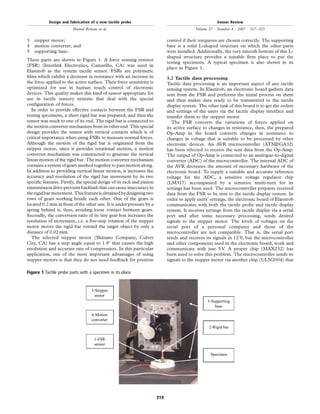
The tactile probe of Elastirob comprises of five parts:
1 sensor;
2 rigid bar;
Design and fabrication of a new tactile probe
Hamid Roham et al.
Sensor Review
Volume 27 · Number 4 · 2007 · 317–323
318
3 stepper motor;
4 motion converter; and
5 supporting base.
These parts are shown in Figure 1. A force sensing resistor
(FSR) (Interlink Electronics, Camarillo, CA) was used in
Elastirob as the system tactile sensor. FSRs are polymeric
films which exhibit a decrease in resistance with an increase in
the force applied to the active surface. Their force sensitivity is
optimized for use in human touch control of electronic
devices. This quality makes this kind of sensor appropriate for
use in tactile sensory systems that deal with the special
configuration of forces.
In order to provide effective contacts between the FSR and
testing specimens, a short rigid bar was prepared, and then the
sensor was stuck to one of its end. The rigid bar is connected to
the motion converter mechanism from its other end. This special
design provides the sensor with vertical contacts which is of
critical importance when using FSRs to measure normal forces.
Although the motion of the rigid bar is originated from the
stepper motor, since it provides rotational motion, a motion
converter mechanism was constructed to generate the vertical
linear motion of the rigid bar. The motion converter mechanism
contains a system of gears meshed together to pass motion along.
In addition to providing vertical linear motion, it increases the
accuracy and resolution of the rigid bar movement by its two
specific features. Firstly, the special design of its rack and pinion
transmissiondrive prevents backlashthatcan causeinaccuracyin
therigidbar movement.Thisfeatureisobtainedbydesigningtwo
rows of gears working beside each other. One of the gears is
located 0.2mm in front of the other one. It is under pressure by a
spring behind it, thus, avoiding loose contact between gears.
Secondly, the conversion ratio of its tiny gear box increases the
resolution of movement, i.e. a five-step rotation of the stepper
motor moves the rigid bar toward the target object by only a
distance of 0.02 mm.
The selected stepper motor (Shinano Company, Culver
City, CA) has a step angle equal to 1.88 that causes the high
resolution and accurate rate of compression. In this particular
application, one of the most important advantages of using
stepper motors is that they do not need feedback for position
control if their torqueses are chosen correctly. The supporting
base is a solid L-shaped structure on which the other parts
were installed. Additionally, the very smooth bottom of this L-
shaped structure provides a suitable firm place to put the
testing specimens. A typical specimen is also shown in its
place in Figure 1.
3.2 Tactile data processing
Tactile data processing is an important aspect of any tactile
sensing system. In Elastirob, an electronic board gathers data
sent from the FSR and performs the initial process on them
and then makes data ready to be transmitted to the tactile
display system. The other task of this board is to get the orders
and settings of the users via the tactile display interface and
transfer them to the stepper motor.
The FSR converts the variations of forces applied on
its active surface to changes in resistance, then, the prepared
Op-Amp in the board converts changes in resistance to
changes in voltage that is suitable to be processed by other
electronic devices. An AVR microcontroller (ATMEGA32)
has been selected to receive the sent data from the Op-Amp.
The output of Op-Amp is connected to an analogue-to-digital
converter (ADC) of the microcontroller. The internal ADC of
the AVR decreases the amount of necessary hardware of the
electronic board. To supply a suitable and accurate reference
voltage for the ADC, a sensitive voltage regulator chip
(LM317) accompanied by a sensitive multi-turn for its
settings has been used. The microcontroller prepares received
data from the FSR to be sent to the tactile display system. In
order to apply users’ settings, the electronic board of Elastirob
communicates with both the tactile probe and tactile display
system. It receives settings from the tactile display via a serial
port and after some necessary processing, sends desired
signals to the stepper motor. The levels of voltages on the
serial port of a personal computer and those of the
microcontroller are not compatible. That is, the serial port
sends and receives its signals in 12 V, but the microcontroller
and other components used in the electronic board, work and
communicate with just 5 V. A proper chip (MAX232) has
been used to solve this problem. The microcontroller sends its
signals to the stepper motor via another chip (ULN2004) that
Figure 1 Tactile probe parts with a specimen in its place
3-Stepper
motor
4-Motion
converter
1-FSR
sensor
5-Supporting
base
2-Rigid bar
Specimen
Design and fabrication of a new tactile probe
Hamid Roham et al.
Sensor Review
Volume 27 · Number 4 · 2007 · 317–323
319
firstly has its external power supply (driving the stepper motor
directly with the ports of the microcontroller can harm the
used ports) and secondly, drives the stepper motor that works
with 12 V. The prepared parallel port on the board facilitates
the programming of the microcontroller and the possible
additional modifications. For safety of the PC, the parallel
port is connected to the electronic board via an Opto Coupler.
In addition, for the users’ convenience, a switch to move
the probe in both upward and downward directions has been
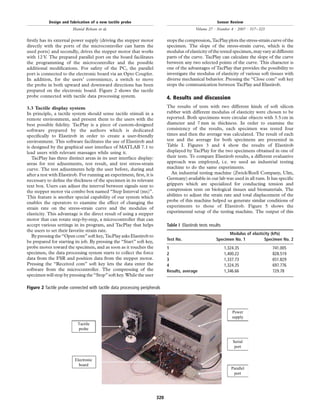
prepared on the electronic board. Figure 2 shows the tactile
probe connected with tactile data processing system.
3.3 Tactile display system
In principle, a tactile system should sense tactile stimuli in a
remote environment, and present them to the users with the
best possible fidelity. TacPlay is a piece of custom-designed
software prepared by the authors which is dedicated
specifically to Elastirob in order to create a user-friendly
environment. This software facilitates the use of Elastirob and
is designed by the graphical user interface of MATLAB 7.1 to
lead users with relevant massages while using it.
TacPlay has three distinct areas in its user interface display:
areas for test adjustments, test result, and test stress-strain
curve. The test adjustments help the user before, during and
after a test with Elastirob. For running an experiment, first, it is
necessary to define the thickness of the specimen in its relevant
text box. Users can adjust the interval between signals sent to
the stepper motor via combo box named “Step Interval (ms)”.
This feature is another special capability of our system which
enables the operators to examine the effect of changing the
strain rate on the stress-strain curve and the modulus of
elasticity. This advantage is the direct result of using a stepper
motor that can rotate step-by-step, a microcontroller that can
accept various settings in its program, and TacPlay that helps
the users to set their favorite strain rate.
By pressing the “Open com” soft key, TacPlay asks Elastirob to
be prepared for starting its job. By pressing the “Start” soft key,
probe moves toward the specimen, and as soon as it touches the
specimen, the data processing system starts to collect the force
data from the FSR and position data from the stepper motor.
Pressing the “Received com” soft key lets the data enter the
software from the microcontroller. The compressing of the
specimen will stop by pressing the “Stop” soft key. While the user
stopsthe compression,TacPlayplotsthe stress-strain curve ofthe
specimen. The slope of the stress-strain curve, which is the
modulus of elasticityof the tested specimen, may vary at different
parts of the curve. TacPlay can calculate the slope of the curve
between any two selected points of the curve. This character is
one of the advantages of TacPlay that provides the possibility to
investigate the modulus of elasticity of various soft tissues with
diverse mechanical behavior. Pressing the “Close com” soft key
stops the communication between TacPlay and Elastirob.
4. Results and discussion
The results of tests with two different kinds of soft silicon
rubber with different modulus of elasticity were chosen to be
reported. Both specimens were circular objects with 3.5 cm in
diameter and 7 mm in thickness. In order to examine the
consistency of the results, each specimen was tested four
times and then the average was calculated. The result of each
test and the average for both specimens are presented in
Table I. Figures 3 and 4 show the results of Elastirob
displayed by TacPlay for the two specimens obtained in one of
their tests. To compare Elastirob results, a different evaluative
approach was employed, i.e. we used an industrial testing
machine to do the same experiments.
An industrial testing machine (Zwick/Roell Company, Ulm,
Germany) available in our lab was used in all runs. It has specific
grippers which are specialized for conducting tension and
compression tests on biological tissues and biomaterials. The
abilities to adjust the strain rate and total displacement of the
probe of this machine helped us generate similar conditions of
experiments to those of Elastirob. Figure 5 shows the
experimental setup of the testing machine. The output of this
Figure 2 Tactile probe connected with tactile data processing peripherals
Tactile
probe
Electronic
board
Power
supply
Serial
port
Parallel
port
Table I Elastirob tests results
Modulus of elasticity (kPa)
Test No. Specimen No. 1 Specimen No. 2
1 1,324.35 741.005
2 1,400.22 828.519
3 1,337.73 651.829
4 1,324.35 697.776
Results, average 1,346.66 729.78
Design and fabrication of a new tactile probe
Hamid Roham et al.
Sensor Review
Volume 27 · Number 4 · 2007 · 317–323
320
machine is force versus displacement. Consequently, in order to
have meaningful comparisons, the results of the experiments
were converted to stress versus strain. Figures 6 and 7 show the
comparison between the results of Elastirob and those of the
testing machine. They show that although the curves obtained
from Elastirob and testing machine experiments are not
coincident, it can be inferred that the slopes of the curves in
most regions of the graphs closely follow each other with an
acceptable accuracy. For example, the difference between the
average results of specimen No. 2 obtained by the two devices is
less than 6 percent.
5. Conclusion
The tactile sensor system presented here, consisting of an
FSR sensor, a stepper motor with its rotating to linear motion
Figure 3 Elastirob result (TacPlay) for specimen No. 1
Figure 4 Elastirob result (TacPlay) for specimen No. 2
Design and fabrication of a new tactile probe
Hamid Roham et al.
Sensor Review
Volume 27 · Number 4 · 2007 · 317–323
321
converter, an electronic board for processing data and
controlling the system motion, and its unique TacPlay
software, is able to measure the modulus of elasticity of
various kinds of soft tissues and biomaterials. Elastirob will
greatly contribute to the field of tactile sensing technology
since all information is acquired by just simple physical
contacts of the probe with testing specimens. Moreover, low
costs of construction, the capability of being miniaturized, the
flexibility of programming and changing the test adjustments
because of using the combination of the FSR, microcontroller
and stepper motor, are the specific Elastirob characteristics
which make it an appropriate device to be developed for
robotic surgery and telemedicine. In addition, TacPlay is very
user-friendly and can guide users through measuring process
with its appropriate massages and can prevent possible
mistakes. The capability of changing the step interval between
every steps of the stepper motor in TacPlay allows the
operators to investigate the effect of strain rate and examine
tissue response with regard to the modulus of elasticity of soft
tissues.
Figure 5 Setup of testing machine experiments
Probe
Testing
machine
Specimen
Controlling
software
Figure 6 Comparison between Elastirob and testing machine results
for specimen No. 1
Specimen No. 1
0
5000
10000
15000
20000
25000
30000
0 0.02 0.04 0.06
Strain (m/m)
Stress(Pa)
Elastirob
Testing
machine
Figure 7 Comparison between Elastirob and testing machine results
for specimen No. 2
0
5000
10000
15000
20000
25000
30000
Stress(Pa)
Specimen No. 2
0 0.02 0.04 0.06
Strain (m/m)
Elastirob
Testing
machine
Design and fabrication of a new tactile probe
Hamid Roham et al.
Sensor Review
Volume 27 · Number 4 · 2007 · 317–323
322
References
Barman, J. and Guha, S.K. (2006), “Analysis of a new
combined stretch and pressure sensor for internal nodule
palpation”, Sensors and Actuators A, Vol. 125, pp. 210-6.
Dargahi, J. and Najarian, S. (2004), “Human tactile
perception as a standard for artificial tactile sensing – a
review”, International Journal of Medical Robotics and
Computer Assisted Surgery, Vol. 1 No. 13, pp. 23-35.
Dargahi, J. and Najarian, S. (2005), “Advances in tactile
sensors design/manufacturing and its impact on robotics
applications – a review”, Industrial Robot: An International
Journal, Vol. 32 No. 3, pp. 268-81.
Dargahi, J., Najarian, S. and Liu, B. (2006), “Sensitivity
analysis of a novel tactile probe for measurement of tissue
softness with applications in biomedical robotics”, Journal
of Materials Processing Technology, Vol. 183 Nos 2/3,
pp. 176-82.
Eltaib, M.E.H. and Hewit, J.R. (2003), “Tactile sensing
technology for minimal access surgery – a review”,
Mechatronics, Vol. 13, pp. 1163-77.
Galea, A.M. (2004), “Mapping tactile imaging information:
parameter estimation and deformable registration”,
Dissertation, Harvard University, Cambridge, MA.
Gao, L., Parker, K.J., Lerner, R.M. and Levinson, S.F.
(1996), “Imaging of the elastic properties of tissue – a
review”, Ultrasound in Med. & Biol., Vol. 22 No. 8,
pp. 959-77.
Hasegava, Y., Shikida, M., Shimizu, T., Miyaji, T., Sasaki, H.,
Sato, K. and Itoigawa, K. (2004), “A micromachined active
tactile sensor for hardness detection”, Sensors and Actuators
A, Vol. 114, pp. 141-6.
Hosseini, S.M., Najarian, S. and Motaghinasab, S. (2007a),
“Analysis of the effects of a tumor in the biological tissue
using artificial tactile sensing modeling”, Amirkabir Journal
of Science & Technology, in press.
Hosseini, S.M., Amiri, M., Najarian, S. and Dargahi, J.
(2007b), “Application of artificial neural networks for
estimation of tumor characteristics in biological tissues”,
International Journal of Medical Robotics and Computer
Assisted Surgery, in press.
Hosseini, S.M., Najarian, S., Motaghinasab, S. and Dargahi,
J. (2006), “Detection of tumours using computational
tactile sensing approach”, International Journal of Medical
Robotics and Computer Assisted Surgery, Vol. 2, pp. 333-40.
Hosseini, S.M., Najarian, S., Motaghinasab, S. and Torabi, S.
(2007c), “Experimental and numerical verification of
artificial tactile sensing approach for predicting tumor
existence in the virtual soft tissue”, Proceedings of the 15th
Annual (International) Conference on Mechanical Engineering-
ISME2007, Amirkabir University of Technology (Tehran
Polytechnic), Tehran.
Kusaka, K., Harihara, Y., Torzilli, G., Kubota, K., Takayama,
T., Makuuchi, M., Mori, M. and Omata, S. (2000),
“Objective evaluation of liver consistency to estimate
hepatic fibrosis and functional reserve for hepatectomy”,
JournaloftheAmericanCollageofSurgeons,Vol.191,pp.47-53.
Lee, M.H. (2000), “Tactile sensing: new directions, new
challenges”, The International Journal of Robotics Research,
Vol. 19 No. 7, pp. 636-43.
Lee, M.H. and Nicholls, H.R. (1999), “Tactile sensing for
mechatronics – a state of-the-art survey”, Mechatronics,
Vol. 9 No. 1, pp. 1-31.
Miyazaki, H., Hasegawa, Y. and Hayashi, K. (2000), “A
newly designed tensile tester for cells and its application to
fibroblasts”, Journal of Biomechanics, Vol. 33, pp. 97-104.
Murayama, Y. and Omata, S. (2004), “Fabrication of micro
tactile sensor for the measurement of micro-scale local
elasticity”, Sensors and Actuators A, Vol. 109, pp. 202-7.
Murayama, Y., Constantinou, C.E. and Omata, S. (2005),
“Development of tactile mapping system for the stiffness
characterization of tissue slice using novel tactile sensing
technology”, Sensors and Actuators A, Vol. 120, pp. 543-9.
Murayama, Y., Omata, S. and Constantinou, C.E. (2004),
“Micro-mechanical sensing platform for the
characterization of the elastic properties of the ovum via
uniaxial measurement”, Journal of Biomechanics, Vol. 37,
pp. 67-72.
Najarian, S., Dargahi, J. and Mirjalili, V. (2006a), “Detecting
embedded objects using haptics with applications in
artificial palpation of tumors”, Sensors & Materials, Vol. 18
No. 4, pp. 215-29.
Najarian, S., Dargahi, J. and Zheng, X.Z. (2006b), “A novel
method in measuring the stiffness of sensed objects with
applications for biomedical robotic systems”, International
Journal of Medical Robotics and Computer Assisted Surgery,
Vol. 2, pp. 84-90.
Omata, S., Murayama, Y. and Constantinou, C.E. (2004),
“Real time robotic tactile sensor system for the
determination of the physical properties of biomaterials”,
Sensors and Actuators A, Vol. 112, pp. 278-85.
Plewes, D.B., Bishop, J., Samani, A. and Sciarretta, J. (2000),
“Visualization and quantification of breast cancer
biomechanical properties with magnetic resonance
elastography”, Phys. Med. Biol., Vol. 45, pp. 1591-610.
Samani, A., Bishop, J., Luginbuhl, C. and Plewes, D.B.
(2003), “Measuring the elastic modulus of ex vivo small
tissue samples”, Phys. Med. Biol., Vol. 48, pp. 2183-98.
Sedaghati, R., Dargahi, J. and Singh, H. (2005), “Design and
modeling of an endoscopic piezoelectric tactile sensor”,
International Journal of Solids and Structures, Vol. 142
Nos 21/22, pp. 5872-86.
Shikida, M., Shimizu, T., Sato, K. and Itoigawa, K. (2003),
“Active tactile sensor for detecting contact force and
hardness of an object”, Sensors and Actuators A, Vol. 103,
pp. 213-8.
Uchio, Y., Ochi, M., Adachi, N., Kawasaki, K. and Iwasa, J.
(2002), “Arthroscopic assessment of human cartilage
stiffness of the femoral condyles and the patella with a
new tactile sensor”, Technical Note, Medical Engineering
& Physics,Vol. 24, pp. 431-5.
Vinckier, A. and Semenza, G. (1998), “Measuring elasticity
of biological materials by atomic force microscopy”, FEBS
Lett., Vol. 430 Nos 1/2, pp. 12-16.
Corresponding author
Siamak Najarian can be contacted at: najarian@aut.ac.ir
Design and fabrication of a new tactile probe
Hamid Roham et al.
Sensor Review
Volume 27 · Number 4 · 2007 · 317–323
323
To purchase reprints of this article please e-mail: reprints@emeraldinsight.com
Or visit our web site for further details: www.emeraldinsight.com/reprints

Roham's Paper

  • 1.
    Research article Design andfabrication of a new tactile probe for measuring the modulus of elasticity of soft tissues Hamid Roham, Siamak Najarian and Seyed Mohsen Hosseini Artificial Tactile Sensing and Robotic Surgery Lab, Department of Biomechanics, Faculty of Biomedical Engineering, Amirkabir University of Technology, Tehran, Iran, and Javad Dargahi Department of Mechanical and Industrial Engineering, Concordia University, Quebec, Canada Abstract Purpose – The paper aims to discuss the design, fabrication, communication, testing, and simulation of a new tactile probe called Elastirob used to measure the modulus of elasticity of biological soft tissues and soft materials. Design/methodology/approach – Both finite element modeling and experimental approaches were used in this analysis. Elastirob, with the ability to apply different rates of strain on testing specimens, is accompanied by a tactile display called TacPlay. This display is a custom-designed user-friendly interface and is able to evaluate the elasticity in each part of the stress-strain curve. Findings – A new device is being constructed that can measure the modulus of elasticity of a sensed object. The results of Elastirob applied on two specimens are reported and compared by the results of experiments obtained by an industrial testing machine. Acceptable validations of Elastirob were achieved from the comparisons. Research limitations/implications – The designed system can be miniaturized to be used in minimally invasive surgeries in the future. Practical implications – Elastirob determines the elasticity by drawing the stress-strain curve and then calculating its slope. The combination of the force sensing resistor, microcontroller and stepper motor provides Elastirob with the ability to apply different rates of strain on testing specimens. Originality/value – It can be employed in both in vivo and in vitro tests for measuring stiffness of touch objects. For the first time, a device has been designed and tested which is a few orders of magnitude smaller than its industrial counterparts and has considerably lower weight. Keywords Elasticity, Robotics, Tactile sensors, Medical equipment, Histology Paper type Research paper 1. Introduction Various properties of biological tissues have been a subject of interest in various medical applications, based on the fact that these properties contain a lot of useful information including age, gender, and whether the organ is healthy or not. Among these properties are Young’s modulus (or stiffness), Poisson’s ratio, and viscosity. Perhaps, the most important parameter among them is Young’s modulus, because of its dependence upon the composition of the tissue. Consequently, changes in soft tissue stiffness may be related to an abnormal pathological complication. Examples include breast, liver and prostate cancers (Plewes et al., 2000; Samani et al., 2003; Galea, 2004). There are different methods to investigate the elasticity of soft tissues. Gao et al. (1996) surveyed some of the previous work done in the related field of biomechanics and measurement techniques. In the first part of their review, they considered elastography as a merger of several related fields of study: tissue elastic constant (biomechanics), tissue contrast differences, tissue motion by using imaging systems (X-ray, ultrasound and magnetic resonance imaging), and vibrating targets by using coherent radiation (laser, sonar and ultrasound) (Gao et al., 1996). In recent years, atomic force microscopy (AFM) has been successfully applied to local elasticity measurements especially in biological fields. However, inevitable use of a cantilever results in difficultiesThe current issue and full text archive of this journal is available at www.emeraldinsight.com/0260-2288.htm Sensor Review 27/4 (2007) 317–323 q Emerald Group Publishing Limited [ISSN 0260-2288] [DOI 10.1108/02602280710821452] The authors gratefully acknowledge the Center of Excellence in Biomedical Engineering of Iran, for their help in conducting this project. The authors also thank the Institute for Robotics and Intelligent Systems and Natural Sciences and Engineering Research Council of Canada for providing the financial support for this project. 317
  • 2.
    in measurements andin sample preparation. Furthermore, the high cost of AFM systems prevents their widespread industrial and clinical use (Vinckier and Semenza, 1998). In addition to aforementioned methods, tactile sensing technology is another approach with which the measurement of soft tissue elasticity is possible. This technology tries to imitate the sense of touch which is of crucial importance in the field of minimally invasive surgery (MIS) and robotic surgery. Lee and Nicholls (1999) and Lee (2000) examined the state-of-the-art of tactile sensing in its mechatronic aspects. After that Eltaib and Hewit (2003) reviewed the tactile sensing technology for minimal access surgery. They addressed the technology from different viewpoints including tactile sensing, tactile data processing, and tactile display. Dargahi and Najarian (2004, 2005) accomplished two comprehensive surveys on this field of research. At first, they reviewed the human tactile perception as a standard for this technology and secondly, they evaluated the advances in tactile sensors and its impact on robotics applications. 2. Tactile elasticity measurements background Various tactile sensors have been reported to measure the elasticity of living tissues from the cellular levels (Miyazaki et al., 2000) to organs (Kusaka et al., 2000). In Murayama et al. (2004), Young’s modulus of zona pellucida of bovine ovum was calculated using micro-tactile sensor (MTS) fabricated using piezoelectric (PZT) material. The sensor consists of a needle- shaped transduction point made by using a micro-electrode puller and mounted on a micro-manipulator platform. In Uchio et al. (2002), the stiffness of the cartilage of the human femoral condyles via an ultrasonic tactile sensor under arthroscopic control was measured. The tactile sensor was useful for determining the intraoperative stiffness of healthy and diseased human cartilage in all grades. In Shikida et al. (2003) and Hasegava et al. (2004), a new type of tactile sensor that can detect both the contact force and hardness of an object along with its fabrication process is developed. In Murayama and Omata (2004), characteristics of local elasticity are evaluated by a new type of MTS, based on simple ultrasonic contact sensing. Its high sensitivity is appropriate for micro-scale measurement. In Omata et al. (2004) and Murayama et al. (2005), a novel tactile sensor system is presented which is specifically designed to detect and quantify, in real time, tissue characteristics in a manner analogous to the human hand. It is suggested that this sensor may prove useful in applications involving robotics in the biomedical field and can be incorporated in the next generation of virtual operating systems. This sensor, then, is modified not only to measure elasticity with high sensitivity but also to detect the instant of contact. In Sedaghati et al. (2005), the main objective of the proposed tactile sensor is to design and model a piezoelectric sensor capable of measuring the total applied force on the sensed object as well as its compliance. This tactile sensor consisting of PVDF films exhibits high force sensitivity and good linearity in order to be integrated with the commercial endoscope graspers used in MIS. In Najarian et al. (2006b), a new method for determining the compliance of various objects with different mechanical properties is presented. Two theoretical approaches are employed in this work. The first approach is a closed-form formula and the second one is based on finite element analysis, which is applied to the objects with complex irregular shapes. The researchers managed to measure the stiffness of the sensed objects with reasonable accuracy (an error of about 20 percent). Comparing the experimental data with the analytical and the numerical approaches proves that there is a good correspondence between the two methods. In Dargahi et al. (2006), the sensitivity of a novel tactile probe is investigated both experimentally and theoretically which has applications both in routine clinical examination and during robotic surgeries. In addition to the capability of tactile sensing approach in measuring elasticity, demonstrated by aforementioned research work, there are a number of reports focusing on detecting tumors inside biological tissues by this approach. In fact, because certain types of tissues such as malignant lesions have elastic properties that are markedly different from surrounding tissues, elasticity measurements may lead to detect tumors. Barman and Guha (2006) designed a deformable force-stretch array capable of detecting indwelling nodules. The results show that the sensor enables the identification of relatively small and deep seated nodules. Hosseini et al. (2006, 2007a, b, c) proved the reliability and accuracy of the artificial tactile sensing approach for detection of tumors in the biological tissues using finite element method and Najarian et al. (2006a) proposed a new analytical method that can be employed as a predictive tool for determining both the stiffness and certain details of the geometry of embedded objects. The results of these investigations can be directly applied to the incorporation of tactile sensing in artificial palpation. In this research work, a comprehensive tactile sensory system called Elastirob which consists of a tactile probe, a tactile data processing system, and a custom-designed tactile display (TacPlay) is developed to measure the elasticity of biological soft tissues. Both the electronics and the mechanical sections were designed and constructed in our lab. The combination of the components used to construct Elastirob along with its specific user-friendly TacPlay software allows the medical staff to measure the elasticity of diverse soft tissues by applying different strain rates. 3. Materials and methods A tactile sensing system is designed which is capable of estimating the modulus of elasticity of soft tissues by drawing their stress-strain curves and calculating the slope of the curves. This tactile sensing system, which is called Elastirob by the authors, consists of three basic components: a tactile probe, a tactile data processing system, and a tactile display system. Elastirob prepares the stress-strain curve by preparing a considerable number of the individual points of the curve and applying curve fitting method to all of them. These individual points are obtained when the tactile probe with its sensor, makes a physical contact with a target object. This contact causes compression between the sensor and target object. Therefore, since the tactile probe is designed to be able to make step-by-step compression by using a stepper motor, tactile data processing and tactile display systems can process and display the output information of the sensor to obtain the individual points of the stress-strain curve. 3.1 Tactile probe The tactile probe of Elastirob comprises of five parts: 1 sensor; 2 rigid bar; Design and fabrication of a new tactile probe Hamid Roham et al. Sensor Review Volume 27 · Number 4 · 2007 · 317–323 318
  • 3.
    3 stepper motor; 4motion converter; and 5 supporting base. These parts are shown in Figure 1. A force sensing resistor (FSR) (Interlink Electronics, Camarillo, CA) was used in Elastirob as the system tactile sensor. FSRs are polymeric films which exhibit a decrease in resistance with an increase in the force applied to the active surface. Their force sensitivity is optimized for use in human touch control of electronic devices. This quality makes this kind of sensor appropriate for use in tactile sensory systems that deal with the special configuration of forces. In order to provide effective contacts between the FSR and testing specimens, a short rigid bar was prepared, and then the sensor was stuck to one of its end. The rigid bar is connected to the motion converter mechanism from its other end. This special design provides the sensor with vertical contacts which is of critical importance when using FSRs to measure normal forces. Although the motion of the rigid bar is originated from the stepper motor, since it provides rotational motion, a motion converter mechanism was constructed to generate the vertical linear motion of the rigid bar. The motion converter mechanism contains a system of gears meshed together to pass motion along. In addition to providing vertical linear motion, it increases the accuracy and resolution of the rigid bar movement by its two specific features. Firstly, the special design of its rack and pinion transmissiondrive prevents backlashthatcan causeinaccuracyin therigidbar movement.Thisfeatureisobtainedbydesigningtwo rows of gears working beside each other. One of the gears is located 0.2mm in front of the other one. It is under pressure by a spring behind it, thus, avoiding loose contact between gears. Secondly, the conversion ratio of its tiny gear box increases the resolution of movement, i.e. a five-step rotation of the stepper motor moves the rigid bar toward the target object by only a distance of 0.02 mm. The selected stepper motor (Shinano Company, Culver City, CA) has a step angle equal to 1.88 that causes the high resolution and accurate rate of compression. In this particular application, one of the most important advantages of using stepper motors is that they do not need feedback for position control if their torqueses are chosen correctly. The supporting base is a solid L-shaped structure on which the other parts were installed. Additionally, the very smooth bottom of this L- shaped structure provides a suitable firm place to put the testing specimens. A typical specimen is also shown in its place in Figure 1. 3.2 Tactile data processing Tactile data processing is an important aspect of any tactile sensing system. In Elastirob, an electronic board gathers data sent from the FSR and performs the initial process on them and then makes data ready to be transmitted to the tactile display system. The other task of this board is to get the orders and settings of the users via the tactile display interface and transfer them to the stepper motor. The FSR converts the variations of forces applied on its active surface to changes in resistance, then, the prepared Op-Amp in the board converts changes in resistance to changes in voltage that is suitable to be processed by other electronic devices. An AVR microcontroller (ATMEGA32) has been selected to receive the sent data from the Op-Amp. The output of Op-Amp is connected to an analogue-to-digital converter (ADC) of the microcontroller. The internal ADC of the AVR decreases the amount of necessary hardware of the electronic board. To supply a suitable and accurate reference voltage for the ADC, a sensitive voltage regulator chip (LM317) accompanied by a sensitive multi-turn for its settings has been used. The microcontroller prepares received data from the FSR to be sent to the tactile display system. In order to apply users’ settings, the electronic board of Elastirob communicates with both the tactile probe and tactile display system. It receives settings from the tactile display via a serial port and after some necessary processing, sends desired signals to the stepper motor. The levels of voltages on the serial port of a personal computer and those of the microcontroller are not compatible. That is, the serial port sends and receives its signals in 12 V, but the microcontroller and other components used in the electronic board, work and communicate with just 5 V. A proper chip (MAX232) has been used to solve this problem. The microcontroller sends its signals to the stepper motor via another chip (ULN2004) that Figure 1 Tactile probe parts with a specimen in its place 3-Stepper motor 4-Motion converter 1-FSR sensor 5-Supporting base 2-Rigid bar Specimen Design and fabrication of a new tactile probe Hamid Roham et al. Sensor Review Volume 27 · Number 4 · 2007 · 317–323 319
  • 4.
    firstly has itsexternal power supply (driving the stepper motor directly with the ports of the microcontroller can harm the used ports) and secondly, drives the stepper motor that works with 12 V. The prepared parallel port on the board facilitates the programming of the microcontroller and the possible additional modifications. For safety of the PC, the parallel port is connected to the electronic board via an Opto Coupler. In addition, for the users’ convenience, a switch to move the probe in both upward and downward directions has been prepared on the electronic board. Figure 2 shows the tactile probe connected with tactile data processing system. 3.3 Tactile display system In principle, a tactile system should sense tactile stimuli in a remote environment, and present them to the users with the best possible fidelity. TacPlay is a piece of custom-designed software prepared by the authors which is dedicated specifically to Elastirob in order to create a user-friendly environment. This software facilitates the use of Elastirob and is designed by the graphical user interface of MATLAB 7.1 to lead users with relevant massages while using it. TacPlay has three distinct areas in its user interface display: areas for test adjustments, test result, and test stress-strain curve. The test adjustments help the user before, during and after a test with Elastirob. For running an experiment, first, it is necessary to define the thickness of the specimen in its relevant text box. Users can adjust the interval between signals sent to the stepper motor via combo box named “Step Interval (ms)”. This feature is another special capability of our system which enables the operators to examine the effect of changing the strain rate on the stress-strain curve and the modulus of elasticity. This advantage is the direct result of using a stepper motor that can rotate step-by-step, a microcontroller that can accept various settings in its program, and TacPlay that helps the users to set their favorite strain rate. By pressing the “Open com” soft key, TacPlay asks Elastirob to be prepared for starting its job. By pressing the “Start” soft key, probe moves toward the specimen, and as soon as it touches the specimen, the data processing system starts to collect the force data from the FSR and position data from the stepper motor. Pressing the “Received com” soft key lets the data enter the software from the microcontroller. The compressing of the specimen will stop by pressing the “Stop” soft key. While the user stopsthe compression,TacPlayplotsthe stress-strain curve ofthe specimen. The slope of the stress-strain curve, which is the modulus of elasticityof the tested specimen, may vary at different parts of the curve. TacPlay can calculate the slope of the curve between any two selected points of the curve. This character is one of the advantages of TacPlay that provides the possibility to investigate the modulus of elasticity of various soft tissues with diverse mechanical behavior. Pressing the “Close com” soft key stops the communication between TacPlay and Elastirob. 4. Results and discussion The results of tests with two different kinds of soft silicon rubber with different modulus of elasticity were chosen to be reported. Both specimens were circular objects with 3.5 cm in diameter and 7 mm in thickness. In order to examine the consistency of the results, each specimen was tested four times and then the average was calculated. The result of each test and the average for both specimens are presented in Table I. Figures 3 and 4 show the results of Elastirob displayed by TacPlay for the two specimens obtained in one of their tests. To compare Elastirob results, a different evaluative approach was employed, i.e. we used an industrial testing machine to do the same experiments. An industrial testing machine (Zwick/Roell Company, Ulm, Germany) available in our lab was used in all runs. It has specific grippers which are specialized for conducting tension and compression tests on biological tissues and biomaterials. The abilities to adjust the strain rate and total displacement of the probe of this machine helped us generate similar conditions of experiments to those of Elastirob. Figure 5 shows the experimental setup of the testing machine. The output of this Figure 2 Tactile probe connected with tactile data processing peripherals Tactile probe Electronic board Power supply Serial port Parallel port Table I Elastirob tests results Modulus of elasticity (kPa) Test No. Specimen No. 1 Specimen No. 2 1 1,324.35 741.005 2 1,400.22 828.519 3 1,337.73 651.829 4 1,324.35 697.776 Results, average 1,346.66 729.78 Design and fabrication of a new tactile probe Hamid Roham et al. Sensor Review Volume 27 · Number 4 · 2007 · 317–323 320
  • 5.
    machine is forceversus displacement. Consequently, in order to have meaningful comparisons, the results of the experiments were converted to stress versus strain. Figures 6 and 7 show the comparison between the results of Elastirob and those of the testing machine. They show that although the curves obtained from Elastirob and testing machine experiments are not coincident, it can be inferred that the slopes of the curves in most regions of the graphs closely follow each other with an acceptable accuracy. For example, the difference between the average results of specimen No. 2 obtained by the two devices is less than 6 percent. 5. Conclusion The tactile sensor system presented here, consisting of an FSR sensor, a stepper motor with its rotating to linear motion Figure 3 Elastirob result (TacPlay) for specimen No. 1 Figure 4 Elastirob result (TacPlay) for specimen No. 2 Design and fabrication of a new tactile probe Hamid Roham et al. Sensor Review Volume 27 · Number 4 · 2007 · 317–323 321
  • 6.
    converter, an electronicboard for processing data and controlling the system motion, and its unique TacPlay software, is able to measure the modulus of elasticity of various kinds of soft tissues and biomaterials. Elastirob will greatly contribute to the field of tactile sensing technology since all information is acquired by just simple physical contacts of the probe with testing specimens. Moreover, low costs of construction, the capability of being miniaturized, the flexibility of programming and changing the test adjustments because of using the combination of the FSR, microcontroller and stepper motor, are the specific Elastirob characteristics which make it an appropriate device to be developed for robotic surgery and telemedicine. In addition, TacPlay is very user-friendly and can guide users through measuring process with its appropriate massages and can prevent possible mistakes. The capability of changing the step interval between every steps of the stepper motor in TacPlay allows the operators to investigate the effect of strain rate and examine tissue response with regard to the modulus of elasticity of soft tissues. Figure 5 Setup of testing machine experiments Probe Testing machine Specimen Controlling software Figure 6 Comparison between Elastirob and testing machine results for specimen No. 1 Specimen No. 1 0 5000 10000 15000 20000 25000 30000 0 0.02 0.04 0.06 Strain (m/m) Stress(Pa) Elastirob Testing machine Figure 7 Comparison between Elastirob and testing machine results for specimen No. 2 0 5000 10000 15000 20000 25000 30000 Stress(Pa) Specimen No. 2 0 0.02 0.04 0.06 Strain (m/m) Elastirob Testing machine Design and fabrication of a new tactile probe Hamid Roham et al. Sensor Review Volume 27 · Number 4 · 2007 · 317–323 322
  • 7.
    References Barman, J. andGuha, S.K. (2006), “Analysis of a new combined stretch and pressure sensor for internal nodule palpation”, Sensors and Actuators A, Vol. 125, pp. 210-6. Dargahi, J. and Najarian, S. (2004), “Human tactile perception as a standard for artificial tactile sensing – a review”, International Journal of Medical Robotics and Computer Assisted Surgery, Vol. 1 No. 13, pp. 23-35. Dargahi, J. and Najarian, S. (2005), “Advances in tactile sensors design/manufacturing and its impact on robotics applications – a review”, Industrial Robot: An International Journal, Vol. 32 No. 3, pp. 268-81. Dargahi, J., Najarian, S. and Liu, B. (2006), “Sensitivity analysis of a novel tactile probe for measurement of tissue softness with applications in biomedical robotics”, Journal of Materials Processing Technology, Vol. 183 Nos 2/3, pp. 176-82. Eltaib, M.E.H. and Hewit, J.R. (2003), “Tactile sensing technology for minimal access surgery – a review”, Mechatronics, Vol. 13, pp. 1163-77. Galea, A.M. (2004), “Mapping tactile imaging information: parameter estimation and deformable registration”, Dissertation, Harvard University, Cambridge, MA. Gao, L., Parker, K.J., Lerner, R.M. and Levinson, S.F. (1996), “Imaging of the elastic properties of tissue – a review”, Ultrasound in Med. & Biol., Vol. 22 No. 8, pp. 959-77. Hasegava, Y., Shikida, M., Shimizu, T., Miyaji, T., Sasaki, H., Sato, K. and Itoigawa, K. (2004), “A micromachined active tactile sensor for hardness detection”, Sensors and Actuators A, Vol. 114, pp. 141-6. Hosseini, S.M., Najarian, S. and Motaghinasab, S. (2007a), “Analysis of the effects of a tumor in the biological tissue using artificial tactile sensing modeling”, Amirkabir Journal of Science & Technology, in press. Hosseini, S.M., Amiri, M., Najarian, S. and Dargahi, J. (2007b), “Application of artificial neural networks for estimation of tumor characteristics in biological tissues”, International Journal of Medical Robotics and Computer Assisted Surgery, in press. Hosseini, S.M., Najarian, S., Motaghinasab, S. and Dargahi, J. (2006), “Detection of tumours using computational tactile sensing approach”, International Journal of Medical Robotics and Computer Assisted Surgery, Vol. 2, pp. 333-40. Hosseini, S.M., Najarian, S., Motaghinasab, S. and Torabi, S. (2007c), “Experimental and numerical verification of artificial tactile sensing approach for predicting tumor existence in the virtual soft tissue”, Proceedings of the 15th Annual (International) Conference on Mechanical Engineering- ISME2007, Amirkabir University of Technology (Tehran Polytechnic), Tehran. Kusaka, K., Harihara, Y., Torzilli, G., Kubota, K., Takayama, T., Makuuchi, M., Mori, M. and Omata, S. (2000), “Objective evaluation of liver consistency to estimate hepatic fibrosis and functional reserve for hepatectomy”, JournaloftheAmericanCollageofSurgeons,Vol.191,pp.47-53. Lee, M.H. (2000), “Tactile sensing: new directions, new challenges”, The International Journal of Robotics Research, Vol. 19 No. 7, pp. 636-43. Lee, M.H. and Nicholls, H.R. (1999), “Tactile sensing for mechatronics – a state of-the-art survey”, Mechatronics, Vol. 9 No. 1, pp. 1-31. Miyazaki, H., Hasegawa, Y. and Hayashi, K. (2000), “A newly designed tensile tester for cells and its application to fibroblasts”, Journal of Biomechanics, Vol. 33, pp. 97-104. Murayama, Y. and Omata, S. (2004), “Fabrication of micro tactile sensor for the measurement of micro-scale local elasticity”, Sensors and Actuators A, Vol. 109, pp. 202-7. Murayama, Y., Constantinou, C.E. and Omata, S. (2005), “Development of tactile mapping system for the stiffness characterization of tissue slice using novel tactile sensing technology”, Sensors and Actuators A, Vol. 120, pp. 543-9. Murayama, Y., Omata, S. and Constantinou, C.E. (2004), “Micro-mechanical sensing platform for the characterization of the elastic properties of the ovum via uniaxial measurement”, Journal of Biomechanics, Vol. 37, pp. 67-72. Najarian, S., Dargahi, J. and Mirjalili, V. (2006a), “Detecting embedded objects using haptics with applications in artificial palpation of tumors”, Sensors & Materials, Vol. 18 No. 4, pp. 215-29. Najarian, S., Dargahi, J. and Zheng, X.Z. (2006b), “A novel method in measuring the stiffness of sensed objects with applications for biomedical robotic systems”, International Journal of Medical Robotics and Computer Assisted Surgery, Vol. 2, pp. 84-90. Omata, S., Murayama, Y. and Constantinou, C.E. (2004), “Real time robotic tactile sensor system for the determination of the physical properties of biomaterials”, Sensors and Actuators A, Vol. 112, pp. 278-85. Plewes, D.B., Bishop, J., Samani, A. and Sciarretta, J. (2000), “Visualization and quantification of breast cancer biomechanical properties with magnetic resonance elastography”, Phys. Med. Biol., Vol. 45, pp. 1591-610. Samani, A., Bishop, J., Luginbuhl, C. and Plewes, D.B. (2003), “Measuring the elastic modulus of ex vivo small tissue samples”, Phys. Med. Biol., Vol. 48, pp. 2183-98. Sedaghati, R., Dargahi, J. and Singh, H. (2005), “Design and modeling of an endoscopic piezoelectric tactile sensor”, International Journal of Solids and Structures, Vol. 142 Nos 21/22, pp. 5872-86. Shikida, M., Shimizu, T., Sato, K. and Itoigawa, K. (2003), “Active tactile sensor for detecting contact force and hardness of an object”, Sensors and Actuators A, Vol. 103, pp. 213-8. Uchio, Y., Ochi, M., Adachi, N., Kawasaki, K. and Iwasa, J. (2002), “Arthroscopic assessment of human cartilage stiffness of the femoral condyles and the patella with a new tactile sensor”, Technical Note, Medical Engineering & Physics,Vol. 24, pp. 431-5. Vinckier, A. and Semenza, G. (1998), “Measuring elasticity of biological materials by atomic force microscopy”, FEBS Lett., Vol. 430 Nos 1/2, pp. 12-16. Corresponding author Siamak Najarian can be contacted at: najarian@aut.ac.ir Design and fabrication of a new tactile probe Hamid Roham et al. Sensor Review Volume 27 · Number 4 · 2007 · 317–323 323 To purchase reprints of this article please e-mail: reprints@emeraldinsight.com Or visit our web site for further details: www.emeraldinsight.com/reprints