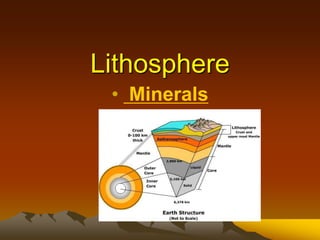
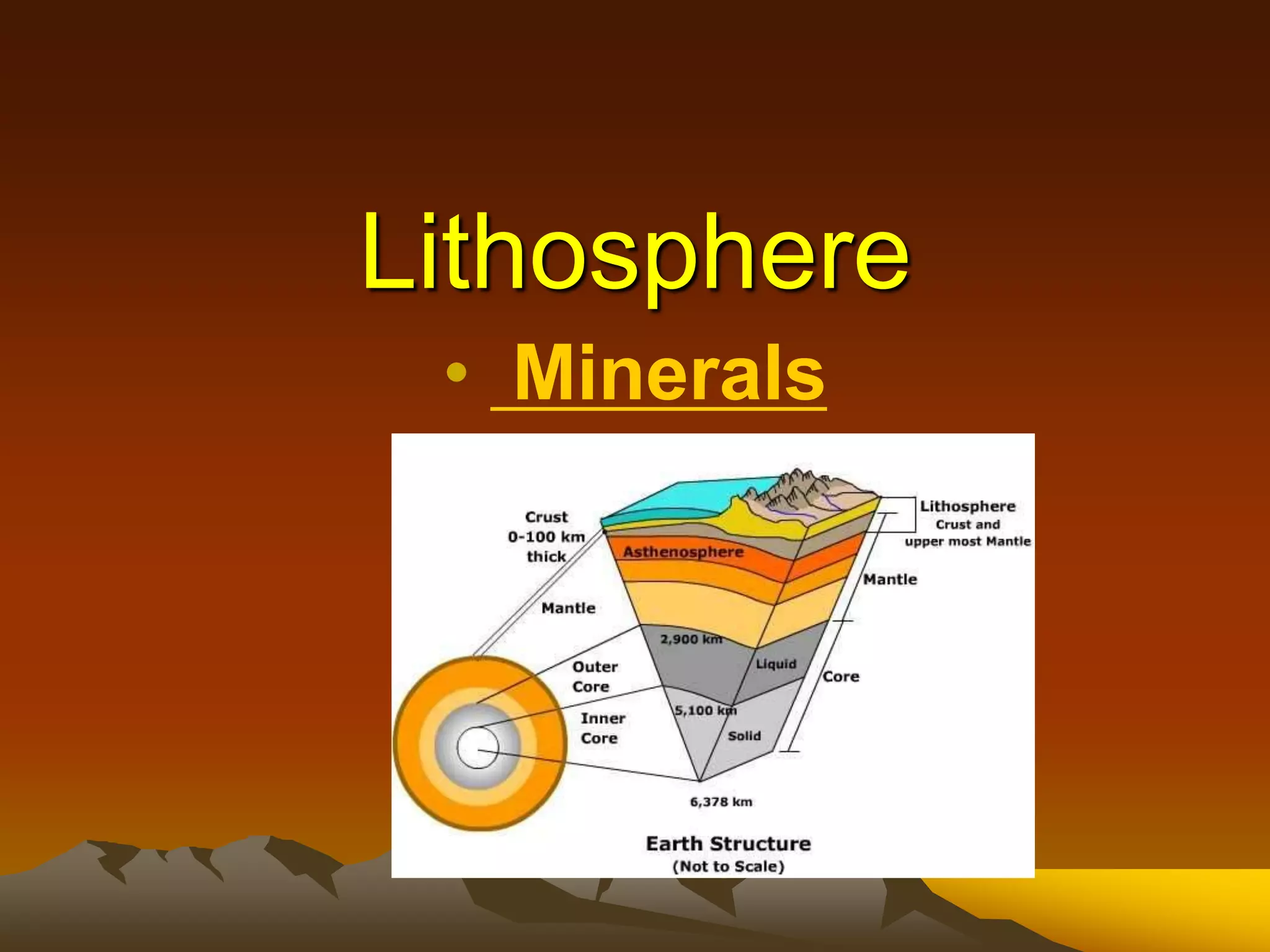
• Minerals
Lithosphere
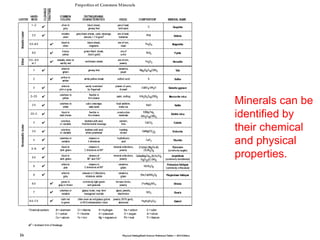
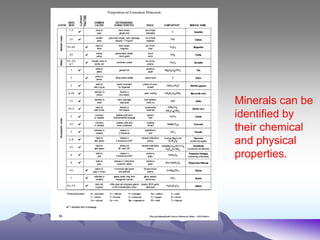
Minerals can be
identified by
their chemical
and physical
properties.
What is
a
Mineral?
Minerals Fist List
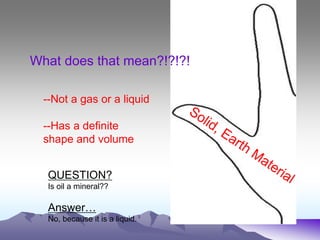
What does that mean?!?!?!
--Not a gas or a liquid
--Has a definite
shape and volume
QUESTION?
Is oil a mineral??
Answer…
No, because it is a liquid.
What does that mean?!?!?!
--Not man-made
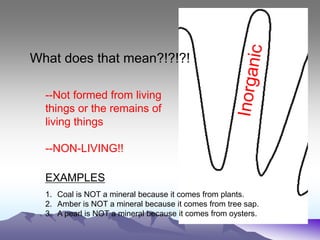
What does that mean?!?!?!
--Not formed from living
things or the remains of
living things
--NON-LIVING!!
EXAMPLES
1. Coal is NOT a mineral because it comes from plants.
2. Amber is NOT a mineral because it comes from tree sap.
3. A pearl is NOT a mineral because it comes from oysters.
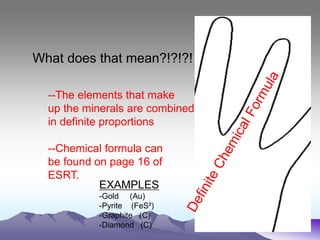
What does that mean?!?!?!
--The elements that make
up the minerals are combined
in definite proportions
--Chemical formula can
be found on page 16 of
ESRT.
EXAMPLES
-Gold (Au)
-Pyrite (FeS²)
-Graphite (C)
-Diamond (C)
What does that mean?!?!?!
--Atoms are arranged
in a repeating pattern
--Each mineral has a
different INTERNAL
ARRANGEMENT OF
ATOMS that gives it
distinct physical and
chemical properties
What does that
mean?!?!?!
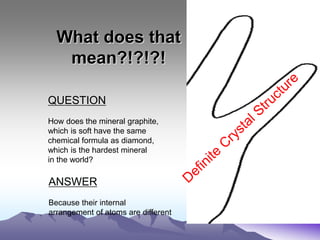
QUESTION
How does the mineral graphite,
which is soft have the same
chemical formula as diamond,
which is the hardest mineral
in the world?
ANSWER
Because their internal
arrangement of atoms are different
How are
Minerals
Identified??
Fill in the spiders
legs as we go!!
Minerals can be
identified by
their chemical
and physical
properties.
How are Minerals Identified??
--Least useful for
identification
--One mineral can
come in many colors
EXAMPLE:
--Hematite: Comes in black, red and brown
How are Minerals Identified??
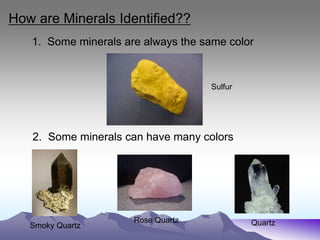
1. Some minerals are always the same color
2. Some minerals can have many colors
Smoky Quartz
Rose Quartz Quartz
Sulfur
Colors can vary as a result of…
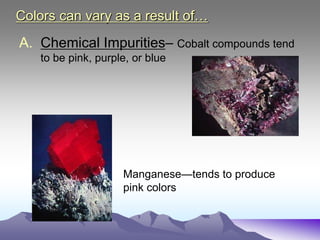
A. Chemical Impurities– Cobalt compounds tend
to be pink, purple, or blue
Manganese—tends to produce
pink colors
Colors can vary as a result of…
B. Oxidation—exposure to air and water
changing the color of the mineral.
Ex. Rust
--Iron is the dominant coloring agent in
rocks and soils
How are Minerals Identified??
--the color of a
mineral when it is
finely powdered
--determined by
rubbing the mineral
on a piece of tile
Hematite has a
reddish-brown streak.
How are Minerals Identified??
--describes how a
mineral appears to
reflect light
There are 2
categories in
which a minerals
luster can fall…
Metallic OR Non-Metallic
How are Minerals Identified??
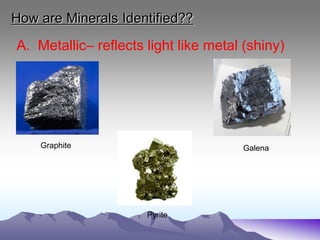
A. Metallic– reflects light like metal (shiny)
Galena
Graphite
Pyrite
How are Minerals Identified??
B. Non-Metallic—any mineral which DOES
NOT exhibit shiny metallic characteristics
Ex. Quartz
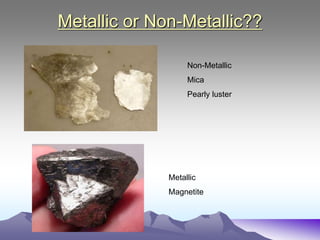
Metallic or Non-Metallic??
Non-Metallic
Mica
Pearly luster
Metallic
Magnetite
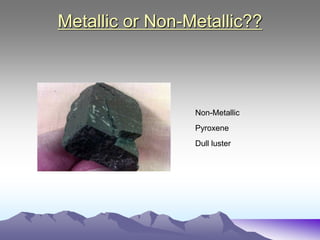
Metallic or Non-Metallic??
Non-Metallic
Pyroxene
Dull luster
How are Minerals Identified??
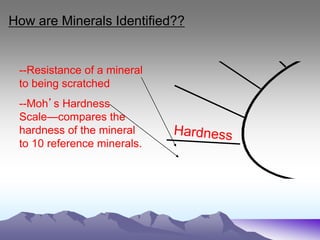
--Resistance of a mineral
to being scratched
--Moh’s Hardness
Scale—compares the
hardness of the mineral
to 10 reference minerals.
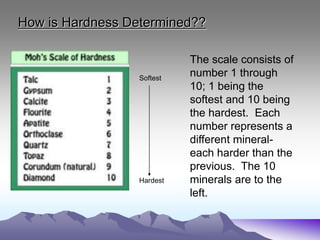
How is Hardness Determined??
Softest
Hardest
The scale consists of
number 1 through
10; 1 being the
softest and 10 being
the hardest. Each
number represents a
different mineral-
each harder than the
previous. The 10
minerals are to the
left.
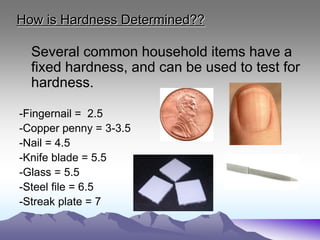
How is Hardness Determined??
Several common household items have a
fixed hardness, and can be used to test for
hardness.
-Fingernail = 2.5
-Copper penny = 3-3.5
-Nail = 4.5
-Knife blade = 5.5
-Glass = 5.5
-Steel file = 6.5
-Streak plate = 7
What Determines Hardness?
--Hardness is determined by a minerals
internal arrangement of atoms.
Ex. Diamond vs. Graphite
-Diamond has hardness of 10 and graphite is ranked
between 1 and 2. Diamond is about 40 times harder
than graphite due to the way the atoms are arranged.
--Hardness is the best property to use to identify a
mineral.
How are Minerals Identified??
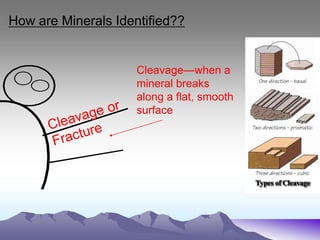
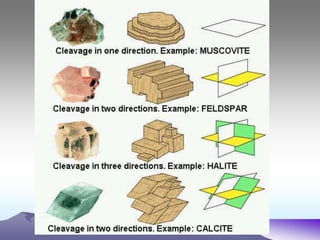
Cleavage—when a
mineral breaks
along a flat, smooth
surface
Examples of Minerals that show Cleavage
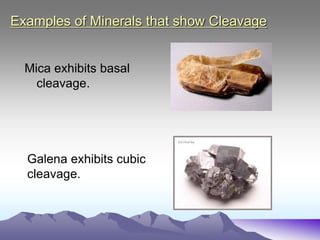
Mica exhibits basal
cleavage.
Galena exhibits cubic
cleavage.
What Determines Cleavage and Hardness?
A minerals internal
arrangement of
atoms!!
How are Minerals Identified??
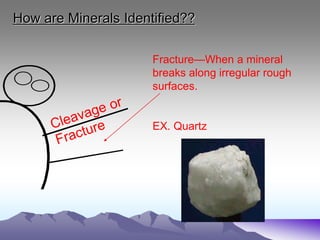
Fracture—When a mineral
breaks along irregular rough
surfaces.
EX. Quartz
How are Minerals Identified??
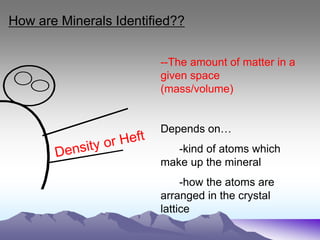
--The amount of matter in a
given space
(mass/volume)
Depends on…
-kind of atoms which
make up the mineral
-how the atoms are
arranged in the crystal
lattice
How are Minerals Identified??
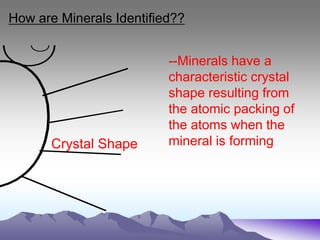
Crystal Shape
--Minerals have a
characteristic crystal
shape resulting from
the atomic packing of
the atoms when the
mineral is forming
How are Minerals Identified??
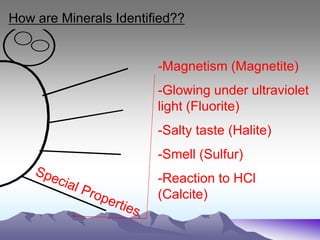
-Magnetism (Magnetite)
-Glowing under ultraviolet
light (Fluorite)
-Salty taste (Halite)
-Smell (Sulfur)
-Reaction to HCl
(Calcite)
Rocks
Parent Material for
all Rock??
Magma!!
Lithosphere
How are rocks
formed?
Rocks are classified
by their process of
formation.
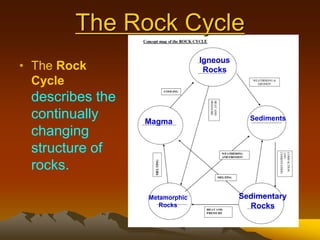
The Rock Cycle
• The Rock
Cycle
describes the
continually
changing
structure of
rocks.
Sedimentary
Rocks
Igneous
Rocks
Metamorphic
Rocks
Magma Sediments
Texture and Grain Size
• Texture is described based on grain
size, grain shape, and grain pattern.
• Most rocks are made up of tiny
particles of minerals or other rocks,
which are called grains.
• A rock’s grains give it its texture
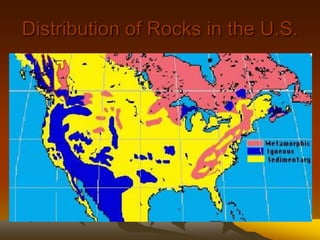
Distribution of Rocks in the U.S.
Rocks
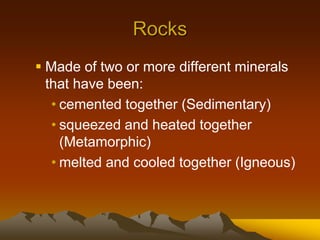
 Made of two or more different minerals
that have been:
• cemented together (Sedimentary)
• squeezed and heated together
(Metamorphic)
• melted and cooled together (Igneous)
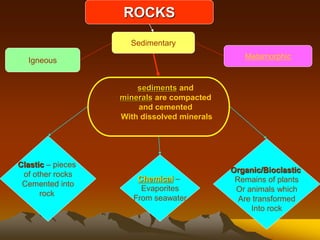
Igneous
Sedimentary
Metamorphic
sediments and
minerals are compacted
and cemented
With dissolved minerals
Clastic – pieces
of other rocks
Cemented into
rock
Chemical –
Evaporites
From seawater
Organic/Bioclastic
Remains of plants
Or animals which
Are transformed
Into rock
ROCKS
Igneous Rock
• Igneous rock forms
when magma or lava
COOLS Solidifies
Crystallizes
hardens
Crystallization
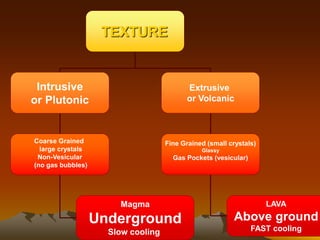
TEXTURE
Intrusive
or Plutonic
Extrusive
or Volcanic
Coarse Grained
large crystals
Non-Vesicular
(no gas bubbles)
Magma
Underground
Slow cooling
Fine Grained (small crystals)
Glassy
Gas Pockets (vesicular)
LAVA
Above ground
FAST cooling
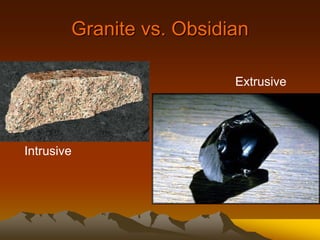
Granite vs. Obsidian
Extrusive
Intrusive
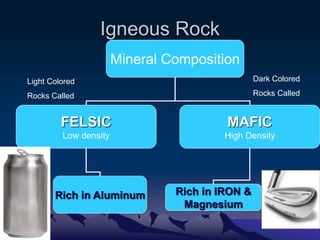
Igneous Rock
Mineral Composition
FELSIC
Low density
MAFIC
High Density
Rich in Aluminum Rich in IRON &
Magnesium
Light Colored
Rocks Called
Dark Colored
Rocks Called
Sedimentary Rocks
Form when
Minerals
Clastic
And
Are cemented together
The 3 types of sedimentary rock are
SEDIMENTS
Chemical Organic
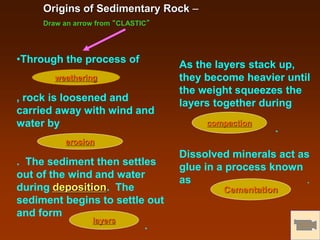
•Through the process of
, rock is loosened and
carried away with wind and
water by
. The sediment then settles
out of the wind and water
during deposition. The
sediment begins to settle out
and form
.
Origins of Sedimentary Rock –
Draw an arrow from “CLASTIC”
weathering
erosion
layers
compaction
Cementation
As the layers stack up,
they become heavier until
the weight squeezes the
layers together during
.
Dissolved minerals act as
glue in a process known
as .
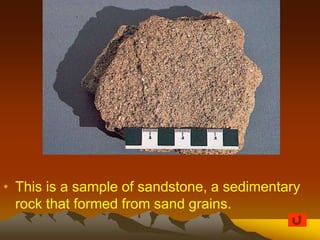
• This is a sample of sandstone, a sedimentary
rock that formed from sand grains.
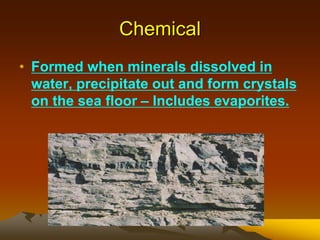
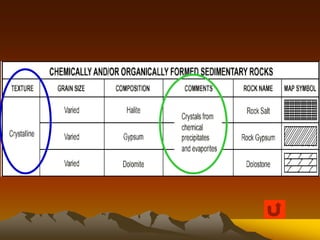
Chemical
• Formed when minerals dissolved in
water, precipitate out and form crystals
on the sea floor – Includes evaporites.
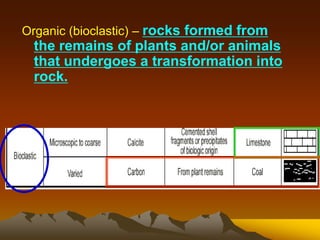
Organic (bioclastic) – rocks formed from
the remains of plants and/or animals
that undergoes a transformation into
rock.
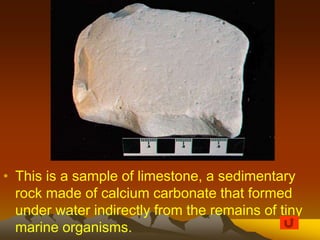
• This is a sample of limestone, a sedimentary
rock made of calcium carbonate that formed
under water indirectly from the remains of tiny
marine organisms.
Grand Canyon
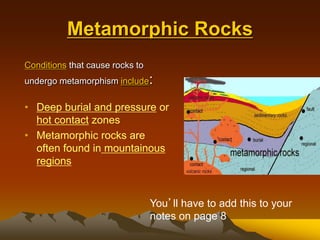
Metamorphic Rocks
Conditions that cause rocks to
undergo metamorphism include:
• Deep burial and pressure or
hot contact zones
• Metamorphic rocks are
often found in mountainous
regions
You’ll have to add this to your
notes on page 8
Heat
Pressure
Chemical due
to Contact
Metamorphic rocks are
characterized by:
• Increased DENSITY
• NEW Minerals
• BANDING
Metamorphic Rocks – formed when a rock is
changed by
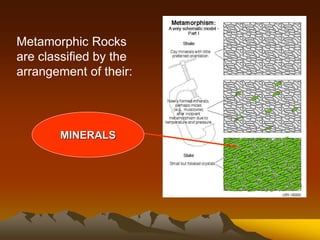
Metamorphic Rocks
are classified by the
arrangement of their:
MINERALS
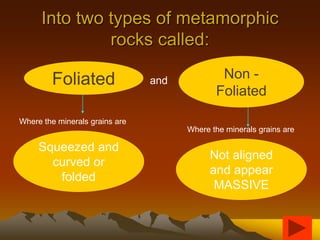
Into two types of metamorphic
rocks called:
Non -
Foliated
Foliated and
Where the minerals grains are
Not aligned
and appear
MASSIVE
Squeezed and
curved or
folded
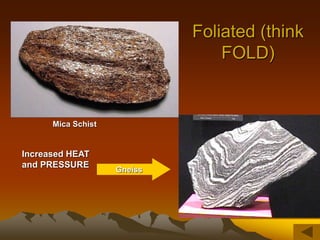
Foliated (think
FOLD)
Mica Schist
Gneiss
Increased HEAT
and PRESSURE
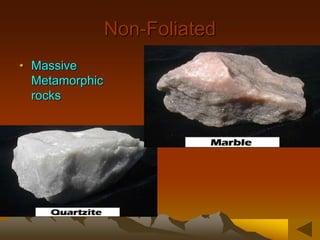
Non-Foliated
• Massive
Metamorphic
rocks
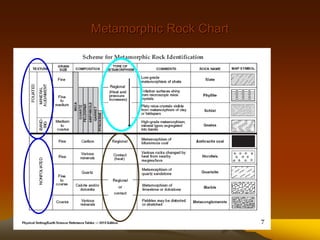
Metamorphic Rock Chart
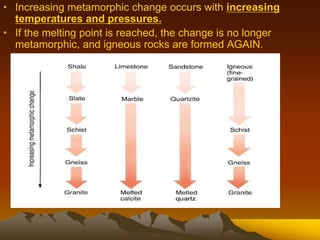
• Increasing metamorphic change occurs with increasing
temperatures and pressures.
• If the melting point is reached, the change is no longer
metamorphic, and igneous rocks are formed AGAIN.

rocks and minerals-131013154238-phpapp01.ppt

  • 1.
  • 2.
    Minerals can be identifiedby their chemical and physical properties.
  • 3.
  • 4.
    What does thatmean?!?!?! --Not a gas or a liquid --Has a definite shape and volume QUESTION? Is oil a mineral?? Answer… No, because it is a liquid.
  • 5.
    What does thatmean?!?!?! --Not man-made
  • 6.
    What does thatmean?!?!?! --Not formed from living things or the remains of living things --NON-LIVING!! EXAMPLES 1. Coal is NOT a mineral because it comes from plants. 2. Amber is NOT a mineral because it comes from tree sap. 3. A pearl is NOT a mineral because it comes from oysters.
  • 7.
    What does thatmean?!?!?! --The elements that make up the minerals are combined in definite proportions --Chemical formula can be found on page 16 of ESRT. EXAMPLES -Gold (Au) -Pyrite (FeS²) -Graphite (C) -Diamond (C)
  • 8.
    What does thatmean?!?!?! --Atoms are arranged in a repeating pattern --Each mineral has a different INTERNAL ARRANGEMENT OF ATOMS that gives it distinct physical and chemical properties
  • 9.
    What does that mean?!?!?! QUESTION Howdoes the mineral graphite, which is soft have the same chemical formula as diamond, which is the hardest mineral in the world? ANSWER Because their internal arrangement of atoms are different
  • 10.
    How are Minerals Identified?? Fill inthe spiders legs as we go!!
  • 11.
    Minerals can be identifiedby their chemical and physical properties.
  • 12.
    How are MineralsIdentified?? --Least useful for identification --One mineral can come in many colors EXAMPLE: --Hematite: Comes in black, red and brown
  • 13.
    How are MineralsIdentified?? 1. Some minerals are always the same color 2. Some minerals can have many colors Smoky Quartz Rose Quartz Quartz Sulfur
  • 14.
    Colors can varyas a result of… A. Chemical Impurities– Cobalt compounds tend to be pink, purple, or blue Manganese—tends to produce pink colors
  • 15.
    Colors can varyas a result of… B. Oxidation—exposure to air and water changing the color of the mineral. Ex. Rust --Iron is the dominant coloring agent in rocks and soils
  • 16.
    How are MineralsIdentified?? --the color of a mineral when it is finely powdered --determined by rubbing the mineral on a piece of tile Hematite has a reddish-brown streak.
  • 17.
    How are MineralsIdentified?? --describes how a mineral appears to reflect light There are 2 categories in which a minerals luster can fall… Metallic OR Non-Metallic
  • 18.
    How are MineralsIdentified?? A. Metallic– reflects light like metal (shiny) Galena Graphite Pyrite
  • 19.
    How are MineralsIdentified?? B. Non-Metallic—any mineral which DOES NOT exhibit shiny metallic characteristics Ex. Quartz
  • 20.
  • 21.
  • 22.
    How are MineralsIdentified?? --Resistance of a mineral to being scratched --Moh’s Hardness Scale—compares the hardness of the mineral to 10 reference minerals.
  • 23.
    How is HardnessDetermined?? Softest Hardest The scale consists of number 1 through 10; 1 being the softest and 10 being the hardest. Each number represents a different mineral- each harder than the previous. The 10 minerals are to the left.
  • 24.
    How is HardnessDetermined?? Several common household items have a fixed hardness, and can be used to test for hardness. -Fingernail = 2.5 -Copper penny = 3-3.5 -Nail = 4.5 -Knife blade = 5.5 -Glass = 5.5 -Steel file = 6.5 -Streak plate = 7
  • 25.
    What Determines Hardness? --Hardnessis determined by a minerals internal arrangement of atoms. Ex. Diamond vs. Graphite -Diamond has hardness of 10 and graphite is ranked between 1 and 2. Diamond is about 40 times harder than graphite due to the way the atoms are arranged. --Hardness is the best property to use to identify a mineral.
  • 26.
    How are MineralsIdentified?? Cleavage—when a mineral breaks along a flat, smooth surface
  • 27.
    Examples of Mineralsthat show Cleavage Mica exhibits basal cleavage. Galena exhibits cubic cleavage.
  • 29.
    What Determines Cleavageand Hardness? A minerals internal arrangement of atoms!!
  • 30.
    How are MineralsIdentified?? Fracture—When a mineral breaks along irregular rough surfaces. EX. Quartz
  • 31.
    How are MineralsIdentified?? --The amount of matter in a given space (mass/volume) Depends on… -kind of atoms which make up the mineral -how the atoms are arranged in the crystal lattice
  • 32.
    How are MineralsIdentified?? Crystal Shape --Minerals have a characteristic crystal shape resulting from the atomic packing of the atoms when the mineral is forming
  • 33.
    How are MineralsIdentified?? -Magnetism (Magnetite) -Glowing under ultraviolet light (Fluorite) -Salty taste (Halite) -Smell (Sulfur) -Reaction to HCl (Calcite)
  • 34.
  • 35.
  • 36.
    How are rocks formed? Rocksare classified by their process of formation.
  • 37.
    The Rock Cycle •The Rock Cycle describes the continually changing structure of rocks. Sedimentary Rocks Igneous Rocks Metamorphic Rocks Magma Sediments
  • 38.
    Texture and GrainSize • Texture is described based on grain size, grain shape, and grain pattern. • Most rocks are made up of tiny particles of minerals or other rocks, which are called grains. • A rock’s grains give it its texture
  • 39.
  • 40.
    Rocks  Made oftwo or more different minerals that have been: • cemented together (Sedimentary) • squeezed and heated together (Metamorphic) • melted and cooled together (Igneous)
  • 41.
    Igneous Sedimentary Metamorphic sediments and minerals arecompacted and cemented With dissolved minerals Clastic – pieces of other rocks Cemented into rock Chemical – Evaporites From seawater Organic/Bioclastic Remains of plants Or animals which Are transformed Into rock ROCKS
  • 42.
    Igneous Rock • Igneousrock forms when magma or lava COOLS Solidifies Crystallizes hardens
  • 43.
  • 44.
    TEXTURE Intrusive or Plutonic Extrusive or Volcanic CoarseGrained large crystals Non-Vesicular (no gas bubbles) Magma Underground Slow cooling Fine Grained (small crystals) Glassy Gas Pockets (vesicular) LAVA Above ground FAST cooling
  • 45.
  • 46.
    Igneous Rock Mineral Composition FELSIC Lowdensity MAFIC High Density Rich in Aluminum Rich in IRON & Magnesium Light Colored Rocks Called Dark Colored Rocks Called
  • 47.
    Sedimentary Rocks Form when Minerals Clastic And Arecemented together The 3 types of sedimentary rock are SEDIMENTS Chemical Organic
  • 48.
    •Through the processof , rock is loosened and carried away with wind and water by . The sediment then settles out of the wind and water during deposition. The sediment begins to settle out and form . Origins of Sedimentary Rock – Draw an arrow from “CLASTIC” weathering erosion layers compaction Cementation As the layers stack up, they become heavier until the weight squeezes the layers together during . Dissolved minerals act as glue in a process known as .
  • 49.
    • This isa sample of sandstone, a sedimentary rock that formed from sand grains.
  • 50.
    Chemical • Formed whenminerals dissolved in water, precipitate out and form crystals on the sea floor – Includes evaporites.
  • 52.
    Organic (bioclastic) –rocks formed from the remains of plants and/or animals that undergoes a transformation into rock.
  • 53.
    • This isa sample of limestone, a sedimentary rock made of calcium carbonate that formed under water indirectly from the remains of tiny marine organisms.
  • 54.
  • 55.
    Metamorphic Rocks Conditions thatcause rocks to undergo metamorphism include: • Deep burial and pressure or hot contact zones • Metamorphic rocks are often found in mountainous regions You’ll have to add this to your notes on page 8
  • 56.
    Heat Pressure Chemical due to Contact Metamorphicrocks are characterized by: • Increased DENSITY • NEW Minerals • BANDING Metamorphic Rocks – formed when a rock is changed by
  • 57.
    Metamorphic Rocks are classifiedby the arrangement of their: MINERALS
  • 58.
    Into two typesof metamorphic rocks called: Non - Foliated Foliated and Where the minerals grains are Where the minerals grains are Not aligned and appear MASSIVE Squeezed and curved or folded
  • 59.
  • 60.
  • 61.
  • 62.
    • Increasing metamorphicchange occurs with increasing temperatures and pressures. • If the melting point is reached, the change is no longer metamorphic, and igneous rocks are formed AGAIN.