• Presented by: Sangita Kantariya
• MA Sem :01
• Paper no : 102 literature of the Neoclassical age
• Topic: Robert Burns Biography
• Roll no : 33
• Submitted By: S.B. Gardiner
Department of English, MKBU
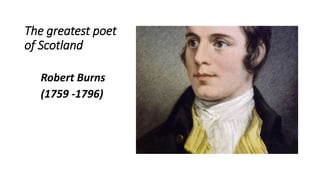
The greatest poet
of Scotland
Robert Burns
(1759 -1796)
Robert Burns life
• The greatest poet of Scotland.
• He Was born in a small town in 1759 and died on 1796, aged 37
• He is famous for writing many poems and songs and is known as the
national poet of Scotland
• He work on their father farm when they were growing up and the
family were quite poor
Poetry and songs
• Rabbit wrote his first poem when he was 15 years old about a girl he
was working on the farm with
• Burns wrote poems in an old dialect of Scottish called ‘scots’ but
some poems are also in English
• Burns penned hundreds and hundreds of poems throughout his
lifetime, and many of them would go on to become famous
worldwide.
• Auld Lang Syne, perhaps the best known of his work, is said to have
been adapted by Burns by an old Scottish folk song.
• In 1785, Burns wrote To A Mouse, which according to legend, was
inspired when Burns accidentally destroyed a mouse’s nest whilst
plugging the fields in winter.
• A Red, Red Rose was published in 1794, when Burns was devoting his
time to preserving the traditional songs of Scotland.
• Tam O’ Shanter tells the story of Tam, a farmer who gets drunk with
his friends and acts in a thoughtless way, especially towards his wife.
• Address to a Haggis was written by Burns to celebrate his
appreciation for haggis. During Burns Night supper, it’s customary to
ready Address to a Haggis before cutting the haggis open.
Burns Night
• Burns Night is annually celebrated in Scotland on or around January
25.
• It commemorates the life of the bard Robert Burns, who was born on
January 25, 1759.
• The day also celebrated Burns contribution to Scottish culture.
Robert Burns famous works
• To a Mouse, on turning her up in her nest with the plugs (1785)
• Address To A Haggis (1786)
• Auld Lang syne (1788)
• Tam o’ shatter (1790)
• A Red, Red Rose (1794)
The ploughman poet
• The main reason Burns is so popular today is because of the themes and
language of everyday life that he used.
• His poem were humorous and he used small subjects to express big ideas.
• This can be seen in poems like ‘To a Mouse’ as he draws a comparison
between the lives of mice and men.
• Burns was a champion of the Scots language at a time when it was not
popular in literary circles.
Lyrical poet
• Burns wasn’t just known for his poems. He was also a prolific song
writer and we often remember songs more easily than we do poems.
• He adapted the words of old Scottish folk songs and contributed over
300 songs to the Scots Musical Museum.
Burns and modern day culture
• His work has even influenced 20th century American authors.
• John Steinbeck‘s novel ‘of mice and men’ is named after a line in the
poem ‘To a Mouse.’
Thank you

Robert Burns Biography

  • 2.
    • Presented by:Sangita Kantariya • MA Sem :01 • Paper no : 102 literature of the Neoclassical age • Topic: Robert Burns Biography • Roll no : 33 • Submitted By: S.B. Gardiner Department of English, MKBU
  • 3.
    The greatest poet ofScotland Robert Burns (1759 -1796)
  • 4.
    Robert Burns life •The greatest poet of Scotland. • He Was born in a small town in 1759 and died on 1796, aged 37 • He is famous for writing many poems and songs and is known as the national poet of Scotland • He work on their father farm when they were growing up and the family were quite poor
  • 5.
    Poetry and songs •Rabbit wrote his first poem when he was 15 years old about a girl he was working on the farm with • Burns wrote poems in an old dialect of Scottish called ‘scots’ but some poems are also in English • Burns penned hundreds and hundreds of poems throughout his lifetime, and many of them would go on to become famous worldwide. • Auld Lang Syne, perhaps the best known of his work, is said to have been adapted by Burns by an old Scottish folk song.
  • 6.
    • In 1785,Burns wrote To A Mouse, which according to legend, was inspired when Burns accidentally destroyed a mouse’s nest whilst plugging the fields in winter. • A Red, Red Rose was published in 1794, when Burns was devoting his time to preserving the traditional songs of Scotland. • Tam O’ Shanter tells the story of Tam, a farmer who gets drunk with his friends and acts in a thoughtless way, especially towards his wife. • Address to a Haggis was written by Burns to celebrate his appreciation for haggis. During Burns Night supper, it’s customary to ready Address to a Haggis before cutting the haggis open.
  • 7.
    Burns Night • BurnsNight is annually celebrated in Scotland on or around January 25. • It commemorates the life of the bard Robert Burns, who was born on January 25, 1759. • The day also celebrated Burns contribution to Scottish culture.
  • 8.
    Robert Burns famousworks • To a Mouse, on turning her up in her nest with the plugs (1785) • Address To A Haggis (1786) • Auld Lang syne (1788) • Tam o’ shatter (1790) • A Red, Red Rose (1794)
  • 9.
    The ploughman poet •The main reason Burns is so popular today is because of the themes and language of everyday life that he used. • His poem were humorous and he used small subjects to express big ideas. • This can be seen in poems like ‘To a Mouse’ as he draws a comparison between the lives of mice and men. • Burns was a champion of the Scots language at a time when it was not popular in literary circles.
  • 10.
    Lyrical poet • Burnswasn’t just known for his poems. He was also a prolific song writer and we often remember songs more easily than we do poems. • He adapted the words of old Scottish folk songs and contributed over 300 songs to the Scots Musical Museum.
  • 11.
    Burns and modernday culture • His work has even influenced 20th century American authors. • John Steinbeck‘s novel ‘of mice and men’ is named after a line in the poem ‘To a Mouse.’
  • 12.