with Rob Hanna
of Precision Content
ROB HANNA
▪ Co-Founder and Chief Information
Architect at Precision Content
▪ Voted into the Top 25 Global Content
Experience Influencers for 2017
▪ Helping organizations make their information easier
to use for more than 20 years
Twitter: @singlesoureror
www.precisioncontent.com
TALKING ABOUT
▪ History of content
▪ Future of content
▪ Conversational UI’s
▪ Microcontent
▪ Structure
▪ Function
▪ Purpose
▪ Context
▪ Conclusions
@singlesourceror
HISTORY
How we got here
@singlesourceror
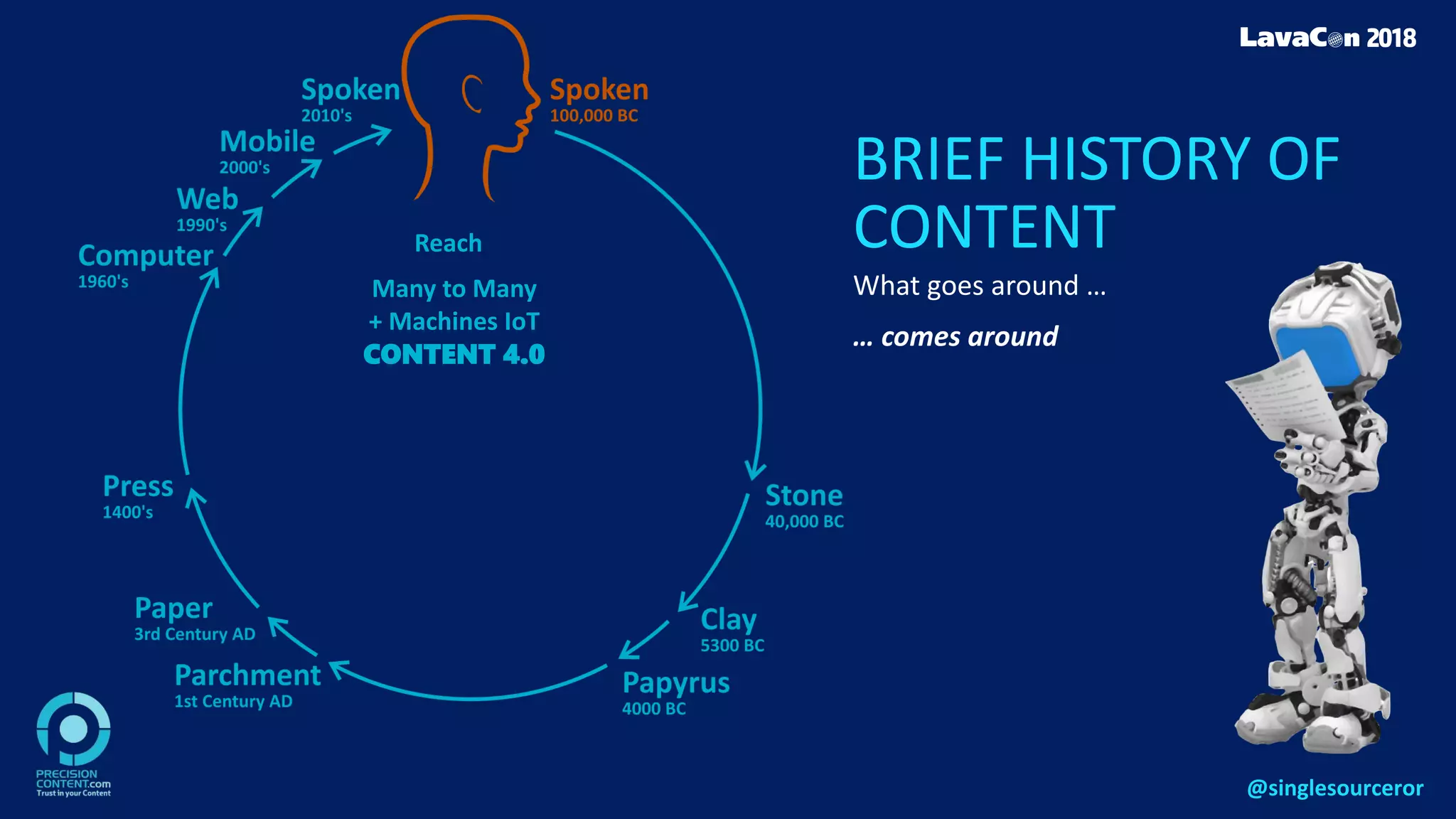
BRIEF HISTORY OF
CONTENT
What goes around …
… comes around
One-to-OneOne-to-Many
CONTENT 1.0
One-to-Many More
CONTENT 2.0
Many-to-Many
CONTENT 3.0
Reach
Many to Many
+ Machines IoT
CONTENT 4.0
@singlesourceror
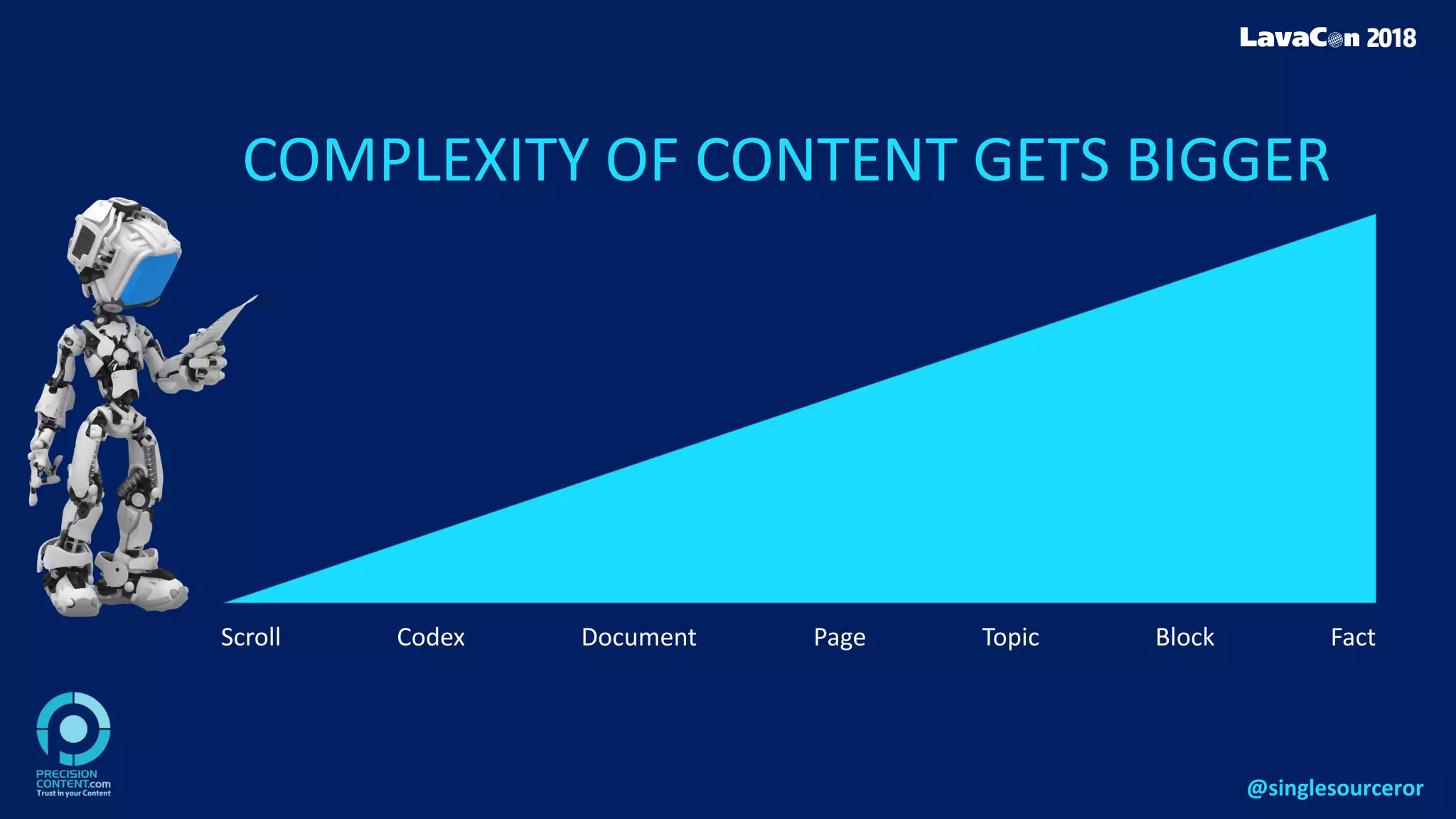
COMPLEXITY OF CONTENT GETS BIGGER
Scroll Codex Document Topic Block FactPage
@singlesourceror
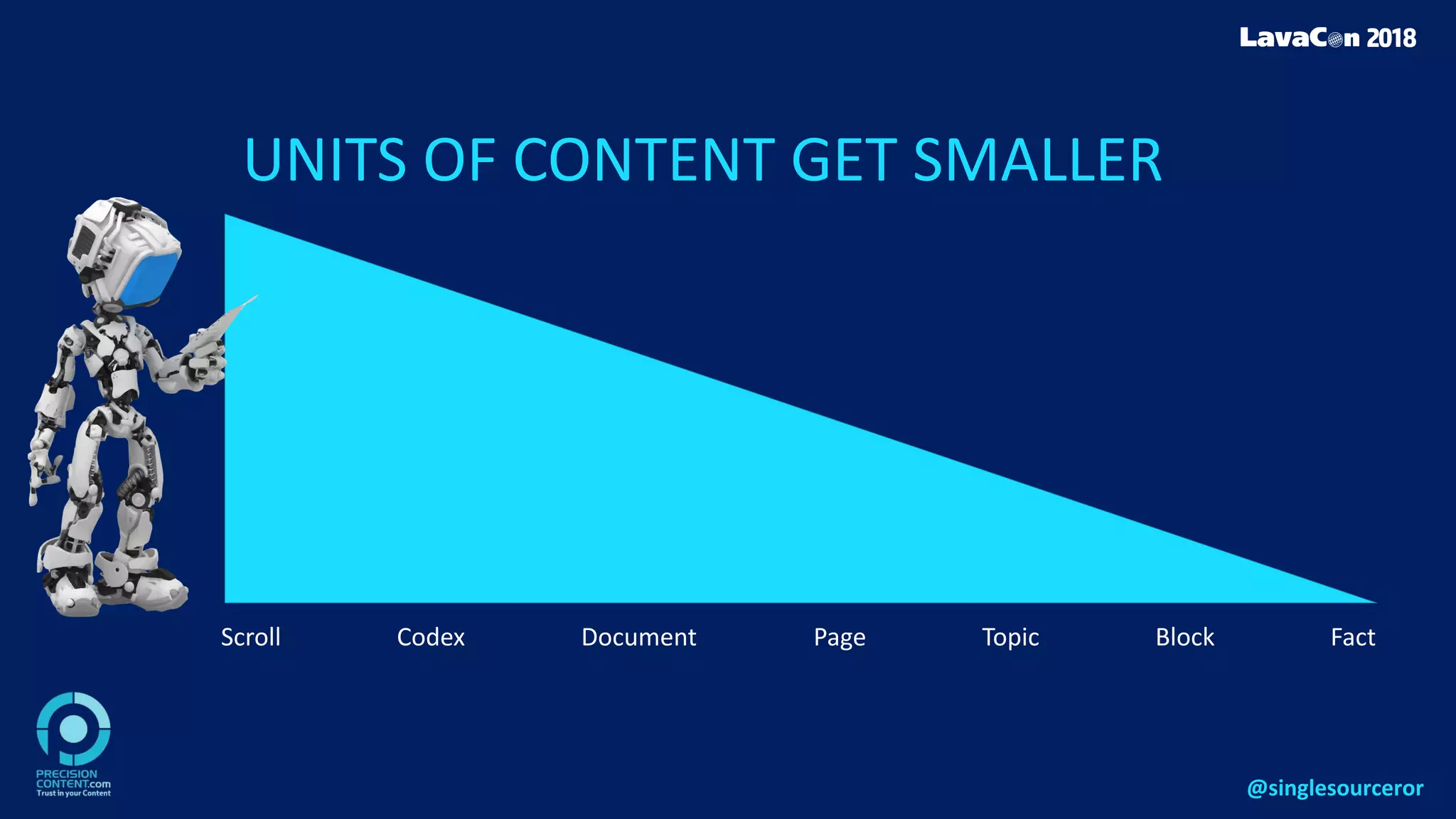
UNITS OF CONTENT GET SMALLER
Scroll Codex Document Topic Block FactPage
@singlesourceror
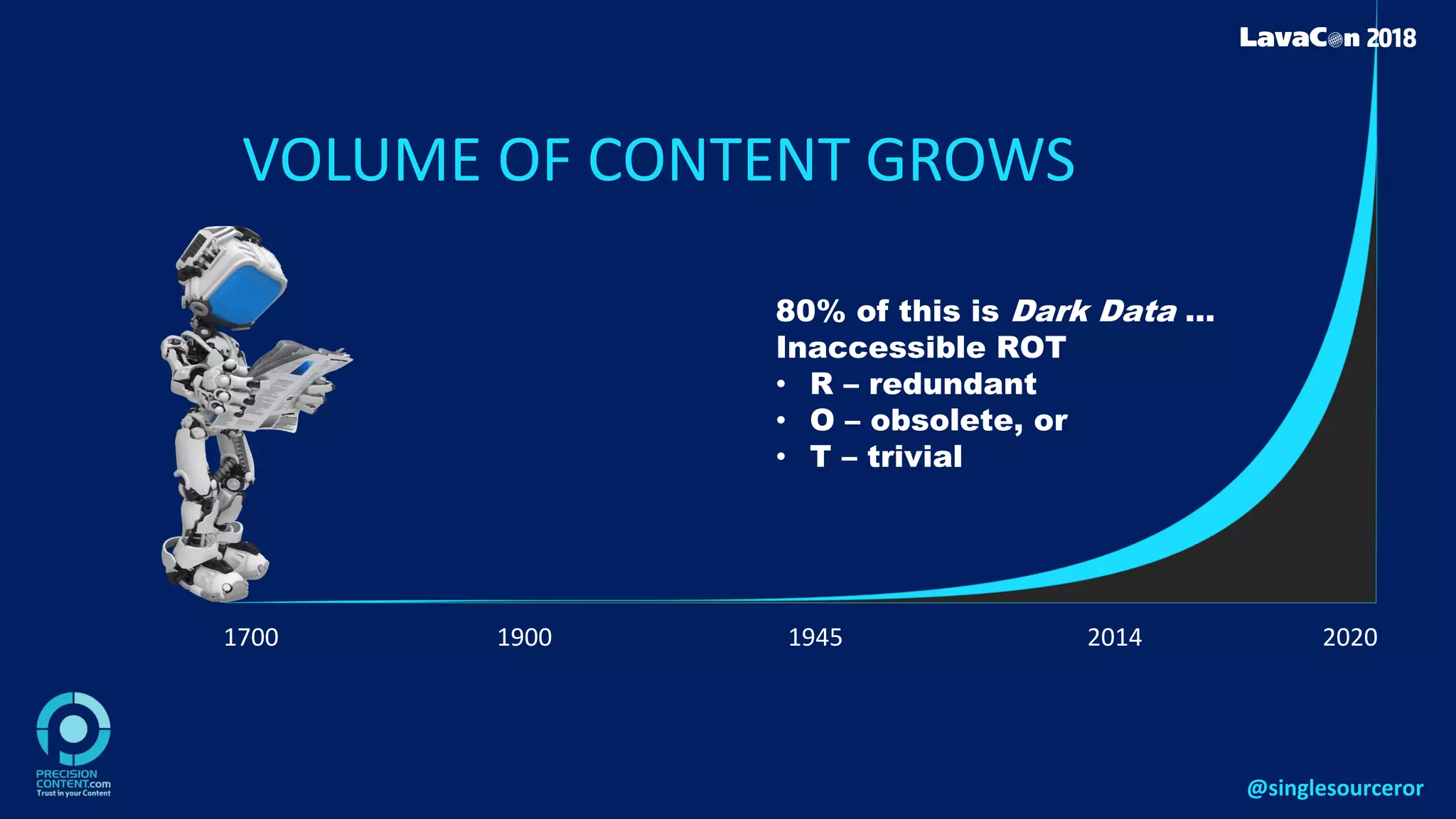
VOLUME OF CONTENT GROWS
1700 1900 2014 20201945
80% of this is Dark Data …
Inaccessible ROT
• R – redundant
• O – obsolete, or
• T – trivial
@singlesourceror
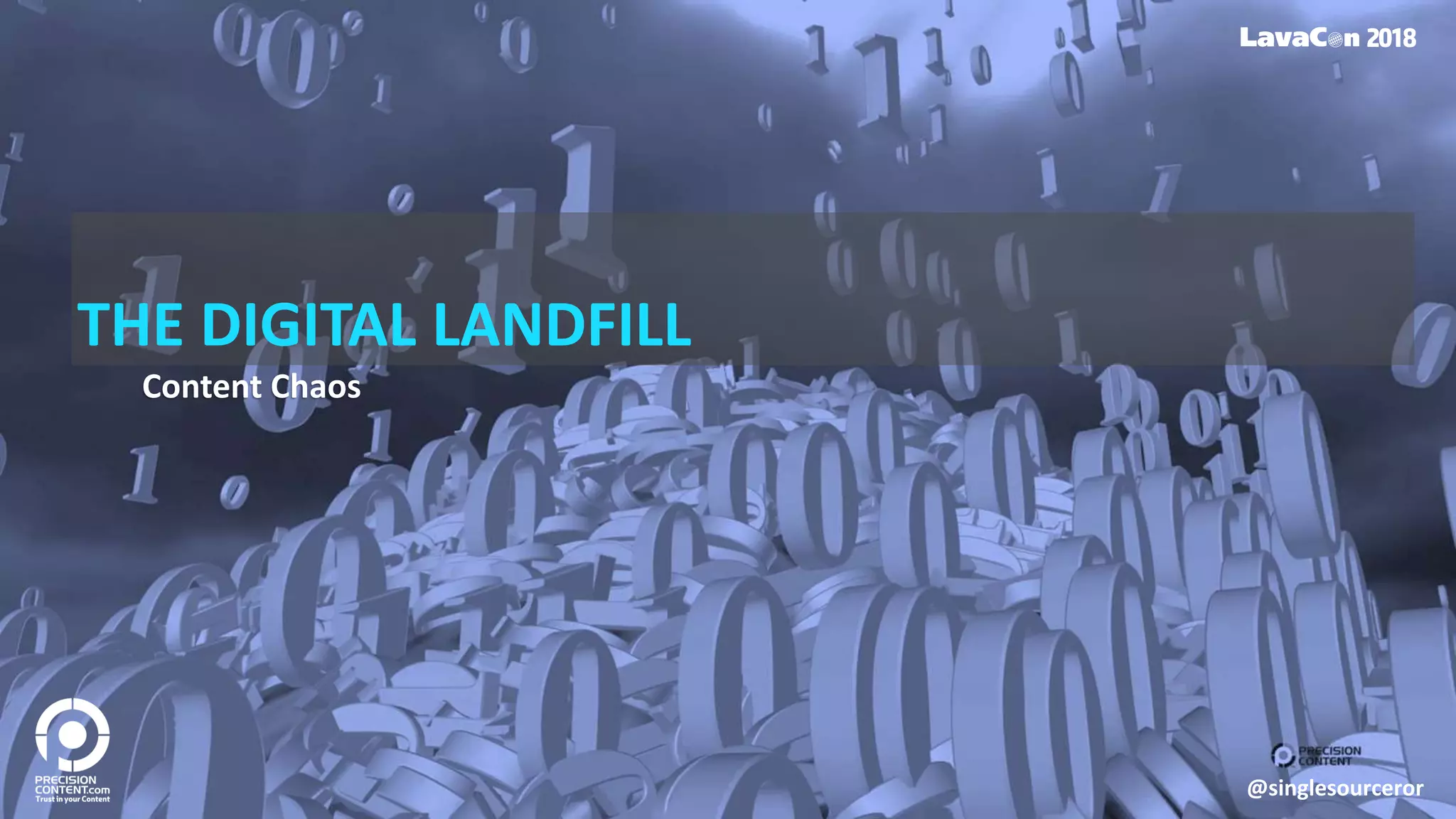
Content Chaos
THE DIGITAL LANDFILL
@singlesourceror
CONVERSATIONAL USER
INTERFACES
Changing how we consume information
@singlesourceror
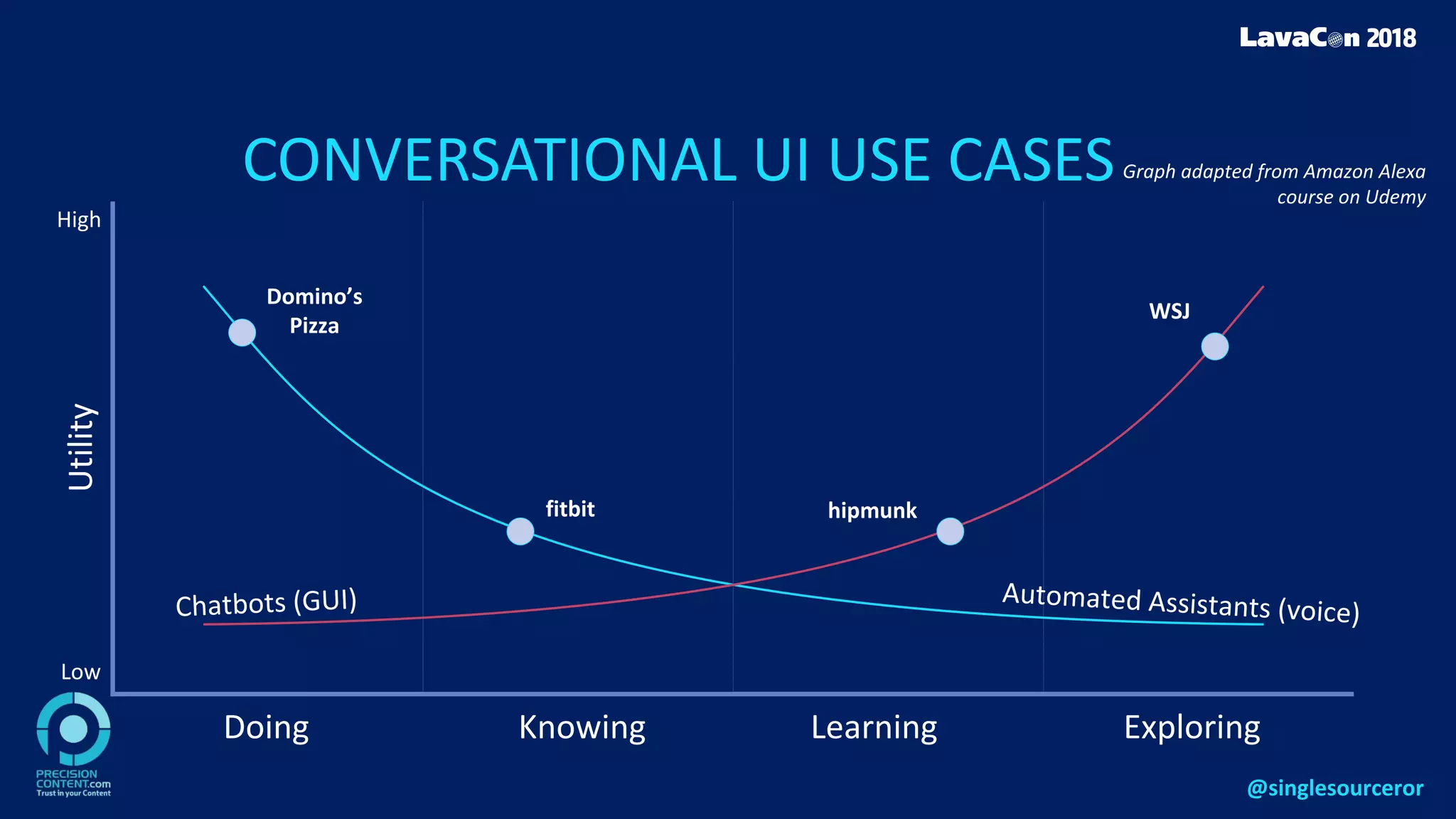
CONVERSATIONAL UI USE CASES
Doing Knowing Learning Exploring
Utility
High
Low
Domino’s
Pizza
fitbit hipmunk
WSJ
Graph adapted from Amazon Alexa
course on Udemy
@singlesourceror
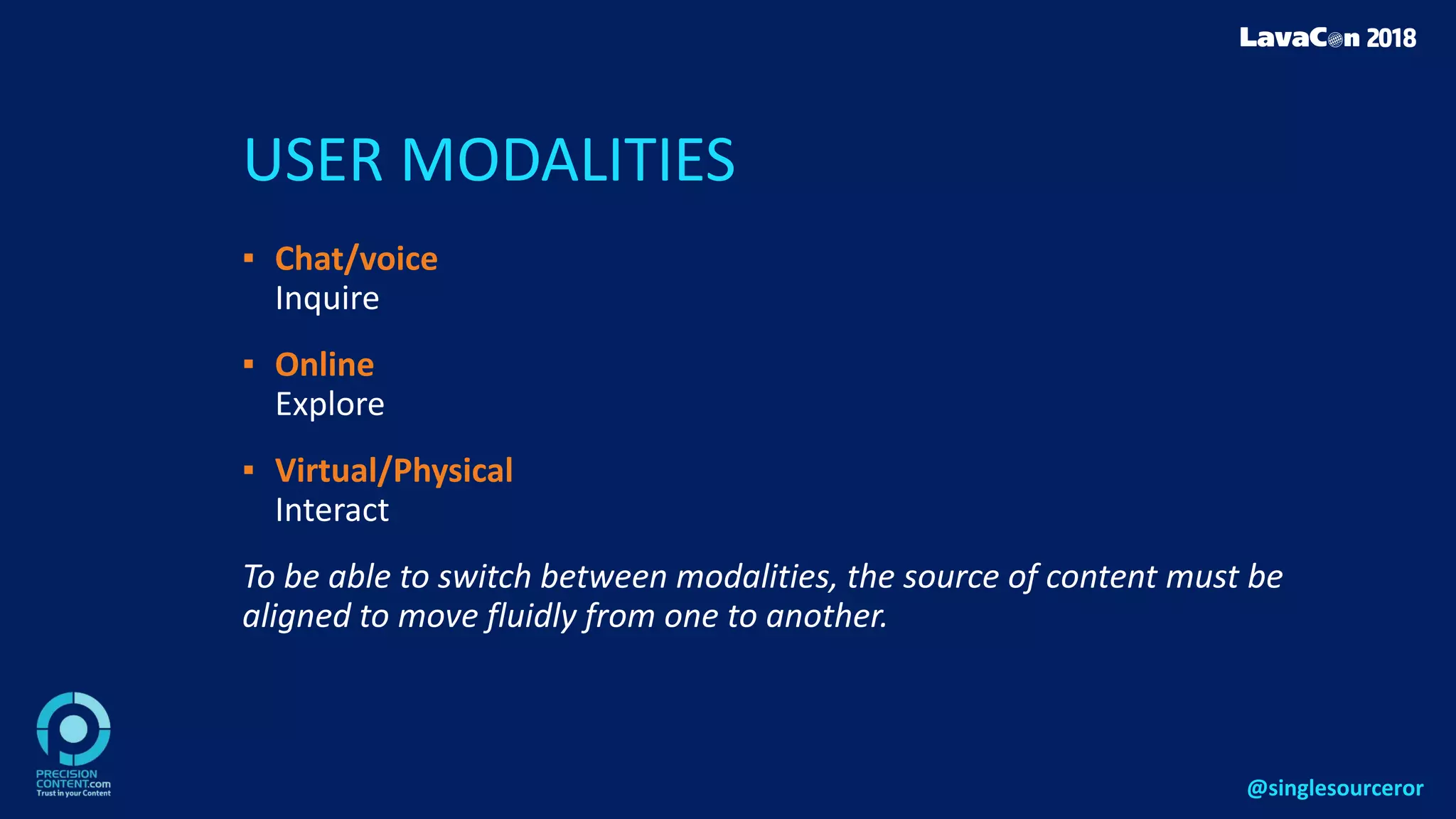
USER MODALITIES
▪ Chat/voice
Inquire
▪ Online
Explore
▪ Virtual/Physical
Interact
To be able to switch between modalities, the source of content must be
aligned to move fluidly from one to another.
@singlesourceror
THREE PRIMARY TYPES OF CHATBOTS
▪ Informational
▪ Transactional
▪ Recreational
@singlesourceror
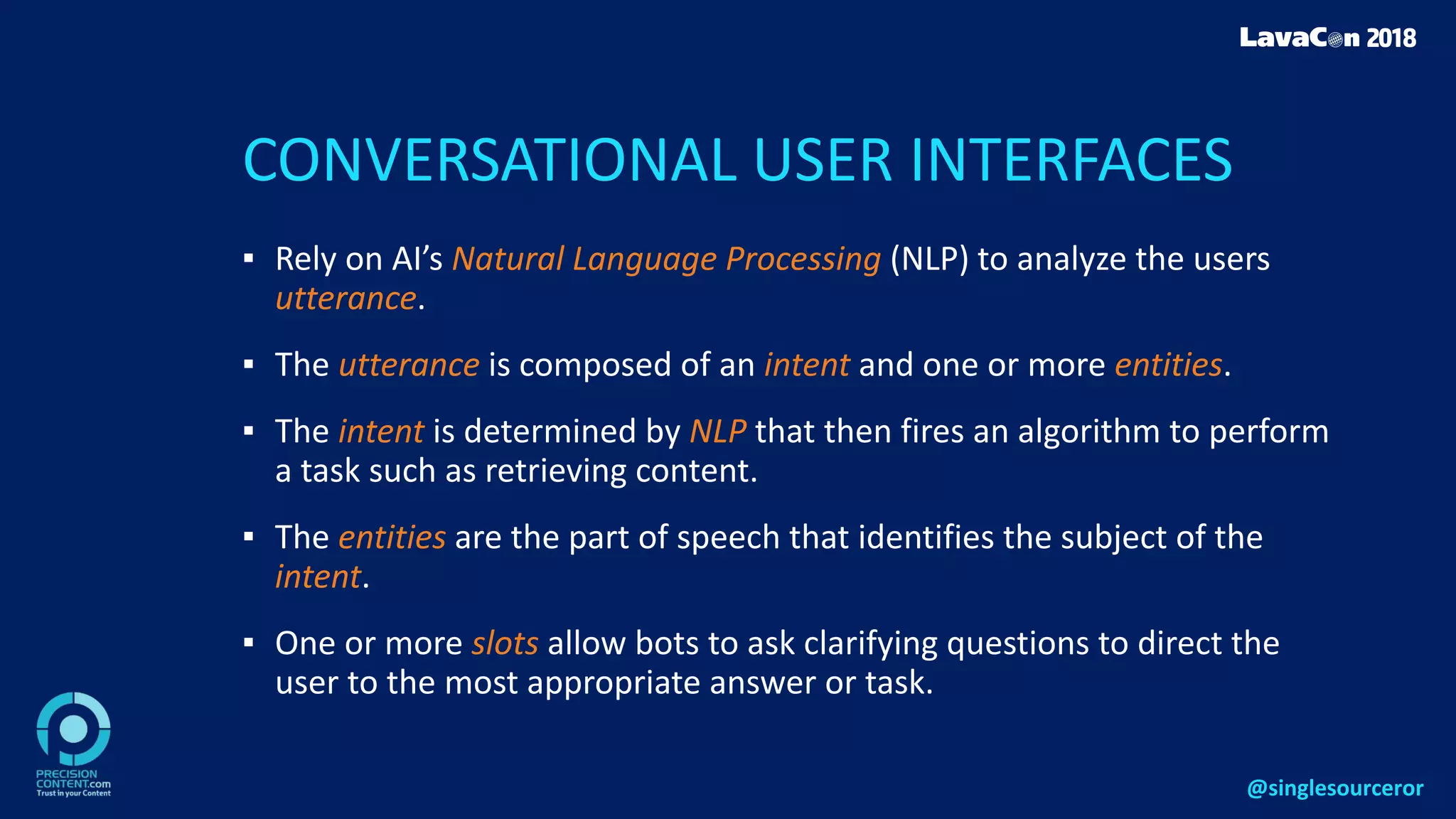
CONVERSATIONAL USER INTERFACES
▪ Rely on AI’s Natural Language Processing (NLP) to analyze the users
utterance.
▪ The utterance is composed of an intent and one or more entities.
▪ The intent is determined by NLP that then fires an algorithm to perform
a task such as retrieving content.
▪ The entities are the part of speech that identifies the subject of the
intent.
▪ One or more slots allow bots to ask clarifying questions to direct the
user to the most appropriate answer or task.
@singlesourceror
MICROCONTENT
The next step in the authoring journey
@singlesourceror
MICROCONTENT
Is content that is
• about one primary idea, fact, or concept
• easily scannable
• labelled for clear identification and meaning, and
• appropriately written and formatted for use anywhere
and any time it is needed.
It’s not microcontent just because it’s small
@singlesourceror
RULES FOR INTELLIGENT
MICROCONTENT
▪ Purpose
Microcontent must be about only one subject
▪ Function
Microcontent must be typed to identify user intent
▪ Context
Microcontent must be easily relatable to other content
▪ Structure
Microcontent must use predictable patterns and language
@singlesourceror
STRUCTURE
Microcontent must use predictable patterns and language
@singlesourceror
STRUCTURED AUTHORING DEFINED
Structured authoring means a standardised,
methodological approach to content creation
incorporating
▪ systematic labelling
▪ modular, topic-based architecture
▪ constrained writing environments, and
▪ the separation of content and form.
From The DITA Style Guide - Best Practices for Authors
Tony Self www.ditastyle.com
@singlesourceror
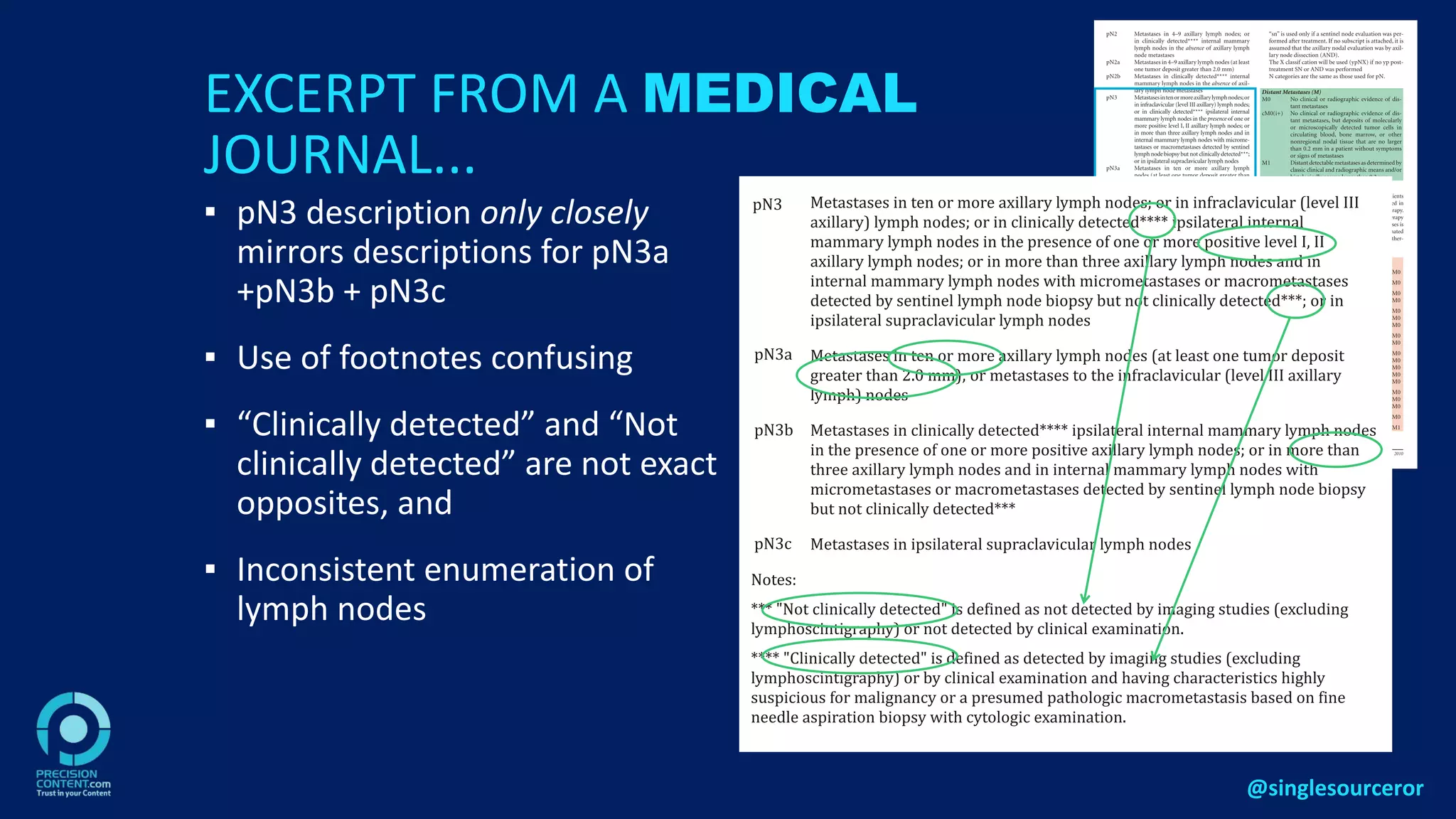
EXCERPT FROM A MEDICAL
JOURNAL...
▪ pN3 description only closely
mirrors descriptions for pN3a
+pN3b + pN3c
▪ Use of footnotes confusing
▪ “Clinically detected” and “Not
clinically detected” are not exact
opposites, and
▪ Inconsistent enumeration of
lymph nodes
@singlesourceror
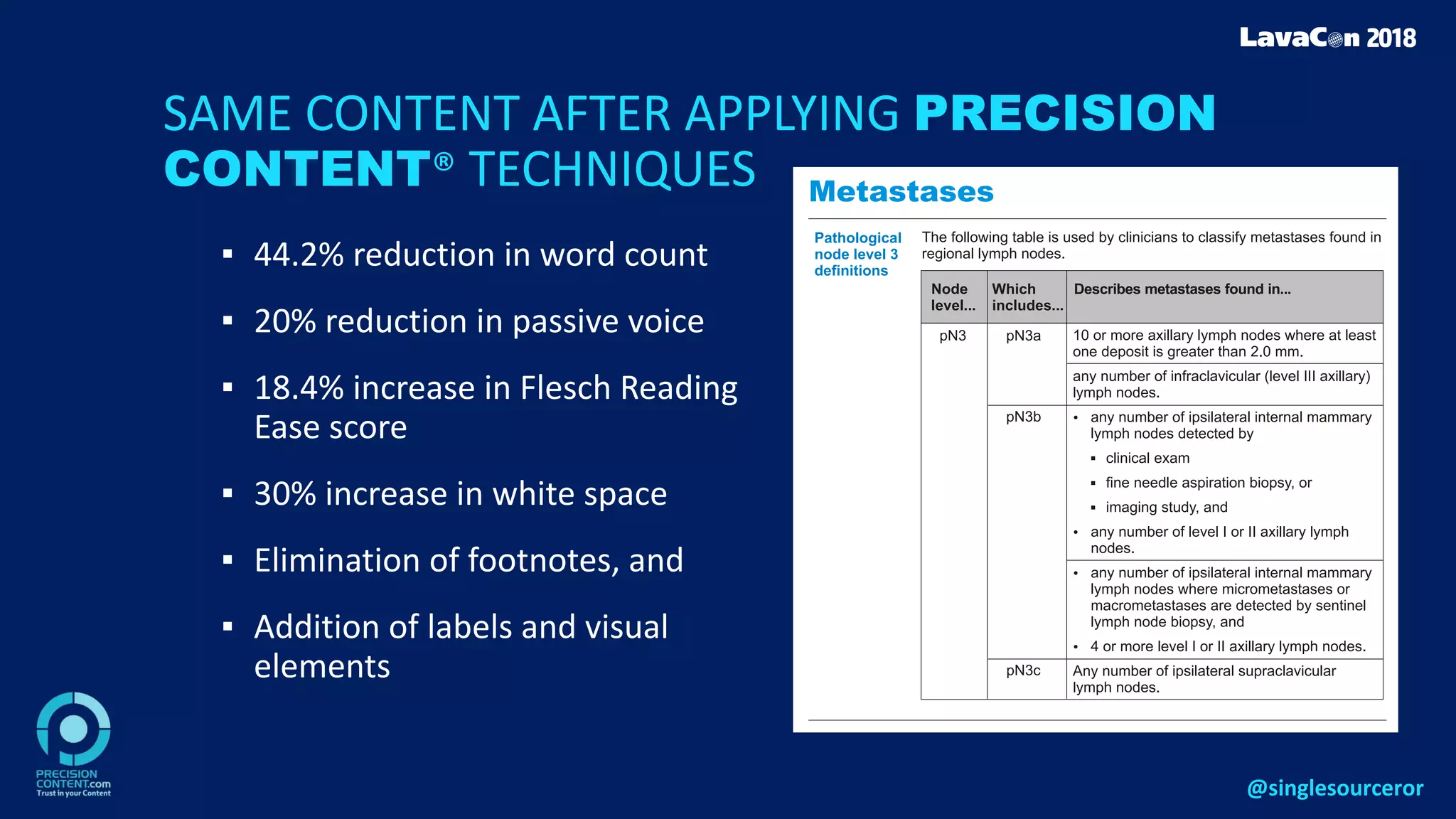
SAME CONTENT AFTER APPLYING PRECISION
CONTENT® TECHNIQUES
▪ 44.2% reduction in word count
▪ 20% reduction in passive voice
▪ 18.4% increase in Flesch Reading
Ease score
▪ 30% increase in white space
▪ Elimination of footnotes, and
▪ Addition of labels and visual
elements
@singlesourceror
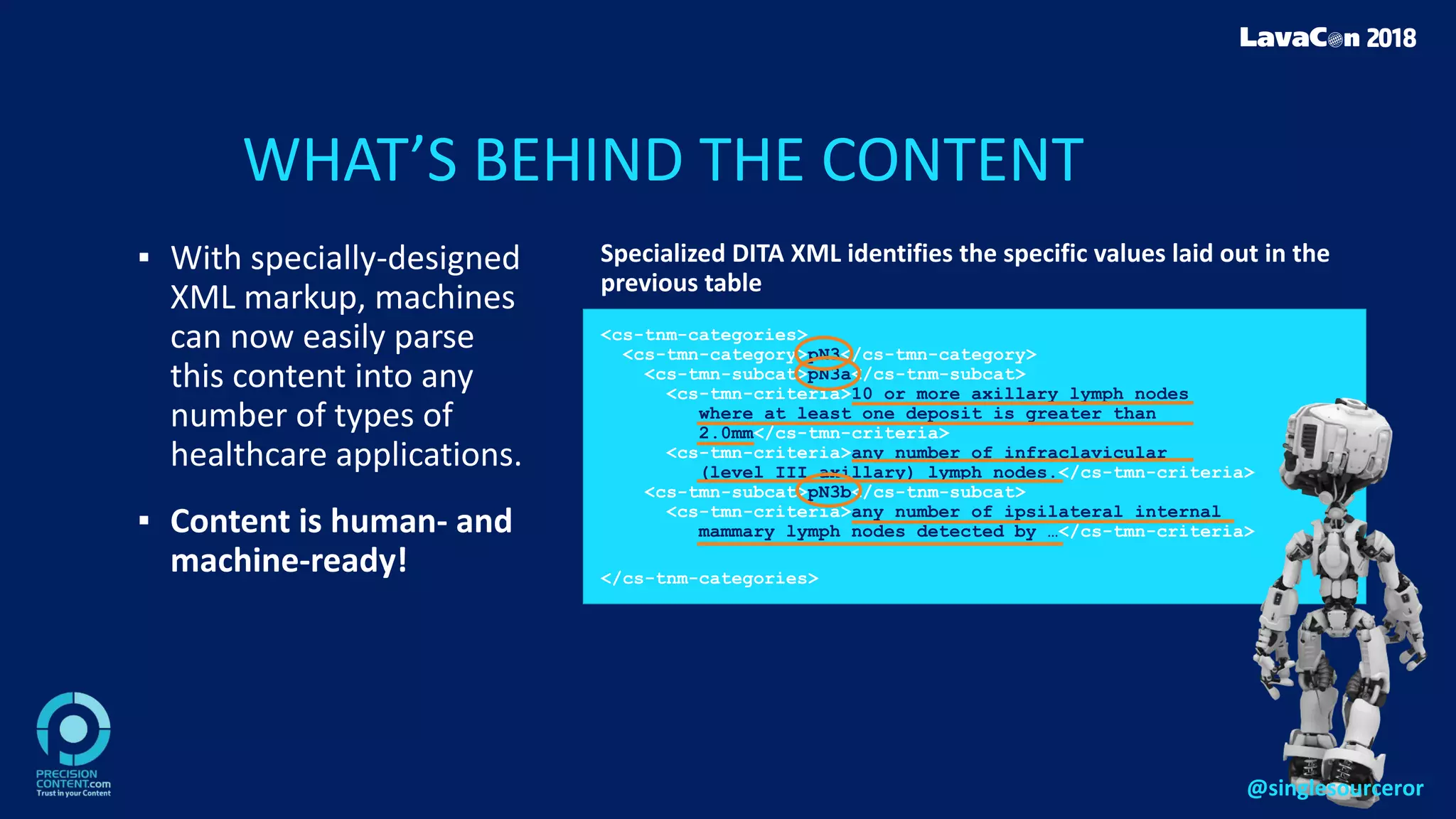
WHAT’S BEHIND THE CONTENT
▪ With specially-designed
XML markup, machines
can now easily parse
this content into any
number of types of
healthcare applications.
▪ Content is human- and
machine-ready!
Specialized DITA XML identifies the specific values laid out in the
previous table
<cs-tnm-categories>
<cs-tmn-category>pN3</cs-tmn-category>
<cs-tmn-subcat>pN3a</cs-tnm-subcat>
<cs-tmn-criteria>10 or more axillary lymph nodes
where at least one deposit is greater than
2.0mm</cs-tmn-criteria>
<cs-tmn-criteria>any number of infraclavicular
(level III axillary) lymph nodes.</cs-tmn-criteria>
<cs-tmn-subcat>pN3b</cs-tnm-subcat>
<cs-tmn-criteria>any number of ipsilateral internal
mammary lymph nodes detected by …</cs-tmn-criteria>
</cs-tnm-categories>
@singlesourceror
FUNCTION
Microcontent must be typed to identify user intent
@singlesourceror
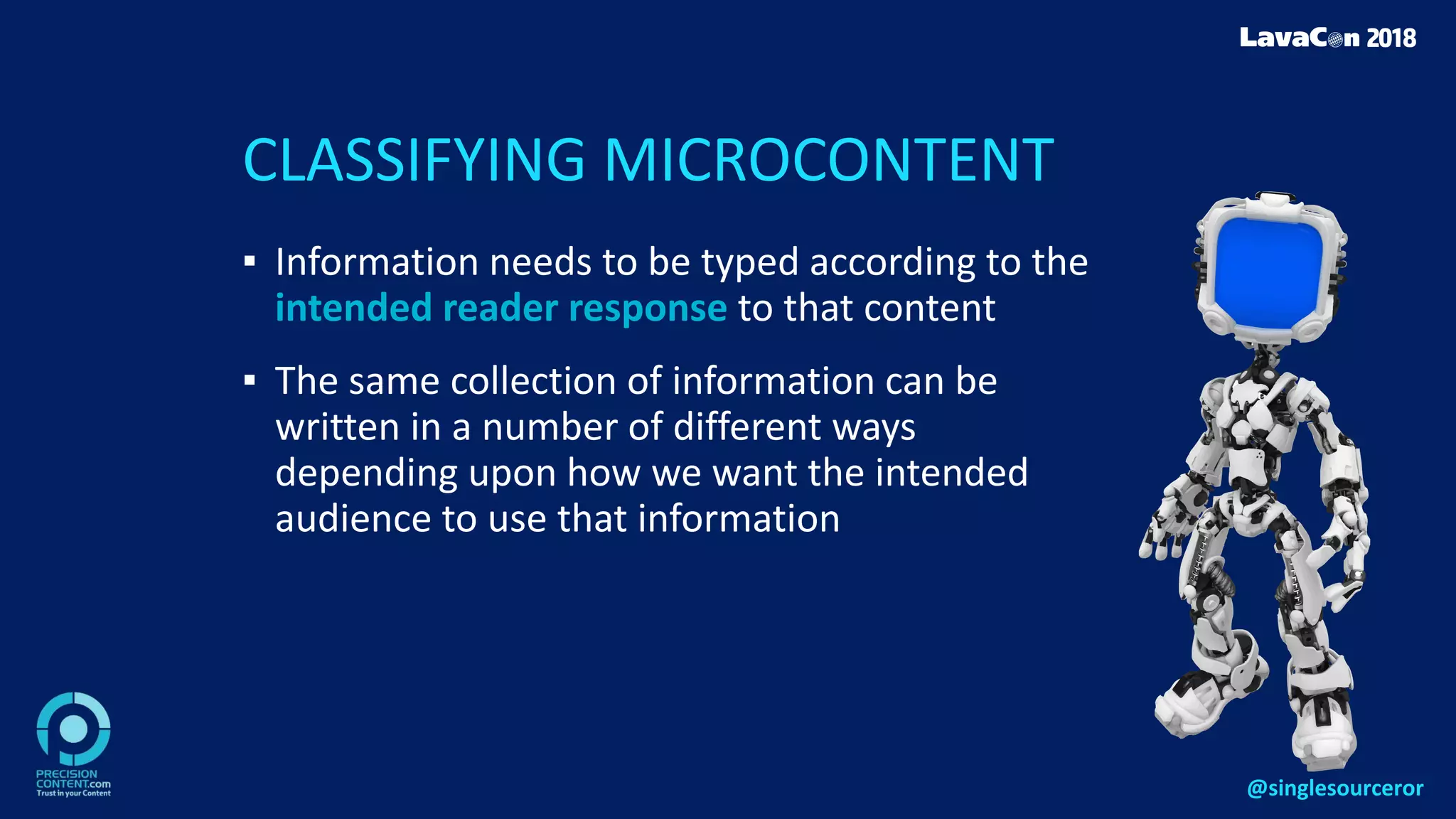
CLASSIFYING MICROCONTENT
▪ Information needs to be typed according to the
intended reader response to that content
▪ The same collection of information can be
written in a number of different ways
depending upon how we want the intended
audience to use that information
@singlesourceror
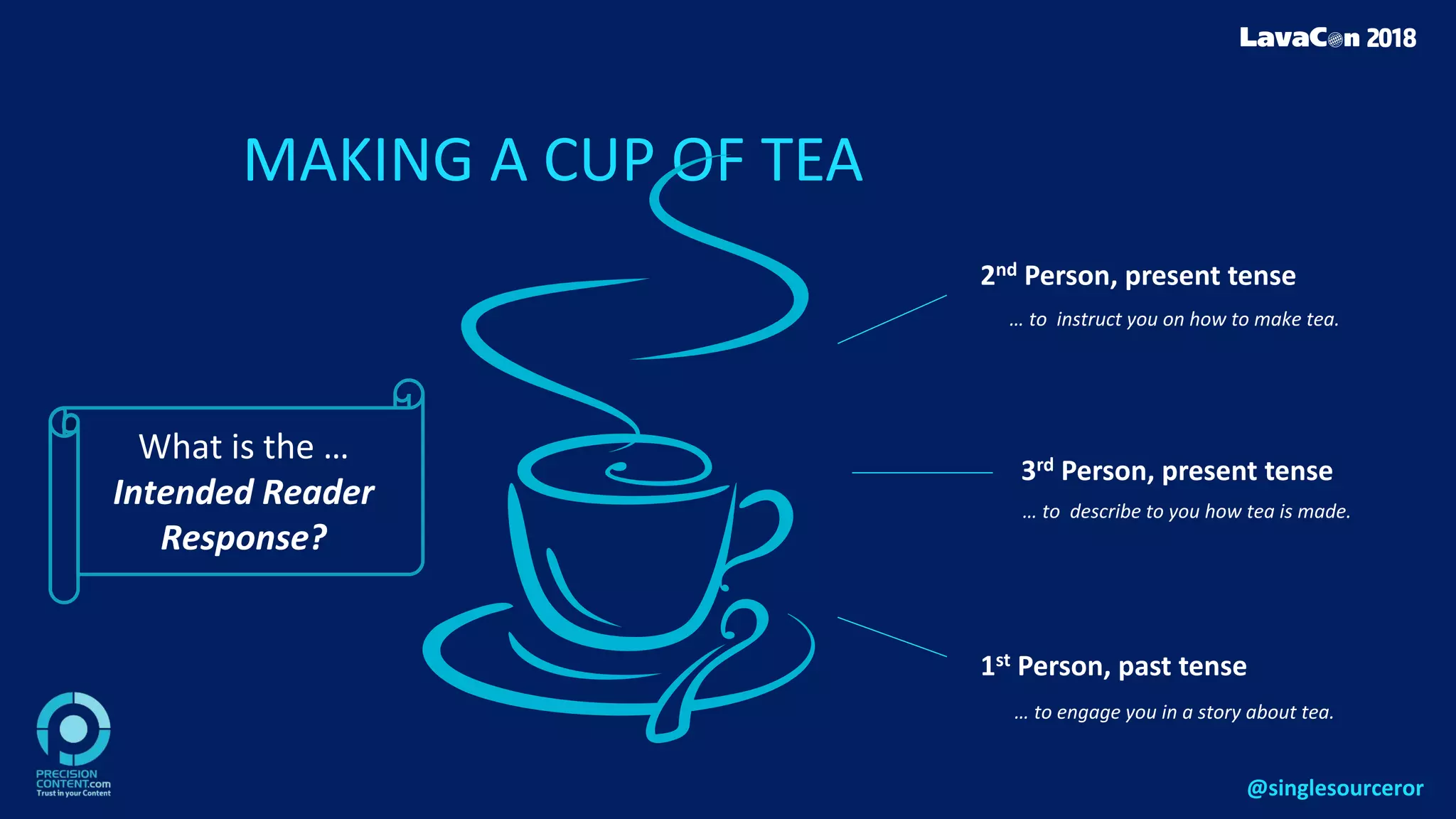
MAKING A CUP OF TEA
2nd Person, present tense
3rd Person, present tense
1st Person, past tense
What is the …
Intended Reader
Response?
… to instruct you on how to make tea.
… to describe to you how tea is made.
… to engage you in a story about tea.
@singlesourceror
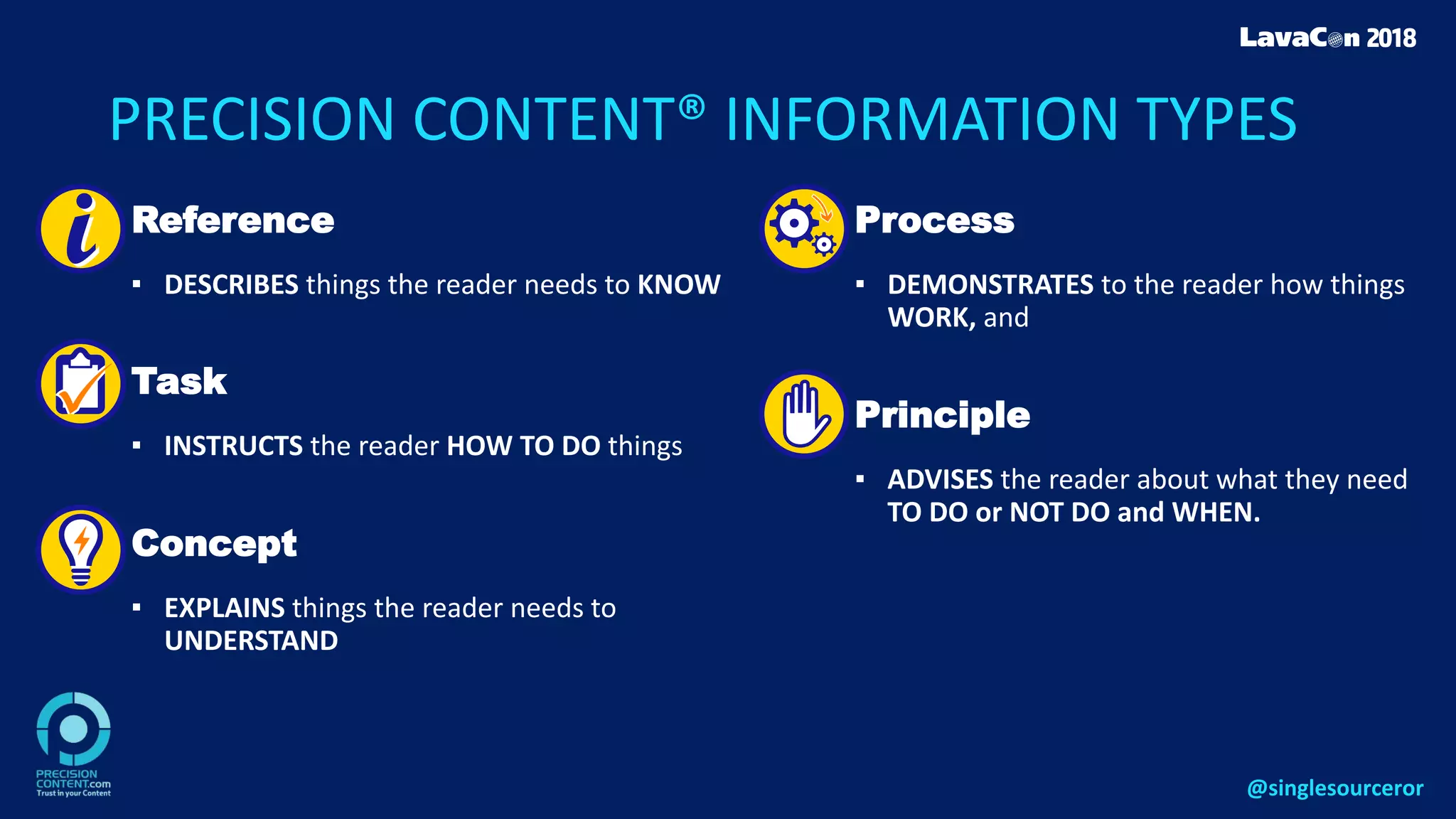
PRECISION CONTENT® INFORMATION TYPES
Reference
▪ DESCRIBES things the reader needs to KNOW
Task
▪ INSTRUCTS the reader HOW TO DO things
Concept
▪ EXPLAINS things the reader needs to
UNDERSTAND
Process
▪ DEMONSTRATES to the reader how things
WORK, and
Principle
▪ ADVISES the reader about what they need
TO DO or NOT DO and WHEN.
@singlesourceror
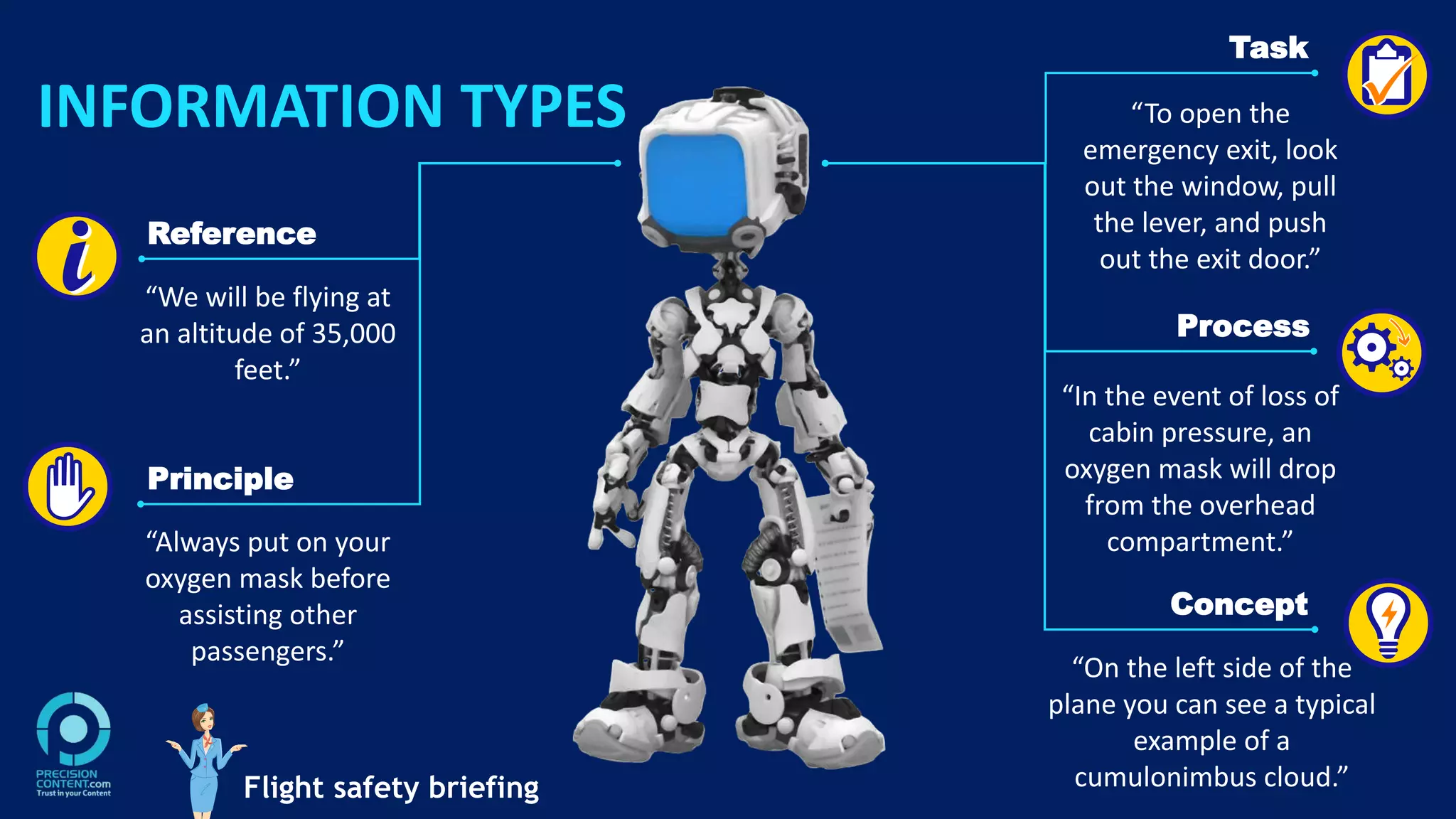
INFORMATION TYPES
Reference
Principle
Task
Process
Concept
“We will be flying at
an altitude of 35,000
feet.”
“Always put on your
oxygen mask before
assisting other
passengers.”
“To open the
emergency exit, look
out the window, pull
the lever, and push
out the exit door.”
“In the event of loss of
cabin pressure, an
oxygen mask will drop
from the overhead
compartment.”
“On the left side of the
plane you can see a typical
example of a
cumulonimbus cloud.”Flight safety briefing
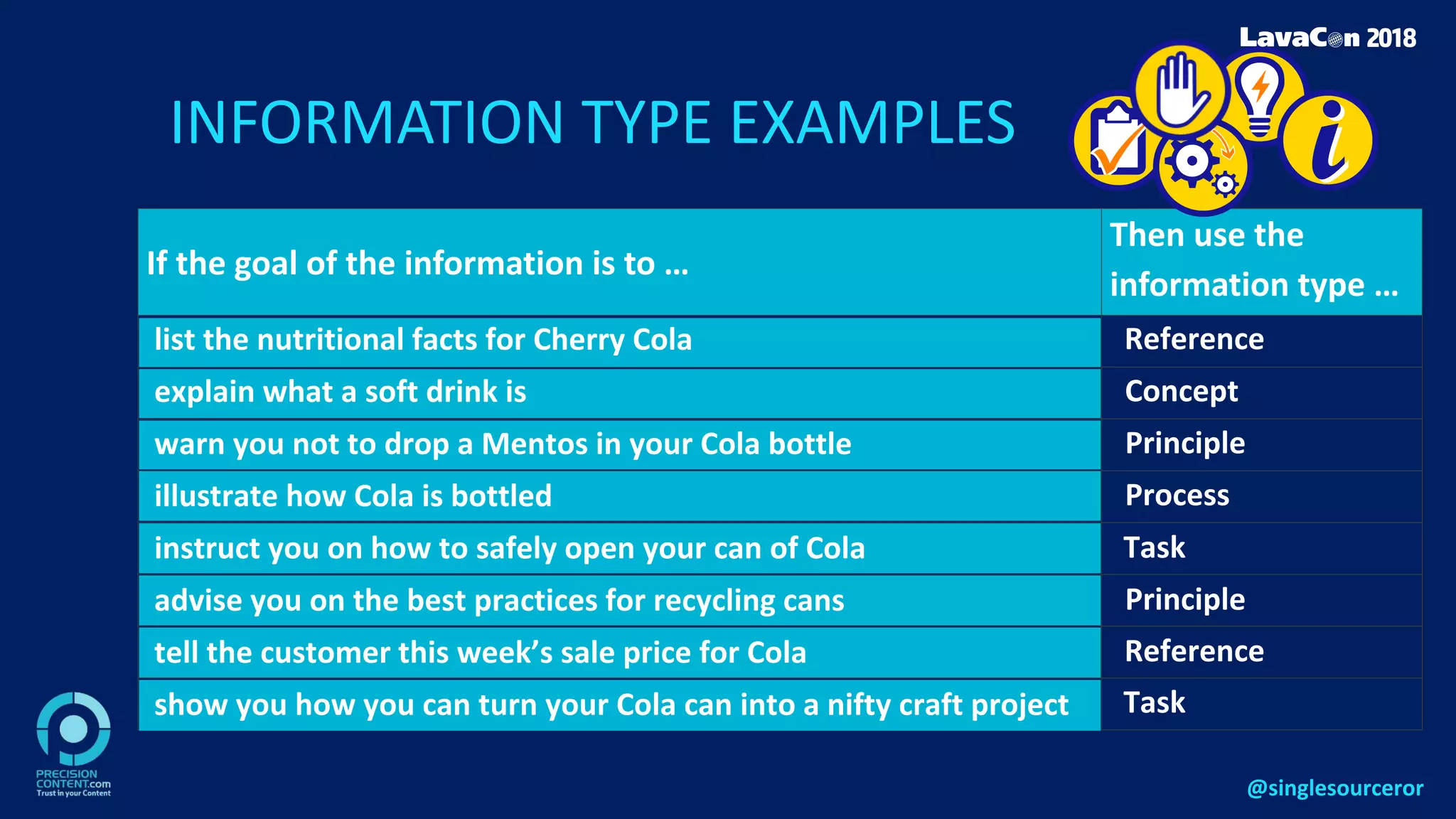
INFORMATION TYPE EXAMPLES
If the goal of the information is to …
Then use the
information type …
Reference
Concept
Principle
Process
Task
Principle
Reference
Task
list the nutritional facts for Cherry Cola
explain what a soft drink is
warn you not to drop a Mentos in your Cola bottle
illustrate how Cola is bottled
instruct you on how to safely open your can of Cola
advise you on the best practices for recycling cans
tell the customer this week’s sale price for Cola
show you how you can turn your Cola can into a nifty craft project
@singlesourceror
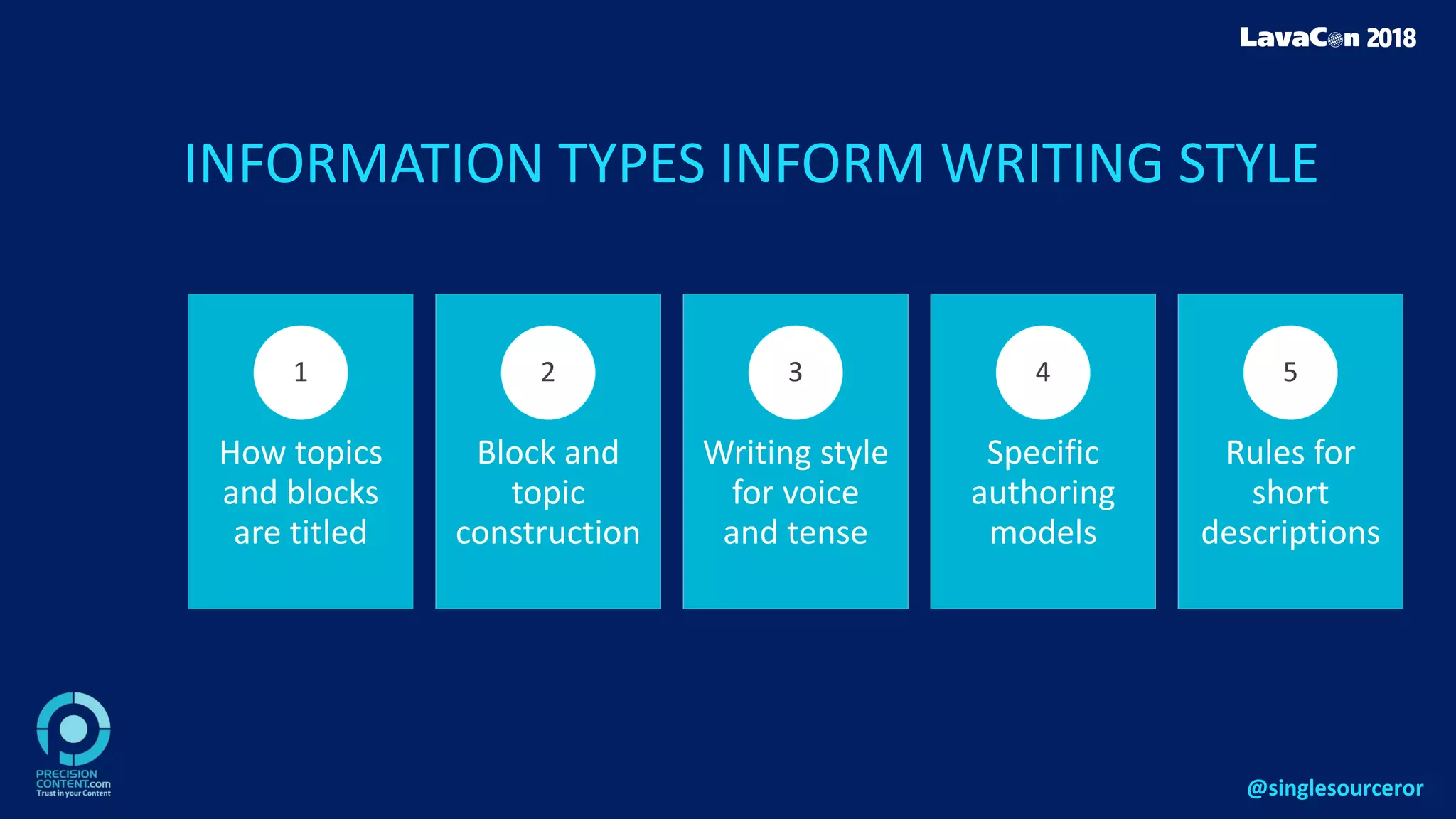
INFORMATION TYPES INFORM WRITING STYLE
How topics
and blocks
are titled
1
Block and
topic
construction
2
Writing style
for voice
and tense
3
Specific
authoring
models
4
Rules for
short
descriptions
5
@singlesourceror
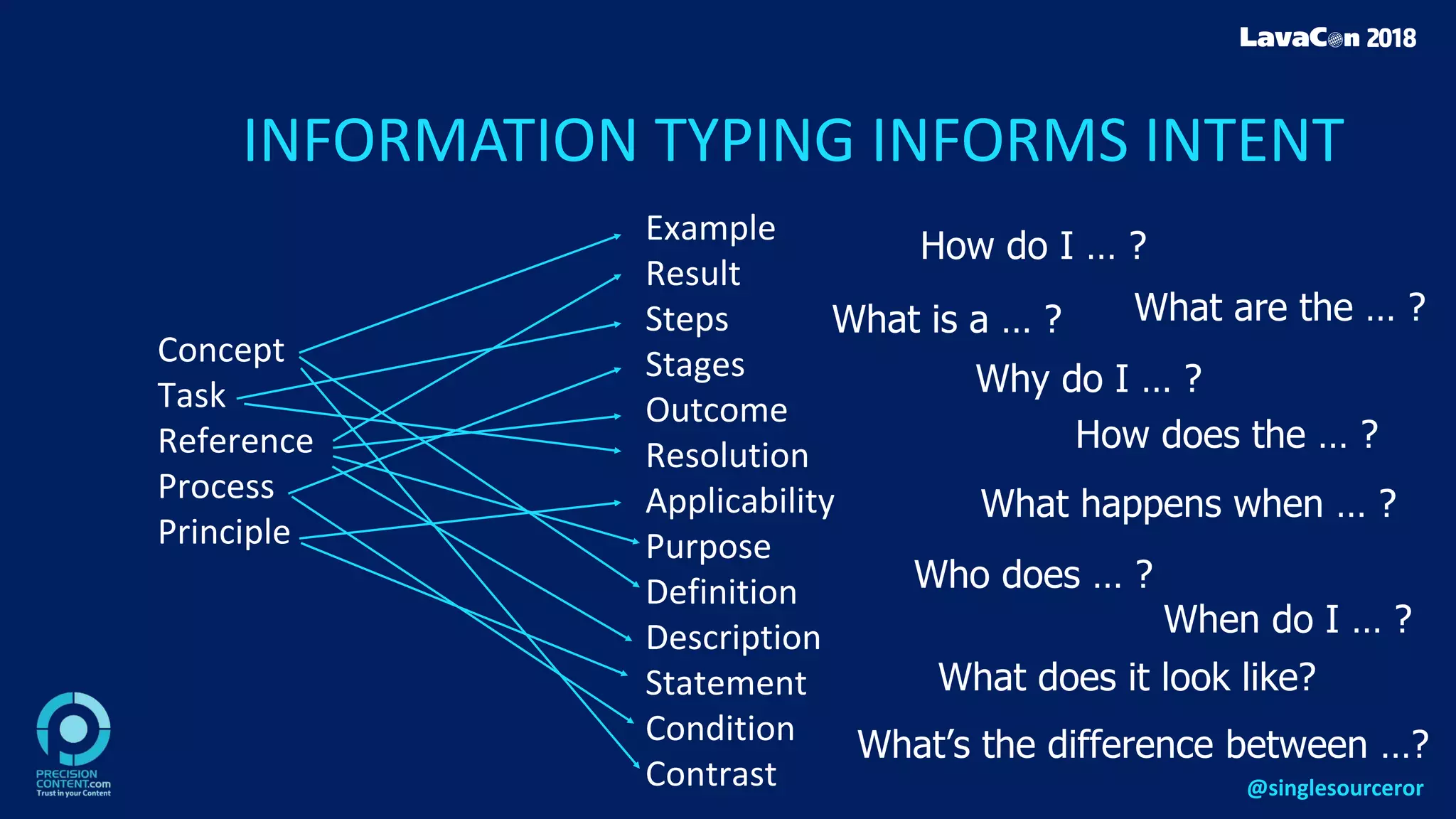
INFORMATION TYPING INFORMS INTENT
Concept
Task
Reference
Process
Principle
Example
Result
Steps
Stages
Outcome
Resolution
Applicability
Purpose
Definition
Description
Statement
Condition
Contrast
How do I … ?
What is a … ?
When do I … ?
What’s the difference between …?
How does the … ?
What happens when … ?
Why do I … ?
Who does … ?
What does it look like?
What are the … ?
@singlesourceror
PURPOSE
Microcontent must be about only one subject
@singlesourceror
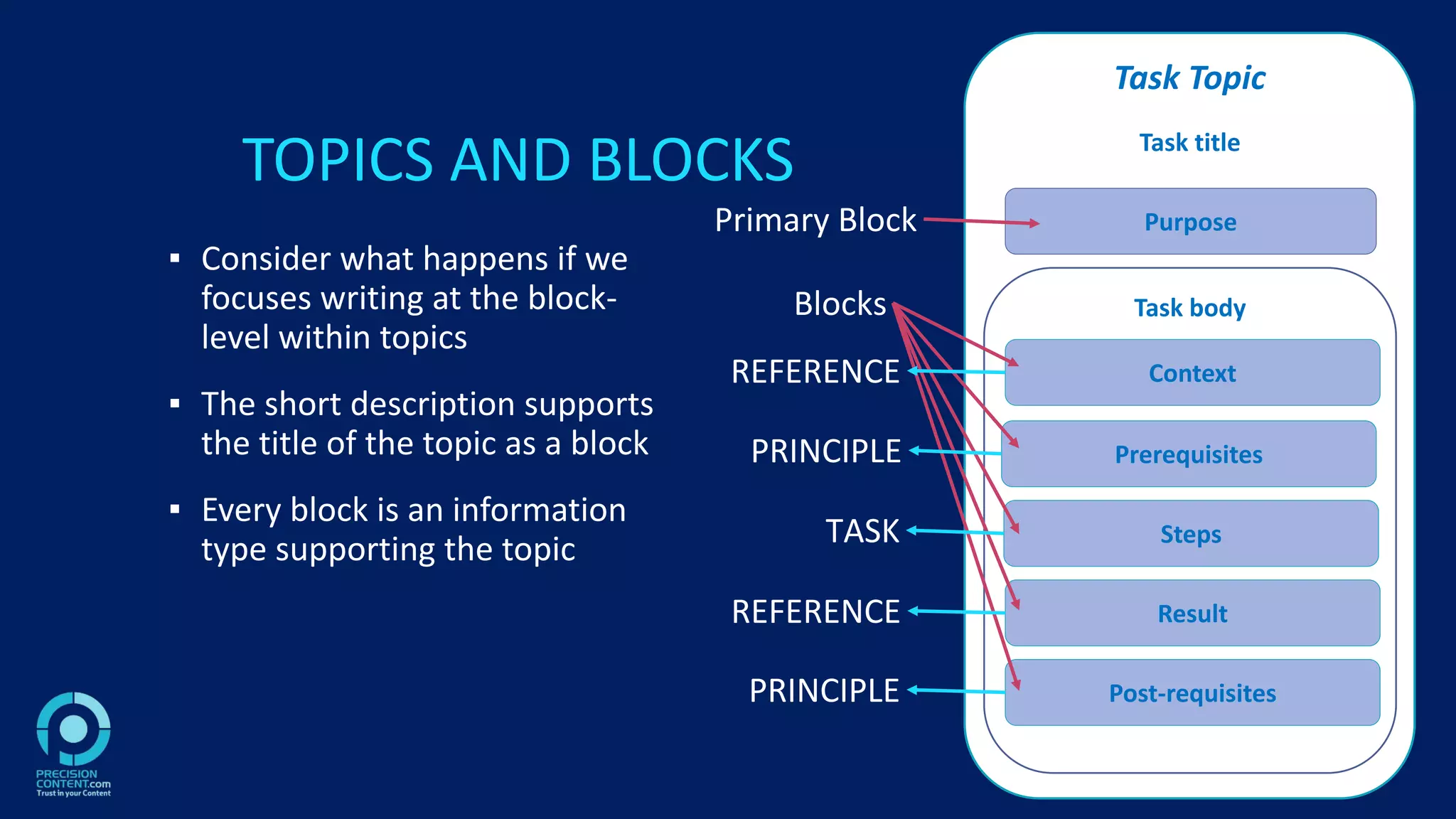
TOPICS AND BLOCKS
▪ Consider what happens if we
focuses writing at the block-
level within topics
▪ The short description supports
the title of the topic as a block
▪ Every block is an information
type supporting the topic
Task Topic
Task title
Task body
Context
Purpose
Prerequisites
Steps
Post-requisites
Result
Primary Block
Blocks
REFERENCE
PRINCIPLE
TASK
PRINCIPLE
REFERENCE
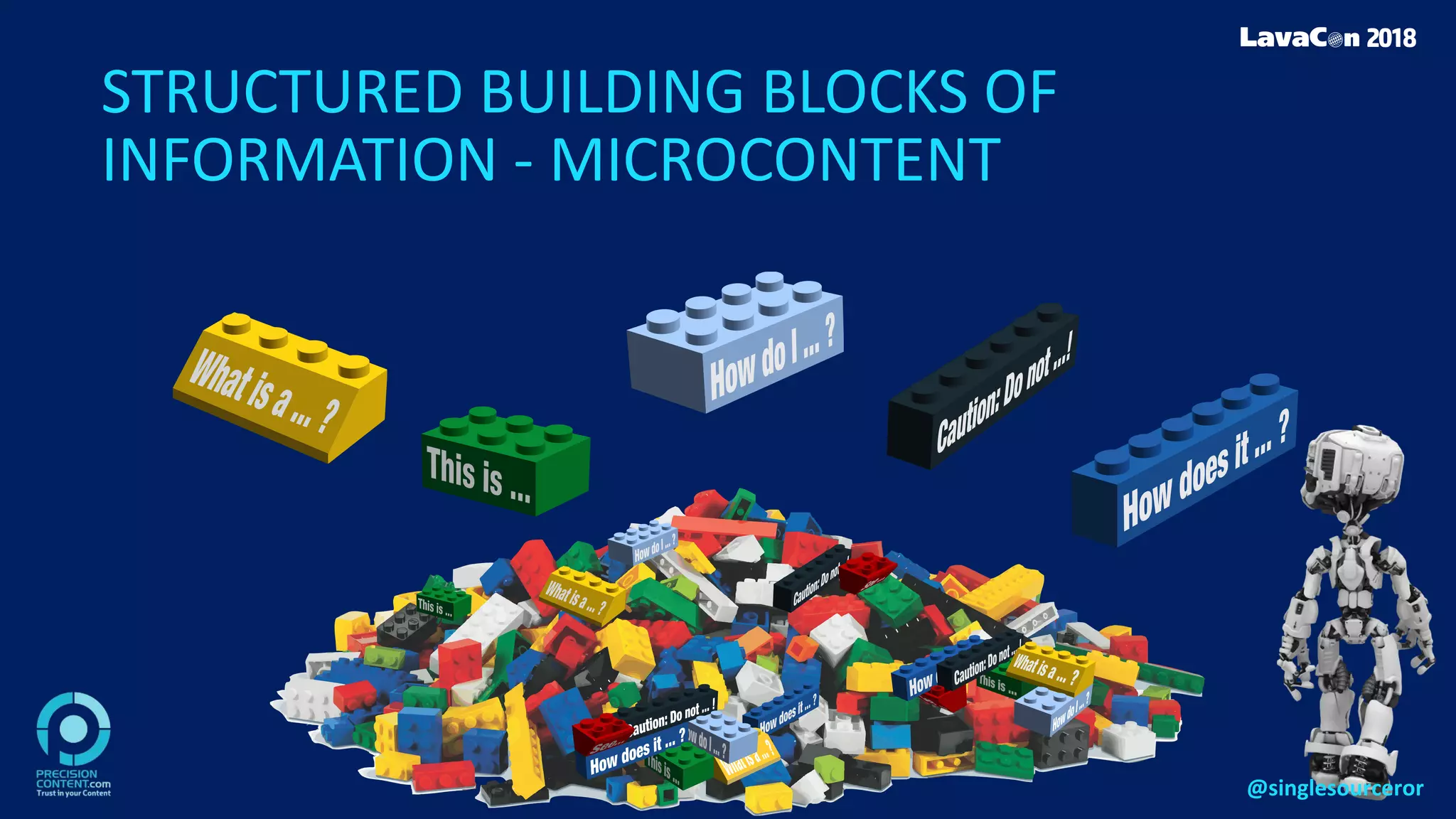
STRUCTURED BUILDING BLOCKS OF
INFORMATION - MICROCONTENT
@singlesourceror
CONTEXT
Microcontent must be easily relatable to other content
@singlesourceror
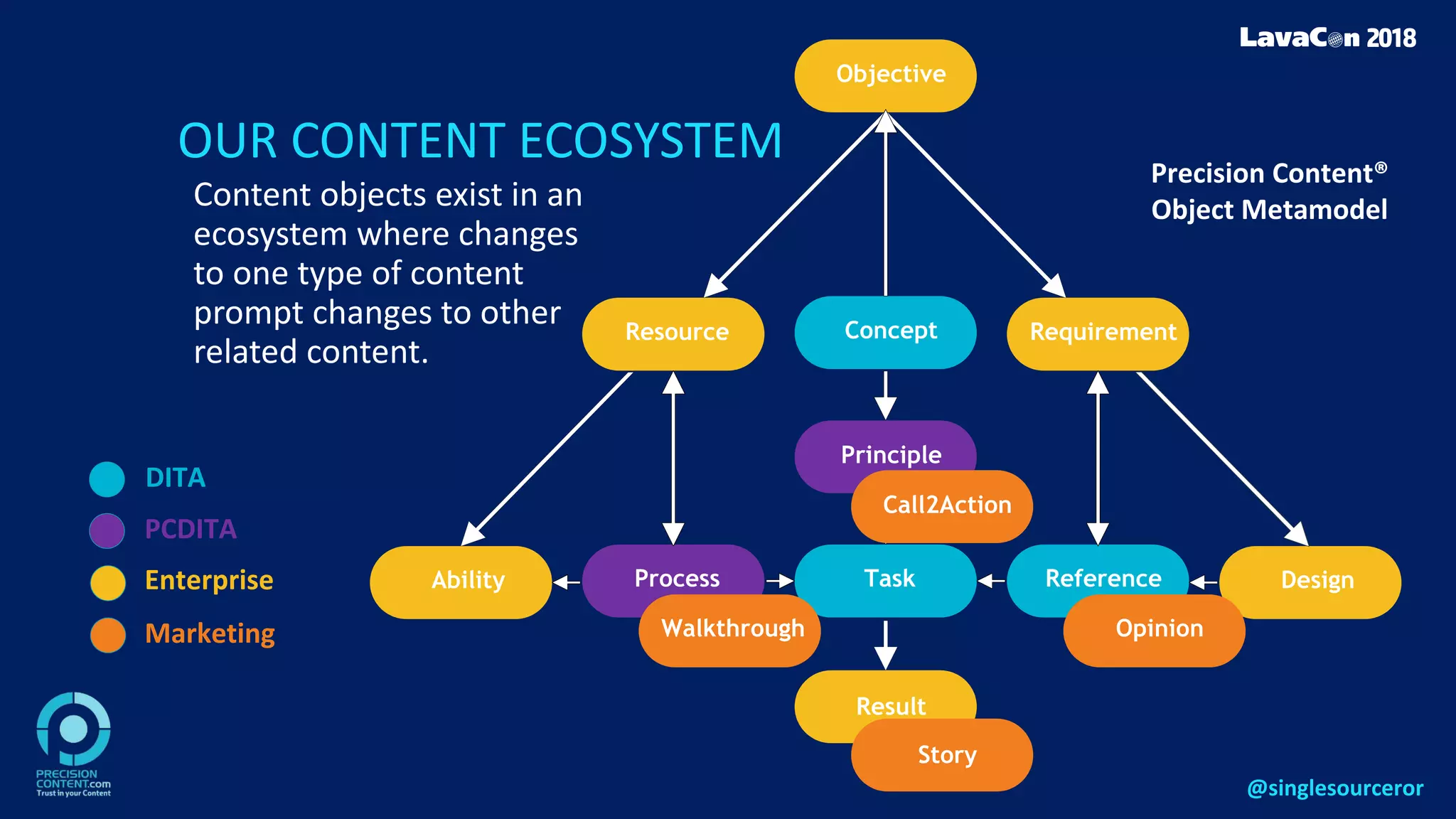
OUR CONTENT ECOSYSTEM
Content objects exist in an
ecosystem where changes
to one type of content
prompt changes to other
related content.
Precision Content®
Object Metamodel
Concept
Task Reference
DITA
Principle
Process
PCDITA
RequirementResource
Objective
DesignAbility
Result
Enterprise
Story
Opinion
Call2Action
WalkthroughMarketing
@singlesourceror
CONCLUSIONS
A call to action
@singlesourceror
OUR OBJECTIONS
▪ It’s just the latest gimmick
▪ It’s far too technical
▪ It’s not appropriate for our content
▪ It’s someone else’s department
@singlesourceror
WHAT’S HOLDING US BACK?
The availability of microcontent and our ability to create
it is our biggest obstacle
• Where is it going to come from?
• Who is going to write it?
@singlesourceror
WHAT IF …
▪ We could repurpose our technical content by automatically
bursting sections into microcontent for the enterprise to
use?
▪ But our content isn’t ready! We would get a lot of noise if
we just burst every section into microcontent
@singlesourceror
WHAT IF …
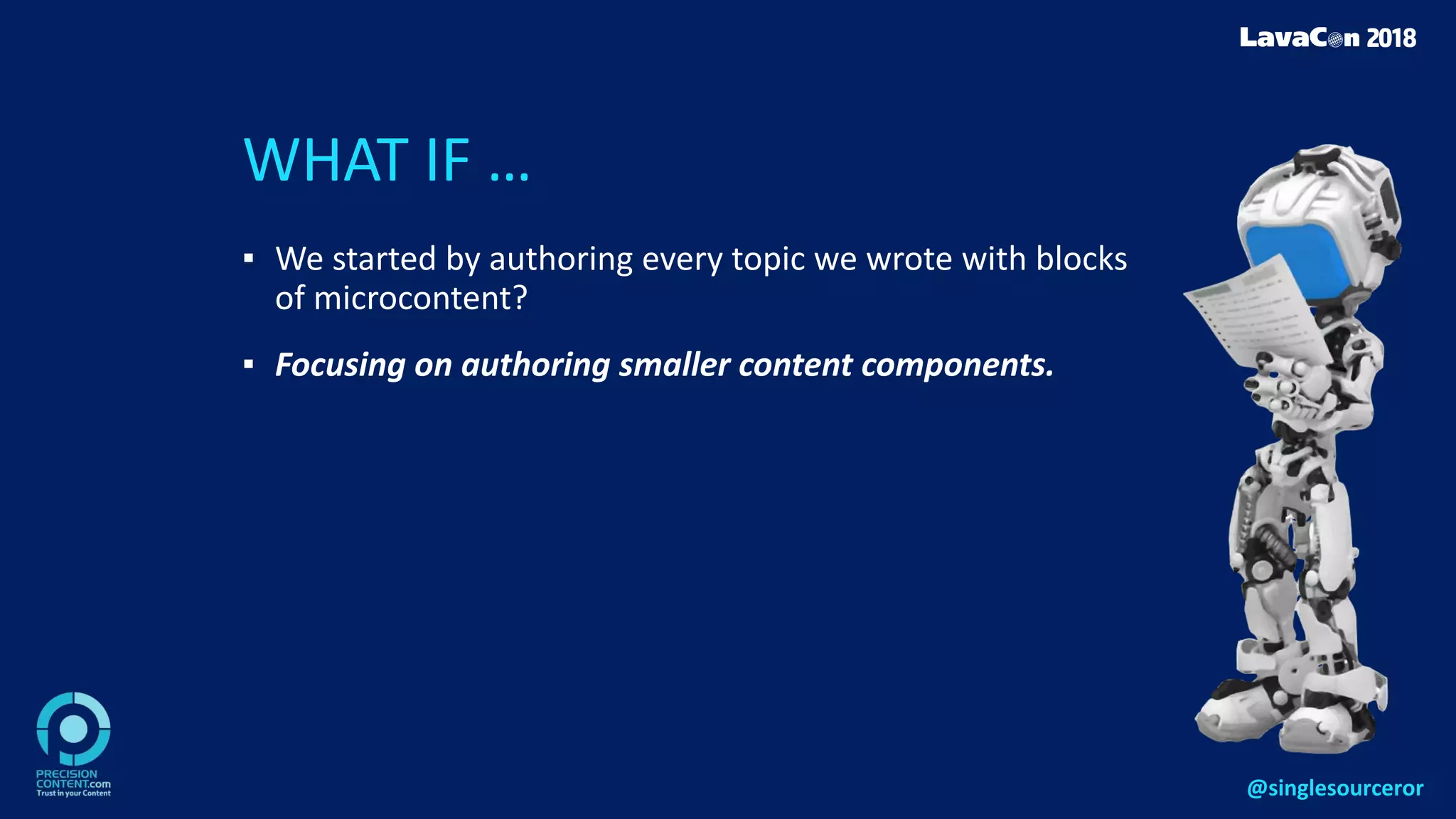
▪ We started by authoring every topic we wrote with blocks
of microcontent?
▪ Focusing on authoring smaller content components.
@singlesourceror
Our journey towards
microcontent is simply
the next step in the evolution
of intelligent content needed to
support omnichannel delivery.
@singlesourceror
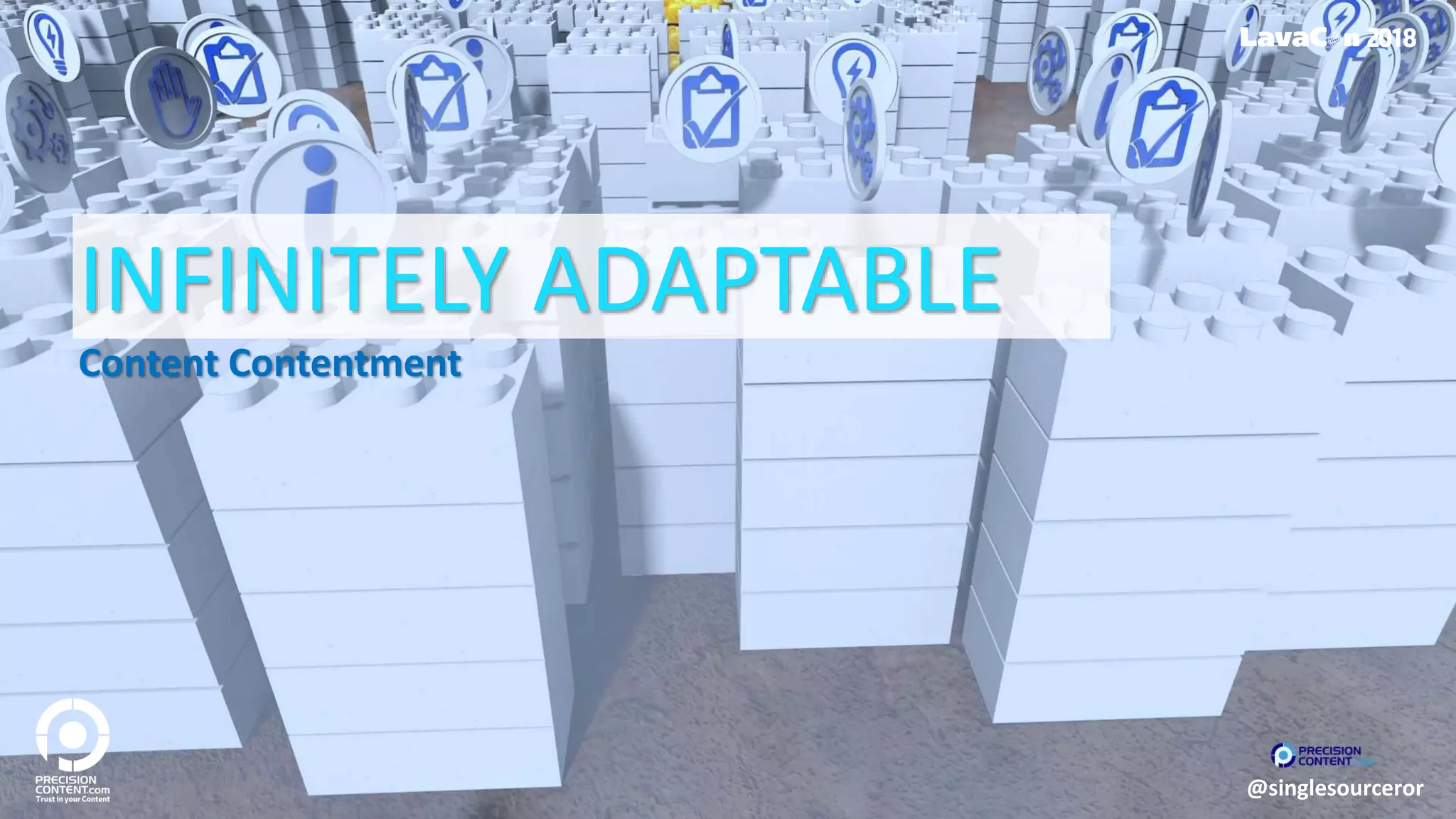
INFINITELY ADAPTABLE
Content Contentment
@singlesourceror
MICROCONTENT WILL CHANGE HOW WE
WORK WITH INFORMATION
▪ Creating and publishing microcontent to your enterprise
▪ improves usability and precision of your content, and
▪ future-proofs your content for what lies ahead.
▪ Do you want to see your high-value microcontent published
by
▪ Sales and marketing
▪ Learning and development, or
▪ Technical publications?
▪ DON’T WAIT FOR THE TECHNOLOGY TO LAND ON YOUR
DOORSTEP
@singlesourceror
QUESTIONS?
Rob Hanna
Co-Founder – Precision Content
rob@precisioncontent.com
@singlesourceror
ASK ME ABOUT …
@singlesourceror

Rob Hanna - The Next Big Thing: Microcontent

  • 1.
    with Rob Hanna ofPrecision Content
  • 2.
    ROB HANNA ▪ Co-Founderand Chief Information Architect at Precision Content ▪ Voted into the Top 25 Global Content Experience Influencers for 2017 ▪ Helping organizations make their information easier to use for more than 20 years Twitter: @singlesoureror www.precisioncontent.com
  • 3.
    TALKING ABOUT ▪ Historyof content ▪ Future of content ▪ Conversational UI’s ▪ Microcontent ▪ Structure ▪ Function ▪ Purpose ▪ Context ▪ Conclusions @singlesourceror
  • 4.
    HISTORY How we gothere @singlesourceror
  • 5.
    BRIEF HISTORY OF CONTENT Whatgoes around … … comes around One-to-OneOne-to-Many CONTENT 1.0 One-to-Many More CONTENT 2.0 Many-to-Many CONTENT 3.0 Reach Many to Many + Machines IoT CONTENT 4.0 @singlesourceror
  • 6.
    COMPLEXITY OF CONTENTGETS BIGGER Scroll Codex Document Topic Block FactPage @singlesourceror
  • 7.
    UNITS OF CONTENTGET SMALLER Scroll Codex Document Topic Block FactPage @singlesourceror
  • 8.
    VOLUME OF CONTENTGROWS 1700 1900 2014 20201945 80% of this is Dark Data … Inaccessible ROT • R – redundant • O – obsolete, or • T – trivial @singlesourceror
  • 9.
    Content Chaos THE DIGITALLANDFILL @singlesourceror
  • 10.
    CONVERSATIONAL USER INTERFACES Changing howwe consume information @singlesourceror
  • 11.
    CONVERSATIONAL UI USECASES Doing Knowing Learning Exploring Utility High Low Domino’s Pizza fitbit hipmunk WSJ Graph adapted from Amazon Alexa course on Udemy @singlesourceror
  • 12.
    USER MODALITIES ▪ Chat/voice Inquire ▪Online Explore ▪ Virtual/Physical Interact To be able to switch between modalities, the source of content must be aligned to move fluidly from one to another. @singlesourceror
  • 13.
    THREE PRIMARY TYPESOF CHATBOTS ▪ Informational ▪ Transactional ▪ Recreational @singlesourceror
  • 14.
    CONVERSATIONAL USER INTERFACES ▪Rely on AI’s Natural Language Processing (NLP) to analyze the users utterance. ▪ The utterance is composed of an intent and one or more entities. ▪ The intent is determined by NLP that then fires an algorithm to perform a task such as retrieving content. ▪ The entities are the part of speech that identifies the subject of the intent. ▪ One or more slots allow bots to ask clarifying questions to direct the user to the most appropriate answer or task. @singlesourceror
  • 15.
    MICROCONTENT The next stepin the authoring journey @singlesourceror
  • 16.
    MICROCONTENT Is content thatis • about one primary idea, fact, or concept • easily scannable • labelled for clear identification and meaning, and • appropriately written and formatted for use anywhere and any time it is needed. It’s not microcontent just because it’s small @singlesourceror
  • 17.
    RULES FOR INTELLIGENT MICROCONTENT ▪Purpose Microcontent must be about only one subject ▪ Function Microcontent must be typed to identify user intent ▪ Context Microcontent must be easily relatable to other content ▪ Structure Microcontent must use predictable patterns and language @singlesourceror
  • 18.
    STRUCTURE Microcontent must usepredictable patterns and language @singlesourceror
  • 19.
    STRUCTURED AUTHORING DEFINED Structuredauthoring means a standardised, methodological approach to content creation incorporating ▪ systematic labelling ▪ modular, topic-based architecture ▪ constrained writing environments, and ▪ the separation of content and form. From The DITA Style Guide - Best Practices for Authors Tony Self www.ditastyle.com @singlesourceror
  • 20.
    EXCERPT FROM AMEDICAL JOURNAL... ▪ pN3 description only closely mirrors descriptions for pN3a +pN3b + pN3c ▪ Use of footnotes confusing ▪ “Clinically detected” and “Not clinically detected” are not exact opposites, and ▪ Inconsistent enumeration of lymph nodes @singlesourceror
  • 21.
    SAME CONTENT AFTERAPPLYING PRECISION CONTENT® TECHNIQUES ▪ 44.2% reduction in word count ▪ 20% reduction in passive voice ▪ 18.4% increase in Flesch Reading Ease score ▪ 30% increase in white space ▪ Elimination of footnotes, and ▪ Addition of labels and visual elements @singlesourceror
  • 22.
    WHAT’S BEHIND THECONTENT ▪ With specially-designed XML markup, machines can now easily parse this content into any number of types of healthcare applications. ▪ Content is human- and machine-ready! Specialized DITA XML identifies the specific values laid out in the previous table <cs-tnm-categories> <cs-tmn-category>pN3</cs-tmn-category> <cs-tmn-subcat>pN3a</cs-tnm-subcat> <cs-tmn-criteria>10 or more axillary lymph nodes where at least one deposit is greater than 2.0mm</cs-tmn-criteria> <cs-tmn-criteria>any number of infraclavicular (level III axillary) lymph nodes.</cs-tmn-criteria> <cs-tmn-subcat>pN3b</cs-tnm-subcat> <cs-tmn-criteria>any number of ipsilateral internal mammary lymph nodes detected by …</cs-tmn-criteria> </cs-tnm-categories> @singlesourceror
  • 23.
    FUNCTION Microcontent must betyped to identify user intent @singlesourceror
  • 24.
    CLASSIFYING MICROCONTENT ▪ Informationneeds to be typed according to the intended reader response to that content ▪ The same collection of information can be written in a number of different ways depending upon how we want the intended audience to use that information @singlesourceror
  • 25.
    MAKING A CUPOF TEA 2nd Person, present tense 3rd Person, present tense 1st Person, past tense What is the … Intended Reader Response? … to instruct you on how to make tea. … to describe to you how tea is made. … to engage you in a story about tea. @singlesourceror
  • 26.
    PRECISION CONTENT® INFORMATIONTYPES Reference ▪ DESCRIBES things the reader needs to KNOW Task ▪ INSTRUCTS the reader HOW TO DO things Concept ▪ EXPLAINS things the reader needs to UNDERSTAND Process ▪ DEMONSTRATES to the reader how things WORK, and Principle ▪ ADVISES the reader about what they need TO DO or NOT DO and WHEN. @singlesourceror
  • 27.
    INFORMATION TYPES Reference Principle Task Process Concept “We willbe flying at an altitude of 35,000 feet.” “Always put on your oxygen mask before assisting other passengers.” “To open the emergency exit, look out the window, pull the lever, and push out the exit door.” “In the event of loss of cabin pressure, an oxygen mask will drop from the overhead compartment.” “On the left side of the plane you can see a typical example of a cumulonimbus cloud.”Flight safety briefing
  • 28.
    INFORMATION TYPE EXAMPLES Ifthe goal of the information is to … Then use the information type … Reference Concept Principle Process Task Principle Reference Task list the nutritional facts for Cherry Cola explain what a soft drink is warn you not to drop a Mentos in your Cola bottle illustrate how Cola is bottled instruct you on how to safely open your can of Cola advise you on the best practices for recycling cans tell the customer this week’s sale price for Cola show you how you can turn your Cola can into a nifty craft project @singlesourceror
  • 29.
    INFORMATION TYPES INFORMWRITING STYLE How topics and blocks are titled 1 Block and topic construction 2 Writing style for voice and tense 3 Specific authoring models 4 Rules for short descriptions 5 @singlesourceror
  • 30.
    INFORMATION TYPING INFORMSINTENT Concept Task Reference Process Principle Example Result Steps Stages Outcome Resolution Applicability Purpose Definition Description Statement Condition Contrast How do I … ? What is a … ? When do I … ? What’s the difference between …? How does the … ? What happens when … ? Why do I … ? Who does … ? What does it look like? What are the … ? @singlesourceror
  • 31.
    PURPOSE Microcontent must beabout only one subject @singlesourceror
  • 32.
    TOPICS AND BLOCKS ▪Consider what happens if we focuses writing at the block- level within topics ▪ The short description supports the title of the topic as a block ▪ Every block is an information type supporting the topic Task Topic Task title Task body Context Purpose Prerequisites Steps Post-requisites Result Primary Block Blocks REFERENCE PRINCIPLE TASK PRINCIPLE REFERENCE
  • 33.
    STRUCTURED BUILDING BLOCKSOF INFORMATION - MICROCONTENT @singlesourceror
  • 34.
    CONTEXT Microcontent must beeasily relatable to other content @singlesourceror
  • 35.
    OUR CONTENT ECOSYSTEM Contentobjects exist in an ecosystem where changes to one type of content prompt changes to other related content. Precision Content® Object Metamodel Concept Task Reference DITA Principle Process PCDITA RequirementResource Objective DesignAbility Result Enterprise Story Opinion Call2Action WalkthroughMarketing @singlesourceror
  • 36.
    CONCLUSIONS A call toaction @singlesourceror
  • 37.
    OUR OBJECTIONS ▪ It’sjust the latest gimmick ▪ It’s far too technical ▪ It’s not appropriate for our content ▪ It’s someone else’s department @singlesourceror
  • 38.
    WHAT’S HOLDING USBACK? The availability of microcontent and our ability to create it is our biggest obstacle • Where is it going to come from? • Who is going to write it? @singlesourceror
  • 39.
    WHAT IF … ▪We could repurpose our technical content by automatically bursting sections into microcontent for the enterprise to use? ▪ But our content isn’t ready! We would get a lot of noise if we just burst every section into microcontent @singlesourceror
  • 40.
    WHAT IF … ▪We started by authoring every topic we wrote with blocks of microcontent? ▪ Focusing on authoring smaller content components. @singlesourceror
  • 41.
    Our journey towards microcontentis simply the next step in the evolution of intelligent content needed to support omnichannel delivery. @singlesourceror
  • 42.
  • 43.
    MICROCONTENT WILL CHANGEHOW WE WORK WITH INFORMATION ▪ Creating and publishing microcontent to your enterprise ▪ improves usability and precision of your content, and ▪ future-proofs your content for what lies ahead. ▪ Do you want to see your high-value microcontent published by ▪ Sales and marketing ▪ Learning and development, or ▪ Technical publications? ▪ DON’T WAIT FOR THE TECHNOLOGY TO LAND ON YOUR DOORSTEP @singlesourceror
  • 44.
    QUESTIONS? Rob Hanna Co-Founder –Precision Content rob@precisioncontent.com @singlesourceror ASK ME ABOUT … @singlesourceror