
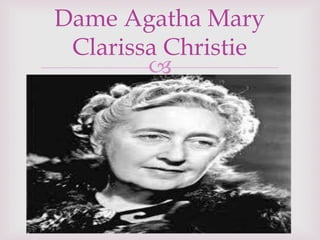
Dame Agatha Mary
Clarissa Christie

I like living. I have
sometimes been wildly,
despairingly, acutely
miserable, racked with
sorrow, but through it
all I still know quite

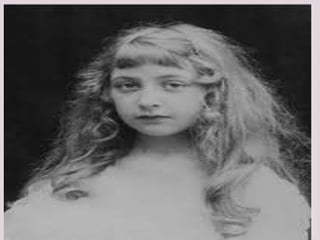
 Agatha suffered from dyslexia but in no way did it
stop her from being creative and learning how to
write.
 in Torquay
 15 September 1890 – 12 January 1976


 Archibald Christie in December 1914
 In late 1926 – divorce
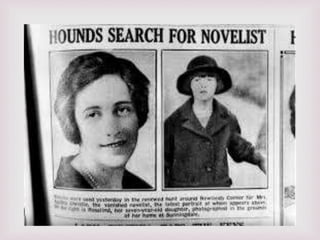
 On 3 December 1926 – her husband left home
 That same evening – missing Agatha
 Unknown 10 days
 Second marriage, in 1930 - archaeologist Max
Mallowan


 the best-selling novelist of all time
 the world's longest-running play
 an English crime novelist, short story writer, and
playwright
 best known for the 66 detective novels and 14 short
story collection

collection


 In the First World War – as a nurse (treat wounded
soldiers)
 Later - a pharmacy
 Her jobs influenced crime stories.
 Christie's interest in archaeology
 ---Christie's works feature archaeological themes,
artifacts, and archaeologists prominently.

 “An archaeologist is
the best husband a
woman can have.
The older she gets,
the more interested

 Agatha Christie’s novels are whodunits.
 detective comes across a murder scene by chance
 He or she gives the reader clues and examines the crime
scene .
 Finally -- Until the real murderer is revealed, the
detective gets all the suspects together and gives away
information that not everyone knows.
Plots of Christie
Novels

.
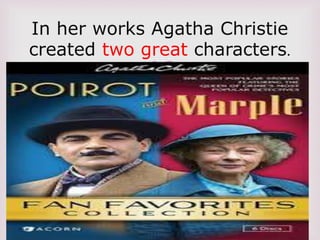
In her works Agatha Christie
created two great characters.

 and Miss
Marple
Hercule Poirot

Poirot

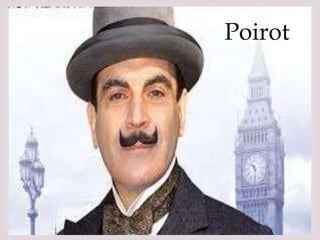
 He appeared in 33 of Agatha Christie’s novels.
 best known for his moustache
 He thinks logically and likes order.
 Every crime can be solved.
 As time went on Agatha Christie wanted to get rid
of him.
 ---- he is popular among her readers. So, When he
died in “Curtain” in 1978 he became the only
fictional character to get an obituary in the New
York Times.
Hercule Poirot


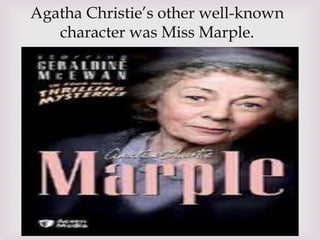
Agatha Christie’s other well-known
character was Miss Marple.

 an amateur detective
 She became famous for solving cases where the
police failed.
 a fictional character appearing in 12 of Agatha
Christie's crime novels and in 20 short stories
 Her first appearance -- in 1926, The Tuesday Night
Club

 Novels featuring Miss Marple
 1. The Murder at the Vicarage (1930)
 2. The Body in the Library (1942)
 3. The Moving Finger (1943)
 4. A Murder is Announced (1950)
 5. They Do It with Mirrors, or Murder with Mirrors (1952)
 6. A Pocket Full of Rye (1953)
 7. 4.50 from Paddington, or What Mrs. McGillicuddy Saw!
(1957)
 8. The Mirror Crack'd from Side to Side, or The Mirror
Crack'd (1962)
 9. A Caribbean Mystery (1964)
 10. At Bertram's Hotel (1965)
 11. Nemesis (1971)
 12. Sleeping Murder (written around 1940, published 1976)

Books about Miss Marple
Life and Times of Miss
Jane Marple – a
biography by Anne Hart

Miss Marple Short Story
Collections

 The Tuesday Night Club" (short story) featured Miss Marple
for the first time ever. Written in 1926.
 The Thirteen Problems (short story collection featuring Miss
Marple, also published as The Tuesday Club Murders) (1932)
 Miss Marple's Final Cases and Two Other Stories (written
between 1939 and 1954, published 1979)
 Miss Marple: The Complete Short Stories, published 1985,
includes 20 from 4 sets: The Tuesday Club Murders, The
Regatta Mystery, Three Blind Mice and Other Stories, and
Double Sin and Other Stories.

 Miss Marple also appears in Greenshaw's Folly, a
short story traditionally included as part of the
Poirot collection The Adventure of the Christmas
Pudding (1960).
 The Autograph edition of Miss Marple's Final Cases
includes the 8 in the original plus Greenshaw's Folly.

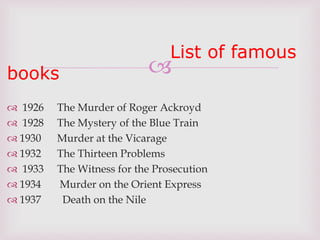
List of famous
books
 1926 The Murder of Roger Ackroyd
 1928 The Mystery of the Blue Train
 1930 Murder at the Vicarage
 1932 The Thirteen Problems
 1933 The Witness for the Prosecution
 1934 Murder on the Orient Express
 1937 Death on the Nile

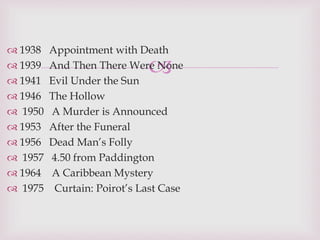
 1938 Appointment with Death
 1939 And Then There Were None
 1941 Evil Under the Sun
 1946 The Hollow
 1950 A Murder is Announced
 1953 After the Funeral
 1956 Dead Man’s Folly
 1957 4.50 from Paddington
 1964 A Caribbean Mystery
 1975 Curtain: Poirot’s Last Case


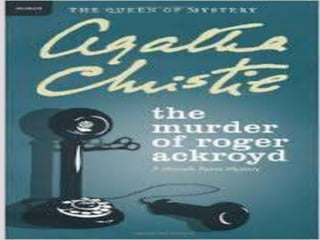
 A typical village murder mystery.
1. The Murder of Roger
Ackroyd (1926)


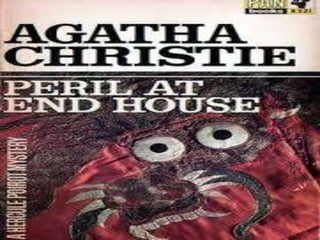
 a party where fireworks camouflage the shot
 Which of the other guests is a murderer?
2. Peril at End House
(1932)


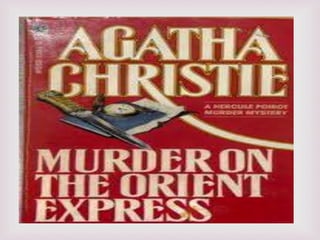
 Mr. Ratchett is found stabbed in his compartment
and untrodden snow shows that the killer is still on
board.
 “The impossible could not have happened,
therefore the impossible must be possible
in spite of appearances.” ― Agatha Christie,
Murder on the Orient Express
3. Murder on the Orient
Express (1934)


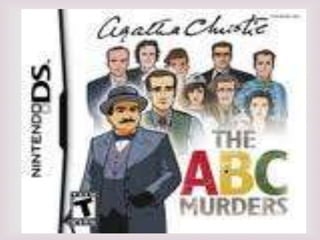
Poirot is unable to prevent the murders of
Alice Ascher, Betty Barnard and Carmichael
Clarke.
One of the earliest examples of the
"serial killer" novel
4. The ABC Murders
(1935)


Although they all harbour a secret, they
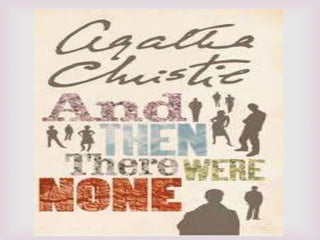
remain unsuspecting until they begin to die,
one by one, until eventually … there are
none.
A perfect combination of thriller and
detective story
5. And Then There Were
None (1939)


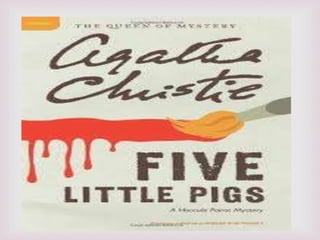
 Sixteen years ago, Caroline Crale died in prison
 Her daughter asks Poirot to investigate a possible
miscarriage of justice
6. Five Little Pigs (1943)


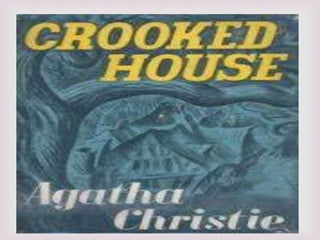
 The Leonides family all live together
 But which of them poisoned the patriarch, Aristides?
7. Crooked House (1949)


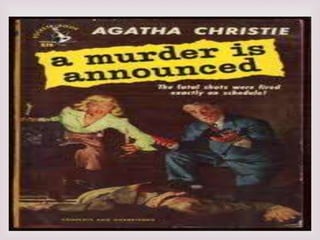
 In the village of Chipping Cleghorn, a murder is
announced in the local paper's small ads.
 This was Christie's 50th title and remains Miss
Marple's finest hour.
8. A Murder is
Announced (1950)


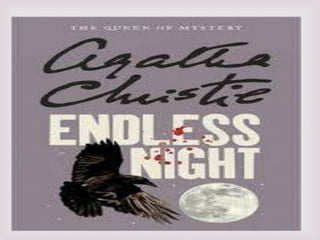
 Working-class Michael Rogers tells the story of his
meeting and marrying Ellie.
 The best novel from her last 20 years.
9. Endless Night (1967)


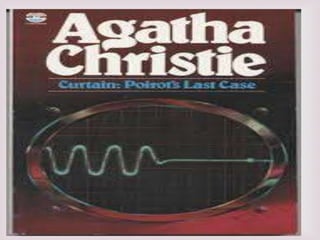
 An old and frail Poirot returns to the scene of his first
case.
 It was actually published in October 1975 (Christie
died in January 1976) and Poirot received a front-
page obituary in the New York Times.
10. Curtain: Poirot's Last Case (1975, but
written during the second world war)

Agatha christie

  • 2.
  • 3.
     I like living.I have sometimes been wildly, despairingly, acutely miserable, racked with sorrow, but through it all I still know quite
  • 4.
      Agatha sufferedfrom dyslexia but in no way did it stop her from being creative and learning how to write.  in Torquay  15 September 1890 – 12 January 1976
  • 5.
  • 6.
      Archibald Christiein December 1914  In late 1926 – divorce  On 3 December 1926 – her husband left home  That same evening – missing Agatha  Unknown 10 days  Second marriage, in 1930 - archaeologist Max Mallowan
  • 7.
  • 8.
      the best-sellingnovelist of all time  the world's longest-running play  an English crime novelist, short story writer, and playwright  best known for the 66 detective novels and 14 short story collection
  • 9.
  • 10.
  • 11.
      In theFirst World War – as a nurse (treat wounded soldiers)  Later - a pharmacy  Her jobs influenced crime stories.  Christie's interest in archaeology  ---Christie's works feature archaeological themes, artifacts, and archaeologists prominently.
  • 12.
      “An archaeologistis the best husband a woman can have. The older she gets, the more interested
  • 13.
      Agatha Christie’snovels are whodunits.  detective comes across a murder scene by chance  He or she gives the reader clues and examines the crime scene .  Finally -- Until the real murderer is revealed, the detective gets all the suspects together and gives away information that not everyone knows. Plots of Christie Novels
  • 14.
     . In her worksAgatha Christie created two great characters.
  • 15.
  • 16.
  • 17.
      He appearedin 33 of Agatha Christie’s novels.  best known for his moustache  He thinks logically and likes order.  Every crime can be solved.  As time went on Agatha Christie wanted to get rid of him.  ---- he is popular among her readers. So, When he died in “Curtain” in 1978 he became the only fictional character to get an obituary in the New York Times. Hercule Poirot
  • 18.
  • 19.
     Agatha Christie’s otherwell-known character was Miss Marple.
  • 20.
      an amateurdetective  She became famous for solving cases where the police failed.  a fictional character appearing in 12 of Agatha Christie's crime novels and in 20 short stories  Her first appearance -- in 1926, The Tuesday Night Club
  • 21.
      Novels featuringMiss Marple  1. The Murder at the Vicarage (1930)  2. The Body in the Library (1942)  3. The Moving Finger (1943)  4. A Murder is Announced (1950)  5. They Do It with Mirrors, or Murder with Mirrors (1952)  6. A Pocket Full of Rye (1953)  7. 4.50 from Paddington, or What Mrs. McGillicuddy Saw! (1957)  8. The Mirror Crack'd from Side to Side, or The Mirror Crack'd (1962)  9. A Caribbean Mystery (1964)  10. At Bertram's Hotel (1965)  11. Nemesis (1971)  12. Sleeping Murder (written around 1940, published 1976)
  • 22.
     Books about MissMarple Life and Times of Miss Jane Marple – a biography by Anne Hart
  • 23.
     Miss Marple ShortStory Collections
  • 24.
      The TuesdayNight Club" (short story) featured Miss Marple for the first time ever. Written in 1926.  The Thirteen Problems (short story collection featuring Miss Marple, also published as The Tuesday Club Murders) (1932)  Miss Marple's Final Cases and Two Other Stories (written between 1939 and 1954, published 1979)  Miss Marple: The Complete Short Stories, published 1985, includes 20 from 4 sets: The Tuesday Club Murders, The Regatta Mystery, Three Blind Mice and Other Stories, and Double Sin and Other Stories.
  • 25.
      Miss Marplealso appears in Greenshaw's Folly, a short story traditionally included as part of the Poirot collection The Adventure of the Christmas Pudding (1960).  The Autograph edition of Miss Marple's Final Cases includes the 8 in the original plus Greenshaw's Folly.
  • 26.
     List of famous books 1926 The Murder of Roger Ackroyd  1928 The Mystery of the Blue Train  1930 Murder at the Vicarage  1932 The Thirteen Problems  1933 The Witness for the Prosecution  1934 Murder on the Orient Express  1937 Death on the Nile
  • 27.
      1938 Appointmentwith Death  1939 And Then There Were None  1941 Evil Under the Sun  1946 The Hollow  1950 A Murder is Announced  1953 After the Funeral  1956 Dead Man’s Folly  1957 4.50 from Paddington  1964 A Caribbean Mystery  1975 Curtain: Poirot’s Last Case
  • 28.
  • 29.
      A typicalvillage murder mystery. 1. The Murder of Roger Ackroyd (1926)
  • 30.
  • 31.
      a partywhere fireworks camouflage the shot  Which of the other guests is a murderer? 2. Peril at End House (1932)
  • 32.
  • 33.
      Mr. Ratchettis found stabbed in his compartment and untrodden snow shows that the killer is still on board.  “The impossible could not have happened, therefore the impossible must be possible in spite of appearances.” ― Agatha Christie, Murder on the Orient Express 3. Murder on the Orient Express (1934)
  • 34.
  • 35.
     Poirot is unableto prevent the murders of Alice Ascher, Betty Barnard and Carmichael Clarke. One of the earliest examples of the "serial killer" novel 4. The ABC Murders (1935)
  • 36.
  • 37.
     Although they allharbour a secret, they remain unsuspecting until they begin to die, one by one, until eventually … there are none. A perfect combination of thriller and detective story 5. And Then There Were None (1939)
  • 38.
  • 39.
      Sixteen yearsago, Caroline Crale died in prison  Her daughter asks Poirot to investigate a possible miscarriage of justice 6. Five Little Pigs (1943)
  • 40.
  • 41.
      The Leonidesfamily all live together  But which of them poisoned the patriarch, Aristides? 7. Crooked House (1949)
  • 42.
  • 43.
      In thevillage of Chipping Cleghorn, a murder is announced in the local paper's small ads.  This was Christie's 50th title and remains Miss Marple's finest hour. 8. A Murder is Announced (1950)
  • 44.
  • 45.
      Working-class MichaelRogers tells the story of his meeting and marrying Ellie.  The best novel from her last 20 years. 9. Endless Night (1967)
  • 46.
  • 47.
      An oldand frail Poirot returns to the scene of his first case.  It was actually published in October 1975 (Christie died in January 1976) and Poirot received a front- page obituary in the New York Times. 10. Curtain: Poirot's Last Case (1975, but written during the second world war)