
Molecular Diagnostics and Personalized Medicine: Challenges and Opportunities David S. Lester, Ph.D.  Executive VP, Corporate Development
Wikipedia Definition “ Personalized medicine  is the concept that information about an patient's  genotype  or  gene expression  profile could be used to tailor medical care to an individual's needs. Such information could be used to help stratify disease status, select between different  medications  and/or tailor their dosage, provide a specific therapy for an individual's disease, or initiate a preventative measure that is particularly suited to that patient at the time of administration.” http://en.wikipedia.org/wiki/Personalized_medicine
The Two Components of Personalized Medicine Pharmaceuticals +  Molecular Diagnostics =  Personalized Medicine
Existing Business Models Pharma:   High Volume + High Margins  (due to high attrition rate and high cost of development). MDx: High Volume + Low Margins  (relative low cost of development and relatively low attrition)
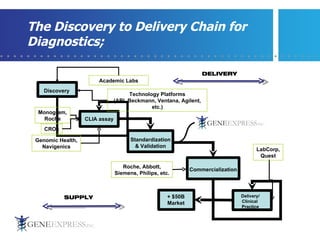
The Discovery to Delivery Chain for Diagnostics; Gene Express, Inc. Discovery CLIA assay Standardization & Validation Commercialization Delivery/ Clinical  Practice + $50B Market Academic Labs Technology Platforms (ABI, Beckmann, Ventana, Agilent, etc.) Monogram, Roche Genomic Health, Navigenics Roche, Abbott, Siemens, Philips, etc. LabCorp, Quest CROs SUPPLY DELIVERY
Speed to Market vs. traditional IP approach Traditional IP approach – results in companies that have single test, “one trick ponies”. Very high risk. Speed to Market approach – biomedical imaging approach. Closer to the software model.
Examples of challenges in the present system Standardization – bcr-abl  CML   as an example
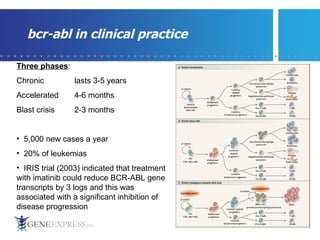
bcr-abl in clinical practice Three phases : Chronic lasts 3-5 years Accelerated 4-6 months Blast crisis 2-3 months 5,000 new cases a year 20% of leukemias IRIS trial (2003) indicated that treatment with imatinib could reduce BCR-ABL gene transcripts by 3 logs and this was associated with a significant inhibition of disease progression
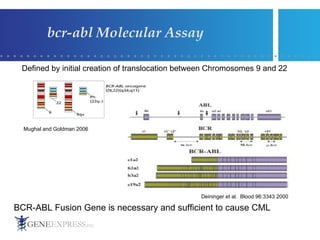
bcr-abl Molecular Assay Defined by initial creation of translocation between Chromosomes 9 and 22 BCR-ABL Fusion Gene is necessary and sufficient to cause CML  Mughal and Goldman 2006 Deininger et al.  Blood 96:3343 2000
bcr-abl Molecular Assay 1993 - competitive PCR  2000 - RQ-PCR 2005 - clear need for standardization - Bethesda Conference  2005 to present - continuing efforts to improve the quantitative RT-PCR assay, IS committee In response to the IRIS trial and success of Imatinib: Problem in US: - 156 Labs - 41 different methods - 6 different control genes - No harmonization of results
Conclusions of AMP Survey to 39 laboratories “ Our study emphasizes the need for optimization of real time qRT-PCR before offering clinical testing and the need for widely available standards that can be used for calibration.” Zhang et al.  J. Mol Diagn.  9:421,2007
Impact for MDx – allows development of kits and propagation of glucose strip diagnostic model. This means high volume and rapid global deployment. Impact for Pharma – allows launch strategy, globalization, of drug with a highly reproducible diagnostic assay.  Impacts of Standardization of Assays
Examples of challenges in the present system 2. The question of reimbursement
Examples of challenges in the present system 2. The question of reimbursement  Adapted from presentation by Bruce Quinn Senior Health Policy Analyst, Foley Hoag LLP
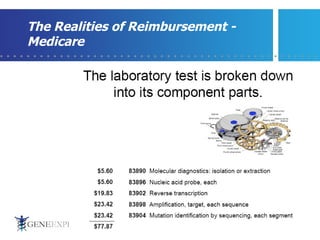
The Realities of Reimbursement - Medicare
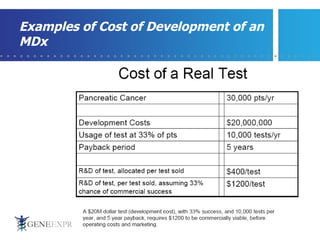
Examples of Cost of Development of an MDx
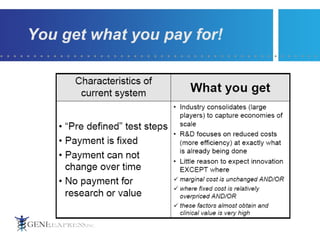
You get what you pay for!
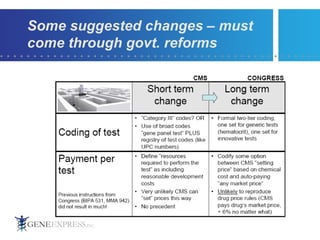
Some suggested changes – must come through govt. reforms
Conclusions
Thank You! David Lester, Executive VP [email_address]

Gene Express Jaima Presentation September 04, 2008 Chiba

  • 1.
    Molecular Diagnostics andPersonalized Medicine: Challenges and Opportunities David S. Lester, Ph.D. Executive VP, Corporate Development
  • 2.
    Wikipedia Definition “Personalized medicine is the concept that information about an patient's genotype or gene expression profile could be used to tailor medical care to an individual's needs. Such information could be used to help stratify disease status, select between different medications and/or tailor their dosage, provide a specific therapy for an individual's disease, or initiate a preventative measure that is particularly suited to that patient at the time of administration.” http://en.wikipedia.org/wiki/Personalized_medicine
  • 3.
    The Two Componentsof Personalized Medicine Pharmaceuticals + Molecular Diagnostics = Personalized Medicine
  • 4.
    Existing Business ModelsPharma: High Volume + High Margins (due to high attrition rate and high cost of development). MDx: High Volume + Low Margins (relative low cost of development and relatively low attrition)
  • 5.
    The Discovery toDelivery Chain for Diagnostics; Gene Express, Inc. Discovery CLIA assay Standardization & Validation Commercialization Delivery/ Clinical Practice + $50B Market Academic Labs Technology Platforms (ABI, Beckmann, Ventana, Agilent, etc.) Monogram, Roche Genomic Health, Navigenics Roche, Abbott, Siemens, Philips, etc. LabCorp, Quest CROs SUPPLY DELIVERY
  • 6.
    Speed to Marketvs. traditional IP approach Traditional IP approach – results in companies that have single test, “one trick ponies”. Very high risk. Speed to Market approach – biomedical imaging approach. Closer to the software model.
  • 7.
    Examples of challengesin the present system Standardization – bcr-abl CML as an example
  • 8.
    bcr-abl in clinicalpractice Three phases : Chronic lasts 3-5 years Accelerated 4-6 months Blast crisis 2-3 months 5,000 new cases a year 20% of leukemias IRIS trial (2003) indicated that treatment with imatinib could reduce BCR-ABL gene transcripts by 3 logs and this was associated with a significant inhibition of disease progression
  • 9.
    bcr-abl Molecular AssayDefined by initial creation of translocation between Chromosomes 9 and 22 BCR-ABL Fusion Gene is necessary and sufficient to cause CML Mughal and Goldman 2006 Deininger et al. Blood 96:3343 2000
  • 10.
    bcr-abl Molecular Assay1993 - competitive PCR 2000 - RQ-PCR 2005 - clear need for standardization - Bethesda Conference 2005 to present - continuing efforts to improve the quantitative RT-PCR assay, IS committee In response to the IRIS trial and success of Imatinib: Problem in US: - 156 Labs - 41 different methods - 6 different control genes - No harmonization of results
  • 11.
    Conclusions of AMPSurvey to 39 laboratories “ Our study emphasizes the need for optimization of real time qRT-PCR before offering clinical testing and the need for widely available standards that can be used for calibration.” Zhang et al. J. Mol Diagn. 9:421,2007
  • 12.
    Impact for MDx– allows development of kits and propagation of glucose strip diagnostic model. This means high volume and rapid global deployment. Impact for Pharma – allows launch strategy, globalization, of drug with a highly reproducible diagnostic assay. Impacts of Standardization of Assays
  • 13.
    Examples of challengesin the present system 2. The question of reimbursement
  • 14.
    Examples of challengesin the present system 2. The question of reimbursement Adapted from presentation by Bruce Quinn Senior Health Policy Analyst, Foley Hoag LLP
  • 15.
    The Realities ofReimbursement - Medicare
  • 16.
    Examples of Costof Development of an MDx
  • 17.
    You get whatyou pay for!
  • 18.
    Some suggested changes– must come through govt. reforms
  • 19.
  • 20.
    Thank You! DavidLester, Executive VP [email_address]