Road to 5G
Rami Aljazzar
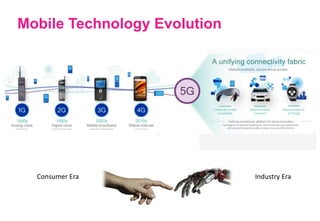
Mobile Technology Evolution
Consumer Era Industry Era
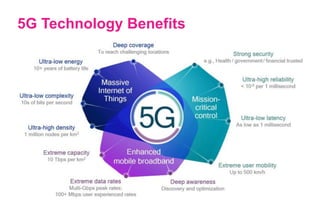
5G Technology Benefits
3D
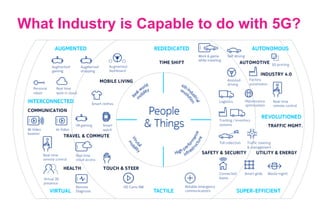
What Industry is Capable to do with 5G?
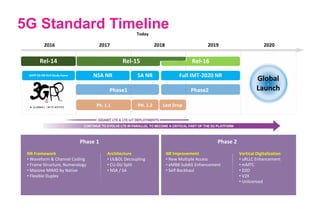
2016 2018 2019 20202017
Phase 2
NR Improvement
• New Multiple Access
• eMBB Sub6G Enhancement
• Self-Backhaul
Vertical Digitalization
• uRLLC Enhancement
• mMTC
• D2D
• V2X
• Unlicensed
Rel-15 Rel-16
NSA NR Full IMT-2020 NRSA NR
Phase1 Phase2
5G Standard TimelineToday
Phase 1
NR Framework
• Waveform & Channel Coding
• Frame Structure, Numerology
• Massive MIMO by Native
• Flexible Duplex
Architecture
• UL&DL Decoupling
• CU-DU Split
• NSA / SA
Rel-14
3GPP 5G NR R14 Study Items
Ph. 1.1 PH. 1.2 Last Drop
Global
Launch
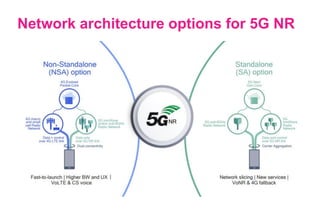
Network architecture options for 5G NR
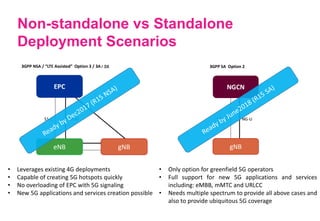
Non-standalone vs Standalone
Deployment Scenarios
• Leverages existing 4G deployments
• Capable of creating 5G hotspots quickly
• No overloading of EPC with 5G signaling
• New 5G applications and services creation possible
• Only option for greenfield 5G operators
• Full support for new 5G applications and services
including: eMBB, mMTC and URLCC
• Needs multiple spectrum to provide all above cases and
also to provide ubiquitous 5G coverage
/ 3X
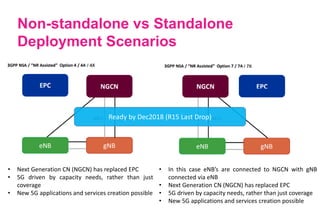
Non-standalone vs Standalone
Deployment Scenarios
• Next Generation CN (NGCN) has replaced EPC
• 5G driven by capacity needs, rather than just
coverage
• New 5G applications and services creation possible
• In this case eNB’s are connected to NGCN with gNB
connected via eNB
• Next Generation CN (NGCN) has replaced EPC
• 5G driven by capacity needs, rather than just coverage
• New 5G applications and services creation possible
Ready by Dec2018 (R15 Last Drop)
/ 4X / 7X
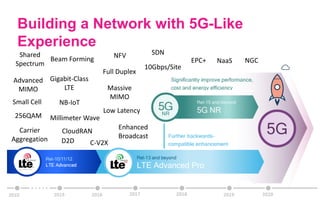
Building a Network with 5G-Like
Experience
Advanced
MIMO
Carrier
Aggregation
Shared
Spectrum
Gigabit-Class
LTE Massive
MIMO
Low Latency
Enhanced
Broadcast
NB-IoT
D2D
Millimeter Wave
Beam Forming
256QAM
Full Duplex
NaaSEPC+ NGC
10Gbps/Site
SDNNFV
Small Cell
C-V2X
CloudRAN
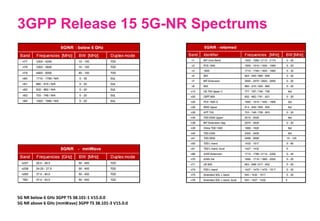
3GPP Release 15 5G-NR Spectrums
5G NR below 6 GHz 3GPP TS 38.101-1 V15.0.0
5G NR above 6 GHz (mmWave) 3GPP TS 38.101-3 V15.0.0
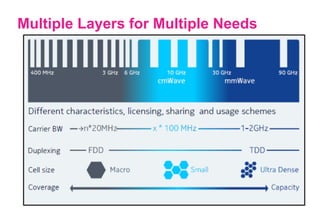
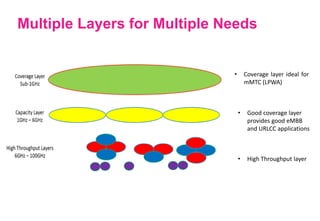
Multiple Layers for Multiple Needs
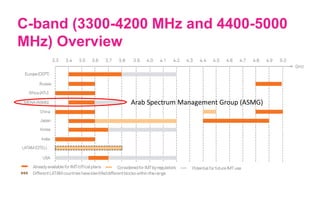
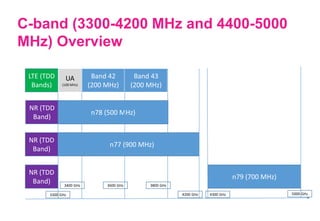
C-band (3300-4200 MHz and 4400-5000
MHz) Overview
Arab Spectrum Management Group (ASMG)
LTE (TDD
Bands)
Band 42
(200 MHz)
UA
(100 MHz)
Band 43
(200 MHz)
NR (TDD
Band)
n77 (900 MHz)
NR (TDD
Band)
n78 (500 MHz)
NR (TDD
Band)
n79 (700 MHz)
C-band (3300-4200 MHz and 4400-5000
MHz) Overview
3300 GHz
3400 GHz 3600 GHz 3800 GHz
4200 GHz 4300 GHz 5000 GHz
Multiple Layers for Multiple Needs
• Good coverage layer
provides good eMBB
and URLCC applications
• Coverage layer ideal for
mMTC (LPWA)
• High Throughput layer
References
• QUALCOMM: https://www.qualcomm.com/media/documents/files/qualcomm-5g-
vision-presentation.pdf
• Nokia and Orang 5G use cases:
https://www.gsmarena.com/nokia_and_orange_will_develop_5g_networks_togethe
r-news-23054.php
• GSACOM reports
• Spectrum : http://niviuk.free.fr/nr_band.php and 3GPP 38.104
• 5G deployment options: Huawei 5G presentations

Road to 5 g for public

  • 1.
  • 2.
  • 3.
  • 4.
    What Industry isCapable to do with 5G?
  • 5.
    2016 2018 201920202017 Phase 2 NR Improvement • New Multiple Access • eMBB Sub6G Enhancement • Self-Backhaul Vertical Digitalization • uRLLC Enhancement • mMTC • D2D • V2X • Unlicensed Rel-15 Rel-16 NSA NR Full IMT-2020 NRSA NR Phase1 Phase2 5G Standard TimelineToday Phase 1 NR Framework • Waveform & Channel Coding • Frame Structure, Numerology • Massive MIMO by Native • Flexible Duplex Architecture • UL&DL Decoupling • CU-DU Split • NSA / SA Rel-14 3GPP 5G NR R14 Study Items Ph. 1.1 PH. 1.2 Last Drop Global Launch
  • 6.
  • 7.
    Non-standalone vs Standalone DeploymentScenarios • Leverages existing 4G deployments • Capable of creating 5G hotspots quickly • No overloading of EPC with 5G signaling • New 5G applications and services creation possible • Only option for greenfield 5G operators • Full support for new 5G applications and services including: eMBB, mMTC and URLCC • Needs multiple spectrum to provide all above cases and also to provide ubiquitous 5G coverage / 3X
  • 8.
    Non-standalone vs Standalone DeploymentScenarios • Next Generation CN (NGCN) has replaced EPC • 5G driven by capacity needs, rather than just coverage • New 5G applications and services creation possible • In this case eNB’s are connected to NGCN with gNB connected via eNB • Next Generation CN (NGCN) has replaced EPC • 5G driven by capacity needs, rather than just coverage • New 5G applications and services creation possible Ready by Dec2018 (R15 Last Drop) / 4X / 7X
  • 9.
    Building a Networkwith 5G-Like Experience Advanced MIMO Carrier Aggregation Shared Spectrum Gigabit-Class LTE Massive MIMO Low Latency Enhanced Broadcast NB-IoT D2D Millimeter Wave Beam Forming 256QAM Full Duplex NaaSEPC+ NGC 10Gbps/Site SDNNFV Small Cell C-V2X CloudRAN
  • 10.
    3GPP Release 155G-NR Spectrums 5G NR below 6 GHz 3GPP TS 38.101-1 V15.0.0 5G NR above 6 GHz (mmWave) 3GPP TS 38.101-3 V15.0.0
  • 11.
    Multiple Layers forMultiple Needs
  • 12.
    C-band (3300-4200 MHzand 4400-5000 MHz) Overview Arab Spectrum Management Group (ASMG)
  • 13.
    LTE (TDD Bands) Band 42 (200MHz) UA (100 MHz) Band 43 (200 MHz) NR (TDD Band) n77 (900 MHz) NR (TDD Band) n78 (500 MHz) NR (TDD Band) n79 (700 MHz) C-band (3300-4200 MHz and 4400-5000 MHz) Overview 3300 GHz 3400 GHz 3600 GHz 3800 GHz 4200 GHz 4300 GHz 5000 GHz
  • 14.
    Multiple Layers forMultiple Needs • Good coverage layer provides good eMBB and URLCC applications • Coverage layer ideal for mMTC (LPWA) • High Throughput layer
  • 15.
    References • QUALCOMM: https://www.qualcomm.com/media/documents/files/qualcomm-5g- vision-presentation.pdf •Nokia and Orang 5G use cases: https://www.gsmarena.com/nokia_and_orange_will_develop_5g_networks_togethe r-news-23054.php • GSACOM reports • Spectrum : http://niviuk.free.fr/nr_band.php and 3GPP 38.104 • 5G deployment options: Huawei 5G presentations