ATHIRA RAJAN
NATURAL SCIENCE
MTTC, PATHANAPURAM
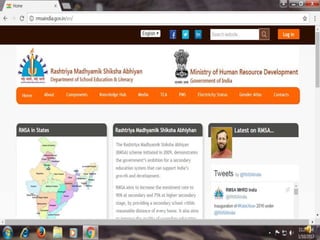
Rashtriya Madhyamik Shiksha Abhiyan (RMSA)
is a centrally sponsored scheme of the Ministry of
Human Resource Development, Government of
India, for the development of secondary
education in public schools throughout India.
It was launched in March 2009.
It aims to provide universal education for all
children between 15–16 years of age.
OBJECTIVES
To improve quality of education imparted at
secondary level through making all secondary schools
conform to prescribed norms.
To remove gender, socio-economic and disability
barriers.
Universal access to secondary level education by
2017, i.e., by the end of the XII Five Year Plan.
Universal retention by 2020.
ACTION PLANS
RMSA is planned to promote secondary
education by establishing in every target
school the following infrastructure:
Additional class rooms
Laboratories
Libraries
Art and crafts room
Toilet blocks
Drinking water provisions
Residential hostels for teachers in
remote areas
In addition it aims to provide
additional teachers to reduce student-
teacher to 30:1, focus on science,
mathematics and English education,
in-service training of teachers, science
laboratories, ICT-enabled education,
curriculum reforms, and teaching-
learning reforms
Quality Improvement
In school, there was promotion of the science
laboratories, environmental education, promotion
of yoga, as well as centrally sponsored schemes of
population education project, international
mathematics and science olympiads. The state
governments provide in-service training for the
teachers and provide infrastructure and research
inputs.
Four major heads
Information communication technologies
(ICT)
ICT comprises the centrally sponsored schemes like computer
education and literacy in schools (CLASS) and educational
technology (ET) which familiarizes the student with
Information technology (IT).
funding support towards computer education plans
strengthening and reorientation of the staffs of SIETS - state
institutes of education and training
c) there is digitalization of SIETs audio and video cassettes
with the partnership of NGOs
d) management of internet-based education by SIETs.
Access and equity
RMSA not only emphasizes on providing secondary
education for the special focus groups that
include scheduled tribe and scheduled caste
groups, minority girls and CWSN children, but it also
give importance on removing the existing disparities in
socio-economic and gender background in the
secondary level of education.
Integrated education for disabled children
(IEDC)
Inclusive education have been highlighted to bring
about expansion in terms of meeting/catering to
the needs of the mentally and physically
disadvantaged children. This schemes continues to
be a separate centrally sponsored scheme. It
includes several components for convergence with
integrated child development services for early
interventions, Sarva Shiksha Abhiyan (SSA) for the
particular group at the elementary level, and
special schools
RMSA ppt athira rajan

RMSA ppt athira rajan

  • 1.
  • 3.
    Rashtriya Madhyamik ShikshaAbhiyan (RMSA) is a centrally sponsored scheme of the Ministry of Human Resource Development, Government of India, for the development of secondary education in public schools throughout India. It was launched in March 2009. It aims to provide universal education for all children between 15–16 years of age.
  • 4.
    OBJECTIVES To improve qualityof education imparted at secondary level through making all secondary schools conform to prescribed norms. To remove gender, socio-economic and disability barriers. Universal access to secondary level education by 2017, i.e., by the end of the XII Five Year Plan. Universal retention by 2020.
  • 5.
    ACTION PLANS RMSA isplanned to promote secondary education by establishing in every target school the following infrastructure: Additional class rooms Laboratories Libraries Art and crafts room Toilet blocks Drinking water provisions Residential hostels for teachers in remote areas
  • 7.
    In addition itaims to provide additional teachers to reduce student- teacher to 30:1, focus on science, mathematics and English education, in-service training of teachers, science laboratories, ICT-enabled education, curriculum reforms, and teaching- learning reforms
  • 8.
    Quality Improvement In school,there was promotion of the science laboratories, environmental education, promotion of yoga, as well as centrally sponsored schemes of population education project, international mathematics and science olympiads. The state governments provide in-service training for the teachers and provide infrastructure and research inputs. Four major heads
  • 9.
    Information communication technologies (ICT) ICTcomprises the centrally sponsored schemes like computer education and literacy in schools (CLASS) and educational technology (ET) which familiarizes the student with Information technology (IT). funding support towards computer education plans strengthening and reorientation of the staffs of SIETS - state institutes of education and training c) there is digitalization of SIETs audio and video cassettes with the partnership of NGOs d) management of internet-based education by SIETs.
  • 10.
    Access and equity RMSAnot only emphasizes on providing secondary education for the special focus groups that include scheduled tribe and scheduled caste groups, minority girls and CWSN children, but it also give importance on removing the existing disparities in socio-economic and gender background in the secondary level of education.
  • 11.
    Integrated education fordisabled children (IEDC) Inclusive education have been highlighted to bring about expansion in terms of meeting/catering to the needs of the mentally and physically disadvantaged children. This schemes continues to be a separate centrally sponsored scheme. It includes several components for convergence with integrated child development services for early interventions, Sarva Shiksha Abhiyan (SSA) for the particular group at the elementary level, and special schools