Shesna.T
RESEARCH DESIGN
&
TYPES
INTRODUCTION
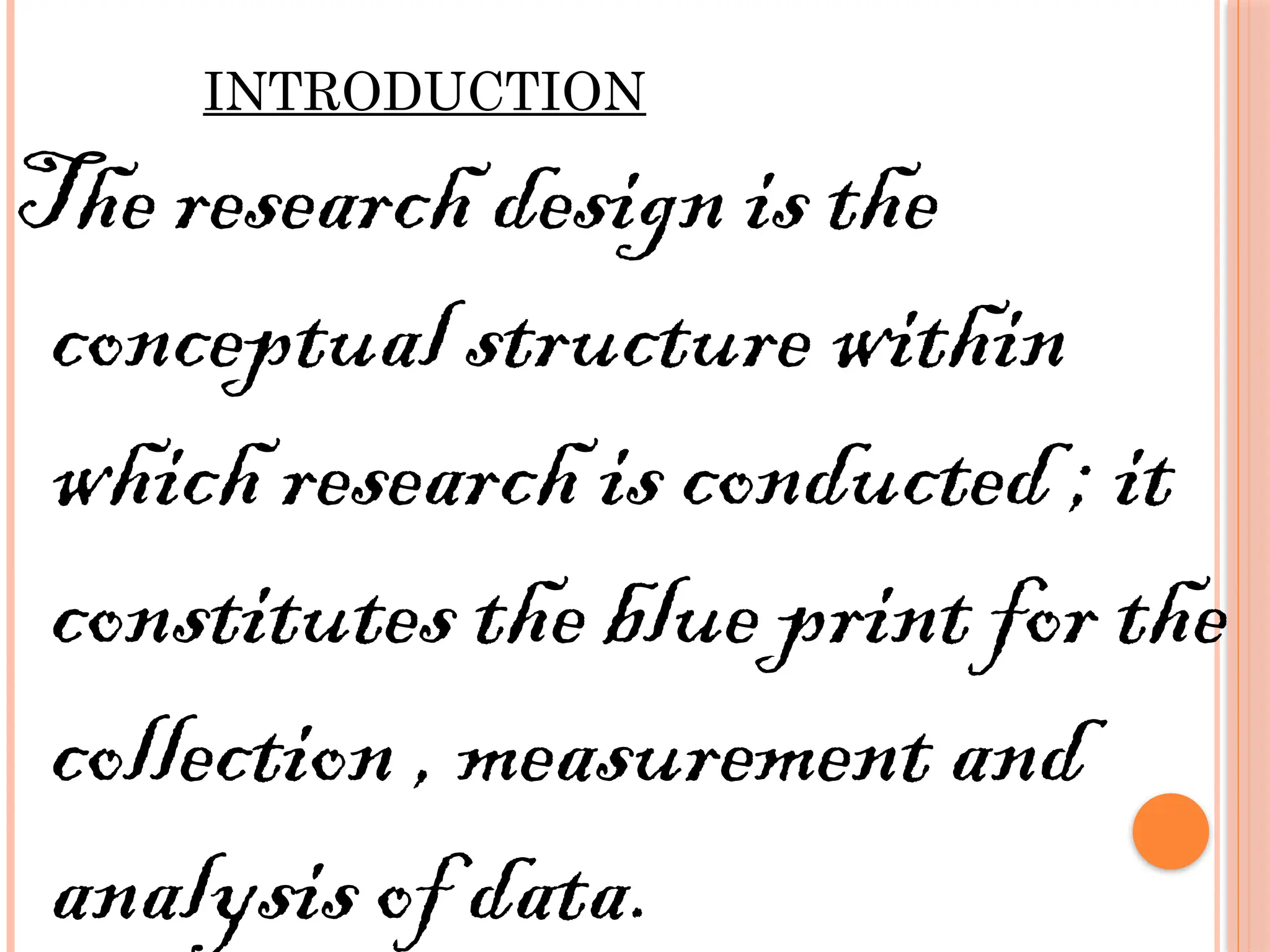
The research design is the
conceptual structure within
which research is conducted ; it
constitutes the blue print for the
collection , measurement and
analysis of data.
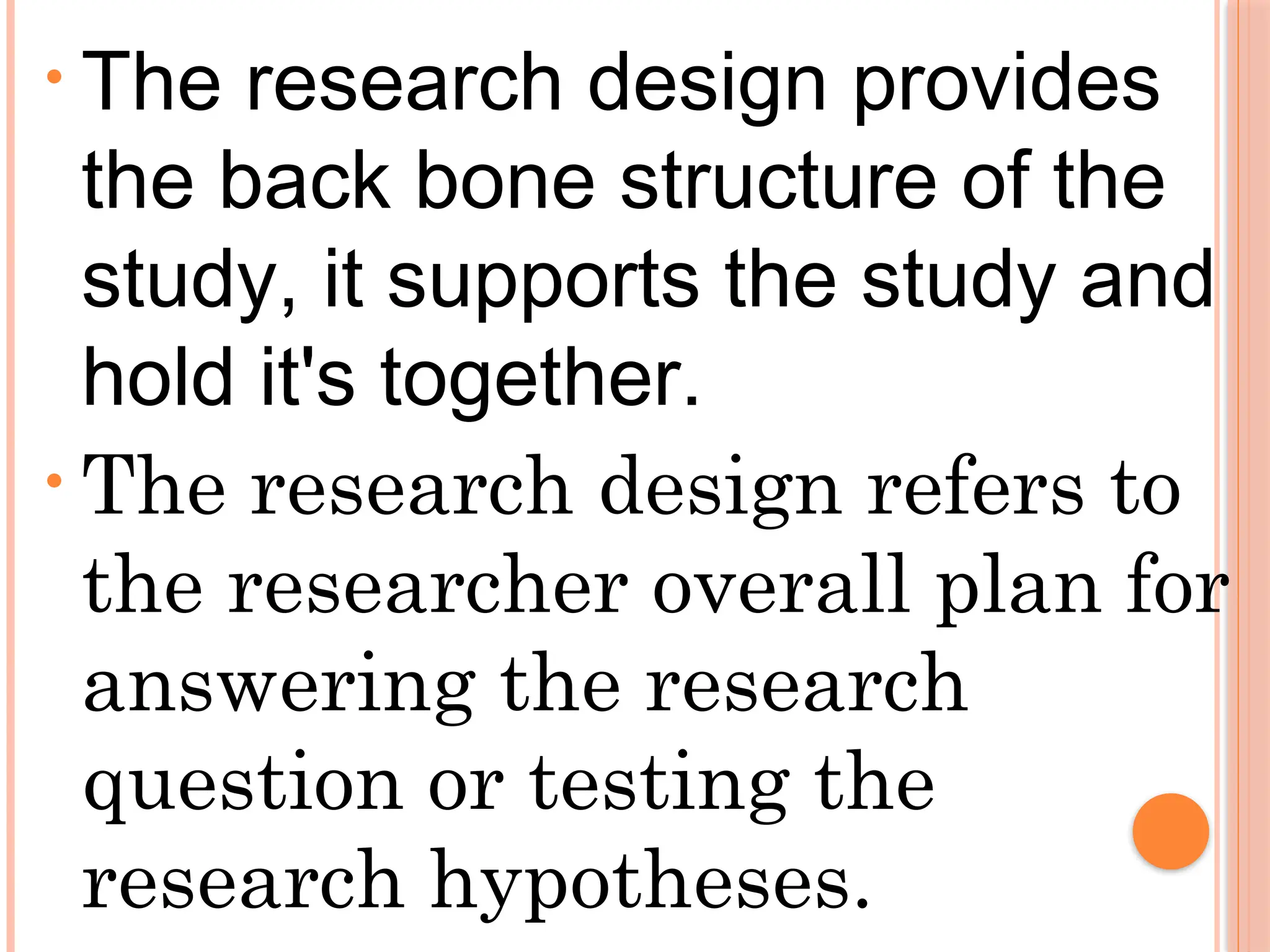
• The research design provides
the back bone structure of the
study, it supports the study and
hold it's together.
• The research design refers to
the researcher overall plan for
answering the research
question or testing the
research hypotheses.
PROCESS OF DESIGNING & CONDUCTING A
RESEARCH PROJECT
 What--What was studied?
 What about--What aspects of
the subject were studied?
 What for--What is/was the
significance of the study?
 What did prior lit./research say?
 What was done--How was the
study conducted?
 What was found?
 So what?
 What now?
Hence Research Design
is:
• a framework for the
research plan of action.
• a master plan that
specifies the methods
and procedures for
collecting and analyzing
the needed information
DEFINITIONS
The Planned sequence of
the entire process involved
in conducting a research
study .
- Miller
PURPOSES OF RESEARCH DESIGN
 It provides the scheme for
answering research question.
 It maintains control to avoid bias
that may affect the outcomes.
 It organize the study in a certain
way defending the advantages
of doing while being aware and
caution about potential
disadvantages .
ADVANTAGES
 Lead to more
accurate results.
 Give optimum
efficiency and
reliability.
• Minimise the wastage
of time as well as
money.
• Instills confidence
in the research.
• Provides satisfaction
& success.
COMPONENTS
 Title of the study
 Statement of the
problem
 Review of literature
 Area & Scope of Study
 Objectives of the study
Formulation of
hypothesis
Definition of concepts
Methodology
Sampling design
Constructing the
schedule/Questionnaire
Collection of data
Analysis of data
Interpretation of results
Reporting the findings
Time & Financial
budgeting
DIFFERENT RESEARCH
DESIGNS
1. Exploratory type research
design
2. Descriptive type research
design
3. Experimental type research
design
4. Experimental type research
design
1) EXPLORATORY TYPE RESEARCH
DESIGN
Explorative research studies
are also termed as formulative
research studies.
Exploratory study is a
systematic scientific approach
which enables a social scientist
to determine whether an idea
is in reality or not.
Explorative studies can provide
ideas , hypothesis , suggestions
that might never occur to the
social scientist sitting in an
office and mediating over the
problem.
More flexible.
Done in the field whether there
is little knowledge is available.
Exploratory studies which do not
sets limits for themselves have
limits imposed by various practical
matters.
Mostly the results obtained through
the explorative study are to be
treated as a sign post for future and
further study in the same or similar
direction.
For this reason , they are also known as
formulative studies.
WHEN EXPLORATIVE RESEARCH ?
2) DESCRIPTIVE TYPE RESEARCH
DESIGN
 Rigid Design.
 Probability sampling design.
 Pre-planned design for
analysis.
 Structured instruments for
collection of data.
 Advanced decisions about
operational procedure.
Research design in which
the major emphasis is
on determining the
frequency with which
something occurs or the
extent to which two
variables co vary.
 Enable researcher to describe picture
of a phenomenon under investigation.
 Methodology involved – qualitative in
nature producing descriptive data.
 Three approaches to enable to
record/analyse the bahavioural
patterns:
i. Participant observation.
ii. Personal documents.
iii. Unstructured interviewing.
4) EXPERIMENTAL TYPE RESEARCH
DESIGN
Professor R.A.Fisher’s name is
associated with experimental designs.
It’s origin in agricultural research was
made by him when he was working in
Rothamsted Experimental
Station (Centre for Agricultural
Research in England).

Experiment is a study in
which the investigator
manipulates or varies
(called the independent
variables) &
measures other variables
(called the
dependent
variables).
 When an experiment is
possible it is the most
effective method of testing
a hypothesis.
i.e; one variable ‘X’
casually influences
another variable ‘Y’
There are three basic principles
of experimental designs :
1. The principle of replication
2. The principle of randomization
3. The principle of local control
1. THE PRINCIPLE OF REPLICATION
According to this , the
experiment should be
repeated more than once.
Thus, each treatment is applied in
many experimental units instead
of one.
By doing so, the statistical accuracy
of the experiments is incresed.
2. THE PRINCIPLE OF RANDOMISATION
This provides protection
against the effects of
extraneous factors by
randomisation.
We may apply randomisation
principle and protect ourselves
against the effects
of the extraneous factors.
3. THE PRINCIPLE OF LOCAL CONTROL
According to this principle, we
first divide the field into several
homogeneous parts, known as
blocks, and then each such
block is divided into part equal
to the number of
treatments.
researchdesignandtypesofresearchdesignfinalppt-190823014804.pptx

researchdesignandtypesofresearchdesignfinalppt-190823014804.pptx

  • 1.
  • 2.
    INTRODUCTION The research designis the conceptual structure within which research is conducted ; it constitutes the blue print for the collection , measurement and analysis of data.
  • 3.
    • The researchdesign provides the back bone structure of the study, it supports the study and hold it's together. • The research design refers to the researcher overall plan for answering the research question or testing the research hypotheses.
  • 4.
    PROCESS OF DESIGNING& CONDUCTING A RESEARCH PROJECT  What--What was studied?  What about--What aspects of the subject were studied?  What for--What is/was the significance of the study?  What did prior lit./research say?  What was done--How was the study conducted?  What was found?  So what?  What now?
  • 5.
    Hence Research Design is: •a framework for the research plan of action. • a master plan that specifies the methods and procedures for collecting and analyzing the needed information
  • 6.
    DEFINITIONS The Planned sequenceof the entire process involved in conducting a research study . - Miller
  • 7.
    PURPOSES OF RESEARCHDESIGN  It provides the scheme for answering research question.  It maintains control to avoid bias that may affect the outcomes.  It organize the study in a certain way defending the advantages of doing while being aware and caution about potential disadvantages .
  • 8.
    ADVANTAGES  Lead tomore accurate results.  Give optimum efficiency and reliability.
  • 9.
    • Minimise thewastage of time as well as money. • Instills confidence in the research. • Provides satisfaction & success.
  • 10.
    COMPONENTS  Title ofthe study  Statement of the problem  Review of literature  Area & Scope of Study  Objectives of the study
  • 11.
    Formulation of hypothesis Definition ofconcepts Methodology Sampling design Constructing the schedule/Questionnaire
  • 12.
    Collection of data Analysisof data Interpretation of results Reporting the findings Time & Financial budgeting
  • 13.
    DIFFERENT RESEARCH DESIGNS 1. Exploratorytype research design 2. Descriptive type research design 3. Experimental type research design 4. Experimental type research design
  • 14.
    1) EXPLORATORY TYPERESEARCH DESIGN Explorative research studies are also termed as formulative research studies. Exploratory study is a systematic scientific approach which enables a social scientist to determine whether an idea is in reality or not.
  • 15.
    Explorative studies canprovide ideas , hypothesis , suggestions that might never occur to the social scientist sitting in an office and mediating over the problem. More flexible. Done in the field whether there is little knowledge is available.
  • 16.
    Exploratory studies whichdo not sets limits for themselves have limits imposed by various practical matters. Mostly the results obtained through the explorative study are to be treated as a sign post for future and further study in the same or similar direction. For this reason , they are also known as formulative studies.
  • 17.
  • 18.
    2) DESCRIPTIVE TYPERESEARCH DESIGN  Rigid Design.  Probability sampling design.  Pre-planned design for analysis.  Structured instruments for collection of data.  Advanced decisions about operational procedure.
  • 19.
    Research design inwhich the major emphasis is on determining the frequency with which something occurs or the extent to which two variables co vary.
  • 20.
     Enable researcherto describe picture of a phenomenon under investigation.  Methodology involved – qualitative in nature producing descriptive data.  Three approaches to enable to record/analyse the bahavioural patterns: i. Participant observation. ii. Personal documents. iii. Unstructured interviewing.
  • 21.
    4) EXPERIMENTAL TYPERESEARCH DESIGN Professor R.A.Fisher’s name is associated with experimental designs. It’s origin in agricultural research was made by him when he was working in Rothamsted Experimental Station (Centre for Agricultural Research in England).
  • 22.
     Experiment is astudy in which the investigator manipulates or varies (called the independent variables) & measures other variables (called the dependent variables).
  • 23.
     When anexperiment is possible it is the most effective method of testing a hypothesis. i.e; one variable ‘X’ casually influences another variable ‘Y’
  • 24.
    There are threebasic principles of experimental designs : 1. The principle of replication 2. The principle of randomization 3. The principle of local control
  • 25.
    1. THE PRINCIPLEOF REPLICATION According to this , the experiment should be repeated more than once. Thus, each treatment is applied in many experimental units instead of one. By doing so, the statistical accuracy of the experiments is incresed.
  • 26.
    2. THE PRINCIPLEOF RANDOMISATION This provides protection against the effects of extraneous factors by randomisation. We may apply randomisation principle and protect ourselves against the effects of the extraneous factors.
  • 27.
    3. THE PRINCIPLEOF LOCAL CONTROL According to this principle, we first divide the field into several homogeneous parts, known as blocks, and then each such block is divided into part equal to the number of treatments.