Romeo and Juliet
Introduction and
Background
William
Shakespeare’s
The Tragedy
of
William Shakespeare
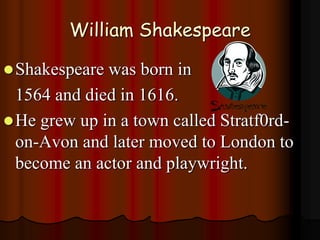
Shakespeare was born in
1564 and died in 1616.
He grew up in a town called Stratf0rd-
on-Avon and later moved to London to
become an actor and playwright.
The Plays
 Shakespeare’s plays include comedies,
histories—and tragedies such as Romeo
and Juliet.
 Some of his other famous plays include
Julius Caesar, Hamlet, Macbeth, Othello,
and A Midsummer Night’s Dream.
 In addition, Shakespeare wrote love
poems called sonnets.
Will the real Shakespeare
please stand up?
 Some scholars
have suggested
Shakespeare, who
had little formal
education, could
not have written
such powerful and
creative plays.
 However, nobody
in Shakespeare’s
day thought to
question his
authorship.
Apparently, he
was just a genius!
Theater
The theater in Shakespeare’s day was
tremendously different from what we
see today.
Being an actor was not a highly
regarded profession; actors were
looked down upon in society.
The Globe
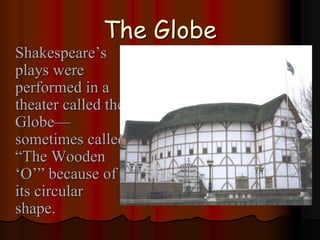
Shakespeare’s
plays were
performed in a
theater called the
Globe—
sometimes called
“The Wooden
‘O’” because of
its circular
shape.
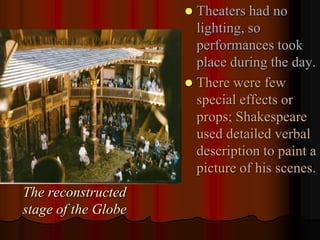
The reconstructed
stage of the Globe
 Theaters had no
lighting, so
performances took
place during the day.
 There were few
special effects or
props; Shakespeare
used detailed verbal
description to paint a
picture of his scenes.
Actors and Actresses
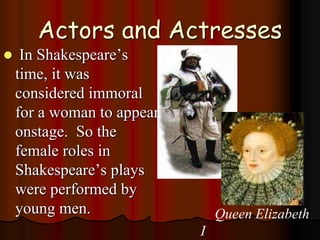
 In Shakespeare’s
time, it was
considered immoral
for a woman to appear
onstage. So the
female roles in
Shakespeare’s plays
were performed by
young men. Queen Elizabeth
I
Context
 The time period in
which Shakespeare
lived—Elizabethan
England, named for
the queen—
influenced the
content of his plays
as well as the way in
which they were
performed.
 Elizabethans believed
the earth was flat.
The Four Humors
 In Elizabethan times, people believed that
a person’s mental, physical, and
emotional state were determined by the
balance of the four “humors” in the body:
blood, yellow bile, phlegm and black
bile. They believed the humors gave off
vapors that affected the brain, so
whatever humor dominated would
determine your personality type.
Marriage
 In Shakespeare’s day, marriages were
generally contracts set up by the parents.
 When Juliet’s parents arrange a marriage
for her, it seems strange to us;
Shakespeare’s audience would have
thought it was completely normal.
Tragedy
 Shakespeare’s tragedies
also follow a pattern
that would have made
sense to his audience.
 Elizabethans believed
that people’s decisions
and mistakes always
had consequences, and
that people sometimes
had to pay a high price
for their mistakes.
 In Shakespeare’s
tragedies, the main
characters make
decisions that upset the
proper order of their
world and so affect
them and everyone
around them. The
situation is resolved
only when others learn
lessons from the main
characters’ deaths.
Why we read…
 So why do we still read plays like Romeo and
Juliet? When Shakespeare’s world was so
different from ours, what can we learn from
his plays?
 Well, the plays are not only great, powerful
stories—they also teach lessons about life that
apply to people in all cultures and time
periods, and those lessons can help us when
we come across hard times in our own lives.
Keep in Mind:
 Don’t be alarmed by
the old-fashioned
language: this is
really a play about
people who are a lot
like us, and the
difficult words, when
you look at them
carefully, express
emotions anyone can
understand.
 And remember, the
play is POETRY: it’s
not supposed to be
written exactly the
way people talk. The
poetry is part of what
makes it beautiful
and powerful—and
worth reading.
Reading the Play
 Shakespeare’s plays
were meant to be
performed—they were
some of the most
popular entertainment of
their time. So when we
read the play, the point
is to try and imagine it
happening onstage!
Two things to know:
 Sometimes a
character will give a
long speech all by
herself, revealing her
secret thoughts to the
audience: this is
called a soliloquy.
 Sometimes a
character will just
make a brief comment
to the audience that
the other characters
don’t hear; this is
called an aside.
Because of the minimal props and scenery,
the action in Shakespeare’s plays had
to be conveyed through words and
conversations. A conversation between
characters is called DIALOGUE.
So Who’s Who Here?
Shakespeare’s plays
can have LOTS of
characters. Let’s
try to get them
straight in our
minds…
First of all, all of the
characters in
Romeo and Juliet
are arranged around a
central conflict between
two rival families: the
Montaguesand the
Capulets.
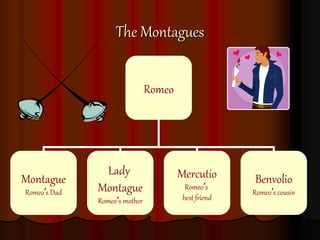
The Montagues
Romeo
Montague
Romeo’s Dad
Lady
Montague
Romeo’s mother
Mercutio
Romeo’s
best friend
Benvolio
Romeo’s cousin
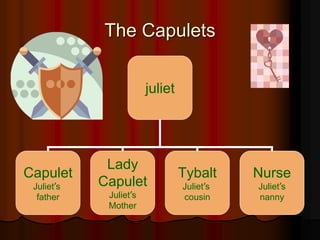
The Capulets
juliet
Capulet
Juliet’s
father
Tybalt
Juliet’s
cousin
Nurse
Juliet’s
nanny
Lady
Capulet
Juliet’s
Mother
The Peacemakers:
The Prince of Verona:
 This ruler tries to
mediate between the
feuding families.
 He is pretty tired of
all the bloodshed
caused by their
“ancient grudge.”
Friar Lawrence:
 This religious leader is
respected as a holy man by
both sides, and would like
to see them reconciled.
 As a friar, he’s interested
not only in religion, but
also in medicinal herbs—
which becomes important
later.
And finally…
One other “character”:
The Chorus
The Chorus is not a part of the action, but
a speaker who comes onstage to make
comments on the action. The Chorus is
kind of like a TV announcer in
contemporary life—as far as the characters
know, the chorus doesn’t exist, but he
helps explain things to us.

romeoandjuliet.ppt

  • 1.
    Romeo and Juliet Introductionand Background William Shakespeare’s The Tragedy of
  • 2.
    William Shakespeare Shakespeare wasborn in 1564 and died in 1616. He grew up in a town called Stratf0rd- on-Avon and later moved to London to become an actor and playwright.
  • 3.
    The Plays  Shakespeare’splays include comedies, histories—and tragedies such as Romeo and Juliet.  Some of his other famous plays include Julius Caesar, Hamlet, Macbeth, Othello, and A Midsummer Night’s Dream.  In addition, Shakespeare wrote love poems called sonnets.
  • 4.
    Will the realShakespeare please stand up?  Some scholars have suggested Shakespeare, who had little formal education, could not have written such powerful and creative plays.  However, nobody in Shakespeare’s day thought to question his authorship. Apparently, he was just a genius!
  • 5.
    Theater The theater inShakespeare’s day was tremendously different from what we see today. Being an actor was not a highly regarded profession; actors were looked down upon in society.
  • 6.
    The Globe Shakespeare’s plays were performedin a theater called the Globe— sometimes called “The Wooden ‘O’” because of its circular shape.
  • 7.
    The reconstructed stage ofthe Globe  Theaters had no lighting, so performances took place during the day.  There were few special effects or props; Shakespeare used detailed verbal description to paint a picture of his scenes.
  • 8.
    Actors and Actresses In Shakespeare’s time, it was considered immoral for a woman to appear onstage. So the female roles in Shakespeare’s plays were performed by young men. Queen Elizabeth I
  • 9.
    Context  The timeperiod in which Shakespeare lived—Elizabethan England, named for the queen— influenced the content of his plays as well as the way in which they were performed.  Elizabethans believed the earth was flat.
  • 10.
    The Four Humors In Elizabethan times, people believed that a person’s mental, physical, and emotional state were determined by the balance of the four “humors” in the body: blood, yellow bile, phlegm and black bile. They believed the humors gave off vapors that affected the brain, so whatever humor dominated would determine your personality type.
  • 11.
    Marriage  In Shakespeare’sday, marriages were generally contracts set up by the parents.  When Juliet’s parents arrange a marriage for her, it seems strange to us; Shakespeare’s audience would have thought it was completely normal.
  • 12.
    Tragedy  Shakespeare’s tragedies alsofollow a pattern that would have made sense to his audience.  Elizabethans believed that people’s decisions and mistakes always had consequences, and that people sometimes had to pay a high price for their mistakes.  In Shakespeare’s tragedies, the main characters make decisions that upset the proper order of their world and so affect them and everyone around them. The situation is resolved only when others learn lessons from the main characters’ deaths.
  • 13.
    Why we read… So why do we still read plays like Romeo and Juliet? When Shakespeare’s world was so different from ours, what can we learn from his plays?  Well, the plays are not only great, powerful stories—they also teach lessons about life that apply to people in all cultures and time periods, and those lessons can help us when we come across hard times in our own lives.
  • 14.
    Keep in Mind: Don’t be alarmed by the old-fashioned language: this is really a play about people who are a lot like us, and the difficult words, when you look at them carefully, express emotions anyone can understand.  And remember, the play is POETRY: it’s not supposed to be written exactly the way people talk. The poetry is part of what makes it beautiful and powerful—and worth reading.
  • 15.
    Reading the Play Shakespeare’s plays were meant to be performed—they were some of the most popular entertainment of their time. So when we read the play, the point is to try and imagine it happening onstage! Two things to know:  Sometimes a character will give a long speech all by herself, revealing her secret thoughts to the audience: this is called a soliloquy.  Sometimes a character will just make a brief comment to the audience that the other characters don’t hear; this is called an aside. Because of the minimal props and scenery, the action in Shakespeare’s plays had to be conveyed through words and conversations. A conversation between characters is called DIALOGUE.
  • 16.
    So Who’s WhoHere? Shakespeare’s plays can have LOTS of characters. Let’s try to get them straight in our minds… First of all, all of the characters in Romeo and Juliet are arranged around a central conflict between two rival families: the Montaguesand the Capulets.
  • 17.
    The Montagues Romeo Montague Romeo’s Dad Lady Montague Romeo’smother Mercutio Romeo’s best friend Benvolio Romeo’s cousin
  • 18.
  • 19.
    The Peacemakers: The Princeof Verona:  This ruler tries to mediate between the feuding families.  He is pretty tired of all the bloodshed caused by their “ancient grudge.” Friar Lawrence:  This religious leader is respected as a holy man by both sides, and would like to see them reconciled.  As a friar, he’s interested not only in religion, but also in medicinal herbs— which becomes important later.
  • 20.
    And finally… One other“character”: The Chorus The Chorus is not a part of the action, but a speaker who comes onstage to make comments on the action. The Chorus is kind of like a TV announcer in contemporary life—as far as the characters know, the chorus doesn’t exist, but he helps explain things to us.