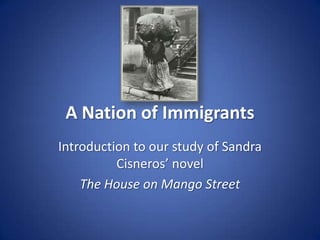
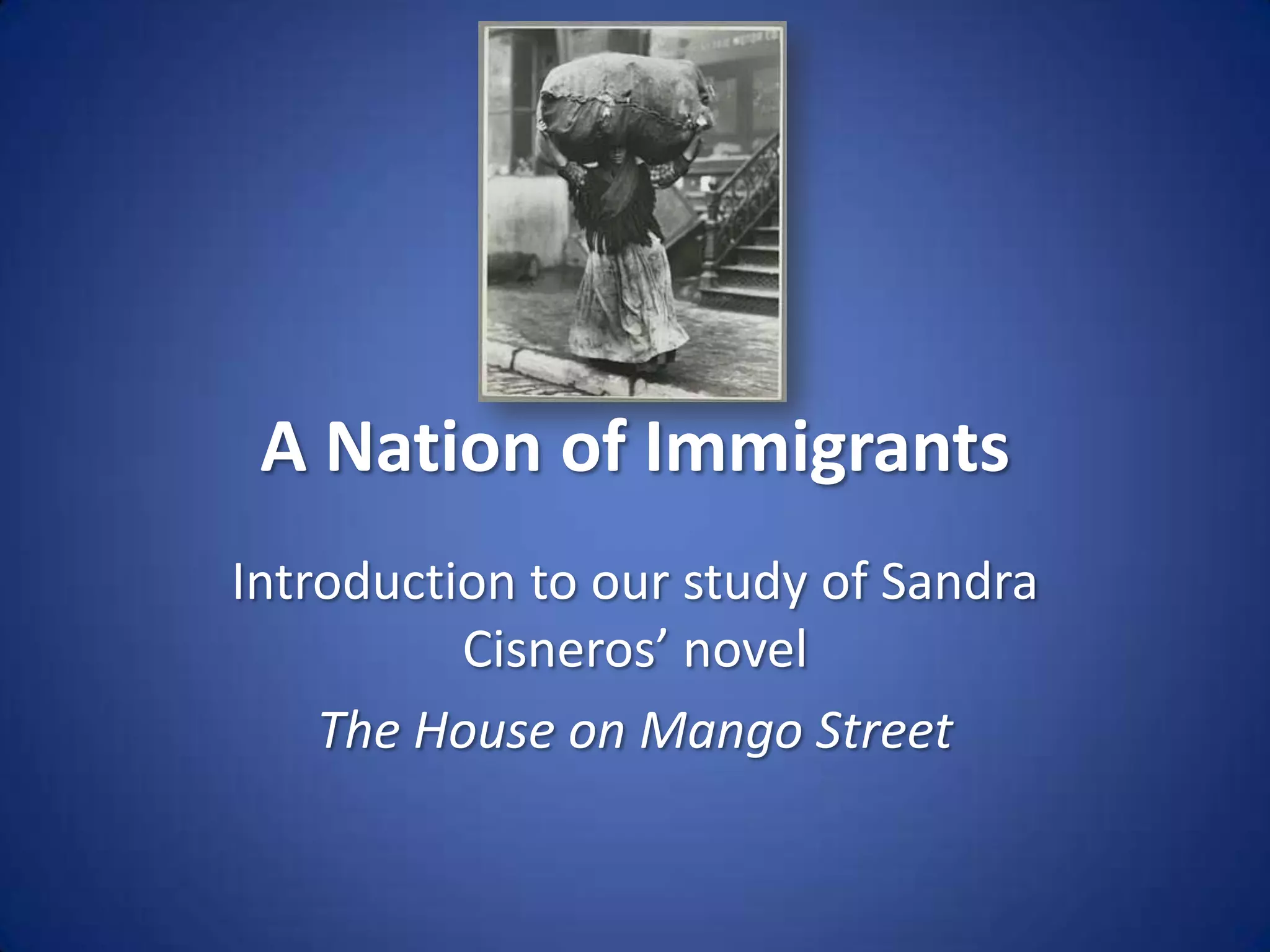



A Nation of ImmigrantsIntroduction to our study of Sandra Cisneros’ novelThe House on Mango Street
TEKS Reading Comprehension / FictionAnalyzenarrator’s point of view — the way in which a work of fiction is shaped by it Make inferences and draw conclusions about the structure and elements of the fiction and provide evidence from text to support understanding.
Key ConceptsExperience of the “Outsider”Literary Elements:Autobiographical narrativeAuthor's purposeDiction: only, alone, I —(How does the diction support the writer's purpose?)
Who is Sandra Cisneros?• Author of The House on Mango Street•Grew up so poor she says her neighborhood seemed like a war zone. •There were broken buildings all around her that looked like they had been bombed. The empty buildings made her feel lonely. Who is Sandra Cisneros? She was very shy.
 Her family moved a lot — she never had lasting friendships.
She also felt different from her classmates, who didn’t have to struggle to learn a new language and who looked so much more like the people she saw on TV.Who is Sandra Cisneros? She turned to writing to express her emotions.
 Her first novel, The House on Mango Street, proved successful because it was one of the few that captured Cisneros’ feelings about growing up Latina in the United States. Who is Sandra Cisneros? Only when she was able to celebrate her sense of being different did she truly find her voice.Reasons to Read & ThinkEverything we read in English 1 we read for a reason. We read to seek insights and answer questions that help us understand our own lives and the lives of others a bit more truly.As we read and discuss House on Mango Street, here are the questions we seek insight into:What does it mean to be an "outsider"?What is unique to the outsider's experience?What defines our culture?How do we reflect our culture?
The House on Mango Street:Story of an OutsiderWritten by Sandra Cisneros and first published in 1983, The House on Mango Street is a linked collection of forty-four short tales that evoke the circumstances and conditions of a Hispanic American ghetto in Chicago.
The House on Mango Street:Story of an OutsiderThe narrative is seen through the eyes of Esperanza Cordero, an adolescent girl coming of age. These short, poetic tales also offer snapshots of the roles of women in this society. They uncover the dual forces that pull Esperanza to stay rooted in her cultural traditions on the one hand (such as foregoing education, becoming a housewife, serving husband and family, etc.), and those that compel her to pursue a better way of life outside the barrio on the other.
The House on Mango Street:Story of an OutsiderThroughout the book Sandra Cisneros explores themes of cultural tradition, gender roles, and coming of age in a binary society that struggles to hang onto its collective past while integrating itself into the American cultural landscape.
The House on Mango StreetSummaryThe novel  opens with a description of the Cordero family's house on Mango Street, the most recent in a long line of houses they have occupied. Esperanza is dissatisfied with the house, which is small and cramped, and doesn't want to stay there. But Mango Street is her home now, and she sets out to try to understand it.
The House on Mango StreetSummaryMango Street is populated by people with many different life stories, stories of hope and despair. First there is Esperanza's own family, her kind father who works two jobs and is absent most of the time; her mother, who can speak two languages and sing opera but never finished high school; her two brothers Carlos and Kiki; and her little sister Nenny.
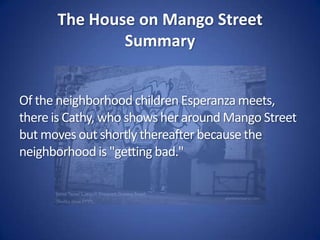
The House on Mango StreetSummaryOf the neighborhood children Esperanza meets, there is Cathy, who shows her around Mango Street but moves out shortly thereafter because the neighborhood is "getting bad."
The House on Mango StreetSummaryThen there are Rachel and Lucy, sisters from Texas, who become Esperanza and Nenny's best friends.
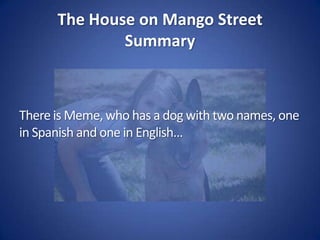
The House on Mango StreetSummaryThere is Meme, who has a dog with two names, one in Spanish and one in English…
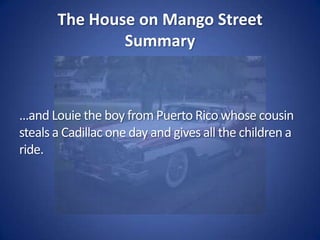
The House on Mango StreetSummary…and Louie the boy from Puerto Rico whose cousin steals a Cadillac one day and gives all the children a ride.
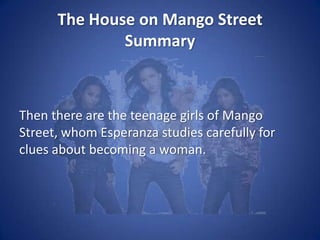
The House on Mango StreetSummaryThen there are the teenage girls of Mango Street, whom Esperanza studies carefully for clues about becoming a woman.
The House on Mango StreetSummaryThere is Marin from Puerto Rico, who sells Avon cosmetics and takes care of her younger cousins, but is waiting for a boyfriend to change her life.
The House on Mango StreetSummaryThere is Alicia, who must take care of her father and siblings because her mother is dead, but is determined to keep going to college.
The House on Mango StreetSummaryAnd there is Esperanza's beautiful friend Sally, who marries in the eighth grade in order to get away from her father but is now forbidden by her husband to see her friends.
The House on Mango StreetSummaryEsperanza, Nenny, Lucy, and Rachel discover that acting sexy is more dangerous than liberating when a neighbor gives them four pairs of hand-me-down high heels. They strut around the neighborhood acting like the older girls until a homeless man accosts them. After fleeing, the girls quickly take off the shoes with the intention of never wearing them again.
Now let’s read and meet the people of Mango Street…Where does our sense of identity come from? Read the Dedication page:Why is the book dedicated to A lasMujeres (To the Women)?
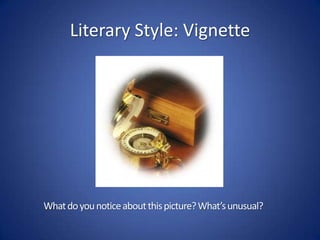
Literary Style: VignetteWhat do you notice about this picture? What’s unusual?
Literary Style: VignetteThe term vignette generally means something small. Originally it meant "something that may be written on a vine-leaf”IN PHOTOGRAPHY: any process by which there is loss in clarity towards the corners and sides of an imageIN LITERATURE: short, impressionistic scenes that focus on one moment or give a particular insight into a character, idea, or setting
Literary Style: VignetteRead the last vignette first: "Mango Says Goodbye Sometimes"Class discussion: Where did Esperanza go? How? Why?
Literary Style: VignetteRead the first vignette first: ”The House On Mango Street"
Literary Style: VignetteParagraph 1:  use of repetition before, contrasting pronouns I and we (who tells the story), tone [insights into family: students draw conclusions - not wealthy, not stable, large, speaker is young, relation to brother)Paragraph 9: repetition and italicizing there Paragraph 11: What does the last sentence show about the narrator? Discussion questions:The narrator's feelings/attitudes about the house.The narrator's desire to have a house I can point to reveals what about the character.
Homs02

Homs02

  • 1.
    A Nation ofImmigrantsIntroduction to our study of Sandra Cisneros’ novelThe House on Mango Street
  • 2.
    TEKS Reading Comprehension/ FictionAnalyzenarrator’s point of view — the way in which a work of fiction is shaped by it Make inferences and draw conclusions about the structure and elements of the fiction and provide evidence from text to support understanding.
  • 3.
    Key ConceptsExperience ofthe “Outsider”Literary Elements:Autobiographical narrativeAuthor's purposeDiction: only, alone, I —(How does the diction support the writer's purpose?)
  • 4.
    Who is SandraCisneros?• Author of The House on Mango Street•Grew up so poor she says her neighborhood seemed like a war zone. •There were broken buildings all around her that looked like they had been bombed. The empty buildings made her feel lonely. Who is Sandra Cisneros? She was very shy.
  • 5.
    Her familymoved a lot — she never had lasting friendships.
  • 6.
    She also feltdifferent from her classmates, who didn’t have to struggle to learn a new language and who looked so much more like the people she saw on TV.Who is Sandra Cisneros? She turned to writing to express her emotions.
  • 7.
    Her firstnovel, The House on Mango Street, proved successful because it was one of the few that captured Cisneros’ feelings about growing up Latina in the United States. Who is Sandra Cisneros? Only when she was able to celebrate her sense of being different did she truly find her voice.Reasons to Read & ThinkEverything we read in English 1 we read for a reason. We read to seek insights and answer questions that help us understand our own lives and the lives of others a bit more truly.As we read and discuss House on Mango Street, here are the questions we seek insight into:What does it mean to be an "outsider"?What is unique to the outsider's experience?What defines our culture?How do we reflect our culture?
  • 8.
    The House onMango Street:Story of an OutsiderWritten by Sandra Cisneros and first published in 1983, The House on Mango Street is a linked collection of forty-four short tales that evoke the circumstances and conditions of a Hispanic American ghetto in Chicago.
  • 9.
    The House onMango Street:Story of an OutsiderThe narrative is seen through the eyes of Esperanza Cordero, an adolescent girl coming of age. These short, poetic tales also offer snapshots of the roles of women in this society. They uncover the dual forces that pull Esperanza to stay rooted in her cultural traditions on the one hand (such as foregoing education, becoming a housewife, serving husband and family, etc.), and those that compel her to pursue a better way of life outside the barrio on the other.
  • 10.
    The House onMango Street:Story of an OutsiderThroughout the book Sandra Cisneros explores themes of cultural tradition, gender roles, and coming of age in a binary society that struggles to hang onto its collective past while integrating itself into the American cultural landscape.
  • 11.
    The House onMango StreetSummaryThe novel opens with a description of the Cordero family's house on Mango Street, the most recent in a long line of houses they have occupied. Esperanza is dissatisfied with the house, which is small and cramped, and doesn't want to stay there. But Mango Street is her home now, and she sets out to try to understand it.
  • 12.
    The House onMango StreetSummaryMango Street is populated by people with many different life stories, stories of hope and despair. First there is Esperanza's own family, her kind father who works two jobs and is absent most of the time; her mother, who can speak two languages and sing opera but never finished high school; her two brothers Carlos and Kiki; and her little sister Nenny.
  • 13.
    The House onMango StreetSummaryOf the neighborhood children Esperanza meets, there is Cathy, who shows her around Mango Street but moves out shortly thereafter because the neighborhood is "getting bad."
  • 14.
    The House onMango StreetSummaryThen there are Rachel and Lucy, sisters from Texas, who become Esperanza and Nenny's best friends.
  • 15.
    The House onMango StreetSummaryThere is Meme, who has a dog with two names, one in Spanish and one in English…
  • 16.
    The House onMango StreetSummary…and Louie the boy from Puerto Rico whose cousin steals a Cadillac one day and gives all the children a ride.
  • 17.
    The House onMango StreetSummaryThen there are the teenage girls of Mango Street, whom Esperanza studies carefully for clues about becoming a woman.
  • 18.
    The House onMango StreetSummaryThere is Marin from Puerto Rico, who sells Avon cosmetics and takes care of her younger cousins, but is waiting for a boyfriend to change her life.
  • 19.
    The House onMango StreetSummaryThere is Alicia, who must take care of her father and siblings because her mother is dead, but is determined to keep going to college.
  • 20.
    The House onMango StreetSummaryAnd there is Esperanza's beautiful friend Sally, who marries in the eighth grade in order to get away from her father but is now forbidden by her husband to see her friends.
  • 21.
    The House onMango StreetSummaryEsperanza, Nenny, Lucy, and Rachel discover that acting sexy is more dangerous than liberating when a neighbor gives them four pairs of hand-me-down high heels. They strut around the neighborhood acting like the older girls until a homeless man accosts them. After fleeing, the girls quickly take off the shoes with the intention of never wearing them again.
  • 22.
    Now let’s readand meet the people of Mango Street…Where does our sense of identity come from? Read the Dedication page:Why is the book dedicated to A lasMujeres (To the Women)?
  • 23.
    Literary Style: VignetteWhatdo you notice about this picture? What’s unusual?
  • 24.
    Literary Style: VignetteTheterm vignette generally means something small. Originally it meant "something that may be written on a vine-leaf”IN PHOTOGRAPHY: any process by which there is loss in clarity towards the corners and sides of an imageIN LITERATURE: short, impressionistic scenes that focus on one moment or give a particular insight into a character, idea, or setting
  • 25.
    Literary Style: VignetteReadthe last vignette first: "Mango Says Goodbye Sometimes"Class discussion: Where did Esperanza go? How? Why?
  • 26.
    Literary Style: VignetteReadthe first vignette first: ”The House On Mango Street"
  • 27.
    Literary Style: VignetteParagraph1:  use of repetition before, contrasting pronouns I and we (who tells the story), tone [insights into family: students draw conclusions - not wealthy, not stable, large, speaker is young, relation to brother)Paragraph 9: repetition and italicizing there Paragraph 11: What does the last sentence show about the narrator? Discussion questions:The narrator's feelings/attitudes about the house.The narrator's desire to have a house I can point to reveals what about the character.