Interact Problem #2
River Deep Mountain High
Jennifer Stuart Lesch
February 22, 2012
Executive Summary
Starting point visualization
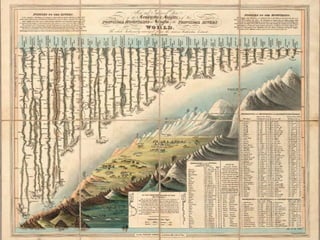
• BiblioOdyssey has a collection of maps from the 1800s
that attempt to describe the world’s rivers and
mountains, mostly by comparing their respective
lengths and heights.
• Common features of the river comparisons are:
• Noting their source and destination
• Marking cities along the path of the river
• Some of the maps also attempt to describe the
rivers’ surrounding climate (e.g., brown shading
to indicate the desert area the Nile travels
through)
• In this case, only the visualization of the rivers on one
particular map will be addressed, the “Comparative
Heights of the Principal Mountains and Lengths of the
Principal Rivers of The World” map by William Darton.
Sense-making task this design will address
• This visualization will take the map “Principal
Mountains and Lengths of the Principal Rivers” and
make the rivers explorable over a period of time. Rivers
are dynamic forces, but their long lifespan (as compared
with humans) makes it difficult to appreciate the full
impact of their changeability.
• Exploring the map over time makes it possible to see
patterns in population, climate, shapes of the rivers,
and a wide variety of other information.
Assumptions made about the visualization
• Since the map has such small detail, it is not possible to
see some labels even at high resolution; a particular
feature may be assumed missing in the map, when in
fact it’s just too small to be seen in the digital image.
Initial visualization
Interact Problem #2 / Rivers
Jennifer Stuart Lesch
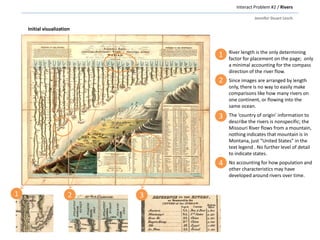
• River length is the only determining
factor for placement on the page; only
a minimal accounting for the compass
direction of the river flow.
• Since images are arranged by length
only, there is no way to easily make
comparisons like how many rivers on
one continent, or flowing into the
same ocean.
• The ‘country of origin’ information to
describe the rivers is nonspecific; the
Missouri River flows from a mountain,
nothing indicates that mountain is in
Montana, just “United States” in the
text legend . No further level of detail
to indicate states.
• No accounting for how population and
other characteristics may have
developed around rivers over time.
1
2
3
4
1 2 3
Revised visualization: Overview
Interact Problem #2 / Rivers
Jennifer Stuart Lesch
0 Length (in miles) 4000
River
River
River
River
River
River
River
River
River
River
River
River
River
River
River
River
River
River
River
River
River
River
River
River
River
River
River
River
River
River
River
River
River
River
Time
1600 2012
Ocean
Ocean
Ocean
Ocean
Ocean
Ocean
Ocean
Ocean
Ocean
Ocean
Ocean
Ocean
Ocean
Ocean
Ocean
Ocean
Ocean
Ocean
Ocean
Ocean
Ocean
Ocean
Ocean
Ocean
Ocean
Ocean
Ocean
Ocean
Ocean
Ocean
Ocean
Ocean
Ocean
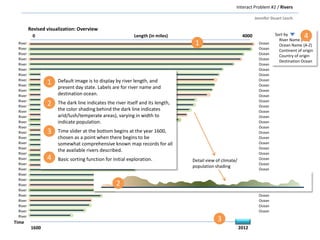
• Default image is to display by river length, and
present day state. Labels are for river name and
destination ocean.
• The dark line indicates the river itself and its length,
the color shading behind the dark line indicates
arid/lush/temperate areas), varying in width to
indicate population.
• Time slider at the bottom begins at the year 1600,
chosen as a point when there begins to be
somewhat comprehensive known map records for all
the available rivers described.
• Basic sorting function for initial exploration.
Sort by
River Name (A-Z)
Ocean Name (A-Z)
Continent of origin
Country of origin
Destination Ocean
Detail view of climate/
population shading
1
2
3
4
4
2
1
3
Revised visualization: Detail
Interact Problem #2 / Rivers
Jennifer Stuart Lesch
0 Length (in miles) 4000
Euphrates
Danube
Indus
Ganges
Orinoco
St. Lawrence
Don
Time
1600 2012
Amazon
Mississippi
Hoan-Ho
Yangtse
Nile
LaPlata
Volga
Dneiper
Senegal
Rhine
Gambia
Elbe
Vistula
Susquehanna
Oder
Tagus
Loire
Rhone
Seine
Po
Eiro
Severn
Thames
Shannon
Humber
Tay
Forth
Persian Gulf
Black Sea
Arabian Sea
Bay of Bengal
Atlantic Ocean
Gulf of St Lawrence
Sea of Azoff
Atlantic
Gulf of Mexico
Eastern
Eastern
Mediterranean
Atlantic
Caspian
Lorem Ipsum
Lorem Ipsum
Lorem Ipsum
Lorem Ipsum
Lorem Ipsum
Lorem Ipsum
Lorem Ipsum
Lorem Ipsum
Lorem Ipsum
Lorem Ipsum
Lorem Ipsum
Lorem Ipsum
Lorem Ipsum
Lorem Ipsum
Lorem Ipsum
Lorem Ipsum
Lorem Ipsum
Lorem Ipsum
Lorem Ipsum
Lorem Ipsum
Lorem Ipsum
Lorem Ipsum
1918
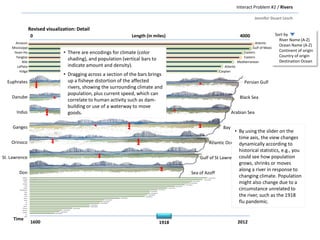
• There are encodings for climate (color
shading), and population (vertical bars to
indicate amount and density).
• Dragging across a section of the bars brings
up a fisheye distortion of the affected
rivers, showing the surrounding climate and
population, plus current speed, which can
correlate to human activity such as dam-
building or use of a waterway to move
goods.
• By using the slider on the
time axis, the view changes
dynamically according to
historical statistics, e.g., you
could see how population
grows, shrinks or moves
along a river in response to
changing climate. Population
might also change due to a
circumstance unrelated to
the river, such as the 1918
flu pandemic.
Sort by
River Name (A-Z)
Ocean Name (A-Z)
Continent of origin
Country of origin
Destination Ocean
Interact Problem #2 / Rivers
Jennifer Stuart Lesch
Revised visualization: Details
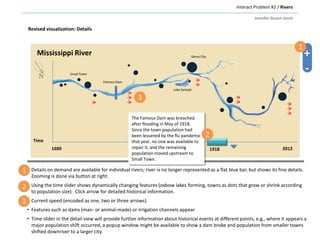
• Details on demand are available for individual rivers; river is no longer represented as a flat blue bar, but shows its fine details.
Zooming is done via button at right.
• Using the time slider shows dynamically changing features (oxbow lakes forming, towns as dots that grow or shrink according
to population size). Click arrow for detailed historical information.
• Current speed (encoded as one, two or three arrows).
• Features such as dams (man- or animal-made) or irrigation channels appear
• Time slider in the detail view will provide further information about historical events at different points, e.g., where it appears a
major population shift occurred, a popup window might be available to show a dam broke and population from smaller towns
shifted downriver to a larger city.
Time
1600 20121918
N
Demo City
Lake Sample
Famous Dam
Small Town
+
-
The Famous Dam was breached
after flooding in May of 1918.
Since the town population had
been lessened by the flu pandemic
that year, no one was available to
repair it, and the remaining
population moved upstream to
Small Town.
Mississippi River
1
3
2
1
3
2

Rivers interaction

  • 2.
    Interact Problem #2 RiverDeep Mountain High Jennifer Stuart Lesch February 22, 2012 Executive Summary Starting point visualization • BiblioOdyssey has a collection of maps from the 1800s that attempt to describe the world’s rivers and mountains, mostly by comparing their respective lengths and heights. • Common features of the river comparisons are: • Noting their source and destination • Marking cities along the path of the river • Some of the maps also attempt to describe the rivers’ surrounding climate (e.g., brown shading to indicate the desert area the Nile travels through) • In this case, only the visualization of the rivers on one particular map will be addressed, the “Comparative Heights of the Principal Mountains and Lengths of the Principal Rivers of The World” map by William Darton. Sense-making task this design will address • This visualization will take the map “Principal Mountains and Lengths of the Principal Rivers” and make the rivers explorable over a period of time. Rivers are dynamic forces, but their long lifespan (as compared with humans) makes it difficult to appreciate the full impact of their changeability. • Exploring the map over time makes it possible to see patterns in population, climate, shapes of the rivers, and a wide variety of other information. Assumptions made about the visualization • Since the map has such small detail, it is not possible to see some labels even at high resolution; a particular feature may be assumed missing in the map, when in fact it’s just too small to be seen in the digital image.
  • 3.
    Initial visualization Interact Problem#2 / Rivers Jennifer Stuart Lesch • River length is the only determining factor for placement on the page; only a minimal accounting for the compass direction of the river flow. • Since images are arranged by length only, there is no way to easily make comparisons like how many rivers on one continent, or flowing into the same ocean. • The ‘country of origin’ information to describe the rivers is nonspecific; the Missouri River flows from a mountain, nothing indicates that mountain is in Montana, just “United States” in the text legend . No further level of detail to indicate states. • No accounting for how population and other characteristics may have developed around rivers over time. 1 2 3 4 1 2 3
  • 4.
    Revised visualization: Overview InteractProblem #2 / Rivers Jennifer Stuart Lesch 0 Length (in miles) 4000 River River River River River River River River River River River River River River River River River River River River River River River River River River River River River River River River River River Time 1600 2012 Ocean Ocean Ocean Ocean Ocean Ocean Ocean Ocean Ocean Ocean Ocean Ocean Ocean Ocean Ocean Ocean Ocean Ocean Ocean Ocean Ocean Ocean Ocean Ocean Ocean Ocean Ocean Ocean Ocean Ocean Ocean Ocean Ocean • Default image is to display by river length, and present day state. Labels are for river name and destination ocean. • The dark line indicates the river itself and its length, the color shading behind the dark line indicates arid/lush/temperate areas), varying in width to indicate population. • Time slider at the bottom begins at the year 1600, chosen as a point when there begins to be somewhat comprehensive known map records for all the available rivers described. • Basic sorting function for initial exploration. Sort by River Name (A-Z) Ocean Name (A-Z) Continent of origin Country of origin Destination Ocean Detail view of climate/ population shading 1 2 3 4 4 2 1 3
  • 5.
    Revised visualization: Detail InteractProblem #2 / Rivers Jennifer Stuart Lesch 0 Length (in miles) 4000 Euphrates Danube Indus Ganges Orinoco St. Lawrence Don Time 1600 2012 Amazon Mississippi Hoan-Ho Yangtse Nile LaPlata Volga Dneiper Senegal Rhine Gambia Elbe Vistula Susquehanna Oder Tagus Loire Rhone Seine Po Eiro Severn Thames Shannon Humber Tay Forth Persian Gulf Black Sea Arabian Sea Bay of Bengal Atlantic Ocean Gulf of St Lawrence Sea of Azoff Atlantic Gulf of Mexico Eastern Eastern Mediterranean Atlantic Caspian Lorem Ipsum Lorem Ipsum Lorem Ipsum Lorem Ipsum Lorem Ipsum Lorem Ipsum Lorem Ipsum Lorem Ipsum Lorem Ipsum Lorem Ipsum Lorem Ipsum Lorem Ipsum Lorem Ipsum Lorem Ipsum Lorem Ipsum Lorem Ipsum Lorem Ipsum Lorem Ipsum Lorem Ipsum Lorem Ipsum Lorem Ipsum Lorem Ipsum 1918 • There are encodings for climate (color shading), and population (vertical bars to indicate amount and density). • Dragging across a section of the bars brings up a fisheye distortion of the affected rivers, showing the surrounding climate and population, plus current speed, which can correlate to human activity such as dam- building or use of a waterway to move goods. • By using the slider on the time axis, the view changes dynamically according to historical statistics, e.g., you could see how population grows, shrinks or moves along a river in response to changing climate. Population might also change due to a circumstance unrelated to the river, such as the 1918 flu pandemic. Sort by River Name (A-Z) Ocean Name (A-Z) Continent of origin Country of origin Destination Ocean
  • 6.
    Interact Problem #2/ Rivers Jennifer Stuart Lesch Revised visualization: Details • Details on demand are available for individual rivers; river is no longer represented as a flat blue bar, but shows its fine details. Zooming is done via button at right. • Using the time slider shows dynamically changing features (oxbow lakes forming, towns as dots that grow or shrink according to population size). Click arrow for detailed historical information. • Current speed (encoded as one, two or three arrows). • Features such as dams (man- or animal-made) or irrigation channels appear • Time slider in the detail view will provide further information about historical events at different points, e.g., where it appears a major population shift occurred, a popup window might be available to show a dam broke and population from smaller towns shifted downriver to a larger city. Time 1600 20121918 N Demo City Lake Sample Famous Dam Small Town + - The Famous Dam was breached after flooding in May of 1918. Since the town population had been lessened by the flu pandemic that year, no one was available to repair it, and the remaining population moved upstream to Small Town. Mississippi River 1 3 2 1 3 2