RISK MANAGEMENT AS APPLIED TO
SAFETY, SECURITY AND
SANITATION
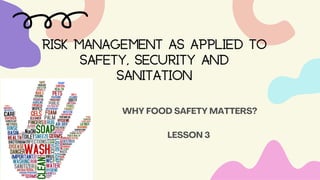
WHY FOOD SAFETY MATTERS?
LESSON 3
LEARNING OBJECTIVES
EXPLAINWHYFOODSAFETYMATTERS
IDENTIFYTHEDANGERSBROUGHTBYFOODBORNE
ILLNESSTOINDIVIDUAL,ESTABLISHMENT,COMMUNITYANDECONOMICCOST
IDENTIFYTHESTEPSTOFOODSAFETYGUIDE
1.
2.
3.
4.
Everydayineverycountrypeoplefallillfromthefood
theyhaveeaten.Thesefoodborne illnessesarecausedby
dangerousmicro-organismsand/ortoxicchemicals.Even
though governmentsthroughouttheworlddotheirutmost
toimprovethesafetyandqualityof food,thehigh
numberoffoodborneillnessesisamajorpublichealth
issueforallcountries.
Foodsafety-
isascientificdisciplinedescribinghandling,preparation,and
storageoffoodinwaysthatpreventfood-borneillness.The
occurrenceoftwoormorecasesofasimilarillnesses
resultingfromtheingestionofacommonfoodisknownasa
food-bornediseaseoutbreak
Food–borneillness
-iscausedbyconsumingcontaminatedfoodsorbeverages.Most
food-bornediseasesareinfectionscausedbybacteria,virusesand
parasites. Otheriscausedbyharmfulbacteria
Mostofusconsiderfoodbornediseasesmildascomparedother
medicalconditions.Westillcannotseethewholeimpactofthisuntil
weseethechronicandmoreseriousconditionsandcomplicationsthat
wouldaffectour organsandothersystem(Buzby&Roberts,2009).
WorldHealthOrganizationestimatesmorethan2millionpeopledie
becauseoffoodborneillnessbroughtbyeatinganddrinking
contaminatedfoodsandbeverage.Healthisanessentialelementin
humanproductivitythatwouldgreatlyaffecteconomicdevelopmentof
acountry.
COSTOFFOODBORNEILLNESS
AccordingtonewstudypublishedinJournalofFoodProtection,FBI
estimates77.7billiondollarseconomicburdensannuallyinU.S.
3000deaths
28,000hospitalized
AccordingtoWorldHealthOrganization(WHO)Newfoodcontaining
harmfulmicroorganisms,parasitesorchemicalsarenowcontributing
tomorethan200diseases.
CASESINTERACTINGFACTORS
thegrowingnumberofoperatorswhointerveneinthefoodchainbetweentheprimary
producerandtheconsumer
thegrowingnumberofoperatorswhointerveneinthefoodchainbetweentheprimary
producerandtheconsumer;
achangeinthewayfoodispreparedandconsumed:shortercookingtimes,more
consumptionofrawproductseitherfortasteortosavetime,lesscanningandmore
freezing,morefermentedproducts,cold-smokedfish,andsoon;
CASESINTERACTINGFACTORS
moreconsumptionoutsidethehomeinrestaurants,canteens,etc.;
morepreparationoffood,ready-to-cookorreadytoeat;
greatersensitivityofproductstospoilage(e.g.:lesssaltorsugarused);
increaseddemandformeatorfish,whicharemorepronetocontamination;
longerfoodpreservationperiodsduetothecomplexityofthefoodchainand
greaterdistancebetweenthefieldandtheconsumer'stable;
CASESINTERACTINGFACTORS
alargerquantityoffoodinvolvedasaresultofindustrialisationofthe
agrifoodchain andcentralizationofdistributionsystems;
moreinternationaltrade,moretransportandstorage,whichoffersfewer
guaranteesthatthecoldchainhasbeenmaintained;
betterdetectionofbacterialcontamination(morecasesarereported);
moreexoticproductsinthediet;
lessrespectforgrowingseasons
MainFactorsleadingtofoodborneillness
outbreak
Contaminationofrawmaterials -54%
Non-respectforthecoldchainduringmealpreparation-40%
Errorinthepreparationprocess -35%
Toomuchtimebetweenpreparationandconsumption- 25%
Contaminationbyequipment-21%
Contaminationbyemployees-17%
Non-respectforthehotchain-14%
MaintainGuestSafety
Toavoidthelossesofbusinesses
ToavoidLawSuits
toMaintaintheguesttrust
toMaintainqualityStandards
reasonswhywestudyFoodSafety
CONTAMINANT
Asubstancethatmaybeharmfulthathasaccidentallygottenintofood.
MICROORGANISM
Alivingsubstancesosmallitcanbeseenonlyunderamicroscope.
ManycontaminatedfoodsDONOTlookorsmellspoiled,buttheycanstill
causeillness.
BACTERIA
Asingle-celledornon-cellularmicroorganism.Theylivealmost
everywhere.Theyarenotallharmful;sometypesofharmless
bacteriaarenormallyfoundinfoods.
Foodcanbecomecontaminatedwithharmfulbacteriaatanypoint
fromfarmtothetable.
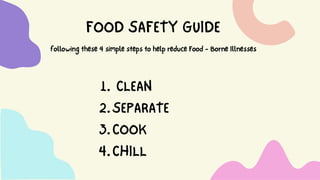
FOODSAFETYGUIDE
followingthese4simplestepstohelpreduceFood-BorneIllnesses
CLEAN
SEPARATE
COOK
CHILL
1.
2.
3.
4.
CLEAN
Before,duringandafteryou
preparefood,washyourhands
withsoapandwaterforatleast
20seconds.
Keepworkareaclean.
CLEAN
Washutensils,cuttingboards,andcounter
topswithhotsoapywater.
Afterhandlingrawmeat,fish,poultry,oreggs,
washhandsthoroughlybeforetouchingother
foods.
CLEAN
Rinsefreshfruitsandvegetablesunderrunning
waterbeforeeatingorcutting
Removedirtyutensilsfromyourworkarea
beforeproceedingtothenexttask.
Neverstoresacksofonionsorpotatoes,canned
goods,etc.undersink.
Usepapertowelstowipeupjuicesfromraw
meatandpoultry.
CLEAN
Ifyouhaveanopensoreorcutonyourhand,put
onglovesbeforehandlingfood.
Designatethekitchenasanonsmokingarea.
Covercoughs/sneezeswithdisposabletissue.Wash
handsimmediately.
Disposeofgarbageproperlyandpromptly.
SEPARATE
Separatecookedandready-to-eatfoodsfromrawfoods.
Cross-contamination-occurswhenharmfulbacteriafrom
onefoodaretransferredtoanotherfood.
Putrawpoultry,meat,andseafoodinseparateplasticbags
beforeplacingtheminyourshoppingcart.
SEPARATE
Storerawpoultry,meat,andseafoodincontainerstokeep
themseparatefromotherfoodsintherefrigerator.
Donottasteandcookwiththesamespoon.
Usecleanutensilsandcontainers.
Neveruseahandtoweltowipethedishes.
Useseparatecuttingboards,platesandkniveswhen
preparingmeat
SEPARATE
cHOPPINGBOARDCOLOR
CODING
Nevertasteanyfoodthatlooksorsmells
questionable.*Whenindoubt-throwitout.
Storenon-perishablesintightlysealedcontainerstokeep
themfreshandfreefrominsectsandrodents.
SEPARATE
Useameatthermometertoensurefood iscookedtoasafe
internaltemperaturebeforeconsuming
Rawmeat,poultry,seafood,andeggscancontainharmful
bacteria.
Disposeanybulging,leaking,orotherwisedamagedcontainer
offood.
COOK
Donoteatrawcookiedoughortastepartiallycookeddishes
containingmeat,poultry,fish,oreggs.
Useonlyclean,fresh,unbrokeneggsforeggnog,custard,and
othereggdishes.
Boillow-acid,home-cannedfoodsfor10-20minutesbefore
tasting.
COOK
Donoteatrawcookiedoughortastepartiallycookeddishes
containingmeat,poultry,fish,oreggs.
Useonlyclean,fresh,unbrokeneggsforeggnog,custard,and
othereggdishes.
Boillow-acid,home-cannedfoodsfor10-20minutesbefore
tasting.
COOK
COOK
Chillingfoodspromptlyafterbuyingorservingthem
willkeepharmfulbacteriafrommultiplying.
Keepcoldfoodscold–below40degrees.
Bacteriamultiplyfastestattemperaturesbetween
60and126degrees.*Neverallowfoodtositout
morethantwohours.
Refrigerateleftoverspromptly
CHILL
Thawfoodintherefrigeratororinthemicrowave
ovenimmediatelybeforecooking.-Donotthawon
thekitchencounterortable.
Keeprefrigeratorandfreezerclean.
Packagerefrigeratorandfrozenfoodsproperly.
(Moistureandvaporproof)
CHILL
CHILL
Useshallowcontainersforrefrigeratorstorageto
helpfoodsreachsafe,cool,temperaturesfaster.
Donotrefreezefoodsunlesstheystillcontainice
crystals.
Putperishableitemsinyourshoppingcartlast.
toreinforceandcontinuallyupdatetheregulatoryframeworktoreflect
technical changesandtheresultsofriskanalyses;
foroperatorstoorganiseself-evaluationandriskcontrolsystemsbasedon
HACCP principles;
toidentifythedatatoberecordedtoensureproducttraceability:tobeable
totracethehistory,destinationororiginofaproduct;
toguaranteeapplicationofthesemeasuresthroughinspections,monitoring
plans,andinternalandexternalaudits.
Toensurethatfoodisharmlessandrestoreconsumers'confidenceandsenseof
security,itisnecessary:
Confidencecanonlyberestoredwhen:
1.Foodhygieneisguaranteed(bytakingmeasuresand
organisingtheconditionsto preventhazardsandensurethat
foodproductsaresuitableforconsumption).
2.Foodsafetyisguaranteed(byusingproductionmodesthat
assurethatthefoodisnotharmfultohealth:goodpractices
andqualitystrategies).
3. Effortsaretakentoprovidecorrectinformationtoall
stakeholdersandthepopulationingeneral(information,
traceability,withdrawalandrecallprocedures).
4.Allactorsinthefoodchainadoptanapproachtowards
foodsafetythatentailsa continuityofresponsibility
throughthewholelifecycleoftheproduct,inother
wordsfrom farmtofork
RISK MANAGEMENT - MODULE 3.pdf

RISK MANAGEMENT - MODULE 3.pdf