An Introduction to Food Safety
Foodborne illness
• Defined as a disease or illness
transmitted to people by food
• When 2 or more people get
sick with the same illness after
eating the same food it is
called a foodborne illness
outbreak
Foodborne illness
• While the foodservice industry does well to
provide safe food to its customers,
foodborne illness happens.
• Foodborne Illness cost the US billions of
dollars each year and according to the
National Restaurant Association (NRA) just
one outbreak can cost an individual
restaurant thousands of dollars.
Cost of Foodborne Illness
• Foodborne Illness can come at a huge cost to
a restaurant including:
– Losing customers and sales
– Negative news coverage
– Lawsuits and associated legal fees
– Increased insurance cost
– Loss of good reputation
– Lowered employee morale
– Staff retraining
– Employee absenteeism
The Human Cost
• According to the Centers for Disease
Control and Prevention (CDC) there are
approximately 76 million cases of
foodborne illness each year.
• Of the 76 million cases more than
300,000 will need to be hospitalized
and 5,000 of these individuals will die.
• Thankfully with proper training and
adherence you can do your part to
prevent foodborne illness.
High-Risk Populations
• Some people are at higher
risk for contracting a
foodborne illness. These
groups are considered high-
risk.
• High-risk groups have
weakened immune systems,
therefore operations that
serve these individuals must
follow special rules.
• Because you never know who
you may be serving food
safety is of upmost
importance!
High-Risk Populations
• High-risk populations include people who:
– Are elderly
– Infants and pre-school age children
– People with cancer, receiving chemotherapy,
those with HIV/AIDS, transplant recipients, or
other general immune deficiency
Even if a high-risk individual survives the illness; the effect can be lasting
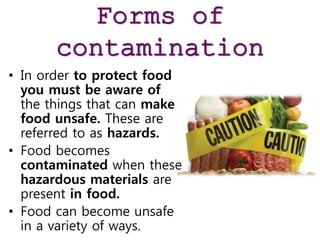
Forms of
contamination
• In order to protect food
you must be aware of
the things that can make
food unsafe. These are
referred to as hazards.
• Food becomes
contaminated when these
hazardous materials are
present in food.
• Food can become unsafe
in a variety of ways.
HOW FOOD BECOMES
UNSAFE
• Poor personal hygiene transfers
pathogens from your body to food.
• Time-temperature abuse allows foods
to stay at temperatures that allows
pathogens to grow
• Cross-contamination transfers
pathogens from one surface or food to
another
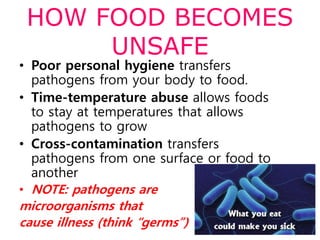
• NOTE: pathogens are
microorganisms that
cause illness (think “germs”)
Biological
Contamination
• Pathogens are the biggest threat to
food safety.
• There are 4 types of pathogens that can
contaminate food. They include:
– Viruses
– Bacteria
– Parasites
– Fungi
HOW FOOD BECOMES
UNSAFE
• Poor cleaning and sanitizing can allow
contaminated surfaces to have contact with
food
• Purchasing food from unapproved suppliers
can allow unsafe foods into the operation.
Biological
Contamination
• While they often cannot be
seen, viruses, present in
food can cause illness.
• Some fungi though, like
mold, can change the
appearance of food, but
may not cause illness.
There are many ways to fight
contamination!
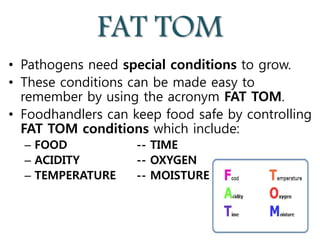
FAT TOM
• Pathogens need special conditions to grow.
• These conditions can be made easy to
remember by using the acronym FAT TOM.
• Foodhandlers can keep food safe by controlling
FAT TOM conditions which include:
– FOOD -- TIME
– ACIDITY -- OXYGEN
– TEMPERATURE -- MOISTURE
FAT…
• FOOD: Pathogens need an
energy source; food provides
this.
• ACIDITY: Pathogens grow best
in food that have little or no
acid. Acid levels between 4.6-
7.5 are most ideal for
pathogen growth.
• TEMPERATURE: Temperatures
between 41*F and 135*F allow
pathogens to grow at rapid
rates. This temperature range is
referred to as the temperature
danger zone (TDZ).
TOM
• Time: Pathogens need time to
grow. When food is in the TDZ,
pathogens grow rapidly. It takes
about 4 hours for pathogen
growth to reach levels that can
make someone sick.
• Oxygen: Some pathogens need
oxygen to grow. Other can grow
without it.
• Moisture: Pathogens need
moisture in food to grow.
Therefore, foods like tomatoes
and melons easily support
pathogen growth.
TCS FOODS
• Some foods are more vulnerable to
pathogen growth than others. These
foods require greater control of time
and temperature when handling and are
referred to as TCS or Time-Temperature
for Safety foods.
TCS FOODS
• Foods most likely to become unsafe or TCS foods
include:
– Milk and Dairy Products
– Meat; beef, pork, lab
– Eggs
– Poultry
– Fish
– Shellfish
TCS FOODS
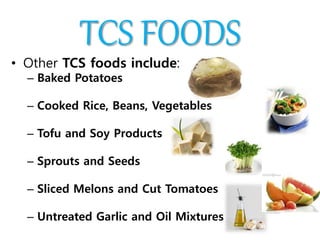
• Other TCS foods include:
– Baked Potatoes
– Cooked Rice, Beans, Vegetables
– Tofu and Soy Products
– Sprouts and Seeds
– Sliced Melons and Cut Tomatoes
– Untreated Garlic and Oil Mixtures
CHEMICAL
CONTAMINATION
• Restaurants use lots of chemicals to keep
things clean. Unfortunately these cleaners,
sanitizers, polishes, and machine lubricants
can contaminate food and cause
foodborne illness.
• For this reason it is important that
chemicals are stored separately from food
and that you follow manufacturers
guidelines for use at all times.
Physical Contamination
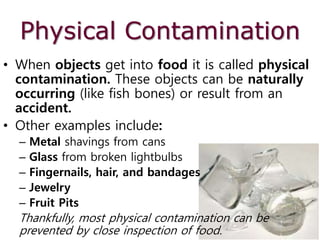
• When objects get into food it is called physical
contamination. These objects can be naturally
occurring (like fish bones) or result from an
accident.
• Other examples include:
– Metal shavings from cans
– Glass from broken lightbulbs
– Fingernails, hair, and bandages
– Jewelry
– Fruit Pits
Thankfully, most physical contamination can be
prevented by close inspection of food.
Keep It SAFE!
• As you can see, there are many potential hazards
to food safety. As a foodhandler it is your
responsibility to be aware of these hazards and
follow proper protocol to avoid them.
• The cost of serving and/or eating unsafe food is
too great to risk it. Anytime you have a question
or are unsure of the safety of something you are
preparing or serving, ask your instructor or
supervisor immediately!

HEALTH 4.pdf

  • 1.
    An Introduction toFood Safety
  • 2.
    Foodborne illness • Definedas a disease or illness transmitted to people by food • When 2 or more people get sick with the same illness after eating the same food it is called a foodborne illness outbreak
  • 3.
    Foodborne illness • Whilethe foodservice industry does well to provide safe food to its customers, foodborne illness happens. • Foodborne Illness cost the US billions of dollars each year and according to the National Restaurant Association (NRA) just one outbreak can cost an individual restaurant thousands of dollars.
  • 4.
    Cost of FoodborneIllness • Foodborne Illness can come at a huge cost to a restaurant including: – Losing customers and sales – Negative news coverage – Lawsuits and associated legal fees – Increased insurance cost – Loss of good reputation – Lowered employee morale – Staff retraining – Employee absenteeism
  • 5.
    The Human Cost •According to the Centers for Disease Control and Prevention (CDC) there are approximately 76 million cases of foodborne illness each year. • Of the 76 million cases more than 300,000 will need to be hospitalized and 5,000 of these individuals will die. • Thankfully with proper training and adherence you can do your part to prevent foodborne illness.
  • 6.
    High-Risk Populations • Somepeople are at higher risk for contracting a foodborne illness. These groups are considered high- risk. • High-risk groups have weakened immune systems, therefore operations that serve these individuals must follow special rules. • Because you never know who you may be serving food safety is of upmost importance!
  • 7.
    High-Risk Populations • High-riskpopulations include people who: – Are elderly – Infants and pre-school age children – People with cancer, receiving chemotherapy, those with HIV/AIDS, transplant recipients, or other general immune deficiency Even if a high-risk individual survives the illness; the effect can be lasting
  • 8.
    Forms of contamination • Inorder to protect food you must be aware of the things that can make food unsafe. These are referred to as hazards. • Food becomes contaminated when these hazardous materials are present in food. • Food can become unsafe in a variety of ways.
  • 9.
    HOW FOOD BECOMES UNSAFE •Poor personal hygiene transfers pathogens from your body to food. • Time-temperature abuse allows foods to stay at temperatures that allows pathogens to grow • Cross-contamination transfers pathogens from one surface or food to another • NOTE: pathogens are microorganisms that cause illness (think “germs”)
  • 10.
    Biological Contamination • Pathogens arethe biggest threat to food safety. • There are 4 types of pathogens that can contaminate food. They include: – Viruses – Bacteria – Parasites – Fungi
  • 11.
    HOW FOOD BECOMES UNSAFE •Poor cleaning and sanitizing can allow contaminated surfaces to have contact with food • Purchasing food from unapproved suppliers can allow unsafe foods into the operation.
  • 12.
    Biological Contamination • While theyoften cannot be seen, viruses, present in food can cause illness. • Some fungi though, like mold, can change the appearance of food, but may not cause illness. There are many ways to fight contamination!
  • 13.
    FAT TOM • Pathogensneed special conditions to grow. • These conditions can be made easy to remember by using the acronym FAT TOM. • Foodhandlers can keep food safe by controlling FAT TOM conditions which include: – FOOD -- TIME – ACIDITY -- OXYGEN – TEMPERATURE -- MOISTURE
  • 14.
    FAT… • FOOD: Pathogensneed an energy source; food provides this. • ACIDITY: Pathogens grow best in food that have little or no acid. Acid levels between 4.6- 7.5 are most ideal for pathogen growth. • TEMPERATURE: Temperatures between 41*F and 135*F allow pathogens to grow at rapid rates. This temperature range is referred to as the temperature danger zone (TDZ).
  • 15.
    TOM • Time: Pathogensneed time to grow. When food is in the TDZ, pathogens grow rapidly. It takes about 4 hours for pathogen growth to reach levels that can make someone sick. • Oxygen: Some pathogens need oxygen to grow. Other can grow without it. • Moisture: Pathogens need moisture in food to grow. Therefore, foods like tomatoes and melons easily support pathogen growth.
  • 16.
    TCS FOODS • Somefoods are more vulnerable to pathogen growth than others. These foods require greater control of time and temperature when handling and are referred to as TCS or Time-Temperature for Safety foods.
  • 17.
    TCS FOODS • Foodsmost likely to become unsafe or TCS foods include: – Milk and Dairy Products – Meat; beef, pork, lab – Eggs – Poultry – Fish – Shellfish
  • 18.
    TCS FOODS • OtherTCS foods include: – Baked Potatoes – Cooked Rice, Beans, Vegetables – Tofu and Soy Products – Sprouts and Seeds – Sliced Melons and Cut Tomatoes – Untreated Garlic and Oil Mixtures
  • 19.
    CHEMICAL CONTAMINATION • Restaurants uselots of chemicals to keep things clean. Unfortunately these cleaners, sanitizers, polishes, and machine lubricants can contaminate food and cause foodborne illness. • For this reason it is important that chemicals are stored separately from food and that you follow manufacturers guidelines for use at all times.
  • 20.
    Physical Contamination • Whenobjects get into food it is called physical contamination. These objects can be naturally occurring (like fish bones) or result from an accident. • Other examples include: – Metal shavings from cans – Glass from broken lightbulbs – Fingernails, hair, and bandages – Jewelry – Fruit Pits Thankfully, most physical contamination can be prevented by close inspection of food.
  • 21.
    Keep It SAFE! •As you can see, there are many potential hazards to food safety. As a foodhandler it is your responsibility to be aware of these hazards and follow proper protocol to avoid them. • The cost of serving and/or eating unsafe food is too great to risk it. Anytime you have a question or are unsure of the safety of something you are preparing or serving, ask your instructor or supervisor immediately!