©2004-2007–Derrell S. James Slide 1
Derrell S. James
Vice President of Operations
Genicon
Winter Park, Florida
From MultiNational to Start-Up:
Social and Technical
Lean Transformation for
ANY Business
©2004-2007–Derrell S. James Slide 2
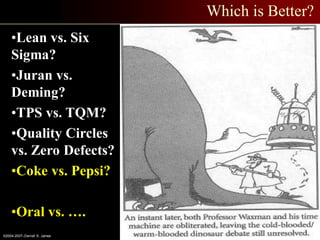
Which is Better?
•Lean vs. Six
Sigma?
•Juran vs.
Deming?
•TPS vs. TQM?
•Quality Circles
vs. Zero Defects?
•Coke vs. Pepsi?
•Oral vs. ….
©2004-2007–Derrell S. James Slide 3
1st Principle - Friction
Everything in business is very simple, but the simplest
thing is difficult. The difficulties accumulate and produce a
kind of friction that is inconceivable unless one has
experienced business….
Countless minor incidents - the kind you can never really
foresee - combine to lower the general level of
performance, so that one always falls short of the
intended goal….
Friction is the only concept that more or less corresponds
to the factors that distinguish real business from business
on paper.
©2004-2007–Derrell S. James Slide 4
1st Principle - Friction
Everything in war is very simple, but the simplest thing is
difficult. The difficulties accumulate and produce a kind of
friction that is inconceivable unless one has experienced
war….
Countless minor incidents - the kind you can never really
foresee - combine to lower the general level of
performance, so that one always falls short of the
intended goal….
Friction is the only concept that more or less corresponds
to the factors that distinguish real war from war on paper.
- Adapted from Carl von Clausewitz, On War
©2004-2007–Derrell S. James Slide 5
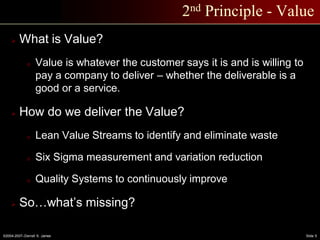
2nd Principle - Value
 What is Value?
o Value is whatever the customer says it is and is willing to
pay a company to deliver – whether the deliverable is a
good or a service.
 How do we deliver the Value?
o Lean Value Streams to identify and eliminate waste
o Six Sigma measurement and variation reduction
o Quality Systems to continuously improve
 So…what’s missing?
©2004-2007–Derrell S. James Slide 6
Exercise
Think about the best value in a
system, product, process, or service
you’ve ever experienced…
©2004-2007–Derrell S. James Slide 7
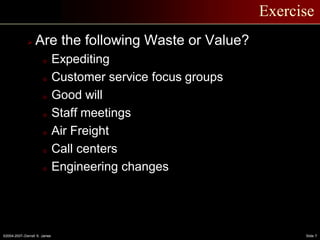
Exercise
 Are the following Waste or Value?
o Expediting
o Customer service focus groups
o Good will
o Staff meetings
o Air Freight
o Call centers
o Engineering changes
©2004-2007–Derrell S. James Slide 8
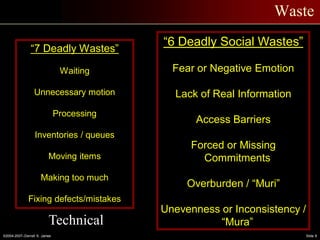
Waste
“7 Deadly Wastes”
Waiting
Unnecessary motion
Processing
Inventories / queues
Moving items
Making too much
Fixing defects/mistakes
“6 Deadly Social Wastes”
Fear or Negative Emotion
Lack of Real Information
Access Barriers
Forced or Missing
Commitments
Overburden / “Muri”
Unevenness or Inconsistency /
“Mura”Technical
©2004-2007–Derrell S. James Slide 9
What NOT to Do
 NBA Changes the Basketball
o Did wrong:
 No employee input
 No value case for change
o Did right:
 Reversed decision quickly
 Admitted the error
 Took accountability
©2004-2007–Derrell S. James Slide 10
What NOT to Do
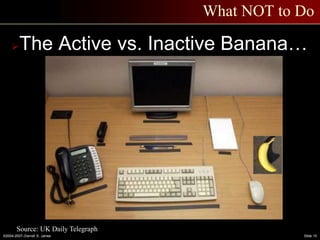
The Active vs. Inactive Banana…
Source: UK Daily Telegraph
©2004-2007–Derrell S. James Slide 11
What NOT to Do
 Business Week (January 2006):
o “He believes in a command-and-control organization…Skip the
touchy-feely stuff. The organization is thriving under CEOs military-
style rule.”
o He is trying to build a disciplined corps, one predisposed to following
orders...
o He is well known for “Gemba walks” to connect with his employees
o "He's the hardest-working guy you'll ever see," says his former boss,
Jack Welch. "If I was working late at GE and wanted to feel good at 9
p.m., I would pick up the phone and call him. He would always be
there.“
WHO IS HE? Bob Nardelli, former CEO of
Home Depot fired…with a $210 million dollar
parachute and investors in uproar
Source: Newsweek – Jan 2006
©2004-2007–Derrell S. James Slide 12
What NOT to Do
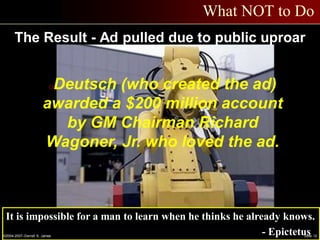
The Result - Ad pulled due to public uproar
oDeutsch (who created the ad)
awarded a $200 million account
by GM Chairman Richard
Wagoner, Jr. who loved the ad.
It is impossible for a man to learn when he thinks he already knows.
- Epictetus
©2004-2007–Derrell S. James Slide 13
What NOT to Do
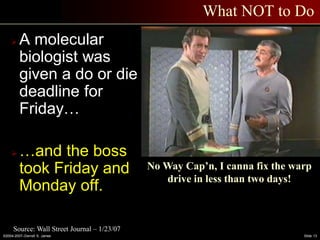
 A molecular
biologist was
given a do or die
deadline for
Friday…
 …and the boss
took Friday and
Monday off.
No Way Cap’n, I canna fix the warp
drive in less than two days!
Source: Wall Street Journal – 1/23/07
©2004-2007–Derrell S. James Slide 14
What NOT to Do
 Mark Fields, President of Ford Americas:
o "We’re changing our culture to adopt a change or die
mentality that is rejecting business as usual.“
o "We are making sacrifices at every level."
 Then Mr. Fields uses the corporate jet every Friday to fly his
family from Detroit to their home in Boca Raton at a cost of
$7000/hour plus crew expenses, or app. $50K/year
 A TV reporter sums it up:
Ford refuses to confirm or deny a figure, but it certainly
could be the cost of one worker’s job every week Fields
flies.
Source: Business Week Online – Dec 18, 2006
©2004-2007–Derrell S. James Slide 15
What NOT to Do
 Bing Lantis, president & CEO of Columbia Aircraft
o “The decision to adopt Lean Manufacturing principles was made 12
months ago. However the short-term need to rapidly increase
production in order to meet growing demand and reduce the backlog
superseded the Lean initiative. This meant adding more production
employees, increasing the footprint of the manufacturing facility &
increasing inventories. That phase is complete and daily production
volume is commensurate with demand. Now a Lean Manufacturing
team will help Columbia improve efficiency across all manufacturing
operations.”
Source: Aero-News Network: Columbia Aircraft Puts Bend Factory On A Diet
“Good business leaders create a vision, articulate the vision,
passionately own the vision, and relentlessly drive it to completion.
- Jack Welch
©2004-2007–Derrell S. James Slide 16
What TO Do
 Jim Womack Audio Interview on Bloomberg.com
 What keeps Toyota’s CEO up at night:
o “Well, first off Toyota worries. You go talk to them… and
they’re always worrying… and the first thing they want to
talk about it how bad things are, how many problems
they’ve got, what they’re obsessing about. Whoa. That’s
a mental trait, that the paranoid do survive… they simply
worry more than anyone I know.”
Source: Bloomberg.com
©2004-2007–Derrell S. James Slide 17
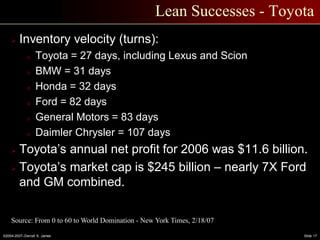
Lean Successes - Toyota
 Inventory velocity (turns):
o Toyota = 27 days, including Lexus and Scion
o BMW = 31 days
o Honda = 32 days
o Ford = 82 days
o General Motors = 83 days
o Daimler Chrysler = 107 days
 Toyota’s annual net profit for 2006 was $11.6 billion.
 Toyota’s market cap is $245 billion – nearly 7X Ford
and GM combined.
Source: From 0 to 60 to World Domination - New York Times, 2/18/07
©2004-2007–Derrell S. James Slide 18
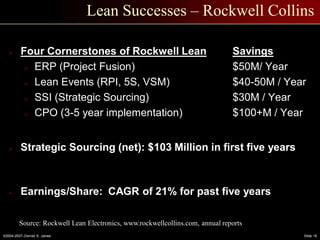
Lean Successes – Rockwell Collins
 Four Cornerstones of Rockwell Lean Savings
o ERP (Project Fusion) $50M/ Year
o Lean Events (RPI, 5S, VSM) $40-50M / Year
o SSI (Strategic Sourcing) $30M / Year
o CPO (3-5 year implementation) $100+M / Year
 Strategic Sourcing (net): $103 Million in first five years
 Earnings/Share: CAGR of 21% for past five years
Source: Rockwell Lean Electronics, www.rockwellcollins.com, annual reports
©2004-2007–Derrell S. James Slide 19
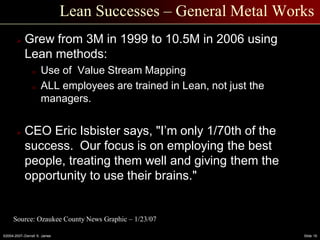
Lean Successes – General Metal Works
 Grew from 3M in 1999 to 10.5M in 2006 using
Lean methods:
o Use of Value Stream Mapping
o ALL employees are trained in Lean, not just the
managers.
 CEO Eric Isbister says, "I’m only 1/70th of the
success. Our focus is on employing the best
people, treating them well and giving them the
opportunity to use their brains."
Source: Ozaukee County News Graphic – 1/23/07
©2004-2007–Derrell S. James Slide 20
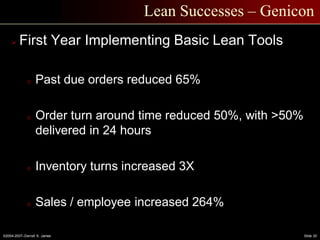
Lean Successes – Genicon
 First Year Implementing Basic Lean Tools
o Past due orders reduced 65%
o Order turn around time reduced 50%, with >50%
delivered in 24 hours
o Inventory turns increased 3X
o Sales / employee increased 264%
©2004-2007–Derrell S. James Slide 21
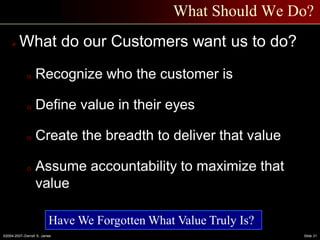
What Should We Do?
 What do our Customers want us to do?
o Recognize who the customer is
o Define value in their eyes
o Create the breadth to deliver that value
o Assume accountability to maximize that
value
Have We Forgotten What Value Truly Is?
©2004-2007–Derrell S. James Slide 22
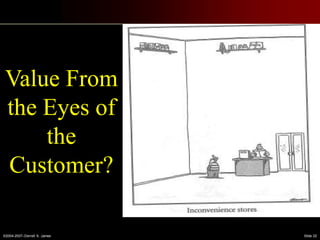
Value From
the Eyes of
the
Customer?
©2004-2007–Derrell S. James Slide 23
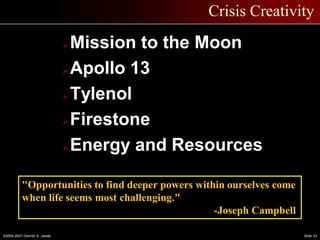
Crisis Creativity
Mission to the Moon
Apollo 13
Tylenol
Firestone
Energy and Resources
"Opportunities to find deeper powers within ourselves come
when life seems most challenging."
-Joseph Campbell
©2004-2007–Derrell S. James Slide 24
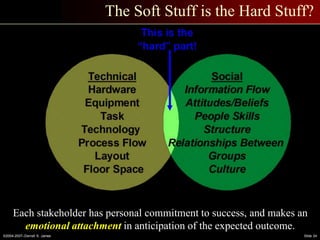
The Soft Stuff is the Hard Stuff?
Each stakeholder has personal commitment to success, and makes an
emotional attachment in anticipation of the expected outcome.
©2004-2007–Derrell S. James Slide 25
Incorporating the Social into VSM
 Define interactions along the lifecycle
o Scrutinize situations that reduce value, add waste, or remove the
passion for success
 Evaluate the relationships
o Describe the relationships between departments, and with suppliers
or customers - cordial, collaborative, adversarial, non-existent?
o Describe the personalities of the people involved in the relationships
– are they proactive or reactive, responsive or procrastinators, talkers
or listeners? How can the relationship be improved?
 Assess other potential flows
o Enabling infrastructures (IT, e-Business, human resources,
accounting)
o External influences (societal, environmental, political)
o De-stabilizing forces (policies, laws, demographics, trends, etc.)
©2004-2007–Derrell S. James Slide 26
Ideal Social State
 Work and information on demand
 Single-piece flow
 Defect free work
 Lowest possible personal cost
 Committed and capable organization
 Autonomous decision making
 Rewards linked to performance
 Goals aligned to Value
 Seamless communications
Dream no small dreams for they have no power to move the
hearts of men.
- Goethe
©2004-2007–Derrell S. James Slide 27
Social Lesson Learned 1
 Do you understand your true business?
o Companies think that their business is the delivery of the
product or specific service produced by the company.
o Customers value more than what your company delivers…
o Companies must think on the level of relationships.
 Suggestion: Search for “enabling” products/services
o Deliver process readiness rather than repair
o Perform joint value stream maps to search for opportunities
©2004-2007–Derrell S. James Slide 28
Social Lesson Learned 2
 Have you identified the friction points between
employees, customers, and vendors?
o One to one relationships are not always possible, and this
introduces friction that can slow or damage opportunities.
o Social stream mapping ensures that friction points
analyzed prior to initiation of the relationship.
 Suggestion: Interview the customer or supplier
o Are you hard to work with? Get examples
o Can we measure our performance better?
o Can we meet regularly to discuss? Can we set a
Cadence?
o What else can I do for you?
©2004-2007–Derrell S. James Slide 29
Social Lesson Learned 3
 Have you identified ALL the waste – including social
wastes – in your company?
o The personality of the company, and the interaction of
people
o Engage and analyze the issues that inhibit the
effectiveness, and readiness of processes.
 Suggestion: Perform a social stream mapping
o Have there been recent layoffs, reorganization, or rapid
growth and new requirements?
o Have job responsibilities recently shifted that will place
your employees in difficult positions?
o Are there “psychic wastes” creeping into the system?
©2004-2007–Derrell S. James Slide 30
Social Lesson Learned 4
 Does every person in the organization understand
how to think and act for success?
o In terms acceptable to the company and customer.
o Solutions tailored to specific needs.
o Products and services must be flexible, and adaptable to
success criteria.
 Suggestion: Determine the success criteria
o Create instructions, metrics, and communications
methods that allow that success to be understood
o Define acceptable behaviors and actions – values for
success
o Create a cadence
©2004-2007–Derrell S. James Slide 31
Social Lesson Learned 5
 Are your processes mature? Are your people
mature? Is there a difference?
o We have the best people in the industry….really?
o We have world class processes….really?
o We ensure total customer satisfaction….really?
 Maturity…
o Cannot be bought or sold.
o Is based on the thoughtful application of relationships,
goals and metrics, and a relentless drive to perfection.
o Regardless of Lean, Six Sigma, or other method, success
for the growing company hinges most on the quick
ascension towards maturity.
©2004-2007–Derrell S. James Slide 32
Social Lesson Learned 7
 Do your metrics and requirements drive the right
behaviors?
o “All things measured improve”.
o Lack of trust is not due to the size of the company, but to
the lack of accountability, visibility, and measurable
results.
 Suggestion: Understand what creates trust…
o Embrace the interaction of metrics and behaviors.
o Communicate honestly – even if it hurts.
o Admit when you’re wrong…ask for help
o Tell the truth
©2004-2007–Derrell S. James Slide 33
Closing
The “3 Things A Spouse Wants
to Hear the Most”
©2004-2007–Derrell S. James Slide 34
Thank You!
For More Information, Contact Derrell James at:
Genicon
6869 Stapoint Court #114
Winter Park, Florida 32792
407-657-4851
www.geniconendo.com
dsj@geniconendo.com

ASQ_Presentation_-_Feb2007

  • 1.
    ©2004-2007–Derrell S. JamesSlide 1 Derrell S. James Vice President of Operations Genicon Winter Park, Florida From MultiNational to Start-Up: Social and Technical Lean Transformation for ANY Business
  • 2.
    ©2004-2007–Derrell S. JamesSlide 2 Which is Better? •Lean vs. Six Sigma? •Juran vs. Deming? •TPS vs. TQM? •Quality Circles vs. Zero Defects? •Coke vs. Pepsi? •Oral vs. ….
  • 3.
    ©2004-2007–Derrell S. JamesSlide 3 1st Principle - Friction Everything in business is very simple, but the simplest thing is difficult. The difficulties accumulate and produce a kind of friction that is inconceivable unless one has experienced business…. Countless minor incidents - the kind you can never really foresee - combine to lower the general level of performance, so that one always falls short of the intended goal…. Friction is the only concept that more or less corresponds to the factors that distinguish real business from business on paper.
  • 4.
    ©2004-2007–Derrell S. JamesSlide 4 1st Principle - Friction Everything in war is very simple, but the simplest thing is difficult. The difficulties accumulate and produce a kind of friction that is inconceivable unless one has experienced war…. Countless minor incidents - the kind you can never really foresee - combine to lower the general level of performance, so that one always falls short of the intended goal…. Friction is the only concept that more or less corresponds to the factors that distinguish real war from war on paper. - Adapted from Carl von Clausewitz, On War
  • 5.
    ©2004-2007–Derrell S. JamesSlide 5 2nd Principle - Value  What is Value? o Value is whatever the customer says it is and is willing to pay a company to deliver – whether the deliverable is a good or a service.  How do we deliver the Value? o Lean Value Streams to identify and eliminate waste o Six Sigma measurement and variation reduction o Quality Systems to continuously improve  So…what’s missing?
  • 6.
    ©2004-2007–Derrell S. JamesSlide 6 Exercise Think about the best value in a system, product, process, or service you’ve ever experienced…
  • 7.
    ©2004-2007–Derrell S. JamesSlide 7 Exercise  Are the following Waste or Value? o Expediting o Customer service focus groups o Good will o Staff meetings o Air Freight o Call centers o Engineering changes
  • 8.
    ©2004-2007–Derrell S. JamesSlide 8 Waste “7 Deadly Wastes” Waiting Unnecessary motion Processing Inventories / queues Moving items Making too much Fixing defects/mistakes “6 Deadly Social Wastes” Fear or Negative Emotion Lack of Real Information Access Barriers Forced or Missing Commitments Overburden / “Muri” Unevenness or Inconsistency / “Mura”Technical
  • 9.
    ©2004-2007–Derrell S. JamesSlide 9 What NOT to Do  NBA Changes the Basketball o Did wrong:  No employee input  No value case for change o Did right:  Reversed decision quickly  Admitted the error  Took accountability
  • 10.
    ©2004-2007–Derrell S. JamesSlide 10 What NOT to Do The Active vs. Inactive Banana… Source: UK Daily Telegraph
  • 11.
    ©2004-2007–Derrell S. JamesSlide 11 What NOT to Do  Business Week (January 2006): o “He believes in a command-and-control organization…Skip the touchy-feely stuff. The organization is thriving under CEOs military- style rule.” o He is trying to build a disciplined corps, one predisposed to following orders... o He is well known for “Gemba walks” to connect with his employees o "He's the hardest-working guy you'll ever see," says his former boss, Jack Welch. "If I was working late at GE and wanted to feel good at 9 p.m., I would pick up the phone and call him. He would always be there.“ WHO IS HE? Bob Nardelli, former CEO of Home Depot fired…with a $210 million dollar parachute and investors in uproar Source: Newsweek – Jan 2006
  • 12.
    ©2004-2007–Derrell S. JamesSlide 12 What NOT to Do The Result - Ad pulled due to public uproar oDeutsch (who created the ad) awarded a $200 million account by GM Chairman Richard Wagoner, Jr. who loved the ad. It is impossible for a man to learn when he thinks he already knows. - Epictetus
  • 13.
    ©2004-2007–Derrell S. JamesSlide 13 What NOT to Do  A molecular biologist was given a do or die deadline for Friday…  …and the boss took Friday and Monday off. No Way Cap’n, I canna fix the warp drive in less than two days! Source: Wall Street Journal – 1/23/07
  • 14.
    ©2004-2007–Derrell S. JamesSlide 14 What NOT to Do  Mark Fields, President of Ford Americas: o "We’re changing our culture to adopt a change or die mentality that is rejecting business as usual.“ o "We are making sacrifices at every level."  Then Mr. Fields uses the corporate jet every Friday to fly his family from Detroit to their home in Boca Raton at a cost of $7000/hour plus crew expenses, or app. $50K/year  A TV reporter sums it up: Ford refuses to confirm or deny a figure, but it certainly could be the cost of one worker’s job every week Fields flies. Source: Business Week Online – Dec 18, 2006
  • 15.
    ©2004-2007–Derrell S. JamesSlide 15 What NOT to Do  Bing Lantis, president & CEO of Columbia Aircraft o “The decision to adopt Lean Manufacturing principles was made 12 months ago. However the short-term need to rapidly increase production in order to meet growing demand and reduce the backlog superseded the Lean initiative. This meant adding more production employees, increasing the footprint of the manufacturing facility & increasing inventories. That phase is complete and daily production volume is commensurate with demand. Now a Lean Manufacturing team will help Columbia improve efficiency across all manufacturing operations.” Source: Aero-News Network: Columbia Aircraft Puts Bend Factory On A Diet “Good business leaders create a vision, articulate the vision, passionately own the vision, and relentlessly drive it to completion. - Jack Welch
  • 16.
    ©2004-2007–Derrell S. JamesSlide 16 What TO Do  Jim Womack Audio Interview on Bloomberg.com  What keeps Toyota’s CEO up at night: o “Well, first off Toyota worries. You go talk to them… and they’re always worrying… and the first thing they want to talk about it how bad things are, how many problems they’ve got, what they’re obsessing about. Whoa. That’s a mental trait, that the paranoid do survive… they simply worry more than anyone I know.” Source: Bloomberg.com
  • 17.
    ©2004-2007–Derrell S. JamesSlide 17 Lean Successes - Toyota  Inventory velocity (turns): o Toyota = 27 days, including Lexus and Scion o BMW = 31 days o Honda = 32 days o Ford = 82 days o General Motors = 83 days o Daimler Chrysler = 107 days  Toyota’s annual net profit for 2006 was $11.6 billion.  Toyota’s market cap is $245 billion – nearly 7X Ford and GM combined. Source: From 0 to 60 to World Domination - New York Times, 2/18/07
  • 18.
    ©2004-2007–Derrell S. JamesSlide 18 Lean Successes – Rockwell Collins  Four Cornerstones of Rockwell Lean Savings o ERP (Project Fusion) $50M/ Year o Lean Events (RPI, 5S, VSM) $40-50M / Year o SSI (Strategic Sourcing) $30M / Year o CPO (3-5 year implementation) $100+M / Year  Strategic Sourcing (net): $103 Million in first five years  Earnings/Share: CAGR of 21% for past five years Source: Rockwell Lean Electronics, www.rockwellcollins.com, annual reports
  • 19.
    ©2004-2007–Derrell S. JamesSlide 19 Lean Successes – General Metal Works  Grew from 3M in 1999 to 10.5M in 2006 using Lean methods: o Use of Value Stream Mapping o ALL employees are trained in Lean, not just the managers.  CEO Eric Isbister says, "I’m only 1/70th of the success. Our focus is on employing the best people, treating them well and giving them the opportunity to use their brains." Source: Ozaukee County News Graphic – 1/23/07
  • 20.
    ©2004-2007–Derrell S. JamesSlide 20 Lean Successes – Genicon  First Year Implementing Basic Lean Tools o Past due orders reduced 65% o Order turn around time reduced 50%, with >50% delivered in 24 hours o Inventory turns increased 3X o Sales / employee increased 264%
  • 21.
    ©2004-2007–Derrell S. JamesSlide 21 What Should We Do?  What do our Customers want us to do? o Recognize who the customer is o Define value in their eyes o Create the breadth to deliver that value o Assume accountability to maximize that value Have We Forgotten What Value Truly Is?
  • 22.
    ©2004-2007–Derrell S. JamesSlide 22 Value From the Eyes of the Customer?
  • 23.
    ©2004-2007–Derrell S. JamesSlide 23 Crisis Creativity Mission to the Moon Apollo 13 Tylenol Firestone Energy and Resources "Opportunities to find deeper powers within ourselves come when life seems most challenging." -Joseph Campbell
  • 24.
    ©2004-2007–Derrell S. JamesSlide 24 The Soft Stuff is the Hard Stuff? Each stakeholder has personal commitment to success, and makes an emotional attachment in anticipation of the expected outcome.
  • 25.
    ©2004-2007–Derrell S. JamesSlide 25 Incorporating the Social into VSM  Define interactions along the lifecycle o Scrutinize situations that reduce value, add waste, or remove the passion for success  Evaluate the relationships o Describe the relationships between departments, and with suppliers or customers - cordial, collaborative, adversarial, non-existent? o Describe the personalities of the people involved in the relationships – are they proactive or reactive, responsive or procrastinators, talkers or listeners? How can the relationship be improved?  Assess other potential flows o Enabling infrastructures (IT, e-Business, human resources, accounting) o External influences (societal, environmental, political) o De-stabilizing forces (policies, laws, demographics, trends, etc.)
  • 26.
    ©2004-2007–Derrell S. JamesSlide 26 Ideal Social State  Work and information on demand  Single-piece flow  Defect free work  Lowest possible personal cost  Committed and capable organization  Autonomous decision making  Rewards linked to performance  Goals aligned to Value  Seamless communications Dream no small dreams for they have no power to move the hearts of men. - Goethe
  • 27.
    ©2004-2007–Derrell S. JamesSlide 27 Social Lesson Learned 1  Do you understand your true business? o Companies think that their business is the delivery of the product or specific service produced by the company. o Customers value more than what your company delivers… o Companies must think on the level of relationships.  Suggestion: Search for “enabling” products/services o Deliver process readiness rather than repair o Perform joint value stream maps to search for opportunities
  • 28.
    ©2004-2007–Derrell S. JamesSlide 28 Social Lesson Learned 2  Have you identified the friction points between employees, customers, and vendors? o One to one relationships are not always possible, and this introduces friction that can slow or damage opportunities. o Social stream mapping ensures that friction points analyzed prior to initiation of the relationship.  Suggestion: Interview the customer or supplier o Are you hard to work with? Get examples o Can we measure our performance better? o Can we meet regularly to discuss? Can we set a Cadence? o What else can I do for you?
  • 29.
    ©2004-2007–Derrell S. JamesSlide 29 Social Lesson Learned 3  Have you identified ALL the waste – including social wastes – in your company? o The personality of the company, and the interaction of people o Engage and analyze the issues that inhibit the effectiveness, and readiness of processes.  Suggestion: Perform a social stream mapping o Have there been recent layoffs, reorganization, or rapid growth and new requirements? o Have job responsibilities recently shifted that will place your employees in difficult positions? o Are there “psychic wastes” creeping into the system?
  • 30.
    ©2004-2007–Derrell S. JamesSlide 30 Social Lesson Learned 4  Does every person in the organization understand how to think and act for success? o In terms acceptable to the company and customer. o Solutions tailored to specific needs. o Products and services must be flexible, and adaptable to success criteria.  Suggestion: Determine the success criteria o Create instructions, metrics, and communications methods that allow that success to be understood o Define acceptable behaviors and actions – values for success o Create a cadence
  • 31.
    ©2004-2007–Derrell S. JamesSlide 31 Social Lesson Learned 5  Are your processes mature? Are your people mature? Is there a difference? o We have the best people in the industry….really? o We have world class processes….really? o We ensure total customer satisfaction….really?  Maturity… o Cannot be bought or sold. o Is based on the thoughtful application of relationships, goals and metrics, and a relentless drive to perfection. o Regardless of Lean, Six Sigma, or other method, success for the growing company hinges most on the quick ascension towards maturity.
  • 32.
    ©2004-2007–Derrell S. JamesSlide 32 Social Lesson Learned 7  Do your metrics and requirements drive the right behaviors? o “All things measured improve”. o Lack of trust is not due to the size of the company, but to the lack of accountability, visibility, and measurable results.  Suggestion: Understand what creates trust… o Embrace the interaction of metrics and behaviors. o Communicate honestly – even if it hurts. o Admit when you’re wrong…ask for help o Tell the truth
  • 33.
    ©2004-2007–Derrell S. JamesSlide 33 Closing The “3 Things A Spouse Wants to Hear the Most”
  • 34.
    ©2004-2007–Derrell S. JamesSlide 34 Thank You! For More Information, Contact Derrell James at: Genicon 6869 Stapoint Court #114 Winter Park, Florida 32792 407-657-4851 www.geniconendo.com dsj@geniconendo.com