Risk Culture

Presented for the Risk Engineering & Assessment Symposium


Presented by: Dean Eddy
Date:         July 2012
Objectives


Risk Engineering & Assessment Symposium   2
What is an organisation?


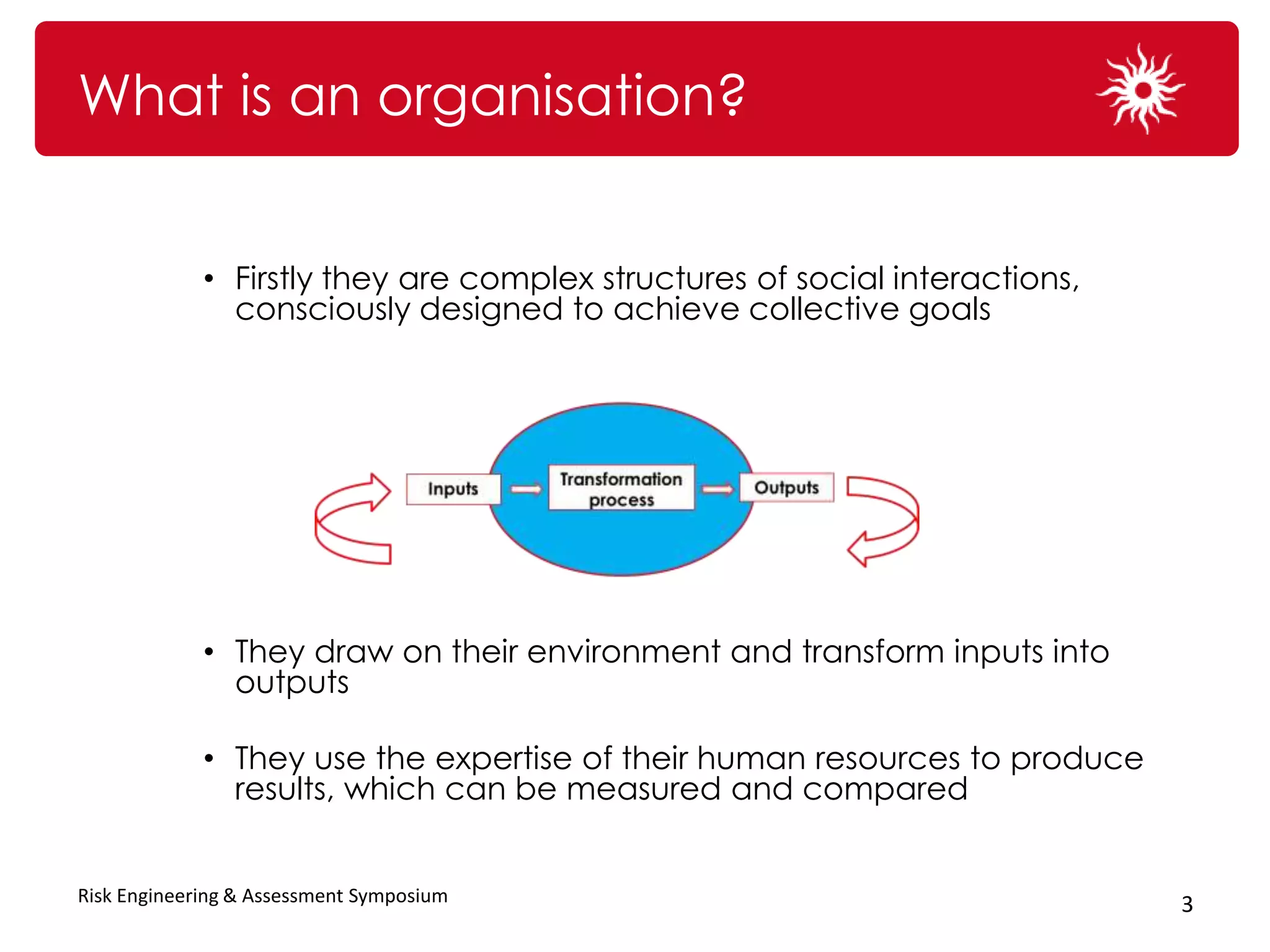
             • Firstly they are complex structures of social interactions,
               consciously designed to achieve collective goals


             • They draw on their environment and transform inputs into
               outputs

             • They use the expertise of their human resources to produce
               results, which can be measured and compared


Risk Engineering & Assessment Symposium                                      3
What is an organisation?


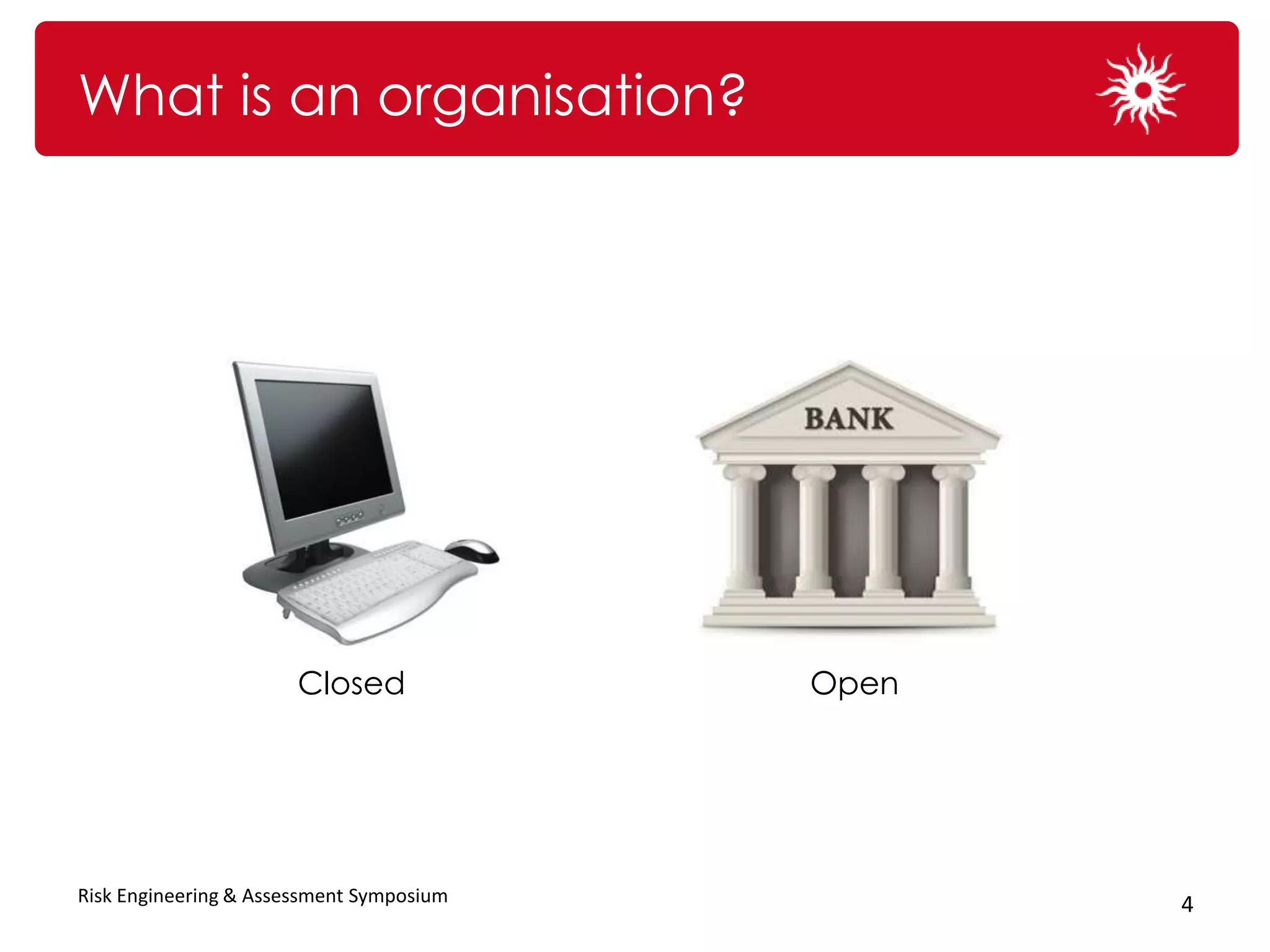
                       Closed             Open


Risk Engineering & Assessment Symposium          4
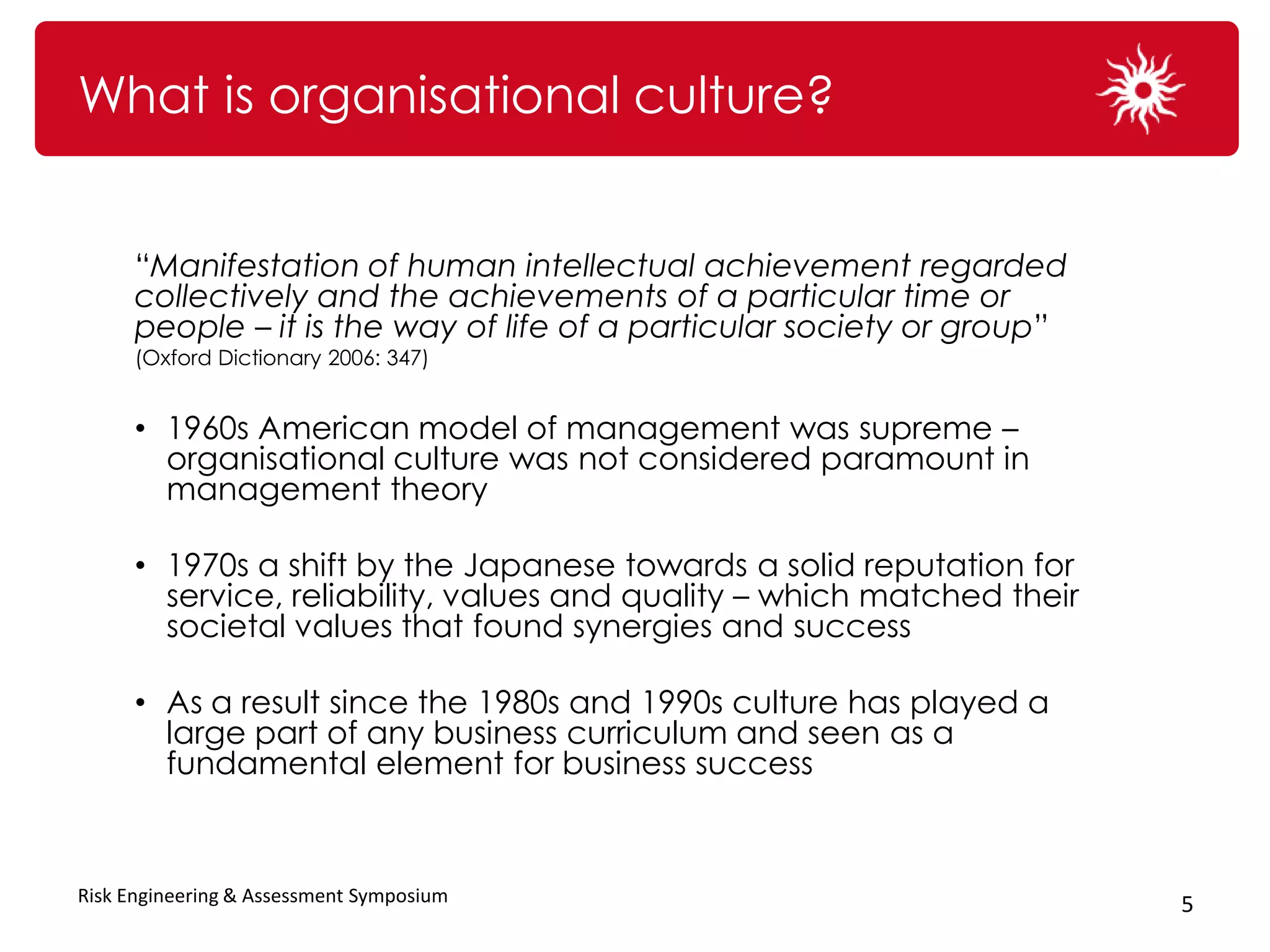
What is organisational culture?


      “Manifestation of human intellectual achievement regarded
      collectively and the achievements of a particular time or
      people – it is the way of life of a particular society or group”
      (Oxford Dictionary 2006: 347)


      • 1960s American model of management was supreme –
        organisational culture was not considered paramount in
        management theory

      • 1970s a shift by the Japanese towards a solid reputation for
        service, reliability, values and quality – which matched their
        societal values that found synergies and success

      • As a result since the 1980s and 1990s culture has played a
        large part of any business curriculum and seen as a
        fundamental element for business success


Risk Engineering & Assessment Symposium                                  5
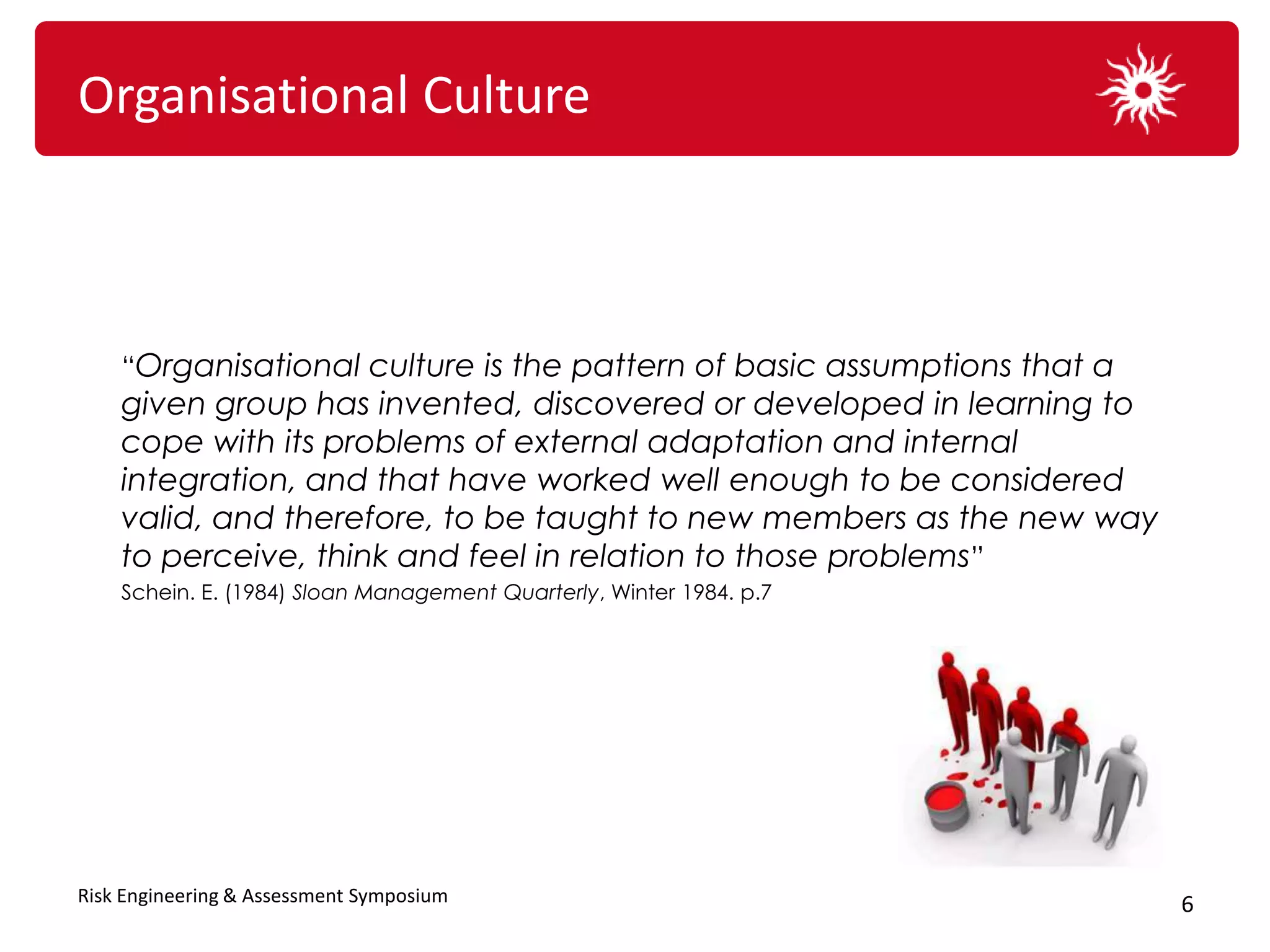
Organisational Culture


    “Organisational culture is the pattern of basic assumptions that a
    given group has invented, discovered or developed in learning to
    cope with its problems of external adaptation and internal
    integration, and that have worked well enough to be considered
    valid, and therefore, to be taught to new members as the new way
    to perceive, think and feel in relation to those problems”
    Schein. E. (1984) Sloan Management Quarterly, Winter 1984. p.7


Risk Engineering & Assessment Symposium                                  6
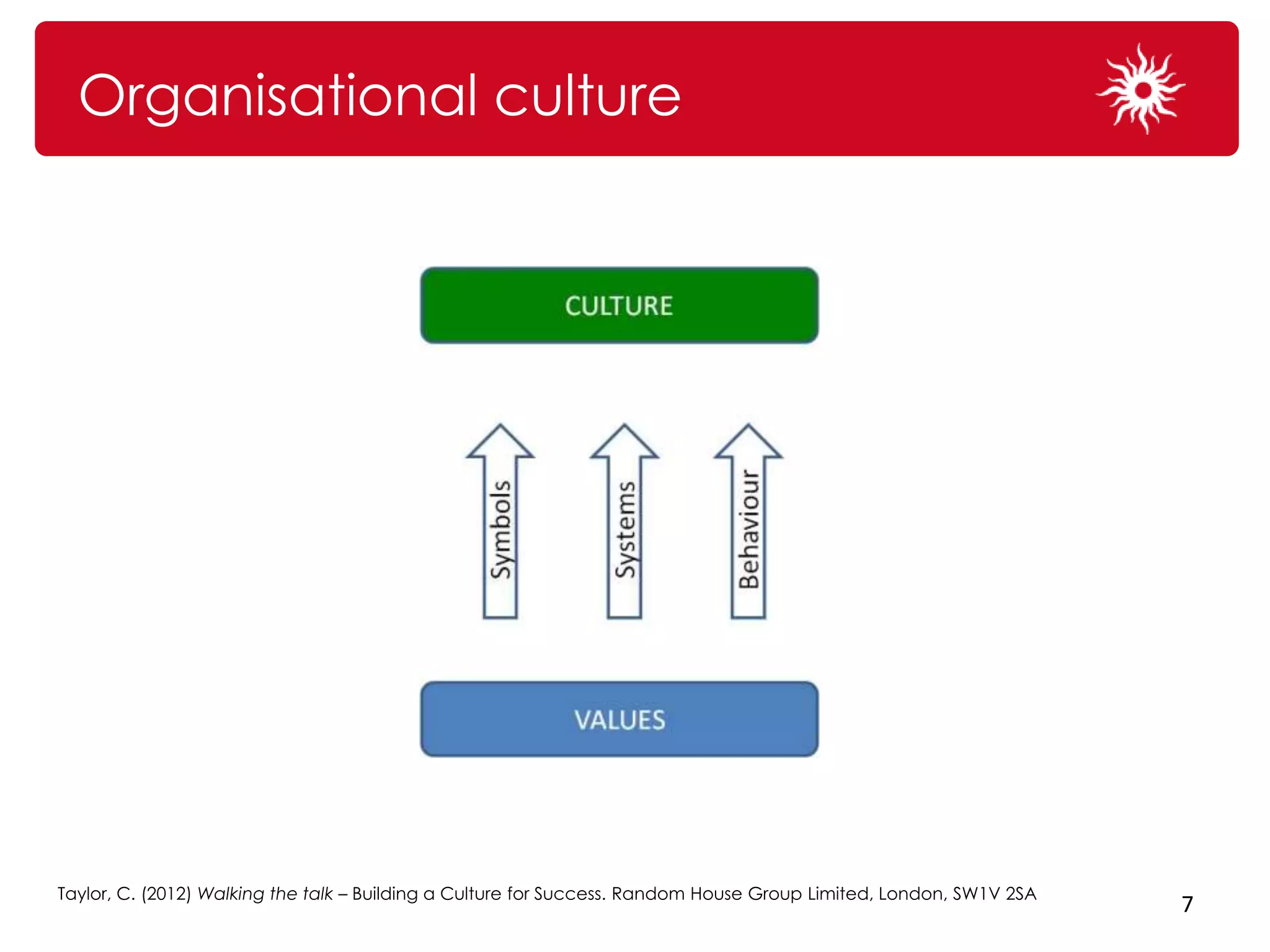
Organisational culture


Taylor, C. (2012) Walking the talk – Building a Culture for Success. Random House Group Limited, London, SW1V 2SA
                                                                                                                    7
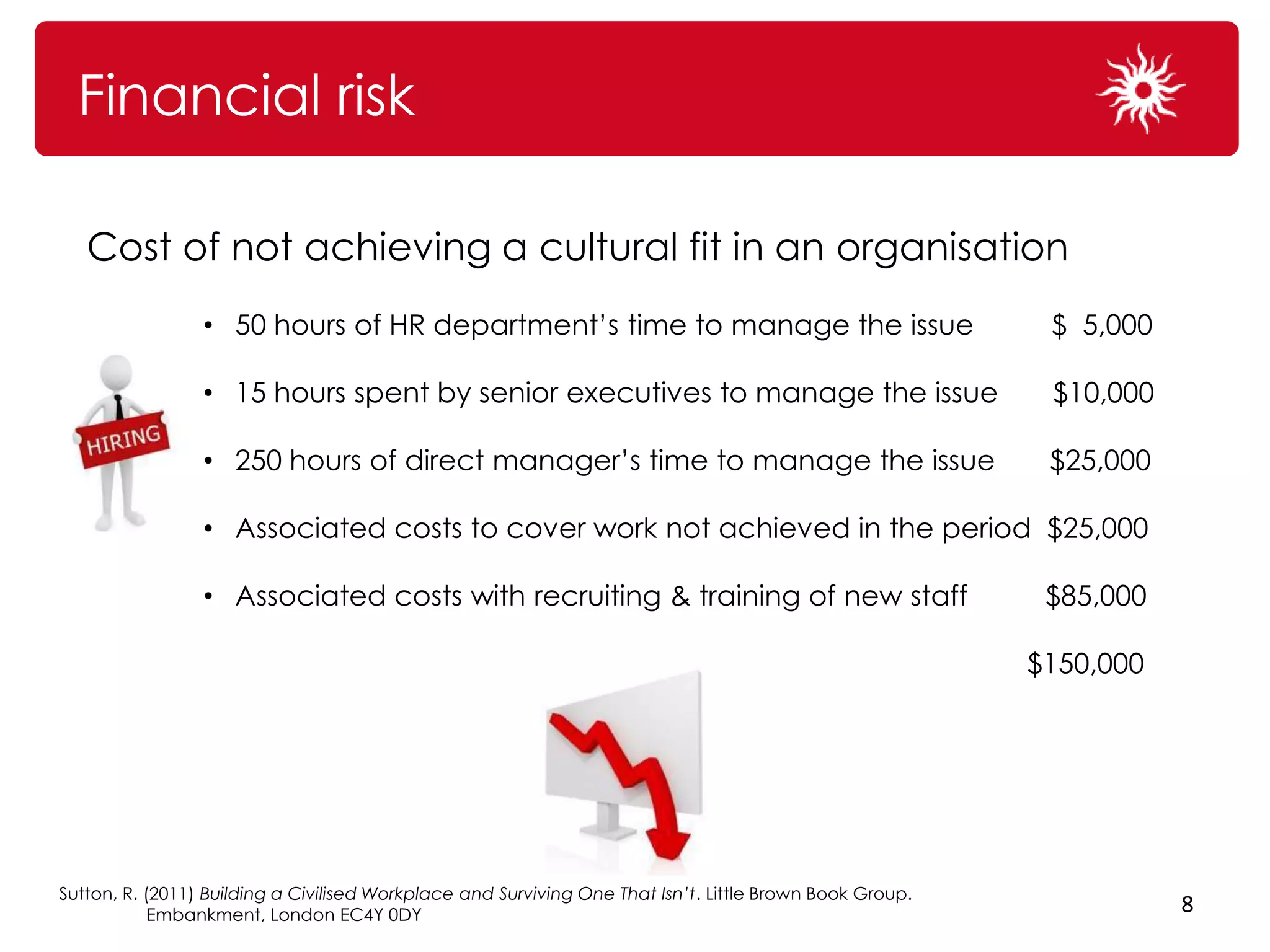
Financial risk

   Cost of not achieving a cultural fit in an organisation
                 • 50 hours of HR department’s time to manage the issue                                    $ 5,000

                 • 15 hours spent by senior executives to manage the issue                                 $10,000

                 • 250 hours of direct manager’s time to manage the issue                                  $25,000

                 • Associated costs to cover work not achieved in the period $25,000

                 • Associated costs with recruiting & training of new staff                                $85,000

                                                                                                          $150,000


Sutton, R. (2011) Building a Civilised Workplace and Surviving One That Isn’t. Little Brown Book Group.
            Embankment, London EC4Y 0DY
                                                                                                                     8
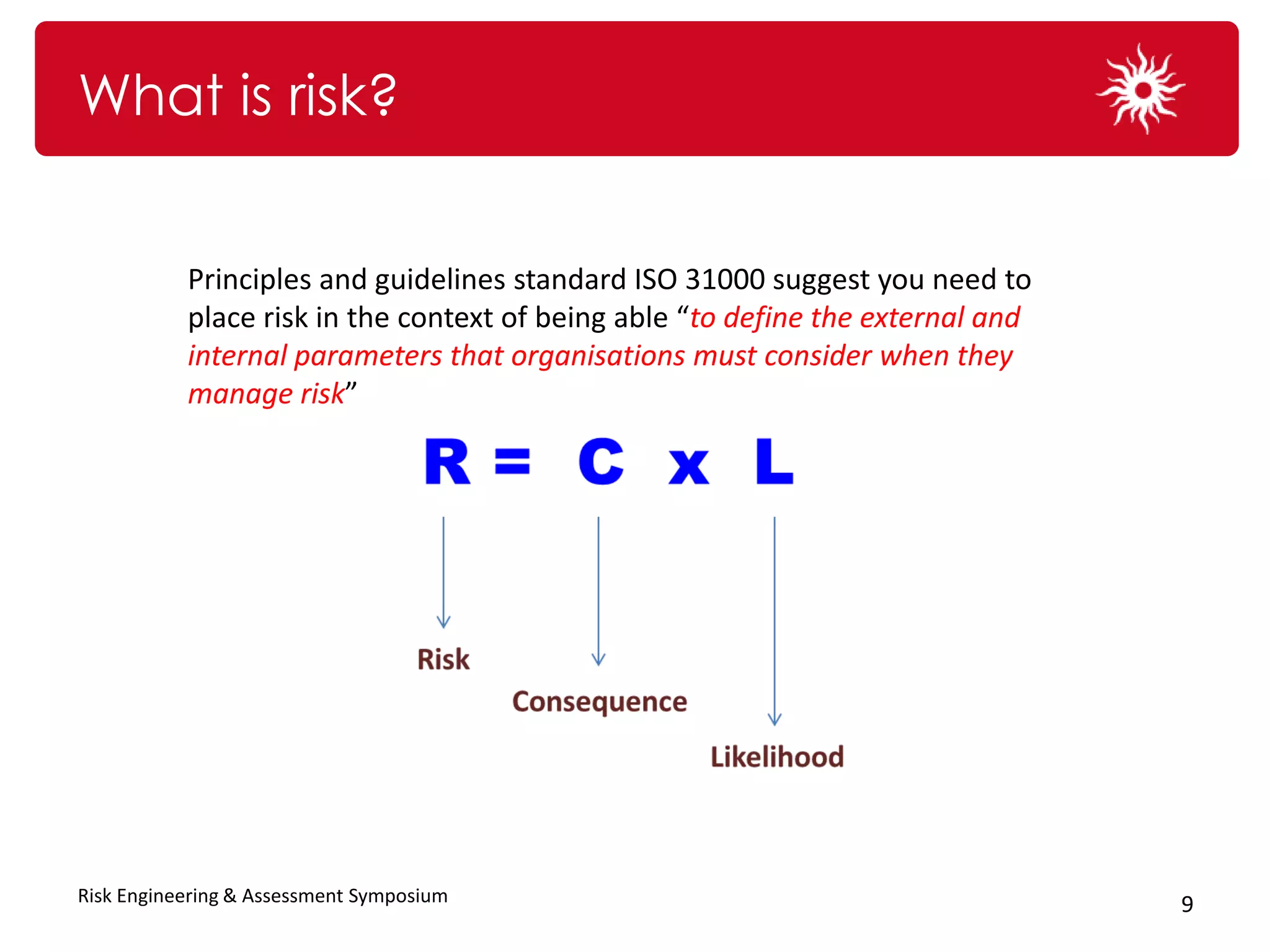
What is risk?


           Principles and guidelines standard ISO 31000 suggest you need to
              “The effect of uncertainty on objectives”
           place risk in the context of being able “to define the external and
           internal parameters that organisations must consider when they
           manage risk”


Risk Engineering & Assessment Symposium                                          9
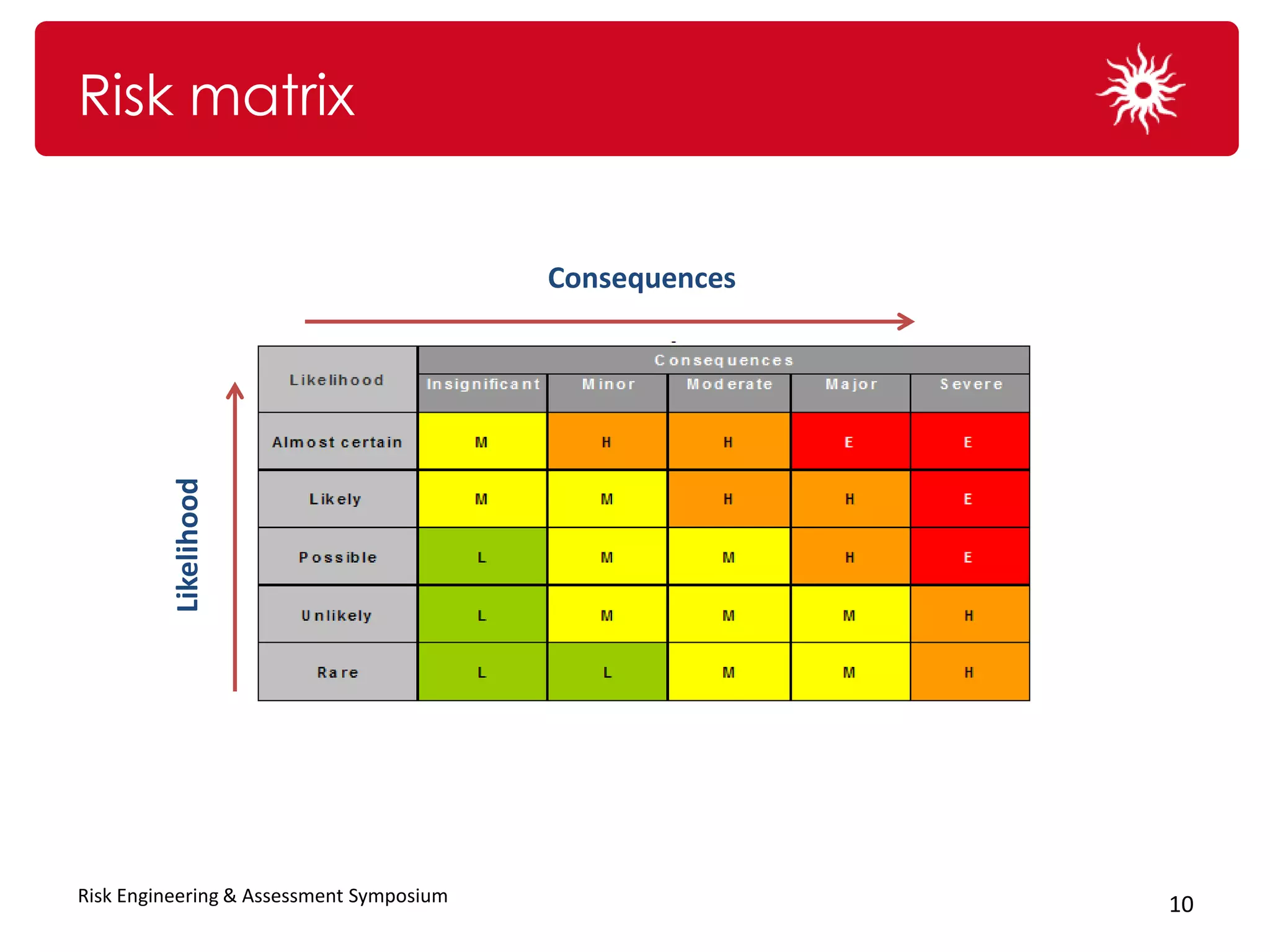
Risk matrix


                                          Consequences
          Likelihood


Risk Engineering & Assessment Symposium                  10
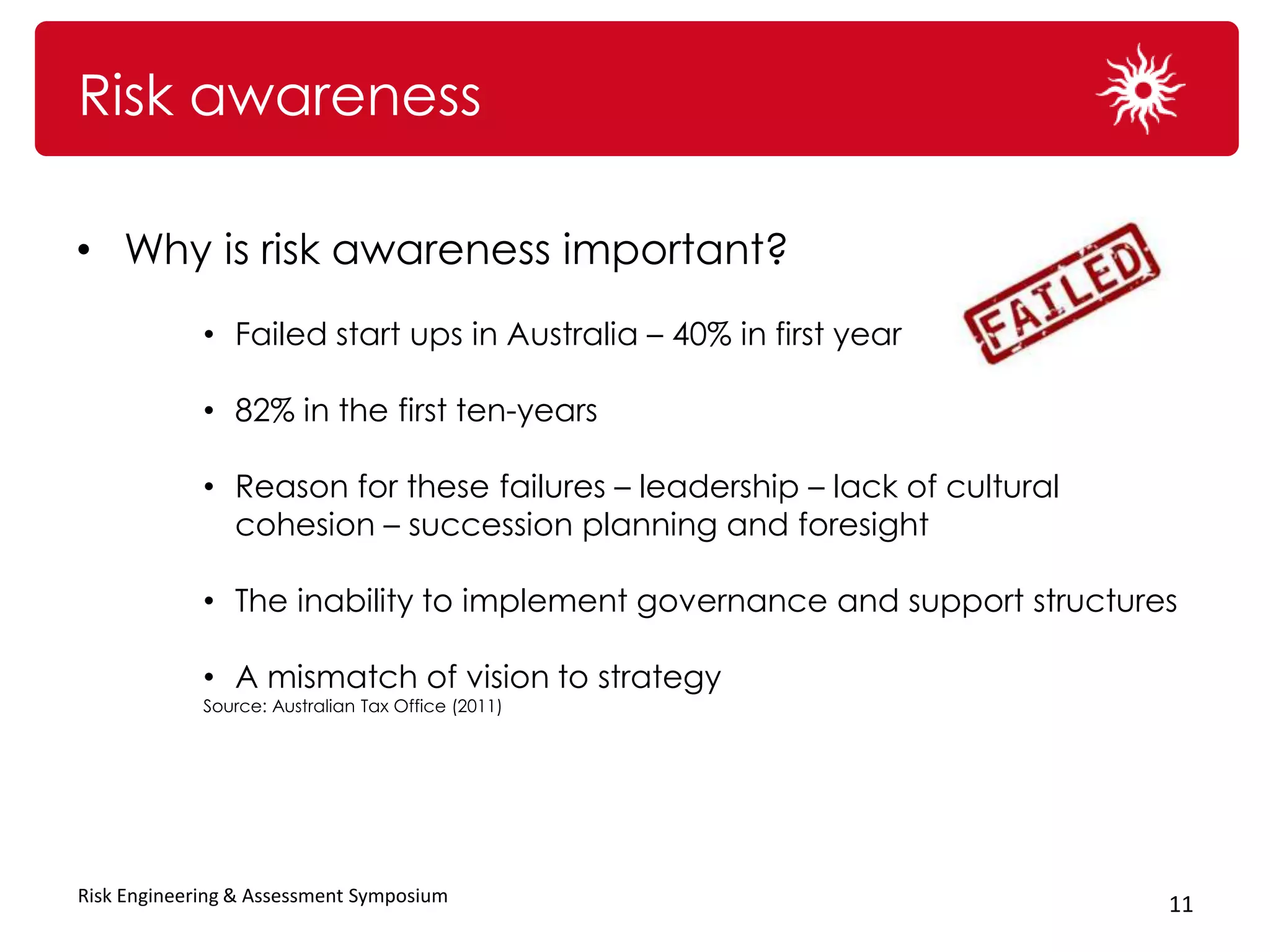
Risk awareness

• Why is risk awareness important?
             • Failed start ups in Australia – 40% in first year

             • 82% in the first ten-years

             • Reason for these failures – leadership – lack of cultural
               cohesion – succession planning and foresight

             • The inability to implement governance and support structures

             • A mismatch of vision to strategy
             Source: Australian Tax Office (2011)


Risk Engineering & Assessment Symposium                                    11
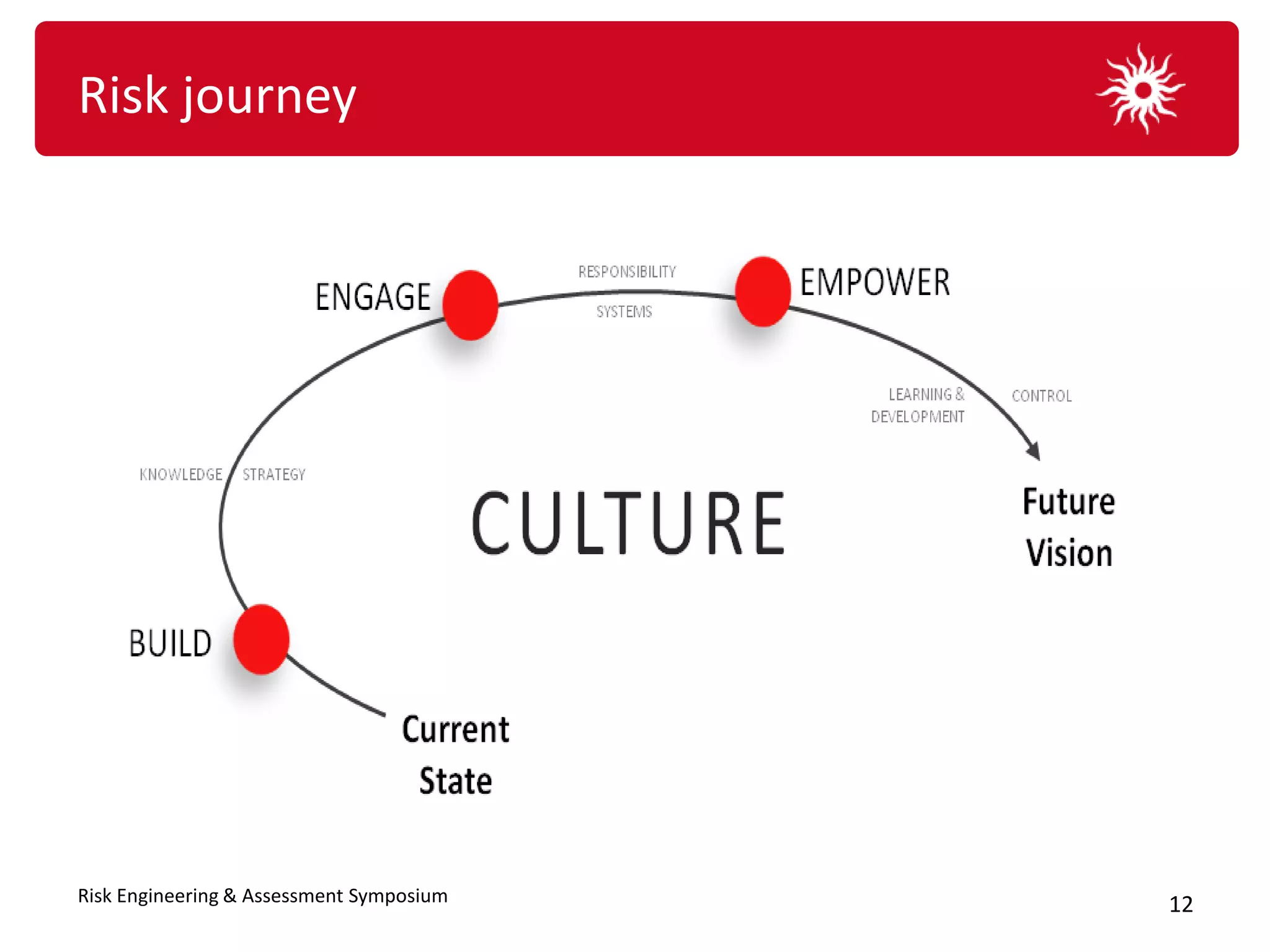
Risk journey


Risk Engineering & Assessment Symposium   12
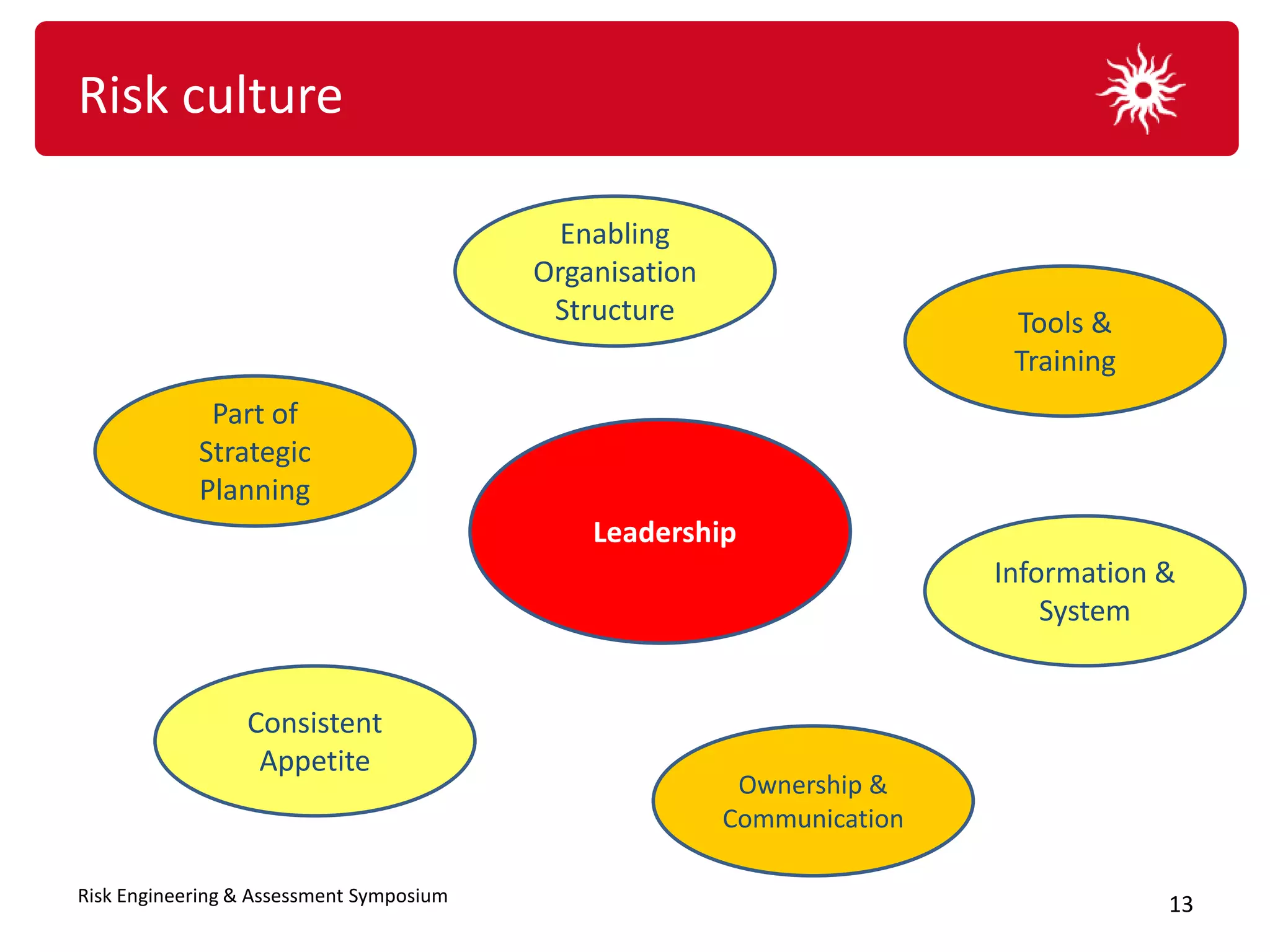
Risk culture

                                            Enabling
                                          Organisation
                                           Structure                      Tools &
                                                                          Training
             Part of
            Strategic
            Planning
                                            Vision / Value
                                              Governance
                                              Leadership
                                                                         Information &
                                                                             System


                 Consistent
                  Appetite
                                                          Ownership &
                                                         Communication

Risk Engineering & Assessment Symposium                                              13
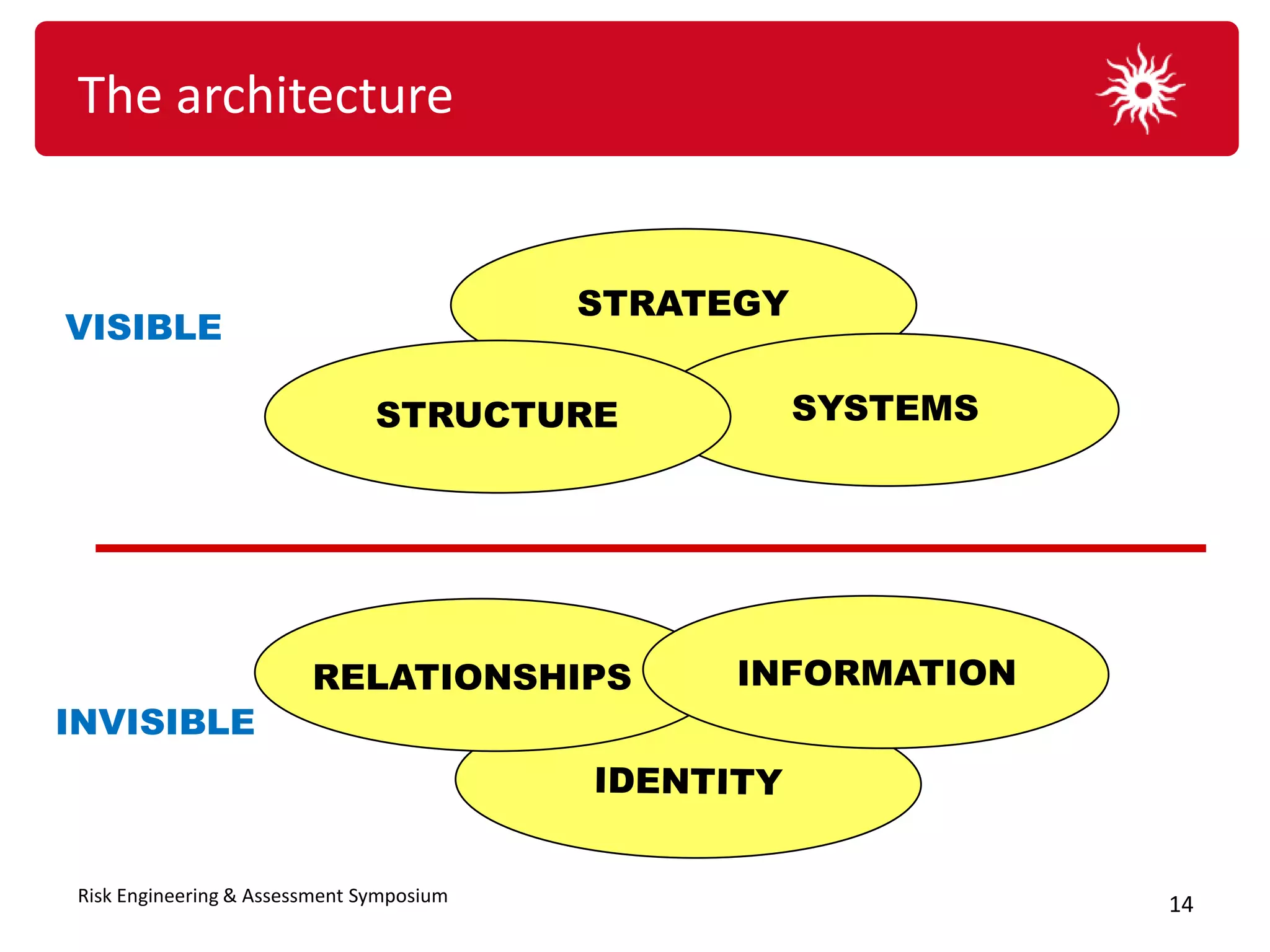
The architecture


                                           STRATEGY
VISIBLE

                                STRUCTURE             SYSTEMS


INVISIBLE


 Risk Engineering & Assessment Symposium                        14
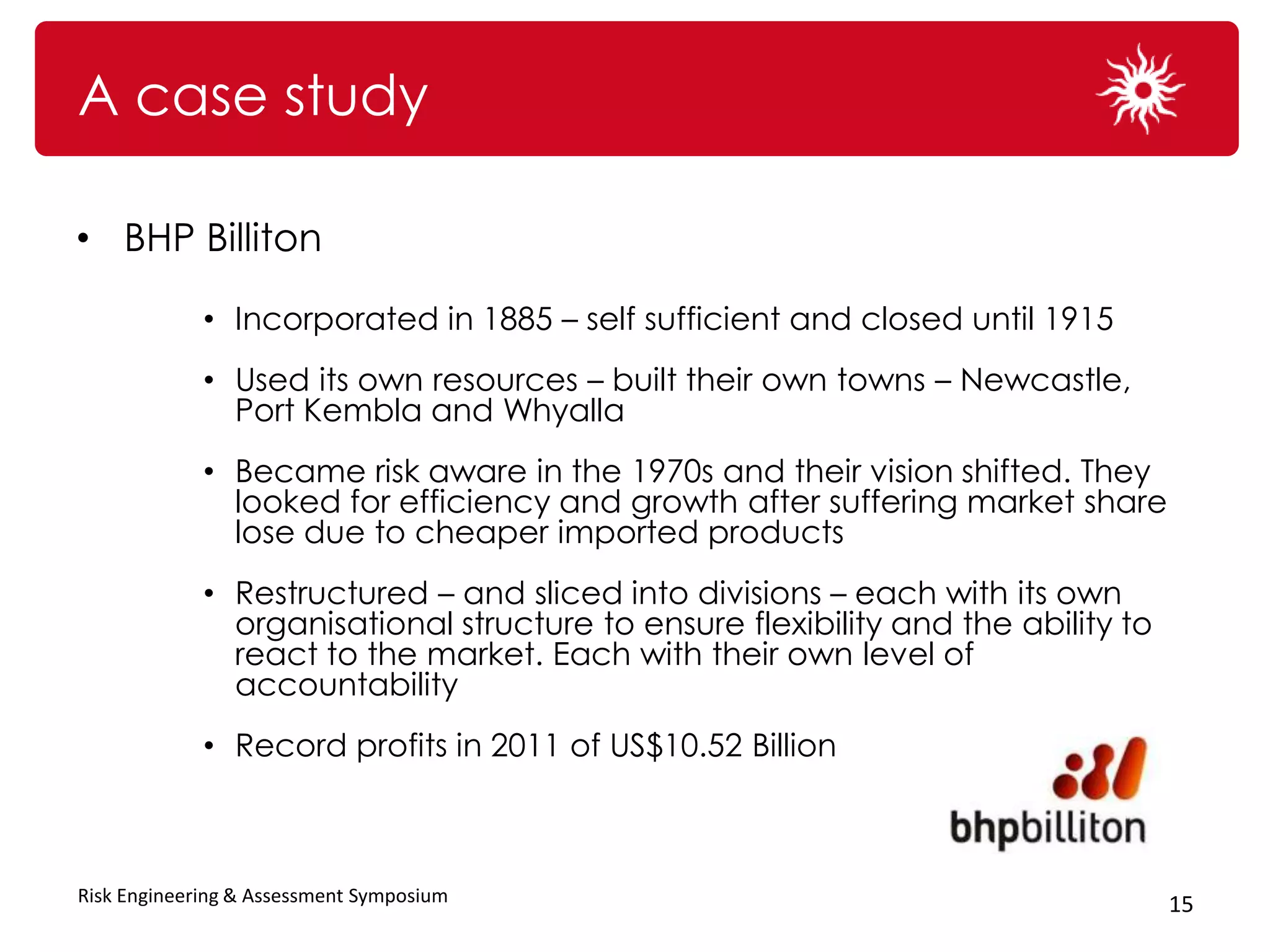
A case study

• BHP Billiton

             • Incorporated in 1885 – self sufficient and closed until 1915
             • Used its own resources – built their own towns – Newcastle,
               Port Kembla and Whyalla
             • Became risk aware in the 1970s and their vision shifted. They
               looked for efficiency and growth after suffering market share
               lose due to cheaper imported products
             • Restructured – and sliced into divisions – each with its own
               organisational structure to ensure flexibility and the ability to
               react to the market. Each with their own level of
               accountability
             • Record profits in 2011 of US$10.52 Billion


Risk Engineering & Assessment Symposium                                            15
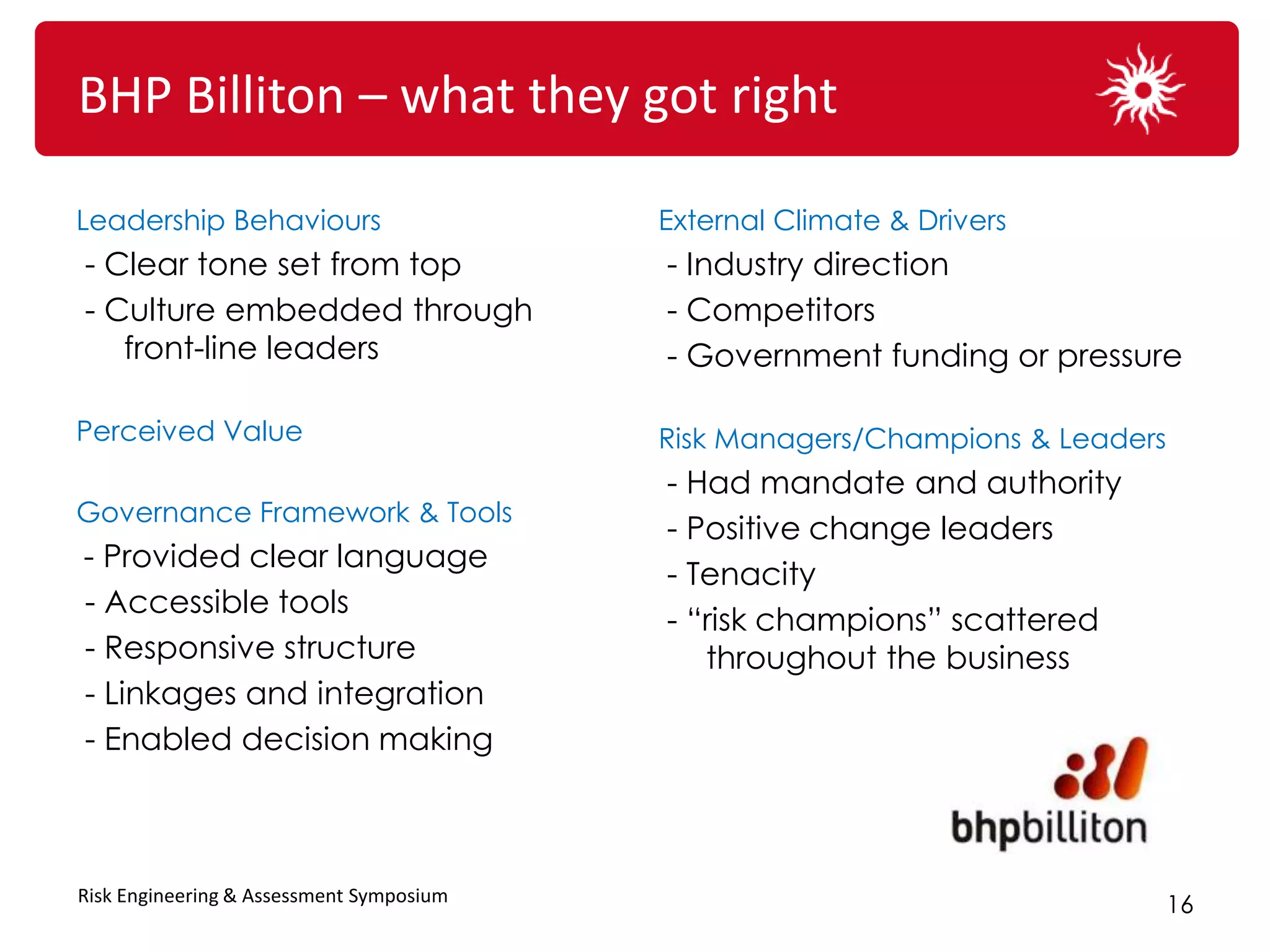
BHP Billiton – what they got right

Leadership Behaviours                     External Climate & Drivers
- Clear tone set from top                 - Industry direction
- Culture embedded through                - Competitors
   front-line leaders                     - Government funding or pressure

Perceived Value                           Risk Managers/Champions & Leaders
                                          - Had mandate and authority
Governance Framework & Tools
                                          - Positive change leaders
- Provided clear language
                                          - Tenacity
- Accessible tools
                                          - “risk champions” scattered
- Responsive structure                       throughout the business
- Linkages and integration
- Enabled decision making


Risk Engineering & Assessment Symposium
                                                                              16
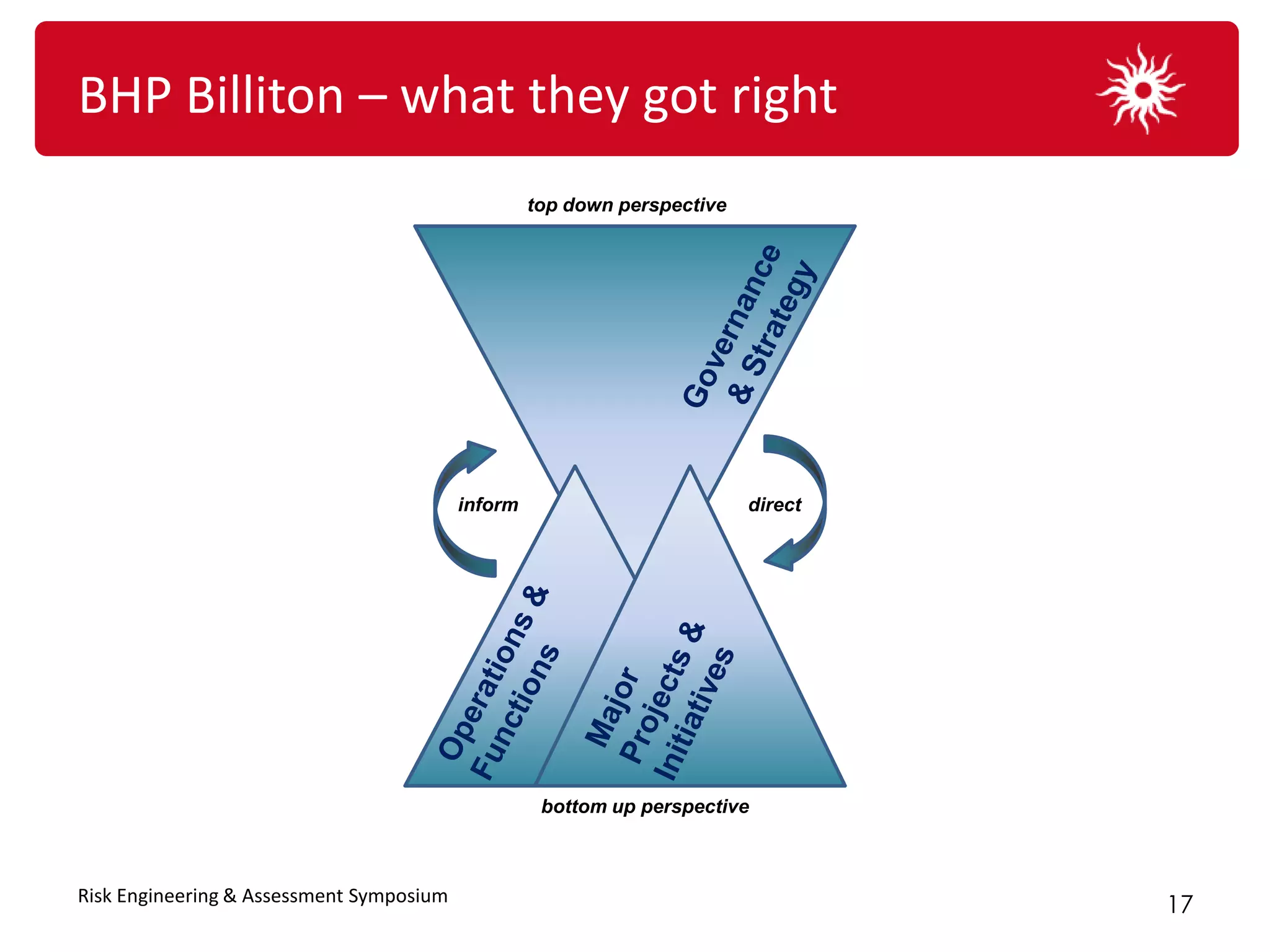
BHP Billiton – what they got right
                                                   top down perspective


                                          inform                          direct


                                                    bottom up perspective


Risk Engineering & Assessment Symposium
                                                                                   17
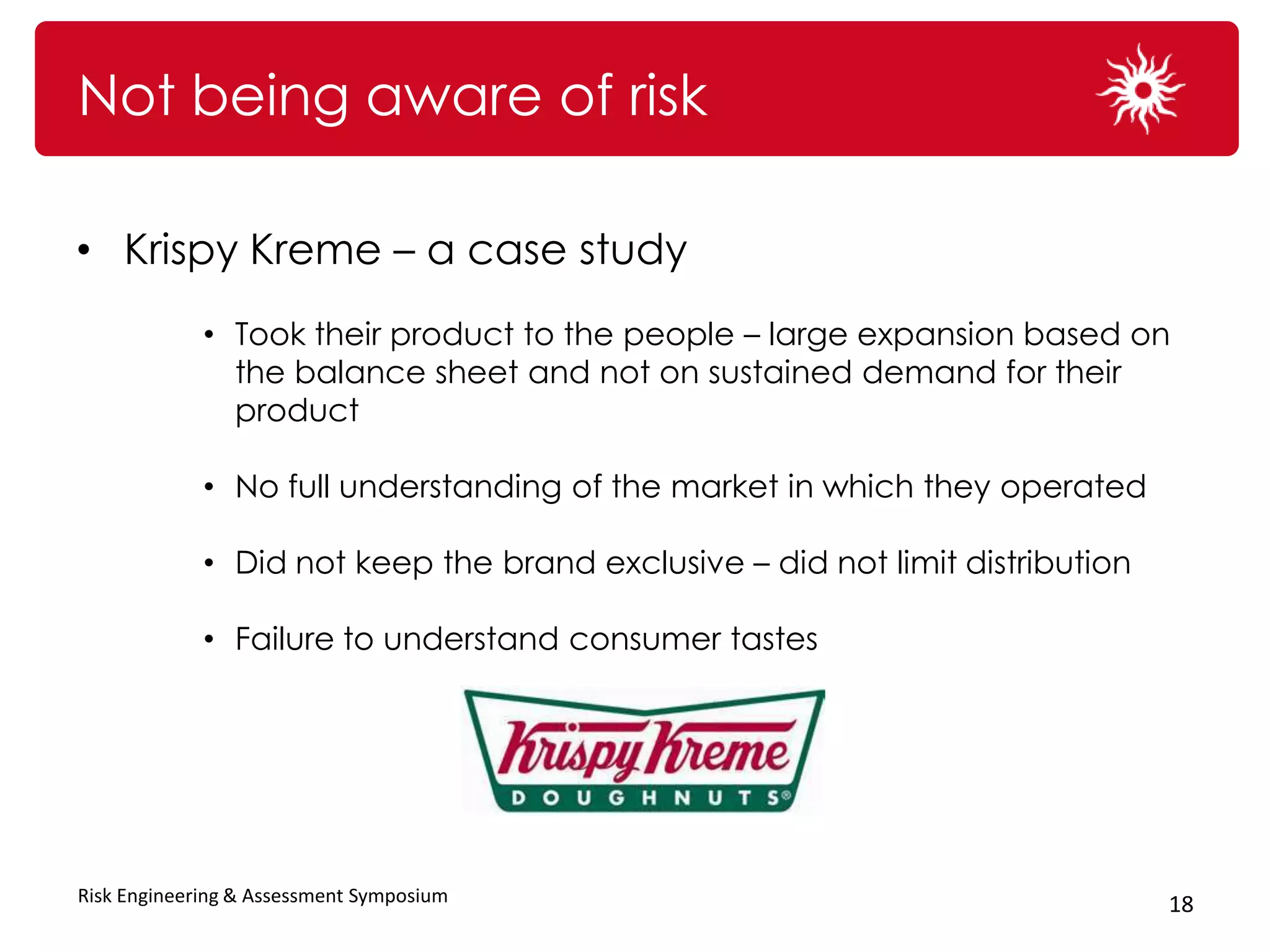
Not being aware of risk

• Krispy Kreme – a case study
             • Took their product to the people – large expansion based on
               the balance sheet and not on sustained demand for their
               product

             • No full understanding of the market in which they operated

             • Did not keep the brand exclusive – did not limit distribution

             • Failure to understand consumer tastes


Risk Engineering & Assessment Symposium                                        18
The cost of not being risk aware


Risk Engineering & Assessment Symposium   19
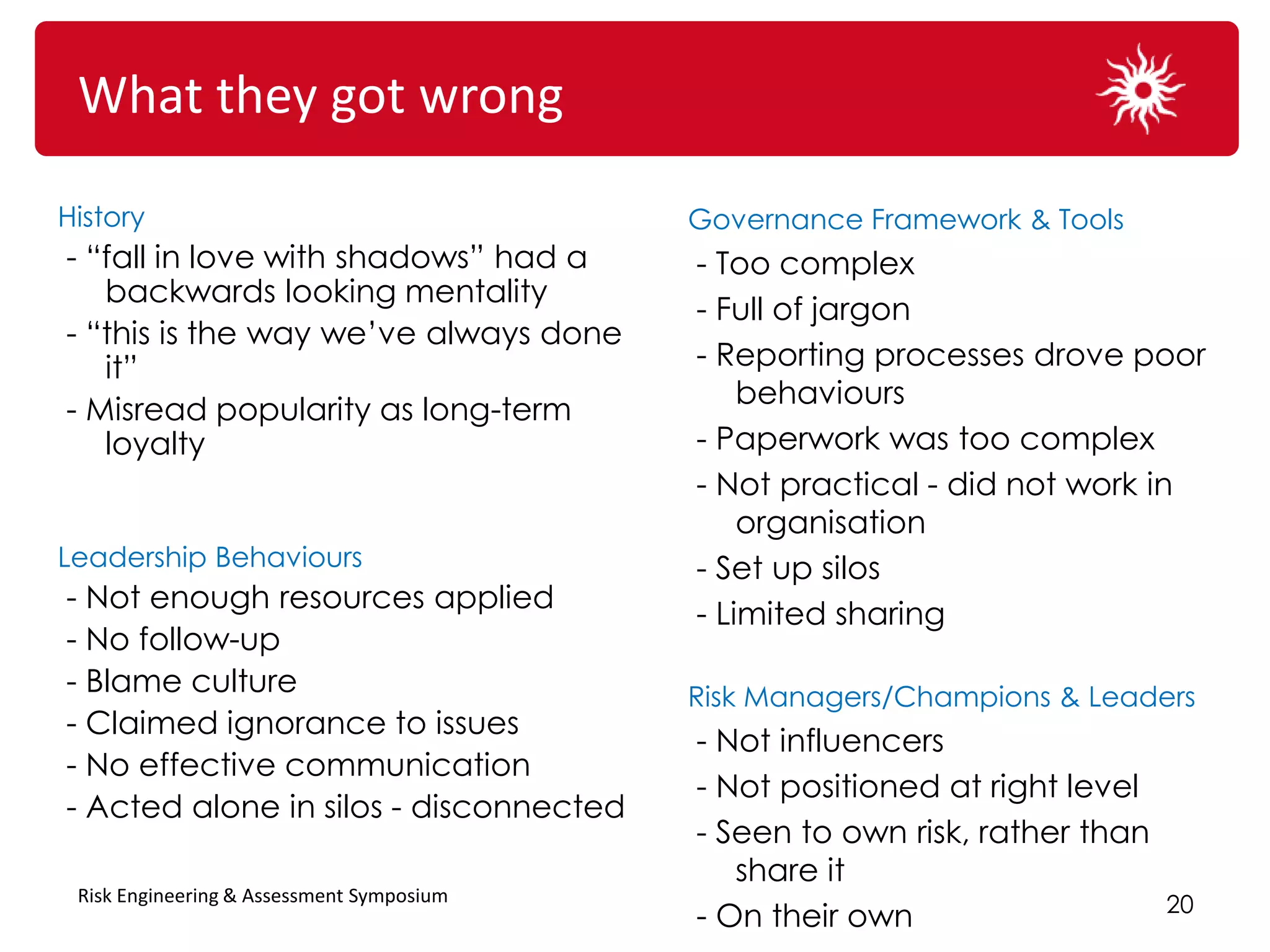
What they got wrong

History                                    Governance Framework & Tools
- “fall in love with shadows” had a        - Too complex
   backwards looking mentality
                                           - Full of jargon
- “this is the way we’ve always done
   it”                                     - Reporting processes drove poor
                                               behaviours
- Misread popularity as long-term
   loyalty                                 - Paperwork was too complex
                                           - Not practical - did not work in
                                               organisation
Leadership Behaviours                      - Set up silos
- Not enough resources applied
                                           - Limited sharing
- No follow-up
- Blame culture                            Risk Managers/Champions & Leaders
- Claimed ignorance to issues
                                           - Not influencers
- No effective communication
                                           - Not positioned at right level
- Acted alone in silos - disconnected
                                           - Seen to own risk, rather than
                                              share it
 Risk Engineering & Assessment Symposium
                                                                             20
                                           - On their own
The journey forward
 Set the stage
  - Create a sense or urgency
  - Put together a guiding team

 Decide what to do                                                     SafetyC’s Journey C’s
                                                                           5 Journey – 5
  - Develop the change vision and
     strategy
                                                               High
                                                                              Management
                                                                              Activity

  Make it happen
                                                                                             Supervisory
  - Communicate the                                                                          Activity

     understanding and buy-in                                         Management
                                                                                                                 Team Activity
  - Empower others to act                                      Low
                                                                                           Leadership

  - Produce short term wins
                                                                      Cr


                                                                               Co


                                                                                            Co


                                                                                                           Co


                                                                                                                       Cu
                                                                       isi


                                                                                 nt


                                                                                              m


                                                                                                            m


                                                                                                                        ltu
  - Do not let up
                                                                          s


                                                                                               pl


                                                                                                            m
                                                                                    ro


                                                                                                                         re
                                                                                                 ia


                                                                                                                itm
                                                                                       l


                                                                                                    nc


                                                                                                                 en
                                                                                                       e


                                                                                                                   t
 Make it stick
  - Create a new culture


MindTools (2012) Implementing Change Powerfully & Successfully [online] MindTools
           http://www.mindtools.com/pages/article/newPPM_82.htm (accessed) 5 July 2012.
                                                                                                                                 21
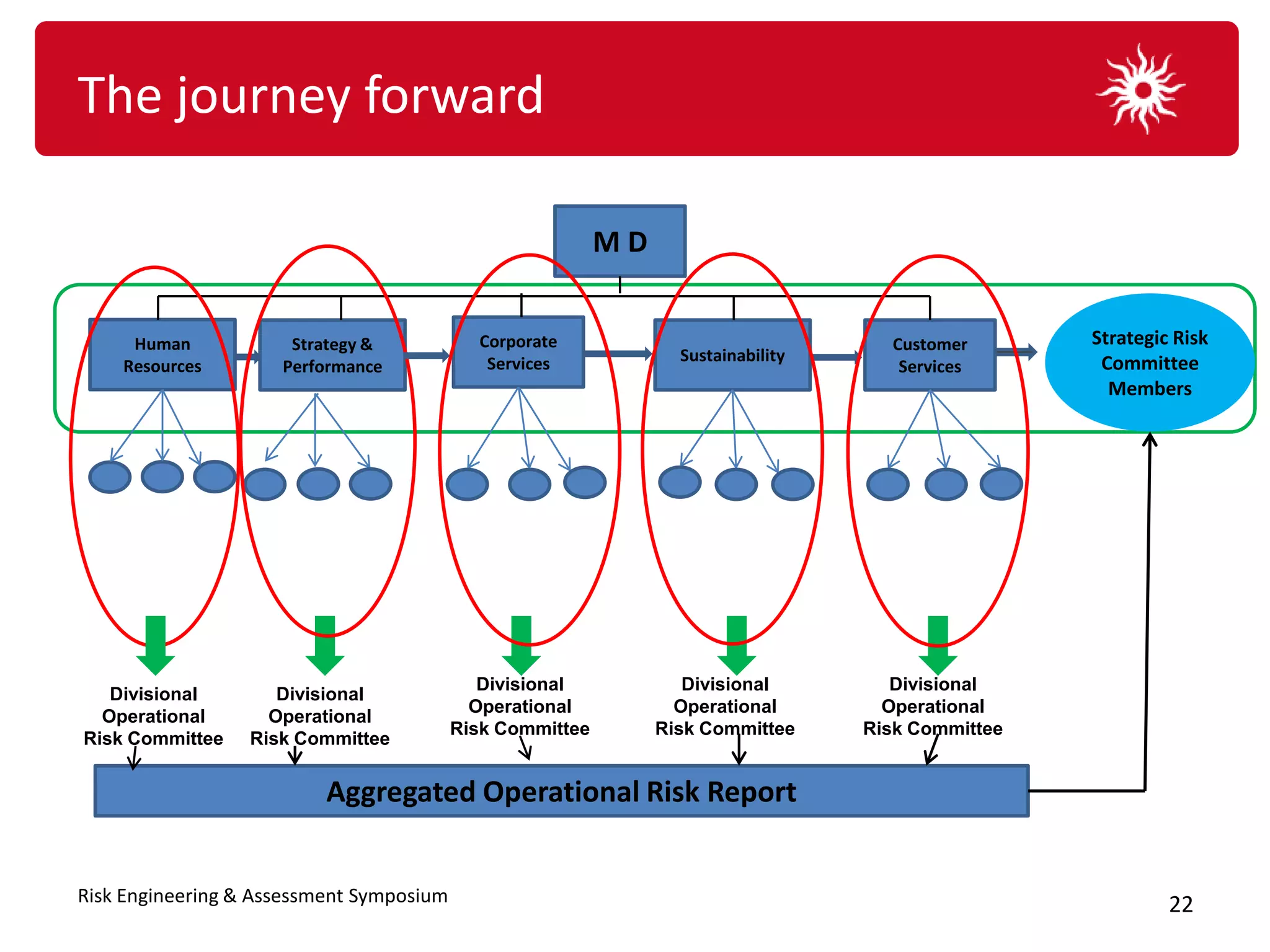
The journey forward

                                                           MD


     Human            Strategy &            Corporate                                Customer       Strategic Risk
                                             Services             Sustainability                     Committee
    Resources        Performance                                                      Services
                                                                                                      Members


                                             Divisional            Divisional         Divisional
   Divisional        Divisional
                                            Operational           Operational        Operational
  Operational       Operational
                                          Risk Committee        Risk Committee     Risk Committee
Risk Committee    Risk Committee


                          Aggregated Operational Risk Report


Risk Engineering & Assessment Symposium                                                                      22
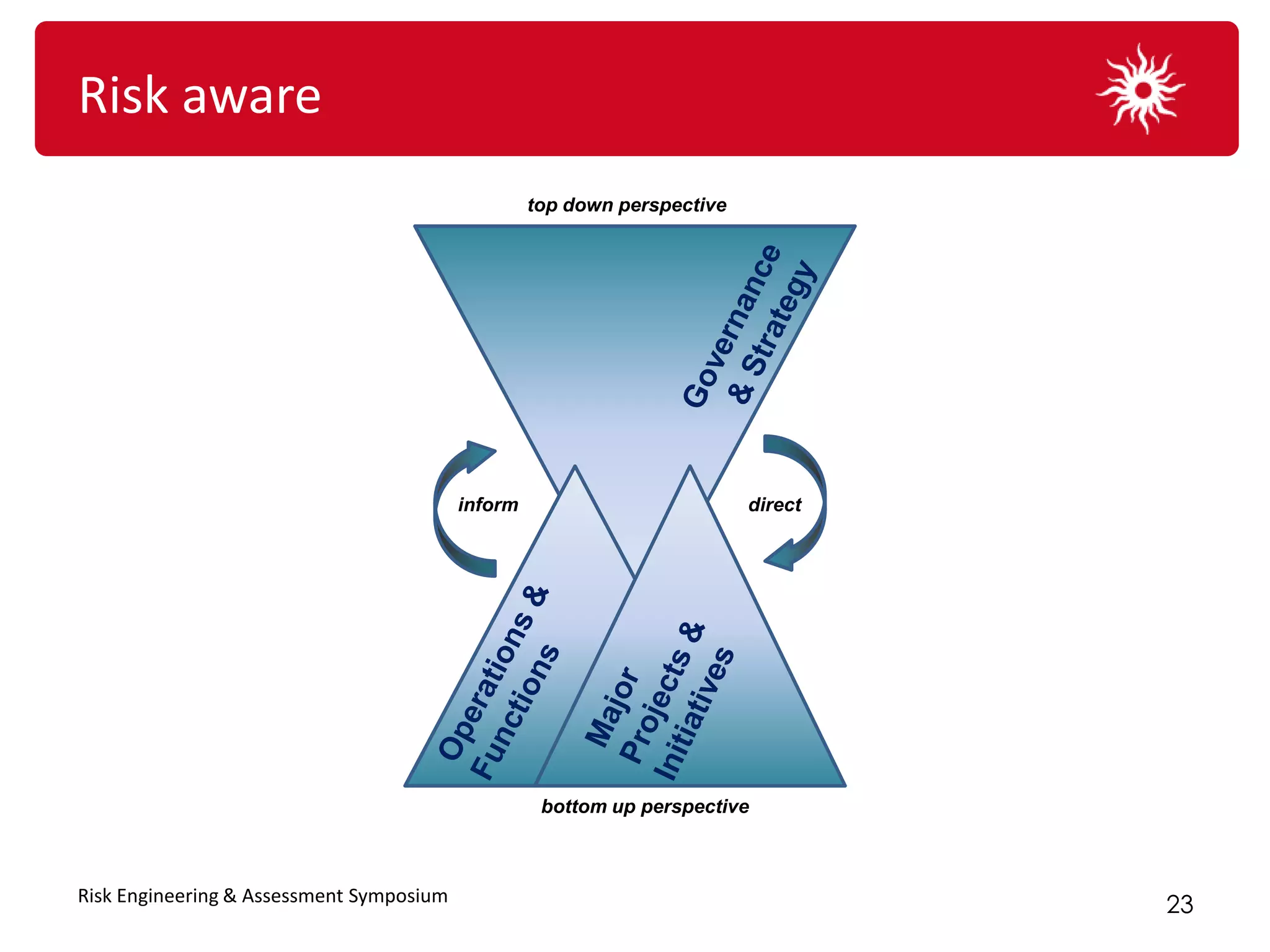
Risk aware
                                                   top down perspective


                                          inform                          direct


                                                    bottom up perspective


Risk Engineering & Assessment Symposium
                                                                                   23
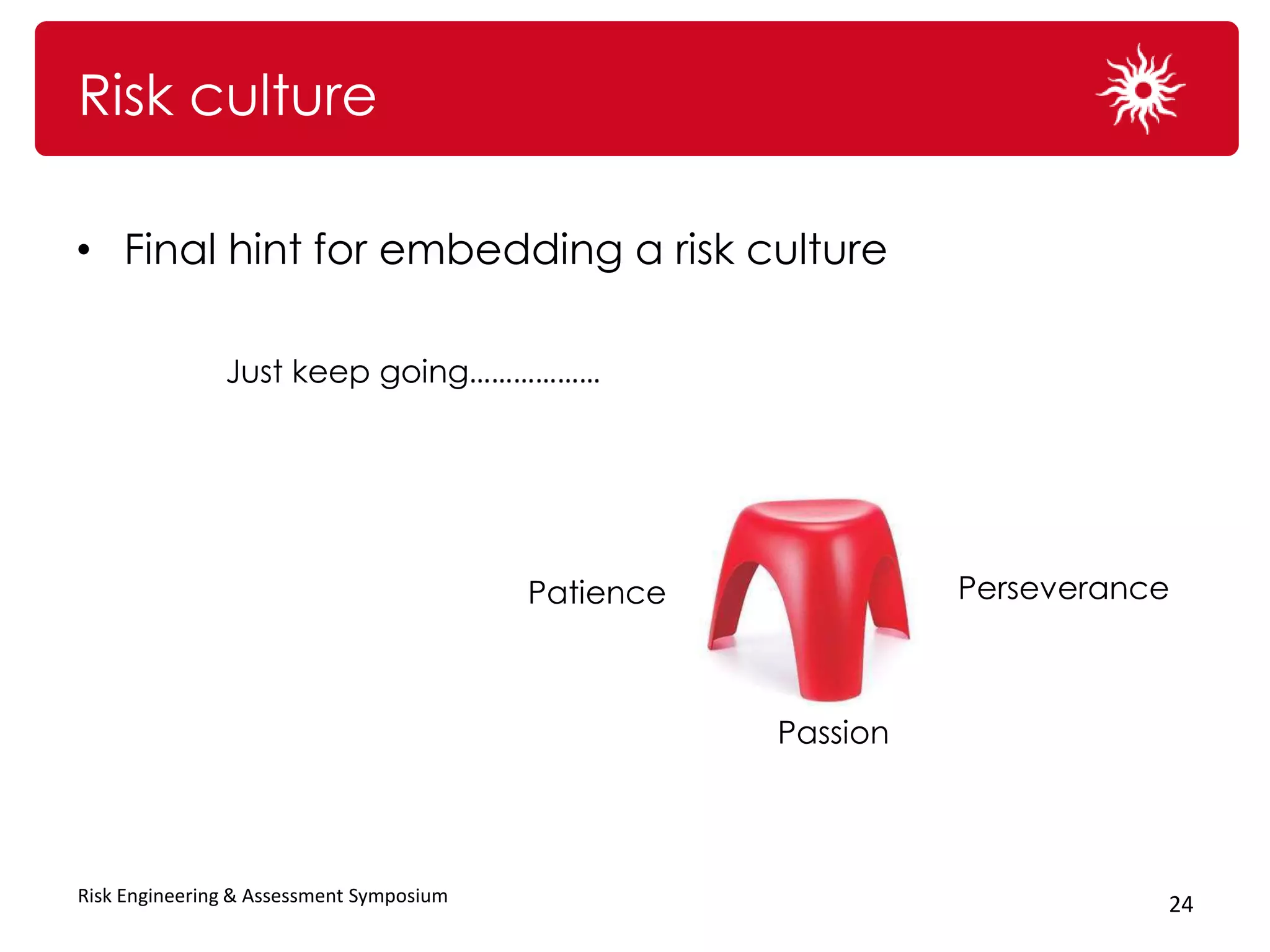
Risk culture

• Final hint for embedding a risk culture

               Just keep going………………


                                          Patience             Perseverance


                                                     Passion


Risk Engineering & Assessment Symposium                                   24
Good luck to you all on the journey!
Dean Eddy

M: 0412 301 336

E: dean@enhancesolutions.com.au

Engineering Symposium

  • 1.
    Risk Culture Presented forthe Risk Engineering & Assessment Symposium Presented by: Dean Eddy Date: July 2012
  • 2.
    Objectives Risk Engineering &Assessment Symposium 2
  • 3.
    What is anorganisation? • Firstly they are complex structures of social interactions, consciously designed to achieve collective goals • They draw on their environment and transform inputs into outputs • They use the expertise of their human resources to produce results, which can be measured and compared Risk Engineering & Assessment Symposium 3
  • 4.
    What is anorganisation? Closed Open Risk Engineering & Assessment Symposium 4
  • 5.
    What is organisationalculture? “Manifestation of human intellectual achievement regarded collectively and the achievements of a particular time or people – it is the way of life of a particular society or group” (Oxford Dictionary 2006: 347) • 1960s American model of management was supreme – organisational culture was not considered paramount in management theory • 1970s a shift by the Japanese towards a solid reputation for service, reliability, values and quality – which matched their societal values that found synergies and success • As a result since the 1980s and 1990s culture has played a large part of any business curriculum and seen as a fundamental element for business success Risk Engineering & Assessment Symposium 5
  • 6.
    Organisational Culture “Organisational culture is the pattern of basic assumptions that a given group has invented, discovered or developed in learning to cope with its problems of external adaptation and internal integration, and that have worked well enough to be considered valid, and therefore, to be taught to new members as the new way to perceive, think and feel in relation to those problems” Schein. E. (1984) Sloan Management Quarterly, Winter 1984. p.7 Risk Engineering & Assessment Symposium 6
  • 7.
    Organisational culture Taylor, C.(2012) Walking the talk – Building a Culture for Success. Random House Group Limited, London, SW1V 2SA 7
  • 8.
    Financial risk Cost of not achieving a cultural fit in an organisation • 50 hours of HR department’s time to manage the issue $ 5,000 • 15 hours spent by senior executives to manage the issue $10,000 • 250 hours of direct manager’s time to manage the issue $25,000 • Associated costs to cover work not achieved in the period $25,000 • Associated costs with recruiting & training of new staff $85,000 $150,000 Sutton, R. (2011) Building a Civilised Workplace and Surviving One That Isn’t. Little Brown Book Group. Embankment, London EC4Y 0DY 8
  • 9.
    What is risk? Principles and guidelines standard ISO 31000 suggest you need to “The effect of uncertainty on objectives” place risk in the context of being able “to define the external and internal parameters that organisations must consider when they manage risk” Risk Engineering & Assessment Symposium 9
  • 10.
    Risk matrix Consequences Likelihood Risk Engineering & Assessment Symposium 10
  • 11.
    Risk awareness • Whyis risk awareness important? • Failed start ups in Australia – 40% in first year • 82% in the first ten-years • Reason for these failures – leadership – lack of cultural cohesion – succession planning and foresight • The inability to implement governance and support structures • A mismatch of vision to strategy Source: Australian Tax Office (2011) Risk Engineering & Assessment Symposium 11
  • 12.
    Risk journey Risk Engineering& Assessment Symposium 12
  • 13.
    Risk culture Enabling Organisation Structure Tools & Training Part of Strategic Planning Vision / Value Governance Leadership Information & System Consistent Appetite Ownership & Communication Risk Engineering & Assessment Symposium 13
  • 14.
    The architecture STRATEGY VISIBLE STRUCTURE SYSTEMS INVISIBLE Risk Engineering & Assessment Symposium 14
  • 15.
    A case study •BHP Billiton • Incorporated in 1885 – self sufficient and closed until 1915 • Used its own resources – built their own towns – Newcastle, Port Kembla and Whyalla • Became risk aware in the 1970s and their vision shifted. They looked for efficiency and growth after suffering market share lose due to cheaper imported products • Restructured – and sliced into divisions – each with its own organisational structure to ensure flexibility and the ability to react to the market. Each with their own level of accountability • Record profits in 2011 of US$10.52 Billion Risk Engineering & Assessment Symposium 15
  • 16.
    BHP Billiton –what they got right Leadership Behaviours External Climate & Drivers - Clear tone set from top - Industry direction - Culture embedded through - Competitors front-line leaders - Government funding or pressure Perceived Value Risk Managers/Champions & Leaders - Had mandate and authority Governance Framework & Tools - Positive change leaders - Provided clear language - Tenacity - Accessible tools - “risk champions” scattered - Responsive structure throughout the business - Linkages and integration - Enabled decision making Risk Engineering & Assessment Symposium 16
  • 17.
    BHP Billiton –what they got right top down perspective inform direct bottom up perspective Risk Engineering & Assessment Symposium 17
  • 18.
    Not being awareof risk • Krispy Kreme – a case study • Took their product to the people – large expansion based on the balance sheet and not on sustained demand for their product • No full understanding of the market in which they operated • Did not keep the brand exclusive – did not limit distribution • Failure to understand consumer tastes Risk Engineering & Assessment Symposium 18
  • 19.
    The cost ofnot being risk aware Risk Engineering & Assessment Symposium 19
  • 20.
    What they gotwrong History Governance Framework & Tools - “fall in love with shadows” had a - Too complex backwards looking mentality - Full of jargon - “this is the way we’ve always done it” - Reporting processes drove poor behaviours - Misread popularity as long-term loyalty - Paperwork was too complex - Not practical - did not work in organisation Leadership Behaviours - Set up silos - Not enough resources applied - Limited sharing - No follow-up - Blame culture Risk Managers/Champions & Leaders - Claimed ignorance to issues - Not influencers - No effective communication - Not positioned at right level - Acted alone in silos - disconnected - Seen to own risk, rather than share it Risk Engineering & Assessment Symposium 20 - On their own
  • 21.
    The journey forward Set the stage - Create a sense or urgency - Put together a guiding team Decide what to do SafetyC’s Journey C’s 5 Journey – 5 - Develop the change vision and strategy High Management Activity Make it happen Supervisory - Communicate the Activity understanding and buy-in Management Team Activity - Empower others to act Low Leadership - Produce short term wins Cr Co Co Co Cu isi nt m m ltu - Do not let up s pl m ro re ia itm l nc en e t Make it stick - Create a new culture MindTools (2012) Implementing Change Powerfully & Successfully [online] MindTools http://www.mindtools.com/pages/article/newPPM_82.htm (accessed) 5 July 2012. 21
  • 22.
    The journey forward MD Human Strategy & Corporate Customer Strategic Risk Services Sustainability Committee Resources Performance Services Members Divisional Divisional Divisional Divisional Divisional Operational Operational Operational Operational Operational Risk Committee Risk Committee Risk Committee Risk Committee Risk Committee Aggregated Operational Risk Report Risk Engineering & Assessment Symposium 22
  • 23.
    Risk aware top down perspective inform direct bottom up perspective Risk Engineering & Assessment Symposium 23
  • 24.
    Risk culture • Finalhint for embedding a risk culture Just keep going……………… Patience Perseverance Passion Risk Engineering & Assessment Symposium 24
  • 25.
    Good luck toyou all on the journey!
  • 26.
    Dean Eddy M: 0412301 336 E: dean@enhancesolutions.com.au