©2013 Center for Creative Leadership. All Rights Reserved. 2.5.1
RISING STRONG
BY
Dr PRAKASH RAMAKRISHNAN PhD
M Sc( Ag) MBA MA(Psychology)
National trainer
Dept of Personnel and Training
Govt of India
9446331825
©2013 Center for Creative Leadership. All Rights Reserved. 2.5.2
RISING STRONG
(Workshop on self Empowerment)
OBJECTIVES
• Create Self awareness
• Develop Empathy
• Sharpen communication skills
• Build and play in teams
• Cope with stress and emotions
• Excel in Leadership
• Ritualize successful habits
©2013 Center for Creative Leadership. All Rights Reserved. 2.5.3
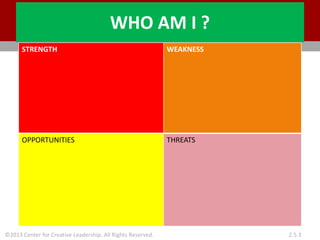
WHO AM I ?
STRENGTH WEAKNESS
OPPORTUNITIES THREATS
©2013 Center for Creative Leadership. All Rights Reserved. 2.5.4
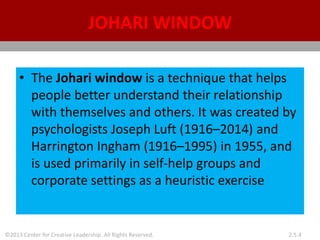
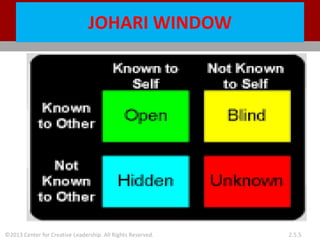
JOHARI WINDOW
• The Johari window is a technique that helps
people better understand their relationship
with themselves and others. It was created by
psychologists Joseph Luft (1916–2014) and
Harrington Ingham (1916–1995) in 1955, and
is used primarily in self-help groups and
corporate settings as a heuristic exercise
©2013 Center for Creative Leadership. All Rights Reserved. 2.5.5
JOHARI WINDOW
©2013 Center for Creative Leadership. All Rights Reserved. 2.5.6
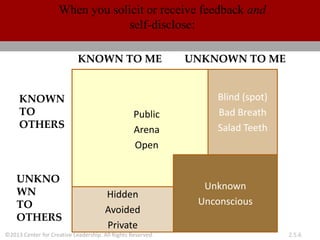
Public
Arena
Open
Blind (spot)
Bad Breath
Salad Teeth
Hidden
Avoided
Private
Unknown
Unconscious
When you solicit or receive feedback and
self-disclose:
KNOWN TO ME UNKNOWN TO ME
KNOWN
TO
OTHERS
UNKNO
WN
TO
OTHERS
©2013 Center for Creative Leadership. All Rights Reserved. 2.5.7
EMPATHY
• Empathy is the capacity to understand or feel
what another person is experiencing from
within their frame of reference, i.e., the
capacity to place oneself in another's position.
©2013 Center for Creative Leadership. All Rights Reserved. 2.5.8
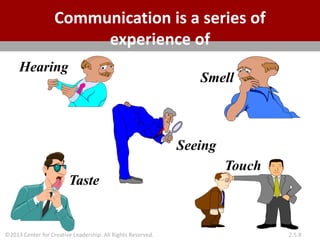
Communication is a series of
experience of
Hearing
Smell
Seeing
Taste
Touch
©2013 Center for Creative Leadership. All Rights Reserved. 2.5.9
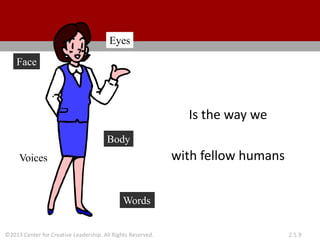
Communication
Is the way we
interact
with fellow humans
Eyes
Face
Body
Voices
Words
©2013 Center for Creative Leadership. All Rights Reserved. 2.5.10
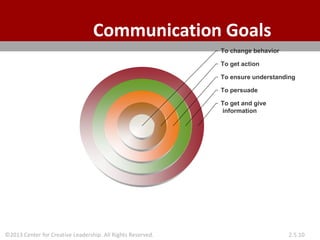
Communication Goals
To get and give
information
To persuade
To ensure understanding
To get action
To change behavior
©2013 Center for Creative Leadership. All Rights Reserved. 2.5.11
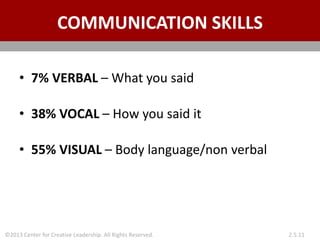
COMMUNICATION SKILLS
• 7% VERBAL – What you said
• 38% VOCAL – How you said it
• 55% VISUAL – Body language/non verbal
©2013 Center for Creative Leadership. All Rights Reserved. 2.5.12
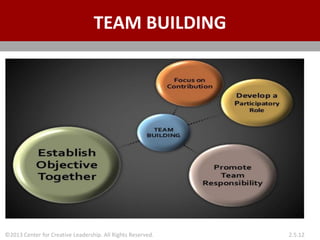
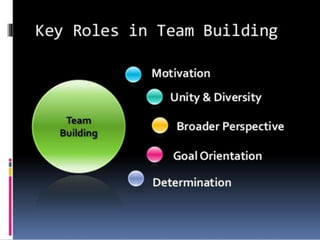
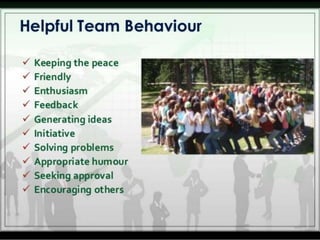
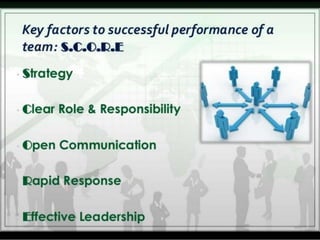
TEAM BUILDING
©2013 Center for Creative Leadership. All Rights Reserved. 2.5.13
©2013 Center for Creative Leadership. All Rights Reserved. 2.5.14
©2013 Center for Creative Leadership. All Rights Reserved. 2.5.15
©2013 Center for Creative Leadership. All Rights Reserved. 2.5.16
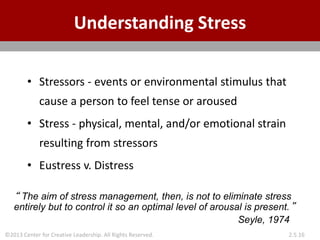
Understanding Stress
• Stressors - events or environmental stimulus that
cause a person to feel tense or aroused
• Stress - physical, mental, and/or emotional strain
resulting from stressors
• Eustress v. Distress
“ The aim of stress management, then, is not to eliminate stress
entirely but to control it so an optimal level of arousal is present.”
Seyle, 1974
©2013 Center for Creative Leadership. All Rights Reserved. 2.5.17
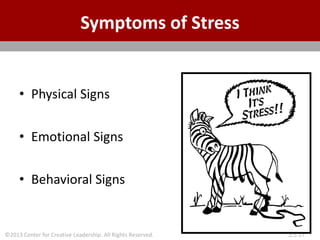
Symptoms of Stress
• Physical Signs
• Emotional Signs
• Behavioral Signs
©2013 Center for Creative Leadership. All Rights Reserved. 2.5.18
Tools for Stress Management
• Physical:
– Nutrition
– Exercise
– Sleep
– Biofeedback
– Massage
– Progressive Relaxation
©2013 Center for Creative Leadership. All Rights Reserved. 2.5.19
Tools for Stress Management
• Cognitive (thoughts):
– Self-talk
– Meditation
– Imagery
– Refocusing Strategies
– Systematic Relaxation
©2013 Center for Creative Leadership. All Rights Reserved. 2.5.20
Tools for Stress Management
• Behavioral:
– Assertiveness
– Time-management
– Support Groups
– Segmentation
– The Breath
©2013 Center for Creative Leadership. All Rights Reserved. 2.5.21
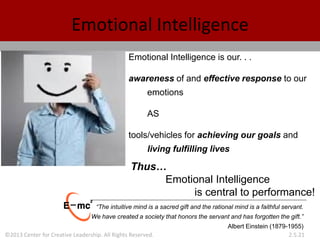
Emotional Intelligence is our. . .
awareness of and effective response to our
emotions
AS
tools/vehicles for achieving our goals and
living fulfilling lives
Emotional Intelligence
Thus…
Emotional Intelligence
is central to performance!
“The intuitive mind is a sacred gift and the rational mind is a faithful servant.
We have created a society that honors the servant and has forgotten the gift.”
Albert Einstein (1879-1955)
©2013 Center for Creative Leadership. All Rights Reserved. 2.5.22
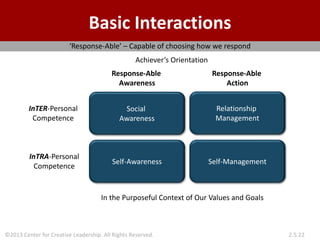
Social
Awareness
Self-Management
Self-Awareness
Relationship
Management
Response-Able
Action
Response-Able
Awareness
InTRA-Personal
Competence
Basic Interactions
‘Response-Able’ – Capable of choosing how we respond
In the Purposeful Context of Our Values and Goals
InTER-Personal
Competence
Achiever’s Orientation
©2013 Center for Creative Leadership. All Rights Reserved. 2.5.23
The Best News:
Emotional Intelligence
can be enhanced through
attention and development
©2013 Center for Creative Leadership. All Rights Reserved. 2.5.24
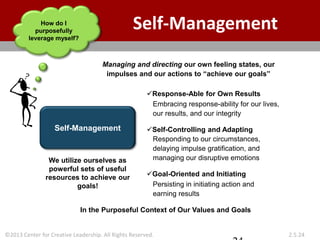
Self-Management
How do I
purposefully
leverage myself?
Managing and directing our own feeling states, our
impulses and our actions to “achieve our goals”
✓Response-Able for Own Results
Embracing response-ability for our lives,
our results, and our integrity
✓Self-Controlling and Adapting
Responding to our circumstances,
delaying impulse gratification, and
managing our disruptive emotions
✓Goal-Oriented and Initiating
Persisting in initiating action and
earning results
In the Purposeful Context of Our Values and Goals
Self-Management
We utilize ourselves as
powerful sets of useful
resources to achieve our
goals!
©2013 Center for Creative Leadership. All Rights Reserved. 2.5.25
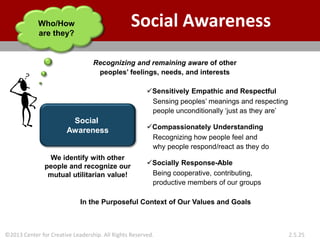
Social Awareness
Who/How
are they?
Recognizing and remaining aware of other
peoples’ feelings, needs, and interests
✓Sensitively Empathic and Respectful
Sensing peoples’ meanings and respecting
people unconditionally ‘just as they are’
✓Compassionately Understanding
Recognizing how people feel and
why people respond/react as they do
✓Socially Response-Able
Being cooperative, contributing,
productive members of our groups
In the Purposeful Context of Our Values and Goals
Social
Awareness
We identify with other
people and recognize our
mutual utilitarian value!
©2013 Center for Creative Leadership. All Rights Reserved. 2.5.26
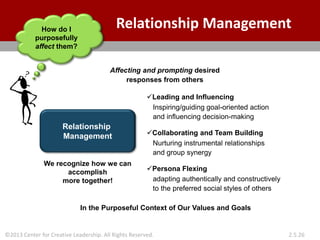
Relationship Management
How do I
purposefully
affect them?
Affecting and prompting desired
responses from others
✓Leading and Influencing
Inspiring/guiding goal-oriented action
and influencing decision-making
✓Collaborating and Team Building
Nurturing instrumental relationships
and group synergy
✓Persona Flexing
adapting authentically and constructively
to the preferred social styles of others
In the Purposeful Context of Our Values and Goals
Relationship
Management
We recognize how we can
accomplish
more together!
©2013 Center for Creative Leadership. All Rights Reserved. 2.5.27
©2013 Center for Creative Leadership. All Rights Reserved. 2.5.28
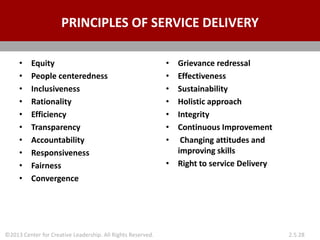
PRINCIPLES OF SERVICE DELIVERY
• Equity
• People centeredness
• Inclusiveness
• Rationality
• Efficiency
• Transparency
• Accountability
• Responsiveness
• Fairness
• Convergence
• Grievance redressal
• Effectiveness
• Sustainability
• Holistic approach
• Integrity
• Continuous Improvement
• Changing attitudes and
improving skills
• Right to service Delivery
©2013 Center for Creative Leadership. All Rights Reserved. 2.5.29
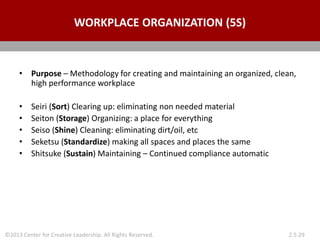
WORKPLACE ORGANIZATION (5S)
• Purpose – Methodology for creating and maintaining an organized, clean,
high performance workplace
• Seiri (Sort) Clearing up: eliminating non needed material
• Seiton (Storage) Organizing: a place for everything
• Seiso (Shine) Cleaning: eliminating dirt/oil, etc
• Seketsu (Standardize) making all spaces and places the same
• Shitsuke (Sustain) Maintaining – Continued compliance automatic
©2013 Center for Creative Leadership. All Rights Reserved. 2.5.30
SEVEN EVERY DAY RITUALS
• Get up at 5 am
• Drink lots of water
• Visualize day’s activities
• Walk around
• Exercise
• Meditate
• Journaling
©2013 Center for Creative Leadership. All Rights Reserved. 2.5.31
©2013 Center for Creative Leadership. All Rights Reserved. 2.5.32
• Dr PRAKASH RAMAKRISHNAN PhD
• M Sc( Ag) MBA MA(Psychology)
• National trainer
• Dept of Personnel and Training
• Govt of India
• 9446331825
• prakasraja@gmail.com

Rising strong converted

  • 1.
    ©2013 Center forCreative Leadership. All Rights Reserved. 2.5.1 RISING STRONG BY Dr PRAKASH RAMAKRISHNAN PhD M Sc( Ag) MBA MA(Psychology) National trainer Dept of Personnel and Training Govt of India 9446331825
  • 2.
    ©2013 Center forCreative Leadership. All Rights Reserved. 2.5.2 RISING STRONG (Workshop on self Empowerment) OBJECTIVES • Create Self awareness • Develop Empathy • Sharpen communication skills • Build and play in teams • Cope with stress and emotions • Excel in Leadership • Ritualize successful habits
  • 3.
    ©2013 Center forCreative Leadership. All Rights Reserved. 2.5.3 WHO AM I ? STRENGTH WEAKNESS OPPORTUNITIES THREATS
  • 4.
    ©2013 Center forCreative Leadership. All Rights Reserved. 2.5.4 JOHARI WINDOW • The Johari window is a technique that helps people better understand their relationship with themselves and others. It was created by psychologists Joseph Luft (1916–2014) and Harrington Ingham (1916–1995) in 1955, and is used primarily in self-help groups and corporate settings as a heuristic exercise
  • 5.
    ©2013 Center forCreative Leadership. All Rights Reserved. 2.5.5 JOHARI WINDOW
  • 6.
    ©2013 Center forCreative Leadership. All Rights Reserved. 2.5.6 Public Arena Open Blind (spot) Bad Breath Salad Teeth Hidden Avoided Private Unknown Unconscious When you solicit or receive feedback and self-disclose: KNOWN TO ME UNKNOWN TO ME KNOWN TO OTHERS UNKNO WN TO OTHERS
  • 7.
    ©2013 Center forCreative Leadership. All Rights Reserved. 2.5.7 EMPATHY • Empathy is the capacity to understand or feel what another person is experiencing from within their frame of reference, i.e., the capacity to place oneself in another's position.
  • 8.
    ©2013 Center forCreative Leadership. All Rights Reserved. 2.5.8 Communication is a series of experience of Hearing Smell Seeing Taste Touch
  • 9.
    ©2013 Center forCreative Leadership. All Rights Reserved. 2.5.9 Communication Is the way we interact with fellow humans Eyes Face Body Voices Words
  • 10.
    ©2013 Center forCreative Leadership. All Rights Reserved. 2.5.10 Communication Goals To get and give information To persuade To ensure understanding To get action To change behavior
  • 11.
    ©2013 Center forCreative Leadership. All Rights Reserved. 2.5.11 COMMUNICATION SKILLS • 7% VERBAL – What you said • 38% VOCAL – How you said it • 55% VISUAL – Body language/non verbal
  • 12.
    ©2013 Center forCreative Leadership. All Rights Reserved. 2.5.12 TEAM BUILDING
  • 13.
    ©2013 Center forCreative Leadership. All Rights Reserved. 2.5.13
  • 14.
    ©2013 Center forCreative Leadership. All Rights Reserved. 2.5.14
  • 15.
    ©2013 Center forCreative Leadership. All Rights Reserved. 2.5.15
  • 16.
    ©2013 Center forCreative Leadership. All Rights Reserved. 2.5.16 Understanding Stress • Stressors - events or environmental stimulus that cause a person to feel tense or aroused • Stress - physical, mental, and/or emotional strain resulting from stressors • Eustress v. Distress “ The aim of stress management, then, is not to eliminate stress entirely but to control it so an optimal level of arousal is present.” Seyle, 1974
  • 17.
    ©2013 Center forCreative Leadership. All Rights Reserved. 2.5.17 Symptoms of Stress • Physical Signs • Emotional Signs • Behavioral Signs
  • 18.
    ©2013 Center forCreative Leadership. All Rights Reserved. 2.5.18 Tools for Stress Management • Physical: – Nutrition – Exercise – Sleep – Biofeedback – Massage – Progressive Relaxation
  • 19.
    ©2013 Center forCreative Leadership. All Rights Reserved. 2.5.19 Tools for Stress Management • Cognitive (thoughts): – Self-talk – Meditation – Imagery – Refocusing Strategies – Systematic Relaxation
  • 20.
    ©2013 Center forCreative Leadership. All Rights Reserved. 2.5.20 Tools for Stress Management • Behavioral: – Assertiveness – Time-management – Support Groups – Segmentation – The Breath
  • 21.
    ©2013 Center forCreative Leadership. All Rights Reserved. 2.5.21 Emotional Intelligence is our. . . awareness of and effective response to our emotions AS tools/vehicles for achieving our goals and living fulfilling lives Emotional Intelligence Thus… Emotional Intelligence is central to performance! “The intuitive mind is a sacred gift and the rational mind is a faithful servant. We have created a society that honors the servant and has forgotten the gift.” Albert Einstein (1879-1955)
  • 22.
    ©2013 Center forCreative Leadership. All Rights Reserved. 2.5.22 Social Awareness Self-Management Self-Awareness Relationship Management Response-Able Action Response-Able Awareness InTRA-Personal Competence Basic Interactions ‘Response-Able’ – Capable of choosing how we respond In the Purposeful Context of Our Values and Goals InTER-Personal Competence Achiever’s Orientation
  • 23.
    ©2013 Center forCreative Leadership. All Rights Reserved. 2.5.23 The Best News: Emotional Intelligence can be enhanced through attention and development
  • 24.
    ©2013 Center forCreative Leadership. All Rights Reserved. 2.5.24 Self-Management How do I purposefully leverage myself? Managing and directing our own feeling states, our impulses and our actions to “achieve our goals” ✓Response-Able for Own Results Embracing response-ability for our lives, our results, and our integrity ✓Self-Controlling and Adapting Responding to our circumstances, delaying impulse gratification, and managing our disruptive emotions ✓Goal-Oriented and Initiating Persisting in initiating action and earning results In the Purposeful Context of Our Values and Goals Self-Management We utilize ourselves as powerful sets of useful resources to achieve our goals!
  • 25.
    ©2013 Center forCreative Leadership. All Rights Reserved. 2.5.25 Social Awareness Who/How are they? Recognizing and remaining aware of other peoples’ feelings, needs, and interests ✓Sensitively Empathic and Respectful Sensing peoples’ meanings and respecting people unconditionally ‘just as they are’ ✓Compassionately Understanding Recognizing how people feel and why people respond/react as they do ✓Socially Response-Able Being cooperative, contributing, productive members of our groups In the Purposeful Context of Our Values and Goals Social Awareness We identify with other people and recognize our mutual utilitarian value!
  • 26.
    ©2013 Center forCreative Leadership. All Rights Reserved. 2.5.26 Relationship Management How do I purposefully affect them? Affecting and prompting desired responses from others ✓Leading and Influencing Inspiring/guiding goal-oriented action and influencing decision-making ✓Collaborating and Team Building Nurturing instrumental relationships and group synergy ✓Persona Flexing adapting authentically and constructively to the preferred social styles of others In the Purposeful Context of Our Values and Goals Relationship Management We recognize how we can accomplish more together!
  • 27.
    ©2013 Center forCreative Leadership. All Rights Reserved. 2.5.27
  • 28.
    ©2013 Center forCreative Leadership. All Rights Reserved. 2.5.28 PRINCIPLES OF SERVICE DELIVERY • Equity • People centeredness • Inclusiveness • Rationality • Efficiency • Transparency • Accountability • Responsiveness • Fairness • Convergence • Grievance redressal • Effectiveness • Sustainability • Holistic approach • Integrity • Continuous Improvement • Changing attitudes and improving skills • Right to service Delivery
  • 29.
    ©2013 Center forCreative Leadership. All Rights Reserved. 2.5.29 WORKPLACE ORGANIZATION (5S) • Purpose – Methodology for creating and maintaining an organized, clean, high performance workplace • Seiri (Sort) Clearing up: eliminating non needed material • Seiton (Storage) Organizing: a place for everything • Seiso (Shine) Cleaning: eliminating dirt/oil, etc • Seketsu (Standardize) making all spaces and places the same • Shitsuke (Sustain) Maintaining – Continued compliance automatic
  • 30.
    ©2013 Center forCreative Leadership. All Rights Reserved. 2.5.30 SEVEN EVERY DAY RITUALS • Get up at 5 am • Drink lots of water • Visualize day’s activities • Walk around • Exercise • Meditate • Journaling
  • 31.
    ©2013 Center forCreative Leadership. All Rights Reserved. 2.5.31
  • 32.
    ©2013 Center forCreative Leadership. All Rights Reserved. 2.5.32 • Dr PRAKASH RAMAKRISHNAN PhD • M Sc( Ag) MBA MA(Psychology) • National trainer • Dept of Personnel and Training • Govt of India • 9446331825 • prakasraja@gmail.com