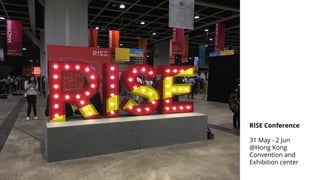
RISE Conference
31 May - 2 Jun
@Hong Kong
Convention and
Exhibition center
RISE
RISE is the first startups conference in
Asia organised by Web Summit. RISE
aims to build a meeting place for
startups from the East and the West so
the leaders of these enterprises can
congregate and demonstrate how
their companies are changing the way
we live.
Stages
Day1 : Center stage / Machine stage / Enterprise stage / Pitch stage
Day2 : Center stage / Marketing stage / Startup university / Pitch stage
Day3 : Center stage / Builders stage / Startup university / Breakthrough stage
Format
Perfectly executed TED
style presentation
Journalist facilitating the
natural discussion
Startup pitching to
investors
Trends and topics
E-commerce, FinTech, Artificial intelligence, IoT, Drones, Robotics, On-demand
economy, AR/VR, Security and hacking, Tech ethics, Cloud computing, Media
and entertainment, Travel, Transportation, Localization, Immersive markets,
Data analytics, Advertising, Brand, Asian markets
Key takeaways
1. AI and Robotics solving real problems
2. Growth and expansion of on-demand economy
3. Changing needs in China
4. Entrepreneurship and innovation
1. AI and robotics solving real problems
People have reflected their
expectation to AI and robots
(in very science fiction way)
Robots in 2000s were either
reflecting human’s dream or
bragging their technology (or both)
Now AI and robotics are being applied to solve real world problems such as
education inequality, aging of population, energy distribution etc. Ability to
see (visual recognition) is the key technology to solve these problems.
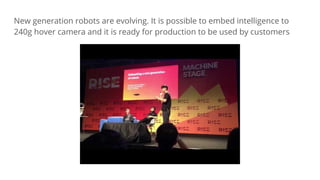
New generation robots are evolving. It is possible to embed intelligence to
240g hover camera and it is ready for production to be used by customers
“In Chinese, robot is 机器人(Humanoid) but
this is a really bad translation. Robots don’t
have to be look like human.
Definition of robot to me is machine that
have sensors, self-learn, act autonomously
and interact with environment.”
- MQ Wang
This robot watches forests and detects fire.
We only need 24 of them to cover whole
Hong Kong area. It self-learns, and acts
properly according to the situation
This year’s pitch winner is MedExo, the
company that develops an “Ironman
arm for Parkinson disease patients”
Summary
● Perception of AI and Robots are shifting from fantasy (e.g. humanoid) to
real world problem-solver
● Visual recognition is a key technology to AI and machine learning (deep
learning) improvement is accelerating its performance
● AI and Robotics are being applied to customer/industrial products and
they are ready to break markets
2. Growth and expansion of on-demand economy
“The on-demand economy (also
known as access economy or shared
economy) is a business model in which
companies fulfil consumer demand on
the basis of immediate access to
goods and services.
Basically, the whole concept of on-
demand economy is based on the idea
that access is better than ownership.
You just rent a thing temporarily
rather than buy it permanently
because it’s inexpensive and
convenient. “
http://bit.ly/1O9RgUx
Deliveroo
They have 3 main stakeholders -
Customers, restaurants, drivers.
Simplicity & Relevance
There are 3 different apps for each
stakeholders to give them less
information
Technology
They are using cutting-edgy algorithm
to deliver foods quickly
Engagement
How to make drivers more loyal -
Paying more is short-term strategy.
Building community is a key. Deliveroo
is sponsoring cycling community in
Europe.
Expanding business
When they started business in France,
French friends said “Because we love
cooking and there are no delivery
culture, the business will not go well”,
but it turned out they are lazy as other
people and they love the service.
Foodpanda
They tested their service in Singapore
first, and expanded to Asian market
and the world. Now it serves for 30
countries/regions
Localization
Same marketing strategy, but execution
has to be different.
E.g. Delivery by bike in Russia is illegal.
Russians don’t like Panda because it’s a
symbol of communism
Mobile use
People tend to use Desktop for lunch
and Mobile for dinner. Also Asian
consumers use Mobile a lot more.
Knowing markets deeper
Their next step is consolidation. They
will go deeper and wider to know each
market and will work on user
segmentation and qualitative research
Wantedly
Offers social recruiting service and
helps matching companies and job-
seekers
Service
If job-seeker likes a certain company’s
post, they can apply for ‘Office visit’
before proceeding interviews or
actively looking for a job. (Only 6% of
Japanese changes job)
Technology
Half of employees are engineers and
designers. We use matching algorithm.
Market
Social recruiting is not Japanese thing,
they found needs from companies and
job-seekers and they believe this can be
applied to other markets. They have an
office in London.
Summary
● Customer needs to on-demand service are similar in many markets and it
is an opportunity to expand markets. However, there are legal/cultural
differences so execution should be differentiated in each markets.
● Excellence in technology is a key to offer better experiences
● Knowing different needs of multiple client segments and building proper
business model are important to success of the business
3. Changing needs in China
Tourism is an extremely fragmented market.
Main businesses are 1. Flights 2. Hotel 3. Local
tourism. Tech is going to disrupt 3. local
tourism (ticketing, offering guides)
3 trends of Chinese tourists
1. They are seeking for activities and
experience instead of products/goods
2. Less than 7% are outbound travellers.
They have huge potential
3. 2nd/3rd times travellers
Possibility of VR
It can be used for those who doesn’t travel. It
will be proven in 5-10 years.
Red (小红书)
Red is targeting young people who were born
in 90s. They are shopping globally, they value
experiences and service quality, and it is part of
their lifestyle.
Service
E-commerce + Social. You can ask people about
purchase experience. Red is offering great
delivery experience and built their brand
successfully. Now they have 17mil users and
people are buying from Red even if it is more
expensive than other shops.
“We have new generation
users”
Summary
● Traditional travel business is going to shrink and tech is going to disrupt
local tourism.
● (Especially younger) Chinese consumers are getting sophisticated and
ready to spend more money for better quality and experience.
4. Entrepreneurship and innovation
There are many obstacles to do startups
such as rent, lack of talent, scalability,
economic situation etc.
However, successful founders don’t
agree. They think Hong Kong is one of the
most global city and they can find lots of
great talents, and it is great time that
many talents are coming to startups, not
investment banks.
“It is easy to survive. The
important thing is creating
meaningful business.”
Hong Kong is great place to make
hardwares. Shenzhen has a wonderful
infrastructure to make things.
Florian from Berlin : In Berlin, he could
select only one kind of vibration motor in
ebay and it takes 2 weeks shipping from
USA. But when he went to Shenzhen, one
old lady showed 90 types of vibration
motors.
It is difficult to meet people’s expectation
and they are testing and interview many
people from prototyping phase.
Professional organizer ‘Konmari’
She suggest ‘Konmari method’ to organize
things. Her book ‘The Life-Changing Magic of
Tidying Up’ were sold 6mil copies in all
around world.
She is starting a ‘Konmari consultant
certification course’ and launching app to
help those who want to organize things.
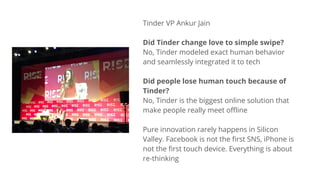
Tinder VP Ankur Jain
Did Tinder change love to simple swipe?
No, Tinder modeled exact human behavior
and seamlessly integrated it to tech
Did people lose human touch because of
Tinder?
No, Tinder is the biggest online solution that
make people really meet offline
Pure innovation rarely happens in Silicon
Valley. Facebook is not the first SNS, iPhone is
not the first touch device. Everything is about
re-thinking
Importance of young entrepreneurs
He invests a lot to young innovators. They
don’t know what’s now to ask and those
questions bring innovation.
He was doing a project with P&G, and one
young fresh mind asked him, “Why are we
building toothbrush?”
-> Actually, toothbrushes are 2000 years old
way from Egypt and there are better ways for
oral hygiene
Summary
● HK startups are having lots of obstacles such as high rents, small
population, bad economy etc. but successful startups are using those
conditions as opportunities
● Business chances come from rethinking existing solutions, and
remodeling existing human behaviour. We must keep asking “Why?” for
innovation
Others
“60 million smart toilet
have been sold. What if
they are all hacked and
hackers set the maximum
water pressure?”
“VR/AR is going to disrupt existing media
and entertainment. Especially sports,
religion and 5 letter word starting with P.”
“Board’s role is setting strategy and
direction of the company. It sounds
easy, but it can totally ruin the
business, like Kodak.”
“FinTech has huge potential. We are just
waiting Chinese government publish
clear regulations”
“My biggest regret was that I invested to
the app that has many features. It
looked good at the time, we could do
this, we could do that...But it was a total
failure. Simplicity is the most important
thing.”
Opportunities as an UXer
● Industrial design -> Digital design -> Everything design
● Knowing technology well and integrating it into service
● Having in-depth knowledge of different markets - Especially China
● Asking questions and making innovative ideas happen
Thank you
soyeon.lee@digitaslbi.com

RISE 2016 report

  • 1.
    RISE Conference 31 May- 2 Jun @Hong Kong Convention and Exhibition center
  • 2.
    RISE RISE is thefirst startups conference in Asia organised by Web Summit. RISE aims to build a meeting place for startups from the East and the West so the leaders of these enterprises can congregate and demonstrate how their companies are changing the way we live.
  • 3.
    Stages Day1 : Centerstage / Machine stage / Enterprise stage / Pitch stage Day2 : Center stage / Marketing stage / Startup university / Pitch stage Day3 : Center stage / Builders stage / Startup university / Breakthrough stage
  • 4.
    Format Perfectly executed TED stylepresentation Journalist facilitating the natural discussion Startup pitching to investors
  • 5.
    Trends and topics E-commerce,FinTech, Artificial intelligence, IoT, Drones, Robotics, On-demand economy, AR/VR, Security and hacking, Tech ethics, Cloud computing, Media and entertainment, Travel, Transportation, Localization, Immersive markets, Data analytics, Advertising, Brand, Asian markets
  • 6.
    Key takeaways 1. AIand Robotics solving real problems 2. Growth and expansion of on-demand economy 3. Changing needs in China 4. Entrepreneurship and innovation
  • 7.
    1. AI androbotics solving real problems
  • 8.
    People have reflectedtheir expectation to AI and robots (in very science fiction way)
  • 9.
    Robots in 2000swere either reflecting human’s dream or bragging their technology (or both)
  • 10.
    Now AI androbotics are being applied to solve real world problems such as education inequality, aging of population, energy distribution etc. Ability to see (visual recognition) is the key technology to solve these problems.
  • 11.
    New generation robotsare evolving. It is possible to embed intelligence to 240g hover camera and it is ready for production to be used by customers
  • 12.
    “In Chinese, robotis 机器人(Humanoid) but this is a really bad translation. Robots don’t have to be look like human. Definition of robot to me is machine that have sensors, self-learn, act autonomously and interact with environment.” - MQ Wang
  • 13.
    This robot watchesforests and detects fire. We only need 24 of them to cover whole Hong Kong area. It self-learns, and acts properly according to the situation
  • 14.
    This year’s pitchwinner is MedExo, the company that develops an “Ironman arm for Parkinson disease patients”
  • 15.
    Summary ● Perception ofAI and Robots are shifting from fantasy (e.g. humanoid) to real world problem-solver ● Visual recognition is a key technology to AI and machine learning (deep learning) improvement is accelerating its performance ● AI and Robotics are being applied to customer/industrial products and they are ready to break markets
  • 16.
    2. Growth andexpansion of on-demand economy
  • 17.
    “The on-demand economy(also known as access economy or shared economy) is a business model in which companies fulfil consumer demand on the basis of immediate access to goods and services. Basically, the whole concept of on- demand economy is based on the idea that access is better than ownership. You just rent a thing temporarily rather than buy it permanently because it’s inexpensive and convenient. “ http://bit.ly/1O9RgUx
  • 18.
    Deliveroo They have 3main stakeholders - Customers, restaurants, drivers. Simplicity & Relevance There are 3 different apps for each stakeholders to give them less information Technology They are using cutting-edgy algorithm to deliver foods quickly
  • 19.
    Engagement How to makedrivers more loyal - Paying more is short-term strategy. Building community is a key. Deliveroo is sponsoring cycling community in Europe. Expanding business When they started business in France, French friends said “Because we love cooking and there are no delivery culture, the business will not go well”, but it turned out they are lazy as other people and they love the service.
  • 20.
    Foodpanda They tested theirservice in Singapore first, and expanded to Asian market and the world. Now it serves for 30 countries/regions Localization Same marketing strategy, but execution has to be different. E.g. Delivery by bike in Russia is illegal. Russians don’t like Panda because it’s a symbol of communism
  • 21.
    Mobile use People tendto use Desktop for lunch and Mobile for dinner. Also Asian consumers use Mobile a lot more. Knowing markets deeper Their next step is consolidation. They will go deeper and wider to know each market and will work on user segmentation and qualitative research
  • 22.
    Wantedly Offers social recruitingservice and helps matching companies and job- seekers Service If job-seeker likes a certain company’s post, they can apply for ‘Office visit’ before proceeding interviews or actively looking for a job. (Only 6% of Japanese changes job)
  • 23.
    Technology Half of employeesare engineers and designers. We use matching algorithm. Market Social recruiting is not Japanese thing, they found needs from companies and job-seekers and they believe this can be applied to other markets. They have an office in London.
  • 24.
    Summary ● Customer needsto on-demand service are similar in many markets and it is an opportunity to expand markets. However, there are legal/cultural differences so execution should be differentiated in each markets. ● Excellence in technology is a key to offer better experiences ● Knowing different needs of multiple client segments and building proper business model are important to success of the business
  • 25.
  • 26.
    Tourism is anextremely fragmented market. Main businesses are 1. Flights 2. Hotel 3. Local tourism. Tech is going to disrupt 3. local tourism (ticketing, offering guides) 3 trends of Chinese tourists 1. They are seeking for activities and experience instead of products/goods 2. Less than 7% are outbound travellers. They have huge potential 3. 2nd/3rd times travellers Possibility of VR It can be used for those who doesn’t travel. It will be proven in 5-10 years.
  • 27.
    Red (小红书) Red istargeting young people who were born in 90s. They are shopping globally, they value experiences and service quality, and it is part of their lifestyle. Service E-commerce + Social. You can ask people about purchase experience. Red is offering great delivery experience and built their brand successfully. Now they have 17mil users and people are buying from Red even if it is more expensive than other shops. “We have new generation users”
  • 28.
    Summary ● Traditional travelbusiness is going to shrink and tech is going to disrupt local tourism. ● (Especially younger) Chinese consumers are getting sophisticated and ready to spend more money for better quality and experience.
  • 29.
  • 30.
    There are manyobstacles to do startups such as rent, lack of talent, scalability, economic situation etc. However, successful founders don’t agree. They think Hong Kong is one of the most global city and they can find lots of great talents, and it is great time that many talents are coming to startups, not investment banks. “It is easy to survive. The important thing is creating meaningful business.”
  • 31.
    Hong Kong isgreat place to make hardwares. Shenzhen has a wonderful infrastructure to make things. Florian from Berlin : In Berlin, he could select only one kind of vibration motor in ebay and it takes 2 weeks shipping from USA. But when he went to Shenzhen, one old lady showed 90 types of vibration motors. It is difficult to meet people’s expectation and they are testing and interview many people from prototyping phase.
  • 32.
    Professional organizer ‘Konmari’ Shesuggest ‘Konmari method’ to organize things. Her book ‘The Life-Changing Magic of Tidying Up’ were sold 6mil copies in all around world. She is starting a ‘Konmari consultant certification course’ and launching app to help those who want to organize things.
  • 33.
    Tinder VP AnkurJain Did Tinder change love to simple swipe? No, Tinder modeled exact human behavior and seamlessly integrated it to tech Did people lose human touch because of Tinder? No, Tinder is the biggest online solution that make people really meet offline Pure innovation rarely happens in Silicon Valley. Facebook is not the first SNS, iPhone is not the first touch device. Everything is about re-thinking
  • 34.
    Importance of youngentrepreneurs He invests a lot to young innovators. They don’t know what’s now to ask and those questions bring innovation. He was doing a project with P&G, and one young fresh mind asked him, “Why are we building toothbrush?” -> Actually, toothbrushes are 2000 years old way from Egypt and there are better ways for oral hygiene
  • 35.
    Summary ● HK startupsare having lots of obstacles such as high rents, small population, bad economy etc. but successful startups are using those conditions as opportunities ● Business chances come from rethinking existing solutions, and remodeling existing human behaviour. We must keep asking “Why?” for innovation
  • 36.
  • 37.
    “60 million smarttoilet have been sold. What if they are all hacked and hackers set the maximum water pressure?”
  • 38.
    “VR/AR is goingto disrupt existing media and entertainment. Especially sports, religion and 5 letter word starting with P.”
  • 39.
    “Board’s role issetting strategy and direction of the company. It sounds easy, but it can totally ruin the business, like Kodak.”
  • 40.
    “FinTech has hugepotential. We are just waiting Chinese government publish clear regulations”
  • 41.
    “My biggest regretwas that I invested to the app that has many features. It looked good at the time, we could do this, we could do that...But it was a total failure. Simplicity is the most important thing.”
  • 42.
    Opportunities as anUXer ● Industrial design -> Digital design -> Everything design ● Knowing technology well and integrating it into service ● Having in-depth knowledge of different markets - Especially China ● Asking questions and making innovative ideas happen
  • 43.