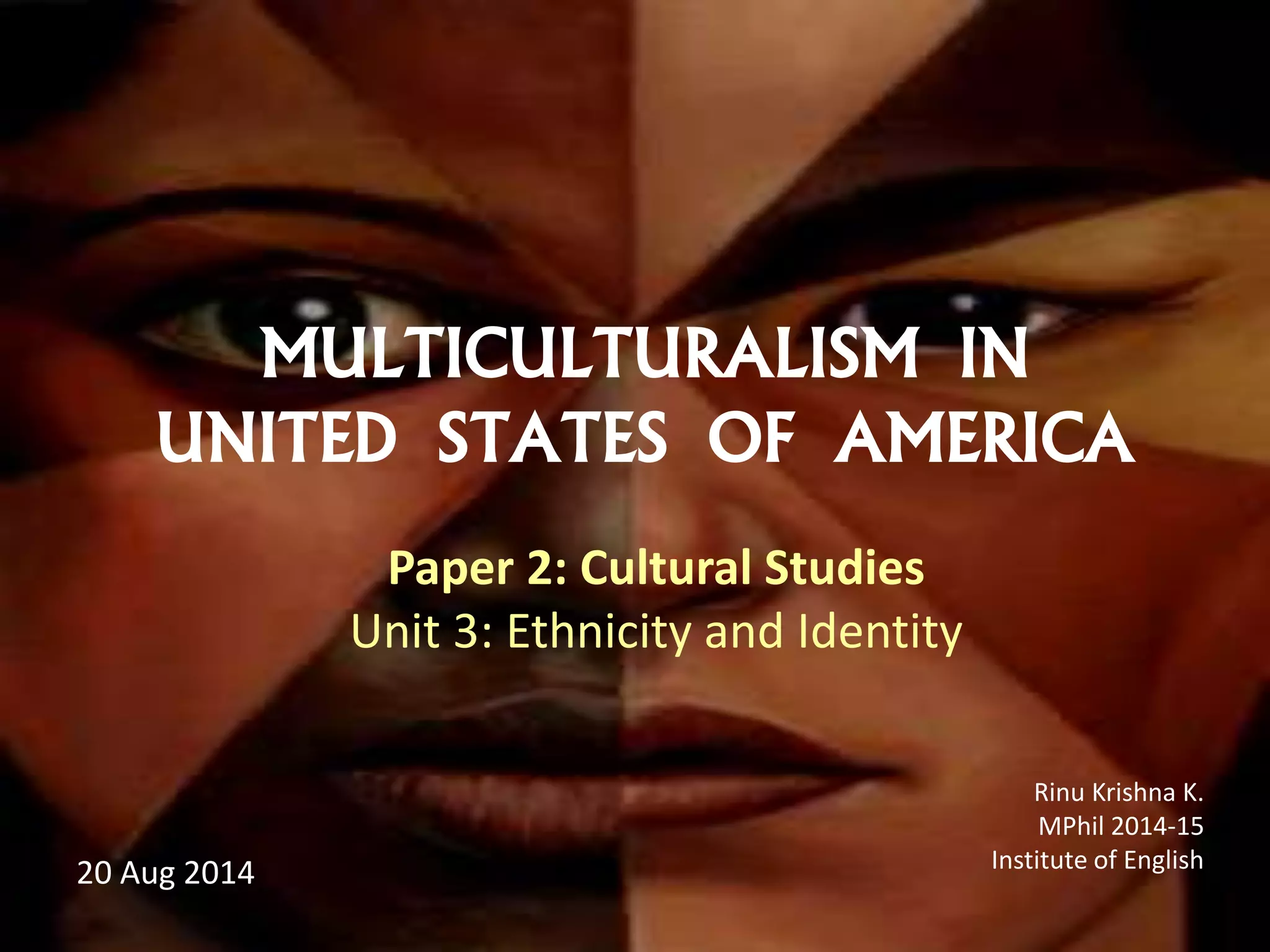
MULTICULTURALISM IN 
UNITED STATES OF AMERICA 
Paper 2: Cultural Studies 
Unit 3: Ethnicity and Identity 
20 Aug 2014 
Rinu Krishna K. 
MPhil 2014-15 
Institute of English
Introduction 
Multiculturalism is the cultural diversity of communities 
within a given society and the policies that promote this 
diversity. It is the co-existence of diverse cultures, peacefully 
and equitably in a single country, and is manifested in 
customary behaviours, cultural assumptions and values, 
patterns of thinking, and communication styles. 
As a philosophy, multiculturalism began as part of the 
pragmatism movement at the end of the nineteenth century in 
Europe and the United States, then as political and cultural 
pluralism at the turn of the twentieth. It was partly in response 
to a new wave of European imperialism in sub-Saharan Africa 
and the massive immigration of Southern and Eastern 
Europeans to the United States and Latin America. 
11/25/2014 Rinu Krishna K Mphil 2014-15 2
Introduction 
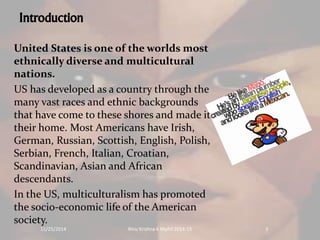
United States is one of the worlds most 
ethnically diverse and multicultural 
nations. 
US has developed as a country through the 
many vast races and ethnic backgrounds 
that have come to these shores and made it 
their home. Most Americans have Irish, 
German, Russian, Scottish, English, Polish, 
Serbian, French, Italian, Croatian, 
Scandinavian, Asian and African 
descendants. 
In the US, multiculturalism has promoted 
the socio-economic life of the American 
society. 
11/25/2014 Rinu Krishna K Mphil 2014-15 3
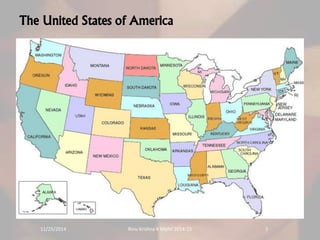
The United States of America/ 
United States (US)/America 
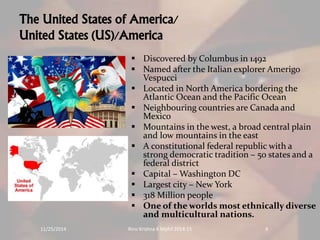
 Discovered by Columbus in 1492 
 Named after the Italian explorer Amerigo 
Vespucci 
 Located in North America bordering the 
Atlantic Ocean and the Pacific Ocean 
 Neighbouring countries are Canada and 
Mexico 
 Mountains in the west, a broad central plain 
and low mountains in the east 
 A constitutional federal republic with a 
strong democratic tradition – 50 states and a 
federal district 
 Capital –Washington DC 
 Largest city – New York 
 318 Million people 
 One of the worlds most ethnically diverse 
and multicultural nations. 
11/25/2014 Rinu Krishna K Mphil 2014-15 4
The United States of America 
11/25/2014 Rinu Krishna K Mphil 2014-15 5
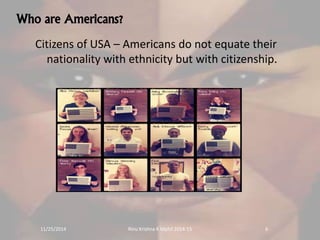
Who are Americans? 
Citizens of USA – Americans do not equate their 
nationality with ethnicity but with citizenship. 
11/25/2014 Rinu Krishna K Mphil 2014-15 6
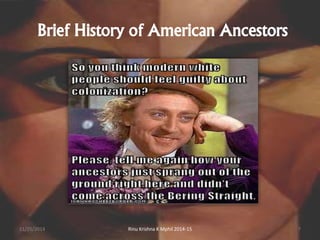
Brief History of American Ancestors 
11/25/2014 Rinu Krishna K Mphil 2014-15 7
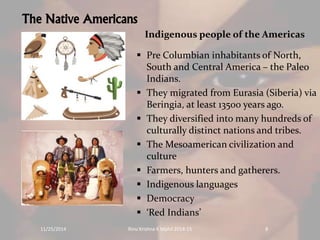
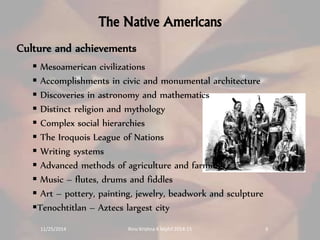
The Native Americans 
Indigenous people of the Americas 
 Pre Columbian inhabitants of North, 
South and Central America – the Paleo 
Indians. 
 They migrated from Eurasia (Siberia) via 
Beringia, at least 13500 years ago. 
 They diversified into many hundreds of 
culturally distinct nations and tribes. 
 The Mesoamerican civilization and 
culture 
 Farmers, hunters and gatherers. 
 Indigenous languages 
 Democracy 
 ‘Red Indians’ 
11/25/2014 Rinu Krishna K Mphil 2014-15 8
The Native Americans 
Culture and achievements 
 Mesoamerican civilizations 
 Accomplishments in civic and monumental architecture 
 Discoveries in astronomy and mathematics 
 Distinct religion and mythology 
 Complex social hierarchies 
 The Iroquois League of Nations 
 Writing systems 
 Advanced methods of agriculture and farming. 
 Music – flutes, drums and fiddles 
 Art – pottery, painting, jewelry, beadwork and sculpture 
Tenochtitlan – Aztecs largest city 
11/25/2014 Rinu Krishna K Mphil 2014-15 9
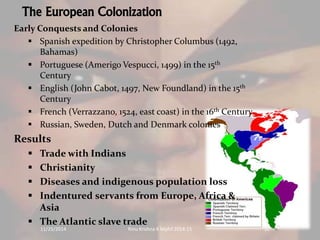
The European Colonization 
Early Conquests and Colonies 
 Spanish expedition by Christopher Columbus (1492, 
Bahamas) 
 Portuguese (Amerigo Vespucci, 1499) in the 15th 
Century 
 English (John Cabot, 1497, New Foundland) in the 15th 
Century 
 French (Verrazzano, 1524, east coast) in the 16th Century 
 Russian, Sweden, Dutch and Denmark colonies 
Results 
 Trade with Indians 
 Christianity 
 Diseases and indigenous population loss 
 Indentured servants from Europe, Africa & 
Asia 
 The Atlantic slave trade 
11/25/2014 Rinu Krishna K Mphil 2014-15 10
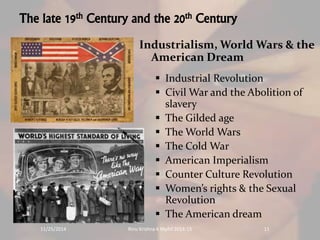
The late 19th Century and the 20th Century 
Industrialism, World Wars & the 
American Dream 
 Industrial Revolution 
 Civil War and the Abolition of 
slavery 
 The Gilded age 
 The World Wars 
 The Cold War 
 American Imperialism 
 Counter Culture Revolution 
 Women’s rights & the Sexual 
Revolution 
 The American dream 
11/25/2014 Rinu Krishna K Mphil 2014-15 11
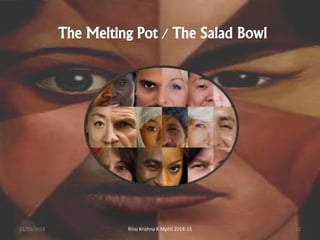
The Melting Pot / The Salad Bowl 
11/25/2014 Rinu Krishna K Mphil 2014-15 12
The Melting Pot 
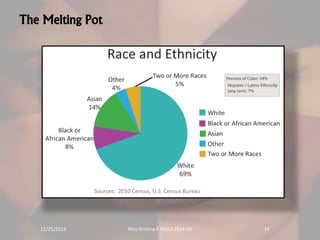
USA officially recognizes six ethnic and racial categories: 
 White American (racial majority) – from Europe & 
Middle East 
 Native American and Alaska Native – North, 
Central & South America 
 African American (racial minority) – from Sub- 
Saharan Africa 
 Asian American – Far East & Indian Subcontinent 
 Native Hawaiian - Pacific Islanders (Polynasia, 
Melanesia and Micronesia) 
 Some Other Race – Multi racial ancestry 
11/25/2014 Rinu Krishna K Mphil 2014-15 13
The Melting Pot 
11/25/2014 Rinu Krishna K Mphil 2014-15 14
The Melting Pot 
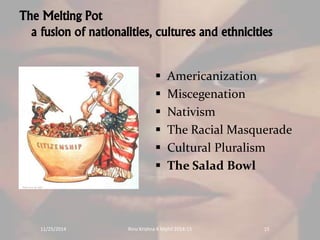
a fusion of nationalities, cultures and ethnicities 
 Americanization 
 Miscegenation 
 Nativism 
 The Racial Masquerade 
 Cultural Pluralism 
 The Salad Bowl 
11/25/2014 Rinu Krishna K Mphil 2014-15 15
American Multiculturalism 
11/25/2014 Rinu Krishna K Mphil 2014-15 16
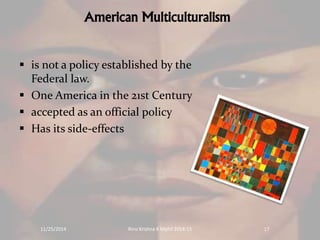
American Multiculturalism 
 is not a policy established by the 
Federal law. 
 One America in the 21st Century 
 accepted as an official policy 
 Has its side-effects 
11/25/2014 Rinu Krishna K Mphil 2014-15 17
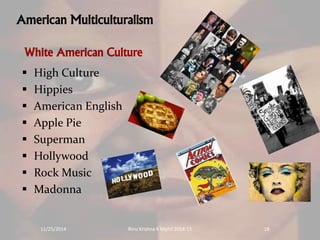
American Multiculturalism 
White American Culture 
 High Culture 
 Hippies 
 American English 
 Apple Pie 
 Superman 
 Hollywood 
 Rock Music 
 Madonna 
11/25/2014 Rinu Krishna K Mphil 2014-15 18
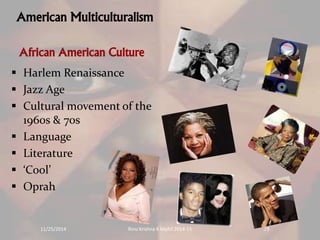
American Multiculturalism 
African American Culture 
 Harlem Renaissance 
 Jazz Age 
 Cultural movement of the 
1960s & 70s 
 Language 
 Literature 
 ‘Cool’ 
 Oprah 
11/25/2014 Rinu Krishna K Mphil 2014-15 19
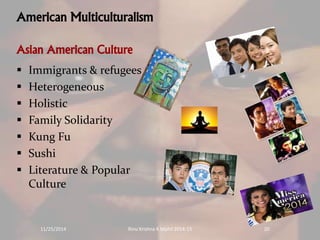
American Multiculturalism 
Asian American Culture 
 Immigrants & refugees 
 Heterogeneous 
 Holistic 
 Family Solidarity 
 Kung Fu 
 Sushi 
 Literature & Popular 
Culture 
11/25/2014 Rinu Krishna K Mphil 2014-15 20
American Multiculturalism 
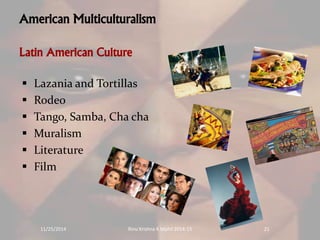
Latin American Culture 
 Lazania and Tortillas 
 Rodeo 
 Tango, Samba, Cha cha 
 Muralism 
 Literature 
 Film 
11/25/2014 Rinu Krishna K Mphil 2014-15 21
American Multiculturalism 
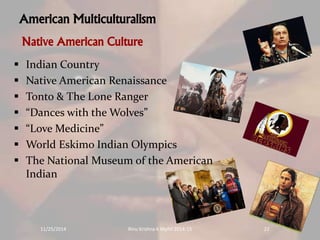
Native American Culture 
 Indian Country 
 Native American Renaissance 
 Tonto & The Lone Ranger 
 “Dances with the Wolves” 
 “Love Medicine” 
 World Eskimo Indian Olympics 
 The National Museum of the American 
Indian 
11/25/2014 Rinu Krishna K Mphil 2014-15 22
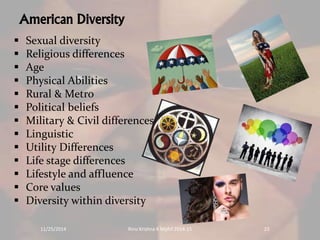
American Diversity 
 Sexual diversity 
 Religious differences 
 Age 
 Physical Abilities 
 Rural & Metro 
 Political beliefs 
 Military & Civil differences 
 Linguistic 
 Utility Differences 
 Life stage differences 
 Lifestyle and affluence 
 Core values 
 Diversity within diversity 
11/25/2014 Rinu Krishna K Mphil 2014-15 23
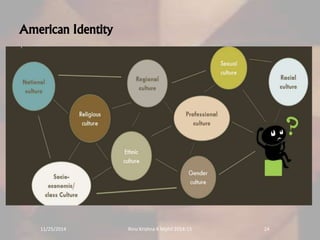
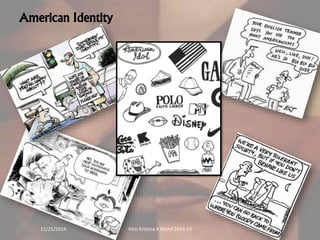
American Identity 
11/25/2014 Rinu Krishna K Mphil 2014-15 24
American Identity 
11/25/2014 Rinu Krishna K Mphil 2014-15 25
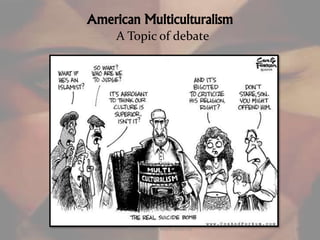
American Multiculturalism 
A Topic of debate 
11/25/2014 Rinu Krishna K Mphil 2014-15 26
Americans 
 They are the citizens of America 
 Americans come in all colours, have all types of religions, and speak many languages from all over the world. 
 Americans are extremely independent, individualistic, and like to be different from each other. 
 Americans believe in freedom of choice. 
 Americans need a lot of “elbow room”; they like personal space around them. 
 Many people, especially teenagers, wear strange clothes, and many have tattoos and body piercings. 
 Americans follow the rule of law. 
 Discriminating against or making any insulting statement about someone else’s religion or ethnicity is against the 
law and could be punishable as a hate crime. 
 In most states, it is illegal to buy cigarettes /alcohol if you are under the age of 18 and often you can only smoke 
in certain places. 
 Americans are extremely informal and call most people by their first name or nickname. 
 Americans smile a lot and talk easily to strangers, sharing personal stories. 
 Americans don’t push or stand too close to anyone in line. They always wait their turn. 
 Polite Americans eat with one hand while the other one is under the table on their laps. 
 Americans have parties for many reasons. Sometimes they are held for friends to get together and to meet new 
people. 
 Never ask Americans a direct question about their religion, age, money, salary, weight, or dress/suit size. 
 Men should not make any “sexist” remarks to or about women—anything that would make women unequal to 
men. 
 It is normal for American women to have male friends who are just friends (and vice versa). 
 American parents speak to their children as adults and teach them how to be responsible for their actions. 
 Americans love their pets, sometimes more than they love people. 
 Domestic violence is against the law. It is illegal to hit anyone: a spouse, a parent, a child, and even a pet. 
11/25/2014 Rinu Krishna K Mphil 2014-15 27
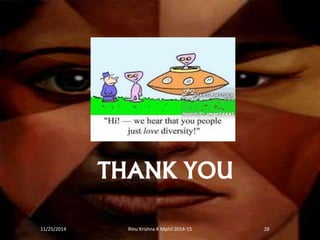
THANK YOU 
11/25/2014 Rinu Krishna K Mphil 2014-15 28
Bibliography 
 Lobo, Susan. Native American Voices. A Reader. Longman. 
Print. 
 Dr. A. Sivaramasubramonia Aiyer Memorial Committee. 
Literary Studies. Coleridge’s Concept of Culture. Print. 
 Cohen, Henry. The American Experience: Approaches to 
the study of the United States. University of Pennsylvania. 
Print. 
 Page, Evelyn. American Genesis. Print 
 Taylor, Jared. Multiculturalism and American Future. You 
Tube. Internet. 
 Colebuck, Claire. New Literary Histories. Second Edition. 
Print. 
 Wikipedia. Internet. 
11/25/2014 Rinu Krishna K Mphil 2014-15 29

Rinu 22 aug multiculturalism in america

  • 1.
    MULTICULTURALISM IN UNITEDSTATES OF AMERICA Paper 2: Cultural Studies Unit 3: Ethnicity and Identity 20 Aug 2014 Rinu Krishna K. MPhil 2014-15 Institute of English
  • 2.
    Introduction Multiculturalism isthe cultural diversity of communities within a given society and the policies that promote this diversity. It is the co-existence of diverse cultures, peacefully and equitably in a single country, and is manifested in customary behaviours, cultural assumptions and values, patterns of thinking, and communication styles. As a philosophy, multiculturalism began as part of the pragmatism movement at the end of the nineteenth century in Europe and the United States, then as political and cultural pluralism at the turn of the twentieth. It was partly in response to a new wave of European imperialism in sub-Saharan Africa and the massive immigration of Southern and Eastern Europeans to the United States and Latin America. 11/25/2014 Rinu Krishna K Mphil 2014-15 2
  • 3.
    Introduction United Statesis one of the worlds most ethnically diverse and multicultural nations. US has developed as a country through the many vast races and ethnic backgrounds that have come to these shores and made it their home. Most Americans have Irish, German, Russian, Scottish, English, Polish, Serbian, French, Italian, Croatian, Scandinavian, Asian and African descendants. In the US, multiculturalism has promoted the socio-economic life of the American society. 11/25/2014 Rinu Krishna K Mphil 2014-15 3
  • 4.
    The United Statesof America/ United States (US)/America  Discovered by Columbus in 1492  Named after the Italian explorer Amerigo Vespucci  Located in North America bordering the Atlantic Ocean and the Pacific Ocean  Neighbouring countries are Canada and Mexico  Mountains in the west, a broad central plain and low mountains in the east  A constitutional federal republic with a strong democratic tradition – 50 states and a federal district  Capital –Washington DC  Largest city – New York  318 Million people  One of the worlds most ethnically diverse and multicultural nations. 11/25/2014 Rinu Krishna K Mphil 2014-15 4
  • 5.
    The United Statesof America 11/25/2014 Rinu Krishna K Mphil 2014-15 5
  • 6.
    Who are Americans? Citizens of USA – Americans do not equate their nationality with ethnicity but with citizenship. 11/25/2014 Rinu Krishna K Mphil 2014-15 6
  • 7.
    Brief History ofAmerican Ancestors 11/25/2014 Rinu Krishna K Mphil 2014-15 7
  • 8.
    The Native Americans Indigenous people of the Americas  Pre Columbian inhabitants of North, South and Central America – the Paleo Indians.  They migrated from Eurasia (Siberia) via Beringia, at least 13500 years ago.  They diversified into many hundreds of culturally distinct nations and tribes.  The Mesoamerican civilization and culture  Farmers, hunters and gatherers.  Indigenous languages  Democracy  ‘Red Indians’ 11/25/2014 Rinu Krishna K Mphil 2014-15 8
  • 9.
    The Native Americans Culture and achievements  Mesoamerican civilizations  Accomplishments in civic and monumental architecture  Discoveries in astronomy and mathematics  Distinct religion and mythology  Complex social hierarchies  The Iroquois League of Nations  Writing systems  Advanced methods of agriculture and farming.  Music – flutes, drums and fiddles  Art – pottery, painting, jewelry, beadwork and sculpture Tenochtitlan – Aztecs largest city 11/25/2014 Rinu Krishna K Mphil 2014-15 9
  • 10.
    The European Colonization Early Conquests and Colonies  Spanish expedition by Christopher Columbus (1492, Bahamas)  Portuguese (Amerigo Vespucci, 1499) in the 15th Century  English (John Cabot, 1497, New Foundland) in the 15th Century  French (Verrazzano, 1524, east coast) in the 16th Century  Russian, Sweden, Dutch and Denmark colonies Results  Trade with Indians  Christianity  Diseases and indigenous population loss  Indentured servants from Europe, Africa & Asia  The Atlantic slave trade 11/25/2014 Rinu Krishna K Mphil 2014-15 10
  • 11.
    The late 19thCentury and the 20th Century Industrialism, World Wars & the American Dream  Industrial Revolution  Civil War and the Abolition of slavery  The Gilded age  The World Wars  The Cold War  American Imperialism  Counter Culture Revolution  Women’s rights & the Sexual Revolution  The American dream 11/25/2014 Rinu Krishna K Mphil 2014-15 11
  • 12.
    The Melting Pot/ The Salad Bowl 11/25/2014 Rinu Krishna K Mphil 2014-15 12
  • 13.
    The Melting Pot USA officially recognizes six ethnic and racial categories:  White American (racial majority) – from Europe & Middle East  Native American and Alaska Native – North, Central & South America  African American (racial minority) – from Sub- Saharan Africa  Asian American – Far East & Indian Subcontinent  Native Hawaiian - Pacific Islanders (Polynasia, Melanesia and Micronesia)  Some Other Race – Multi racial ancestry 11/25/2014 Rinu Krishna K Mphil 2014-15 13
  • 14.
    The Melting Pot 11/25/2014 Rinu Krishna K Mphil 2014-15 14
  • 15.
    The Melting Pot a fusion of nationalities, cultures and ethnicities  Americanization  Miscegenation  Nativism  The Racial Masquerade  Cultural Pluralism  The Salad Bowl 11/25/2014 Rinu Krishna K Mphil 2014-15 15
  • 16.
    American Multiculturalism 11/25/2014Rinu Krishna K Mphil 2014-15 16
  • 17.
    American Multiculturalism is not a policy established by the Federal law.  One America in the 21st Century  accepted as an official policy  Has its side-effects 11/25/2014 Rinu Krishna K Mphil 2014-15 17
  • 18.
    American Multiculturalism WhiteAmerican Culture  High Culture  Hippies  American English  Apple Pie  Superman  Hollywood  Rock Music  Madonna 11/25/2014 Rinu Krishna K Mphil 2014-15 18
  • 19.
    American Multiculturalism AfricanAmerican Culture  Harlem Renaissance  Jazz Age  Cultural movement of the 1960s & 70s  Language  Literature  ‘Cool’  Oprah 11/25/2014 Rinu Krishna K Mphil 2014-15 19
  • 20.
    American Multiculturalism AsianAmerican Culture  Immigrants & refugees  Heterogeneous  Holistic  Family Solidarity  Kung Fu  Sushi  Literature & Popular Culture 11/25/2014 Rinu Krishna K Mphil 2014-15 20
  • 21.
    American Multiculturalism LatinAmerican Culture  Lazania and Tortillas  Rodeo  Tango, Samba, Cha cha  Muralism  Literature  Film 11/25/2014 Rinu Krishna K Mphil 2014-15 21
  • 22.
    American Multiculturalism NativeAmerican Culture  Indian Country  Native American Renaissance  Tonto & The Lone Ranger  “Dances with the Wolves”  “Love Medicine”  World Eskimo Indian Olympics  The National Museum of the American Indian 11/25/2014 Rinu Krishna K Mphil 2014-15 22
  • 23.
    American Diversity Sexual diversity  Religious differences  Age  Physical Abilities  Rural & Metro  Political beliefs  Military & Civil differences  Linguistic  Utility Differences  Life stage differences  Lifestyle and affluence  Core values  Diversity within diversity 11/25/2014 Rinu Krishna K Mphil 2014-15 23
  • 24.
    American Identity 11/25/2014Rinu Krishna K Mphil 2014-15 24
  • 25.
    American Identity 11/25/2014Rinu Krishna K Mphil 2014-15 25
  • 26.
    American Multiculturalism ATopic of debate 11/25/2014 Rinu Krishna K Mphil 2014-15 26
  • 27.
    Americans  Theyare the citizens of America  Americans come in all colours, have all types of religions, and speak many languages from all over the world.  Americans are extremely independent, individualistic, and like to be different from each other.  Americans believe in freedom of choice.  Americans need a lot of “elbow room”; they like personal space around them.  Many people, especially teenagers, wear strange clothes, and many have tattoos and body piercings.  Americans follow the rule of law.  Discriminating against or making any insulting statement about someone else’s religion or ethnicity is against the law and could be punishable as a hate crime.  In most states, it is illegal to buy cigarettes /alcohol if you are under the age of 18 and often you can only smoke in certain places.  Americans are extremely informal and call most people by their first name or nickname.  Americans smile a lot and talk easily to strangers, sharing personal stories.  Americans don’t push or stand too close to anyone in line. They always wait their turn.  Polite Americans eat with one hand while the other one is under the table on their laps.  Americans have parties for many reasons. Sometimes they are held for friends to get together and to meet new people.  Never ask Americans a direct question about their religion, age, money, salary, weight, or dress/suit size.  Men should not make any “sexist” remarks to or about women—anything that would make women unequal to men.  It is normal for American women to have male friends who are just friends (and vice versa).  American parents speak to their children as adults and teach them how to be responsible for their actions.  Americans love their pets, sometimes more than they love people.  Domestic violence is against the law. It is illegal to hit anyone: a spouse, a parent, a child, and even a pet. 11/25/2014 Rinu Krishna K Mphil 2014-15 27
  • 28.
    THANK YOU 11/25/2014Rinu Krishna K Mphil 2014-15 28
  • 29.
    Bibliography  Lobo,Susan. Native American Voices. A Reader. Longman. Print.  Dr. A. Sivaramasubramonia Aiyer Memorial Committee. Literary Studies. Coleridge’s Concept of Culture. Print.  Cohen, Henry. The American Experience: Approaches to the study of the United States. University of Pennsylvania. Print.  Page, Evelyn. American Genesis. Print  Taylor, Jared. Multiculturalism and American Future. You Tube. Internet.  Colebuck, Claire. New Literary Histories. Second Edition. Print.  Wikipedia. Internet. 11/25/2014 Rinu Krishna K Mphil 2014-15 29