AN EXAMINATION OF REVERSE LOGISTICS PRACTICES
by
Dale S. Rogers
and
Ronald Tibben-Lembke
University of Nevada
There is a new focus on reverse logistics, as a growing number of articles in the trade press (Jedd
1999, 2000; Melbin 1995; Ross 1998; “Shifting Logistics” 1999), and conference sessions bear out
(Austhof, Helferich, and Otis 1997; Rogers 1998; Stock 1998b). Several books and papers have recently
been published on the topic (Carter and Ellram 1998; Kopicki et al. 1993; Krikke 1998; Kroon and
Vrijens 1995; Pohlen and Farris 1992; Stock 1992, 1998a; Theirry et al. 1995). While there is new
interest in reverse logistics, little is known about the size and scope of reverse logistics activities: How
much money is being spent on these activities? What activities are companies involved in and why?
What is the best way to organize reverse logistics? Should centralized facilities be used?Addition-
ally, most of the work on reverse logistics examined in preparation for this research emphasized “green”
or environmental issues. In this paper, green issues are briefly discussed, but the primary focus is on
economic and supply chain issues relating to reverse logistics.
This paper defines reverse logistics and describes reverse logistics practices and barriers to imple-
menting good reverse logistics practices.Aportion of the research charter was to determine the extent
of reverse logistics activity in the United States.The objective was to identify current practices, exam-
ine these practices, and develop information surrounding trends in reverse logistics practices.
DEFINING REVERSE LOGISTICS
One of the earliest descriptions of reverse logistics was given by Lambert and Stock in 1981.
They described it as “going the wrong way on a one-way street because the great majority of prod-
uct shipments flow in one direction” (Lambert and Stock 1981, p. 19). This is similar to a definition
by Murphy in 1986, and by Murphy and Poist in 1989 who defined reverse logistics as the “move-
ment of goods from a consumer towards a producer in a channel of distribution.”Throughout the 1980s,
the scope of reverse logistics was limited to the movement of material against the primary flow, from
the customer toward the producer.
In 1998, Stock defined reverse logistics as “the role of logistics in product returns, source
reduction, recycling, materials substitution, reuse of materials, waste disposal and refurbishing,
JOURNAL OF BUSINESS LOGISTICS, Vol.22, No.2,2001 129
repair, and remanufacturing” (1998a, p. 20). This is similar to the definition given by Stock in 1992
(p. i) and by Kopicki et al. in 1993 (p. 323). In a 1998 paper in the Journal of Business Logistics, Carter
and Ellram adopted a similar definition, calling it “the process whereby companies can become more
environmentally efficient through recycling, reusing, and reducing the amount of materials used”
(p. 85).
If the focus of logistics is the movement of material from the point of origin toward the point
of consumption (Council of Logistics Management 1999), then the focus of reverse logistics should
be the movement of material from the point of consumption toward the point of origin. While this
is how the term was originally used, it has become a blanket term for efforts to reduce the environ-
mental impact of the supply chain.Activities such as source reduction and material substitution do
have a significant impact on logistics. However, these and other activities primarily motivated by envi-
ronmental considerations might better be labeled “green logistics” or “environmental logistics,” which
we would define as “efforts to measure and minimize the environmental impact of logistics activi-
ties.” The term “reverse logistics” should be reserved for the flow of products and materials going
“the wrong way on a one-way street.”Therefore, drawing on the Council of Logistics Management’s
definition of logistics, we define reverse logistics as:
“The process of planning, implementing, and controlling the efficient, cost effective
flow of raw materials, in-process inventory, finished goods, and related information from
the point of consumption to the point of origin for the purpose of recapturing or creating
value or proper disposal” (Rogers and Tibben-Lembke 1999, p. 2).
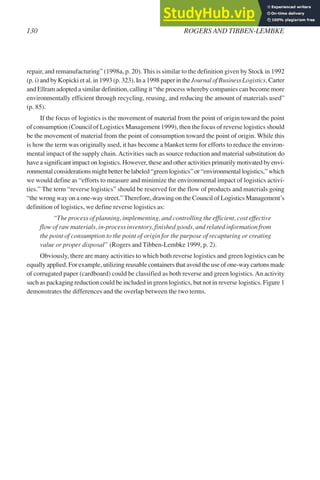
Obviously, there are many activities to which both reverse logistics and green logistics can be
equally applied. For example, utilizing reusable containers that avoid the use of one-way cartons made
of corrugated paper (cardboard) could be classified as both reverse and green logistics.An activity
such as packaging reduction could be included in green logistics, but not in reverse logistics. Figure 1
demonstrates the differences and the overlap between the two terms.
130 ROGERS AND TIBBEN-LEMBKE
FIGURE 1
COMPARISON OF REVERSE LOGISTICS
AND GREEN LOGISTICS
RESEARCH DESCRIPTION
The research team interviewed more than 150 managers with reverse logistics responsibilities,
and visits were made to companies to examine, firsthand, reverse logistics processes. An early
version of the mail survey questionnaire was used as an interview guide for many early interviews.
The survey was revised and pre-tested on two different groups before being mailed to 1,200 logistics
managers who were members of the Council of Logistics Management. In the first mailing, as an incen-
tive, a dollar bill was included. There were 147 undeliverable questionnaires. Among the 1,053
that reached their destinations, 258 were returned. A second mailing to the non-respondents (with-
out the incentive), yielded 53 returns, for a total of 311 usable questionnaires, a 29.53% response rate.
Non-response bias was examined by comparing later and earlier responses. Because late respondents
are generally considered to be similar to non-respondents, non-response bias is not believed to be an
issue of concern (Armstrong and Overton 1977; Lambert and Harrington 1990).All respondents were
located in the U.S.
Companies included in this research are manufacturers, wholesalers, retailers, and service
firms. In some cases, a company may occupy more than one supply chain position. For example, many
of the manufacturers are also retailers and wholesalers.The supply chain position of the respondents
is depicted in Table 1.
Reverse Logistics
• Product returns • Recycling • Packaging reduction
• Marketing returns • Remanufacturing • Air & noise emissions
• Secondary markets • Reusable • Environmental impact
packaging of mode selection
Green Logistics
JOURNAL OF BUSINESS LOGISTICS, Vol.22, No.2,2001 131
TABLE 1
SUPPLY CHAIN POSITION OF RESPONDENT FIRMS
Supply Chain Percentage of
Position Respondents
Manufacturer 64.0%
Wholesaler 29.9%
Retailer 28.9%
Service Provider 9.0%
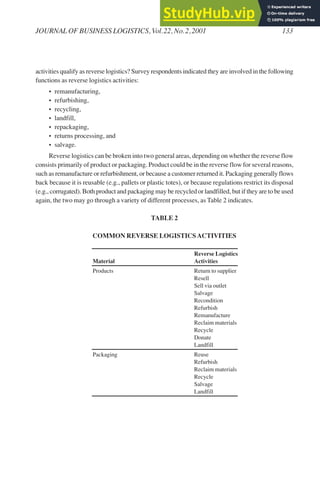
Most of the companies are very large.As shown in Figure 2, nearly half have annual sales of more
than $1 billion. Conclusions drawn here are probably most applicable to large companies.
FIGURE 2
ANNUALSALES OF RESPONDENT FIRMS
REVERSE LOGISTICSACTIVITIES
As the preceding discussion illustrates, there are many activities that could fall under the head-
ing of reverse logistics, as we have defined it. Of all of the supply chain duties within a company, which
Percentage
of
Respondents
50%
40%
30%
20%
10%
0%
<$10M $10- $50- $100M- $200M- $500M- >$1B
$50M $100M $200M $500M $1B
Annual Sales
132 ROGERS AND TIBBEN-LEMBKE
activities qualify as reverse logistics? Survey respondents indicated they are involved in the following
functions as reverse logistics activities:
• remanufacturing,
• refurbishing,
• recycling,
• landfill,
• repackaging,
• returns processing, and
• salvage.
Reverse logistics can be broken into two general areas, depending on whether the reverse flow
consists primarily of product or packaging. Product could be in the reverse flow for several reasons,
such as remanufacture or refurbishment, or because a customer returned it. Packaging generally flows
back because it is reusable (e.g., pallets or plastic totes), or because regulations restrict its disposal
(e.g., corrugated). Both product and packaging may be recycled or landfilled, but if they are to be used
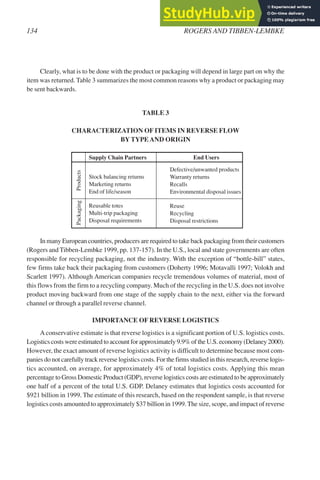
again, the two may go through a variety of different processes, as Table 2 indicates.
TABLE 2
COMMON REVERSE LOGISTICSACTIVITIES
Reverse Logistics
Material Activities
Products Return to supplier
Resell
Sell via outlet
Salvage
Recondition
Refurbish
Remanufacture
Reclaim materials
Recycle
Donate
Landfill
Packaging Reuse
Refurbish
Reclaim materials
Recycle
Salvage
Landfill
JOURNAL OF BUSINESS LOGISTICS, Vol.22, No.2,2001 133
Clearly, what is to be done with the product or packaging will depend in large part on why the
item was returned. Table 3 summarizes the most common reasons why a product or packaging may
be sent backwards.
TABLE 3
CHARACTERIZATION OF ITEMS IN REVERSE FLOW
BYTYPEAND ORIGIN
Supply Chain Partners End Users
Stock balancing returns
Marketing returns
End of life/season
Reusable totes
Multi-trip packaging
Disposal requirements
In many European countries, producers are required to take back packaging from their customers
(Rogers and Tibben-Lembke 1999, pp. 137-157). In the U.S., local and state governments are often
responsible for recycling packaging, not the industry. With the exception of “bottle-bill” states,
few firms take back their packaging from customers (Doherty 1996; Motavalli 1997; Volokh and
Scarlett 1997). Although American companies recycle tremendous volumes of material, most of
this flows from the firm to a recycling company. Much of the recycling in the U.S. does not involve
product moving backward from one stage of the supply chain to the next, either via the forward
channel or through a parallel reverse channel.
IMPORTANCE OF REVERSE LOGISTICS
Aconservative estimate is that reverse logistics is a significant portion of U.S. logistics costs.
Logistics costs were estimated to account for approximately 9.9% of the U.S. economy (Delaney 2000).
However, the exact amount of reverse logistics activity is difficult to determine because most com-
panies do not carefully track reverse logistics costs. For the firms studied in this research, reverse logis-
tics accounted, on average, for approximately 4% of total logistics costs. Applying this mean
percentage to Gross Domestic Product (GDP), reverse logistics costs are estimated to be approximately
one half of a percent of the total U.S. GDP. Delaney estimates that logistics costs accounted for
$921 billion in 1999. The estimate of this research, based on the respondent sample, is that reverse
logistics costs amounted to approximately $37 billion in 1999.The size, scope, and impact of reverse
134 ROGERS AND TIBBEN-LEMBKE
Defective/unwanted products
Warranty returns
Recalls
Environmental disposal issues
Reuse
Recycling
Disposal restrictions
Packaging
Products
logistics vary by industry and channel position as well as the type of distribution channel. It is clear,
however, that the overall amount of reverse logistics activity in the economy is large and still growing.
Within specific industries, reverse logistics activities can be critical for the firm. Generally, when
the value of the product is large, or the return rate is great, much more effort has been spent on improv-
ing return processes.The auto parts industry is a good example. In 1998, the remanufactured auto parts
market was estimated by the Automotive Parts Rebuilders Association (APRA) at $36 billion. For
example, 90-95% of all starters and alternators sold for replacement are remanufactured. By one con-
servative estimate, 12,000 automobile dismantlers and remanufacturers are operating in the United
States (Automotive Parts RebuildersAssociation 1998).
Rebuilding and remanufacturing conserve a considerable amount of resources.According to the
APRA, about 50% of an automotive starter is recovered in the rebuilding process. This may result
in saving several million gallons of crude oil, as well as steel and other metals. TheAPRAestimates
that raw materials saved by remanufacturing worldwide would fill 155,000 railroad cars annually,
a train over 1,100 miles long.
THE ROLE OF REVERSE LOGISTICS
For product returns, a high percentage comes from customer returns. Based on information gath-
ered in interviews, overall customer returns for general merchandise are estimated to be approximately
6%, although return rates vary significantly by industry. In many industries, learning to manage the
reverse flow is of prime importance, because the large volume of product returned represents a
significant cost. In addition to the cost of producing and transporting the product, the firm may face
significant costs in disposing of the product.
According to the U.S. Census Bureau, sales for general merchandise, sporting goods, appliances,
electronics, computers, and building supply retailers totaled $630 billion for 1999 (U.S. Census Bureau
1999). Applying an estimated 6% return rate, this is over $38 billion dollars worth of returned
products.
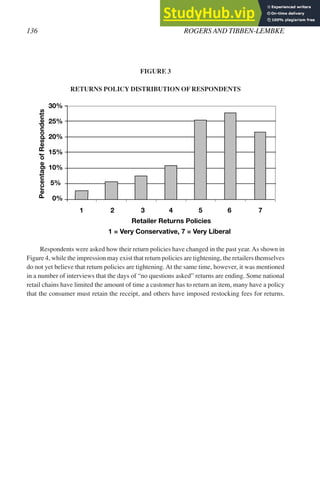
Despite the costs, companies appear very willing to accept customer returns. Respondents
were asked to rate their return policies on a seven-point scale, with 1 representing very conservative
(restrictive), and 7 representing very liberal.As Figure 3 shows, respondent firms believe that their
return policies are rather liberal.
JOURNAL OF BUSINESS LOGISTICS, Vol.22, No.2,2001 135
FIGURE 3
RETURNS POLICY DISTRIBUTION OF RESPONDENTS
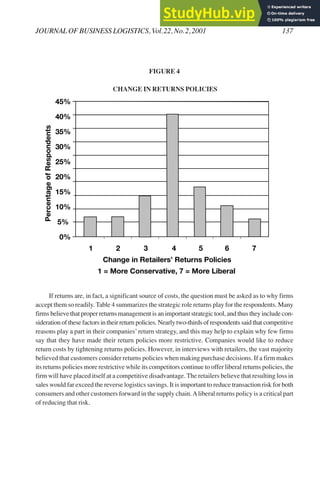
Respondents were asked how their return policies have changed in the past year. As shown in
Figure 4, while the impression may exist that return policies are tightening, the retailers themselves
do not yet believe that return policies are tightening. At the same time, however, it was mentioned
in a number of interviews that the days of “no questions asked” returns are ending. Some national
retail chains have limited the amount of time a customer has to return an item, many have a policy
that the consumer must retain the receipt, and others have imposed restocking fees for returns.
Percentage
of
Respondents
30%
25%
20%
15%
10%
5%
0%
1 2 3 4 5 6 7
Retailer Returns Policies
1 = Very Conservative, 7 = Very Liberal
136 ROGERS AND TIBBEN-LEMBKE
FIGURE 4
CHANGE IN RETURNS POLICIES
If returns are, in fact, a significant source of costs, the question must be asked as to why firms
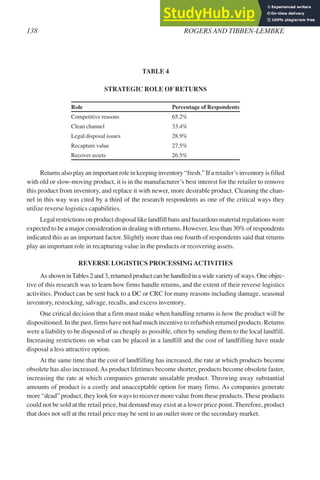
accept them so readily. Table 4 summarizes the strategic role returns play for the respondents. Many
firms believe that proper returns management is an important strategic tool, and thus they include con-
sideration of these factors in their return policies. Nearly two-thirds of respondents said that competitive
reasons play a part in their companies’return strategy, and this may help to explain why few firms
say that they have made their return policies more restrictive. Companies would like to reduce
return costs by tightening returns policies. However, in interviews with retailers, the vast majority
believed that customers consider returns policies when making purchase decisions. If a firm makes
its returns policies more restrictive while its competitors continue to offer liberal returns policies, the
firm will have placed itself at a competitive disadvantage. The retailers believe that resulting loss in
sales would far exceed the reverse logistics savings. It is important to reduce transaction risk for both
consumers and other customers forward in the supply chain.Aliberal returns policy is a critical part
of reducing that risk.
Percentage
of
Respondents
45%
40%
35%
30%
25%
20%
15%
10%
5%
0%
1 2 3 4 5 6 7
Change in Retailers’ Returns Policies
1 = More Conservative, 7 = More Liberal
JOURNAL OF BUSINESS LOGISTICS, Vol.22, No.2,2001 137
TABLE 4
STRATEGIC ROLE OF RETURNS
Role Percentage of Respondents
Competitive reasons 65.2%
Clean channel 33.4%
Legal disposal issues 28.9%
Recapture value 27.5%
Recover assets 26.5%
Returns also play an important role in keeping inventory “fresh.” If a retailer’s inventory is filled
with old or slow-moving product, it is in the manufacturer’s best interest for the retailer to remove
this product from inventory, and replace it with newer, more desirable product. Cleaning the chan-
nel in this way was cited by a third of the research respondents as one of the critical ways they
utilize reverse logistics capabilities.
Legal restrictions on product disposal like landfill bans and hazardous material regulations were
expected to be a major consideration in dealing with returns. However, less than 30% of respondents
indicated this as an important factor. Slightly more than one fourth of respondents said that returns
play an important role in recapturing value in the products or recovering assets.
REVERSE LOGISTICS PROCESSINGACTIVITIES
As shown inTables 2 and 3, returned product can be handled in a wide variety of ways. One objec-
tive of this research was to learn how firms handle returns, and the extent of their reverse logistics
activities. Product can be sent back to a DC or CRC for many reasons including damage, seasonal
inventory, restocking, salvage, recalls, and excess inventory.
One critical decision that a firm must make when handling returns is how the product will be
dispositioned. In the past, firms have not had much incentive to refurbish returned products. Returns
were a liability to be disposed of as cheaply as possible, often by sending them to the local landfill.
Increasing restrictions on what can be placed in a landfill and the cost of landfilling have made
disposal a less attractive option.
At the same time that the cost of landfilling has increased, the rate at which products become
obsolete has also increased.As product lifetimes become shorter, products become obsolete faster,
increasing the rate at which companies generate unsalable product. Throwing away substantial
amounts of product is a costly and unacceptable option for many firms. As companies generate
more “dead” product, they look for ways to recover more value from these products. These products
could not be sold at the retail price, but demand may exist at a lower price point. Therefore, product
that does not sell at the retail price may be sent to an outlet store or the secondary market.
138 ROGERS AND TIBBEN-LEMBKE
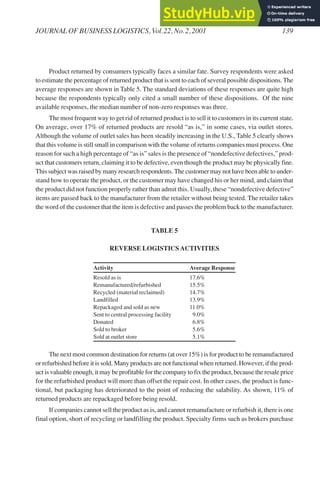
Product returned by consumers typically faces a similar fate. Survey respondents were asked
to estimate the percentage of returned product that is sent to each of several possible dispositions.The
average responses are shown in Table 5. The standard deviations of these responses are quite high
because the respondents typically only cited a small number of these dispositions. Of the nine
available responses, the median number of non-zero responses was three.
The most frequent way to get rid of returned product is to sell it to customers in its current state.
On average, over 17% of returned products are resold “as is,” in some cases, via outlet stores.
Although the volume of outlet sales has been steadily increasing in the U.S., Table 5 clearly shows
that this volume is still small in comparison with the volume of returns companies must process. One
reason for such a high percentage of “as is” sales is the presence of “nondefective defectives,” prod-
uct that customers return, claiming it to be defective, even though the product may be physically fine.
This subject was raised by many research respondents.The customer may not have been able to under-
stand how to operate the product, or the customer may have changed his or her mind, and claim that
the product did not function properly rather than admit this. Usually, these “nondefective defective”
items are passed back to the manufacturer from the retailer without being tested. The retailer takes
the word of the customer that the item is defective and passes the problem back to the manufacturer.
TABLE 5
REVERSE LOGISTICSACTIVITIES
Activity Average Response
Resold as is 17.6%
Remanufactured/refurbished 15.5%
Recycled (material reclaimed) 14.7%
Landfilled 13.9%
Repackaged and sold as new 11.0%
Sent to central processing facility 9.0%
Donated 6.8%
Sold to broker 5.6%
Sold at outlet store 5.1%
The next most common destination for returns (at over 15%) is for product to be remanufactured
or refurbished before it is sold. Many products are not functional when returned. However, if the prod-
uct is valuable enough, it may be profitable for the company to fix the product, because the resale price
for the refurbished product will more than offset the repair cost. In other cases, the product is func-
tional, but packaging has deteriorated to the point of reducing the salability. As shown, 11% of
returned products are repackaged before being resold.
If companies cannot sell the product as is, and cannot remanufacture or refurbish it, there is one
final option, short of recycling or landfilling the product. Specialty firms such as brokers purchase
JOURNAL OF BUSINESS LOGISTICS, Vol.22, No.2,2001 139
product for resale on the secondary market. These companies buy and sell product that has already
been through the primary sales channel, and for one reason or another, is again available for sale. Prod-
uct sold to these firms may eventually be sold to customers at dollar stores, flea markets, or overseas.
Because the resale prices will be well below retail and even outlet store prices, the prices obtained
when selling to these specialty firms are very low. In interviews, respondents indicated that when-
ever possible, outlet sales or other channels were preferred over selling to brokers. In addition to receiv-
ing lower prices, when a company sells its product to a broker, it does not have as much control over
where and how the product will be sold to the end consumer. Companies have spent large sums of
money building their “brand equity,” that is, giving their products a certain image, and therefore do
not want to reduce the value of that investment by having their products appear in outlets such as flea
markets and dollar stores.
If the product cannot be sold in its current state, or if the company resists selling to a broker, rather
than incurring the cost of landfilling the product, many companies will donate the product to a char-
itable organization. Respondents indicated that more returns are disposed of in this way (almost 7%)
than are sold to brokers or via outlet stores. Firms typically do not receive payment from charitable
organizations for the product, although some exceptions were found. Despite a lack of payment, the
firm benefits from the donation in a number of ways. First, the firm can gain a tax advantage from
the donated product, which may, in some cases, be more valuable than the payment from the broker
would have been. Secondly, charitable organizations are often able to offer firms guarantees about
how the product will be used. Finally, many firms pride themselves on being good corporate citizens,
and find it important to support charities.
If a product cannot be resold or remanufactured, and cannot be donated, firms want to avoid as
much cost as possible and hopefully recover some of the cost of producing the item.Almost 15% of
returned products are recycled, that is, the product is destroyed, and its primary materials are recov-
ered. Unfortunately, not all products can be readily recycled, or in some cases, there is no market for
their primary components.Almost 14% of returned products are sent to landfills, generally the least
desirable option for any firm.
On average, 9% of returns are sent to a centralized returns processing center. As will be
described in detail below, many benefits arise from centralizing the returns process.
CENTRALIZED RETURNS PROCESSING
An important portion of this research was the examination of central returns centers.Acentral
returns center (CRC) is a distribution center or a portion of a distribution center where returns orig-
inating from multiple locations flow back to a central collection point. In this research, nearly 70%
of survey respondents said that they used a CRC for processing returns.
Centralizing the returns process provides a number of benefits. As discussed above, a crucial
step in returns processing is determining what will be done with each product. Because firms often
recover a very small percentage of the product’s cost, choosing the best place to send a particular prod-
140 ROGERS AND TIBBEN-LEMBKE
uct can increase the percentage by a number of percentage points, which results in a substantial impact
on cash flow.When disposition decision making is centralized, personnel have an opportunity to process
large volumes of each product over time and gain more information and much more experience about
the best disposition for a particular product, increasing revenues. By and large, the companies that
purchase these returned products prefer to deal in large volumes, and concentration of the goods in
one place appeals to potential bidders, raising the prices they are willing to pay for the product.
The major perceived disadvantage of CRCs is that the company spends a lot of money to trans-
port product that ultimately may be thrown away. If a product is to be thrown away, empowering the
store personnel to throw it away can result in significant cost savings. However, there can also be dis-
advantages to this plan.As outlined above, personnel at a central facility learn from their exposure
to larger volumes of product.They will know which buyer will be willing to buy which products, and
in what condition. Retail personnel cannot gain this experience.
An important and related issue concerns the ultimate responsibility for processing returns. A
returns center located at a forward distribution site will operate very differently from one that oper-
ates independently. In the course of the interview process, the research team observed that many com-
panies believe that in order to be effective, reverse logistics must be allowed to function as a separate
entity, not connected to the forward distribution process.
Combining forward distribution and returns processing was described by many as a problem
of “serving two masters.” When personnel, equipment, or facilities are shared, the returns process
will be subordinated to the forward channel any time a crisis arises. Returns will constantly be wait-
ing to be processed while the current emergency is resolved. If product is not shipped to customers,
the customers will complain loudly. However, if a distribution center manager is slow in processing
returns, there are generally few complaints. Unfortunately, as the returns accumulate, the product
deteriorates and becomes more obsolete, reducing the company’s potential return. For returns to be
processed effectively and efficiently, they should usually be separated from the forward channel.
SPEED OF DISPOSITION
For most firms, processing returns is not a priority. New product generates revenue after it is
shipped, so management’s focus is correctly focused on shipping new product. In most firms, returns
do not generate significant revenues, so few are in a hurry to process returns quickly. For many peo-
ple, returns represent failure, and thus management does not want to devote its attention to failure.
Allocating additional resources for processing returns would be perceived as spending good money
after bad.
However, this attitude overlooks the fact that the cost of holding returned product is actually quite
high. The product is worth only a fraction of its initial value. The longer it sits, the more its value
declines. In part, this is due to the physical nature of returns. It is very unlikely that the combination
of products sent from a retailer will lend itself to being stacked in a well-formed pallet. Typically, a
variety of products of all shapes and sizes will be shrink-wrapped together on a pallet. If any of the
JOURNAL OF BUSINESS LOGISTICS, Vol.22, No.2,2001 141
original packaging is still present, the product may not have been properly put back into it.This makes
stacking the product more difficult, and increases the likelihood of damage while in storage or in tran-
sit. The more times the product is handled and moved, the more opportunities for damage, and the
more its remaining value is diminished.
Obsolescence also represents a significant cost. For electronics and computer equipment, the
rapidly changing pace of technology means that the value of an item decreases steadily as newer mod-
els come out at the same price, offering more advanced features. Fashion-related merchandise expe-
riences a similar price decline over time, as does seasonal merchandise (including clothing).As one
executive pointed out: “This stuff is not like fine wine; it does not get better with age.” Some com-
panies realize the importance of dealing with returns quickly, and have made a priority of process-
ing them in a timely manner.
Respondents were asked how long it typically takes to dispose of returned product, and the results
are summarized in Table 6. Over 15% of the respondents disposition returns in two days or less, and
over 40% process the returns in a week or less.At the other end of the spectrum, nearly 15% of firms
average more than one month to process their returns.
TABLE 6
AVERAGE DISPOSITION CYCLE TIMES
Cycle Time Percentage of Respondents
Less than 1 day 4.8%
More than 1 day to 2 days 11.6%
More than 2 days to 1 week 25.6%
More than 1 week to 2 weeks 20.1%
More than 2 weeks to 1 month 23.2%
More than 1 month to 2 months 7.8%
More than 2 months 6.8%
If these disposition times are plotted on a graph, they nearly form a normal, bell-shaped curve.
Although most firms (over 70%) have come to see the wisdom of CRCs, many still do not appreci-
ate the importance of fast dispositioning of product. Given the number of companies that are using
CRCs, it is even more surprising that there are so many companies which are slow to process their
returns.ACRC dedicated to processing returns should result in faster disposition cycle times. InTable
5, CRCs were the destination, on average, for 9% of the returned products.Therefore, although many
firms are using CRCs, they do not yet process a large proportion of returns.AsTable 6 suggests, they
have not yet significantly reduced average processing times.
142 ROGERS AND TIBBEN-LEMBKE
BARRIERS TO EXECUTING REVERSE LOGISTICS
Many of the research respondents reported significant difficulties in attempting to implement
reverse logistics strategies. The reasons are listed below in Table 7.As might be expected, the great-
est barrier to implementation of reverse logistics solutions is its importance relative to other issues.
Nearly 40% of the respondents said that reverse logistics was not a priority for their firms. For
many firms it has not been possible to justify a large investment in improving reverse logistics sys-
tems and capabilities. As one executive said, “After all, it is junk.” There is evidence that this atti-
tude is changing. For example, in the book industry, reverse logistics recently has been recognized
as a significant factor. High return rates have caused some publishers to operate in the red (Carvajal
1996; Kish 1997; Stevens and Grover 1998). It is clear that in the long run these publishers cannot
continue to overlook the necessity of good reverse logistics practices.
TABLE 7
BARRIERS TO REVERSE LOGISTICS
Percentage of
Barrier Respondents
Importance of reverse logistics relative to other issues 39.9%
Company policies 35.4%
Lack of systems 35.1%
Competitive issues 32.1%
Management inattention 27.3%
Personnel resources 19.3%
Financial resources 18.9%
Legal issues 14.1%
Company policies which prevent reverse logistics from operating effectively or efficiently were
thesecondmostcommonlycitedbarriertogoodreverselogistics.Forexample,allreturnsaredestroyed,
even though they could be sold profitably without danger of market cannibalization or damaging
brand equity. More than one-third (35%) of the respondents believe that company policies negatively
impacttheirreverselogisticsmanagement.Thisfindingwassurprising,andmayberelatedtomanagement
inattention and the lack of importance placed on reverse logistics. It also is related to corporate strat-
egy regarding disposition. Because companies do not want to see their “junk” cannibalizing their first
qualityor“A”channel,theyoftendeveloppoliciesthatmakeitverydifficulttohandlereturnsefficiently
orrecovermuchvaluefromthemonthesecondarymarket.However,basedupontheinterviews,itappears
that the pendulum is swinging toward eliminating overly restrictive policies.
JOURNAL OF BUSINESS LOGISTICS, Vol.22, No.2,2001 143
Lack of reverse logistics information systems is another serious problem for 35% of the respon-
dent base. In the course of this research project, few good reverse logistics management systems were
found. There are a number of reasons why there are not many good reverse logistics systems. Few
firms have successfully automated information relevant to the return process. Because information
systems (IS) department resources are typically stretched to their limit, those resources are usually
not available for developing reverse logistics applications. The queue in an IS department is often
greater than one year for building applications not determined to be “core” processes. Some IS
departments have queues that stretch out longer than two years. Given this difficulty, reverse logis-
tics applications are not a priority for information systems departments. Some firms included in the
research mentioned that they have difficulty cost-justifying a reverse logistics system.
Most return processes are paper-intensive. In addition to insufficient programming resources,
automation of reverse logistics processes is difficult because they have so many exceptions. Reverse
logistics is typically a boundary-spanning process between firms or business units within a company.
Developing systems that work across boundaries adds additional complexity to the problem.To work
well, a reverse logistics information system has to be flexible.
EDI standards to facilitate this boundary spanning have been developed to handle returns. The
180 transaction set was developed to manage the flow of information surrounding the return process
(Rogers and Tibben-Lembke 1999, pp. 241-254). The majority of the respondents have imple-
mented some EDI functionality, but none have currently implemented the 180 EDI transaction set.
Companies have not devoted many resources to developing EDI linkages for the return flow of goods.
One executive commented, “I can get suppliers to send meASNs (advance shipping notices) all day.
I just can’t get anyone to tell me what product is coming back to the warehouse.” In the future, many
experts predict that XML (extensible markup language) will allow EDI functionality at a lower
cost, which could lead to more reverse logistics EDI usage. However, because management inattention
(not money) is the major barrier, reducing the cost of EDI, by itself, is unlikely to increase usage.
In general, financial and personnel issues were cited as barriers by 19% of those surveyed. This
figure was lower than expected although it is not insignificant. For most firms, executive inattention
and policies are a much greater problem than adequate access to financial and personnel resources.
The problem that appears to have the smallest effect is legal issues. This finding is contrary to
researcher expectations. The conventional wisdom has been that over the last few years, most com-
panies have practiced reverse logistics primarily because of government regulation or pressure
from environmental agencies, and not for economic gains.While this may be true, legal issues do not
appear to be a major problem for most of the firms included in our research.
Afinal finding that was developed in the interviews is that disposition of product is made more
difficult by the tension between retailers and manufacturers (one interviewee called the gap between
them a “chasm”). Retailers naturally want to return more to manufacturers than the manufacturers
would like to see come back. This can lead to disagreements about what should be allowed to be
144 ROGERS AND TIBBEN-LEMBKE
returned, in what quantity, in what condition, and how quickly after purchase, etc. Such tension clearly
is a barrier to good reverse logistics practices.
CONCLUSIONSAND FUTURE RESEARCH
In this paper, we have discussed the definition of reverse logistics and presented an overview
of the current state and estimated the size of reverse logistics activities.While much of the world does
not yet care about the reverse flow of product, many firms have begun to realize that reverse logis-
tics is an important and often strategic part of their business mission.This research found many exam-
ples of large bottom-line impact. For example, some large retailers have realized savings of as much
as $6 million per $1 billion in retail sales (Jedd 2000). Good reverse logistics management not only
results in reduced costs, but it can also increase revenues. A lot of money is being made and saved
by bright managers who are focused on improving the reverse logistics processes of their company.
It is clear that, while sometimes derisively referred to as junk, much value can be obtained from man-
aging the reverse flow cost-effectively. While the efficient handling and disposition of returned
product is unlikely to be the primary basis upon which a firm competes, it can make a competitive
difference.
In some cases, reverse logistics can even be strategic. Good reverse logistics practices can
make a firm more competitive by reducing the customer’s risk when buying a product, because the
customer knows that the product can be returned easily. It is clear that most customers prefer reduced
risk and will include consideration of transaction risk when selecting a supplier. Reverse logistics also
can help the firm be more agile. Most firms have inventory that does not sell as well as expected. If
they can quickly disposition this material, and perhaps even receive some of its cost back, their
ability to be successful in the marketplace increases.
The question that this research raises is how should companies best pursue their reverse logis-
tics strategies? There are many ways to structure reverse logistics: using centralized returns centers
or forward distribution centers to process returns, or some combination of the two. Each approach
offers advantages and disadvantages. How should the best strategy be determined? If a forward DC
will be used, what steps must be taken to make this effective? How can the effectiveness of reverse
logistics be maximized, and how can the cost of the system be minimized? Depending on the life cycle
of a manufacturer’s products, and the value of the products, firms will discover that different com-
binations of the above strategies will be needed to handle returns effectively and efficiently. How should
a firm’s reverse logistics strategy for a particular product change over the course of the product’s life?
Future research could be pursued along several different tracks. Since many returned items are
resold outside the domestic market, how can firms efficiently manage reverse logistics activities that
include an international element? Some of the returned materials intended to be sold outside of the
domestic market end up coming back to the domestic market. How can a firm effectively manage chan-
nels of distribution for returns and avoid leakage into markets that they do not want returns to flow
through?
JOURNAL OF BUSINESS LOGISTICS, Vol.22, No.2,2001 145
Research into effective gatekeeping strategies may be important. How can companies reduce
return rates and limit the number of items into the reverse flow? More work is needed on how firms
can reduce the return flow without damaging customer service. Arelated question is the importance
of returns policies in customer decision making. In interviews, many retailers felt that they are an impor-
tant consideration. As a result, firms were reluctant to make policy changes which could have had
cost savings, because of concerns of significant negative impacts on revenue.
Finally, there is much room for improvement in reverse logistics information systems, which
have not been a priority for many firms. It is hoped that in the future more firms will be able to invest
in reverse logistics systems which should improve the effectiveness and efficiency of reverse logis-
tics processes. Because there currently are not many reverse logistics information systems, work exam-
ining the specific elements that should be included in a good reverse logistics management system
should be completed.
NOTES
Armstrong, J. Scott and Terry S. Overton (1977), “Estimating Nonresponse Bias in Mail
Surveys,” Journal of Marketing Research, Vol. 14,August, pp. 396-402.
Austhof, James H., Omar Keith Helferich, andArthur H. Otis (1997), “Achieving an Effective
Supply Chain: ‘Color My Pipeline Green,’” Council of Logistics Management 1997 Annual
Conference, October 6, 1997.
Automotive Parts Rebuilders Association (1998), Rebuilding/Remanufacturing: Saving the
World’s Environment [brochure], Fairfax, VA:Automotive Parts RebuildersAssociation.
Carter, Craig R. and Lisa M. Ellram (1998), “Reverse Logistics:AReview of the Literature and
Framework for Future Investigation,” Journal of Business Logistics, Vol. 19, No. 1, pp. 85-102.
Carvajal, Doreen (1996), “Many, Many, Unhappy Returns; In High Season, Publishers are
Awash in Unsold Books,” New York Times,August 1, p. 1.
Council of Logistics Management (1999), 1999 Membership Roster, Oak Brook, IL: Council
of Logistics Management, p. 506.
Delaney, Bob (2000), EleventhAnnual State of Logistics Report, St. Louis, MO: Cass Logistics.
Doherty, Katherine (1996), “What Goes Around … Comes Back (Reverse Logistics),” U.S.
Distribution Journal, Vol. 223, No. 10, pp. 40-43.
Jedd, Marcia (1999), “Going Forward with Reverse Logistics,” Inbound Logistics, August,
pp. 46-52.
Jedd, Marcia (2000), “Returns Happen: Reverse Logistics Online,” Inbound Logistics,
February, pp. 22-28.
146 ROGERS AND TIBBEN-LEMBKE
Kish, Richard J. (1997), “The ReturnsTask Force,” 1997 Book Industry Trends, NewYork: Book
Industry Study Group.
Kopicki, Ronald, Michael J. Berg, Leslie Legg, Vijetha Dasappa, and Cara Maggioni (1993),
Reuse and Recycling—Reverse Logistics Opportunities, Oak Brook, IL: Council of Logistics
Management.
Krikke, Hans Ronald (1998), Recovery Strategies and Reverse Logistic Network Design,
Enschede, The Netherlands: University of Twente.
Kroon, Leo and Gaby Vrijens (1995), “Returnable Containers: an Example of Reverse Logis-
tics,” International Journal of Physical Distribution and Logistics Management, Vol. 25, No. 2,
pp. 56-68.
Lambert, Douglas M. and Thomas C. Harrington (1990), “Measuring Nonresponse Bias in
Customer Service Mail Surveys,” Journal of Business Logistics, Vol. 11, No. 2, pp. 5-25.
Lambert, Douglas M. and James R. Stock (1981), Strategic Physical Distribution Management,
Homewood, IL: Irwin, p. 19.
Melbin, Jodi E. (1995), “The Never-Ending Cycle,” Distribution, October, pp. 36-38.
Motavalli, Jim (1997), “The Producer Pays:With Germany Leading theWay, Governments are
Taking a Hard Look at Packaging Waste—and Making Manufacturers Bear the Cost,” E, Vol. 8,
No. 3, pp. 36-41.
Murphy, Paul R. (1986), “APreliminary Study of Transportation and WarehousingAspects of
Reverse Distribution,” Transportation Journal, Vol. 35, No. 4, pp. 12-21.
Murphy, Paul R. and Richard P. Poist (1989), “Management of Logistical Retromovements:An
Empirical Analysis of Literature Suggestions,” Transportation Research Forum, Vol. 29, No. 1,
pp. 177-84.
Pohlen,Terrance L. and M.Theodore Farris II (1992), “Reverse Logistics in Plastic Recycling,”
International Journal of Physical Distribution and Logistics Management,Vol. 22, No. 7, pp. 35-47.
Rogers, Dale S. (1998), “Going Backwards: a Study of Reverse LogisticsTrends and Practices,”
Council of Logistics Management 1998Annual Conference, October 13, 1998.
Rogers, Dale S. and Ronald S. Tibben-Lembke (1999), Going Backwards: Reverse Logistics
Trends and Practices, Pittsburgh, PA: RLEC Press, p. 2.
Ross, Julie Ritzer (1998), “Returns Gatekeeping Seen as Key to Efficient Reverse Logistics,”
Stores, February, pp. 49-50.
“Shifting Logistics into Reverse” (1999), Transport Topics, January 18, 1999, p. 1.
Stevens, Elizabeth Lesly and Ronald Grover (1998), “The Entertainment Glut,” Business
Week, February 16, p. 93.
Stock, James R. (1992), Reverse Logistics, Oak Brook, IL: Council of Logistics Management.
JOURNAL OF BUSINESS LOGISTICS, Vol.22, No.2,2001 147
Stock, James R. (1998a), Development and Implementation of Reverse Logistics Programs, Oak
Brook, IL: Council of Logistics Management.
Stock, James R. (1998b), “Development and Implementation of Reverse Logistics Programs,”
in Annual Conference Proceedings, Oak Brook, IL: Council of Logistics Management, pp. 579-586.
Theirry, Martin, Marc Salomon, Jo van Nunen, and Luk vanWassenhove (1995), “Strategic Issues
in Product Recovery Management,” California Management Review, Vol. 37, No. 2, pp. 114-136.
U.S. Census Bureau (1999), Estimated Monthly Retail Sales, by Kind of Business, retrieved
January 19, 2001, from the World Wide Web: http://www.census.gov/svsd/retlann/view/artssal.txt.
Volokh,Alexander and Lynn Scarlett (1997), “Is Recycling Good or Bad — or Both?” Consumers’
Research Magazine, Vol. 80, No. 9, pp. 14-18.
ABOUT THEAUTHORS
Dale S. Rogers is the Director of the Center for Logistics Management and Professor of Sup-
ply Chain Management at the University of Nevada. He received his Ph.D., MBA, and undergrad-
uate degrees from Michigan State University. In addition to articles in several logistics journals, Dale
is a co-author of three books on logistics, including Going Backwards: Reverse Logistics Trends and
Practices, with Ron Tibben-Lembke.
Ronald S. Tibben-Lembke is an Assistant Professor of Supply Chain Management at the
University of Nevada. He holds a Ph.D. and M.S. in Industrial Engineering from Northwestern
University and a degree in Mathematics and Computer Science from St. Olaf College. Ron has
worked with a number of companies designing distribution networks and is the co-author of Going
Backwards: Reverse Logistics Trends and Practices, with Dale Rogers.
148 ROGERS AND TIBBEN-LEMBKE

AN EXAMINATION OF REVERSE LOGISTICS PRACTICES

  • 1.
    AN EXAMINATION OFREVERSE LOGISTICS PRACTICES by Dale S. Rogers and Ronald Tibben-Lembke University of Nevada There is a new focus on reverse logistics, as a growing number of articles in the trade press (Jedd 1999, 2000; Melbin 1995; Ross 1998; “Shifting Logistics” 1999), and conference sessions bear out (Austhof, Helferich, and Otis 1997; Rogers 1998; Stock 1998b). Several books and papers have recently been published on the topic (Carter and Ellram 1998; Kopicki et al. 1993; Krikke 1998; Kroon and Vrijens 1995; Pohlen and Farris 1992; Stock 1992, 1998a; Theirry et al. 1995). While there is new interest in reverse logistics, little is known about the size and scope of reverse logistics activities: How much money is being spent on these activities? What activities are companies involved in and why? What is the best way to organize reverse logistics? Should centralized facilities be used?Addition- ally, most of the work on reverse logistics examined in preparation for this research emphasized “green” or environmental issues. In this paper, green issues are briefly discussed, but the primary focus is on economic and supply chain issues relating to reverse logistics. This paper defines reverse logistics and describes reverse logistics practices and barriers to imple- menting good reverse logistics practices.Aportion of the research charter was to determine the extent of reverse logistics activity in the United States.The objective was to identify current practices, exam- ine these practices, and develop information surrounding trends in reverse logistics practices. DEFINING REVERSE LOGISTICS One of the earliest descriptions of reverse logistics was given by Lambert and Stock in 1981. They described it as “going the wrong way on a one-way street because the great majority of prod- uct shipments flow in one direction” (Lambert and Stock 1981, p. 19). This is similar to a definition by Murphy in 1986, and by Murphy and Poist in 1989 who defined reverse logistics as the “move- ment of goods from a consumer towards a producer in a channel of distribution.”Throughout the 1980s, the scope of reverse logistics was limited to the movement of material against the primary flow, from the customer toward the producer. In 1998, Stock defined reverse logistics as “the role of logistics in product returns, source reduction, recycling, materials substitution, reuse of materials, waste disposal and refurbishing, JOURNAL OF BUSINESS LOGISTICS, Vol.22, No.2,2001 129
  • 2.
    repair, and remanufacturing”(1998a, p. 20). This is similar to the definition given by Stock in 1992 (p. i) and by Kopicki et al. in 1993 (p. 323). In a 1998 paper in the Journal of Business Logistics, Carter and Ellram adopted a similar definition, calling it “the process whereby companies can become more environmentally efficient through recycling, reusing, and reducing the amount of materials used” (p. 85). If the focus of logistics is the movement of material from the point of origin toward the point of consumption (Council of Logistics Management 1999), then the focus of reverse logistics should be the movement of material from the point of consumption toward the point of origin. While this is how the term was originally used, it has become a blanket term for efforts to reduce the environ- mental impact of the supply chain.Activities such as source reduction and material substitution do have a significant impact on logistics. However, these and other activities primarily motivated by envi- ronmental considerations might better be labeled “green logistics” or “environmental logistics,” which we would define as “efforts to measure and minimize the environmental impact of logistics activi- ties.” The term “reverse logistics” should be reserved for the flow of products and materials going “the wrong way on a one-way street.”Therefore, drawing on the Council of Logistics Management’s definition of logistics, we define reverse logistics as: “The process of planning, implementing, and controlling the efficient, cost effective flow of raw materials, in-process inventory, finished goods, and related information from the point of consumption to the point of origin for the purpose of recapturing or creating value or proper disposal” (Rogers and Tibben-Lembke 1999, p. 2). Obviously, there are many activities to which both reverse logistics and green logistics can be equally applied. For example, utilizing reusable containers that avoid the use of one-way cartons made of corrugated paper (cardboard) could be classified as both reverse and green logistics.An activity such as packaging reduction could be included in green logistics, but not in reverse logistics. Figure 1 demonstrates the differences and the overlap between the two terms. 130 ROGERS AND TIBBEN-LEMBKE
  • 3.
    FIGURE 1 COMPARISON OFREVERSE LOGISTICS AND GREEN LOGISTICS RESEARCH DESCRIPTION The research team interviewed more than 150 managers with reverse logistics responsibilities, and visits were made to companies to examine, firsthand, reverse logistics processes. An early version of the mail survey questionnaire was used as an interview guide for many early interviews. The survey was revised and pre-tested on two different groups before being mailed to 1,200 logistics managers who were members of the Council of Logistics Management. In the first mailing, as an incen- tive, a dollar bill was included. There were 147 undeliverable questionnaires. Among the 1,053 that reached their destinations, 258 were returned. A second mailing to the non-respondents (with- out the incentive), yielded 53 returns, for a total of 311 usable questionnaires, a 29.53% response rate. Non-response bias was examined by comparing later and earlier responses. Because late respondents are generally considered to be similar to non-respondents, non-response bias is not believed to be an issue of concern (Armstrong and Overton 1977; Lambert and Harrington 1990).All respondents were located in the U.S. Companies included in this research are manufacturers, wholesalers, retailers, and service firms. In some cases, a company may occupy more than one supply chain position. For example, many of the manufacturers are also retailers and wholesalers.The supply chain position of the respondents is depicted in Table 1. Reverse Logistics • Product returns • Recycling • Packaging reduction • Marketing returns • Remanufacturing • Air & noise emissions • Secondary markets • Reusable • Environmental impact packaging of mode selection Green Logistics JOURNAL OF BUSINESS LOGISTICS, Vol.22, No.2,2001 131
  • 4.
    TABLE 1 SUPPLY CHAINPOSITION OF RESPONDENT FIRMS Supply Chain Percentage of Position Respondents Manufacturer 64.0% Wholesaler 29.9% Retailer 28.9% Service Provider 9.0% Most of the companies are very large.As shown in Figure 2, nearly half have annual sales of more than $1 billion. Conclusions drawn here are probably most applicable to large companies. FIGURE 2 ANNUALSALES OF RESPONDENT FIRMS REVERSE LOGISTICSACTIVITIES As the preceding discussion illustrates, there are many activities that could fall under the head- ing of reverse logistics, as we have defined it. Of all of the supply chain duties within a company, which Percentage of Respondents 50% 40% 30% 20% 10% 0% <$10M $10- $50- $100M- $200M- $500M- >$1B $50M $100M $200M $500M $1B Annual Sales 132 ROGERS AND TIBBEN-LEMBKE
  • 5.
    activities qualify asreverse logistics? Survey respondents indicated they are involved in the following functions as reverse logistics activities: • remanufacturing, • refurbishing, • recycling, • landfill, • repackaging, • returns processing, and • salvage. Reverse logistics can be broken into two general areas, depending on whether the reverse flow consists primarily of product or packaging. Product could be in the reverse flow for several reasons, such as remanufacture or refurbishment, or because a customer returned it. Packaging generally flows back because it is reusable (e.g., pallets or plastic totes), or because regulations restrict its disposal (e.g., corrugated). Both product and packaging may be recycled or landfilled, but if they are to be used again, the two may go through a variety of different processes, as Table 2 indicates. TABLE 2 COMMON REVERSE LOGISTICSACTIVITIES Reverse Logistics Material Activities Products Return to supplier Resell Sell via outlet Salvage Recondition Refurbish Remanufacture Reclaim materials Recycle Donate Landfill Packaging Reuse Refurbish Reclaim materials Recycle Salvage Landfill JOURNAL OF BUSINESS LOGISTICS, Vol.22, No.2,2001 133
  • 6.
    Clearly, what isto be done with the product or packaging will depend in large part on why the item was returned. Table 3 summarizes the most common reasons why a product or packaging may be sent backwards. TABLE 3 CHARACTERIZATION OF ITEMS IN REVERSE FLOW BYTYPEAND ORIGIN Supply Chain Partners End Users Stock balancing returns Marketing returns End of life/season Reusable totes Multi-trip packaging Disposal requirements In many European countries, producers are required to take back packaging from their customers (Rogers and Tibben-Lembke 1999, pp. 137-157). In the U.S., local and state governments are often responsible for recycling packaging, not the industry. With the exception of “bottle-bill” states, few firms take back their packaging from customers (Doherty 1996; Motavalli 1997; Volokh and Scarlett 1997). Although American companies recycle tremendous volumes of material, most of this flows from the firm to a recycling company. Much of the recycling in the U.S. does not involve product moving backward from one stage of the supply chain to the next, either via the forward channel or through a parallel reverse channel. IMPORTANCE OF REVERSE LOGISTICS Aconservative estimate is that reverse logistics is a significant portion of U.S. logistics costs. Logistics costs were estimated to account for approximately 9.9% of the U.S. economy (Delaney 2000). However, the exact amount of reverse logistics activity is difficult to determine because most com- panies do not carefully track reverse logistics costs. For the firms studied in this research, reverse logis- tics accounted, on average, for approximately 4% of total logistics costs. Applying this mean percentage to Gross Domestic Product (GDP), reverse logistics costs are estimated to be approximately one half of a percent of the total U.S. GDP. Delaney estimates that logistics costs accounted for $921 billion in 1999. The estimate of this research, based on the respondent sample, is that reverse logistics costs amounted to approximately $37 billion in 1999.The size, scope, and impact of reverse 134 ROGERS AND TIBBEN-LEMBKE Defective/unwanted products Warranty returns Recalls Environmental disposal issues Reuse Recycling Disposal restrictions Packaging Products
  • 7.
    logistics vary byindustry and channel position as well as the type of distribution channel. It is clear, however, that the overall amount of reverse logistics activity in the economy is large and still growing. Within specific industries, reverse logistics activities can be critical for the firm. Generally, when the value of the product is large, or the return rate is great, much more effort has been spent on improv- ing return processes.The auto parts industry is a good example. In 1998, the remanufactured auto parts market was estimated by the Automotive Parts Rebuilders Association (APRA) at $36 billion. For example, 90-95% of all starters and alternators sold for replacement are remanufactured. By one con- servative estimate, 12,000 automobile dismantlers and remanufacturers are operating in the United States (Automotive Parts RebuildersAssociation 1998). Rebuilding and remanufacturing conserve a considerable amount of resources.According to the APRA, about 50% of an automotive starter is recovered in the rebuilding process. This may result in saving several million gallons of crude oil, as well as steel and other metals. TheAPRAestimates that raw materials saved by remanufacturing worldwide would fill 155,000 railroad cars annually, a train over 1,100 miles long. THE ROLE OF REVERSE LOGISTICS For product returns, a high percentage comes from customer returns. Based on information gath- ered in interviews, overall customer returns for general merchandise are estimated to be approximately 6%, although return rates vary significantly by industry. In many industries, learning to manage the reverse flow is of prime importance, because the large volume of product returned represents a significant cost. In addition to the cost of producing and transporting the product, the firm may face significant costs in disposing of the product. According to the U.S. Census Bureau, sales for general merchandise, sporting goods, appliances, electronics, computers, and building supply retailers totaled $630 billion for 1999 (U.S. Census Bureau 1999). Applying an estimated 6% return rate, this is over $38 billion dollars worth of returned products. Despite the costs, companies appear very willing to accept customer returns. Respondents were asked to rate their return policies on a seven-point scale, with 1 representing very conservative (restrictive), and 7 representing very liberal.As Figure 3 shows, respondent firms believe that their return policies are rather liberal. JOURNAL OF BUSINESS LOGISTICS, Vol.22, No.2,2001 135
  • 8.
    FIGURE 3 RETURNS POLICYDISTRIBUTION OF RESPONDENTS Respondents were asked how their return policies have changed in the past year. As shown in Figure 4, while the impression may exist that return policies are tightening, the retailers themselves do not yet believe that return policies are tightening. At the same time, however, it was mentioned in a number of interviews that the days of “no questions asked” returns are ending. Some national retail chains have limited the amount of time a customer has to return an item, many have a policy that the consumer must retain the receipt, and others have imposed restocking fees for returns. Percentage of Respondents 30% 25% 20% 15% 10% 5% 0% 1 2 3 4 5 6 7 Retailer Returns Policies 1 = Very Conservative, 7 = Very Liberal 136 ROGERS AND TIBBEN-LEMBKE
  • 9.
    FIGURE 4 CHANGE INRETURNS POLICIES If returns are, in fact, a significant source of costs, the question must be asked as to why firms accept them so readily. Table 4 summarizes the strategic role returns play for the respondents. Many firms believe that proper returns management is an important strategic tool, and thus they include con- sideration of these factors in their return policies. Nearly two-thirds of respondents said that competitive reasons play a part in their companies’return strategy, and this may help to explain why few firms say that they have made their return policies more restrictive. Companies would like to reduce return costs by tightening returns policies. However, in interviews with retailers, the vast majority believed that customers consider returns policies when making purchase decisions. If a firm makes its returns policies more restrictive while its competitors continue to offer liberal returns policies, the firm will have placed itself at a competitive disadvantage. The retailers believe that resulting loss in sales would far exceed the reverse logistics savings. It is important to reduce transaction risk for both consumers and other customers forward in the supply chain.Aliberal returns policy is a critical part of reducing that risk. Percentage of Respondents 45% 40% 35% 30% 25% 20% 15% 10% 5% 0% 1 2 3 4 5 6 7 Change in Retailers’ Returns Policies 1 = More Conservative, 7 = More Liberal JOURNAL OF BUSINESS LOGISTICS, Vol.22, No.2,2001 137
  • 10.
    TABLE 4 STRATEGIC ROLEOF RETURNS Role Percentage of Respondents Competitive reasons 65.2% Clean channel 33.4% Legal disposal issues 28.9% Recapture value 27.5% Recover assets 26.5% Returns also play an important role in keeping inventory “fresh.” If a retailer’s inventory is filled with old or slow-moving product, it is in the manufacturer’s best interest for the retailer to remove this product from inventory, and replace it with newer, more desirable product. Cleaning the chan- nel in this way was cited by a third of the research respondents as one of the critical ways they utilize reverse logistics capabilities. Legal restrictions on product disposal like landfill bans and hazardous material regulations were expected to be a major consideration in dealing with returns. However, less than 30% of respondents indicated this as an important factor. Slightly more than one fourth of respondents said that returns play an important role in recapturing value in the products or recovering assets. REVERSE LOGISTICS PROCESSINGACTIVITIES As shown inTables 2 and 3, returned product can be handled in a wide variety of ways. One objec- tive of this research was to learn how firms handle returns, and the extent of their reverse logistics activities. Product can be sent back to a DC or CRC for many reasons including damage, seasonal inventory, restocking, salvage, recalls, and excess inventory. One critical decision that a firm must make when handling returns is how the product will be dispositioned. In the past, firms have not had much incentive to refurbish returned products. Returns were a liability to be disposed of as cheaply as possible, often by sending them to the local landfill. Increasing restrictions on what can be placed in a landfill and the cost of landfilling have made disposal a less attractive option. At the same time that the cost of landfilling has increased, the rate at which products become obsolete has also increased.As product lifetimes become shorter, products become obsolete faster, increasing the rate at which companies generate unsalable product. Throwing away substantial amounts of product is a costly and unacceptable option for many firms. As companies generate more “dead” product, they look for ways to recover more value from these products. These products could not be sold at the retail price, but demand may exist at a lower price point. Therefore, product that does not sell at the retail price may be sent to an outlet store or the secondary market. 138 ROGERS AND TIBBEN-LEMBKE
  • 11.
    Product returned byconsumers typically faces a similar fate. Survey respondents were asked to estimate the percentage of returned product that is sent to each of several possible dispositions.The average responses are shown in Table 5. The standard deviations of these responses are quite high because the respondents typically only cited a small number of these dispositions. Of the nine available responses, the median number of non-zero responses was three. The most frequent way to get rid of returned product is to sell it to customers in its current state. On average, over 17% of returned products are resold “as is,” in some cases, via outlet stores. Although the volume of outlet sales has been steadily increasing in the U.S., Table 5 clearly shows that this volume is still small in comparison with the volume of returns companies must process. One reason for such a high percentage of “as is” sales is the presence of “nondefective defectives,” prod- uct that customers return, claiming it to be defective, even though the product may be physically fine. This subject was raised by many research respondents.The customer may not have been able to under- stand how to operate the product, or the customer may have changed his or her mind, and claim that the product did not function properly rather than admit this. Usually, these “nondefective defective” items are passed back to the manufacturer from the retailer without being tested. The retailer takes the word of the customer that the item is defective and passes the problem back to the manufacturer. TABLE 5 REVERSE LOGISTICSACTIVITIES Activity Average Response Resold as is 17.6% Remanufactured/refurbished 15.5% Recycled (material reclaimed) 14.7% Landfilled 13.9% Repackaged and sold as new 11.0% Sent to central processing facility 9.0% Donated 6.8% Sold to broker 5.6% Sold at outlet store 5.1% The next most common destination for returns (at over 15%) is for product to be remanufactured or refurbished before it is sold. Many products are not functional when returned. However, if the prod- uct is valuable enough, it may be profitable for the company to fix the product, because the resale price for the refurbished product will more than offset the repair cost. In other cases, the product is func- tional, but packaging has deteriorated to the point of reducing the salability. As shown, 11% of returned products are repackaged before being resold. If companies cannot sell the product as is, and cannot remanufacture or refurbish it, there is one final option, short of recycling or landfilling the product. Specialty firms such as brokers purchase JOURNAL OF BUSINESS LOGISTICS, Vol.22, No.2,2001 139
  • 12.
    product for resaleon the secondary market. These companies buy and sell product that has already been through the primary sales channel, and for one reason or another, is again available for sale. Prod- uct sold to these firms may eventually be sold to customers at dollar stores, flea markets, or overseas. Because the resale prices will be well below retail and even outlet store prices, the prices obtained when selling to these specialty firms are very low. In interviews, respondents indicated that when- ever possible, outlet sales or other channels were preferred over selling to brokers. In addition to receiv- ing lower prices, when a company sells its product to a broker, it does not have as much control over where and how the product will be sold to the end consumer. Companies have spent large sums of money building their “brand equity,” that is, giving their products a certain image, and therefore do not want to reduce the value of that investment by having their products appear in outlets such as flea markets and dollar stores. If the product cannot be sold in its current state, or if the company resists selling to a broker, rather than incurring the cost of landfilling the product, many companies will donate the product to a char- itable organization. Respondents indicated that more returns are disposed of in this way (almost 7%) than are sold to brokers or via outlet stores. Firms typically do not receive payment from charitable organizations for the product, although some exceptions were found. Despite a lack of payment, the firm benefits from the donation in a number of ways. First, the firm can gain a tax advantage from the donated product, which may, in some cases, be more valuable than the payment from the broker would have been. Secondly, charitable organizations are often able to offer firms guarantees about how the product will be used. Finally, many firms pride themselves on being good corporate citizens, and find it important to support charities. If a product cannot be resold or remanufactured, and cannot be donated, firms want to avoid as much cost as possible and hopefully recover some of the cost of producing the item.Almost 15% of returned products are recycled, that is, the product is destroyed, and its primary materials are recov- ered. Unfortunately, not all products can be readily recycled, or in some cases, there is no market for their primary components.Almost 14% of returned products are sent to landfills, generally the least desirable option for any firm. On average, 9% of returns are sent to a centralized returns processing center. As will be described in detail below, many benefits arise from centralizing the returns process. CENTRALIZED RETURNS PROCESSING An important portion of this research was the examination of central returns centers.Acentral returns center (CRC) is a distribution center or a portion of a distribution center where returns orig- inating from multiple locations flow back to a central collection point. In this research, nearly 70% of survey respondents said that they used a CRC for processing returns. Centralizing the returns process provides a number of benefits. As discussed above, a crucial step in returns processing is determining what will be done with each product. Because firms often recover a very small percentage of the product’s cost, choosing the best place to send a particular prod- 140 ROGERS AND TIBBEN-LEMBKE
  • 13.
    uct can increasethe percentage by a number of percentage points, which results in a substantial impact on cash flow.When disposition decision making is centralized, personnel have an opportunity to process large volumes of each product over time and gain more information and much more experience about the best disposition for a particular product, increasing revenues. By and large, the companies that purchase these returned products prefer to deal in large volumes, and concentration of the goods in one place appeals to potential bidders, raising the prices they are willing to pay for the product. The major perceived disadvantage of CRCs is that the company spends a lot of money to trans- port product that ultimately may be thrown away. If a product is to be thrown away, empowering the store personnel to throw it away can result in significant cost savings. However, there can also be dis- advantages to this plan.As outlined above, personnel at a central facility learn from their exposure to larger volumes of product.They will know which buyer will be willing to buy which products, and in what condition. Retail personnel cannot gain this experience. An important and related issue concerns the ultimate responsibility for processing returns. A returns center located at a forward distribution site will operate very differently from one that oper- ates independently. In the course of the interview process, the research team observed that many com- panies believe that in order to be effective, reverse logistics must be allowed to function as a separate entity, not connected to the forward distribution process. Combining forward distribution and returns processing was described by many as a problem of “serving two masters.” When personnel, equipment, or facilities are shared, the returns process will be subordinated to the forward channel any time a crisis arises. Returns will constantly be wait- ing to be processed while the current emergency is resolved. If product is not shipped to customers, the customers will complain loudly. However, if a distribution center manager is slow in processing returns, there are generally few complaints. Unfortunately, as the returns accumulate, the product deteriorates and becomes more obsolete, reducing the company’s potential return. For returns to be processed effectively and efficiently, they should usually be separated from the forward channel. SPEED OF DISPOSITION For most firms, processing returns is not a priority. New product generates revenue after it is shipped, so management’s focus is correctly focused on shipping new product. In most firms, returns do not generate significant revenues, so few are in a hurry to process returns quickly. For many peo- ple, returns represent failure, and thus management does not want to devote its attention to failure. Allocating additional resources for processing returns would be perceived as spending good money after bad. However, this attitude overlooks the fact that the cost of holding returned product is actually quite high. The product is worth only a fraction of its initial value. The longer it sits, the more its value declines. In part, this is due to the physical nature of returns. It is very unlikely that the combination of products sent from a retailer will lend itself to being stacked in a well-formed pallet. Typically, a variety of products of all shapes and sizes will be shrink-wrapped together on a pallet. If any of the JOURNAL OF BUSINESS LOGISTICS, Vol.22, No.2,2001 141
  • 14.
    original packaging isstill present, the product may not have been properly put back into it.This makes stacking the product more difficult, and increases the likelihood of damage while in storage or in tran- sit. The more times the product is handled and moved, the more opportunities for damage, and the more its remaining value is diminished. Obsolescence also represents a significant cost. For electronics and computer equipment, the rapidly changing pace of technology means that the value of an item decreases steadily as newer mod- els come out at the same price, offering more advanced features. Fashion-related merchandise expe- riences a similar price decline over time, as does seasonal merchandise (including clothing).As one executive pointed out: “This stuff is not like fine wine; it does not get better with age.” Some com- panies realize the importance of dealing with returns quickly, and have made a priority of process- ing them in a timely manner. Respondents were asked how long it typically takes to dispose of returned product, and the results are summarized in Table 6. Over 15% of the respondents disposition returns in two days or less, and over 40% process the returns in a week or less.At the other end of the spectrum, nearly 15% of firms average more than one month to process their returns. TABLE 6 AVERAGE DISPOSITION CYCLE TIMES Cycle Time Percentage of Respondents Less than 1 day 4.8% More than 1 day to 2 days 11.6% More than 2 days to 1 week 25.6% More than 1 week to 2 weeks 20.1% More than 2 weeks to 1 month 23.2% More than 1 month to 2 months 7.8% More than 2 months 6.8% If these disposition times are plotted on a graph, they nearly form a normal, bell-shaped curve. Although most firms (over 70%) have come to see the wisdom of CRCs, many still do not appreci- ate the importance of fast dispositioning of product. Given the number of companies that are using CRCs, it is even more surprising that there are so many companies which are slow to process their returns.ACRC dedicated to processing returns should result in faster disposition cycle times. InTable 5, CRCs were the destination, on average, for 9% of the returned products.Therefore, although many firms are using CRCs, they do not yet process a large proportion of returns.AsTable 6 suggests, they have not yet significantly reduced average processing times. 142 ROGERS AND TIBBEN-LEMBKE
  • 15.
    BARRIERS TO EXECUTINGREVERSE LOGISTICS Many of the research respondents reported significant difficulties in attempting to implement reverse logistics strategies. The reasons are listed below in Table 7.As might be expected, the great- est barrier to implementation of reverse logistics solutions is its importance relative to other issues. Nearly 40% of the respondents said that reverse logistics was not a priority for their firms. For many firms it has not been possible to justify a large investment in improving reverse logistics sys- tems and capabilities. As one executive said, “After all, it is junk.” There is evidence that this atti- tude is changing. For example, in the book industry, reverse logistics recently has been recognized as a significant factor. High return rates have caused some publishers to operate in the red (Carvajal 1996; Kish 1997; Stevens and Grover 1998). It is clear that in the long run these publishers cannot continue to overlook the necessity of good reverse logistics practices. TABLE 7 BARRIERS TO REVERSE LOGISTICS Percentage of Barrier Respondents Importance of reverse logistics relative to other issues 39.9% Company policies 35.4% Lack of systems 35.1% Competitive issues 32.1% Management inattention 27.3% Personnel resources 19.3% Financial resources 18.9% Legal issues 14.1% Company policies which prevent reverse logistics from operating effectively or efficiently were thesecondmostcommonlycitedbarriertogoodreverselogistics.Forexample,allreturnsaredestroyed, even though they could be sold profitably without danger of market cannibalization or damaging brand equity. More than one-third (35%) of the respondents believe that company policies negatively impacttheirreverselogisticsmanagement.Thisfindingwassurprising,andmayberelatedtomanagement inattention and the lack of importance placed on reverse logistics. It also is related to corporate strat- egy regarding disposition. Because companies do not want to see their “junk” cannibalizing their first qualityor“A”channel,theyoftendeveloppoliciesthatmakeitverydifficulttohandlereturnsefficiently orrecovermuchvaluefromthemonthesecondarymarket.However,basedupontheinterviews,itappears that the pendulum is swinging toward eliminating overly restrictive policies. JOURNAL OF BUSINESS LOGISTICS, Vol.22, No.2,2001 143
  • 16.
    Lack of reverselogistics information systems is another serious problem for 35% of the respon- dent base. In the course of this research project, few good reverse logistics management systems were found. There are a number of reasons why there are not many good reverse logistics systems. Few firms have successfully automated information relevant to the return process. Because information systems (IS) department resources are typically stretched to their limit, those resources are usually not available for developing reverse logistics applications. The queue in an IS department is often greater than one year for building applications not determined to be “core” processes. Some IS departments have queues that stretch out longer than two years. Given this difficulty, reverse logis- tics applications are not a priority for information systems departments. Some firms included in the research mentioned that they have difficulty cost-justifying a reverse logistics system. Most return processes are paper-intensive. In addition to insufficient programming resources, automation of reverse logistics processes is difficult because they have so many exceptions. Reverse logistics is typically a boundary-spanning process between firms or business units within a company. Developing systems that work across boundaries adds additional complexity to the problem.To work well, a reverse logistics information system has to be flexible. EDI standards to facilitate this boundary spanning have been developed to handle returns. The 180 transaction set was developed to manage the flow of information surrounding the return process (Rogers and Tibben-Lembke 1999, pp. 241-254). The majority of the respondents have imple- mented some EDI functionality, but none have currently implemented the 180 EDI transaction set. Companies have not devoted many resources to developing EDI linkages for the return flow of goods. One executive commented, “I can get suppliers to send meASNs (advance shipping notices) all day. I just can’t get anyone to tell me what product is coming back to the warehouse.” In the future, many experts predict that XML (extensible markup language) will allow EDI functionality at a lower cost, which could lead to more reverse logistics EDI usage. However, because management inattention (not money) is the major barrier, reducing the cost of EDI, by itself, is unlikely to increase usage. In general, financial and personnel issues were cited as barriers by 19% of those surveyed. This figure was lower than expected although it is not insignificant. For most firms, executive inattention and policies are a much greater problem than adequate access to financial and personnel resources. The problem that appears to have the smallest effect is legal issues. This finding is contrary to researcher expectations. The conventional wisdom has been that over the last few years, most com- panies have practiced reverse logistics primarily because of government regulation or pressure from environmental agencies, and not for economic gains.While this may be true, legal issues do not appear to be a major problem for most of the firms included in our research. Afinal finding that was developed in the interviews is that disposition of product is made more difficult by the tension between retailers and manufacturers (one interviewee called the gap between them a “chasm”). Retailers naturally want to return more to manufacturers than the manufacturers would like to see come back. This can lead to disagreements about what should be allowed to be 144 ROGERS AND TIBBEN-LEMBKE
  • 17.
    returned, in whatquantity, in what condition, and how quickly after purchase, etc. Such tension clearly is a barrier to good reverse logistics practices. CONCLUSIONSAND FUTURE RESEARCH In this paper, we have discussed the definition of reverse logistics and presented an overview of the current state and estimated the size of reverse logistics activities.While much of the world does not yet care about the reverse flow of product, many firms have begun to realize that reverse logis- tics is an important and often strategic part of their business mission.This research found many exam- ples of large bottom-line impact. For example, some large retailers have realized savings of as much as $6 million per $1 billion in retail sales (Jedd 2000). Good reverse logistics management not only results in reduced costs, but it can also increase revenues. A lot of money is being made and saved by bright managers who are focused on improving the reverse logistics processes of their company. It is clear that, while sometimes derisively referred to as junk, much value can be obtained from man- aging the reverse flow cost-effectively. While the efficient handling and disposition of returned product is unlikely to be the primary basis upon which a firm competes, it can make a competitive difference. In some cases, reverse logistics can even be strategic. Good reverse logistics practices can make a firm more competitive by reducing the customer’s risk when buying a product, because the customer knows that the product can be returned easily. It is clear that most customers prefer reduced risk and will include consideration of transaction risk when selecting a supplier. Reverse logistics also can help the firm be more agile. Most firms have inventory that does not sell as well as expected. If they can quickly disposition this material, and perhaps even receive some of its cost back, their ability to be successful in the marketplace increases. The question that this research raises is how should companies best pursue their reverse logis- tics strategies? There are many ways to structure reverse logistics: using centralized returns centers or forward distribution centers to process returns, or some combination of the two. Each approach offers advantages and disadvantages. How should the best strategy be determined? If a forward DC will be used, what steps must be taken to make this effective? How can the effectiveness of reverse logistics be maximized, and how can the cost of the system be minimized? Depending on the life cycle of a manufacturer’s products, and the value of the products, firms will discover that different com- binations of the above strategies will be needed to handle returns effectively and efficiently. How should a firm’s reverse logistics strategy for a particular product change over the course of the product’s life? Future research could be pursued along several different tracks. Since many returned items are resold outside the domestic market, how can firms efficiently manage reverse logistics activities that include an international element? Some of the returned materials intended to be sold outside of the domestic market end up coming back to the domestic market. How can a firm effectively manage chan- nels of distribution for returns and avoid leakage into markets that they do not want returns to flow through? JOURNAL OF BUSINESS LOGISTICS, Vol.22, No.2,2001 145
  • 18.
    Research into effectivegatekeeping strategies may be important. How can companies reduce return rates and limit the number of items into the reverse flow? More work is needed on how firms can reduce the return flow without damaging customer service. Arelated question is the importance of returns policies in customer decision making. In interviews, many retailers felt that they are an impor- tant consideration. As a result, firms were reluctant to make policy changes which could have had cost savings, because of concerns of significant negative impacts on revenue. Finally, there is much room for improvement in reverse logistics information systems, which have not been a priority for many firms. It is hoped that in the future more firms will be able to invest in reverse logistics systems which should improve the effectiveness and efficiency of reverse logis- tics processes. Because there currently are not many reverse logistics information systems, work exam- ining the specific elements that should be included in a good reverse logistics management system should be completed. NOTES Armstrong, J. Scott and Terry S. Overton (1977), “Estimating Nonresponse Bias in Mail Surveys,” Journal of Marketing Research, Vol. 14,August, pp. 396-402. Austhof, James H., Omar Keith Helferich, andArthur H. Otis (1997), “Achieving an Effective Supply Chain: ‘Color My Pipeline Green,’” Council of Logistics Management 1997 Annual Conference, October 6, 1997. Automotive Parts Rebuilders Association (1998), Rebuilding/Remanufacturing: Saving the World’s Environment [brochure], Fairfax, VA:Automotive Parts RebuildersAssociation. Carter, Craig R. and Lisa M. Ellram (1998), “Reverse Logistics:AReview of the Literature and Framework for Future Investigation,” Journal of Business Logistics, Vol. 19, No. 1, pp. 85-102. Carvajal, Doreen (1996), “Many, Many, Unhappy Returns; In High Season, Publishers are Awash in Unsold Books,” New York Times,August 1, p. 1. Council of Logistics Management (1999), 1999 Membership Roster, Oak Brook, IL: Council of Logistics Management, p. 506. Delaney, Bob (2000), EleventhAnnual State of Logistics Report, St. Louis, MO: Cass Logistics. Doherty, Katherine (1996), “What Goes Around … Comes Back (Reverse Logistics),” U.S. Distribution Journal, Vol. 223, No. 10, pp. 40-43. Jedd, Marcia (1999), “Going Forward with Reverse Logistics,” Inbound Logistics, August, pp. 46-52. Jedd, Marcia (2000), “Returns Happen: Reverse Logistics Online,” Inbound Logistics, February, pp. 22-28. 146 ROGERS AND TIBBEN-LEMBKE
  • 19.
    Kish, Richard J.(1997), “The ReturnsTask Force,” 1997 Book Industry Trends, NewYork: Book Industry Study Group. Kopicki, Ronald, Michael J. Berg, Leslie Legg, Vijetha Dasappa, and Cara Maggioni (1993), Reuse and Recycling—Reverse Logistics Opportunities, Oak Brook, IL: Council of Logistics Management. Krikke, Hans Ronald (1998), Recovery Strategies and Reverse Logistic Network Design, Enschede, The Netherlands: University of Twente. Kroon, Leo and Gaby Vrijens (1995), “Returnable Containers: an Example of Reverse Logis- tics,” International Journal of Physical Distribution and Logistics Management, Vol. 25, No. 2, pp. 56-68. Lambert, Douglas M. and Thomas C. Harrington (1990), “Measuring Nonresponse Bias in Customer Service Mail Surveys,” Journal of Business Logistics, Vol. 11, No. 2, pp. 5-25. Lambert, Douglas M. and James R. Stock (1981), Strategic Physical Distribution Management, Homewood, IL: Irwin, p. 19. Melbin, Jodi E. (1995), “The Never-Ending Cycle,” Distribution, October, pp. 36-38. Motavalli, Jim (1997), “The Producer Pays:With Germany Leading theWay, Governments are Taking a Hard Look at Packaging Waste—and Making Manufacturers Bear the Cost,” E, Vol. 8, No. 3, pp. 36-41. Murphy, Paul R. (1986), “APreliminary Study of Transportation and WarehousingAspects of Reverse Distribution,” Transportation Journal, Vol. 35, No. 4, pp. 12-21. Murphy, Paul R. and Richard P. Poist (1989), “Management of Logistical Retromovements:An Empirical Analysis of Literature Suggestions,” Transportation Research Forum, Vol. 29, No. 1, pp. 177-84. Pohlen,Terrance L. and M.Theodore Farris II (1992), “Reverse Logistics in Plastic Recycling,” International Journal of Physical Distribution and Logistics Management,Vol. 22, No. 7, pp. 35-47. Rogers, Dale S. (1998), “Going Backwards: a Study of Reverse LogisticsTrends and Practices,” Council of Logistics Management 1998Annual Conference, October 13, 1998. Rogers, Dale S. and Ronald S. Tibben-Lembke (1999), Going Backwards: Reverse Logistics Trends and Practices, Pittsburgh, PA: RLEC Press, p. 2. Ross, Julie Ritzer (1998), “Returns Gatekeeping Seen as Key to Efficient Reverse Logistics,” Stores, February, pp. 49-50. “Shifting Logistics into Reverse” (1999), Transport Topics, January 18, 1999, p. 1. Stevens, Elizabeth Lesly and Ronald Grover (1998), “The Entertainment Glut,” Business Week, February 16, p. 93. Stock, James R. (1992), Reverse Logistics, Oak Brook, IL: Council of Logistics Management. JOURNAL OF BUSINESS LOGISTICS, Vol.22, No.2,2001 147
  • 20.
    Stock, James R.(1998a), Development and Implementation of Reverse Logistics Programs, Oak Brook, IL: Council of Logistics Management. Stock, James R. (1998b), “Development and Implementation of Reverse Logistics Programs,” in Annual Conference Proceedings, Oak Brook, IL: Council of Logistics Management, pp. 579-586. Theirry, Martin, Marc Salomon, Jo van Nunen, and Luk vanWassenhove (1995), “Strategic Issues in Product Recovery Management,” California Management Review, Vol. 37, No. 2, pp. 114-136. U.S. Census Bureau (1999), Estimated Monthly Retail Sales, by Kind of Business, retrieved January 19, 2001, from the World Wide Web: http://www.census.gov/svsd/retlann/view/artssal.txt. Volokh,Alexander and Lynn Scarlett (1997), “Is Recycling Good or Bad — or Both?” Consumers’ Research Magazine, Vol. 80, No. 9, pp. 14-18. ABOUT THEAUTHORS Dale S. Rogers is the Director of the Center for Logistics Management and Professor of Sup- ply Chain Management at the University of Nevada. He received his Ph.D., MBA, and undergrad- uate degrees from Michigan State University. In addition to articles in several logistics journals, Dale is a co-author of three books on logistics, including Going Backwards: Reverse Logistics Trends and Practices, with Ron Tibben-Lembke. Ronald S. Tibben-Lembke is an Assistant Professor of Supply Chain Management at the University of Nevada. He holds a Ph.D. and M.S. in Industrial Engineering from Northwestern University and a degree in Mathematics and Computer Science from St. Olaf College. Ron has worked with a number of companies designing distribution networks and is the co-author of Going Backwards: Reverse Logistics Trends and Practices, with Dale Rogers. 148 ROGERS AND TIBBEN-LEMBKE