Revenue Management (Part 2)
Hotel Website Effectiveness
 Organization & Preparation
 Are you Organized & Prepared?
 Inventory Management
 Revenue Forecast

 Hotel Website






Attractiveness, Appeal & Interest
SEO; Search Engine Optimization
Simple & Easy to Use
Guest Demographic
Does it represent your hotel correctly
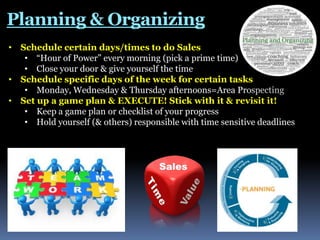
Planning & Organizing
• Schedule certain days/times to do Sales
• “Hour of Power” every morning (pick a prime time)
• Close your door & give yourself the time
• Schedule specific days of the week for certain tasks
• Monday, Wednesday & Thursday afternoons=Area Prospecting
• Set up a game plan & EXECUTE! Stick with it & revisit it!
• Keep a game plan or checklist of your progress
• Hold yourself (& others) responsible with time sensitive deadlines
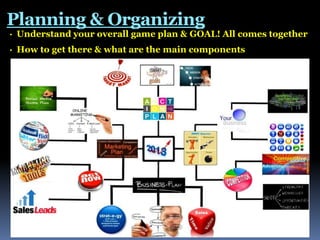
Planning & Organizing
•

Understand your overall game plan & GOAL! All comes together

•

How to get there & what are the main components
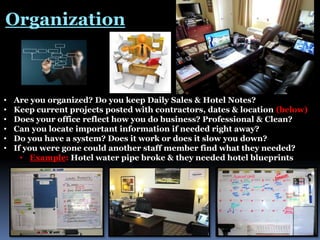
Organization

•
•
•
•
•
•

Are you organized? Do you keep Daily Sales & Hotel Notes?
Keep current projects posted with contractors, dates & location (below)
Does your office reflect how you do business? Professional & Clean?
Can you locate important information if needed right away?
Do you have a system? Does it work or does it slow you down?
If you were gone could another staff member find what they needed?
• Example: Hotel water pipe broke & they needed hotel blueprints
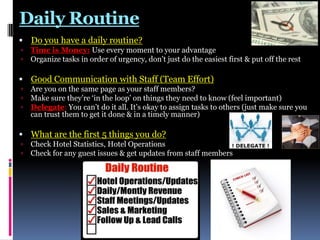
Daily Routine
 Do you have a daily routine?



Time is Money: Use every moment to your advantage
Organize tasks in order of urgency, don‟t just do the easiest first & put off the rest

 Good Communication with Staff (Team Effort)




Are you on the same page as your staff members?
Make sure they‟re „in the loop‟ on things they need to know (feel important)
Delegate: You can‟t do it all. It‟s okay to assign tasks to others (just make sure you
can trust them to get it done & in a timely manner)

 What are the first 5 things you do?



Check Hotel Statistics, Hotel Operations
Check for any guest issues & get updates from staff members
Revenue Management
Organization & Preparation
“Spending the time to stay organized & ahead of any issues or needs that arise.”

Inventory Management: “Inventory management is the process of
efficiently overseeing the constant flow of units into and out of an existing
inventory. This process usually involves controlling the transfer in of units in
order to prevent the inventory from becoming too high, or dwindling to levels
that could put the operation of the company into jeopardy.”
Inventory Management (continued)
 3 Key Aspects
 Time: Timeframe it takes to order, receive & pay for inventory needed

(stay ahead)

 Don‟t wait until you‟re out of something before ordering
 But order too much that you can‟t keep track of it (or use it)

 Calculating: Amount of inventory to order (more or less) based on

forecasted demand

 Know your demand: Busy Season, Slower Time
 Summer vs. Winter: Some hotels are busier during Summer & others in the
Winter

 Keeping Accurate Records: Tracking inventory correctly & the

amount you have & need

 Accountability: Make sure you‟re tracking housekeeping carts & in-room
amenities (soap, shampoo, towels).

 Impact


How it effects the hotel‟s Bottom Line, Balance Sheet & Income Statement
 Always keep „the big picture‟ in mind.
Inventory Management (continued)
 Impact: Always keep „the big picture‟ in mind.
 How it effects the hotel‟s Bottom Line, Balance Sheet & Income

Statement
 “Bottom Line” Definition:
1. (Business / Commerce) the last line of a financial statement that shows
the net profit or loss of a company or organization
2. the final outcome of a process
3. the most important or fundamental aspect of a situation
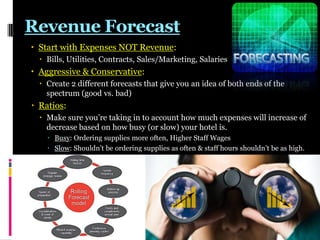
Revenue Forecast
 Start with Expenses NOT Revenue:
 Bills, Utilities, Contracts, Sales/Marketing, Salaries

 Aggressive & Conservative:
 Create 2 different forecasts that give you an idea of both ends of the
spectrum (good vs. bad)

 Ratios:
 Make sure you‟re taking in to account how much expenses will increase of
decrease based on how busy (or slow) your hotel is.
 Busy: Ordering supplies more often, Higher Staff Wages
 Slow: Shouldn‟t be ordering supplies as often & staff hours shouldn‟t be as high.
HOTEL WEBSITE ONLINE APPEAL
•

Attractiveness, Appeal & Interest: What drives traffic?

•

(SEO) Search Engine Optimization: Can guests find your hotel?

•

Keep it SIMPLE & STANDARD: Is it easy to use/navigate?

•

Guest Demographic & Trends: Who are your guests?

•

Website Image: Does it represent your hotel correctly?
Guest Appeal
Attractiveness, Appeal & Interest?
• Creative Content: Relatable to viewers; „Why we‟re a great hotel‟
•
•

„Don‟t be afraid to ‘toot your horn’ (Awards, Renovations, Guest Reviews)
Post relevant & current information (make sure it‟s accurate)

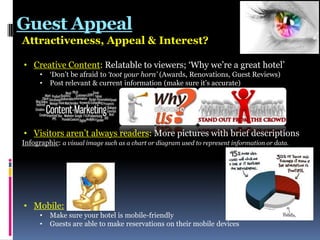
• Visitors aren‟t always readers: More pictures with brief descriptions
Infographic: a visual image such as a chart or diagram used to represent information or data.

• Mobile:
•
•

Make sure your hotel is mobile-friendly
Guests are able to make reservations on their mobile devices
SEO: Search Engine Optimization
(SEO) Search Engine Optimization:
How easy is your website to find?
• „Google‟ your hotel & see where it ranks
• Investing in SEO is a good idea if you‟re in the right
market but it can be expensive so stay in control.
• Some markets are so saturated with hotels that all the
common „keywords‟ are taken & not worth the $
• Create a new Domain Page: If you‟re not getting enough
traffic you can create an additional webpage for less than
$15/year! www.godaddy.com
Keep it Simple & Standard
Make sure hotel‟s website is simple & easy to use (not frustrating)
• You want to be unique but you don‟t want to overwhelm the viewer
•

Clean, Crisp & to the point. Don‟t let the guest get „lost‟ or confused (they will leave)

• Too many bells & whistles prove to be more distracting than appealing
•

Pictures are good but make sure you keep the guest focused on making the reservation!

• Pictures & Information up to date, correct & easy to find.
•
•

Make sure all hotel information & property pictures are correct & are of good quality.
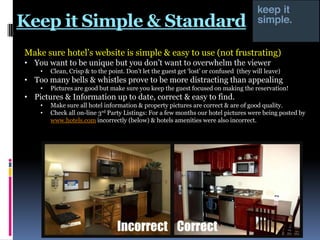
Check all on-line 3rd Party Listings: For a few months our hotel pictures were being posted by
www.hotels.com incorrectly (below) & hotels amenities were also incorrect.
Guest Demographic & Trends
What are your Key Demographic Groups? What Trends do you see?
Demographics are the quantifiable statistics of a given population. Demographics is also used to identify the study of
quantifiable subsets within a given population which characterize that population at a specific point in time.
Commonly examined demographics include gender, age, ethnicity, knowledge of languages, disabilities, mobility, home
ownership, employment status, and even location. Demographic trends describe the historical changes in demographics
in a population over time (for example, the average age of a population may increase or decrease over time). Both
distributions and trends of values within a demographic variable are of interest.

•
•
•

•

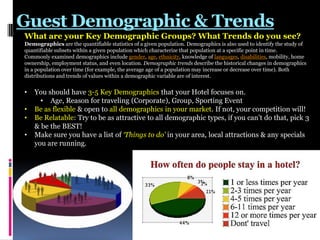
You should have 3-5 Key Demographics that your Hotel focuses on.
• Age, Reason for traveling (Corporate), Group, Sporting Event
Be as flexible & open to all demographics in your market. If not, your competition will!
Be Relatable: Try to be as attractive to all demographic types, if you can‟t do that, pick 3
& be the BEST!
Make sure you have a list of ‘Things to do’ in your area, local attractions & any specials
you are running.
Website Images
Does your website reflect & represent your hotel correctly?
Are pictures current, correct & look professional? Quality over Quantity!
•
•

Google your business & check all your listings
Click the „Images‟ button & to see the first 10-20 images that come up.
• You may be SURPRISED (and a little embarrassed).

Contact Information, Address & Amenities should all be correct & TRUE!
•
•
•

Not only make sure they‟re correct but make sure all of them are posted!
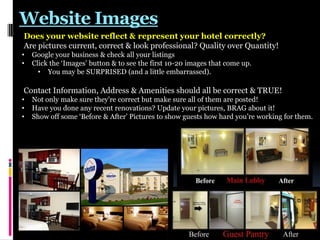
Have you done any recent renovations? Update your pictures, BRAG about it!
Show off some „Before & After‟ Pictures to show guests how hard you‟re working for them.
15 Company Website Tips
GOALS GOALS GOALS: Before changing any design elements, gather a clear understanding of the goals of the
website. Ask your team “What do we want our website to do?”
LESS IS MORE: Too many components are a distraction to your users. Limit widgets to those that are essential to
getting your point across.
BROWSER COMPATABILITY: Make sure that your website runs fairly well on at least the most popular browsers
(Internet Explorer, Firefox, Chrome, and Safari).
MOBILE: Test your website on mobile devices. Make sure you can still utilize the website when accessing it from a
phone or tablet.
ON PAGE OPTIMIZATION: Help your website get found in the search engines by providing Title Tags, Meta
Descriptions and including important keywords whenever possible.
NAVIGATION: Create a clear navigation structure and organize page elements in a grid. Don’t be afraid of white
space!
COLORS: Use the right colors for your audience and keep the colors consistent throughout the website.
IMAGES: Use images on your site. When possible avoid the use of stock photography and use real images of your
products, employees and customers.
TESTIMONALS AND CASE STUDIES: Provide proof to your prospects by showcasing customer testimonials and
case studies.
AVOID FLASH: Mobile applications lack the capacity to use flash animation and many people simply don’t want to
be bothered with unexpected noises and animations.
CALLS TO ACTION: Include clear calls to action and next steps. Include links in your body copy and links at the
end of copy.
UNIQUE: Never copy content from other websites; this can get you kicked off the search engines.
VALUE: Offer and communicate value throughout your website.
Hotel Marketing Demographic: http://hotelexecutive.com/business_review/683/a-hotels-new-marketing-demographic-thinking-outside-the-comp-set

Revenue Management

  • 1.
    Revenue Management (Part2) Hotel Website Effectiveness  Organization & Preparation  Are you Organized & Prepared?  Inventory Management  Revenue Forecast  Hotel Website      Attractiveness, Appeal & Interest SEO; Search Engine Optimization Simple & Easy to Use Guest Demographic Does it represent your hotel correctly
  • 2.
    Planning & Organizing •Schedule certain days/times to do Sales • “Hour of Power” every morning (pick a prime time) • Close your door & give yourself the time • Schedule specific days of the week for certain tasks • Monday, Wednesday & Thursday afternoons=Area Prospecting • Set up a game plan & EXECUTE! Stick with it & revisit it! • Keep a game plan or checklist of your progress • Hold yourself (& others) responsible with time sensitive deadlines
  • 3.
    Planning & Organizing • Understandyour overall game plan & GOAL! All comes together • How to get there & what are the main components
  • 4.
    Organization • • • • • • Are you organized?Do you keep Daily Sales & Hotel Notes? Keep current projects posted with contractors, dates & location (below) Does your office reflect how you do business? Professional & Clean? Can you locate important information if needed right away? Do you have a system? Does it work or does it slow you down? If you were gone could another staff member find what they needed? • Example: Hotel water pipe broke & they needed hotel blueprints
  • 5.
    Daily Routine  Doyou have a daily routine?   Time is Money: Use every moment to your advantage Organize tasks in order of urgency, don‟t just do the easiest first & put off the rest  Good Communication with Staff (Team Effort)    Are you on the same page as your staff members? Make sure they‟re „in the loop‟ on things they need to know (feel important) Delegate: You can‟t do it all. It‟s okay to assign tasks to others (just make sure you can trust them to get it done & in a timely manner)  What are the first 5 things you do?   Check Hotel Statistics, Hotel Operations Check for any guest issues & get updates from staff members
  • 6.
    Revenue Management Organization &Preparation “Spending the time to stay organized & ahead of any issues or needs that arise.” Inventory Management: “Inventory management is the process of efficiently overseeing the constant flow of units into and out of an existing inventory. This process usually involves controlling the transfer in of units in order to prevent the inventory from becoming too high, or dwindling to levels that could put the operation of the company into jeopardy.”
  • 7.
    Inventory Management (continued) 3 Key Aspects  Time: Timeframe it takes to order, receive & pay for inventory needed (stay ahead)  Don‟t wait until you‟re out of something before ordering  But order too much that you can‟t keep track of it (or use it)  Calculating: Amount of inventory to order (more or less) based on forecasted demand  Know your demand: Busy Season, Slower Time  Summer vs. Winter: Some hotels are busier during Summer & others in the Winter  Keeping Accurate Records: Tracking inventory correctly & the amount you have & need  Accountability: Make sure you‟re tracking housekeeping carts & in-room amenities (soap, shampoo, towels).  Impact  How it effects the hotel‟s Bottom Line, Balance Sheet & Income Statement  Always keep „the big picture‟ in mind.
  • 8.
    Inventory Management (continued) Impact: Always keep „the big picture‟ in mind.  How it effects the hotel‟s Bottom Line, Balance Sheet & Income Statement  “Bottom Line” Definition: 1. (Business / Commerce) the last line of a financial statement that shows the net profit or loss of a company or organization 2. the final outcome of a process 3. the most important or fundamental aspect of a situation
  • 9.
    Revenue Forecast  Startwith Expenses NOT Revenue:  Bills, Utilities, Contracts, Sales/Marketing, Salaries  Aggressive & Conservative:  Create 2 different forecasts that give you an idea of both ends of the spectrum (good vs. bad)  Ratios:  Make sure you‟re taking in to account how much expenses will increase of decrease based on how busy (or slow) your hotel is.  Busy: Ordering supplies more often, Higher Staff Wages  Slow: Shouldn‟t be ordering supplies as often & staff hours shouldn‟t be as high.
  • 10.
    HOTEL WEBSITE ONLINEAPPEAL • Attractiveness, Appeal & Interest: What drives traffic? • (SEO) Search Engine Optimization: Can guests find your hotel? • Keep it SIMPLE & STANDARD: Is it easy to use/navigate? • Guest Demographic & Trends: Who are your guests? • Website Image: Does it represent your hotel correctly?
  • 11.
    Guest Appeal Attractiveness, Appeal& Interest? • Creative Content: Relatable to viewers; „Why we‟re a great hotel‟ • • „Don‟t be afraid to ‘toot your horn’ (Awards, Renovations, Guest Reviews) Post relevant & current information (make sure it‟s accurate) • Visitors aren‟t always readers: More pictures with brief descriptions Infographic: a visual image such as a chart or diagram used to represent information or data. • Mobile: • • Make sure your hotel is mobile-friendly Guests are able to make reservations on their mobile devices
  • 12.
    SEO: Search EngineOptimization (SEO) Search Engine Optimization: How easy is your website to find? • „Google‟ your hotel & see where it ranks • Investing in SEO is a good idea if you‟re in the right market but it can be expensive so stay in control. • Some markets are so saturated with hotels that all the common „keywords‟ are taken & not worth the $ • Create a new Domain Page: If you‟re not getting enough traffic you can create an additional webpage for less than $15/year! www.godaddy.com
  • 13.
    Keep it Simple& Standard Make sure hotel‟s website is simple & easy to use (not frustrating) • You want to be unique but you don‟t want to overwhelm the viewer • Clean, Crisp & to the point. Don‟t let the guest get „lost‟ or confused (they will leave) • Too many bells & whistles prove to be more distracting than appealing • Pictures are good but make sure you keep the guest focused on making the reservation! • Pictures & Information up to date, correct & easy to find. • • Make sure all hotel information & property pictures are correct & are of good quality. Check all on-line 3rd Party Listings: For a few months our hotel pictures were being posted by www.hotels.com incorrectly (below) & hotels amenities were also incorrect.
  • 14.
    Guest Demographic &Trends What are your Key Demographic Groups? What Trends do you see? Demographics are the quantifiable statistics of a given population. Demographics is also used to identify the study of quantifiable subsets within a given population which characterize that population at a specific point in time. Commonly examined demographics include gender, age, ethnicity, knowledge of languages, disabilities, mobility, home ownership, employment status, and even location. Demographic trends describe the historical changes in demographics in a population over time (for example, the average age of a population may increase or decrease over time). Both distributions and trends of values within a demographic variable are of interest. • • • • You should have 3-5 Key Demographics that your Hotel focuses on. • Age, Reason for traveling (Corporate), Group, Sporting Event Be as flexible & open to all demographics in your market. If not, your competition will! Be Relatable: Try to be as attractive to all demographic types, if you can‟t do that, pick 3 & be the BEST! Make sure you have a list of ‘Things to do’ in your area, local attractions & any specials you are running.
  • 15.
    Website Images Does yourwebsite reflect & represent your hotel correctly? Are pictures current, correct & look professional? Quality over Quantity! • • Google your business & check all your listings Click the „Images‟ button & to see the first 10-20 images that come up. • You may be SURPRISED (and a little embarrassed). Contact Information, Address & Amenities should all be correct & TRUE! • • • Not only make sure they‟re correct but make sure all of them are posted! Have you done any recent renovations? Update your pictures, BRAG about it! Show off some „Before & After‟ Pictures to show guests how hard you‟re working for them.
  • 16.
    15 Company WebsiteTips GOALS GOALS GOALS: Before changing any design elements, gather a clear understanding of the goals of the website. Ask your team “What do we want our website to do?” LESS IS MORE: Too many components are a distraction to your users. Limit widgets to those that are essential to getting your point across. BROWSER COMPATABILITY: Make sure that your website runs fairly well on at least the most popular browsers (Internet Explorer, Firefox, Chrome, and Safari). MOBILE: Test your website on mobile devices. Make sure you can still utilize the website when accessing it from a phone or tablet. ON PAGE OPTIMIZATION: Help your website get found in the search engines by providing Title Tags, Meta Descriptions and including important keywords whenever possible. NAVIGATION: Create a clear navigation structure and organize page elements in a grid. Don’t be afraid of white space! COLORS: Use the right colors for your audience and keep the colors consistent throughout the website. IMAGES: Use images on your site. When possible avoid the use of stock photography and use real images of your products, employees and customers. TESTIMONALS AND CASE STUDIES: Provide proof to your prospects by showcasing customer testimonials and case studies. AVOID FLASH: Mobile applications lack the capacity to use flash animation and many people simply don’t want to be bothered with unexpected noises and animations. CALLS TO ACTION: Include clear calls to action and next steps. Include links in your body copy and links at the end of copy. UNIQUE: Never copy content from other websites; this can get you kicked off the search engines. VALUE: Offer and communicate value throughout your website. Hotel Marketing Demographic: http://hotelexecutive.com/business_review/683/a-hotels-new-marketing-demographic-thinking-outside-the-comp-set