Reuse of public proteomics data
Dr. Juan Antonio Vizcaíno
EMBL-EBI
Hinxton, Cambridge, UK
Juan A. Vizcaíno
juan@ebi.ac.uk
WT Proteomics Bioinformatics Course 2018
Hinxton, 19 July 2018
PRIDE data submissions and data growth
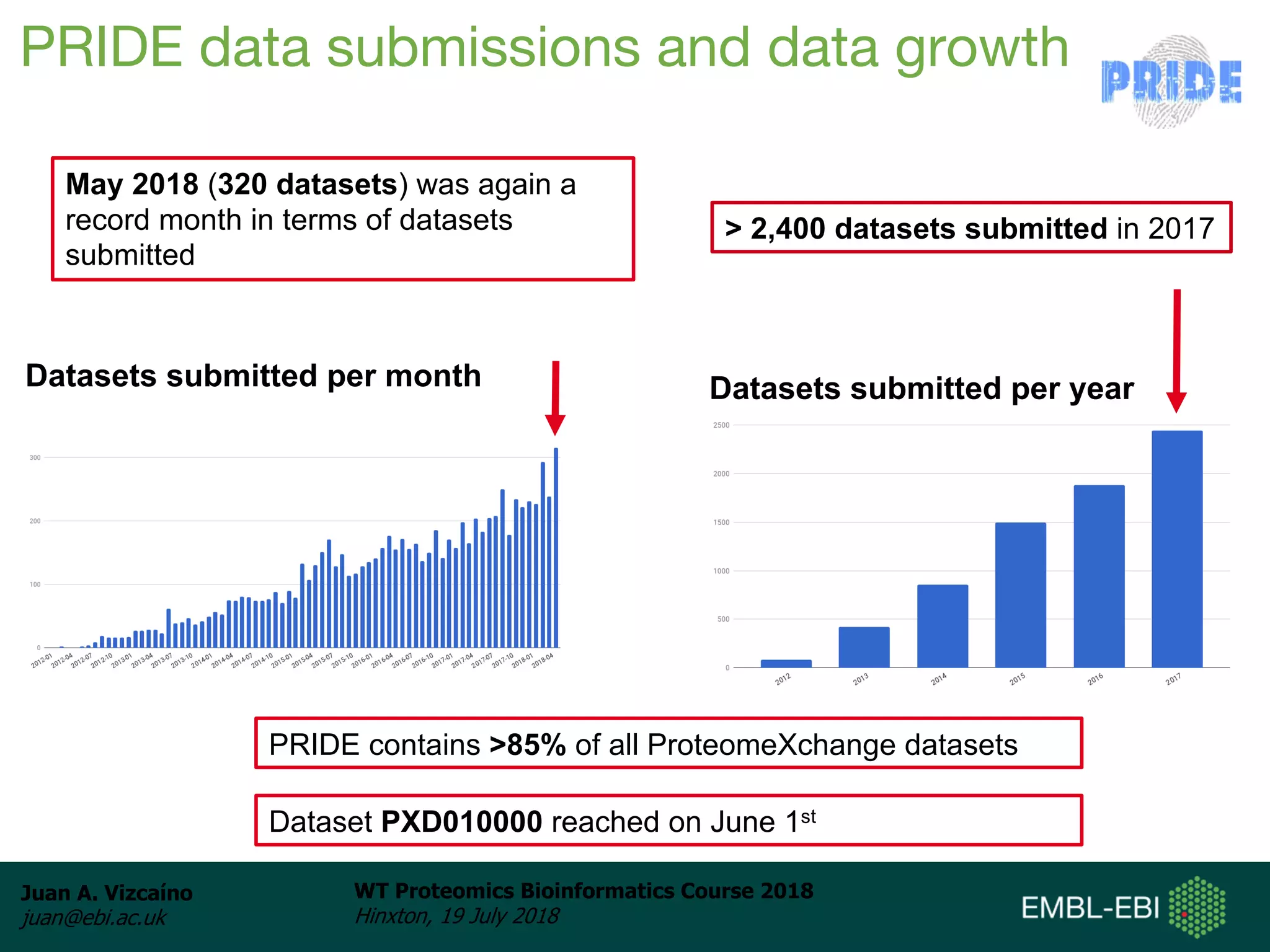
May 2018 (320 datasets) was again a
record month in terms of datasets
submitted
Datasets submitted per month
> 2,400 datasets submitted in 2017
Datasets submitted per year
PRIDE contains >85% of all ProteomeXchange datasets
Dataset PXD010000 reached on June 1st
Juan A. Vizcaíno
juan@ebi.ac.uk
WT Proteomics Bioinformatics Course 2018
Hinxton, 19 July 2018
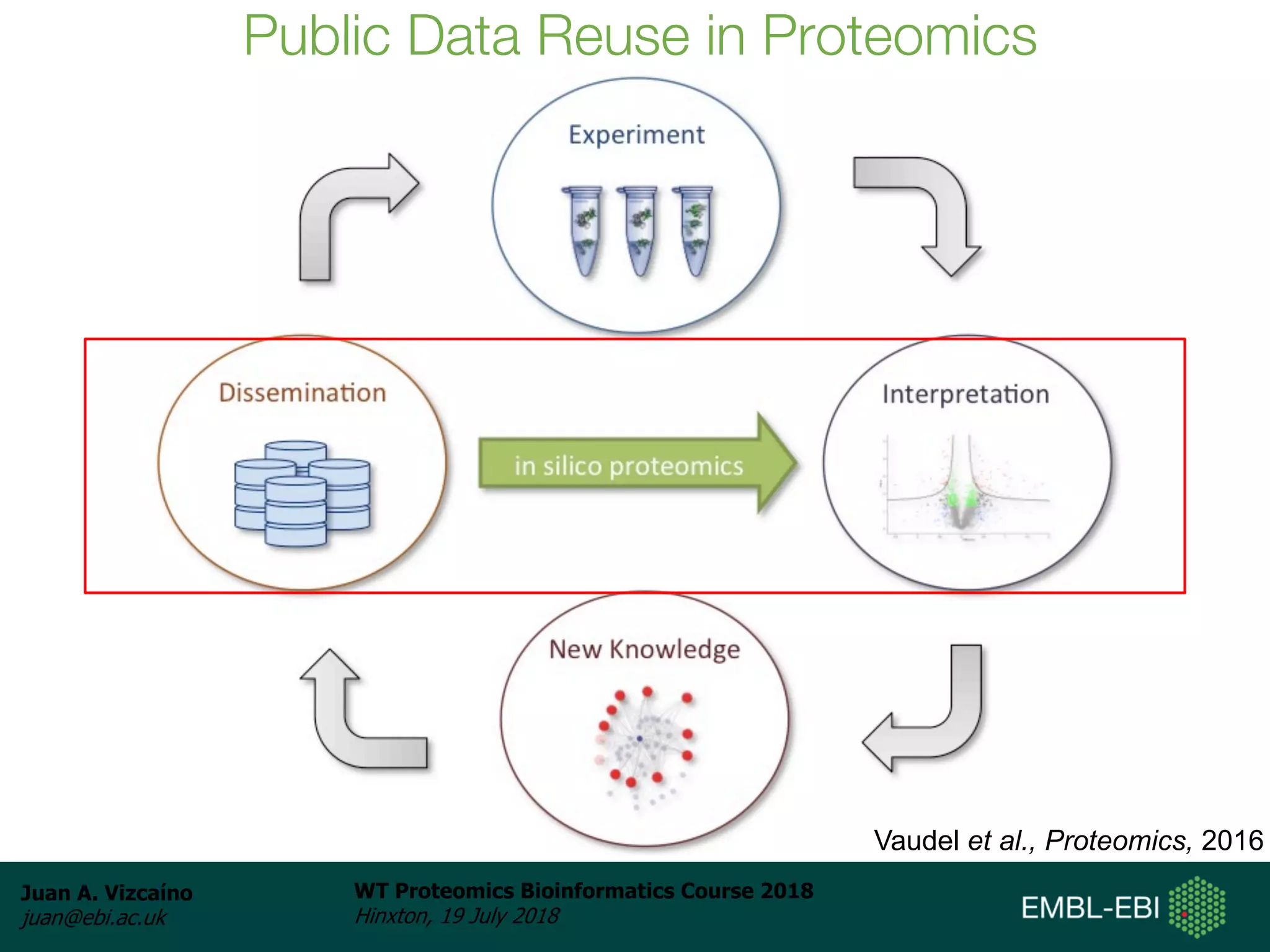
Public Data Reuse in Proteomics
Vaudel et al., Proteomics, 2016
Juan A. Vizcaíno
juan@ebi.ac.uk
WT Proteomics Bioinformatics Course 2018
Hinxton, 19 July 2018
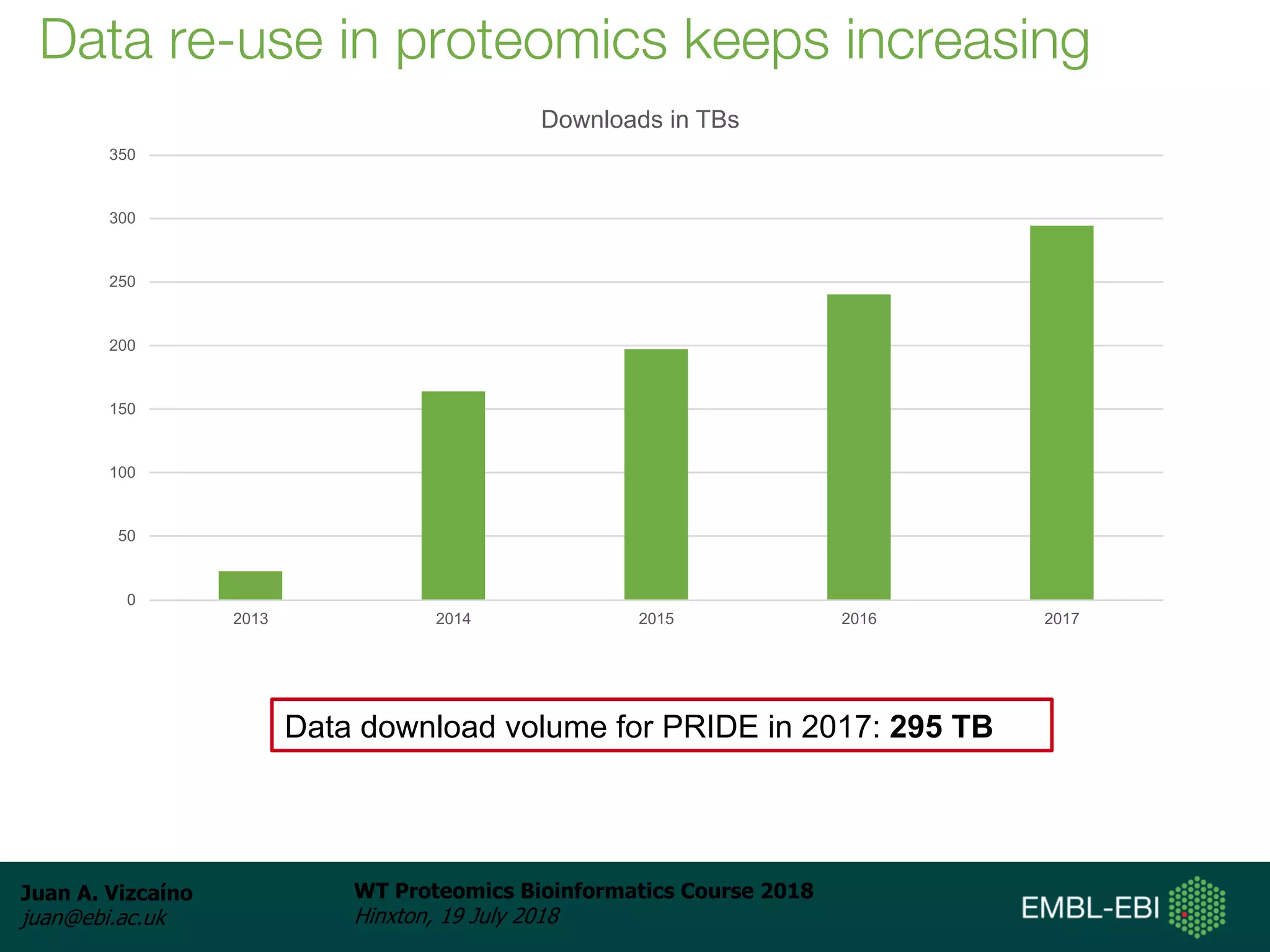
Data re-use in proteomics keeps increasing
Data download volume for PRIDE in 2017: 295 TB
0
50
100
150
200
250
300
350
2013 2014 2015 2016 2017
Downloads in TBs
Juan A. Vizcaíno
juan@ebi.ac.uk
WT Proteomics Bioinformatics Course 2018
Hinxton, 19 July 2018
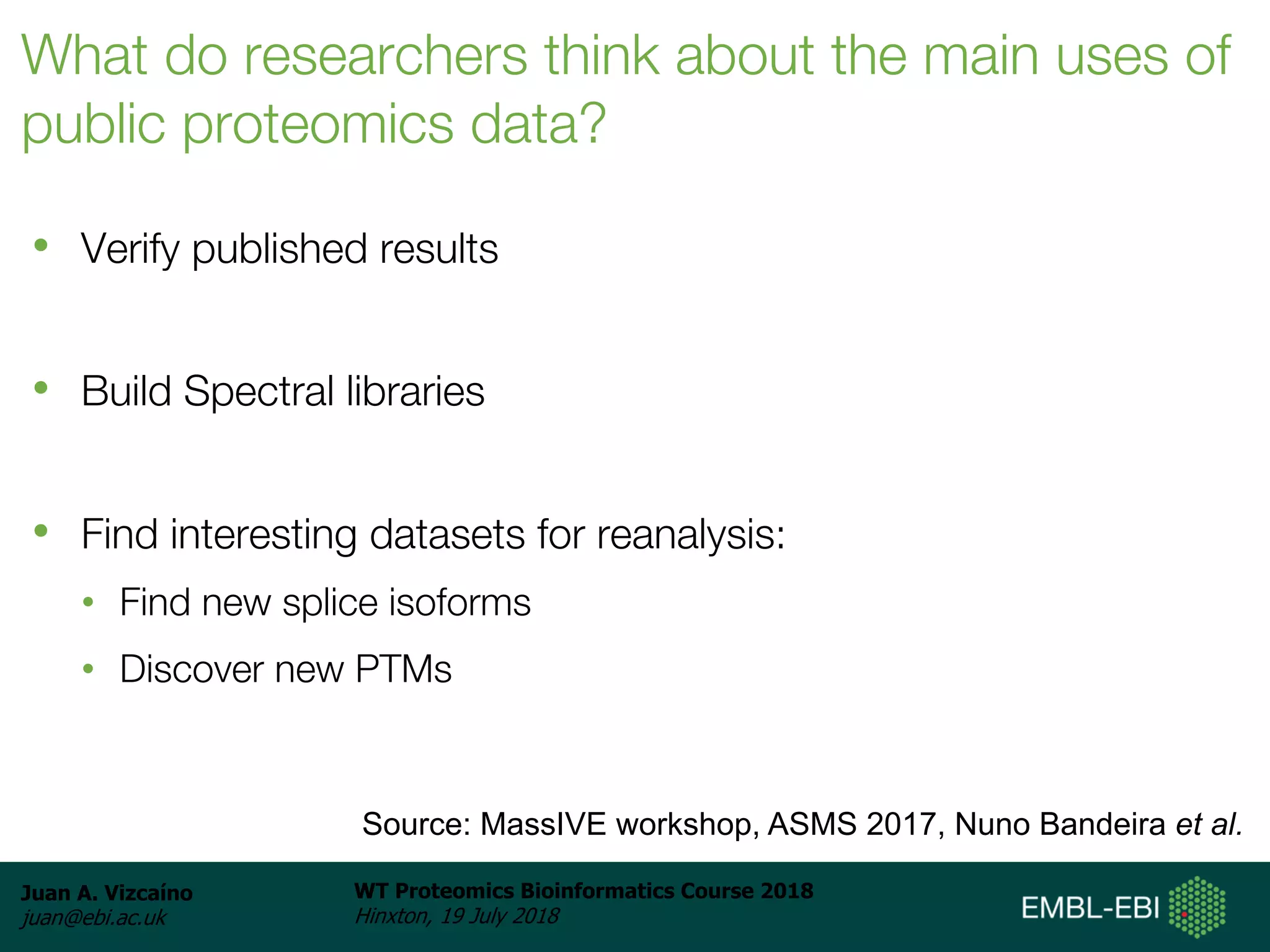
What do researchers think about the main uses of
public proteomics data?
• Verify published results
• Build Spectral libraries
• Find interesting datasets for reanalysis:
• Find new splice isoforms
• Discover new PTMs
Source: MassIVE workshop, ASMS 2017, Nuno Bandeira et al.
Juan A. Vizcaíno
juan@ebi.ac.uk
WT Proteomics Bioinformatics Course 2018
Hinxton, 19 July 2018
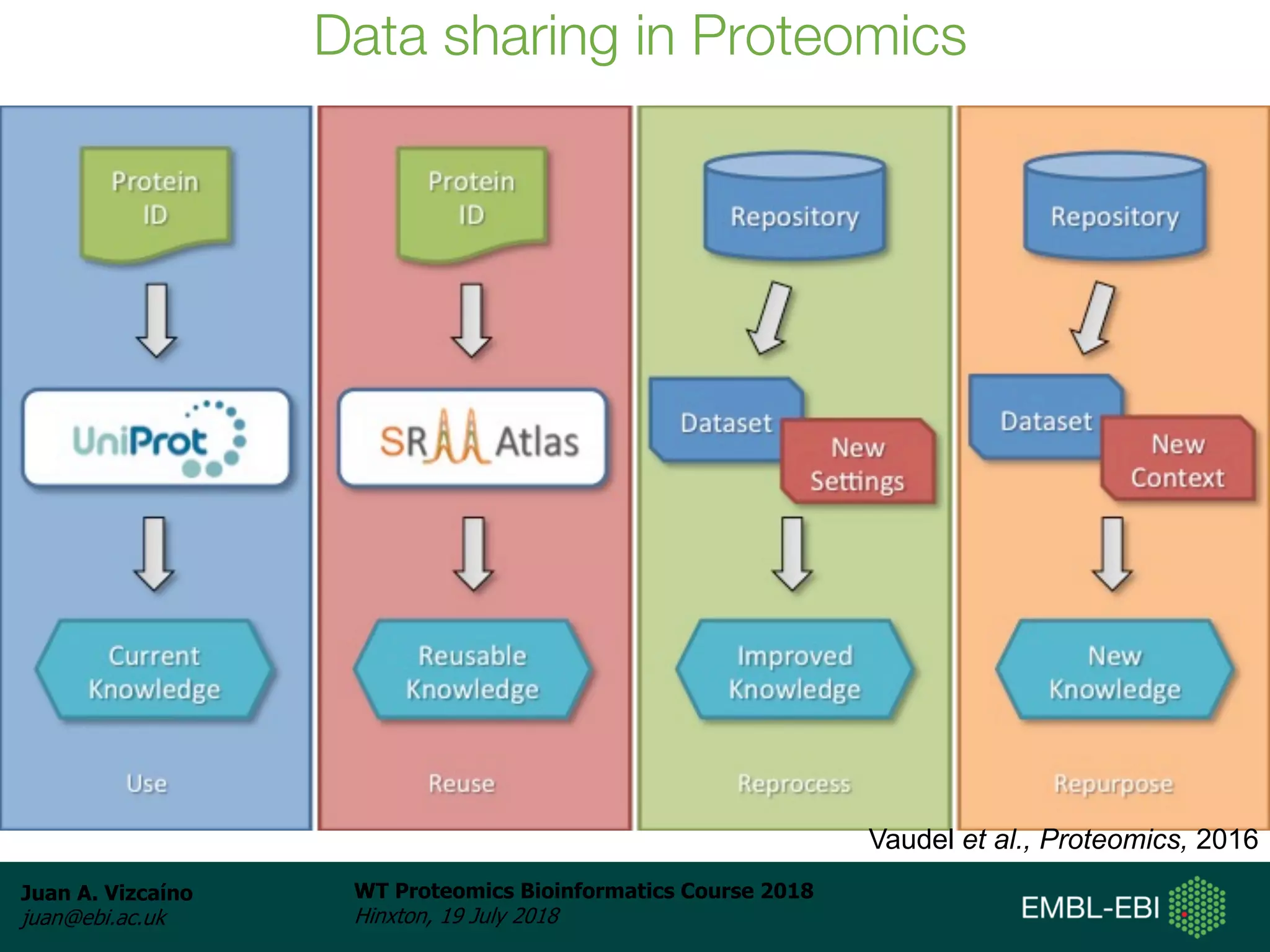
Data sharing in Proteomics
Vaudel et al., Proteomics, 2016
Juan A. Vizcaíno
juan@ebi.ac.uk
WT Proteomics Bioinformatics Course 2018
Hinxton, 19 July 2018
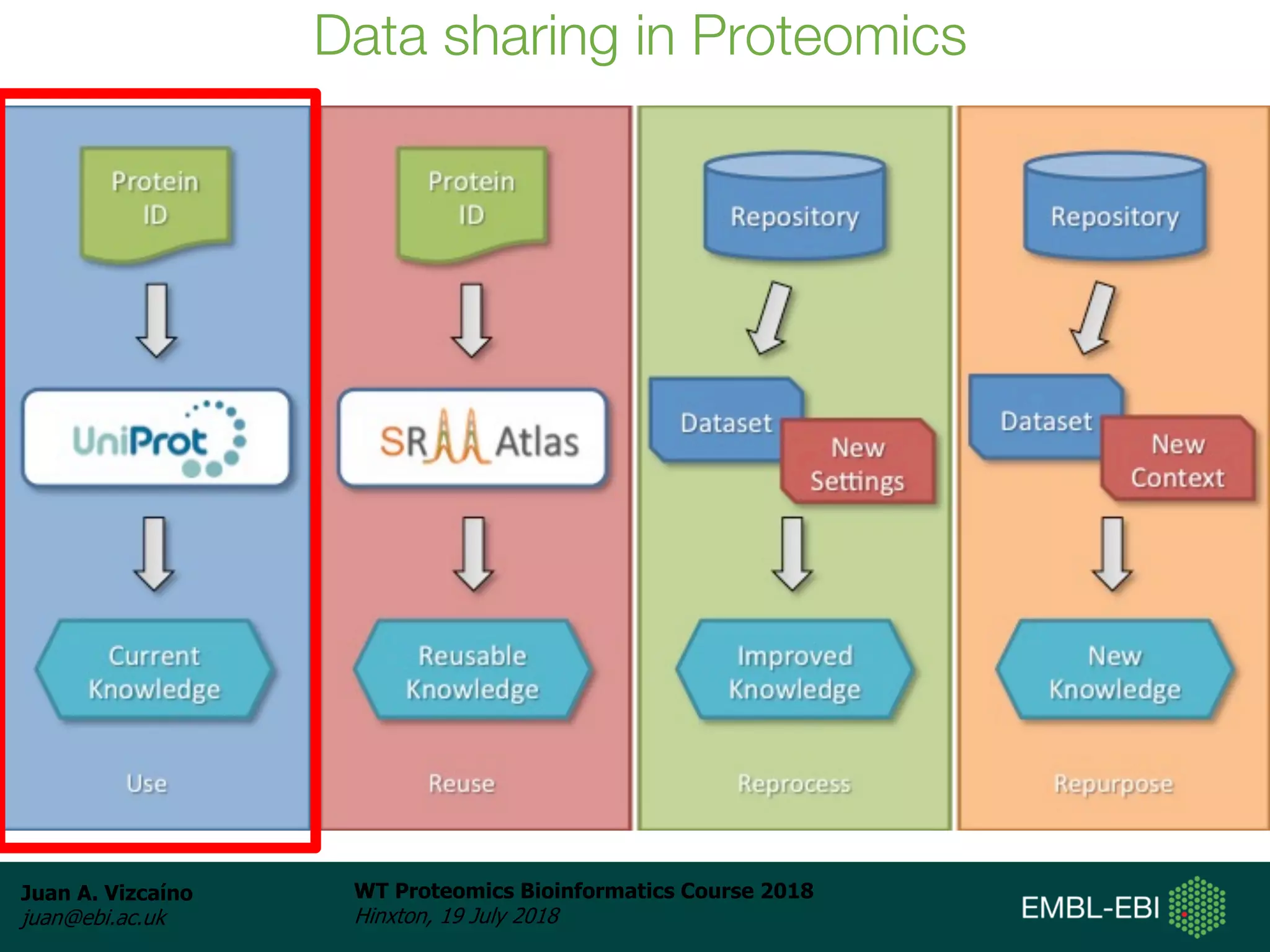
Data sharing in Proteomics
Juan A. Vizcaíno
juan@ebi.ac.uk
WT Proteomics Bioinformatics Course 2018
Hinxton, 19 July 2018
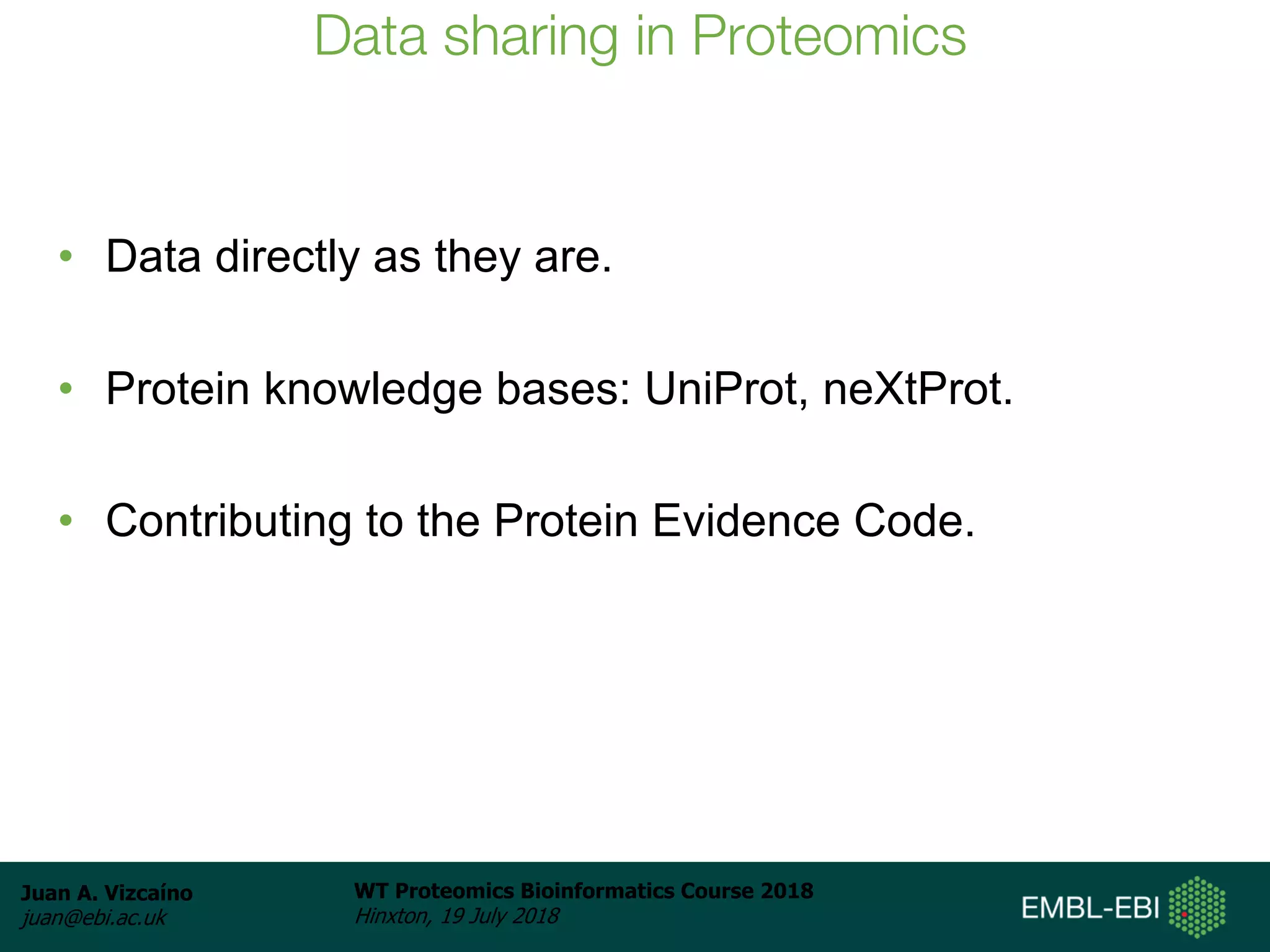
Data sharing in Proteomics
• Data directly as they are.
• Protein knowledge bases: UniProt, neXtProt.
• Contributing to the Protein Evidence Code.
Juan A. Vizcaíno
juan@ebi.ac.uk
WT Proteomics Bioinformatics Course 2018
Hinxton, 19 July 2018
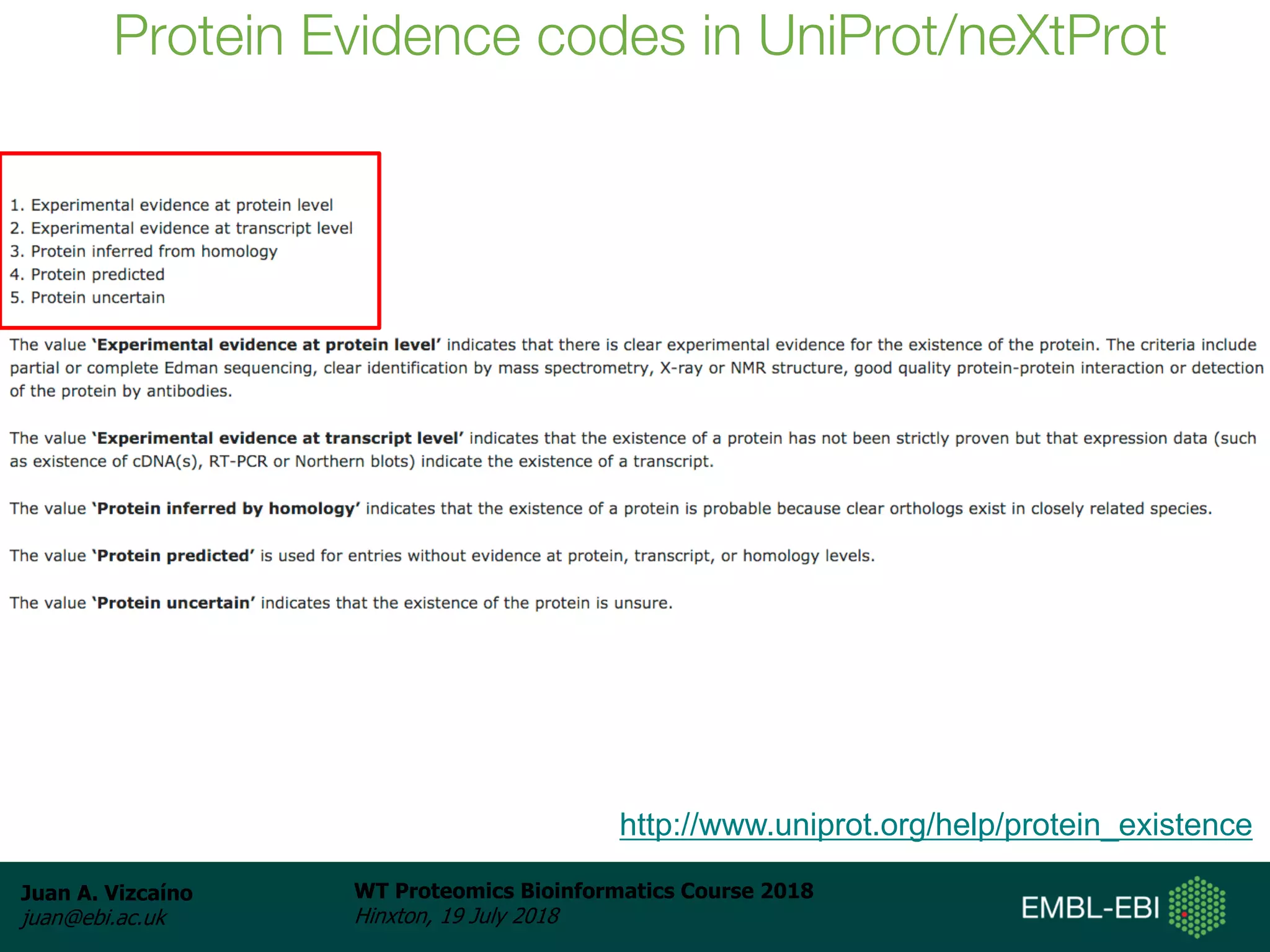
Protein Evidence codes in UniProt/neXtProt
http://www.uniprot.org/help/protein_existence
Juan A. Vizcaíno
juan@ebi.ac.uk
WT Proteomics Bioinformatics Course 2018
Hinxton, 19 July 2018
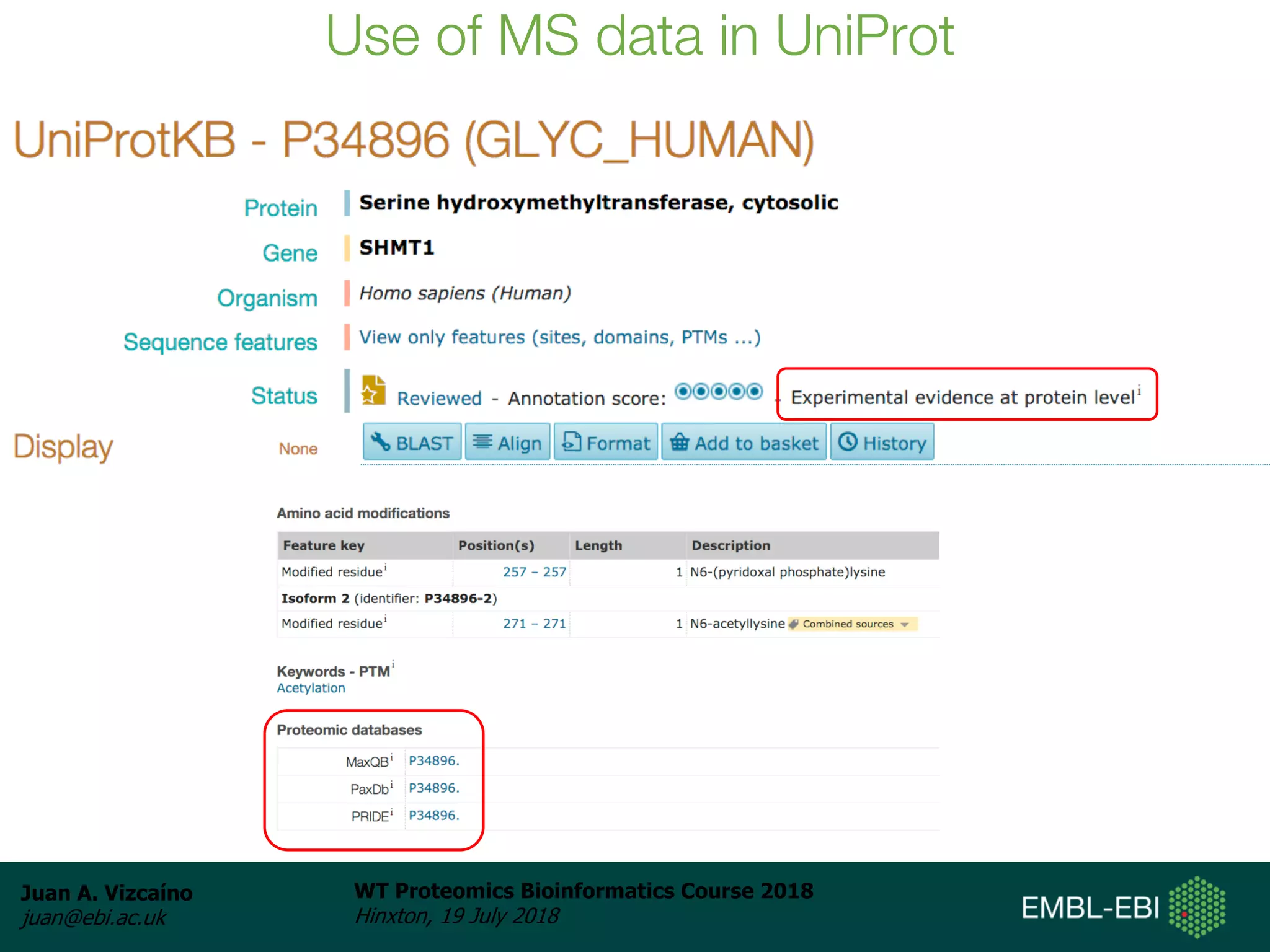
Use of MS data in UniProt
Juan A. Vizcaíno
juan@ebi.ac.uk
WT Proteomics Bioinformatics Course 2018
Hinxton, 19 July 2018
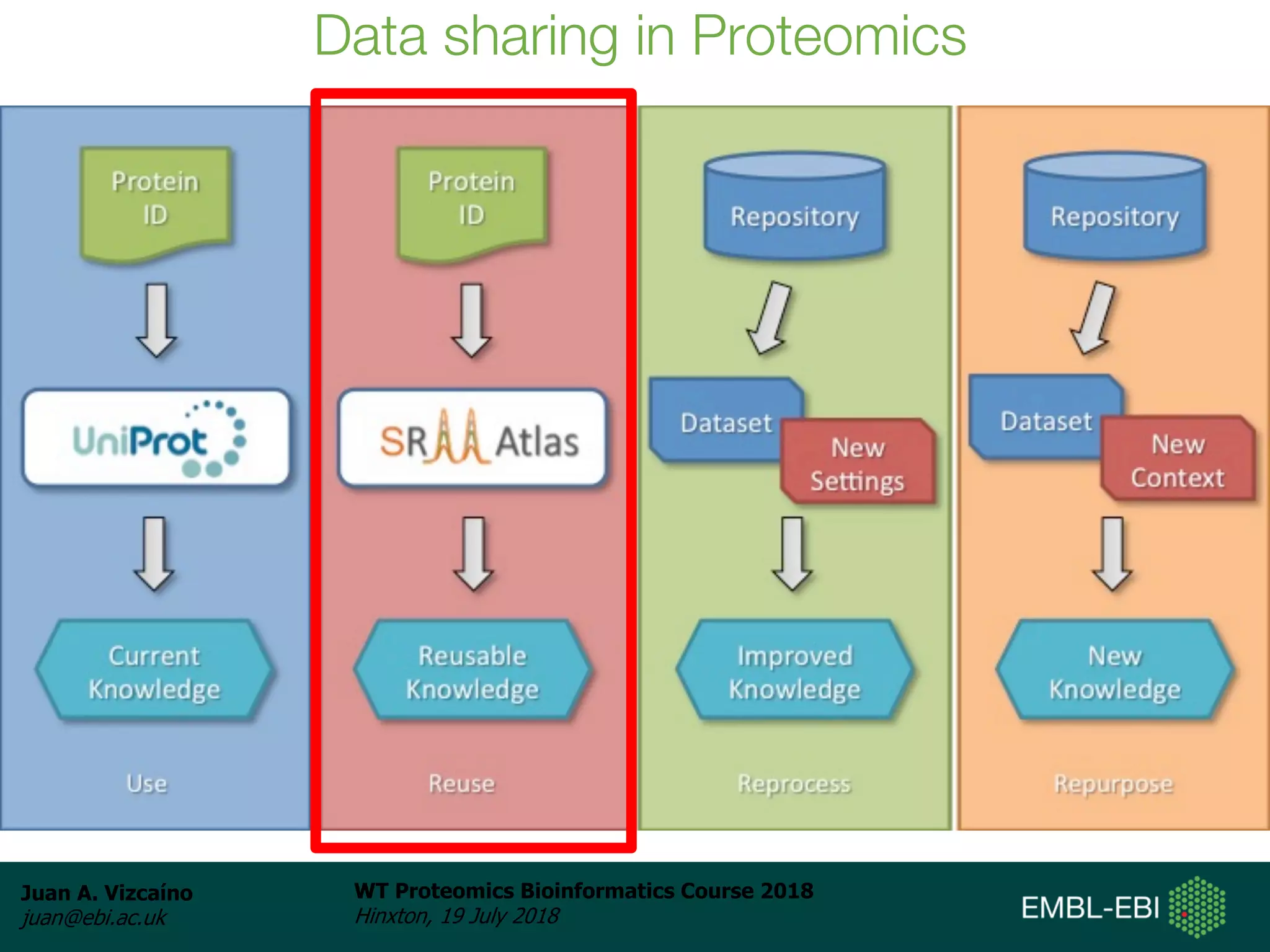
Data sharing in Proteomics
Juan A. Vizcaíno
juan@ebi.ac.uk
WT Proteomics Bioinformatics Course 2018
Hinxton, 19 July 2018
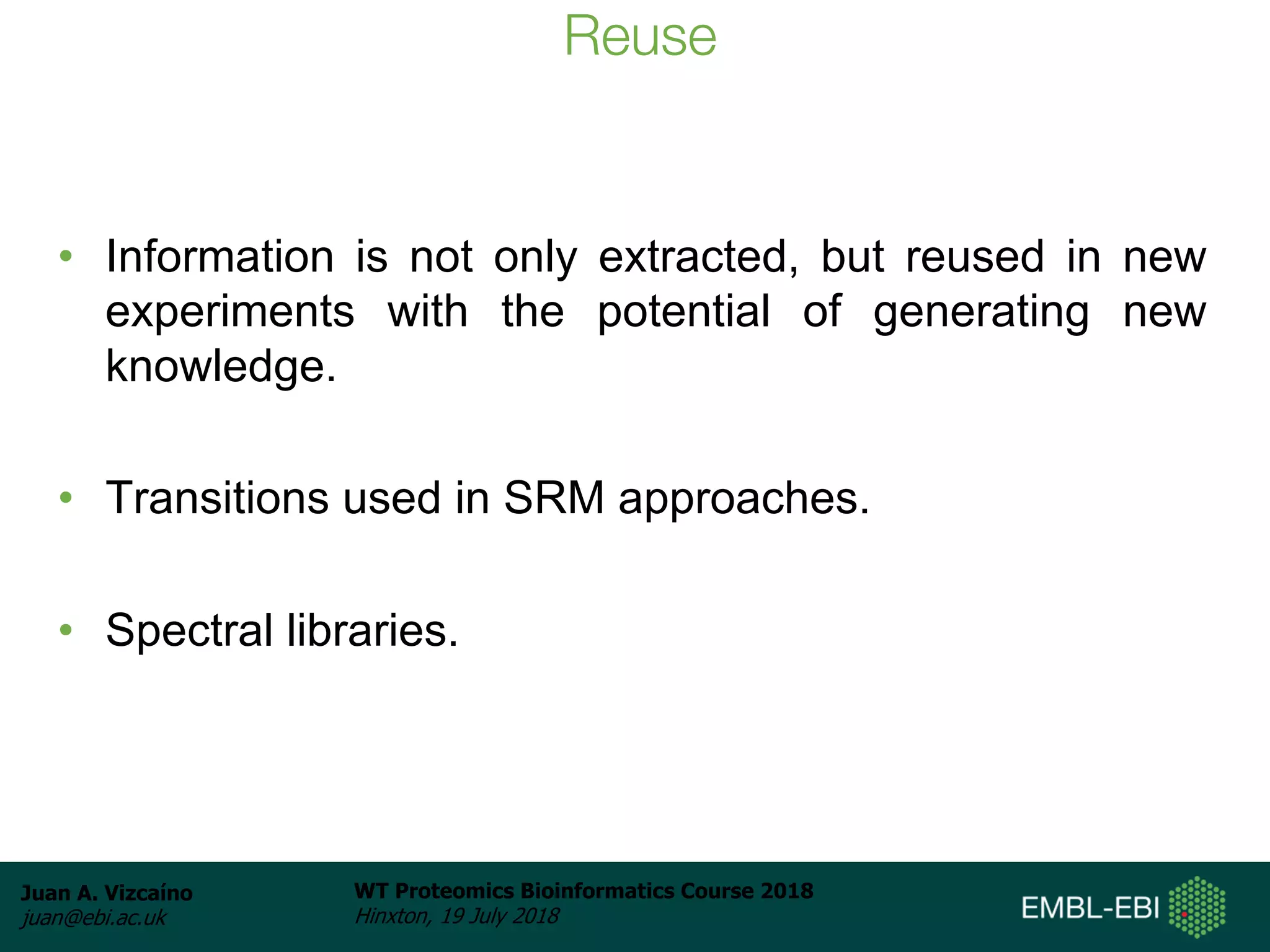
Reuse
• Information is not only extracted, but reused in new
experiments with the potential of generating new
knowledge.
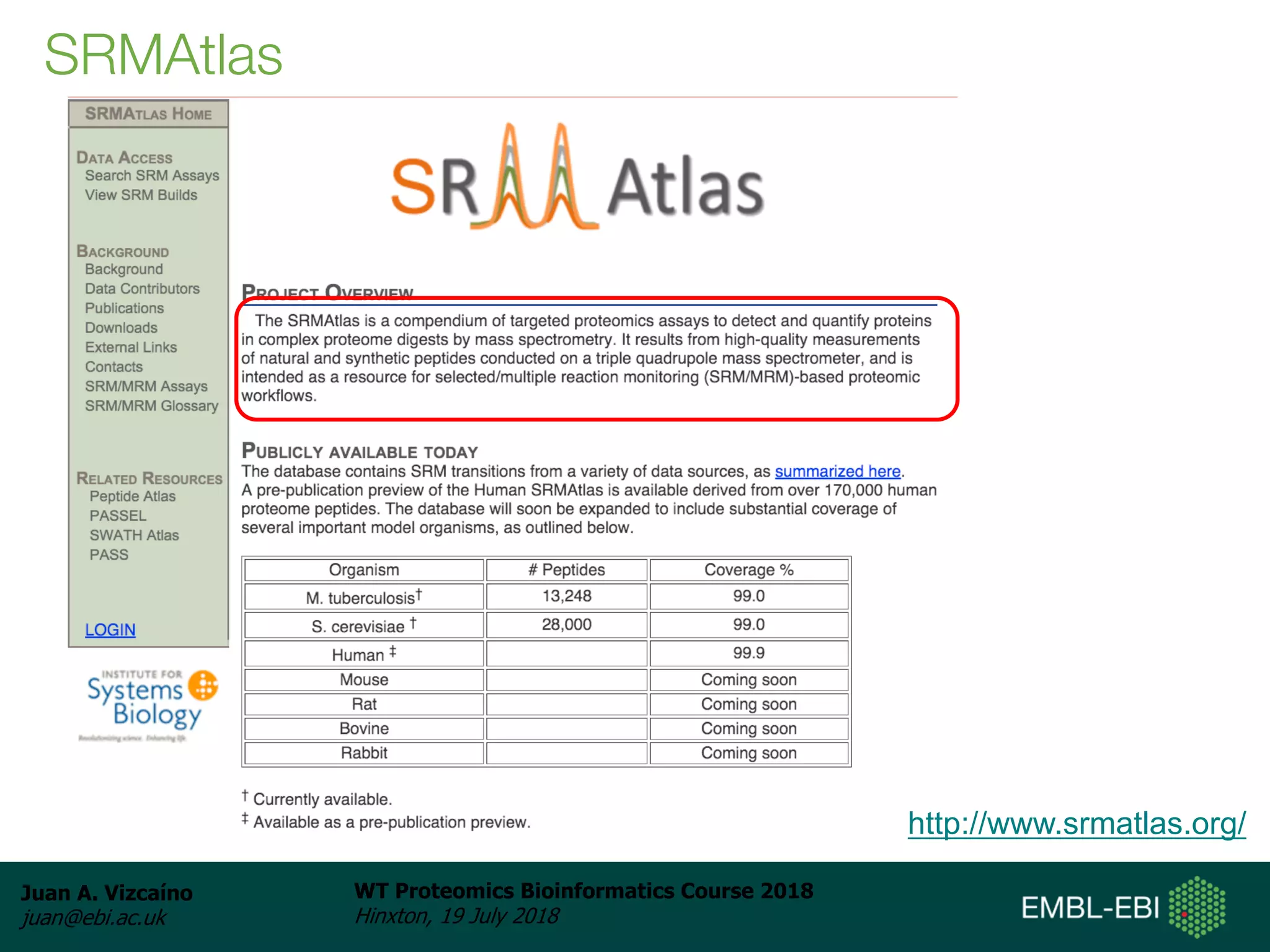
• Transitions used in SRM approaches.
• Spectral libraries.
Juan A. Vizcaíno
juan@ebi.ac.uk
WT Proteomics Bioinformatics Course 2018
Hinxton, 19 July 2018
SRMAtlas
http://www.srmatlas.org/
Juan A. Vizcaíno
juan@ebi.ac.uk
WT Proteomics Bioinformatics Course 2018
Hinxton, 19 July 2018
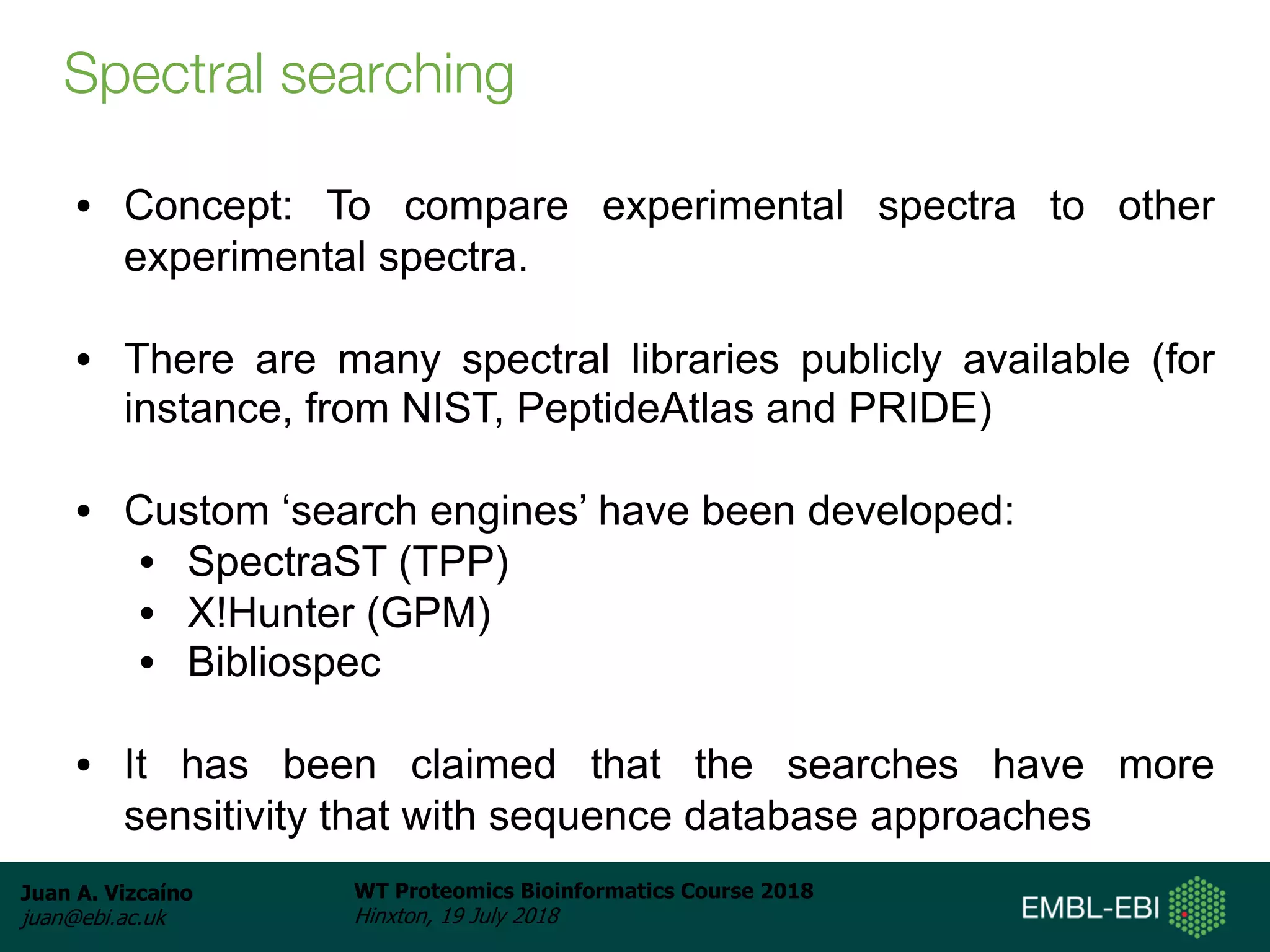
Spectral searching
• Concept: To compare experimental spectra to other
experimental spectra.
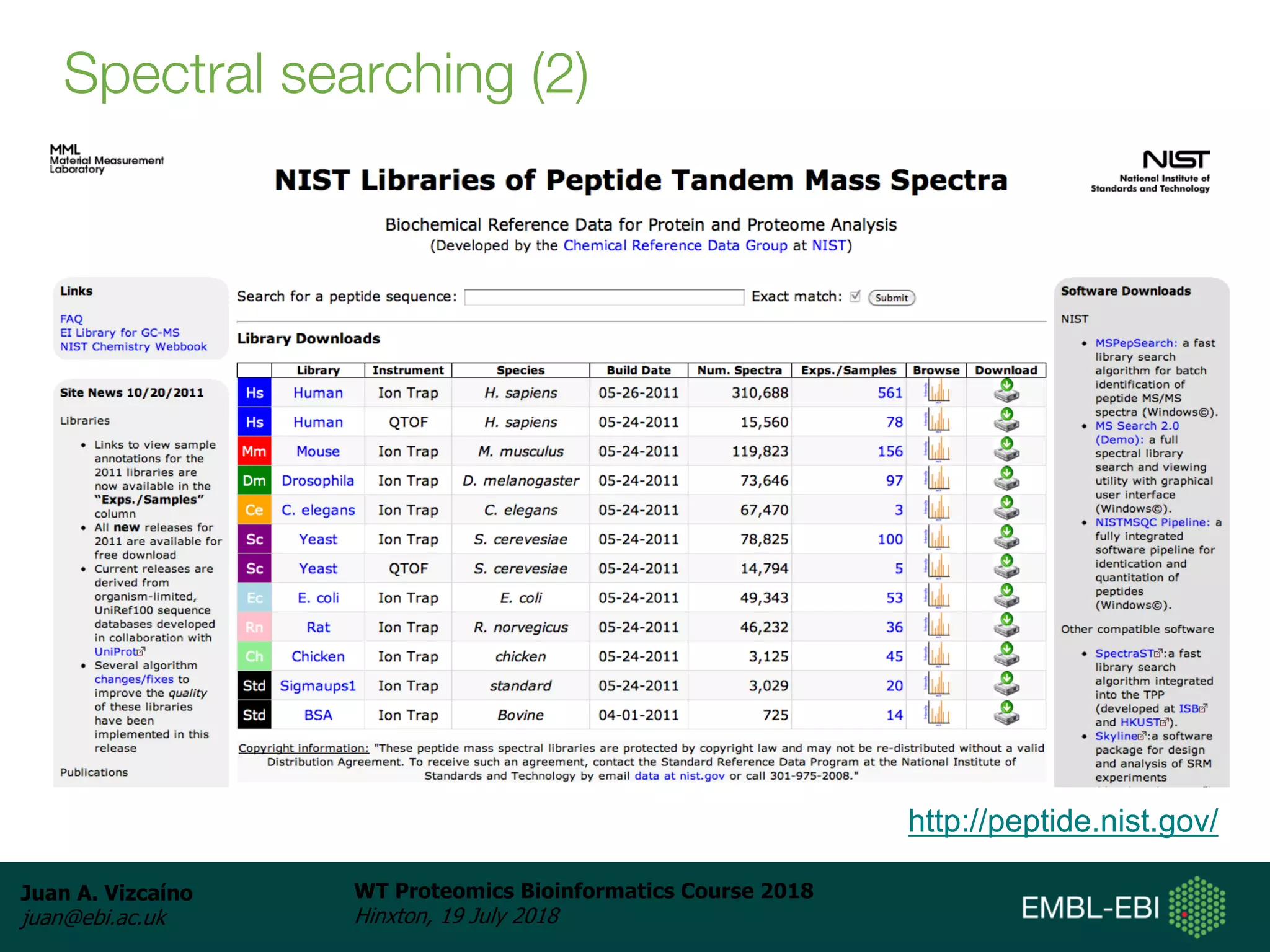
• There are many spectral libraries publicly available (for
instance, from NIST, PeptideAtlas and PRIDE)
• Custom ‘search engines’ have been developed:
• SpectraST (TPP)
• X!Hunter (GPM)
• Bibliospec
• It has been claimed that the searches have more
sensitivity that with sequence database approaches
Juan A. Vizcaíno
juan@ebi.ac.uk
WT Proteomics Bioinformatics Course 2018
Hinxton, 19 July 2018
Spectral searching (2)
http://peptide.nist.gov/
Juan A. Vizcaíno
juan@ebi.ac.uk
WT Proteomics Bioinformatics Course 2018
Hinxton, 19 July 2018
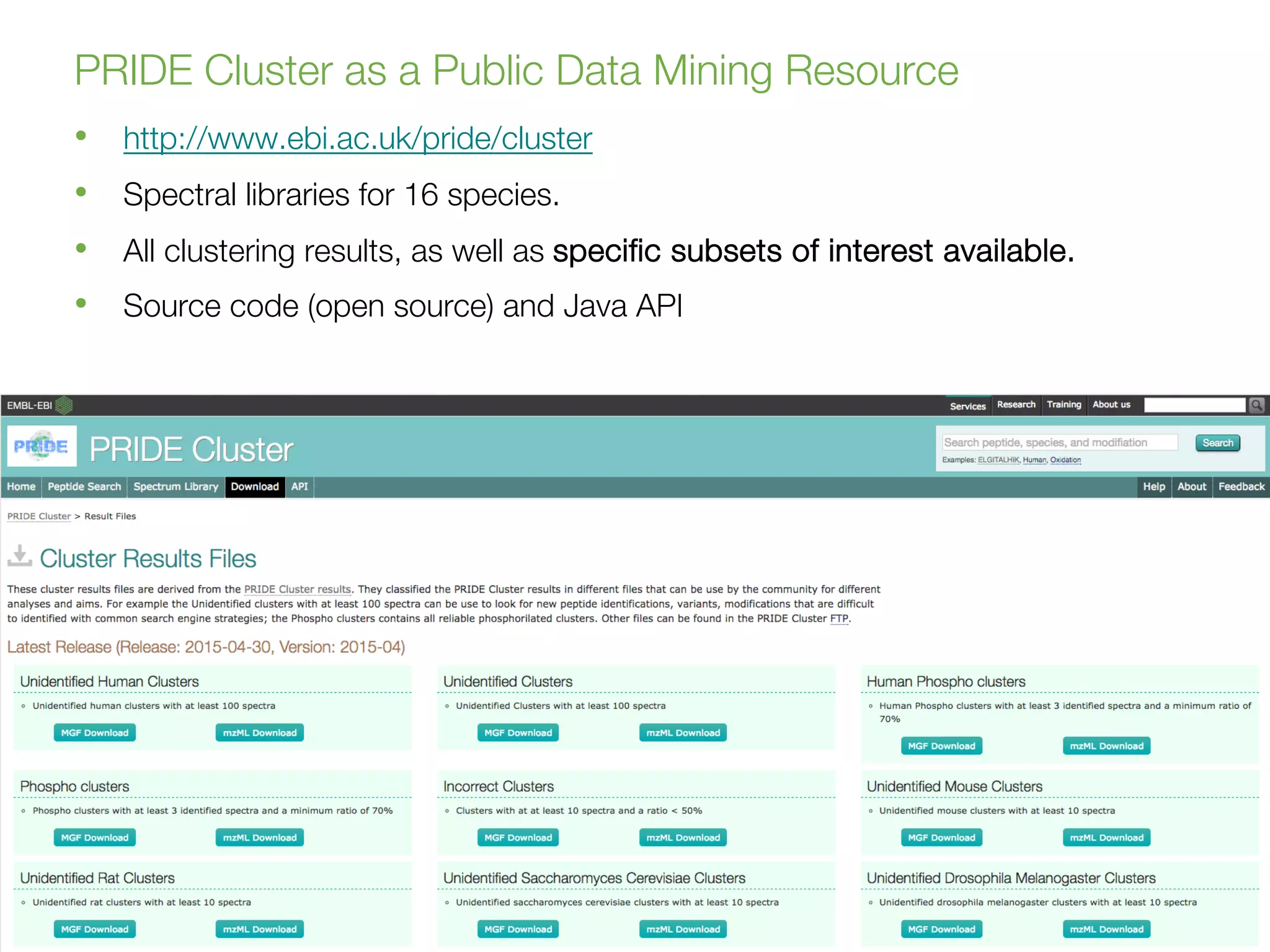
PRIDE Cluster as a Public Data Mining Resource
16
• http://www.ebi.ac.uk/pride/cluster
• Spectral libraries for 16 species.
• All clustering results, as well as specific subsets of interest available.
• Source code (open source) and Java API
Juan A. Vizcaíno
juan@ebi.ac.uk
WT Proteomics Bioinformatics Course 2018
Hinxton, 19 July 2018
Benchmarking
• Many datasets are reused to benchmark new algorithms
and/or tools. Comparison with previous tools.
• Usually raw data is used as the base (new analysis), but
not always.
• Very common reuse case -> A lot of examples.
Juan A. Vizcaíno
juan@ebi.ac.uk
WT Proteomics Bioinformatics Course 2018
Hinxton, 19 July 2018
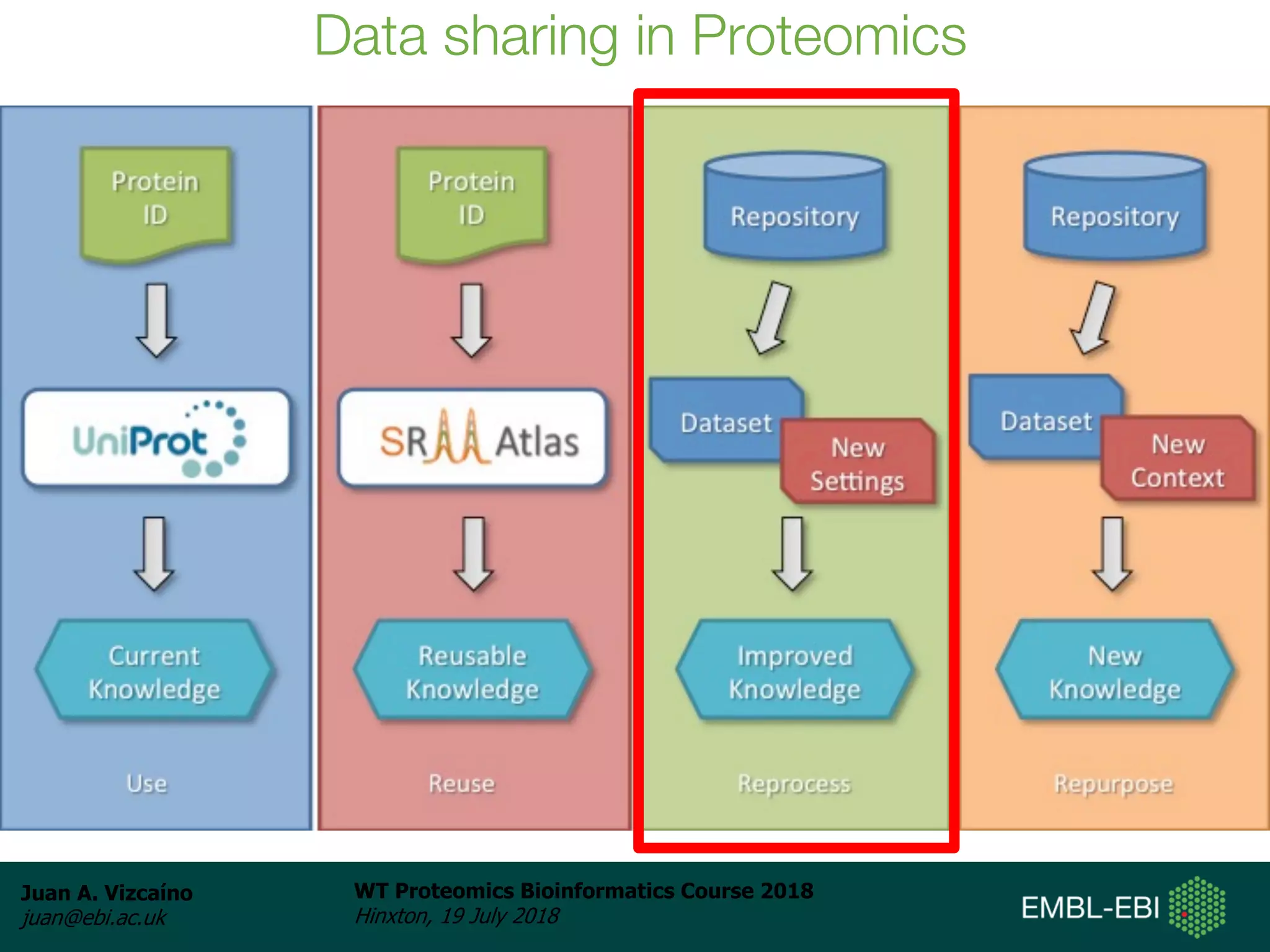
Data sharing in Proteomics
Juan A. Vizcaíno
juan@ebi.ac.uk
WT Proteomics Bioinformatics Course 2018
Hinxton, 19 July 2018
Reprocess
• Data are reprocessed with the intention of obtaining
new knowledge or to provide an updated view on
the results.
• It mainly serves the same purpose of the original
experiment.
• For instance, a shot-gun dataset can be reprocessed
with a different algorithm or an updated sequence
database.
Juan A. Vizcaíno
juan@ebi.ac.uk
WT Proteomics Bioinformatics Course 2018
Hinxton, 19 July 2018
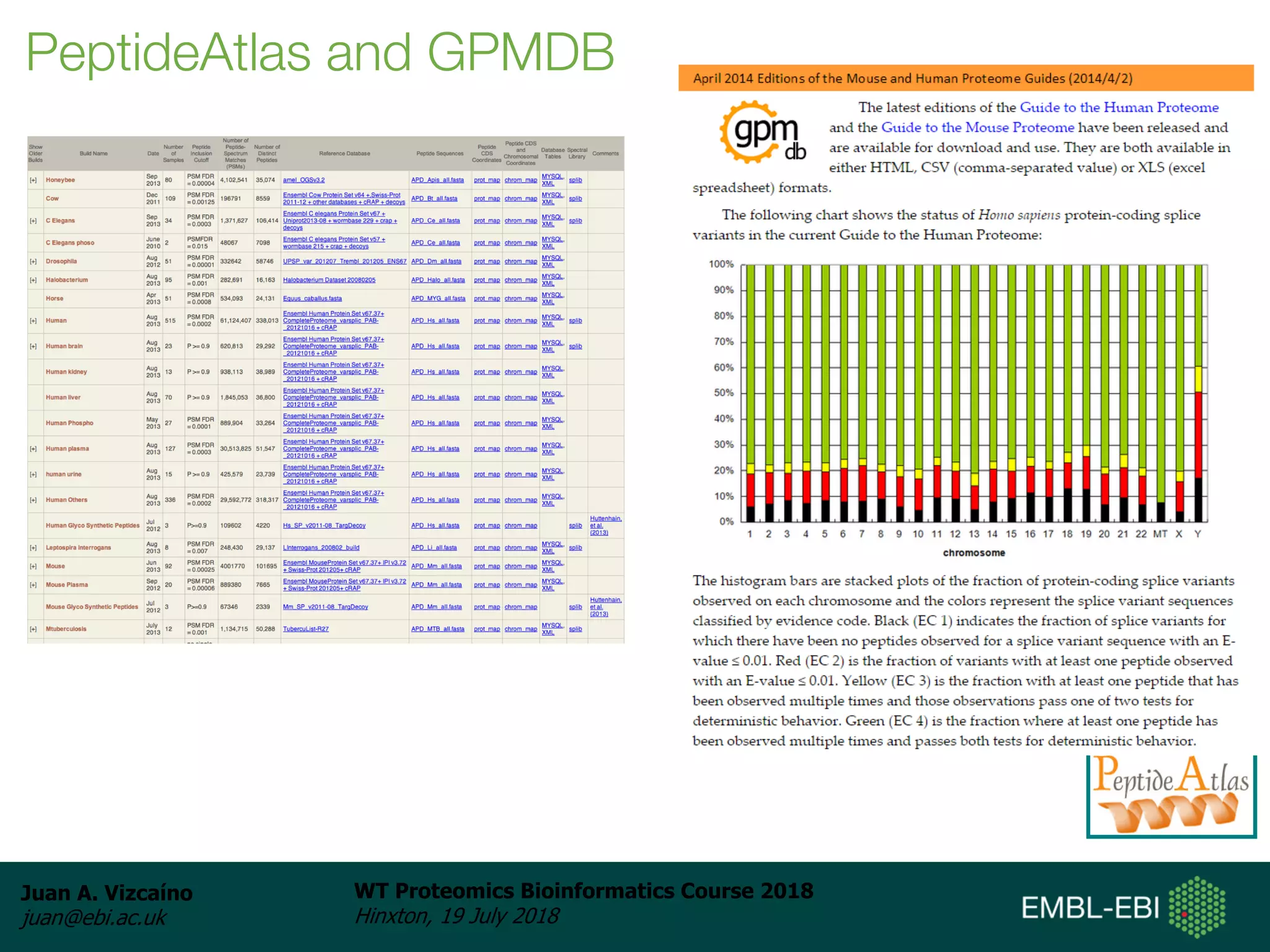
PeptideAtlas and GPMDB
Juan A. Vizcaíno
juan@ebi.ac.uk
WT Proteomics Bioinformatics Course 2018
Hinxton, 19 July 2018
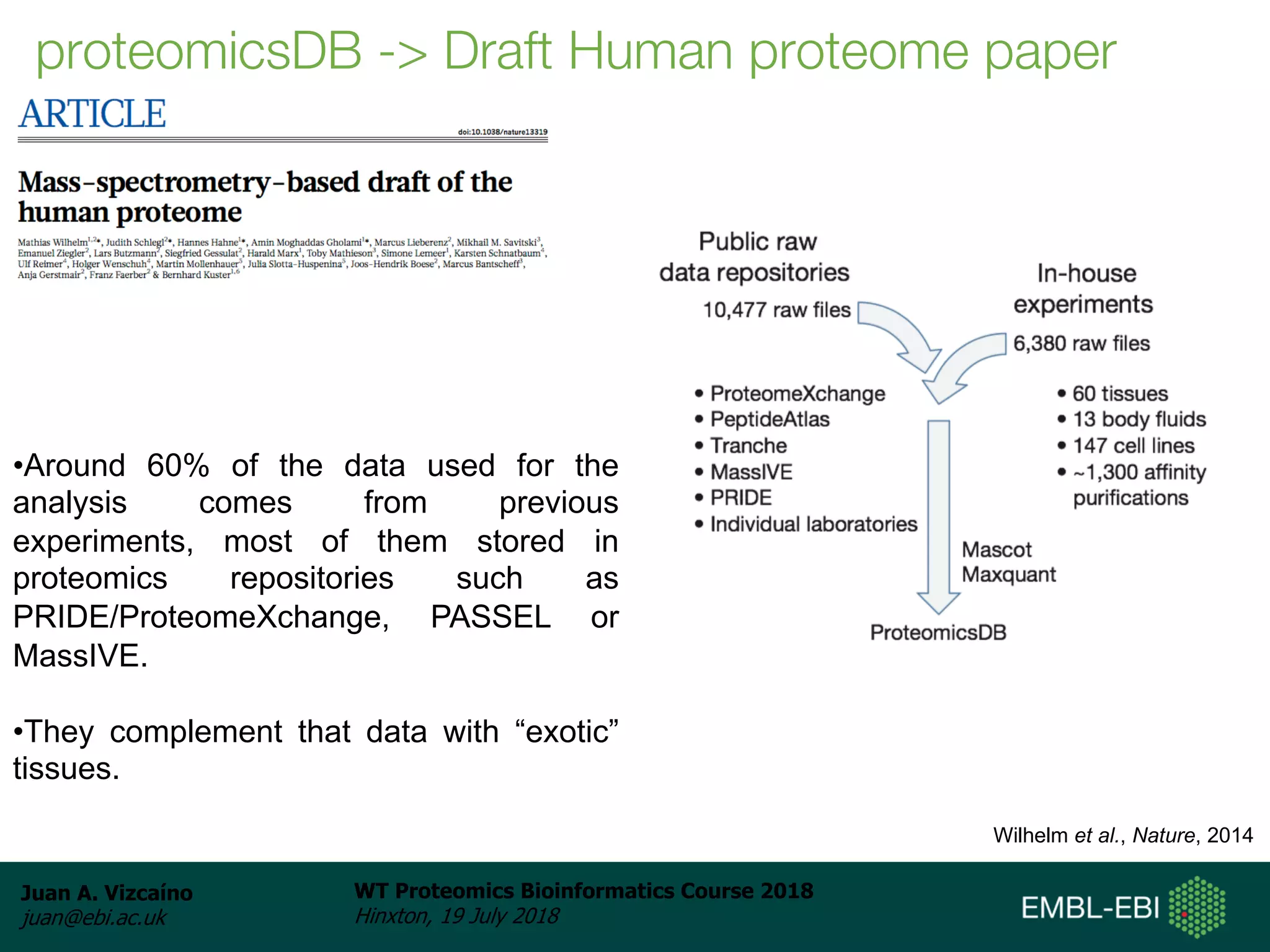
proteomicsDB -> Draft Human proteome paper
Wilhelm et al., Nature, 2014
•Around 60% of the data used for the
analysis comes from previous
experiments, most of them stored in
proteomics repositories such as
PRIDE/ProteomeXchange, PASSEL or
MassIVE.
•They complement that data with “exotic”
tissues.
Juan A. Vizcaíno
juan@ebi.ac.uk
WT Proteomics Bioinformatics Course 2018
Hinxton, 19 July 2018
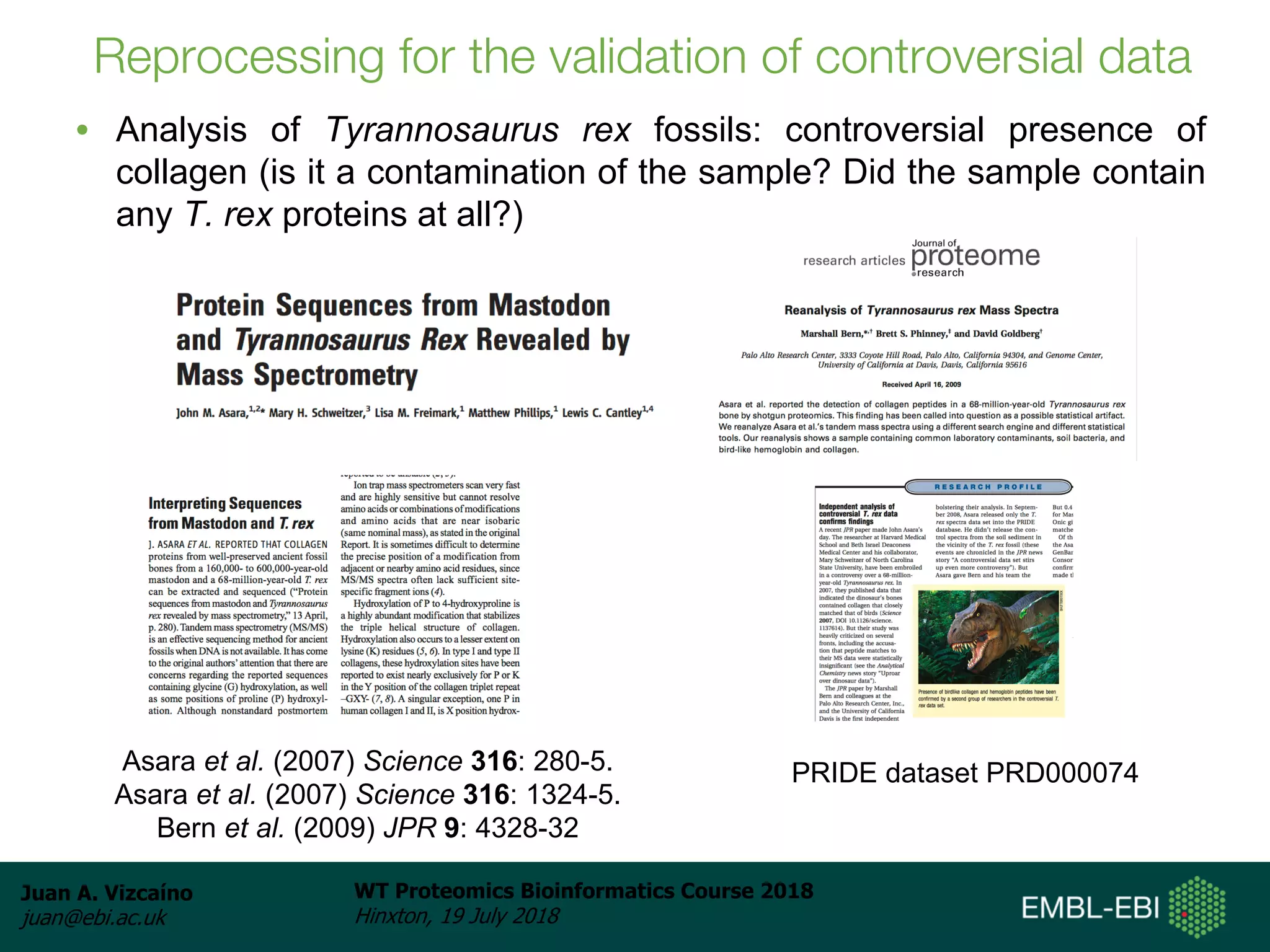
Reprocessing for the validation of controversial data
• Analysis of Tyrannosaurus rex fossils: controversial presence of
collagen (is it a contamination of the sample? Did the sample contain
any T. rex proteins at all?)
Asara et al. (2007) Science 316: 280-5.
Asara et al. (2007) Science 316: 1324-5.
Bern et al. (2009) JPR 9: 4328-32
PRIDE dataset PRD000074
Juan A. Vizcaíno
juan@ebi.ac.uk
WT Proteomics Bioinformatics Course 2018
Hinxton, 19 July 2018
Info from R. Chalkley
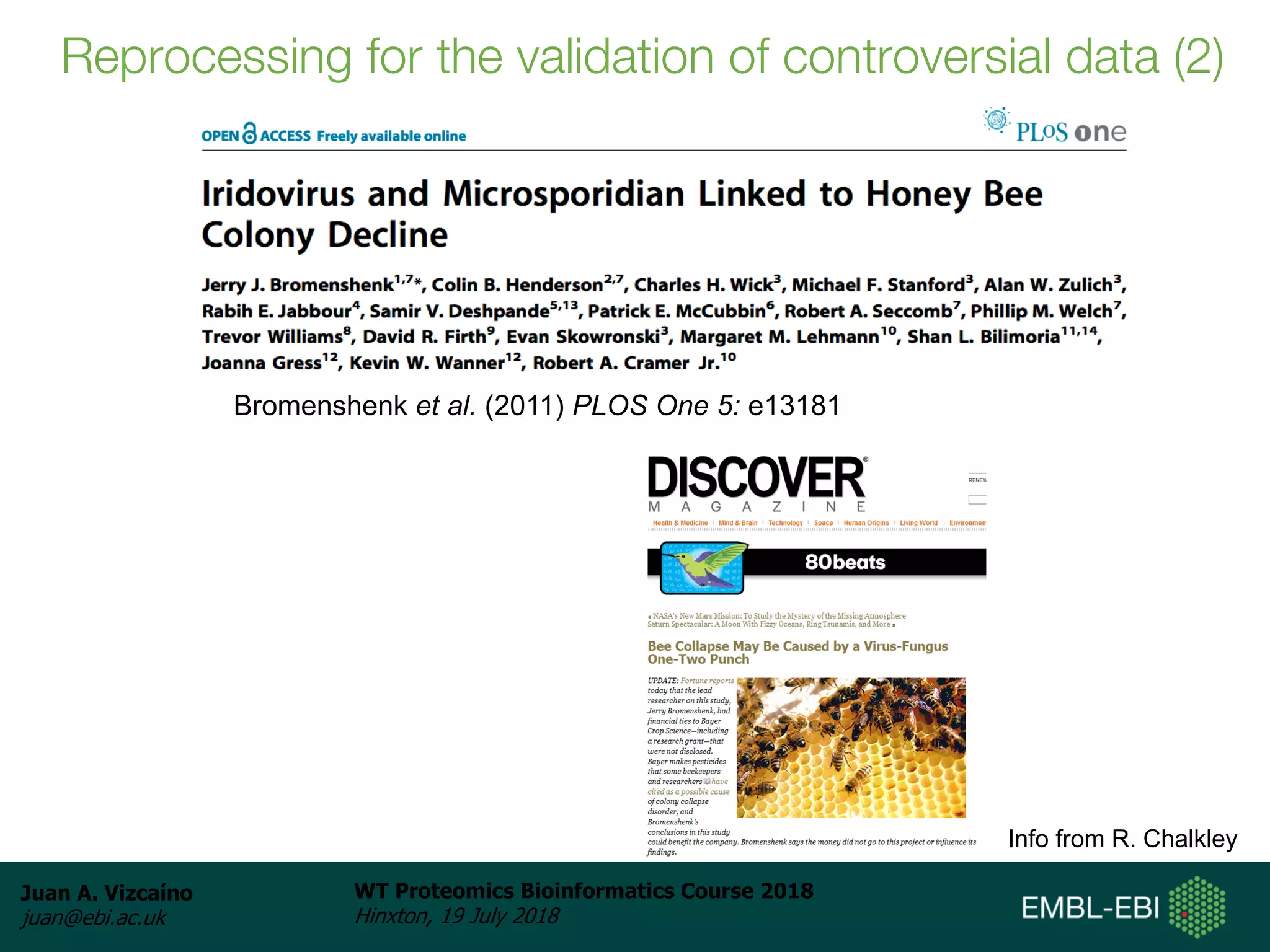
Bromenshenk et al. (2011) PLOS One 5: e13181
Reprocessing for the validation of controversial data (2)
Juan A. Vizcaíno
juan@ebi.ac.uk
WT Proteomics Bioinformatics Course 2018
Hinxton, 19 July 2018
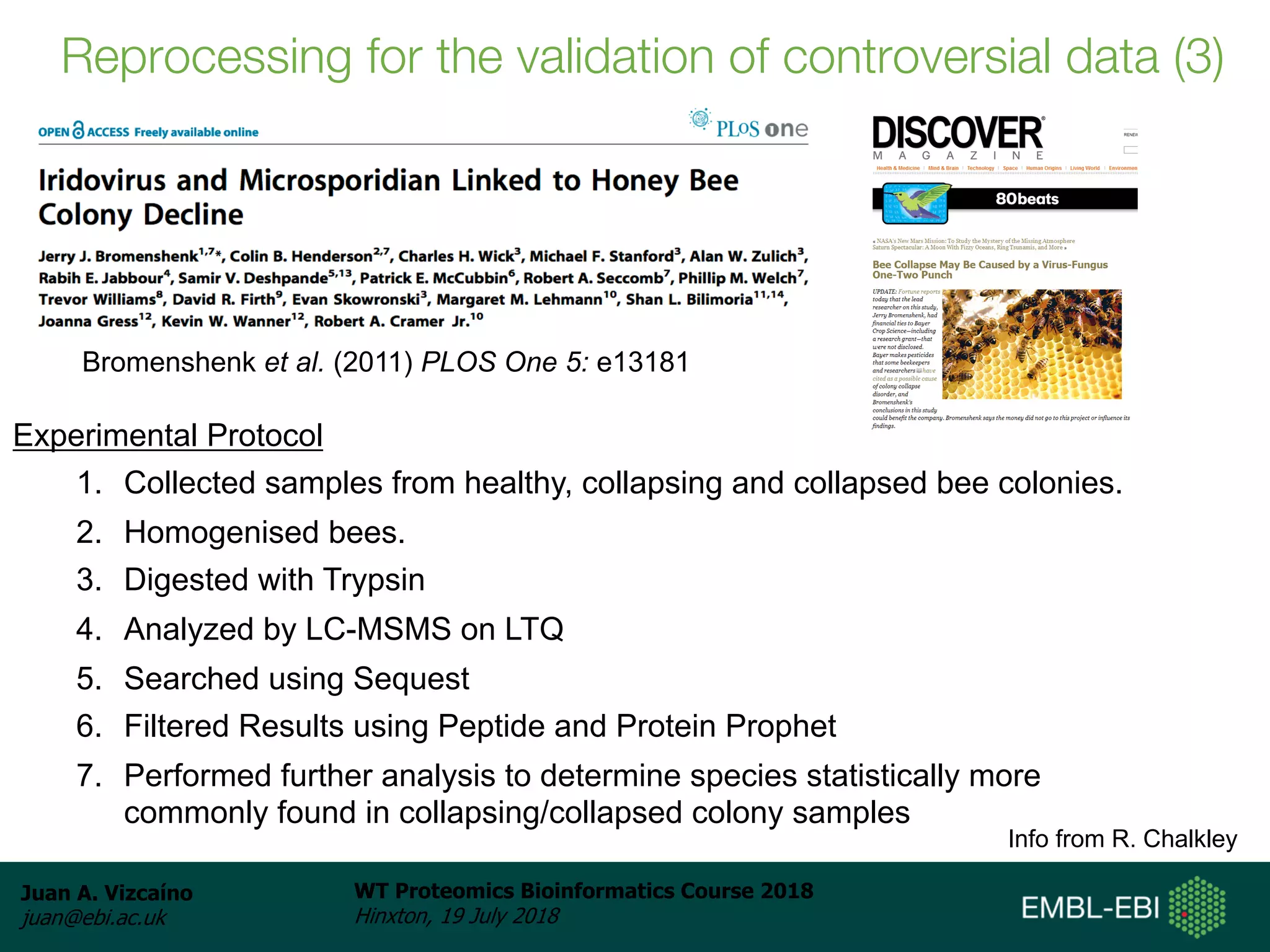
Experimental Protocol
1. Collected samples from healthy, collapsing and collapsed bee colonies.
2. Homogenised bees.
3. Digested with Trypsin
4. Analyzed by LC-MSMS on LTQ
5. Searched using Sequest
6. Filtered Results using Peptide and Protein Prophet
7. Performed further analysis to determine species statistically more
commonly found in collapsing/collapsed colony samples
Info from R. Chalkley
Bromenshenk et al. (2011) PLOS One 5: e13181
Reprocessing for the validation of controversial data (3)
Juan A. Vizcaíno
juan@ebi.ac.uk
WT Proteomics Bioinformatics Course 2018
Hinxton, 19 July 2018
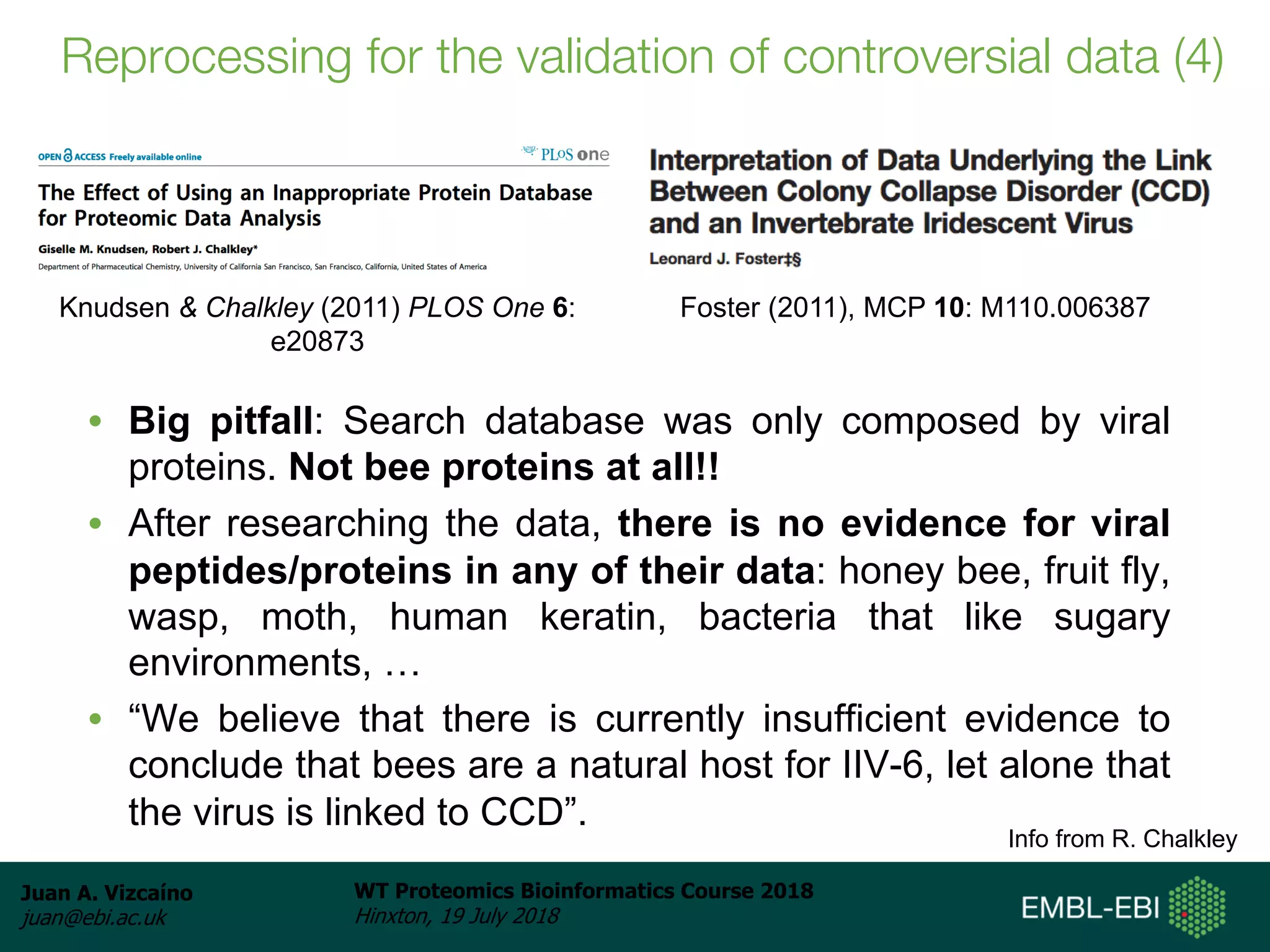
• Big pitfall: Search database was only composed by viral
proteins. Not bee proteins at all!!
• After researching the data, there is no evidence for viral
peptides/proteins in any of their data: honey bee, fruit fly,
wasp, moth, human keratin, bacteria that like sugary
environments, …
• “We believe that there is currently insufficient evidence to
conclude that bees are a natural host for IIV-6, let alone that
the virus is linked to CCD”.
Info from R. Chalkley
Knudsen & Chalkley (2011) PLOS One 6:
e20873
Foster (2011), MCP 10: M110.006387
Reprocessing for the validation of controversial data (4)
Juan A. Vizcaíno
juan@ebi.ac.uk
WT Proteomics Bioinformatics Course 2018
Hinxton, 19 July 2018
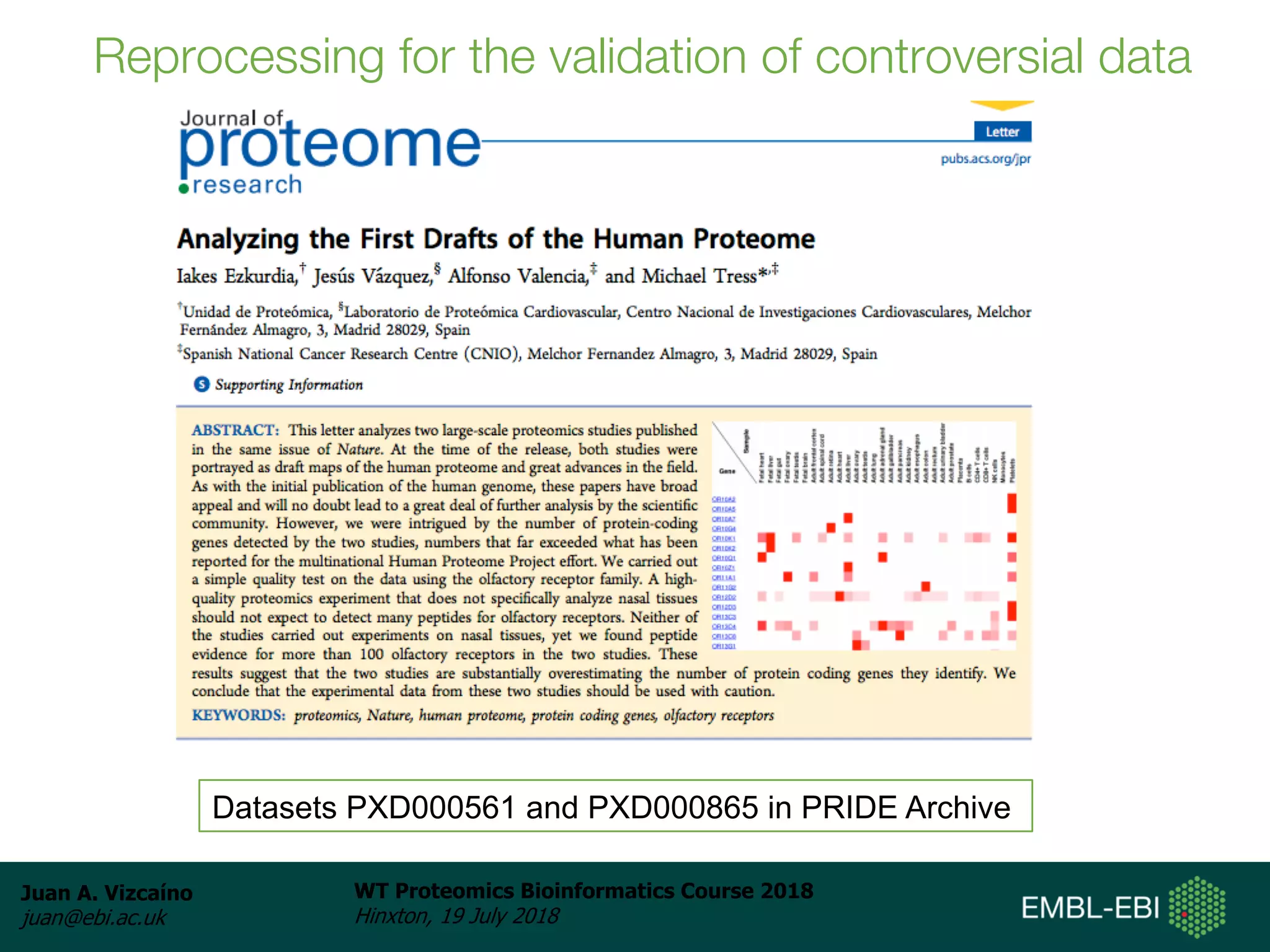
Reprocessing for the validation of controversial data
Datasets PXD000561 and PXD000865 in PRIDE Archive
Juan A. Vizcaíno
juan@ebi.ac.uk
WT Proteomics Bioinformatics Course 2018
Hinxton, 19 July 2018
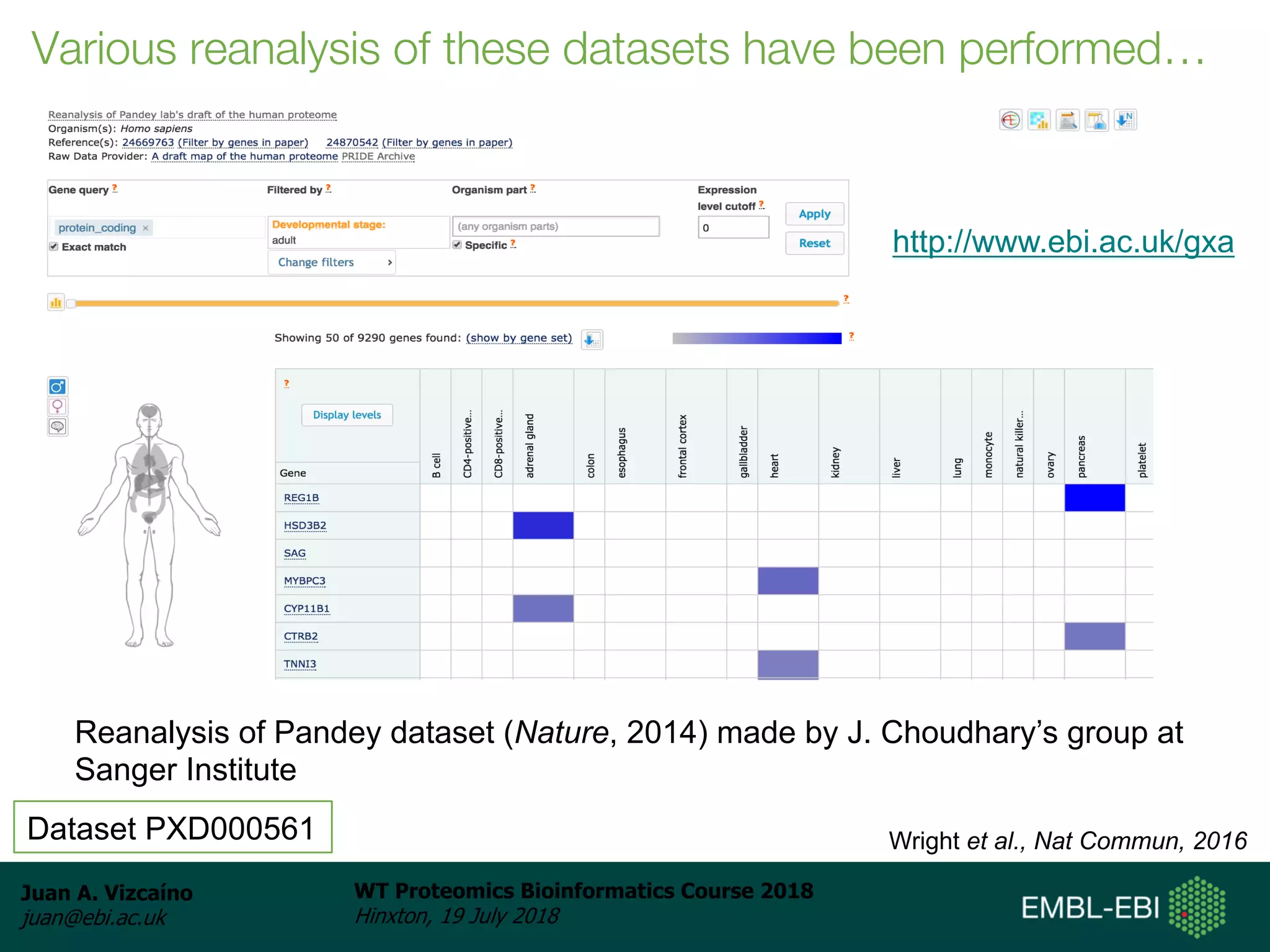
Various reanalysis of these datasets have been performed…
Reanalysis of Pandey dataset (Nature, 2014) made by J. Choudhary’s group at
Sanger Institute
Wright et al., Nat Commun, 2016Dataset PXD000561
http://www.ebi.ac.uk/gxa
Juan A. Vizcaíno
juan@ebi.ac.uk
WT Proteomics Bioinformatics Course 2018
Hinxton, 19 July 2018
Meta-analysis approaches
• Putting data coming from a lot of experiments
together, to extract new knowledge. Examples:
• Peptide fragmentation patterns.
• Retention time prediction.
• Data integration of experiments done at different time
points.
• Two different approaches:
• Data as submitted
• Reanalysis all the data together
Juan A. Vizcaíno
juan@ebi.ac.uk
WT Proteomics Bioinformatics Course 2018
Hinxton, 19 July 2018
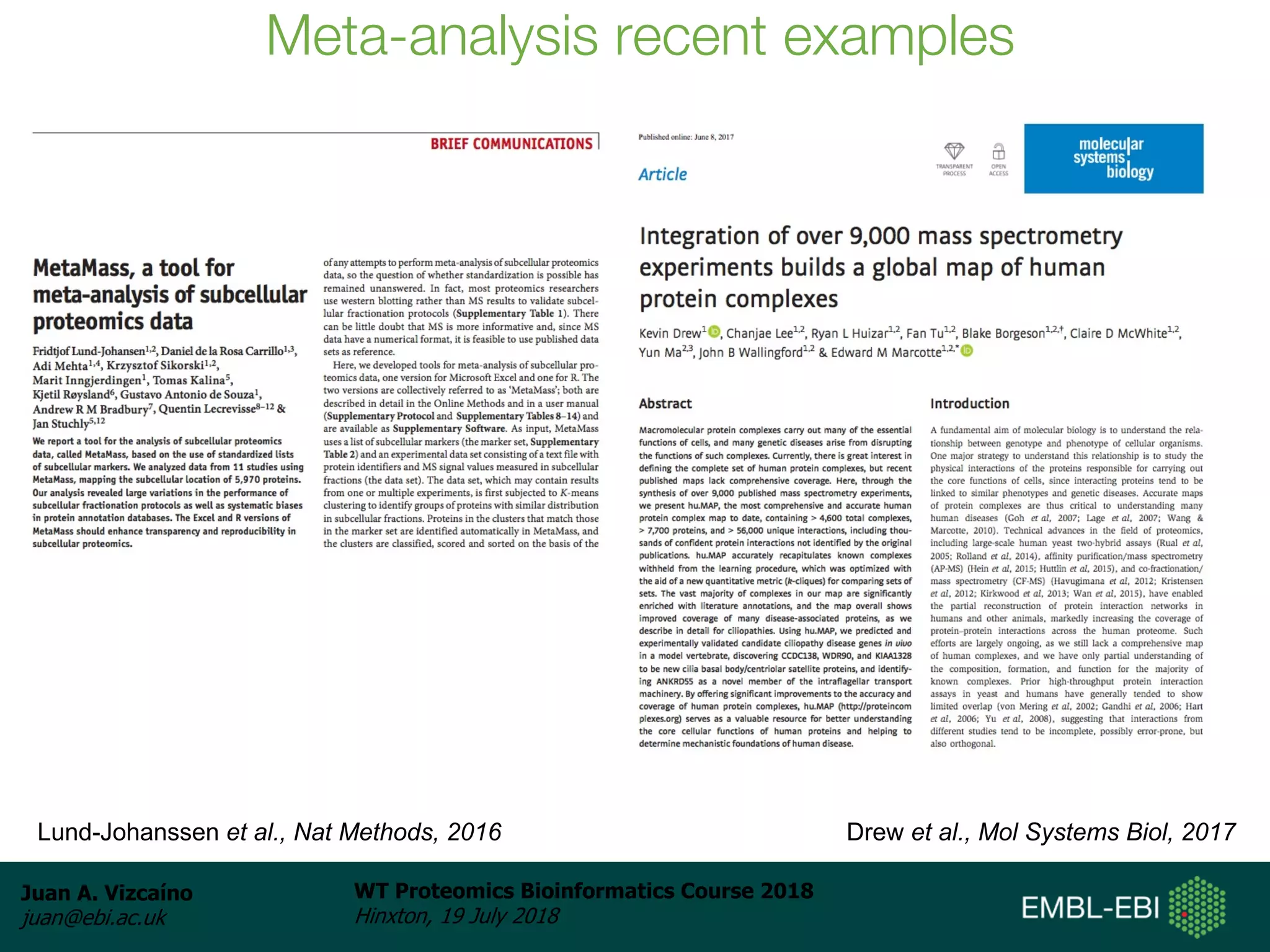
Meta-analysis recent examples
Lund-Johanssen et al., Nat Methods, 2016 Drew et al., Mol Systems Biol, 2017
Juan A. Vizcaíno
juan@ebi.ac.uk
WT Proteomics Bioinformatics Course 2018
Hinxton, 19 July 2018
Data sharing in Proteomics
Juan A. Vizcaíno
juan@ebi.ac.uk
WT Proteomics Bioinformatics Course 2018
Hinxton, 19 July 2018
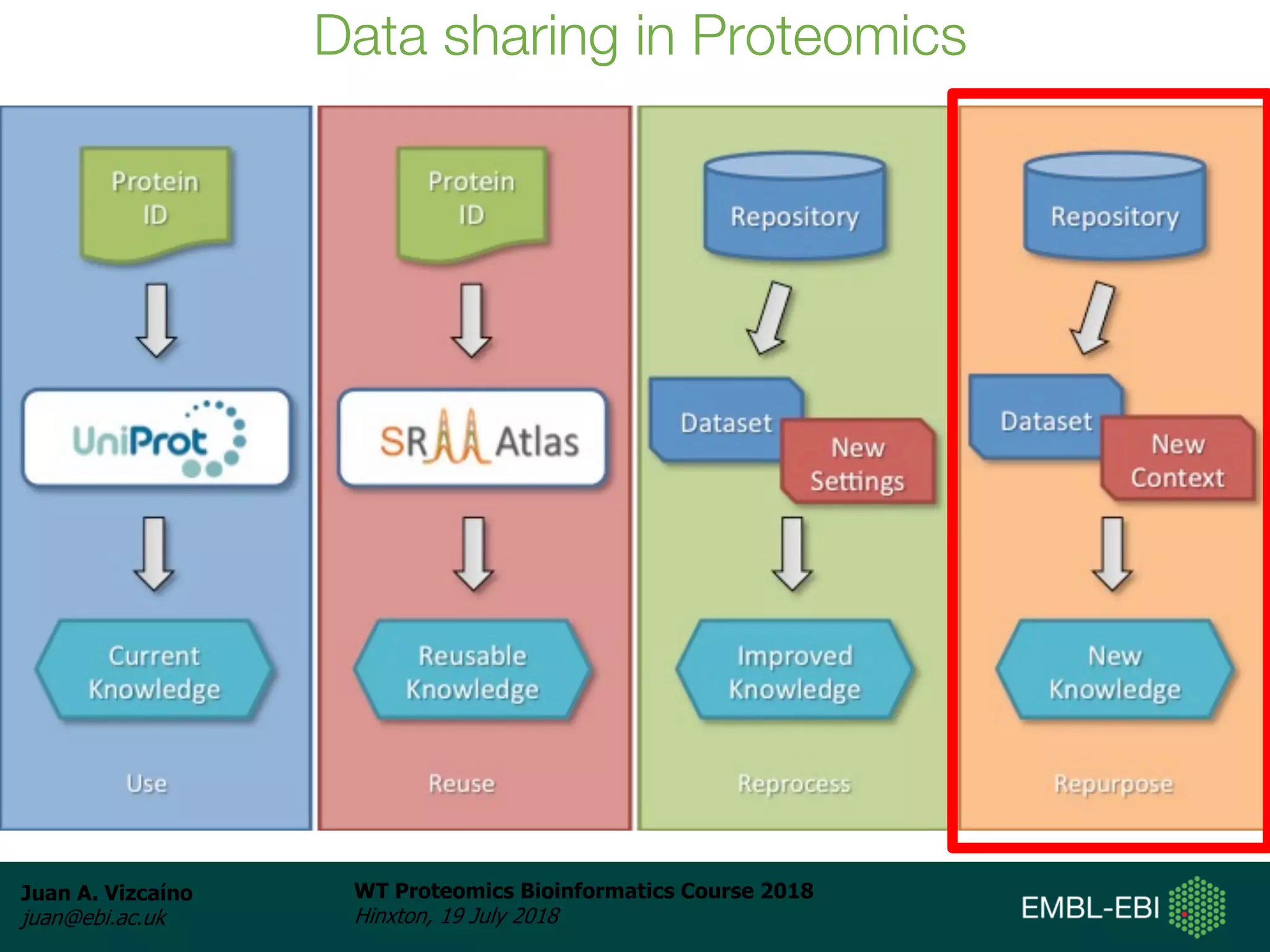
Repurposing
• Data are considered in light of a question or a
context that is different from the original study.
• Proteogenomics studies
• Discovery of novel PTMs.
Juan A. Vizcaíno
juan@ebi.ac.uk
WT Proteomics Bioinformatics Course 2018
Hinxton, 19 July 2018
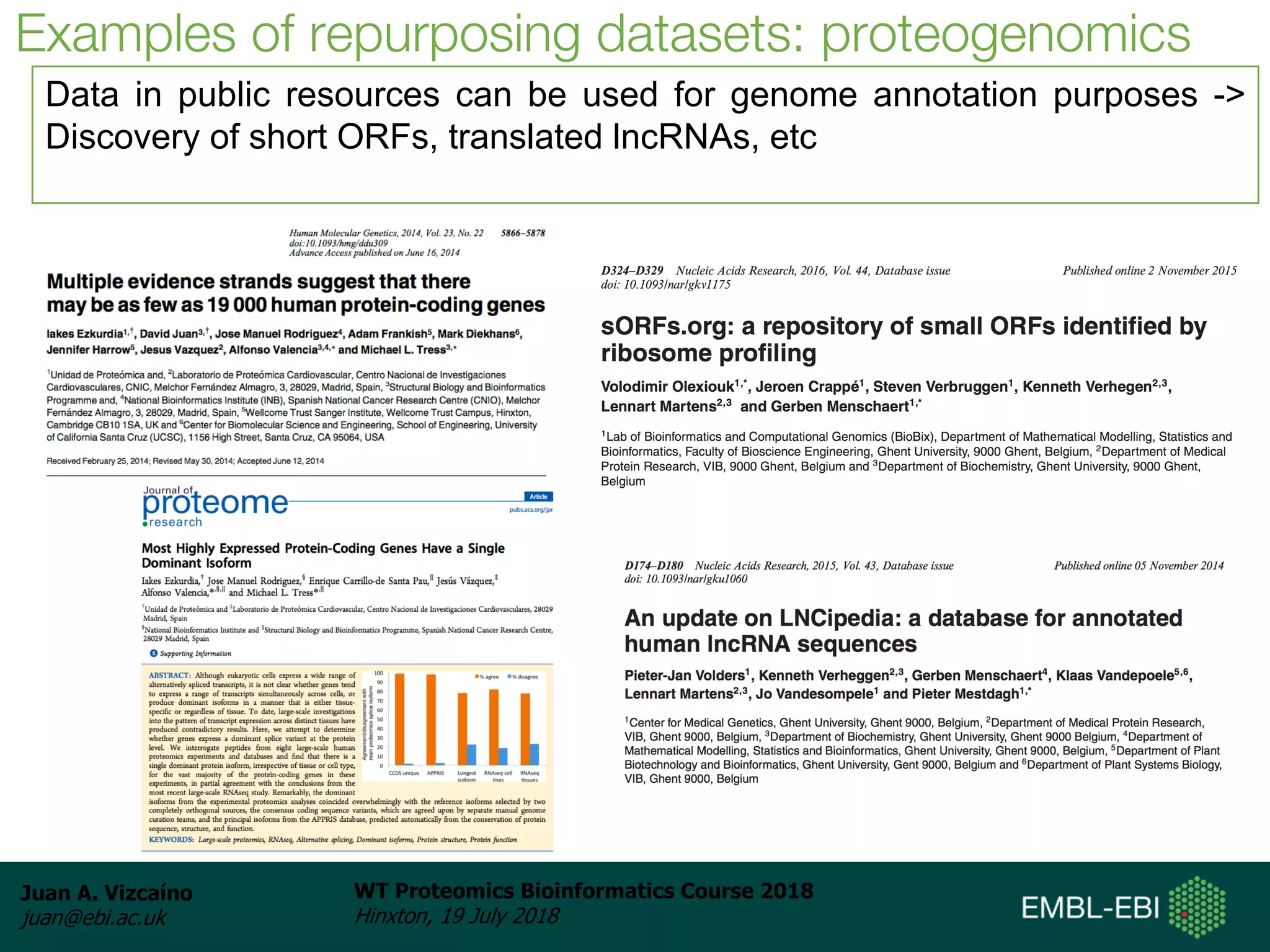
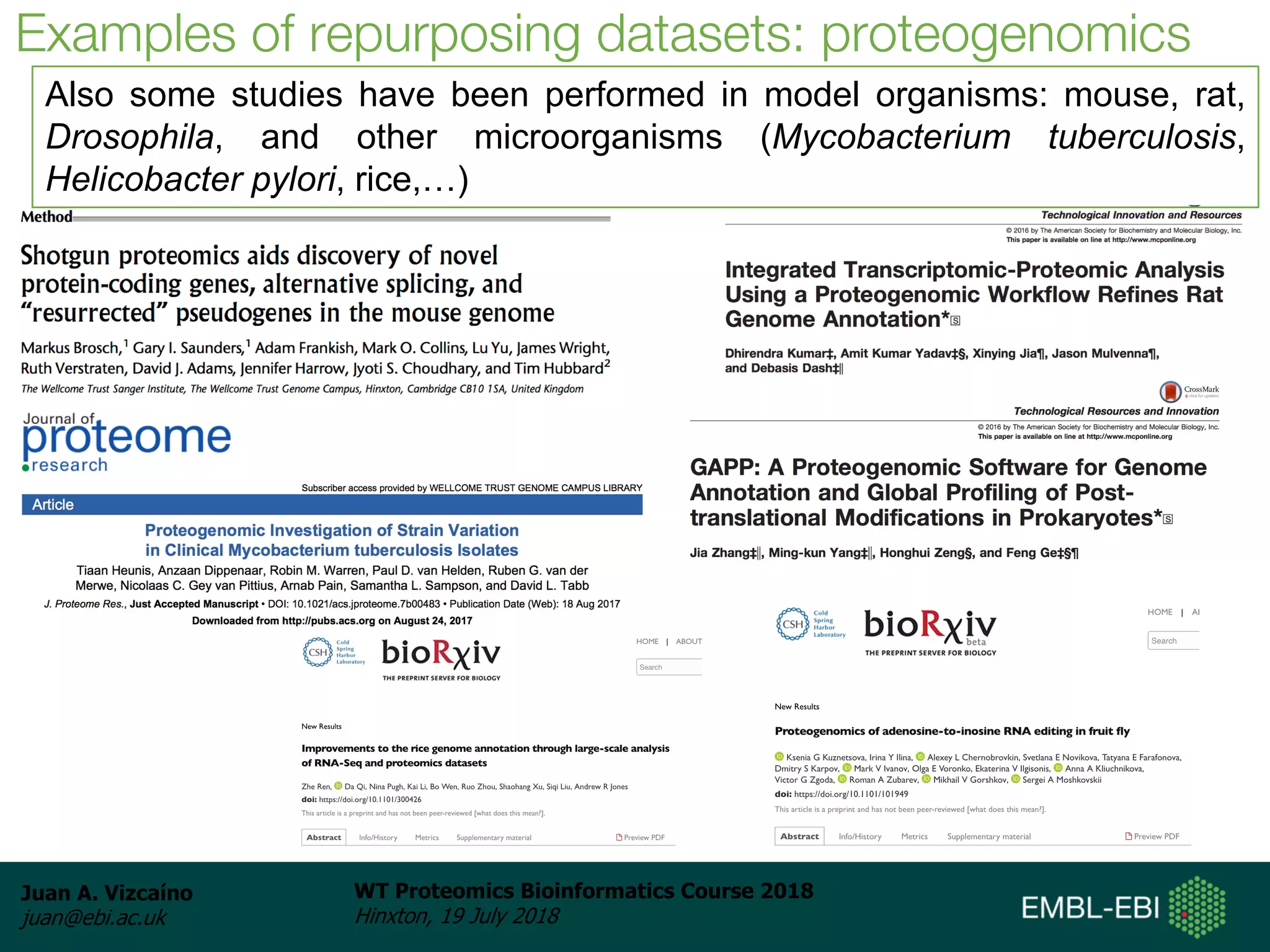
Examples of repurposing datasets: proteogenomics
Data in public resources can be used for genome annotation purposes ->
Discovery of short ORFs, translated lncRNAs, etc
Juan A. Vizcaíno
juan@ebi.ac.uk
WT Proteomics Bioinformatics Course 2018
Hinxton, 19 July 2018
Examples of repurposing datasets: proteogenomics
Also some studies have been performed in model organisms: mouse, rat,
Drosophila, and other microorganisms (Mycobacterium tuberculosis,
Helicobacter pylori, rice,…)
Juan A. Vizcaíno
juan@ebi.ac.uk
WT Proteomics Bioinformatics Course 2018
Hinxton, 19 July 2018
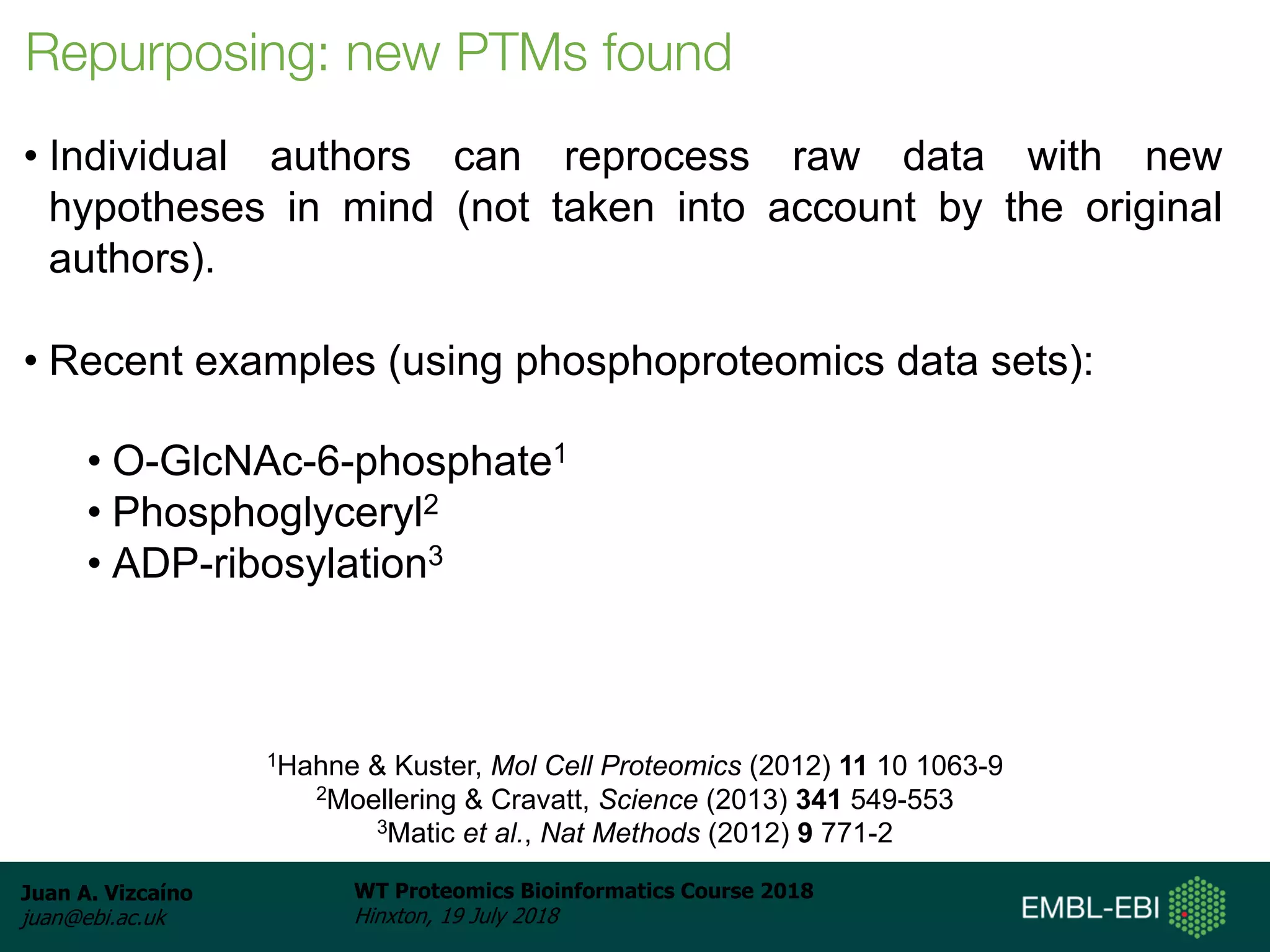
Repurposing: new PTMs found
• Individual authors can reprocess raw data with new
hypotheses in mind (not taken into account by the original
authors).
• Recent examples (using phosphoproteomics data sets):
• O-GlcNAc-6-phosphate1
• Phosphoglyceryl2
• ADP-ribosylation3
1Hahne & Kuster, Mol Cell Proteomics (2012) 11 10 1063-9
2Moellering & Cravatt, Science (2013) 341 549-553
3Matic et al., Nat Methods (2012) 9 771-2
Juan A. Vizcaíno
juan@ebi.ac.uk
WT Proteomics Bioinformatics Course 2018
Hinxton, 19 July 2018
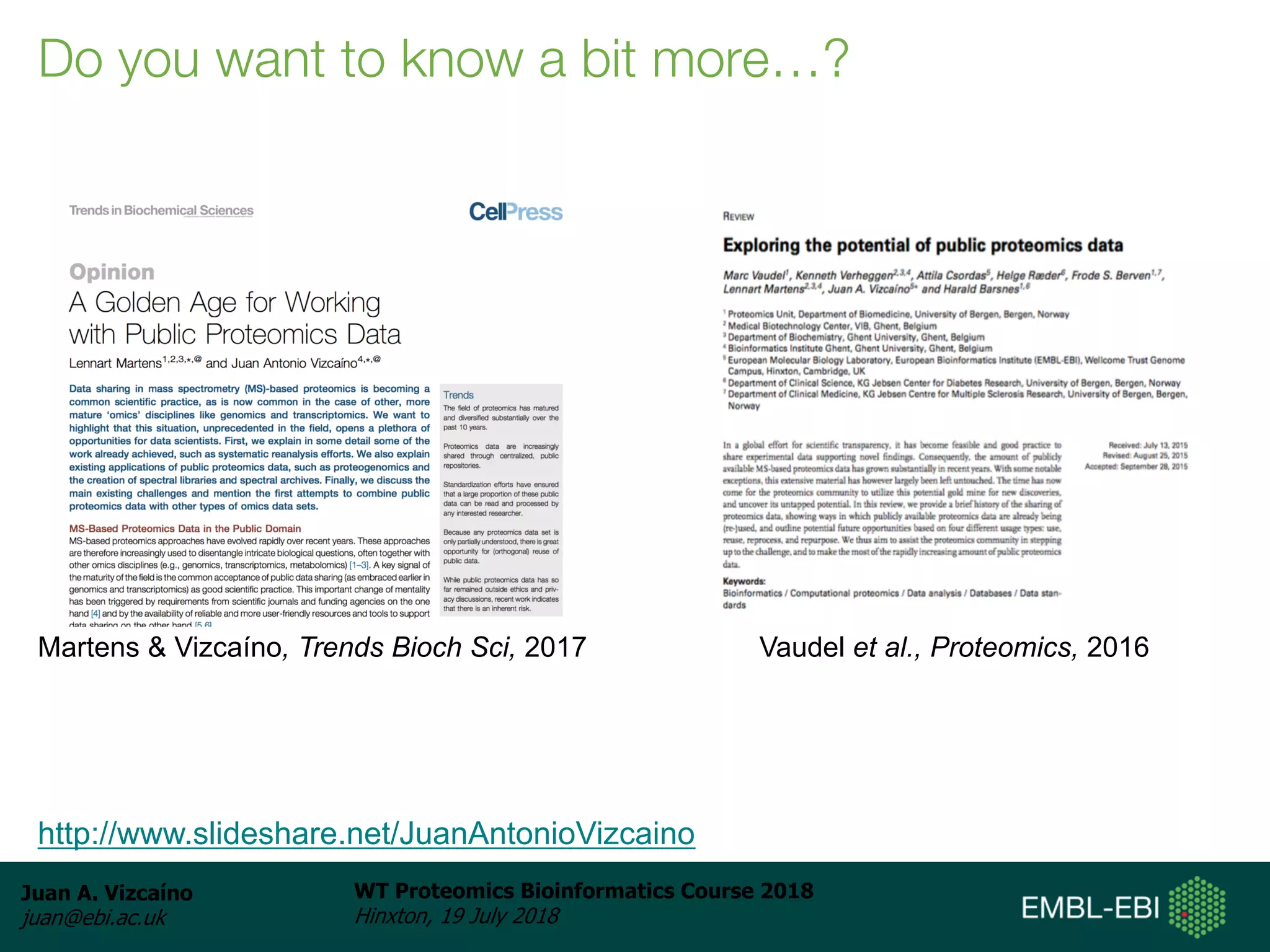
Do you want to know a bit more…?
http://www.slideshare.net/JuanAntonioVizcaino
Martens & Vizcaíno, Trends Bioch Sci, 2017 Vaudel et al., Proteomics, 2016
Juan A. Vizcaíno
juan@ebi.ac.uk
WT Proteomics Bioinformatics Course 2018
Hinxton, 19 July 2018
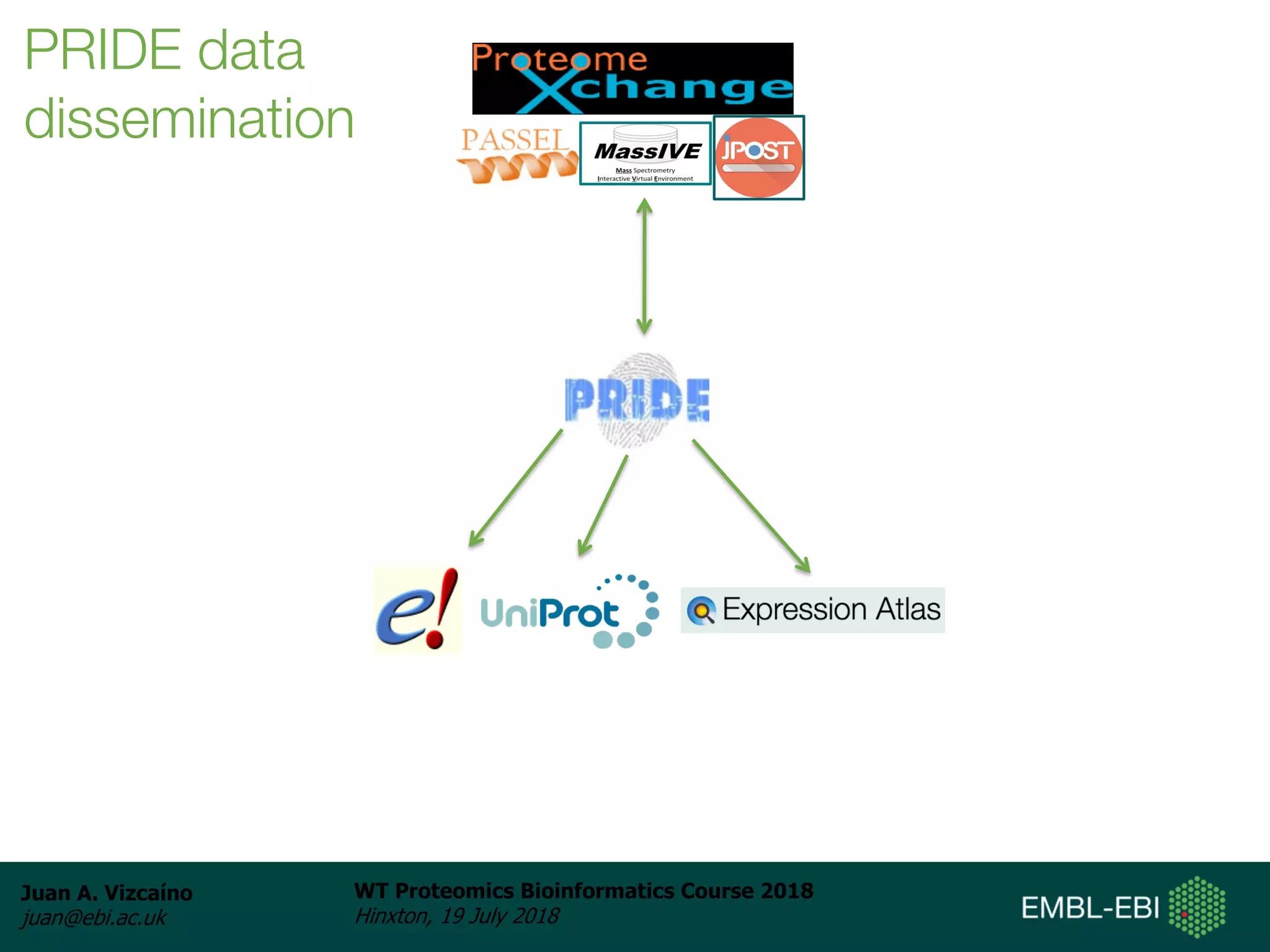
PRIDE data
dissemination
Juan A. Vizcaíno
juan@ebi.ac.uk
WT Proteomics Bioinformatics Course 2018
Hinxton, 19 July 2018
EXERCISE
Juan A. Vizcaíno
juan@ebi.ac.uk
WT Proteomics Bioinformatics Course 2018
Hinxton, 19 July 2018
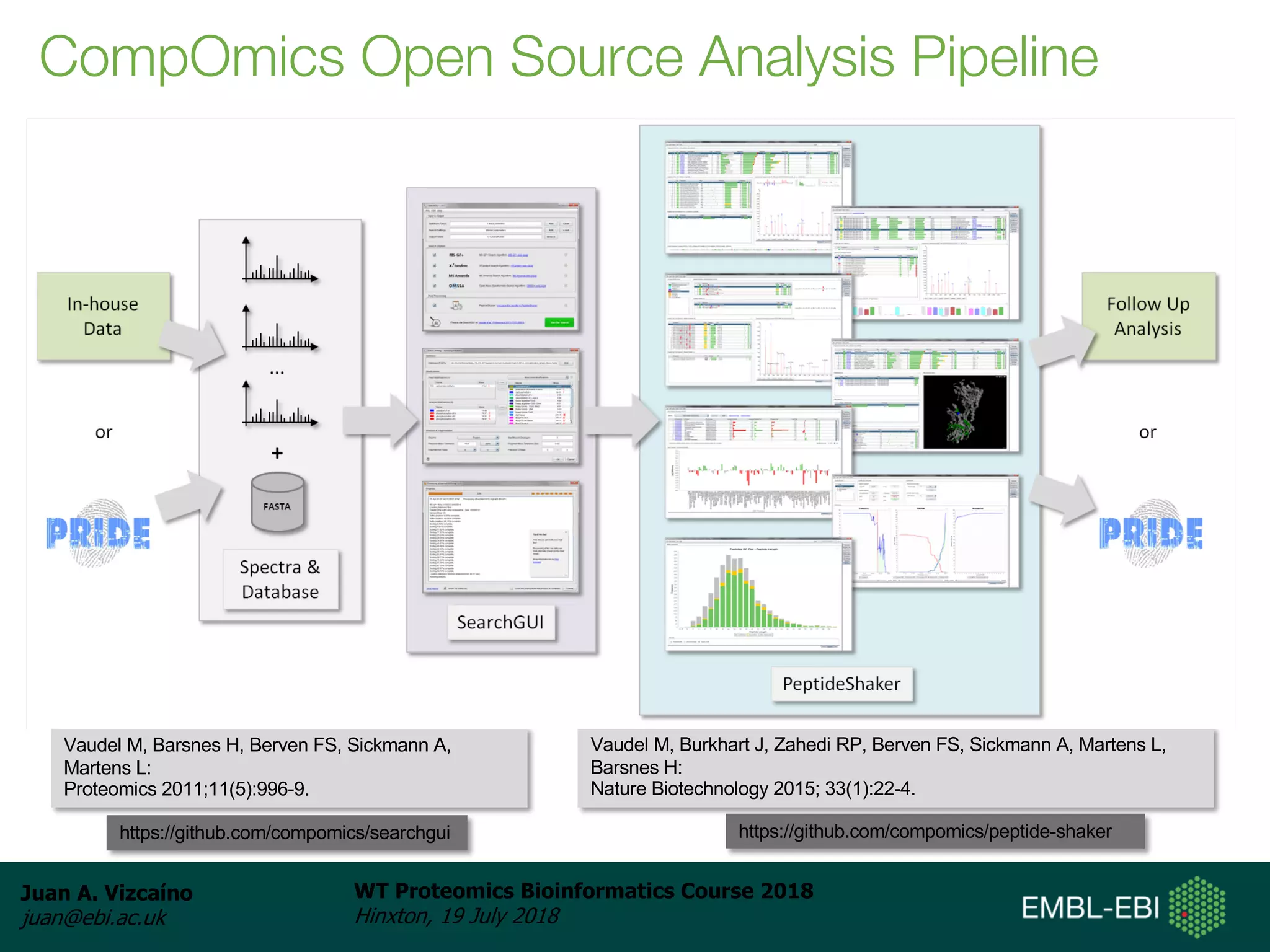
Vaudel M, Barsnes H, Berven FS, Sickmann A,
Martens L:
Proteomics 2011;11(5):996-9.
https://github.com/compomics/searchgui https://github.com/compomics/peptide-shaker
Vaudel M, Burkhart J, Zahedi RP, Berven FS, Sickmann A, Martens L,
Barsnes H:
Nature Biotechnology 2015; 33(1):22-4.
CompOmics Open Source Analysis Pipeline
Juan A. Vizcaíno
juan@ebi.ac.uk
WT Proteomics Bioinformatics Course 2018
Hinxton, 19 July 2018
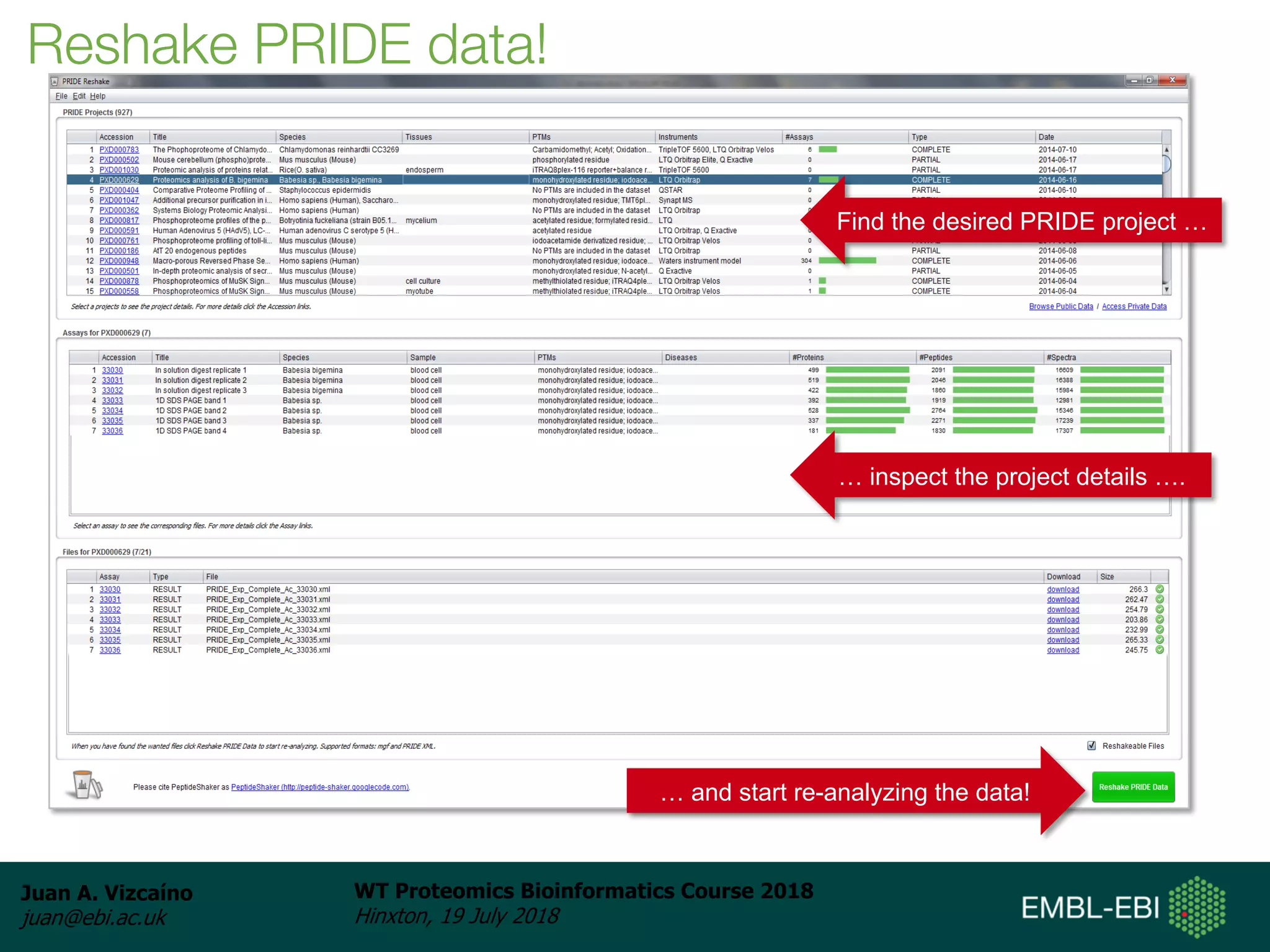
Find the desired PRIDE project …
… and start re-analyzing the data!
… inspect the project details ….
Reshake PRIDE data!
Juan A. Vizcaíno
juan@ebi.ac.uk
WT Proteomics Bioinformatics Course 2018
Hinxton, 19 July 2018

Reuse of public proteomics data

  • 1.
    Reuse of publicproteomics data Dr. Juan Antonio Vizcaíno EMBL-EBI Hinxton, Cambridge, UK
  • 2.
    Juan A. Vizcaíno juan@ebi.ac.uk WTProteomics Bioinformatics Course 2018 Hinxton, 19 July 2018 PRIDE data submissions and data growth May 2018 (320 datasets) was again a record month in terms of datasets submitted Datasets submitted per month > 2,400 datasets submitted in 2017 Datasets submitted per year PRIDE contains >85% of all ProteomeXchange datasets Dataset PXD010000 reached on June 1st
  • 3.
    Juan A. Vizcaíno juan@ebi.ac.uk WTProteomics Bioinformatics Course 2018 Hinxton, 19 July 2018 Public Data Reuse in Proteomics Vaudel et al., Proteomics, 2016
  • 4.
    Juan A. Vizcaíno juan@ebi.ac.uk WTProteomics Bioinformatics Course 2018 Hinxton, 19 July 2018 Data re-use in proteomics keeps increasing Data download volume for PRIDE in 2017: 295 TB 0 50 100 150 200 250 300 350 2013 2014 2015 2016 2017 Downloads in TBs
  • 5.
    Juan A. Vizcaíno juan@ebi.ac.uk WTProteomics Bioinformatics Course 2018 Hinxton, 19 July 2018 What do researchers think about the main uses of public proteomics data? • Verify published results • Build Spectral libraries • Find interesting datasets for reanalysis: • Find new splice isoforms • Discover new PTMs Source: MassIVE workshop, ASMS 2017, Nuno Bandeira et al.
  • 6.
    Juan A. Vizcaíno juan@ebi.ac.uk WTProteomics Bioinformatics Course 2018 Hinxton, 19 July 2018 Data sharing in Proteomics Vaudel et al., Proteomics, 2016
  • 7.
    Juan A. Vizcaíno juan@ebi.ac.uk WTProteomics Bioinformatics Course 2018 Hinxton, 19 July 2018 Data sharing in Proteomics
  • 8.
    Juan A. Vizcaíno juan@ebi.ac.uk WTProteomics Bioinformatics Course 2018 Hinxton, 19 July 2018 Data sharing in Proteomics • Data directly as they are. • Protein knowledge bases: UniProt, neXtProt. • Contributing to the Protein Evidence Code.
  • 9.
    Juan A. Vizcaíno juan@ebi.ac.uk WTProteomics Bioinformatics Course 2018 Hinxton, 19 July 2018 Protein Evidence codes in UniProt/neXtProt http://www.uniprot.org/help/protein_existence
  • 10.
    Juan A. Vizcaíno juan@ebi.ac.uk WTProteomics Bioinformatics Course 2018 Hinxton, 19 July 2018 Use of MS data in UniProt
  • 11.
    Juan A. Vizcaíno juan@ebi.ac.uk WTProteomics Bioinformatics Course 2018 Hinxton, 19 July 2018 Data sharing in Proteomics
  • 12.
    Juan A. Vizcaíno juan@ebi.ac.uk WTProteomics Bioinformatics Course 2018 Hinxton, 19 July 2018 Reuse • Information is not only extracted, but reused in new experiments with the potential of generating new knowledge. • Transitions used in SRM approaches. • Spectral libraries.
  • 13.
    Juan A. Vizcaíno juan@ebi.ac.uk WTProteomics Bioinformatics Course 2018 Hinxton, 19 July 2018 SRMAtlas http://www.srmatlas.org/
  • 14.
    Juan A. Vizcaíno juan@ebi.ac.uk WTProteomics Bioinformatics Course 2018 Hinxton, 19 July 2018 Spectral searching • Concept: To compare experimental spectra to other experimental spectra. • There are many spectral libraries publicly available (for instance, from NIST, PeptideAtlas and PRIDE) • Custom ‘search engines’ have been developed: • SpectraST (TPP) • X!Hunter (GPM) • Bibliospec • It has been claimed that the searches have more sensitivity that with sequence database approaches
  • 15.
    Juan A. Vizcaíno juan@ebi.ac.uk WTProteomics Bioinformatics Course 2018 Hinxton, 19 July 2018 Spectral searching (2) http://peptide.nist.gov/
  • 16.
    Juan A. Vizcaíno juan@ebi.ac.uk WTProteomics Bioinformatics Course 2018 Hinxton, 19 July 2018 PRIDE Cluster as a Public Data Mining Resource 16 • http://www.ebi.ac.uk/pride/cluster • Spectral libraries for 16 species. • All clustering results, as well as specific subsets of interest available. • Source code (open source) and Java API
  • 17.
    Juan A. Vizcaíno juan@ebi.ac.uk WTProteomics Bioinformatics Course 2018 Hinxton, 19 July 2018 Benchmarking • Many datasets are reused to benchmark new algorithms and/or tools. Comparison with previous tools. • Usually raw data is used as the base (new analysis), but not always. • Very common reuse case -> A lot of examples.
  • 18.
    Juan A. Vizcaíno juan@ebi.ac.uk WTProteomics Bioinformatics Course 2018 Hinxton, 19 July 2018 Data sharing in Proteomics
  • 19.
    Juan A. Vizcaíno juan@ebi.ac.uk WTProteomics Bioinformatics Course 2018 Hinxton, 19 July 2018 Reprocess • Data are reprocessed with the intention of obtaining new knowledge or to provide an updated view on the results. • It mainly serves the same purpose of the original experiment. • For instance, a shot-gun dataset can be reprocessed with a different algorithm or an updated sequence database.
  • 20.
    Juan A. Vizcaíno juan@ebi.ac.uk WTProteomics Bioinformatics Course 2018 Hinxton, 19 July 2018 PeptideAtlas and GPMDB
  • 21.
    Juan A. Vizcaíno juan@ebi.ac.uk WTProteomics Bioinformatics Course 2018 Hinxton, 19 July 2018 proteomicsDB -> Draft Human proteome paper Wilhelm et al., Nature, 2014 •Around 60% of the data used for the analysis comes from previous experiments, most of them stored in proteomics repositories such as PRIDE/ProteomeXchange, PASSEL or MassIVE. •They complement that data with “exotic” tissues.
  • 22.
    Juan A. Vizcaíno juan@ebi.ac.uk WTProteomics Bioinformatics Course 2018 Hinxton, 19 July 2018 Reprocessing for the validation of controversial data • Analysis of Tyrannosaurus rex fossils: controversial presence of collagen (is it a contamination of the sample? Did the sample contain any T. rex proteins at all?) Asara et al. (2007) Science 316: 280-5. Asara et al. (2007) Science 316: 1324-5. Bern et al. (2009) JPR 9: 4328-32 PRIDE dataset PRD000074
  • 23.
    Juan A. Vizcaíno juan@ebi.ac.uk WTProteomics Bioinformatics Course 2018 Hinxton, 19 July 2018 Info from R. Chalkley Bromenshenk et al. (2011) PLOS One 5: e13181 Reprocessing for the validation of controversial data (2)
  • 24.
    Juan A. Vizcaíno juan@ebi.ac.uk WTProteomics Bioinformatics Course 2018 Hinxton, 19 July 2018 Experimental Protocol 1. Collected samples from healthy, collapsing and collapsed bee colonies. 2. Homogenised bees. 3. Digested with Trypsin 4. Analyzed by LC-MSMS on LTQ 5. Searched using Sequest 6. Filtered Results using Peptide and Protein Prophet 7. Performed further analysis to determine species statistically more commonly found in collapsing/collapsed colony samples Info from R. Chalkley Bromenshenk et al. (2011) PLOS One 5: e13181 Reprocessing for the validation of controversial data (3)
  • 25.
    Juan A. Vizcaíno juan@ebi.ac.uk WTProteomics Bioinformatics Course 2018 Hinxton, 19 July 2018 • Big pitfall: Search database was only composed by viral proteins. Not bee proteins at all!! • After researching the data, there is no evidence for viral peptides/proteins in any of their data: honey bee, fruit fly, wasp, moth, human keratin, bacteria that like sugary environments, … • “We believe that there is currently insufficient evidence to conclude that bees are a natural host for IIV-6, let alone that the virus is linked to CCD”. Info from R. Chalkley Knudsen & Chalkley (2011) PLOS One 6: e20873 Foster (2011), MCP 10: M110.006387 Reprocessing for the validation of controversial data (4)
  • 26.
    Juan A. Vizcaíno juan@ebi.ac.uk WTProteomics Bioinformatics Course 2018 Hinxton, 19 July 2018 Reprocessing for the validation of controversial data Datasets PXD000561 and PXD000865 in PRIDE Archive
  • 27.
    Juan A. Vizcaíno juan@ebi.ac.uk WTProteomics Bioinformatics Course 2018 Hinxton, 19 July 2018 Various reanalysis of these datasets have been performed… Reanalysis of Pandey dataset (Nature, 2014) made by J. Choudhary’s group at Sanger Institute Wright et al., Nat Commun, 2016Dataset PXD000561 http://www.ebi.ac.uk/gxa
  • 28.
    Juan A. Vizcaíno juan@ebi.ac.uk WTProteomics Bioinformatics Course 2018 Hinxton, 19 July 2018 Meta-analysis approaches • Putting data coming from a lot of experiments together, to extract new knowledge. Examples: • Peptide fragmentation patterns. • Retention time prediction. • Data integration of experiments done at different time points. • Two different approaches: • Data as submitted • Reanalysis all the data together
  • 29.
    Juan A. Vizcaíno juan@ebi.ac.uk WTProteomics Bioinformatics Course 2018 Hinxton, 19 July 2018 Meta-analysis recent examples Lund-Johanssen et al., Nat Methods, 2016 Drew et al., Mol Systems Biol, 2017
  • 30.
    Juan A. Vizcaíno juan@ebi.ac.uk WTProteomics Bioinformatics Course 2018 Hinxton, 19 July 2018 Data sharing in Proteomics
  • 31.
    Juan A. Vizcaíno juan@ebi.ac.uk WTProteomics Bioinformatics Course 2018 Hinxton, 19 July 2018 Repurposing • Data are considered in light of a question or a context that is different from the original study. • Proteogenomics studies • Discovery of novel PTMs.
  • 32.
    Juan A. Vizcaíno juan@ebi.ac.uk WTProteomics Bioinformatics Course 2018 Hinxton, 19 July 2018 Examples of repurposing datasets: proteogenomics Data in public resources can be used for genome annotation purposes -> Discovery of short ORFs, translated lncRNAs, etc
  • 33.
    Juan A. Vizcaíno juan@ebi.ac.uk WTProteomics Bioinformatics Course 2018 Hinxton, 19 July 2018 Examples of repurposing datasets: proteogenomics Also some studies have been performed in model organisms: mouse, rat, Drosophila, and other microorganisms (Mycobacterium tuberculosis, Helicobacter pylori, rice,…)
  • 34.
    Juan A. Vizcaíno juan@ebi.ac.uk WTProteomics Bioinformatics Course 2018 Hinxton, 19 July 2018 Repurposing: new PTMs found • Individual authors can reprocess raw data with new hypotheses in mind (not taken into account by the original authors). • Recent examples (using phosphoproteomics data sets): • O-GlcNAc-6-phosphate1 • Phosphoglyceryl2 • ADP-ribosylation3 1Hahne & Kuster, Mol Cell Proteomics (2012) 11 10 1063-9 2Moellering & Cravatt, Science (2013) 341 549-553 3Matic et al., Nat Methods (2012) 9 771-2
  • 35.
    Juan A. Vizcaíno juan@ebi.ac.uk WTProteomics Bioinformatics Course 2018 Hinxton, 19 July 2018 Do you want to know a bit more…? http://www.slideshare.net/JuanAntonioVizcaino Martens & Vizcaíno, Trends Bioch Sci, 2017 Vaudel et al., Proteomics, 2016
  • 36.
    Juan A. Vizcaíno juan@ebi.ac.uk WTProteomics Bioinformatics Course 2018 Hinxton, 19 July 2018 PRIDE data dissemination
  • 37.
    Juan A. Vizcaíno juan@ebi.ac.uk WTProteomics Bioinformatics Course 2018 Hinxton, 19 July 2018 EXERCISE
  • 38.
    Juan A. Vizcaíno juan@ebi.ac.uk WTProteomics Bioinformatics Course 2018 Hinxton, 19 July 2018 Vaudel M, Barsnes H, Berven FS, Sickmann A, Martens L: Proteomics 2011;11(5):996-9. https://github.com/compomics/searchgui https://github.com/compomics/peptide-shaker Vaudel M, Burkhart J, Zahedi RP, Berven FS, Sickmann A, Martens L, Barsnes H: Nature Biotechnology 2015; 33(1):22-4. CompOmics Open Source Analysis Pipeline
  • 39.
    Juan A. Vizcaíno juan@ebi.ac.uk WTProteomics Bioinformatics Course 2018 Hinxton, 19 July 2018 Find the desired PRIDE project … … and start re-analyzing the data! … inspect the project details …. Reshake PRIDE data!
  • 40.
    Juan A. Vizcaíno juan@ebi.ac.uk WTProteomics Bioinformatics Course 2018 Hinxton, 19 July 2018