RETAIL MANAGEMENT
MODULE 1
BY HENNA PUNJABI
What is Retailing ?
1. Retailing includes all the activities involved
in selling goods or services to the final
consumers for personal, non-business use. A
retailer or retail store is any business
enterprise whose sales volume comes
primarily from retailing.
Characteristics of Retailing
1. Direct interaction with customers
2. Point-of-purchase display and promotions
3. Lower average amount of sales transaction
4. Location / larger number of retail business
units
Functions of Retailers
1. Providing assortment
2. Breaking bulk
3. Holding inventory
4. Providing services
5. Channel of communication
6. Transport and advertising functions
7. Creation of utilities
Imp. Of Retailer / Retailing
1. Higher sales / employment
2. Access for consumers
3. Convenience
4. Assortment
5. Advertisement
6. Completes transactions
7. Links producers and consumers
8. Anticipates cutomer’s wants
Factors influencing Retail Mgmt.
1. Range of merchandise
2. Convenience of shopping at a particular
outlet
3. Time to travel
4. Socio-economic background and culture
5. The stage of Family Life Cycle
Scope of Retail Mgmt.
1. Category management
2. Customer relationship management
3. Store management
4. Supply Chain Management
5. Inventory Management
6. Vendor Management
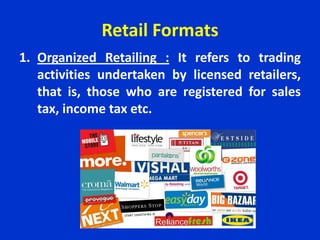
Retail Formats
1. Organized Retailing : It refers to trading
activities undertaken by licensed retailers,
that is, those who are registered for sales
tax, income tax etc.
Retail Formats
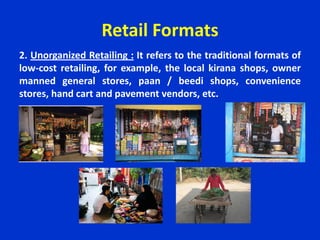
2. Unorganized Retailing : It refers to the traditional formats of
low-cost retailing, for example, the local kirana shops, owner
manned general stores, paan / beedi shops, convenience
stores, hand cart and pavement vendors, etc.
Factors responsible for the growth of
organized retailing in India
1. Urbanization
2. Convenience
3. Quality goods
4. Prompt after sales service
5. Rising household income
Multichannel Retailing
A. Store Channel
B. Catalogue Channel
C. Internet Channel
Multichannel Retailing
A. Store Channel
1. Browsing
2. Touching and feeling products
3. Personal service
4. Cash payment
5. Immediate Gratification
6. Risk reduction
7. Entertainment and social experience
Multichannel Retailing
B. Catalogue Channel
1. Convenience
2. Safety
3. Quality of visual presentation
Multichannel Retailing
C. Internet Channel
1. Broader selection
2. More information to evaluate merchandise
3. Personalization
E-tailing
E-tailing is the sale of goods and services
through the Internet.
Advantages of E-tailing
1. Round the clock business
2. Consumer convenience
3. Level playing field
4. Cost effective
5. Simplicity
6. Improved customer service
7. Lower transaction cost
8. Access to all markets
9. Reduction in setup cost
Advantages of E-tailing
10.Many products and services from a single
stop
11.Quick service
12.Building relatinship
13.Enhanced productivity of sales people
14.Enables the marketer adjust to market
conditions quickly
15.Consumer can ‘get more for less’
Advantages of E-tailing
16.Transparency
17.Accuracy of information
18.Customer loyalty
19.Creating new business models
20.Security and privacy
21.Instant payment
22.Increase market share
Disadvantages of E-tailing
1. Lack of awareness
2. Lack of infrastructure
3. Lack of confidence
4. Skeptic attitude
5. Credit card frauds
6. Absence of tax laws
7. Cyber laws
Disadvantages of E-tailing
8. Stock dilemma
9. Lack of strength
10.Lack of skills and expertise
11.Internet outrage
12.Absence of cyber brand image
13.Inadequate government role
14.No emphasis on commercial exploration
15.No encouragement from business community
Disadvantages of E-tailing
16.Preferring foreign sites
17.Inactive Indian software houses
18.Cyber competition
19.Difficulty of Reengineering
20.Skepticism
21.Internet for small business
22.Blocking and censorship
23.Infant stages
24.Barriers survey findings
Advantages of I.T. in Retail
1. Strategize business
2. Efficient management
3. Better integration and communication
4. Real – life shopping experience online
Disadvantages of I.T. in Retail
1. Customer data
2. Transparency and tracking
3. Global data synchronization
4. PCI security compliance
Application of I.T.
1. EDI
2. Bar Coding
3. RFI Tags
4. Electronic article surveillance
5. Electronic shelf labels
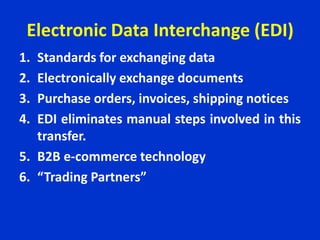
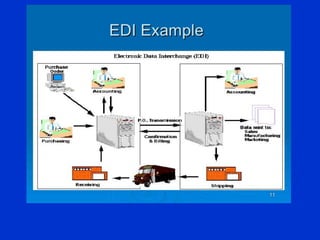
Electronic Data Interchange (EDI)
1. Standards for exchanging data
2. Electronically exchange documents
3. Purchase orders, invoices, shipping notices
4. EDI eliminates manual steps involved in this
transfer.
5. B2B e-commerce technology
6. “Trading Partners”
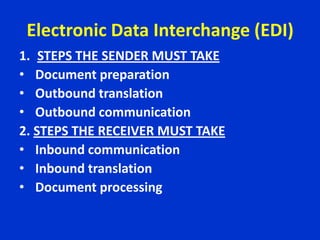
Electronic Data Interchange (EDI)
1. STEPS THE SENDER MUST TAKE
• Document preparation
• Outbound translation
• Outbound communication
2. STEPS THE RECEIVER MUST TAKE
• Inbound communication
• Inbound translation
• Document processing
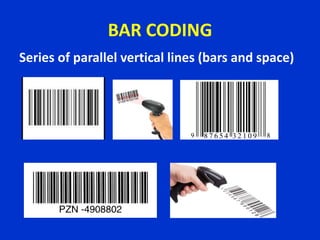
BAR CODING
Series of parallel vertical lines (bars and space)
BAR CODING
1. Series of parallel vertical lines
2. Read by barcode scanners
3. Price tags, carton labels, invoices, credit card
bills.
Advantages of bar coding
1. Eliminates human error
2. Fast and reliable
3. Reduces employee training and reduces costs
4. Inexpensive method
5. Customizable
6. Tracks inventory control
7. Accuracy
8. Directly stored on computer
9. Better decision making
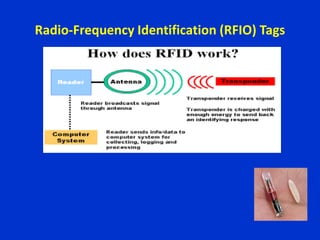
Radio-Frequency Identification (RFID) Tags
Radio-frequency identification (RFID)
uses electromagnetic fields to automatically
identify and track tags attached to objects. The tags
contain electronically stored information. Passive
tags collect energy from a nearby RFID reader's
interrogating radio waves. Active tags have a local
power source (such as a battery) and may operate
hundreds of meters from the RFID reader. Unlike
a barcode, the tag need not be within the line of
sight of the reader, so it may be embedded in the
tracked object. RFID is one method for Automatic
Identification and Data Capture (AIDC).
Radio-Frequency Identification (RFIO) Tags
How RFID works ?
1. A scanning antenna
2. A transceiver with a decoder to interpret
data
3. A transponder – the RFID tag – that has
been programmed with information
Uses of RFID
1. Tracking pets
2. Identifies trees or wood items
3. Anti-theft tags in stores
4. Heavy duty 120 by 100 by 50 mm
rectangular transponders
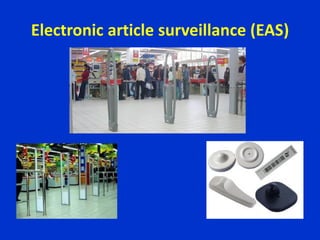
Electronic article surveillance (EAS)
1. It’s a method for preventing shoplifting from
retail stores, pilferage of books from libraries or
removal of properties from office buildings.
2. These tags are deactivated by clerks if they are
sold out
3. But if any active source checks out, the alarm
rings
4. This method helps retailers boost sales and
protect their profits.
Electronic article surveillance (EAS)
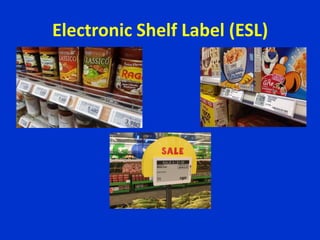
Electronic Shelf Label (ESL)
1. Displays product prices on shelves.
2. It shows current product price to the
customer.
3. A communication network allows the price
display to be automatically updated
whenever prices change.
4. It improves pricing accuracy
Electronic Shelf Label (ESL)
FDI in Retail
Foreign Direct Investment (FDI) means cross
border investment, where foreign assets are
invested into the organizations of the domestic
market. It brings private funds from overseas
into products or services. The domestic
company in which
Features of FDI in Retail
1. Developing economy
2. Abundant human resources
3. Low salaried employees
4. Low wage workers
5. Big private economy
Advantages of FDI in retail
1. Growth in economy
2. Job opportunities
3. Benefits to farmers
4. Benefits to consumers
5. Lack of infrastructure
6. Cheaper production facilities
7. Availability of new technology
Advantages of FDI in retail
8. Long term cash liquidity
9. Conducive for the country’s economic growth
10.FDI opens up new avenue for franchising
11.Foreign companies should source min. 30%
from Indian small industries
12.Higher the FDI… higher is economic growth
13.Supply chain management avoids food wastage
and perishables.
Franchising
Arrangement where one party (the franchisor) grants
another party (the franchisee) the right to use its
trademark or trade-name as well as certain business
systems and processes, to produce and market a good or
service according to certain specifications. The franchisee
usually pays a one-time franchise fee plus a percentage of
sales revenue as royalty, and gains (1) immediate name
recognition, (2) tried and tested products, (3) standard
building design and décor, (4) detailed techniques in
running and promoting the business, (5) training of
employees, and (6) ongoing help in promoting and
upgrading of the products.
(Students can refer any textbook for meaning)
Advantages of Franchising
1. Low risk
2. Growth
3. Ease of financing
4. Operational support
5. Advertising
Disadvantages of Franchising
1. Royalty / Fees
2. Lack of control
Green Retailing
Green retailing is the step every large retailer is
taking to reduce carbon emission, to make
themselves more energy efficient, recycling and
designing products that are more energy
efficient, recycling and designing products that
are more sustainable. Green retailing touches
every aspect of retailer’s supply chain – how
the product is designed, sourced, stored and
distributed
Green Retailing Initiatives
1. Green design
2. Green packaging
3. Green customer relationship management
and recycling
4. Green sourcing
5. Green logistics
6. Green Infrastructure
7. Green I.T.
Green Design & Packaging initiatives
1. Materials selection
2. Energy efficiency
3. Durability
4. Ease of disassembly
5. Recyclability
6. Disposability
Green Packaging
Green Sourcing
Sourcing fabric which is manufactured by using
least chemicals, least water and least energy
resources.
Green Logistics
1. Efficient transport management
2. Using alternate fuel
3. Consolidating shipments
4. Reducing food miles
Green Infrastructure
1. Energy efficient warehouses
2. Environmental friendly décor
3. Using least electricity
4. Efficient design of floor
Green Information Technology
1. Reduce power consumption
2. Reducing carbon footprint
3. Recycling ideas
Airport Retailing (advantages)
1. Increase in travel
2. Increased duration of halts
3. New international airports
Distinctive features of Airport Retailing
1. Large group of prospective buyers
2. Temporarily captive audience
3. Higher sales
4. Carry fewer items
5. Replenishing merchandise
6. Gift items
7. Longer hours
8. Duty-free shopping
9. Tighter security
THANK YOU

retail m1 pointers.pdf

  • 1.
  • 2.
    What is Retailing? 1. Retailing includes all the activities involved in selling goods or services to the final consumers for personal, non-business use. A retailer or retail store is any business enterprise whose sales volume comes primarily from retailing.
  • 3.
    Characteristics of Retailing 1.Direct interaction with customers 2. Point-of-purchase display and promotions 3. Lower average amount of sales transaction 4. Location / larger number of retail business units
  • 4.
    Functions of Retailers 1.Providing assortment 2. Breaking bulk 3. Holding inventory 4. Providing services 5. Channel of communication 6. Transport and advertising functions 7. Creation of utilities
  • 5.
    Imp. Of Retailer/ Retailing 1. Higher sales / employment 2. Access for consumers 3. Convenience 4. Assortment 5. Advertisement 6. Completes transactions 7. Links producers and consumers 8. Anticipates cutomer’s wants
  • 6.
    Factors influencing RetailMgmt. 1. Range of merchandise 2. Convenience of shopping at a particular outlet 3. Time to travel 4. Socio-economic background and culture 5. The stage of Family Life Cycle
  • 7.
    Scope of RetailMgmt. 1. Category management 2. Customer relationship management 3. Store management 4. Supply Chain Management 5. Inventory Management 6. Vendor Management
  • 8.
    Retail Formats 1. OrganizedRetailing : It refers to trading activities undertaken by licensed retailers, that is, those who are registered for sales tax, income tax etc.
  • 9.
    Retail Formats 2. UnorganizedRetailing : It refers to the traditional formats of low-cost retailing, for example, the local kirana shops, owner manned general stores, paan / beedi shops, convenience stores, hand cart and pavement vendors, etc.
  • 10.
    Factors responsible forthe growth of organized retailing in India 1. Urbanization 2. Convenience 3. Quality goods 4. Prompt after sales service 5. Rising household income
  • 11.
    Multichannel Retailing A. StoreChannel B. Catalogue Channel C. Internet Channel
  • 12.
    Multichannel Retailing A. StoreChannel 1. Browsing 2. Touching and feeling products 3. Personal service 4. Cash payment 5. Immediate Gratification 6. Risk reduction 7. Entertainment and social experience
  • 13.
    Multichannel Retailing B. CatalogueChannel 1. Convenience 2. Safety 3. Quality of visual presentation
  • 14.
    Multichannel Retailing C. InternetChannel 1. Broader selection 2. More information to evaluate merchandise 3. Personalization
  • 15.
    E-tailing E-tailing is thesale of goods and services through the Internet.
  • 16.
    Advantages of E-tailing 1.Round the clock business 2. Consumer convenience 3. Level playing field 4. Cost effective 5. Simplicity 6. Improved customer service 7. Lower transaction cost 8. Access to all markets 9. Reduction in setup cost
  • 17.
    Advantages of E-tailing 10.Manyproducts and services from a single stop 11.Quick service 12.Building relatinship 13.Enhanced productivity of sales people 14.Enables the marketer adjust to market conditions quickly 15.Consumer can ‘get more for less’
  • 18.
    Advantages of E-tailing 16.Transparency 17.Accuracyof information 18.Customer loyalty 19.Creating new business models 20.Security and privacy 21.Instant payment 22.Increase market share
  • 19.
    Disadvantages of E-tailing 1.Lack of awareness 2. Lack of infrastructure 3. Lack of confidence 4. Skeptic attitude 5. Credit card frauds 6. Absence of tax laws 7. Cyber laws
  • 20.
    Disadvantages of E-tailing 8.Stock dilemma 9. Lack of strength 10.Lack of skills and expertise 11.Internet outrage 12.Absence of cyber brand image 13.Inadequate government role 14.No emphasis on commercial exploration 15.No encouragement from business community
  • 21.
    Disadvantages of E-tailing 16.Preferringforeign sites 17.Inactive Indian software houses 18.Cyber competition 19.Difficulty of Reengineering 20.Skepticism 21.Internet for small business 22.Blocking and censorship 23.Infant stages 24.Barriers survey findings
  • 22.
    Advantages of I.T.in Retail 1. Strategize business 2. Efficient management 3. Better integration and communication 4. Real – life shopping experience online
  • 23.
    Disadvantages of I.T.in Retail 1. Customer data 2. Transparency and tracking 3. Global data synchronization 4. PCI security compliance
  • 24.
    Application of I.T. 1.EDI 2. Bar Coding 3. RFI Tags 4. Electronic article surveillance 5. Electronic shelf labels
  • 25.
    Electronic Data Interchange(EDI) 1. Standards for exchanging data 2. Electronically exchange documents 3. Purchase orders, invoices, shipping notices 4. EDI eliminates manual steps involved in this transfer. 5. B2B e-commerce technology 6. “Trading Partners”
  • 27.
    Electronic Data Interchange(EDI) 1. STEPS THE SENDER MUST TAKE • Document preparation • Outbound translation • Outbound communication 2. STEPS THE RECEIVER MUST TAKE • Inbound communication • Inbound translation • Document processing
  • 28.
    BAR CODING Series ofparallel vertical lines (bars and space)
  • 29.
    BAR CODING 1. Seriesof parallel vertical lines 2. Read by barcode scanners 3. Price tags, carton labels, invoices, credit card bills.
  • 30.
    Advantages of barcoding 1. Eliminates human error 2. Fast and reliable 3. Reduces employee training and reduces costs 4. Inexpensive method 5. Customizable 6. Tracks inventory control 7. Accuracy 8. Directly stored on computer 9. Better decision making
  • 31.
    Radio-Frequency Identification (RFID)Tags Radio-frequency identification (RFID) uses electromagnetic fields to automatically identify and track tags attached to objects. The tags contain electronically stored information. Passive tags collect energy from a nearby RFID reader's interrogating radio waves. Active tags have a local power source (such as a battery) and may operate hundreds of meters from the RFID reader. Unlike a barcode, the tag need not be within the line of sight of the reader, so it may be embedded in the tracked object. RFID is one method for Automatic Identification and Data Capture (AIDC).
  • 32.
  • 33.
    How RFID works? 1. A scanning antenna 2. A transceiver with a decoder to interpret data 3. A transponder – the RFID tag – that has been programmed with information
  • 34.
    Uses of RFID 1.Tracking pets 2. Identifies trees or wood items 3. Anti-theft tags in stores 4. Heavy duty 120 by 100 by 50 mm rectangular transponders
  • 35.
    Electronic article surveillance(EAS) 1. It’s a method for preventing shoplifting from retail stores, pilferage of books from libraries or removal of properties from office buildings. 2. These tags are deactivated by clerks if they are sold out 3. But if any active source checks out, the alarm rings 4. This method helps retailers boost sales and protect their profits.
  • 36.
  • 37.
    Electronic Shelf Label(ESL) 1. Displays product prices on shelves. 2. It shows current product price to the customer. 3. A communication network allows the price display to be automatically updated whenever prices change. 4. It improves pricing accuracy
  • 38.
  • 39.
    FDI in Retail ForeignDirect Investment (FDI) means cross border investment, where foreign assets are invested into the organizations of the domestic market. It brings private funds from overseas into products or services. The domestic company in which
  • 40.
    Features of FDIin Retail 1. Developing economy 2. Abundant human resources 3. Low salaried employees 4. Low wage workers 5. Big private economy
  • 41.
    Advantages of FDIin retail 1. Growth in economy 2. Job opportunities 3. Benefits to farmers 4. Benefits to consumers 5. Lack of infrastructure 6. Cheaper production facilities 7. Availability of new technology
  • 42.
    Advantages of FDIin retail 8. Long term cash liquidity 9. Conducive for the country’s economic growth 10.FDI opens up new avenue for franchising 11.Foreign companies should source min. 30% from Indian small industries 12.Higher the FDI… higher is economic growth 13.Supply chain management avoids food wastage and perishables.
  • 43.
    Franchising Arrangement where oneparty (the franchisor) grants another party (the franchisee) the right to use its trademark or trade-name as well as certain business systems and processes, to produce and market a good or service according to certain specifications. The franchisee usually pays a one-time franchise fee plus a percentage of sales revenue as royalty, and gains (1) immediate name recognition, (2) tried and tested products, (3) standard building design and décor, (4) detailed techniques in running and promoting the business, (5) training of employees, and (6) ongoing help in promoting and upgrading of the products. (Students can refer any textbook for meaning)
  • 44.
    Advantages of Franchising 1.Low risk 2. Growth 3. Ease of financing 4. Operational support 5. Advertising Disadvantages of Franchising 1. Royalty / Fees 2. Lack of control
  • 45.
    Green Retailing Green retailingis the step every large retailer is taking to reduce carbon emission, to make themselves more energy efficient, recycling and designing products that are more energy efficient, recycling and designing products that are more sustainable. Green retailing touches every aspect of retailer’s supply chain – how the product is designed, sourced, stored and distributed
  • 46.
    Green Retailing Initiatives 1.Green design 2. Green packaging 3. Green customer relationship management and recycling 4. Green sourcing 5. Green logistics 6. Green Infrastructure 7. Green I.T.
  • 47.
    Green Design &Packaging initiatives 1. Materials selection 2. Energy efficiency 3. Durability 4. Ease of disassembly 5. Recyclability 6. Disposability
  • 48.
  • 49.
    Green Sourcing Sourcing fabricwhich is manufactured by using least chemicals, least water and least energy resources.
  • 50.
    Green Logistics 1. Efficienttransport management 2. Using alternate fuel 3. Consolidating shipments 4. Reducing food miles
  • 51.
    Green Infrastructure 1. Energyefficient warehouses 2. Environmental friendly décor 3. Using least electricity 4. Efficient design of floor
  • 52.
    Green Information Technology 1.Reduce power consumption 2. Reducing carbon footprint 3. Recycling ideas
  • 53.
    Airport Retailing (advantages) 1.Increase in travel 2. Increased duration of halts 3. New international airports
  • 54.
    Distinctive features ofAirport Retailing 1. Large group of prospective buyers 2. Temporarily captive audience 3. Higher sales 4. Carry fewer items 5. Replenishing merchandise 6. Gift items 7. Longer hours 8. Duty-free shopping 9. Tighter security
  • 55.