RESTful Microservices
Arthur De Magalhaes
WebSphere REST API Architect
arthurdm@ca.ibm.com
Agenda
• API Economy: Why REST?
• Best Practices
• WebSphere Liberty and REST
• Future Directions
• References
1
API Economy: Why REST?
Why do we need REST?
• So many languages, how do they expose data & functionality
consistently?
• How is communication between all the “Internet of Things”
components?
• REST abstracts languages (client and server), implementations
(libraries), and frameworks (VMs, HA, on-demand)
• But remember, not all REST apps are microservices!
3
REST API Principles
4
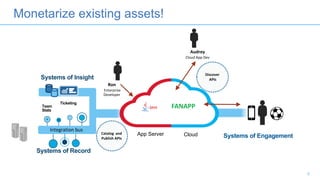
Monetarize existing assets!
5
Systems of Engagement
Systems of Record
Integration	bus
Team
Stats
Ticketing
Systems of Insight
Audrey
Cloud	App	Dev
Ron
Enterprise		
Developer	
Catalog		and	
Publish	APIs	
Discover	
APIs	
FANAPP
App Server Cloud
Best Practices
HTTP verbs - use them! (…with caution)
7
• Idempotent - identical requests get the same result
• Safe - can be called without modification to data.
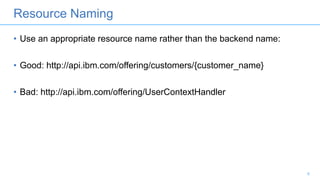
Resource Naming
• Use an appropriate resource name rather than the backend name:
• Good: http://api.ibm.com/offering/customers/{customer_name}
• Bad: http://api.ibm.com/offering/UserContextHandler
8
Resource Chaining
• Resources in RESTful URLs can be chained together to form a
hierarchy of relationships.
– resource1/{id}/resource2/{id}
• Always use a collection followed by a member
– …/customers/123/orders/456/items/789
– Items belong to orders, orders belong to customers.
9
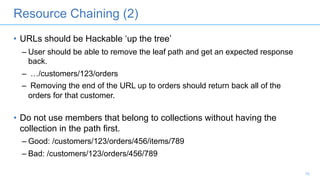
Resource Chaining (2)
• URLs should be Hackable ‘up the tree’
– User should be able to remove the leaf path and get an expected response
back.
– …/customers/123/orders
– Removing the end of the URL up to orders should return back all of the
orders for that customer.
• Do not use members that belong to collections without having the
collection in the path first.
– Good: /customers/123/orders/456/items/789
– Bad: /customers/123/orders/456/789
10
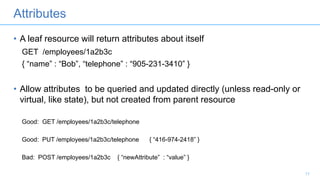
Attributes
• A leaf resource will return attributes about itself
GET /employees/1a2b3c
{ “name” : “Bob”, “telephone” : “905-231-3410” }
• Allow attributes to be queried and updated directly (unless read-only or
virtual, like state), but not created from parent resource
Good: GET /employees/1a2b3c/telephone
Good: PUT /employees/1a2b3c/telephone { “416-974-2418” }
Bad: POST /employees/1a2b3c { “newAttribute” : “value” }
11
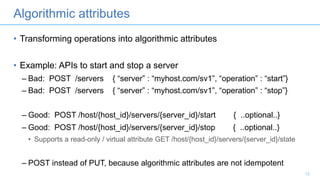
Algorithmic attributes
• Transforming operations into algorithmic attributes
• Example: APIs to start and stop a server
– Bad: POST /servers { “server” : “myhost.com/sv1”, “operation” : “start”}
– Bad: POST /servers { “server” : “myhost.com/sv1”, “operation” : “stop”}
– Good: POST /host/{host_id}/servers/{server_id}/start { ..optional..}
– Good: POST /host/{host_id}/servers/{server_id}/stop { ..optional..}
• Supports a read-only / virtual attribute GET /host/{host_id}/servers/{server_id}/state
– POST instead of PUT, because algorithmic attributes are not idempotent
12
Query parameters vs header
• Use query parameters for characteristics that have an affinity to the
resource
– Ex: paging, filtering, sorting
• Use header for characteristics that have an affinity to the whole request
– Ex: security credentials, caching attribute
13
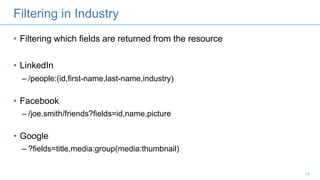
Filtering in Industry
• Filtering which fields are returned from the resource
• LinkedIn
– /people:(id,first-name,last-name,industry)
• Facebook
– /joe.smith/friends?fields=id,name,picture
• Google
– ?fields=title,media:group(media:thumbnail)
14
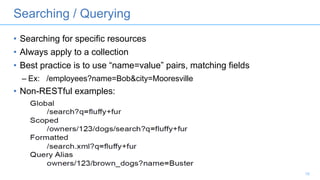
Searching / Querying
• Searching for specific resources
• Always apply to a collection
• Best practice is to use “name=value” pairs, matching fields
– Ex: /employees?name=Bob&city=Mooresville
• Non-RESTful examples:
15
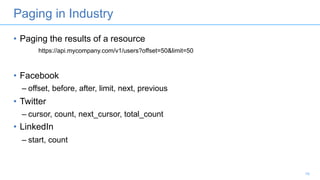
Paging in Industry
• Paging the results of a resource
https://api.mycompany.com/v1/users?offset=50&limit=50
• Facebook
– offset, before, after, limit, next, previous
• Twitter
– cursor, count, next_cursor, total_count
• LinkedIn
– start, count
16
Versioning
• Best practice is to put the version as "vX" after context root, ie:
/myApp/v2, /myApp/v3
• Top level GET should yield what versions are available.
– ie:GET /myApp should return something like {v1 : /myApp/v1, v2:
/myApp/v2}
• No version implies v1, so specifying v1 is optional, but if expecting new
versions to come along, adding v1 from the start is considered best
practice.
17
Versioning in the industry
• Twilio
– /2010-04-01/Accounts/
• Salesforce.com
– /services/data/v20.0/objects/Account
• •Facebook
– ?v=1.0
18
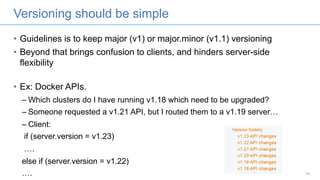
Versioning should be simple
• Guidelines is to keep major (v1) or major.minor (v1.1) versioning
• Beyond that brings confusion to clients, and hinders server-side
flexibility
• Ex: Docker APIs.
– Which clusters do I have running v1.18 which need to be upgraded?
– Someone requested a v1.21 API, but I routed them to a v1.19 server…
– Client:
if (server.version = v1.23)
….
else if (server.version = v1.22)
…. 19
Security of REST APIs
• No security
– Only for trials or prototypes, never for production-level
– Need enforcement of overall transaction rate
• Basic authorization
– Simplest and oldest form of authorization
– User/Password, or Certificates
– Ex: header(“Authorization”, “Basic kjz022zxlksa”)
20
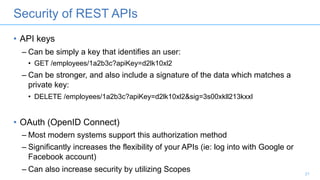
Security of REST APIs
• API keys
– Can be simply a key that identifies an user:
• GET /employees/1a2b3c?apiKey=d2lk10xl2
– Can be stronger, and also include a signature of the data which matches a
private key:
• DELETE /employees/1a2b3c?apiKey=d2lk10xl2&sig=3s00xkll213kxxl
• OAuth (OpenID Connect)
– Most modern systems support this authorization method
– Significantly increases the flexibility of your APIs (ie: log into with Google or
Facebook account)
– Can also increase security by utilizing Scopes 21
Error handling
• Industry error handling:
22
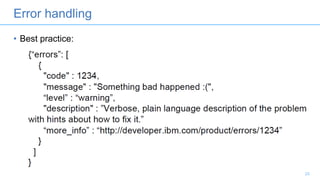
Error handling
• Best practice:
23
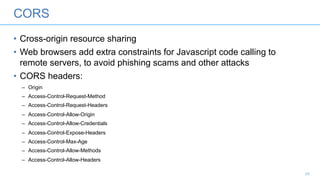
CORS
• Cross-origin resource sharing
• Web browsers add extra constraints for Javascript code calling to
remote servers, to avoid phishing scams and other attacks
• CORS headers:
– Origin
– Access-Control-Request-Method
– Access-Control-Request-Headers
– Access-Control-Allow-Origin
– Access-Control-Allow-Credentials
– Access-Control-Expose-Headers
– Access-Control-Max-Age
– Access-Control-Allow-Methods
– Access-Control-Allow-Headers
24
Documentation: Swagger Introduction
• Industry leading specification for defining REST APIs.
• Supports both JSON and YAML formats.
• Large open source community with various projects on GitHub:
• Client code generation (26 languages).
• Server code generation (9 languages).
• Online editor and GUI.
• Over 2000 related open-source repository, with 15000 daily downloads.
• Base specification for Open API Initiative (https://openapis.org/), under
Linux foundation.
25
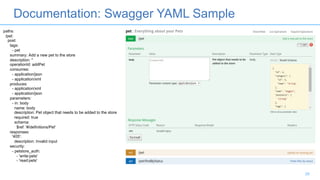
Documentation: Swagger YAML Sample
26
paths:
/pet:
post:
tags:
- pet
summary: Add a new pet to the store
description: ''
operationId: addPet
consumes:
- application/json
- application/xml
produces:
- application/xml
- application/json
parameters:
- in: body
name: body
description: Pet object that needs to be added to the store
required: true
schema:
$ref: '#/definitions/Pet'
responses:
'405':
description: Invalid input
security:
- petstore_auth:
- 'write:pets'
- 'read:pets'
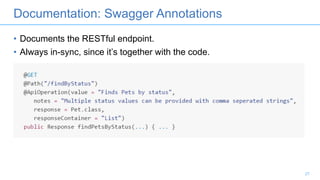
Documentation: Swagger Annotations
• Documents the RESTful endpoint.
• Always in-sync, since it’s together with the code.
27
Management
• Rate limiting
– Subscription to APIs; Plans
• API lifecycle
– Deprecation; N – 2 approach
• High availability
• Load balancing (API split)
– Splitting becomes more critical when using hybrid cloud environments
• Logging and auditing
28
Languages
29
• A lot of languages to choose from!
• Which is the best one??
Languages
30
• Which languages are you familiar with?
• What are your requirements today? (routing, db access)
• What are your requirements tomorrow? (on-prem vs cloud)
• Look at all the entire lifecycle of your REST APIs
• Development, Maintenance, Fire-drills, Upgrades, Access
control, etc.
• Don’t just focus on how quickly they can be made available
WebSphere Liberty and REST
API Discovery
• All applications are discoverable in a single RESTful endpoint,
/ibm/api/docs
• Query parameter allows filtering based on context root.
• Support both JSON and YAML.
• Application participation can be configured in server.xml (location, on/off).
• Available through apiDiscovery-1.0 feature.
32
Admin UI
Applications
Liberty
REST
APIProviders
API	Manager
API Discovery User Interface
• Based on the Open Source Swagger UI
• Available at /ibm/api/explorer
33
API Discovery Collective Support
• Enabling apiDiscovery-1.0 on a collective member will expose their
aggregated Swagger documentation available.
• Endpoints:
– /ibm/api/collective/docs
– /ibm/api/collective/explorer
34
Admin	UI
RepositoryREST
Controller
API	Manager
M M
M
REST	APIs	from	Members
M
API Discovery Cloud Scenario
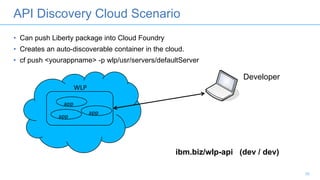
• Can push Liberty package into Cloud Foundry
• Creates an auto-discoverable container in the cloud.
• cf push <yourappname> -p wlp/usr/servers/defaultServer
35
app
app
app
WLP
Developer
ibm.biz/wlp-api (dev / dev)
36
1.		Git	commit	java	code
2.		Travis	build	is	triggered	and	successful
3.		swagger.yaml	is	extracted	from	app,	using
IBM’s	open	source	offline	swagger	processor
4. apic’s module is invoked, passing in a committed product.yaml
from Git and generated swagger.yaml
ex: apic publish product.yaml –catalog sb
5.			APIs	are	now	available	in	APIC’s	developer	portal	
CI flow #1: auto-processing APIs during build time
CI flow #2: auto-processing APIs after deployment
37
1.		Git	commit	java	or	node	code	or	dockerfile
6.			APIs	are	now	available	in	APIC’s	developer	portal
Deploy Invoke
2.		Jenkins	builds	and	packages	apps	&	containers,	and	invokes	UCD
3.		UCD	deploys	artifacts	onto	collective
(on-prem,	cloud,	etc)
4. UCD	invokes	“curl	POST	/ibm/api/collective/docs/apiconnect,”	
sending	a	committed	product.yaml as	input
M M
MM
Future directions
Public and Branded UIs | Collective UI redesign
39
• Branded	and	public	Swagger	UI
• Inlined	collective	APIs
[
{
"title"	:	"ACME	Air",
"description"	:	“Flight	booking	service",
"version"	:	"1.0.0",
"hosts"	:	[	"myHost1:9080",	
"myHost2:9085"]
}
]
• Query	APIs	as	services
API integration with data
40
1. Many new apps use loopback to quickly expose APIs over a DB
2. Expose these system APIs via a single aggregated Swagger catalog
3. Use the app accelerator (Swagger -> jaxrs client/server) to build interaction APIs that call
various system APIs, and deploy them in Docker containers.
Data Data
system	APIs	collective
Data
Data
on-premises
interaction	APIs
private	cloud
app	developers
public	cloud
API integration with other cloud platforms
41
Amazon	API	gateway Azure	API	management	 Google	Cloud	Endpoint	+	Apigee
Liberty Collective Docker	w/	Liberty
Using subset of Swagger to register services
42
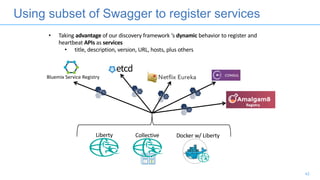
• Taking	advantage of	our	discovery	framework	‘s	dynamic behavior	to	register	and	
heartbeat	APIs as	services
• title,	description,	version,	URL,	hosts,	plus	others
Bluemix Service	Registry
Liberty Collective Docker	w/	Liberty
References
Additional Info / Resources
• IBM Middleware User Community (WAS Forum)
https://www.imwuc.org/p/fo/si/topic=1007
• Create and vote for enhancements
https://www.ibm.com/developerworks/rfe
• dwAnswers
https://developer.ibm.com/answers/
• StackOverflow
Tags: swagger, websphere-liberty
44
Demonstration
• The following blog introduces 3 videos for API Discovery
http://ibm.co/1Ytyyaa
45

REST APIs

  • 1.
    RESTful Microservices Arthur DeMagalhaes WebSphere REST API Architect arthurdm@ca.ibm.com
  • 2.
    Agenda • API Economy:Why REST? • Best Practices • WebSphere Liberty and REST • Future Directions • References 1
  • 3.
  • 4.
    Why do weneed REST? • So many languages, how do they expose data & functionality consistently? • How is communication between all the “Internet of Things” components? • REST abstracts languages (client and server), implementations (libraries), and frameworks (VMs, HA, on-demand) • But remember, not all REST apps are microservices! 3
  • 5.
  • 6.
    Monetarize existing assets! 5 Systemsof Engagement Systems of Record Integration bus Team Stats Ticketing Systems of Insight Audrey Cloud App Dev Ron Enterprise Developer Catalog and Publish APIs Discover APIs FANAPP App Server Cloud
  • 7.
  • 8.
    HTTP verbs -use them! (…with caution) 7 • Idempotent - identical requests get the same result • Safe - can be called without modification to data.
  • 9.
    Resource Naming • Usean appropriate resource name rather than the backend name: • Good: http://api.ibm.com/offering/customers/{customer_name} • Bad: http://api.ibm.com/offering/UserContextHandler 8
  • 10.
    Resource Chaining • Resourcesin RESTful URLs can be chained together to form a hierarchy of relationships. – resource1/{id}/resource2/{id} • Always use a collection followed by a member – …/customers/123/orders/456/items/789 – Items belong to orders, orders belong to customers. 9
  • 11.
    Resource Chaining (2) •URLs should be Hackable ‘up the tree’ – User should be able to remove the leaf path and get an expected response back. – …/customers/123/orders – Removing the end of the URL up to orders should return back all of the orders for that customer. • Do not use members that belong to collections without having the collection in the path first. – Good: /customers/123/orders/456/items/789 – Bad: /customers/123/orders/456/789 10
  • 12.
    Attributes • A leafresource will return attributes about itself GET /employees/1a2b3c { “name” : “Bob”, “telephone” : “905-231-3410” } • Allow attributes to be queried and updated directly (unless read-only or virtual, like state), but not created from parent resource Good: GET /employees/1a2b3c/telephone Good: PUT /employees/1a2b3c/telephone { “416-974-2418” } Bad: POST /employees/1a2b3c { “newAttribute” : “value” } 11
  • 13.
    Algorithmic attributes • Transformingoperations into algorithmic attributes • Example: APIs to start and stop a server – Bad: POST /servers { “server” : “myhost.com/sv1”, “operation” : “start”} – Bad: POST /servers { “server” : “myhost.com/sv1”, “operation” : “stop”} – Good: POST /host/{host_id}/servers/{server_id}/start { ..optional..} – Good: POST /host/{host_id}/servers/{server_id}/stop { ..optional..} • Supports a read-only / virtual attribute GET /host/{host_id}/servers/{server_id}/state – POST instead of PUT, because algorithmic attributes are not idempotent 12
  • 14.
    Query parameters vsheader • Use query parameters for characteristics that have an affinity to the resource – Ex: paging, filtering, sorting • Use header for characteristics that have an affinity to the whole request – Ex: security credentials, caching attribute 13
  • 15.
    Filtering in Industry •Filtering which fields are returned from the resource • LinkedIn – /people:(id,first-name,last-name,industry) • Facebook – /joe.smith/friends?fields=id,name,picture • Google – ?fields=title,media:group(media:thumbnail) 14
  • 16.
    Searching / Querying •Searching for specific resources • Always apply to a collection • Best practice is to use “name=value” pairs, matching fields – Ex: /employees?name=Bob&city=Mooresville • Non-RESTful examples: 15
  • 17.
    Paging in Industry •Paging the results of a resource https://api.mycompany.com/v1/users?offset=50&limit=50 • Facebook – offset, before, after, limit, next, previous • Twitter – cursor, count, next_cursor, total_count • LinkedIn – start, count 16
  • 18.
    Versioning • Best practiceis to put the version as "vX" after context root, ie: /myApp/v2, /myApp/v3 • Top level GET should yield what versions are available. – ie:GET /myApp should return something like {v1 : /myApp/v1, v2: /myApp/v2} • No version implies v1, so specifying v1 is optional, but if expecting new versions to come along, adding v1 from the start is considered best practice. 17
  • 19.
    Versioning in theindustry • Twilio – /2010-04-01/Accounts/ • Salesforce.com – /services/data/v20.0/objects/Account • •Facebook – ?v=1.0 18
  • 20.
    Versioning should besimple • Guidelines is to keep major (v1) or major.minor (v1.1) versioning • Beyond that brings confusion to clients, and hinders server-side flexibility • Ex: Docker APIs. – Which clusters do I have running v1.18 which need to be upgraded? – Someone requested a v1.21 API, but I routed them to a v1.19 server… – Client: if (server.version = v1.23) …. else if (server.version = v1.22) …. 19
  • 21.
    Security of RESTAPIs • No security – Only for trials or prototypes, never for production-level – Need enforcement of overall transaction rate • Basic authorization – Simplest and oldest form of authorization – User/Password, or Certificates – Ex: header(“Authorization”, “Basic kjz022zxlksa”) 20
  • 22.
    Security of RESTAPIs • API keys – Can be simply a key that identifies an user: • GET /employees/1a2b3c?apiKey=d2lk10xl2 – Can be stronger, and also include a signature of the data which matches a private key: • DELETE /employees/1a2b3c?apiKey=d2lk10xl2&sig=3s00xkll213kxxl • OAuth (OpenID Connect) – Most modern systems support this authorization method – Significantly increases the flexibility of your APIs (ie: log into with Google or Facebook account) – Can also increase security by utilizing Scopes 21
  • 23.
    Error handling • Industryerror handling: 22
  • 24.
  • 25.
    CORS • Cross-origin resourcesharing • Web browsers add extra constraints for Javascript code calling to remote servers, to avoid phishing scams and other attacks • CORS headers: – Origin – Access-Control-Request-Method – Access-Control-Request-Headers – Access-Control-Allow-Origin – Access-Control-Allow-Credentials – Access-Control-Expose-Headers – Access-Control-Max-Age – Access-Control-Allow-Methods – Access-Control-Allow-Headers 24
  • 26.
    Documentation: Swagger Introduction •Industry leading specification for defining REST APIs. • Supports both JSON and YAML formats. • Large open source community with various projects on GitHub: • Client code generation (26 languages). • Server code generation (9 languages). • Online editor and GUI. • Over 2000 related open-source repository, with 15000 daily downloads. • Base specification for Open API Initiative (https://openapis.org/), under Linux foundation. 25

  • 27.
    Documentation: Swagger YAMLSample 26 paths: /pet: post: tags: - pet summary: Add a new pet to the store description: '' operationId: addPet consumes: - application/json - application/xml produces: - application/xml - application/json parameters: - in: body name: body description: Pet object that needs to be added to the store required: true schema: $ref: '#/definitions/Pet' responses: '405': description: Invalid input security: - petstore_auth: - 'write:pets' - 'read:pets'
  • 28.
    Documentation: Swagger Annotations •Documents the RESTful endpoint. • Always in-sync, since it’s together with the code. 27
  • 29.
    Management • Rate limiting –Subscription to APIs; Plans • API lifecycle – Deprecation; N – 2 approach • High availability • Load balancing (API split) – Splitting becomes more critical when using hybrid cloud environments • Logging and auditing 28
  • 30.
    Languages 29 • A lotof languages to choose from! • Which is the best one??
  • 31.
    Languages 30 • Which languagesare you familiar with? • What are your requirements today? (routing, db access) • What are your requirements tomorrow? (on-prem vs cloud) • Look at all the entire lifecycle of your REST APIs • Development, Maintenance, Fire-drills, Upgrades, Access control, etc. • Don’t just focus on how quickly they can be made available
  • 32.
  • 33.
    API Discovery • Allapplications are discoverable in a single RESTful endpoint, /ibm/api/docs • Query parameter allows filtering based on context root. • Support both JSON and YAML. • Application participation can be configured in server.xml (location, on/off). • Available through apiDiscovery-1.0 feature. 32 Admin UI Applications Liberty REST APIProviders API Manager
  • 34.
    API Discovery UserInterface • Based on the Open Source Swagger UI • Available at /ibm/api/explorer 33
  • 35.
    API Discovery CollectiveSupport • Enabling apiDiscovery-1.0 on a collective member will expose their aggregated Swagger documentation available. • Endpoints: – /ibm/api/collective/docs – /ibm/api/collective/explorer 34 Admin UI RepositoryREST Controller API Manager M M M REST APIs from Members M
  • 36.
    API Discovery CloudScenario • Can push Liberty package into Cloud Foundry • Creates an auto-discoverable container in the cloud. • cf push <yourappname> -p wlp/usr/servers/defaultServer 35 app app app WLP Developer ibm.biz/wlp-api (dev / dev)
  • 37.
    36 1. Git commit java code 2. Travis build is triggered and successful 3. swagger.yaml is extracted from app, using IBM’s open source offline swagger processor 4. apic’s moduleis invoked, passing in a committed product.yaml from Git and generated swagger.yaml ex: apic publish product.yaml –catalog sb 5. APIs are now available in APIC’s developer portal CI flow #1: auto-processing APIs during build time
  • 38.
    CI flow #2:auto-processing APIs after deployment 37 1. Git commit java or node code or dockerfile 6. APIs are now available in APIC’s developer portal Deploy Invoke 2. Jenkins builds and packages apps & containers, and invokes UCD 3. UCD deploys artifacts onto collective (on-prem, cloud, etc) 4. UCD invokes “curl POST /ibm/api/collective/docs/apiconnect,” sending a committed product.yaml as input M M MM
  • 39.
  • 40.
    Public and BrandedUIs | Collective UI redesign 39 • Branded and public Swagger UI • Inlined collective APIs [ { "title" : "ACME Air", "description" : “Flight booking service", "version" : "1.0.0", "hosts" : [ "myHost1:9080", "myHost2:9085"] } ] • Query APIs as services
  • 41.
    API integration withdata 40 1. Many new apps use loopback to quickly expose APIs over a DB 2. Expose these system APIs via a single aggregated Swagger catalog 3. Use the app accelerator (Swagger -> jaxrs client/server) to build interaction APIs that call various system APIs, and deploy them in Docker containers. Data Data system APIs collective Data Data on-premises interaction APIs private cloud app developers public cloud
  • 42.
    API integration withother cloud platforms 41 Amazon API gateway Azure API management Google Cloud Endpoint + Apigee Liberty Collective Docker w/ Liberty
  • 43.
    Using subset ofSwagger to register services 42 • Taking advantage of our discovery framework ‘s dynamic behavior to register and heartbeat APIs as services • title, description, version, URL, hosts, plus others Bluemix Service Registry Liberty Collective Docker w/ Liberty
  • 44.
  • 45.
    Additional Info /Resources • IBM Middleware User Community (WAS Forum) https://www.imwuc.org/p/fo/si/topic=1007 • Create and vote for enhancements https://www.ibm.com/developerworks/rfe • dwAnswers https://developer.ibm.com/answers/ • StackOverflow Tags: swagger, websphere-liberty 44
  • 46.
    Demonstration • The followingblog introduces 3 videos for API Discovery http://ibm.co/1Ytyyaa 45