Vulnerabilities,
Problem and Underage Gambling /
Betting
&
G4 Responsible Gambling / Betting
Awareness
Kyiv, January 2020
Pieter Remmers
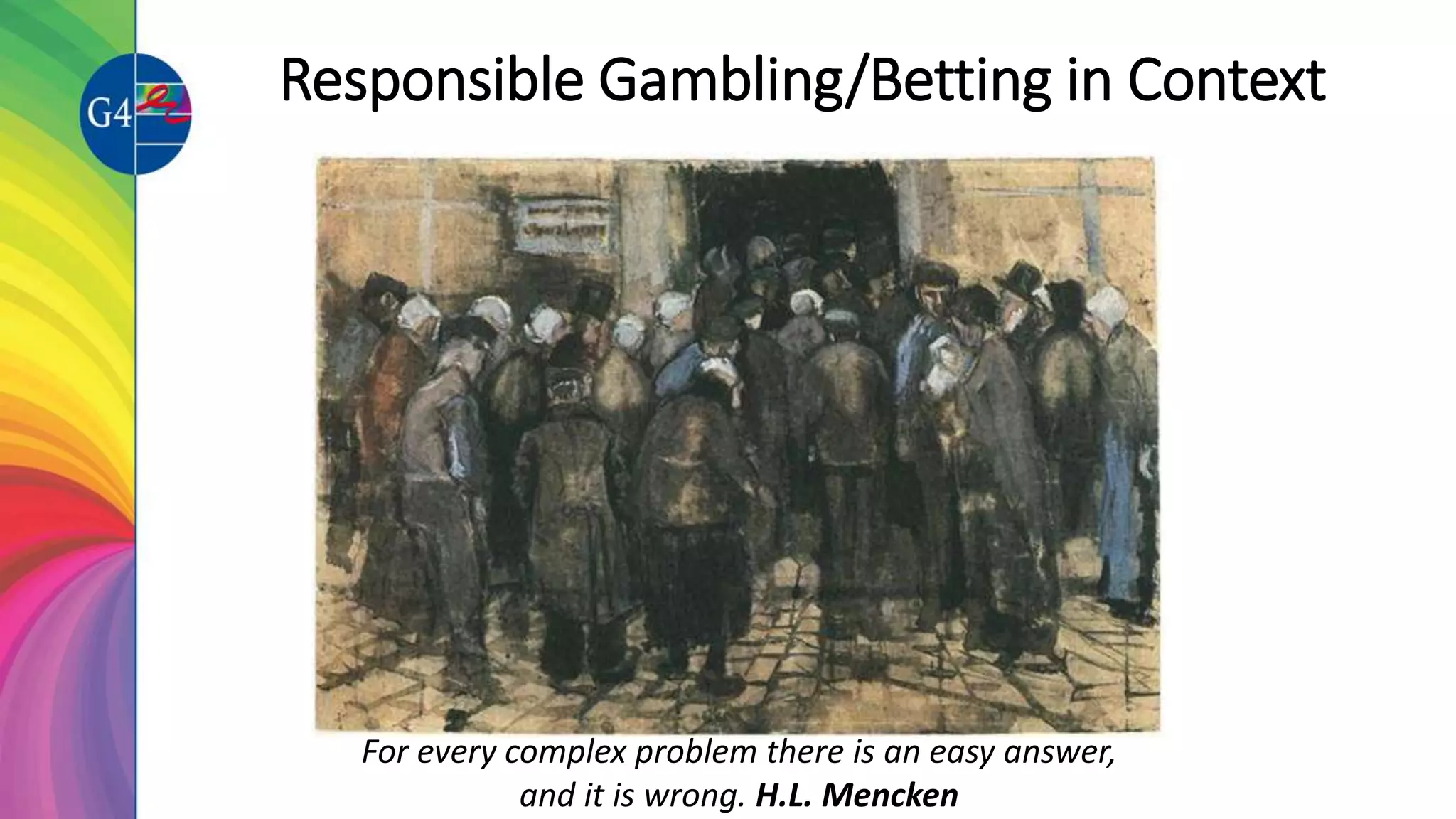
Responsible Gambling/Betting in Context
For every complex problem there is an easy answer,
and it is wrong. H.L. Mencken
What are we talking about? (1)
• Games of skill vs. games of chance
• The risks of the game
• Integrated mix of factors
• Biological / genetic predisposition
• Psychological constitution
• Social environment
What are we talking about? (2)
• Nature of the activity itself
• Problem Gambling / Betting
• Terminology
• Responsible Gambling / Betting Strategies
• Policy
Why do we gamble / bet ?
• Chance to win
respect/honour
• Play
• Entertainment
• Availability
• Chance of winning
money
• Part of culture
• Provides action
• Provides escape
• Form of problem
solving
• Attractive environments
What is Responsible Gambling/Betting?
• Policies and practices to prevent and reduce harm of
gambling/betting
• Responsible gambling is about informed choice to
play in a secure and supportive environment
What is Responsible Gambling/Betting?
3 different and equally important definitions:
1. For the operator – it means the Policies and Practices to
prevent and reduce harm of gambling/betting
2. For players – it means having the Informed Choice to
play well designed games in a secure and supportive
environment
3. For regulators – it means ensuring Compliance with
the social responsibility provisions of regulation
Aim of the Global Gambling Guidance
Group/ G4
To minimise the impact of problem gambling/betting by
promoting a worldwide accreditation programme on
responsible gambling/betting
Typical RG Prevention Tools
1. Deposit limits
2. Visible Clock
3. Take a Break function
4. Advice on Responsible Play
5. Account monitoring by Customer Care team
6. Self-assessment for Gambling/Betting Problems
7. Self-exclusion
8. Underage Play prevention advice
9. Links to external Sources of Help
Games of skill versus Games of chance
The characteristics should always be looked at in the
way they are mixed and interact.
In this process, it may happen that some
characteristics of one and the same game rather
indicate towards a game of chance, and others
towards a game of skill.
Games of chance; the risks
• Illusion of control
• Accessibility
• Easy usage
• Continuous games
• Quickly reinvested winnings
• Short odds <-> long odds games
• Vulnerable risk-groups
Other factors
• Stake size
• Event frequency
• Amount of money
• Prize structures
• Probability of winning
• Size of jackpot
• Skill and pseudo skill
• Near miss
• Light and color
• Sound effects
• Social and anti social
• Accessibility
• Location
• Type of
gambling/betting
Anyone
can be a
problem gambler/can
have problems with
betting
Gambling/ betting that disrupts or damages personal, family or
recreational pursuits
What is problem
gambling / betting?
A problem gambler or someone with
betting problems is someone who:
• Loses too much money
• Spends too much time
• Influences his/her own life and
the lives of significant others negatively
• And feels bad about it
How common is problem
gambling/betting?
• Many of us like to place the odd bet or play the
lottery – but it’s only a problem for about 1 or 2
people in every 100
• However, a further 7 people out of every 100
gamble / bet at risky levels that can become a
problem in the future
Who is most vulnerable?
• Men – (women gamble/bet less than men)
• Teenagers and young adults – but problems can
start at any age
• If someone else in your family is a problem
gambler, has problems with betting (genetics and
learned behaviour)
• If you drink heavily or use illegal drugs
• If you have a depression or anxiety
• Industry employees!
Three phases
1. Winning phase - Non problem gambling/betting
2. Losing phase - Problem gambling/betting
3. Desperate phase – Pathological
gambling/betting
Winning phase
• Pleasure
• Excitement
• Amusement
• Growing self-esteem
• Win a lot
• Use chat function
• Have patience (e-mail and phone)
• Borrow money (without problems)
Losing phase
• Chasing luck
• Other activities are nuisance
• No financial overview
• Lowering self-esteem
• Hope for the big prize
• Longer session duration
• Start asking more and more questions
• Blaming the operator (others) for decreasing pay
out percentages/ changing the odds
Desperate phase
• Full-time busy with gambling/betting
• Problems with support team, starts to be
aggressive
• Create new payment methods/create multiple
accounts
• Major problems at work
• Lowering optimism to solve all problems
• Disorders of eating and sleeping
• Psychological and physical disorder
• Extremely nervous & suicidal thoughts
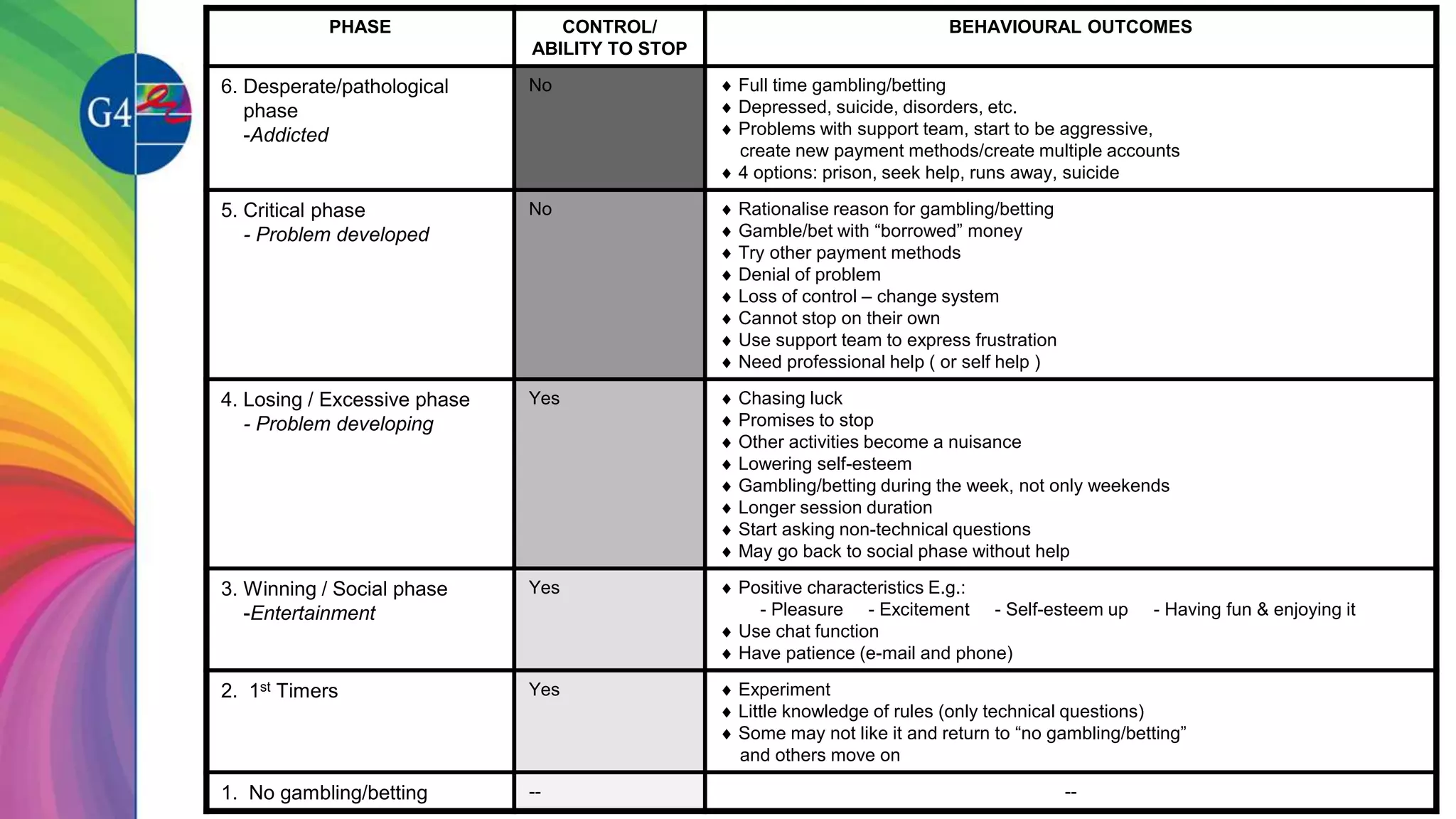
PHASE CONTROL/
ABILITY TO STOP
BEHAVIOURAL OUTCOMES
6. Desperate/pathological
phase
-Addicted
No  Full time gambling/betting
 Depressed, suicide, disorders, etc.
 Problems with support team, start to be aggressive,
create new payment methods/create multiple accounts
 4 options: prison, seek help, runs away, suicide
5. Critical phase
- Problem developed
No  Rationalise reason for gambling/betting
 Gamble/bet with “borrowed” money
 Try other payment methods
 Denial of problem
 Loss of control – change system
 Cannot stop on their own
 Use support team to express frustration
 Need professional help ( or self help )
4. Losing / Excessive phase
- Problem developing
Yes  Chasing luck
 Promises to stop
 Other activities become a nuisance
 Lowering self-esteem
 Gambling/betting during the week, not only weekends
 Longer session duration
 Start asking non-technical questions
 May go back to social phase without help
3. Winning / Social phase
-Entertainment
Yes  Positive characteristics E.g.:
- Pleasure - Excitement - Self-esteem up - Having fun & enjoying it
 Use chat function
 Have patience (e-mail and phone)
2. 1st Timers Yes  Experiment
 Little knowledge of rules (only technical questions)
 Some may not like it and return to “no gambling/betting”
and others move on
1. No gambling/betting -- --
Who should be targeted?
No risk
gamblers
Low risk
gamblers
Moderate risk
gamblers
High risk
gamblers
Personal decision, but………..
• The company has taken measures to inform and
support the customer on the negative aspects of
gambling/betting. RG tools are implemented and
staff is trained. However the company does not
take any responsibility concerning personal
decisions of the customer to bet or gamble
• This decision is ultimately the choice of the
informed customer
Focus on:
1. Gamification vs. gamblification
2. The role of Artificial Intelligence
3. What does the problem really look like
4. Pro-active vs. re-active
5. Difference and similarities land based/ online
6. Advertising and marketing
7. Regulatory issues
E-mail: info@gx4.com; pieter@gx4.com

Responsible gaming mr. remmers

  • 1.
    Vulnerabilities, Problem and UnderageGambling / Betting & G4 Responsible Gambling / Betting Awareness Kyiv, January 2020 Pieter Remmers
  • 2.
    Responsible Gambling/Betting inContext For every complex problem there is an easy answer, and it is wrong. H.L. Mencken
  • 3.
    What are wetalking about? (1) • Games of skill vs. games of chance • The risks of the game • Integrated mix of factors • Biological / genetic predisposition • Psychological constitution • Social environment
  • 4.
    What are wetalking about? (2) • Nature of the activity itself • Problem Gambling / Betting • Terminology • Responsible Gambling / Betting Strategies • Policy
  • 5.
    Why do wegamble / bet ? • Chance to win respect/honour • Play • Entertainment • Availability • Chance of winning money • Part of culture • Provides action • Provides escape • Form of problem solving • Attractive environments
  • 6.
    What is ResponsibleGambling/Betting? • Policies and practices to prevent and reduce harm of gambling/betting • Responsible gambling is about informed choice to play in a secure and supportive environment
  • 7.
    What is ResponsibleGambling/Betting? 3 different and equally important definitions: 1. For the operator – it means the Policies and Practices to prevent and reduce harm of gambling/betting 2. For players – it means having the Informed Choice to play well designed games in a secure and supportive environment 3. For regulators – it means ensuring Compliance with the social responsibility provisions of regulation
  • 8.
    Aim of theGlobal Gambling Guidance Group/ G4 To minimise the impact of problem gambling/betting by promoting a worldwide accreditation programme on responsible gambling/betting
  • 9.
    Typical RG PreventionTools 1. Deposit limits 2. Visible Clock 3. Take a Break function 4. Advice on Responsible Play 5. Account monitoring by Customer Care team 6. Self-assessment for Gambling/Betting Problems 7. Self-exclusion 8. Underage Play prevention advice 9. Links to external Sources of Help
  • 10.
    Games of skillversus Games of chance The characteristics should always be looked at in the way they are mixed and interact. In this process, it may happen that some characteristics of one and the same game rather indicate towards a game of chance, and others towards a game of skill.
  • 11.
    Games of chance;the risks • Illusion of control • Accessibility • Easy usage • Continuous games • Quickly reinvested winnings • Short odds <-> long odds games • Vulnerable risk-groups
  • 12.
    Other factors • Stakesize • Event frequency • Amount of money • Prize structures • Probability of winning • Size of jackpot • Skill and pseudo skill • Near miss • Light and color • Sound effects • Social and anti social • Accessibility • Location • Type of gambling/betting
  • 13.
    Anyone can be a problemgambler/can have problems with betting
  • 14.
    Gambling/ betting thatdisrupts or damages personal, family or recreational pursuits What is problem gambling / betting?
  • 15.
    A problem gambleror someone with betting problems is someone who: • Loses too much money • Spends too much time • Influences his/her own life and the lives of significant others negatively • And feels bad about it
  • 16.
    How common isproblem gambling/betting? • Many of us like to place the odd bet or play the lottery – but it’s only a problem for about 1 or 2 people in every 100 • However, a further 7 people out of every 100 gamble / bet at risky levels that can become a problem in the future
  • 17.
    Who is mostvulnerable? • Men – (women gamble/bet less than men) • Teenagers and young adults – but problems can start at any age • If someone else in your family is a problem gambler, has problems with betting (genetics and learned behaviour) • If you drink heavily or use illegal drugs • If you have a depression or anxiety • Industry employees!
  • 18.
    Three phases 1. Winningphase - Non problem gambling/betting 2. Losing phase - Problem gambling/betting 3. Desperate phase – Pathological gambling/betting
  • 19.
    Winning phase • Pleasure •Excitement • Amusement • Growing self-esteem • Win a lot • Use chat function • Have patience (e-mail and phone) • Borrow money (without problems)
  • 20.
    Losing phase • Chasingluck • Other activities are nuisance • No financial overview • Lowering self-esteem • Hope for the big prize • Longer session duration • Start asking more and more questions • Blaming the operator (others) for decreasing pay out percentages/ changing the odds
  • 21.
    Desperate phase • Full-timebusy with gambling/betting • Problems with support team, starts to be aggressive • Create new payment methods/create multiple accounts • Major problems at work • Lowering optimism to solve all problems • Disorders of eating and sleeping • Psychological and physical disorder • Extremely nervous & suicidal thoughts
  • 22.
    PHASE CONTROL/ ABILITY TOSTOP BEHAVIOURAL OUTCOMES 6. Desperate/pathological phase -Addicted No  Full time gambling/betting  Depressed, suicide, disorders, etc.  Problems with support team, start to be aggressive, create new payment methods/create multiple accounts  4 options: prison, seek help, runs away, suicide 5. Critical phase - Problem developed No  Rationalise reason for gambling/betting  Gamble/bet with “borrowed” money  Try other payment methods  Denial of problem  Loss of control – change system  Cannot stop on their own  Use support team to express frustration  Need professional help ( or self help ) 4. Losing / Excessive phase - Problem developing Yes  Chasing luck  Promises to stop  Other activities become a nuisance  Lowering self-esteem  Gambling/betting during the week, not only weekends  Longer session duration  Start asking non-technical questions  May go back to social phase without help 3. Winning / Social phase -Entertainment Yes  Positive characteristics E.g.: - Pleasure - Excitement - Self-esteem up - Having fun & enjoying it  Use chat function  Have patience (e-mail and phone) 2. 1st Timers Yes  Experiment  Little knowledge of rules (only technical questions)  Some may not like it and return to “no gambling/betting” and others move on 1. No gambling/betting -- --
  • 23.
    Who should betargeted? No risk gamblers Low risk gamblers Moderate risk gamblers High risk gamblers
  • 24.
    Personal decision, but……….. •The company has taken measures to inform and support the customer on the negative aspects of gambling/betting. RG tools are implemented and staff is trained. However the company does not take any responsibility concerning personal decisions of the customer to bet or gamble • This decision is ultimately the choice of the informed customer
  • 25.
    Focus on: 1. Gamificationvs. gamblification 2. The role of Artificial Intelligence 3. What does the problem really look like 4. Pro-active vs. re-active 5. Difference and similarities land based/ online 6. Advertising and marketing 7. Regulatory issues E-mail: info@gx4.com; pieter@gx4.com