RESPONDING TO
STUDENT WRITING:
REVISITING MOTIVATION
FOR REVISION
 Nayelee Villanueva
 Southern Nevada Writing Project
 2011
Introduction
At some point in the writing cycle, teachers will engage with
student writing through response often as a means for
assessment.

Whether the assessment is informal or formal, questions
regarding perception, motivation, and authorship come in to
play both for the teacher and student.

Typically, the main objective for providing response as a
means of assessment is to foster revision in order to increase
student writing levels. Therefore, the role that revision plays
within this process is critical.
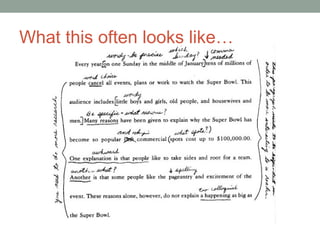
What this often looks like…
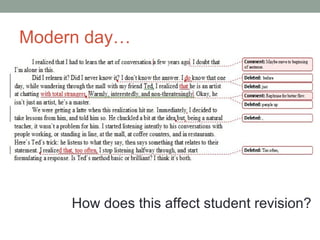
Modern day…


     How does this affect student revision?
Confused and angry, he stared at the red marks on his paper. He had awked
again. And he had fragged. He always awked and fragged. On every theme, a
couple of awks and a frag or two. And the inevitable puncs and sp's. The cw's
didn't bother him anymore. He knew the teacher preferred words like courage
and contemptible person to guts and fink. The teacher had dismissed guts
and fink as slang, telling students never to use slang in their themes. But he
liked to write guts and fink; they meant something to him. Besides, they were
in the dictionary. So why couldn't he use them when they helped him say what
he wanted to say? He rarely got to say what he wanted to say in an English
class, and when he did, he always regretted it. But even that didn't bother him
much. He really didn't care anymore....


Edward B. Jenkinson and Donald Seybold, "Prologue," Writing as a Process of Discovery, p. 3
Origin of a Dilemma
• Responding to student writing to promote the revision
 process is often a difficult task.

• No “one size fits all” approach to responding to student
 writing.

• Best efforts to provide effective feedback for students in
 order to promote revision often fall flat.

• Students are quick to feel the sense of hopelessness about
 writing, and their motivation for writing wanes with each
 writing assignment.

• Students often lose the sense of authorship and inevitably
 adopt what they perceive to be my agenda as the teacher.
Dilemma Questions
• When responding to student writing, how can I ensure
 students do not lose the sense of
  authorship?

• How can I get students to truly think about their
 writing and apply it to their revision process more
 authentically after I have provided written feedback?

• How can I involve the students more in the response
 process?
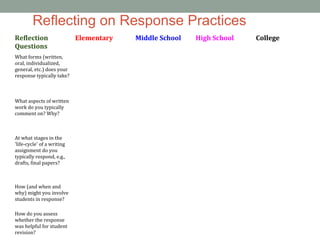
Reflecting on Response Practices
Reflection                  Elementary   Middle School   High School   College
Questions
What forms (written,
oral, individualized,
general, etc.) does your
response typically take?


What aspects of written
work do you typically
comment on? Why?


At what stages in the
'life-cycle' of a writing
assignment do you
typically respond, e.g.,
drafts, final papers?


How (and when and
why) might you involve
students in response?

How do you assess
whether the response
was helpful for student
revision?
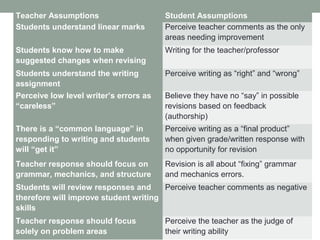
Teacher Assumptions                     Student Assumptions
Students understand linear marks        Perceive teacher comments as the only
                                        areas needing improvement
Students know how to make               Writing for the teacher/professor
suggested changes when revising
Students understand the writing         Perceive writing as “right” and “wrong”
assignment
Perceive low level writer’s errors as   Believe they have no “say” in possible
“careless”                              revisions based on feedback
                                        (authorship)
There is a “common language” in         Perceive writing as a “final product”
responding to writing and students      when given grade/written response with
will “get it”                           no opportunity for revision
Teacher response should focus on        Revision is all about “fixing” grammar
grammar, mechanics, and structure       and mechanics errors.
Students will review responses and     Perceive teacher comments as negative
therefore will improve student writing
skills
Teacher response should focus           Perceive the teacher as the judge of
solely on problem areas                 their writing ability
What the Research Says
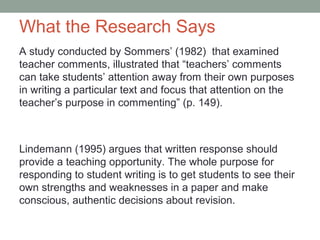
A study conducted by Sommers’ (1982) that examined
teacher comments, illustrated that “teachers’ comments
can take students’ attention away from their own purposes
in writing a particular text and focus that attention on the
teacher’s purpose in commenting” (p. 149).


Lindemann (1995) argues that written response should
provide a teaching opportunity. The whole purpose for
responding to student writing is to get students to see their
own strengths and weaknesses in a paper and make
conscious, authentic decisions about revision.
Research
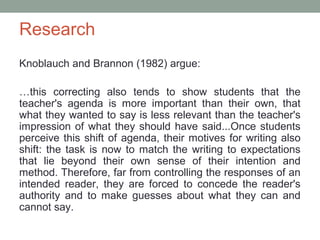
Knoblauch and Brannon (1982) argue:

…this correcting also tends to show students that the
teacher's agenda is more important than their own, that
what they wanted to say is less relevant than the teacher's
impression of what they should have said...Once students
perceive this shift of agenda, their motives for writing also
shift: the task is now to match the writing to expectations
that lie beyond their own sense of their intention and
method. Therefore, far from controlling the responses of an
intended reader, they are forced to concede the reader's
authority and to make guesses about what they can and
cannot say.
How to respond to student writing while maintaining student
authorship and motivation?

•Dialogue
•Addressing students motives for writing
•Involving students in the response process


This leads us to our activity…
Activity
1.   Fortune Cookie/ Writing Prompt
2.   Template and something to write with!
3.   Directions Sheet
4.   Choose a partner
5.   Writing Time
6.   Response Time
7.   Debrief Time
Discussion Questions
How can this activity be adapted for all grade levels?

How can this activity be used in various ways within the
writing process?

How can this activity be used across the different content
areas?

How can teachers use this activity in contexts with time
constraints?

Other questions to consider…

Responding to Student Writing

  • 1.
    RESPONDING TO STUDENT WRITING: REVISITINGMOTIVATION FOR REVISION Nayelee Villanueva Southern Nevada Writing Project 2011
  • 2.
    Introduction At some pointin the writing cycle, teachers will engage with student writing through response often as a means for assessment. Whether the assessment is informal or formal, questions regarding perception, motivation, and authorship come in to play both for the teacher and student. Typically, the main objective for providing response as a means of assessment is to foster revision in order to increase student writing levels. Therefore, the role that revision plays within this process is critical.
  • 3.
    What this oftenlooks like…
  • 4.
    Modern day… How does this affect student revision?
  • 5.
    Confused and angry,he stared at the red marks on his paper. He had awked again. And he had fragged. He always awked and fragged. On every theme, a couple of awks and a frag or two. And the inevitable puncs and sp's. The cw's didn't bother him anymore. He knew the teacher preferred words like courage and contemptible person to guts and fink. The teacher had dismissed guts and fink as slang, telling students never to use slang in their themes. But he liked to write guts and fink; they meant something to him. Besides, they were in the dictionary. So why couldn't he use them when they helped him say what he wanted to say? He rarely got to say what he wanted to say in an English class, and when he did, he always regretted it. But even that didn't bother him much. He really didn't care anymore.... Edward B. Jenkinson and Donald Seybold, "Prologue," Writing as a Process of Discovery, p. 3
  • 6.
    Origin of aDilemma • Responding to student writing to promote the revision process is often a difficult task. • No “one size fits all” approach to responding to student writing. • Best efforts to provide effective feedback for students in order to promote revision often fall flat. • Students are quick to feel the sense of hopelessness about writing, and their motivation for writing wanes with each writing assignment. • Students often lose the sense of authorship and inevitably adopt what they perceive to be my agenda as the teacher.
  • 7.
    Dilemma Questions • Whenresponding to student writing, how can I ensure students do not lose the sense of authorship? • How can I get students to truly think about their writing and apply it to their revision process more authentically after I have provided written feedback? • How can I involve the students more in the response process?
  • 8.
    Reflecting on ResponsePractices Reflection Elementary Middle School High School College Questions What forms (written, oral, individualized, general, etc.) does your response typically take? What aspects of written work do you typically comment on? Why? At what stages in the 'life-cycle' of a writing assignment do you typically respond, e.g., drafts, final papers? How (and when and why) might you involve students in response? How do you assess whether the response was helpful for student revision?
  • 9.
    Teacher Assumptions Student Assumptions Students understand linear marks Perceive teacher comments as the only areas needing improvement Students know how to make Writing for the teacher/professor suggested changes when revising Students understand the writing Perceive writing as “right” and “wrong” assignment Perceive low level writer’s errors as Believe they have no “say” in possible “careless” revisions based on feedback (authorship) There is a “common language” in Perceive writing as a “final product” responding to writing and students when given grade/written response with will “get it” no opportunity for revision Teacher response should focus on Revision is all about “fixing” grammar grammar, mechanics, and structure and mechanics errors. Students will review responses and Perceive teacher comments as negative therefore will improve student writing skills Teacher response should focus Perceive the teacher as the judge of solely on problem areas their writing ability
  • 10.
    What the ResearchSays A study conducted by Sommers’ (1982) that examined teacher comments, illustrated that “teachers’ comments can take students’ attention away from their own purposes in writing a particular text and focus that attention on the teacher’s purpose in commenting” (p. 149). Lindemann (1995) argues that written response should provide a teaching opportunity. The whole purpose for responding to student writing is to get students to see their own strengths and weaknesses in a paper and make conscious, authentic decisions about revision.
  • 11.
    Research Knoblauch and Brannon(1982) argue: …this correcting also tends to show students that the teacher's agenda is more important than their own, that what they wanted to say is less relevant than the teacher's impression of what they should have said...Once students perceive this shift of agenda, their motives for writing also shift: the task is now to match the writing to expectations that lie beyond their own sense of their intention and method. Therefore, far from controlling the responses of an intended reader, they are forced to concede the reader's authority and to make guesses about what they can and cannot say.
  • 12.
    How to respondto student writing while maintaining student authorship and motivation? •Dialogue •Addressing students motives for writing •Involving students in the response process This leads us to our activity…
  • 13.
    Activity 1. Fortune Cookie/ Writing Prompt 2. Template and something to write with! 3. Directions Sheet 4. Choose a partner 5. Writing Time 6. Response Time 7. Debrief Time
  • 14.
    Discussion Questions How canthis activity be adapted for all grade levels? How can this activity be used in various ways within the writing process? How can this activity be used across the different content areas? How can teachers use this activity in contexts with time constraints? Other questions to consider…