Resilient Heritage 2011: Social Media opportunities for the Heritage SectorJames Mott ProjectBook FounderA wide range of information & resources for the conservation restoration, care and repair ofperiod and listed buildings.
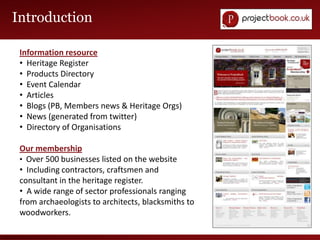
IntroductionInformation resource  Heritage Register
  Products Directory
  Event Calendar
  Articles
  Blogs (PB, Members news & Heritage Orgs)
  News (generated from twitter)
  Directory of OrganisationsOur membership Over 500 businesses listed on the website
  Including contractors, craftsmen and consultant in the heritage register.
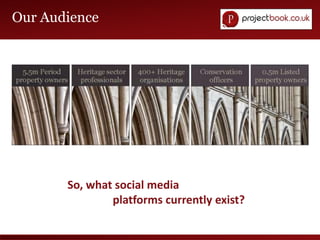
  A wide range of sector professionals ranging from archaeologists to architects, blacksmiths to woodworkers.Our AudienceSo, what social media                platforms currently exist?
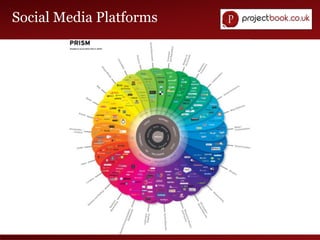
Social Media Platforms
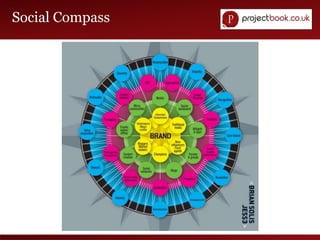
Social Compass
Social Media for the Heritage Sector?!+ Are you missing a trick? ?!By James Mott – Founder of ProjectBook.co.uk@projectbook
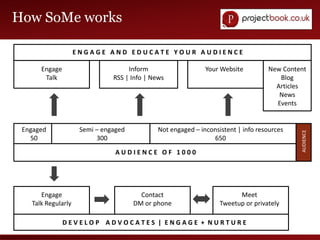
How SoMe worksE N G A G E   A N D   E D U C A T E   Y O U R   A U D I E N C E EngageTalk InformRSS | Info | NewsYour WebsiteNew ContentBlogArticlesNewsEventsEngaged50Semi – engaged300Not engaged – inconsistent | info resources650AUDIENCEA U D I E N C E   O F   1 0 0 0 EngageTalk RegularlyMeetTweetup or privatelyContactDM or phoneD E V E L O P    A D V O C A T E S  |  E N G A G E  +  N U R T U R E
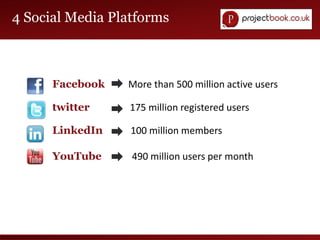
4 Social Media PlatformsFacebook	     More than 500 million active userstwitter	     175 million registered usersLinkedIn 	      100 million members YouTube        490 million users per month
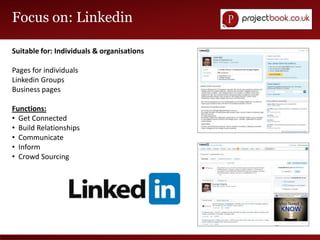
Focus on: LinkedinSuitable for: Individuals & organisations  Pages for individualsLinkedin GroupsBusiness pagesFunctions:  Get Connected
  Build Relationships
  Communicate
  Inform
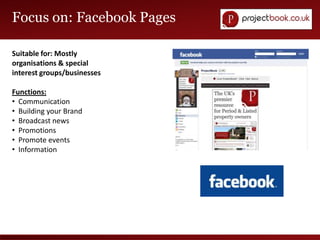
  Crowd SourcingFocus on: Facebook PagesSuitable for: Mostly organisations & special interest groups/businessesFunctions:  Communication
  Building your Brand

Resilient heritage - Peterborough 2011

  • 1.
    Resilient Heritage 2011:Social Media opportunities for the Heritage SectorJames Mott ProjectBook FounderA wide range of information & resources for the conservation restoration, care and repair ofperiod and listed buildings.
  • 2.
  • 3.
    ProductsDirectory
  • 4.
    EventCalendar
  • 5.
  • 6.
    Blogs(PB, Members news & Heritage Orgs)
  • 7.
    News(generated from twitter)
  • 8.
    Directoryof OrganisationsOur membership Over 500 businesses listed on the website
  • 9.
    Includingcontractors, craftsmen and consultant in the heritage register.
  • 10.
    Awide range of sector professionals ranging from archaeologists to architects, blacksmiths to woodworkers.Our AudienceSo, what social media platforms currently exist?
  • 11.
  • 12.
  • 13.
    Social Media forthe Heritage Sector?!+ Are you missing a trick? ?!By James Mott – Founder of ProjectBook.co.uk@projectbook
  • 14.
    How SoMe worksEN G A G E A N D E D U C A T E Y O U R A U D I E N C E EngageTalk InformRSS | Info | NewsYour WebsiteNew ContentBlogArticlesNewsEventsEngaged50Semi – engaged300Not engaged – inconsistent | info resources650AUDIENCEA U D I E N C E O F 1 0 0 0 EngageTalk RegularlyMeetTweetup or privatelyContactDM or phoneD E V E L O P A D V O C A T E S | E N G A G E + N U R T U R E
  • 15.
    4 Social MediaPlatformsFacebook More than 500 million active userstwitter 175 million registered usersLinkedIn 100 million members YouTube 490 million users per month
  • 16.
    Focus on: LinkedinSuitablefor: Individuals & organisations Pages for individualsLinkedin GroupsBusiness pagesFunctions: Get Connected
  • 17.
    BuildRelationships
  • 18.
  • 19.
  • 20.
    CrowdSourcingFocus on: Facebook PagesSuitable for: Mostly organisations & special interest groups/businessesFunctions: Communication
  • 21.
    Buildingyour Brand

Editor's Notes

  • #2 Good morning. I am James Mott founder of ProjectBook.co.uk which is which is an organisation brongingtogether everyone involved in the Heritage sector. ProjectBook.co.uk holds a wide range of information & resources for the conservation restoration, care and repair of period and listed buildings.The title of my talk today is : Social Media opportunities for the Heritage Sector, which hopefully I will be able to unpack for you.
  • #3 Throughout this talk we will be sharing some of the ways that ProjectBook uses Social Media. So, as a way of introduction I will just say a few words about what ProjectBook is so you can see where we are coming from.
  • #4 Like many organisations working in the sector we have a wide and varied audience that can be difficult to reach effectively. In addition to traditional marketing tools , we now have the opportunity to target a much larger audience than previously possible through the use of social media. So what SoMe platforms currently exist?
  • #5 A lot is the simple answer. As you can see on this prism diagram there are literally hundreds of different platforms to utilise. However whilst many platforms have possibilities there are four main platforms which stand out from the crowd.
  • #7 The 4 main social platforms that we will look at briefly today are twitter, Linkedin, Facebook and Youtube.
  • #8 Before we look at the social platforms it is important to understand why you might use them.
  • #9 As you can see, these social platforms all have millions of users and attract different types of audiences. First of all lets have a look at LinkedIn.
  • #10 Linkedin has three main functions and is generally thought of as a platform for individuals - basically an online CV. However businesses or organisations etc can have a page to promote what they do and there are also a myriad of groups available to join. The groups are particularly relevant for organisations many of which are used as a forum to get their members interacting.
  • #11 Facebook has risen in popularity over many years and is best know as a social platform, used mostly by individuals. In recent times facebook has added business pages and groups which can be utilised by organisations and specialist interest groups to raise awareness and publicise events. Many big brands like Starbucks or Virgin use this platform to create effect. As things stand at the moment there is very little documented evidence that the use of facebook page by businesses generates anything more than website traffic.
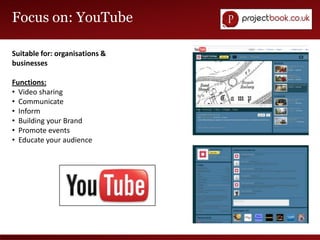
  • #12 Youtube is the largest video sharing site on the web.
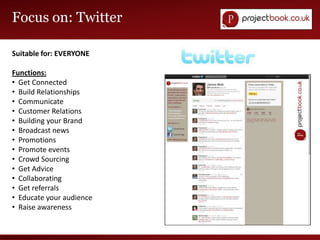
  • #13 Out of all the popular social media channels, twitter is the one platform that is suitable for everyone to use and in my opinion the most versatile and effective.
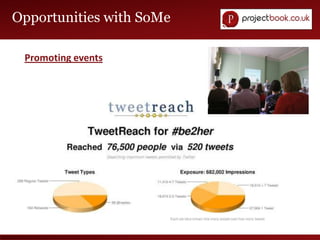
  • #14 Promoting any type of event using social media is an excellent way of reaching a large audience. Traditionally most events that are put on in the heritage sector go on behind closed doors and do not engage with a wider audience and only the people attending benefit from the event. The picture shown was a small event we put on at the Georgian group last month which attracted around 60 people. Attendees were encouraged to take pictures and comment on the talks which were posted on twitter. The tweet reach report shows that many people were able to follow the event online and as a result the event had a far greater audience that just those who physically attended.
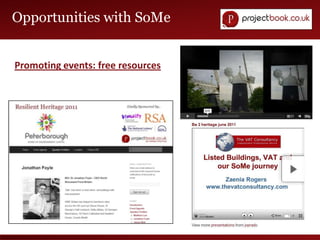
  • #15 As well as being able to promote your events successfully, there are also a wide range of free resources available online which will enable you to not only promote an event but also to accurately report on the event afterwards. For instance we put together this dedicated website for today’s resilient heritage event. This was publicised online with profiles of all the speakers and event information. Following today we will add the speakers slides (like on the right in slideshare) and also perhaps put together photographs taken through the day to create a short video clip. Amazingly this is all free.
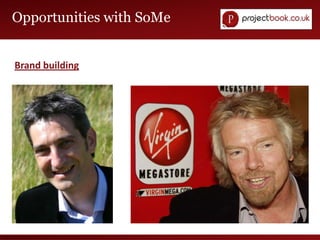
  • #16 Social Media is great for raising your profile and establishing your reputation, which works for individuals, businesses and organisations alike. Being able to discuss the topics you specialise in means you can reinforce that status. Using social media also enables you to give a human face to your organisation.Take for example Richard Branson and Virgin...At ProjectBook we use me!
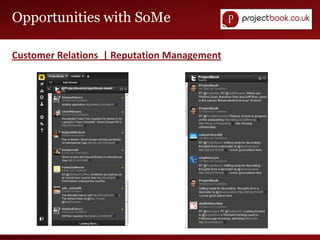
  • #17 Many larger brands successfully use different social media platforms as a customer interaction tool. But you don’t have to be a large company to look after your customers or members using social media. With very little effort you can easily keep in touch with what they are thinking and feeling and be able to respond directly to their needs.We use twitter to follow our members progress, communicate with them and promote them(left image)We also conduct a search on twitter to monitor what people say about us online..
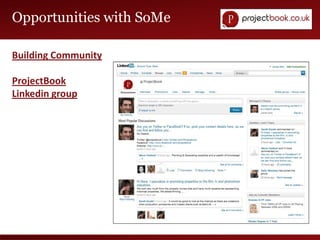
  • #18 We have recently set up a group on Linkedin for our members and others with an established reputation working in the sector, which you may like to join BTW. There are many heritage professionals who use Linkedin, so no shortage of people to populate a group and get some good interaction going.
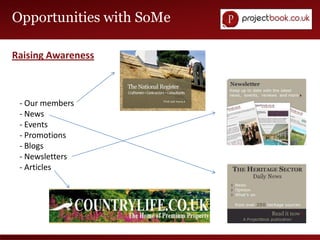
  • #19 Social media is an excellent way of raising awareness about your business or organisation to a large audience. Give examples...
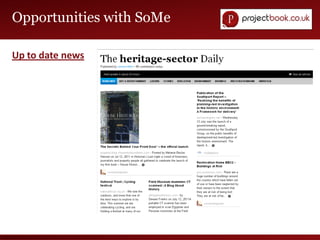
  • #20 The slide shown is taken form a twitter generated newspaper which comes out every day generated by one of our ProjectBooktwitter lists. It publishes on average over 100 news stories and comment each day.
  • #21 In conclusion social media has huge benefits and opportunities for the heritage sector. With literally thousands of individuals, business and organisations successfully using it, for those of you not yet using SoMe, I would strongly suggest that now is the time to look at the possibilities.If you would like to explore further how social media would benefit you, your company or your organisation we do run tailored courses to assist you. If you would like to know more please collar me during the day or go to www.creativecomms.co.uk for more information.
  • #22 Thankyou