Can	
  our	
  stories	
  help	
  young	
  people	
  develop	
  resilience?	


Often	
  people	
  naively	
  believe	
  that	
  young	
  people	
  today	
  ‘have	
  it	
  easy’	
  because	
  of	
  the	
  prosperity	
  of	
  our	
  
country	
   and	
   the	
   various	
   technologies	
   available.	
   However	
   the	
   high	
   rates	
   of	
   depression,	
   suicide,	
  
bullying,	
  self-­‐harm,	
  school	
  refusal	
  and	
  eating	
  disorders	
  in	
  young	
  people	
  suggest	
  that	
  this	
  is	
  not	
  true.	


In	
  an	
  attempt	
  to	
  counter	
  this	
  rising	
  trend	
  in	
  young	
  adults,	
  our	
  class	
  is	
  going	
  to	
  composean	
  anthology	
  
of	
   short	
   stories	
   exploring	
   the	
   theme	
   ‘resilience’.	
   These	
   stories	
   will	
   be	
   used	
   tohelp	
   support	
   young	
  
people	
  having	
  a	
  tough	
  time	
  in	
  life.	


The	
  completed	
  anthology	
  will	
  be	
  published	
  as	
  an	
  eBook	
  and	
  sold	
  through	
  the	
  iBook	
  store.	
  All	
  money	
  
raised	
  from	
  the	
  sales	
  of	
  this	
  book	
  will	
  be	
  donated	
  to	
  Youth	
  Beyondblue.	


The	
  Challenge:	
  
To	
  successfully	
  complete	
  this	
  project	
  you	
  will	
  be	
  required	
  to	
  work	
  both	
  individually	
  and	
  in	
  small	
  
groups	
  to	
  research	
  resilience	
  and	
  develop	
  an	
  understanding	
  of	
  how	
  the	
  short	
  story	
  form	
  might	
  be	
  
used	
  to	
  help	
  young	
  people	
  to	
  become	
  more	
  resilient	
  when	
  confronted	
  with	
  life’s	
  challenges.	
  
To	
  become	
  an	
  ‘expert’	
  in	
  resilience	
  and	
  short	
  story-­‐writing,	
  you	
  will	
  need	
  to	
  complete	
  the	
  following	
  
tasks:	


      1. Discover:	
  
                 a. Contribute	
  to	
  a	
  series	
  of	
  videoed	
  discussions	
  about	
  ‘resilience’	
  with	
  our	
  American	
  sister	
  
                       schools.	


                 b. Research	
  a	
  case	
  study	
  of	
  a	
  remarkably	
  resilient	
  individual	
  and	
  write	
  a	
  blog	
  post	
  
                       comparing	
  this	
  individual’s	
  level	
  of	
  resilience	
  to	
  Holden	
  Caulfield’s	
  level	
  of	
  resilience.	
  In	
  
                       your	
  post	
  you	
  should	
  reflect	
  on	
  what	
  factors	
  may	
  have	
  contributed	
  to	
  the	
  
                       differences/similarities	
  between	
  the	
  two	
  individuals.	
  Find	
  an	
  image	
  to	
  support	
  your	
  
                       written	
  text.	
  
                 c. Research	
  and	
  write	
  a	
  blog	
  post	
  on	
  one	
  of	
  the	
  following	
  issues	
  impacting	
  young	
  
                       Australians:	
  	
  depression,	
  self-­‐harm,	
  bullying,	
  school	
  refusal,	
  eating	
  disorders.	
  In	
  your	
  
                       blog	
  post	
  include	
  a	
  discussion	
  of	
  where	
  this	
  issue	
  may	
  be	
  evident	
  in	
  the	
  novel	
  The	
  
                       Catcher	
  in	
  the	
  Rye.	
  Find	
  an	
  image	
  to	
  support	
  your	
  written	
  text.	
  
                 d. Look	
  closely	
  at	
  J.D	
  Salinger’s	
  Catcher	
  in	
  the	
  Rye	
  for	
  inspiration	
  and	
  insight	
  into	
  resilience	
  
                       in	
  young	
  people	
  as	
  well	
  as	
  how	
  to	
  create	
  an	
  engaging	
  narrative	
  that	
  emotionally	
  and	
  
                       intellectually	
  impacts	
  the	
  reader.	


      2. Produce:	
  
                 a. Workshop	
  an	
  original	
  short	
  story	
  from	
  an	
  initial	
  idea	
  to	
  a	
  complete	
  product.	
  This	
  will	
  
                       include	
  a	
  plan,	
  draft,	
  polished	
  story	
  and	
  reflection.	


      3. Present:	
  
                 a. Publish	
  an	
  eBook	
  anthology	
  of	
  stories	
  titled:	
  ‘The	
  Resilience	
  Writers’	
  on	
  the	
  iBook	
  store.	
  
                 b. Plan	
  and	
  run	
  a	
  class	
  ‘book	
  launch’	
  for	
  The	
  Resilience	
  Writers	
  anthology.	


                                                   Bianca	
  Hewes,	
  Davidson	
  High	
  School	


Guidelines:	


       •   The	
  whole	
  challenge	
  is	
  limited	
  to	
  6	
  weeks	
  of	
  class	
  time	
  to	
  complete.	
  
       •   You	
  will	
  be	
  working	
  in	
  teams	
  of	
  up	
  to	
  4	
  people	
  to	
  research	
  resilience	
  and	
  formulate	
  a	
  plan	
  for	
  
           your	
  story,	
  write	
  a	
  draft	
  and	
  then	
  collaborate	
  with	
  the	
  class	
  group	
  to	
  publish	
  the	
  completed	
  
           stories	
  in	
  an	
  eBook	
  and	
  make	
  this	
  available	
  for	
  purchase	
  on	
  the	
  iBooks	
  store.	
  
       •   Your	
  class	
  group	
  will	
  be	
  required	
  to	
  present	
  research	
  findings	
  and	
  completed	
  stories	
  at	
  the	
  
           ‘Book	
  Launch’.	
  Each	
  small	
  group	
  will	
  be	
  allocated	
  one	
  or	
  two	
  of	
  the	
  following	
  roles:	
  MCs,	
  
           resilience	
  experts,	
  Case	
  Studies	
  experts,	
  Catcher	
  in	
  the	
  Rye	
  experts,	
  short	
  story	
  experts,	
  short	
  
           story	
  readers.	


What	
  does	
  it	
  mean	
  to	
  be	
  an	
  Expert?	
  
An	
  expert	
  understands	
  a	
  particular	
  area	
  of	
  knowledge	
  extremely	
  well.	
  You	
  will	
  be	
  required	
  to	
  develop	
  
expertise	
   through	
   research,	
   critical	
   thinking,	
   discussions	
   and	
   collaboration	
   with	
   peers.	
  It	
   will	
   be	
   clear	
  
that	
  you	
  are	
  experts	
  because	
  you	
  will	
  create	
  engaging	
  narratives	
  that	
  help	
  young	
  people	
  understand	
  
resilience.	
  Your	
  ‘Book	
  Launch’	
  will	
  demonstrate	
  an	
  expert	
  knowledge	
  of	
  resilience,	
  The	
  Catcher	
  in	
  the	
  
Rye	
   and	
   the	
   short	
   story	
   form	
   including	
   setting,	
   writing	
   style,	
   characterisation,	
   plot	
   structure	
   and	
  
theme.	


Being	
   an	
   expert	
   will	
   also	
   mean	
   that	
   you	
   will	
   be	
   able	
   to	
   critically	
   analyse	
   and	
   assess	
   the	
   stories	
  
developed	
  by	
  other	
  experts.	
  You	
  will	
  be	
  required	
  to	
  peer	
  assess	
  their	
  stories	
  using	
  the	
  given	
  check-­‐list	
  
and	
  rubric.	


Quality	
  Learning	
  
In	
  order	
  for	
  each	
  student	
  to	
  complete	
  this	
  unit	
  of	
  work	
  an	
  individual	
  is	
  required	
  to	
  complete	
  and	
  
submit	
  the	
  following:	
  
       • A	
  completed	
  project	
  plan	
  and	
  timeline	
  of	
  what	
  is	
  required	
  of	
  you	
  to	
  complete	
  each	
  task	
  
       • A	
  KWL	
  for	
  each	
  task	
  
       • A	
  daily	
  record	
  of	
  your	
  learning	
  using	
  the	
  ‘GOALS/MEDALS/MISSIONS’	
  framework	


                                                      Bianca	
  Hewes,	
  Davidson	
  High	
  School	
  
 
                                                               What	
  will	
  you	
  learn	
  …	


Students	
  learn	
  to:	
  
1.1	
  respond	
  to	
  and	
  compose	
  imaginative	
  and	
  critical	
  texts	
  which	
  are	
  increasingly	
  demanding	
  in	
  terms	
  of	
  their	
  linguistic,	
  
structural,	
  cognitive,	
  emotional	
  and	
  moral	
  
complexity	
  
1.6	
  respond	
  to	
  and	
  compose	
  texts	
  that	
  use	
  inference	
  and	
  figurative	
  language,	
  such	
  as	
  symbolism	
  and	
  allusion,	
  in	
  complex	
  
and	
  subtle	
  ways.	


Students	
  learn	
  about:	
  
1.8	
  the	
  features	
  of	
  increasingly	
  complex	
  imaginative,	
  factual	
  and	
  critical	
  texts,	
  including	
  the	
  cognitive,	
  emotional	
  and	
  moral	
  
dimensions	
  of	
  the	
  text	
  and	
  its	
  linguistic	
  and	
  structural	
  features	
  
1.9	
  the	
  ways	
  sustained	
  texts	
  use	
  elements	
  such	
  as	
  evidence,	
  argument,	
  narrative,	
  dialogue	
  and	
  climax	
  
1.11	
  their	
  own	
  emerging	
  sense	
  of	
  style,	
  personal	
  preference	
  and	
  discernment	
  in	
  responding	
  to	
  and	
  composing	
  texts	


  Students	
  learn	
  to:	
  
4.2	
  describe,	
  explain	
  and	
  evaluate	
  the	
  composer’s	
  choices	
  of	
  language	
  forms	
  and	
  features	
  and	
  structures	
  of	
  texts	
  in	
  terms	
  
of	
  purpose,	
  audience	
  and	
  context	
  
4.3	
  use	
  appropriate	
  language	
  forms	
  and	
  features	
  and	
  structures	
  of	
  texts	
  in	
  their	
  own	
  compositions	
  and	
  describe,	
  explain	
  
and	
  justify	
  their	
  choices	
  in	
  terms	
  of	
  purpose,	
  audience	
  and	
  context	
  
4.4	
  experiment	
  with	
  and	
  explain	
  altered	
  perceptions	
  of	
  ideas	
  and	
  information	
  that	
  result	
  from	
  changes	
  in	
  language	
  
features	
  and	
  structures	


Students	
  learn	
  about:	
  
4.10	
  the	
  metalanguage	
  for	
  describing,	
  explaining	
  and	
  justifying	
  the	
  composer’s	
  choices	
  of	
  language	
  forms	
  and	
  features	
  and	
  
structures	
  of	
  texts	
  in	
  terms	
  of	
  purpose,	
  audience	
  and	
  context	
  	
  
4.11	
  the	
  influence	
  of	
  purpose,	
  audience	
  and	
  context	
  on	
  the	
  use	
  of	
  particular	
  language	
  forms	
  and	
  features	
  and	
  structures	
  of	
  
texts	
  
4.13	
  codes	
  and	
  conventions,	
  including	
  emotive,	
  evocative	
  and	
  impersonal	
  language	
  and	
  signs,	
  used	
  to	
  signal	
  tone,	
  mood	
  
and	
  atmosphere	
  in	
  written	
  texts	


Students	
  learn	
  to:	
  
6.1	
  explore	
  real	
  and	
  imagined	
  worlds	
  through	
  close	
  and	
  wide	
  engagement	
  with	
  increasingly	
  demanding	
  texts	
  
6.2	
  respond	
  imaginatively	
  and	
  interpretively	
  to	
  an	
  increasingly	
  demanding	
  range	
  of	
  literary	
  and	
  non-­‐literary	
  texts	
  
6.3	
  compose	
  texts	
  that	
  demonstrate	
  originality,	
  imagination	
  and	
  ingenuity	
  in	
  content	
  and	
  language	
  
6.5	
  experiment	
  with	
  ways	
  of	
  representing	
  the	
  real	
  world	
  imaginatively	


Students	
  learn	
  about:	
  
6.7	
  ways	
  in	
  which	
  literary	
  and	
  non-­‐literary	
  composers	
  transform	
  ideas	
  and	
  experience	
  into	
  texts,	
  including	
  consideration	
  
of	
  their	
  insight,	
  imaginative	
  powers	
  and	
  verbal	
  ingenuity	
  
6.9	
  the	
  ways	
  in	
  which	
  imaginative	
  texts	
  can	
  explore	
  universal	
  themes	
  and	
  social	
  reality.	


Students	
  learn	
  to:	
  
11.1	
  understand	
  the	
  learning	
  purposes,	
  specific	
  requirements	
  and	
  targeted	
  outcomes	
  of	
  tasks	
  
11.3	
  identify,	
  plan	
  and	
  monitor	
  stages	
  of	
  tasks	
  with	
  guidance	
  
11.4	
  choose	
  learning	
  processes,	
  resources	
  and	
  technologies	
  appropriate	
  for	
  particular	
  tasks	
  and	
  situations	
  
11.5	
  use	
  individual	
  and	
  group	
  processes	
  to	
  generate,	
  investigate,	
  document,	
  clarify,	
  refine,	
  critically	
  evaluate	
  and	
  present	
  
ideas	
  and	
  information	
  drawn	
  from	
  books,	
  the	
  internet	
  and	
  other	
  sources	
  of	
  information	
  
11.6	
  establish	
  and	
  adopt	
  roles	
  and	
  responsibilities,	
  negotiate	
  and	
  implement	
  strategies	
  and	
  meet	
  deadlines	
  
11.7	
  reflect	
  on	
  and	
  assess	
  their	
  own	
  and	
  others’	
  learning	
  and	
  learning	
  strategies	
  against	
  outcomes,	
  criteria	
  and	
  guidelines	
  
established	
  for	
  tasks	


Students	
  learn	
  about:	
  
11.11	
  outcomes,	
  criteria	
  and	
  guidelines	
  for	
  tasks	
  and	
  the	
  value	
  of	
  outcomes-­‐based	
  learning	
  
11.12	
  their	
  own	
  learning	
  strengths	
  and	
  learning	
  needs	
  including	
  their	
  preferred	
  ways	
  of	
  gathering,	
  processing	
  and	
  
representing	
  information	
  
11.13	
  management	
  strategies	
  including	
  drawing	
  up	
  schedules,	
  timing,	
  delegation	
  and	
  sharing	
  in	
  group	
  work	
  
11.14	
  ways	
  of	
  managing	
  information	
  and	
  communication	
  technologies	
  for	
  effective	
  learning	


                                                           Bianca	
  Hewes,	
  Davidson	
  High	
  School	
  

Resilience.writers

  • 1.
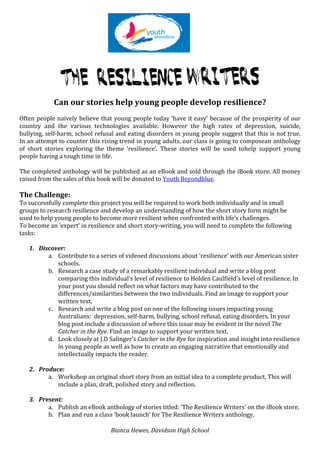
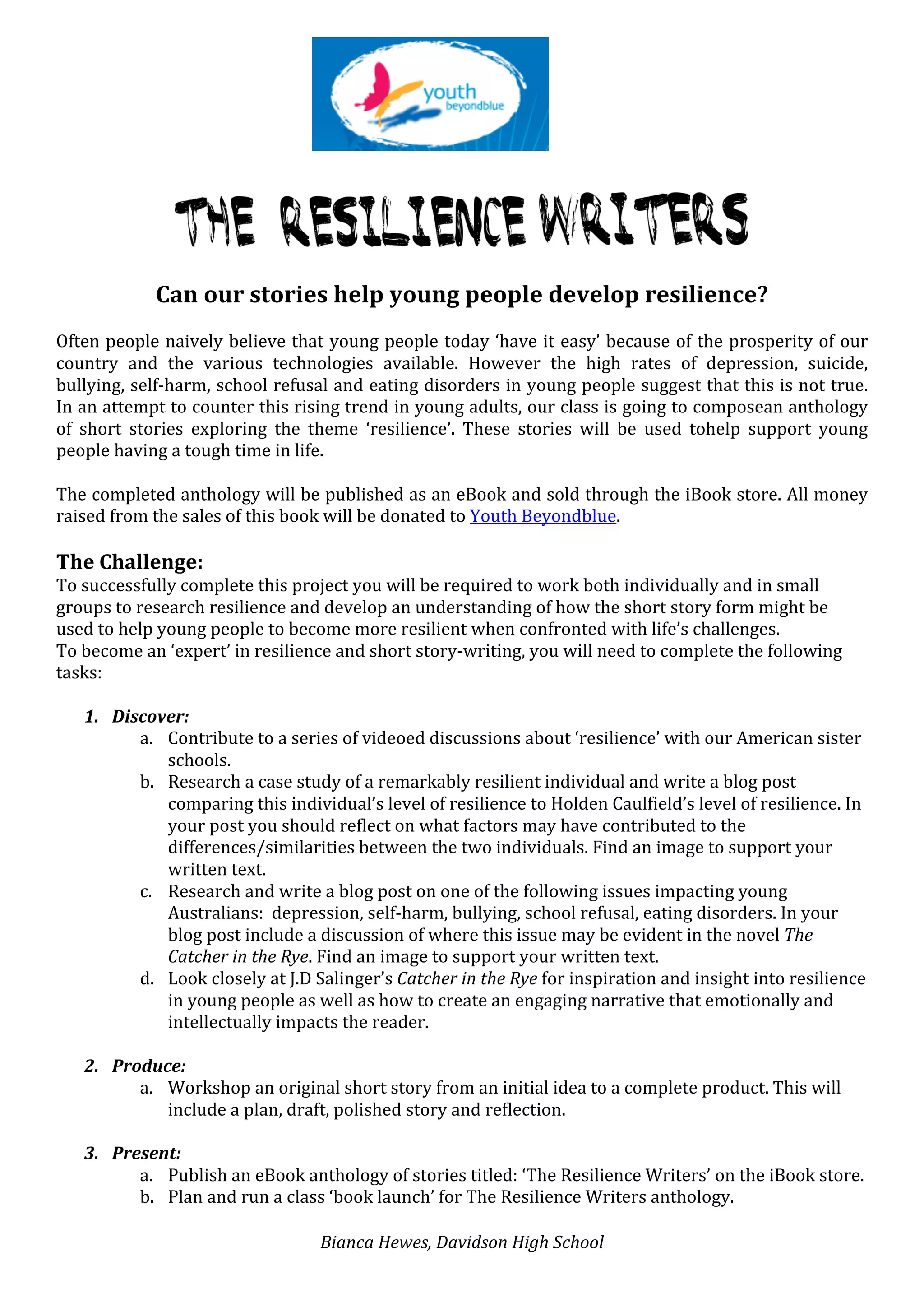
                  Can  our  stories  help  young  people  develop  resilience?     Often  people  naively  believe  that  young  people  today  ‘have  it  easy’  because  of  the  prosperity  of  our   country   and   the   various   technologies   available.   However   the   high   rates   of   depression,   suicide,   bullying,  self-­‐harm,  school  refusal  and  eating  disorders  in  young  people  suggest  that  this  is  not  true.       In  an  attempt  to  counter  this  rising  trend  in  young  adults,  our  class  is  going  to  composean  anthology   of   short   stories   exploring   the   theme   ‘resilience’.   These   stories   will   be   used   tohelp   support   young   people  having  a  tough  time  in  life.       The  completed  anthology  will  be  published  as  an  eBook  and  sold  through  the  iBook  store.  All  money   raised  from  the  sales  of  this  book  will  be  donated  to  Youth  Beyondblue.       The  Challenge:   To  successfully  complete  this  project  you  will  be  required  to  work  both  individually  and  in  small   groups  to  research  resilience  and  develop  an  understanding  of  how  the  short  story  form  might  be   used  to  help  young  people  to  become  more  resilient  when  confronted  with  life’s  challenges.   To  become  an  ‘expert’  in  resilience  and  short  story-­‐writing,  you  will  need  to  complete  the  following   tasks:     1. Discover:   a. Contribute  to  a  series  of  videoed  discussions  about  ‘resilience’  with  our  American  sister   schools.       b. Research  a  case  study  of  a  remarkably  resilient  individual  and  write  a  blog  post   comparing  this  individual’s  level  of  resilience  to  Holden  Caulfield’s  level  of  resilience.  In   your  post  you  should  reflect  on  what  factors  may  have  contributed  to  the   differences/similarities  between  the  two  individuals.  Find  an  image  to  support  your   written  text.   c. Research  and  write  a  blog  post  on  one  of  the  following  issues  impacting  young   Australians:    depression,  self-­‐harm,  bullying,  school  refusal,  eating  disorders.  In  your   blog  post  include  a  discussion  of  where  this  issue  may  be  evident  in  the  novel  The   Catcher  in  the  Rye.  Find  an  image  to  support  your  written  text.   d. Look  closely  at  J.D  Salinger’s  Catcher  in  the  Rye  for  inspiration  and  insight  into  resilience   in  young  people  as  well  as  how  to  create  an  engaging  narrative  that  emotionally  and   intellectually  impacts  the  reader.     2. Produce:   a. Workshop  an  original  short  story  from  an  initial  idea  to  a  complete  product.  This  will   include  a  plan,  draft,  polished  story  and  reflection.     3. Present:   a. Publish  an  eBook  anthology  of  stories  titled:  ‘The  Resilience  Writers’  on  the  iBook  store.   b. Plan  and  run  a  class  ‘book  launch’  for  The  Resilience  Writers  anthology.     Bianca  Hewes,  Davidson  High  School  
  • 2.
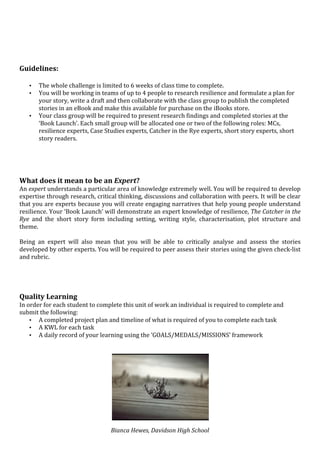
              Guidelines:     • The  whole  challenge  is  limited  to  6  weeks  of  class  time  to  complete.   • You  will  be  working  in  teams  of  up  to  4  people  to  research  resilience  and  formulate  a  plan  for   your  story,  write  a  draft  and  then  collaborate  with  the  class  group  to  publish  the  completed   stories  in  an  eBook  and  make  this  available  for  purchase  on  the  iBooks  store.   • Your  class  group  will  be  required  to  present  research  findings  and  completed  stories  at  the   ‘Book  Launch’.  Each  small  group  will  be  allocated  one  or  two  of  the  following  roles:  MCs,   resilience  experts,  Case  Studies  experts,  Catcher  in  the  Rye  experts,  short  story  experts,  short   story  readers.             What  does  it  mean  to  be  an  Expert?   An  expert  understands  a  particular  area  of  knowledge  extremely  well.  You  will  be  required  to  develop   expertise   through   research,   critical   thinking,   discussions   and   collaboration   with   peers.  It   will   be   clear   that  you  are  experts  because  you  will  create  engaging  narratives  that  help  young  people  understand   resilience.  Your  ‘Book  Launch’  will  demonstrate  an  expert  knowledge  of  resilience,  The  Catcher  in  the   Rye   and   the   short   story   form   including   setting,   writing   style,   characterisation,   plot   structure   and   theme.     Being   an   expert   will   also   mean   that   you   will   be   able   to   critically   analyse   and   assess   the   stories   developed  by  other  experts.  You  will  be  required  to  peer  assess  their  stories  using  the  given  check-­‐list   and  rubric.           Quality  Learning   In  order  for  each  student  to  complete  this  unit  of  work  an  individual  is  required  to  complete  and   submit  the  following:   • A  completed  project  plan  and  timeline  of  what  is  required  of  you  to  complete  each  task   • A  KWL  for  each  task   • A  daily  record  of  your  learning  using  the  ‘GOALS/MEDALS/MISSIONS’  framework         Bianca  Hewes,  Davidson  High  School  
  • 3.
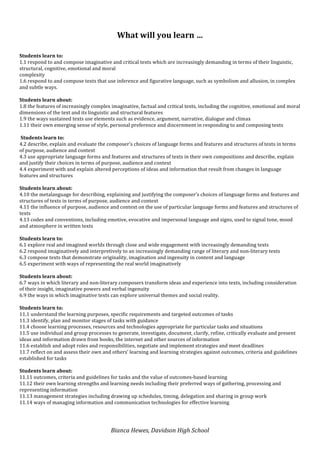
      What  will  you  learn  …       Students  learn  to:   1.1  respond  to  and  compose  imaginative  and  critical  texts  which  are  increasingly  demanding  in  terms  of  their  linguistic,   structural,  cognitive,  emotional  and  moral   complexity   1.6  respond  to  and  compose  texts  that  use  inference  and  figurative  language,  such  as  symbolism  and  allusion,  in  complex   and  subtle  ways.     Students  learn  about:   1.8  the  features  of  increasingly  complex  imaginative,  factual  and  critical  texts,  including  the  cognitive,  emotional  and  moral   dimensions  of  the  text  and  its  linguistic  and  structural  features   1.9  the  ways  sustained  texts  use  elements  such  as  evidence,  argument,  narrative,  dialogue  and  climax   1.11  their  own  emerging  sense  of  style,  personal  preference  and  discernment  in  responding  to  and  composing  texts      Students  learn  to:   4.2  describe,  explain  and  evaluate  the  composer’s  choices  of  language  forms  and  features  and  structures  of  texts  in  terms   of  purpose,  audience  and  context   4.3  use  appropriate  language  forms  and  features  and  structures  of  texts  in  their  own  compositions  and  describe,  explain   and  justify  their  choices  in  terms  of  purpose,  audience  and  context   4.4  experiment  with  and  explain  altered  perceptions  of  ideas  and  information  that  result  from  changes  in  language   features  and  structures     Students  learn  about:   4.10  the  metalanguage  for  describing,  explaining  and  justifying  the  composer’s  choices  of  language  forms  and  features  and   structures  of  texts  in  terms  of  purpose,  audience  and  context     4.11  the  influence  of  purpose,  audience  and  context  on  the  use  of  particular  language  forms  and  features  and  structures  of   texts   4.13  codes  and  conventions,  including  emotive,  evocative  and  impersonal  language  and  signs,  used  to  signal  tone,  mood   and  atmosphere  in  written  texts     Students  learn  to:   6.1  explore  real  and  imagined  worlds  through  close  and  wide  engagement  with  increasingly  demanding  texts   6.2  respond  imaginatively  and  interpretively  to  an  increasingly  demanding  range  of  literary  and  non-­‐literary  texts   6.3  compose  texts  that  demonstrate  originality,  imagination  and  ingenuity  in  content  and  language   6.5  experiment  with  ways  of  representing  the  real  world  imaginatively     Students  learn  about:   6.7  ways  in  which  literary  and  non-­‐literary  composers  transform  ideas  and  experience  into  texts,  including  consideration   of  their  insight,  imaginative  powers  and  verbal  ingenuity   6.9  the  ways  in  which  imaginative  texts  can  explore  universal  themes  and  social  reality.     Students  learn  to:   11.1  understand  the  learning  purposes,  specific  requirements  and  targeted  outcomes  of  tasks   11.3  identify,  plan  and  monitor  stages  of  tasks  with  guidance   11.4  choose  learning  processes,  resources  and  technologies  appropriate  for  particular  tasks  and  situations   11.5  use  individual  and  group  processes  to  generate,  investigate,  document,  clarify,  refine,  critically  evaluate  and  present   ideas  and  information  drawn  from  books,  the  internet  and  other  sources  of  information   11.6  establish  and  adopt  roles  and  responsibilities,  negotiate  and  implement  strategies  and  meet  deadlines   11.7  reflect  on  and  assess  their  own  and  others’  learning  and  learning  strategies  against  outcomes,  criteria  and  guidelines   established  for  tasks     Students  learn  about:   11.11  outcomes,  criteria  and  guidelines  for  tasks  and  the  value  of  outcomes-­‐based  learning   11.12  their  own  learning  strengths  and  learning  needs  including  their  preferred  ways  of  gathering,  processing  and   representing  information   11.13  management  strategies  including  drawing  up  schedules,  timing,  delegation  and  sharing  in  group  work   11.14  ways  of  managing  information  and  communication  technologies  for  effective  learning     Bianca  Hewes,  Davidson  High  School