+
Dr Gary Jones - @DrGaryJones – jones.gary@gmail.com
https://evidencebasededucationalleadership.blogspot.com
Becoming an evidence-based SENCO – six steps to
making evidence-based decisions
researchSEND, Saturday 18 November, 2017
+
By the end of this session I hope to
have provided you with
 A brief overview of Effective SEN support: research evidence
on effective approaches and examples of current practice in
good and outstanding schools and colleges
 A comprehensive definition of evidence-based practice
 An awareness of common misconceptions about evidence-
based practice
 Highlight a number of techniques/tools that you can use to
make decisions based on the best available evidence
 A stimulating 30 minute session
2
+
Key message
 Evidence-based practice is ethically essential within SEND
 But significant challenges to its adoption – time, money, skill,
motivation, opportunity
 Some reasonably straightforward techniques which anyone can
use to help make decisions evidence-based
3
+
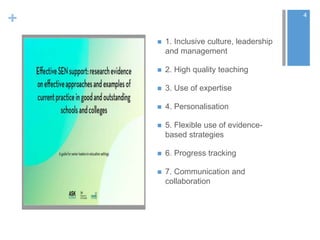
 1. Inclusive culture, leadership
and management
 2. High quality teaching
 3. Use of expertise
 4. Personalisation
 5. Flexible use of evidence-
based strategies
 6. Progress tracking
 7. Communication and
collaboration
4
+
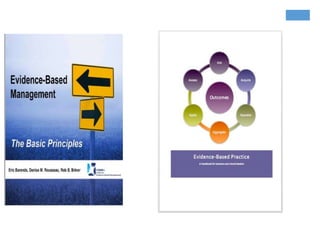
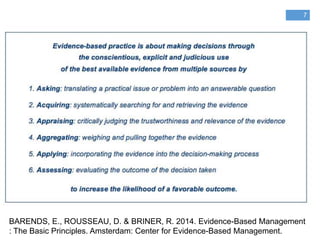
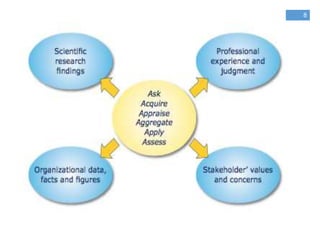
The only definition of evidence-
based practice you will ever need
5
7
BARENDS, E., ROUSSEAU, D. & BRINER, R. 2014. Evidence-Based Management
: The Basic Principles. Amsterdam: Center for Evidence-Based Management.
8
9
+
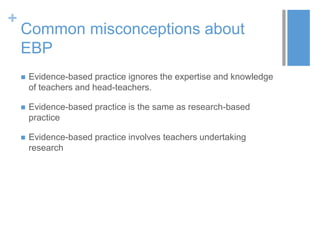
Common misconceptions about
EBP
 Evidence-based practice ignores the expertise and knowledge
of teachers and head-teachers.
 Evidence-based practice is the same as research-based
practice
 Evidence-based practice involves teachers undertaking
research
+
Evidence-based practice –
tools and techniques
11
+
Asking well formulated
questions
12
+
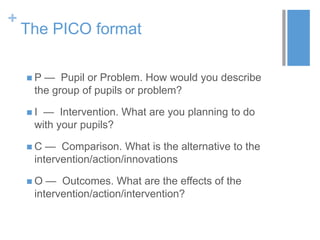
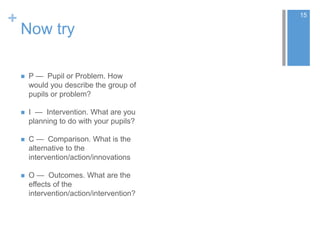
The PICO format
 P — Pupil or Problem. How would you describe
the group of pupils or problem?
 I — Intervention. What are you planning to do
with your pupils?
 C — Comparison. What is the alternative to the
intervention/action/innovations
 O — Outcomes. What are the effects of the
intervention/action/intervention?
+
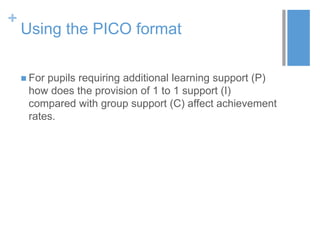
Using the PICO format
 For pupils requiring additional learning support (P)
how does the provision of 1 to 1 support (I)
compared with group support (C) affect achievement
rates.
+
Now try
 P — Pupil or Problem. How
would you describe the group of
pupils or problem?
 I — Intervention. What are you
planning to do with your pupils?
 C — Comparison. What is the
alternative to the
intervention/action/innovations
 O — Outcomes. What are the
effects of the
intervention/action/intervention?
15
+
Acquiring the evidence
16
+
What to do if you cannot access
journal articles
 Use Google Scholar
 Use Twitter
 Contact the author
17
+
Appraising the evidence
18
+
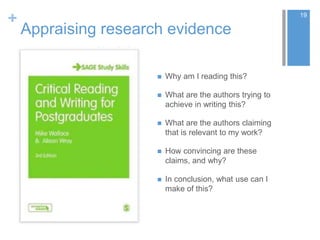
Appraising research evidence
 Why am I reading this?
 What are the authors trying to
achieve in writing this?
 What are the authors claiming
that is relevant to my work?
 How convincing are these
claims, and why?
 In conclusion, what use can I
make of this?
19
+
Aggregating the evidence
20
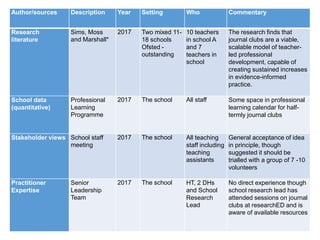
21Author/sources Description Year Setting Who Commentary
Research
literature
Sims, Moss
and Marshall*
2017 Two mixed 11-
18 schools
Ofsted -
outstanding
10 teachers
in school A
and 7
teachers in
school
The research finds that
journal clubs are a viable,
scalable model of teacher-
led professional
development, capable of
creating sustained increases
in evidence-informed
practice.
School data
(quantitative)
Professional
Learning
Programme
2017 The school All staff Some space in professional
learning calendar for half-
termly journal clubs
Stakeholder views School staff
meeting
2017 The school All teaching
staff including
teaching
assistants
General acceptance of idea
in principle, though
suggested it should be
trialled with a group of 7 -10
volunteers
Practitioner
Expertise
Senior
Leadership
Team
2017 The school HT, 2 DHs
and School
Research
Lead
No direct experience though
school research lead has
attended sessions on journal
clubs at researchED and is
aware of available resources
+
Acting on the evidence
22
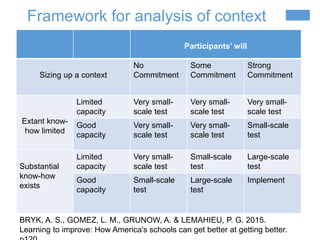
Framework for analysis of context
Participants’ will
Sizing up a context
No
Commitment
Some
Commitment
Strong
Commitment
Extant know-
how limited
Limited
capacity
Very small-
scale test
Very small-
scale test
Very small-
scale test
Good
capacity
Very small-
scale test
Very small-
scale test
Small-scale
test
Substantial
know-how
exists
Limited
capacity
Very small-
scale test
Small-scale
test
Large-scale
test
Good
capacity
Small-scale
test
Large-scale
test
Implement
BRYK, A. S., GOMEZ, L. M., GRUNOW, A. & LEMAHIEU, P. G. 2015.
Learning to improve: How America's schools can get better at getting better.
+
Assessing the research
evidence?
24
+
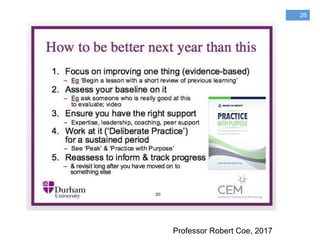
After-Action-Review
 What did we set out to do?
 What actually happened?
 Why did it happen?
 What are we going to do next time?
25
26
Professor Robert Coe, 2017
+
In summary
 Evidence-based practice is ethically essential within SEND
 But significant challenges to its adoption – time, money, skill,
motivation, opportunity
 Some reasonably straightforward techniques which anyone can
use to help make decisions evidence-based
27
+
@DrGaryJones
jones.gary@gmail.com
http://evidencebasededucationalleadership.blogspot.com

ResearchSEND - Becoming an Evidence based SENCO - 18.11.2017

  • 1.
    + Dr Gary Jones- @DrGaryJones – jones.gary@gmail.com https://evidencebasededucationalleadership.blogspot.com Becoming an evidence-based SENCO – six steps to making evidence-based decisions researchSEND, Saturday 18 November, 2017
  • 2.
    + By the endof this session I hope to have provided you with  A brief overview of Effective SEN support: research evidence on effective approaches and examples of current practice in good and outstanding schools and colleges  A comprehensive definition of evidence-based practice  An awareness of common misconceptions about evidence- based practice  Highlight a number of techniques/tools that you can use to make decisions based on the best available evidence  A stimulating 30 minute session 2
  • 3.
    + Key message  Evidence-basedpractice is ethically essential within SEND  But significant challenges to its adoption – time, money, skill, motivation, opportunity  Some reasonably straightforward techniques which anyone can use to help make decisions evidence-based 3
  • 4.
    +  1. Inclusiveculture, leadership and management  2. High quality teaching  3. Use of expertise  4. Personalisation  5. Flexible use of evidence- based strategies  6. Progress tracking  7. Communication and collaboration 4
  • 5.
    + The only definitionof evidence- based practice you will ever need 5
  • 7.
    7 BARENDS, E., ROUSSEAU,D. & BRINER, R. 2014. Evidence-Based Management : The Basic Principles. Amsterdam: Center for Evidence-Based Management.
  • 8.
  • 9.
  • 10.
    + Common misconceptions about EBP Evidence-based practice ignores the expertise and knowledge of teachers and head-teachers.  Evidence-based practice is the same as research-based practice  Evidence-based practice involves teachers undertaking research
  • 11.
  • 12.
  • 13.
    + The PICO format P — Pupil or Problem. How would you describe the group of pupils or problem?  I — Intervention. What are you planning to do with your pupils?  C — Comparison. What is the alternative to the intervention/action/innovations  O — Outcomes. What are the effects of the intervention/action/intervention?
  • 14.
    + Using the PICOformat  For pupils requiring additional learning support (P) how does the provision of 1 to 1 support (I) compared with group support (C) affect achievement rates.
  • 15.
    + Now try  P— Pupil or Problem. How would you describe the group of pupils or problem?  I — Intervention. What are you planning to do with your pupils?  C — Comparison. What is the alternative to the intervention/action/innovations  O — Outcomes. What are the effects of the intervention/action/intervention? 15
  • 16.
  • 17.
    + What to doif you cannot access journal articles  Use Google Scholar  Use Twitter  Contact the author 17
  • 18.
  • 19.
    + Appraising research evidence Why am I reading this?  What are the authors trying to achieve in writing this?  What are the authors claiming that is relevant to my work?  How convincing are these claims, and why?  In conclusion, what use can I make of this? 19
  • 20.
  • 21.
    21Author/sources Description YearSetting Who Commentary Research literature Sims, Moss and Marshall* 2017 Two mixed 11- 18 schools Ofsted - outstanding 10 teachers in school A and 7 teachers in school The research finds that journal clubs are a viable, scalable model of teacher- led professional development, capable of creating sustained increases in evidence-informed practice. School data (quantitative) Professional Learning Programme 2017 The school All staff Some space in professional learning calendar for half- termly journal clubs Stakeholder views School staff meeting 2017 The school All teaching staff including teaching assistants General acceptance of idea in principle, though suggested it should be trialled with a group of 7 -10 volunteers Practitioner Expertise Senior Leadership Team 2017 The school HT, 2 DHs and School Research Lead No direct experience though school research lead has attended sessions on journal clubs at researchED and is aware of available resources
  • 22.
    + Acting on theevidence 22
  • 23.
    Framework for analysisof context Participants’ will Sizing up a context No Commitment Some Commitment Strong Commitment Extant know- how limited Limited capacity Very small- scale test Very small- scale test Very small- scale test Good capacity Very small- scale test Very small- scale test Small-scale test Substantial know-how exists Limited capacity Very small- scale test Small-scale test Large-scale test Good capacity Small-scale test Large-scale test Implement BRYK, A. S., GOMEZ, L. M., GRUNOW, A. & LEMAHIEU, P. G. 2015. Learning to improve: How America's schools can get better at getting better.
  • 24.
  • 25.
    + After-Action-Review  What didwe set out to do?  What actually happened?  Why did it happen?  What are we going to do next time? 25
  • 26.
  • 27.
    + In summary  Evidence-basedpractice is ethically essential within SEND  But significant challenges to its adoption – time, money, skill, motivation, opportunity  Some reasonably straightforward techniques which anyone can use to help make decisions evidence-based 27
  • 28.

Editor's Notes

  • #24 Apply different to school – Very-small – volunteers – small scale – department – large-scale – year group or key stage – implement – whole school