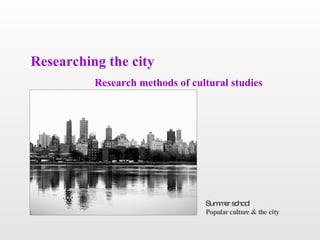
Researching the city
          Research methods of cultural studies


                                 Sum e s ho l
                                     mr c o
                                 Popular culture & the city
Teaser
•   Interest in culture, i.e. processes of
    meaning making
•   But this culture is not necessarily our own
    (in terms of class, ethnicity, age, gender,
    sexuality etc).
•   And we are aware of our and their
    particular position in the socio-political
    landscape
Outline
•       Qualitative research methods
    •     The nature of…
    •     Doing participant observation
    •     Other forms of qualitative research
2. Doing cultural studies (discussion)
    •     Distaste for rules
    •     Interdisciplinary nature
3. A bit about me…
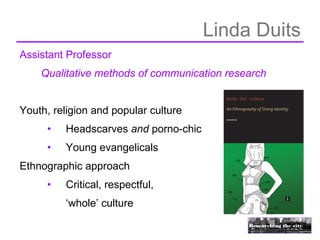
Linda Duits
Assistant Professor
    Qualitative methods of communication research


Youth, religion and popular culture
     •   Headscarves and porno-chic
     •   Young evangelicals
Ethnographic approach
     •   Critical, respectful,
         ‘whole’ culture
Lecture
•       Qualitative research methods
    •     The nature of…
    •     Doing participant observation
    •     Other forms

    •     What do you want to research?
    •     Why would you want to do this?
    •     How can you do this?
doing research   What?
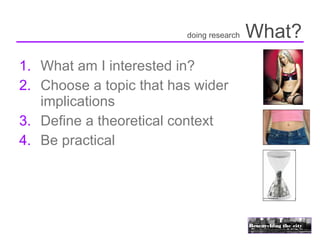
1. What am I interested in?
2. Choose a topic that has wider
   implications
3. Define a theoretical context
4. Be practical
doing research   Why?

• Because you have to (i.e. contractor)
• For political reasons  cultural studies

• Societal relevance
• Scientific relevance
doing research   How?
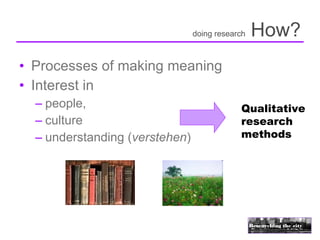
• Processes of making meaning
• Interest in
  – people,                                 Qualitative
  – culture                                 research
  – understanding (verstehen)               methods
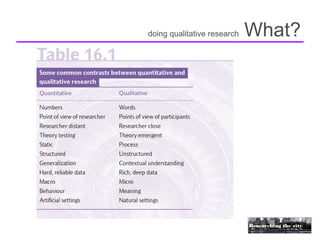
doing qualitative research   What?
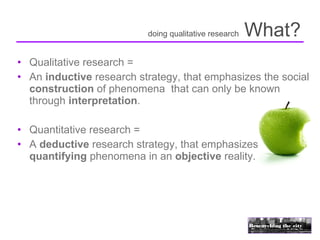
• Qualitative research =
• An inductive research strategy, that emphasizes the social
  construction of phenomena that can only be known
  through interpretation.

• Quantitative research =
• A deductive research strategy, that emphasizes
  quantifying phenomena in an objective reality.
doing qualitative research   Why?

• Induction
 =   theory derives from research
• Construction (ontology)
 =   social properties are outcomes of interactions
• Interpretation (epistemology)
 =   how people make sense of their social world
doing qualitative research   How?

• Seeing through the eyes of those you
  study
• Description of and emphasis on context
• Emphasis on process
• Flexibility and limited structure
• Concepts and theory they are grounded in
  data
 Using qualitative research methods
doing participant observation   What?
• Method of data collection where the
  researcher immerses him/herself for a
  prolonged period of time in a social
  setting
• It implies
  – Participation
     • Get active
     • Talk
  – Observation
     • Look
     • Listen
doing participant observation   Why?
• Emphasis on data derived in context
• Analysis of what people do and of what
  people say (triangulation)
• Relevant for those interested in culture
  (i.e. groups, group processes etc instead
  of individuals – compare psychology and
  sociology)
doing participant observation   How?
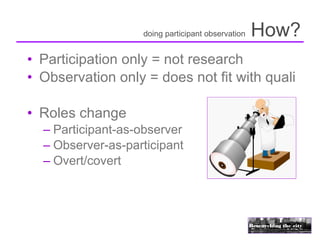
• Participation only = not research
• Observation only = does not fit with quali

• Roles change
  – Participant-as-observer
  – Observer-as-participant
  – Overt/covert
doing participant observation   How?
Topic list

• Research always start with a RQ
• Research question
   areas of interest
   subquestions

What do you want to know?
What will you look/listen/ask for?
doing participant observation   How?
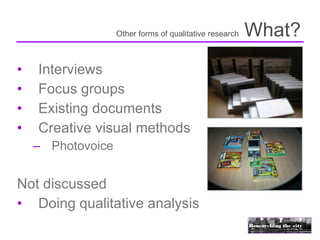
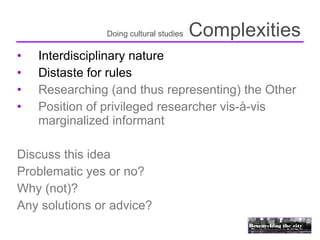
Other forms of qualitative research   What?
•   Interviews
•   Focus groups
•   Existing documents
•   Creative visual methods
    – Photovoice


Not discussed
• Doing qualitative analysis
Doing cultural studies   Complexities
•   Interdisciplinary nature
•   Distaste for rules
•   Researching (and thus representing) the Other
•   Position of privileged researcher vis-à-vis
    marginalized informant

Discuss this idea
Problematic yes or no?
Why (not)?
Any solutions or advice?
Conclusion
You now know:
• What qualitative research entails (globally)
• When to chose participant observation
You are now able to:
• Start your (first) participant observation
• Discuss the peculiarities of doing cultural
  studies research
More resources
•   Recommended reading
    Practical, clear instructions
    Davis, A. (2008). Investigating cultural producers.
    Meyer, A. (2008). Investigating cultural consumers.


•   Website Bryman book
    http://www.oup.com/uk/orc/bin/9780199202959/


    See you soon!

Researching The City

  • 1.
    Researching the city Research methods of cultural studies Sum e s ho l mr c o Popular culture & the city
  • 2.
    Teaser • Interest in culture, i.e. processes of meaning making • But this culture is not necessarily our own (in terms of class, ethnicity, age, gender, sexuality etc). • And we are aware of our and their particular position in the socio-political landscape
  • 3.
    Outline • Qualitative research methods • The nature of… • Doing participant observation • Other forms of qualitative research 2. Doing cultural studies (discussion) • Distaste for rules • Interdisciplinary nature 3. A bit about me…
  • 4.
    Linda Duits Assistant Professor Qualitative methods of communication research Youth, religion and popular culture • Headscarves and porno-chic • Young evangelicals Ethnographic approach • Critical, respectful, ‘whole’ culture
  • 5.
    Lecture • Qualitative research methods • The nature of… • Doing participant observation • Other forms • What do you want to research? • Why would you want to do this? • How can you do this?
  • 6.
    doing research What? 1. What am I interested in? 2. Choose a topic that has wider implications 3. Define a theoretical context 4. Be practical
  • 7.
    doing research Why? • Because you have to (i.e. contractor) • For political reasons  cultural studies • Societal relevance • Scientific relevance
  • 8.
    doing research How? • Processes of making meaning • Interest in – people, Qualitative – culture research – understanding (verstehen) methods
  • 9.
  • 10.
    doing qualitative research What? • Qualitative research = • An inductive research strategy, that emphasizes the social construction of phenomena that can only be known through interpretation. • Quantitative research = • A deductive research strategy, that emphasizes quantifying phenomena in an objective reality.
  • 11.
    doing qualitative research Why? • Induction = theory derives from research • Construction (ontology) = social properties are outcomes of interactions • Interpretation (epistemology) = how people make sense of their social world
  • 12.
    doing qualitative research How? • Seeing through the eyes of those you study • Description of and emphasis on context • Emphasis on process • Flexibility and limited structure • Concepts and theory they are grounded in data  Using qualitative research methods
  • 13.
    doing participant observation What? • Method of data collection where the researcher immerses him/herself for a prolonged period of time in a social setting • It implies – Participation • Get active • Talk – Observation • Look • Listen
  • 14.
    doing participant observation Why? • Emphasis on data derived in context • Analysis of what people do and of what people say (triangulation) • Relevant for those interested in culture (i.e. groups, group processes etc instead of individuals – compare psychology and sociology)
  • 15.
    doing participant observation How? • Participation only = not research • Observation only = does not fit with quali • Roles change – Participant-as-observer – Observer-as-participant – Overt/covert
  • 16.
    doing participant observation How? Topic list • Research always start with a RQ • Research question  areas of interest  subquestions What do you want to know? What will you look/listen/ask for?
  • 17.
  • 18.
    Other forms ofqualitative research What? • Interviews • Focus groups • Existing documents • Creative visual methods – Photovoice Not discussed • Doing qualitative analysis
  • 19.
    Doing cultural studies Complexities • Interdisciplinary nature • Distaste for rules • Researching (and thus representing) the Other • Position of privileged researcher vis-à-vis marginalized informant Discuss this idea Problematic yes or no? Why (not)? Any solutions or advice?
  • 20.
    Conclusion You now know: •What qualitative research entails (globally) • When to chose participant observation You are now able to: • Start your (first) participant observation • Discuss the peculiarities of doing cultural studies research
  • 21.
    More resources • Recommended reading Practical, clear instructions Davis, A. (2008). Investigating cultural producers. Meyer, A. (2008). Investigating cultural consumers. • Website Bryman book http://www.oup.com/uk/orc/bin/9780199202959/ See you soon!