Internet and Higher Education 14 (2011) 3–9


                                                                  Contents lists available at ScienceDirect


                                                         Internet and Higher Education


The Internet and teacher education: Traversing between the digitized
world and schools
Ching Sing Chai a, Cher Ping Lim b,⁎
a
    National Institute of Education, Nanyang Technological University, 1 Nanyang Walk, Singapore 637616, Singapore
b
    Hong Kong Institute of Education, 10 Lo Ping Road, Tai Po, New Territories, Hong Kong


a r t i c l e           i n f o                           a b s t r a c t

Keywords:                                                 In the face of rapid technological and economic developments globally, pre-service teacher education
Pre-service teacher education                             programs in the Asia-Pacific region are challenged to prepare teachers who are open to new ideas, new
Constructivist teaching and learning practices            practices and information and communication technologies (ICT), to learn how to learn, unlearn and relearn,
Teacher agency                                            and to understand and accept the need for change. Extending Popper's (1978) framework of the three
                                                          worlds — the physical world as World 1, the mental world as World 2, and the world of products of human
                                                          ideas as World 3 — this paper examines how teachers may assume agency to mediate the tensions and
                                                          opportunities between these worlds in order to chart possible developmental trajectories that may provide
                                                          future directions for pre-service teacher education. With respect to the use of ICT for teaching and learning,
                                                          pre-service teacher education programs are then expected to move pre-service teachers away from learning
                                                          specific ICT application and towards learning how to learn, and more important, moving towards a
                                                          commitment to constructivist-oriented teaching and learning practices.
                                                                                                                               © 2010 Elsevier Inc. All rights reserved.


    The rapid development of information and communication tech-                             envisioned by policymakers. They may be categorized into exogenous/
nologies (ICT), in particular web-based technologies and the Internet,                       contextual or endogenous/personal factors. Assessment system, curric-
has enabled more and more people to live in an increasingly inter-                           ular structure, school policies and resources availability are common
connected world. The connection is more than just social in nature.                          contextual factors, and teachers' skills, values, knowledge and beliefs are
More importantly, knowledge, ideas, and expertise are now easily                             some personal factors that may encourage or hinder teachers' use of ICT
linked and spanned to form new ideas and practices. The rate at which                        in the classroom (Hew & Brush, 2007). Therefore, more effort has to be
new ideas and consequently new products are created is faster than                           made to build the capacity of teachers and to support them to assume
any individuals can handle. This key characteristic of the purported                         the role of change agents in the school context.
knowledge society inevitably challenges traditional notion of school-                            Drawing upon Popper's (1978) framework of the three worlds, this
ing. Many education researchers have argued that the premises of                             paper first identifies and examines the key competencies that
schooling have shifted and schools should be remodeled to fit the                             beginning teachers need to take up the affordances of ICT to facilitate
knowledge society (Bereiter & Scardamalia, 2006; Greenhow, Robelia,                          students' development of 21st century skills. The identification of
& Hughes, 2009; Jonassen, Howland, Marra, & Crismond, 2008;                                  these key competencies would then generate the implications for the
Sawyer, 2006). While the calls from these researchers have informed                          design of pre-service teacher education programs. Popper's idea of the
policymakers in many countries to equip schools with ICT and to                              three worlds comprises the physical world as World 1, the mental
provide teachers and school leaders with professional development,                           world as World 2, and the world of products of human ideas as World
the shift towards constructivist-oriented pedagogies is still not a                          3. Analyzing the dilemmas that he faces from the tensions arising
salient feature in school (Laurillard, 2008; Lim & Chai, 2008; Selwyn,                       between these three evolving worlds, Teo (2009), an experienced
2008). Many teachers are still using ICT to support traditional                              teacher from Singapore reflects upon his identity in the demanding
teaching or are generally doubtful about the effectiveness of ICT to                         tides of reforms in the society vis-à-vis the school. Extending his work
mediate teaching and learning practices.                                                     and that of Bereiter (1994), this paper examines how teachers may
    Researchers have identified several interacting factors that may                          assume agency to mediate the tensions and opportunities among
explain why ICT has not brought about pedagogical changes as                                 these worlds so as to chart some possible developmental trajectories
                                                                                             that may provide future directions for pre-service teacher education.
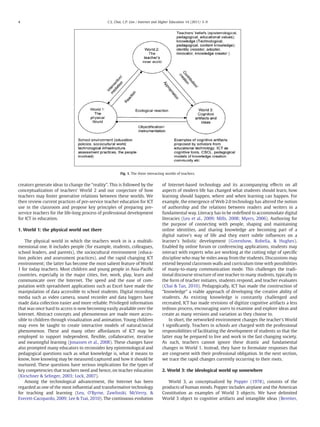
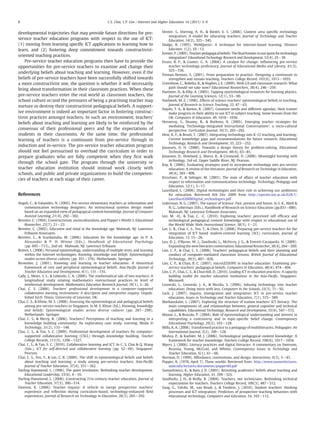
                                                                                             Fig. 1 is a visual representation of the adapted framework that guides
  ⁎ Corresponding author. Tel.: +65 98635742.
                                                                                             the discussion for the rest of this paper.
    E-mail addresses: Chingsing.chai@nie.edu.sg (C.S. Chai), cherping_lim@hotmail.com            In the following sections, we first describe World 1 where teachers
(C.P. Lim).                                                                                  operate in and World 3 where researchers and other knowledge

1096-7516/$ – see front matter © 2010 Elsevier Inc. All rights reserved.
doi:10.1016/j.iheduc.2010.04.003
4                                              C.S. Chai, C.P. Lim / Internet and Higher Education 14 (2011) 3–9


                                                       Fig. 1. The three interacting worlds of teachers.


creators generate ideas to change the “reality”. This is followed by the          of Internet-based technology and its accompanying effects on all
conceptualization of teachers' World 2 and our conjecture of how                  aspects of modern life has changed what students should learn, how
teachers may foster generative relations between these worlds. We                 learning should happen, where and when learning can happen. For
then review current practices of pre-service teacher education for ICT            example, the emergence of Web 2.0 technology has altered the notion
use in the classroom and propose key principles of preparing pre-                 of authorship and the relations between readers and writers in a
service teachers for the life-long process of professional development            fundamental way. Literacy has to be redefined to accommodate digital
for ICT in education.                                                             literacies (Leu et al., 2009; Mills, 2008; Myers, 2006). Authoring for
                                                                                  the purpose of connecting with people, shaping and maintaining
1. World 1: the physical world out there                                          online identities, and sharing knowledge are becoming part of a
                                                                                  digital native's way of life and they exert subtle influences on a
    The physical world in which the teachers work in is a multidi-                learner's holistic development (Greenhow, Robelia, & Hughes).
mensional one. It includes people (for example, students, colleagues,             Enabled by online forum or conferencing applications, students may
school leaders, and parents), the sociocultural environment (educa-               interact with experts who are working at the cutting edge of specific
tion policies and assessment practices), and the rapid changing ICT               discipline who may be miles away from the students. Discussions may
environment; the latter has become the most salient feature of World              extend beyond classroom walls and curriculum time with possibilities
1 for today teachers. Most children and young people in Asia-Pacific               of many-to-many communication mode. This challenges the tradi-
countries, especially in the major cities, live, work, play, learn and            tional discourse structure of one teacher to many students, typically in
communicate over the Internet. The speed and the ease of com-                     the form of teacher initiates, students respond, and teacher evaluates
putation with spreadsheet applications such as Excel have made the                (Chai & Tan, 2010). Pedagogically, ICT has made the construction of
manipulation of data accessible to school students. Digital recording             “knowledge” a viable approach of developing the creative ability of
media such as video camera, sound recorder and data loggers have                  students. As existing knowledge is constantly challenged and
made data collection easier and more reliable. Privileged information             recreated, ICT has made revisions of digitize cognitive artifacts a less
that was once hard to access is now becoming easily available over the            tedious process, encouraging users to examine and explore ideas and
Internet. Abstract concepts and phenomenon are made more acces-                   create as many versions and variation as they choose to.
sible to children through visualization and animation. Young children                 In short, the networked environment changes the teacher's World
may even be taught to create interactive models of natural/social                 1 significantly. Teachers in schools are charged with the professional
phenomenon. These and many other affordances of ICT may be                        responsibilities of facilitating the development of students so that the
employed to support independent, flexible, collaborative, iterative                latter may be prepared to live and work in the fast changing society.
and meaningful learning (Jonassen et al., 2008). These changes have               As such, teachers cannot ignore these drastic and fundamental
also prompted many educators to reconsider key epistemological and                changes in World 1. Instead, they have to formulate responses that
pedagogical questions such as what knowledge is, what it means to                 are congruent with their professional obligation. In the next section,
know, how knowing may be measured/captured and how it should be                   we trace the rapid changes currently occurring to their roots.
nurtured. These questions have serious implications for the types of
key competencies that teachers need and hence, on teacher education               2. World 3: the ideological world up somewhere
(Kirschner & Selinger, 2003; Lock, 2007).
    Among the technological advancement, the Internet has been                       World 3, as conceptualized by Popper (1978), consists of the
regarded as one of the most influential and transformative technology              products of human minds. Popper includes airplane and the American
for teaching and learning (Leu, O'Byrne, Zawlinski, McVerry, &                    Constitution as examples of World 3 objects. We have delimited
Everett-Cacopardo, 2009; Lee & Tsai, 2010). The continuous evolution              World 3 object to cognitive artifacts and intangible ideas (Bereiter,
C.S. Chai, C.P. Lim / Internet and Higher Education 14 (2011) 3–9                                            5


1994), which is a subset of Popper original's conception. When the                scientists are attempting to make sense of. We propose that the
ideas produced by man are concretized/objectified to become physical               teachers' phenomenological world may be organized into two inter-
objects, we relegate them as part of the physical world; they become              acting dimensions of beliefs and knowledge. The beliefs and knowledge
physical objects that teachers and students may interact with. In                 are sensitive to the sociocultural and political contexts (Chai, Teo, & Lee,
addition, when ideas are converted into physical objects, the objects             2009; Hammer & Elby, 2003), and teachers' decisions in terms of how
are more or less cast in its form but the ideas behind the objects                they relate to World 1 and World 3 are determined partially by the
remain as improvable ideas for further refinement. World 3 in this                 existing meaning structure (which is a combination of their beliefs and
paper refers to the improvable ideas that are essential for the                   knowledge) within them, and the moment-to-moment discursive
continuous growth of the knowledge society (Bereiter, 2002). All                  decisions that the teachers make by exerting their epistemic agency.
things that are part of culture, in contrast to nature, originate from                Among the myriad beliefs that may influence teachers' use of ICT, we
World 3. Prior to the digital age, the main tools for working on World            consider teachers' epistemological and pedagogical beliefs as core
3 objects for its own evolvement are what Vygotsky (1978) refers to               beliefs that warrant further attention. Education researchers recognize
as psychological tools such as language and symbols. The invention of             that epistemology is an important field of philosophy that examines
the computers has now greatly enhanced human's work in World 3                    critically the theories about the nature and justification of knowledge.
due to the various affordances of computers that are designed to                  Hofer and Pintrich (1997) proposed that the core construct of epistemic
support and enhance human cognition. As World 3 objects are being                 belief to be composed of “certainty of knowledge, simplicity of
physically objectified, they enter World 1 and interact with existing              knowledge, source of knowledge, and justification of knowledge”
World 1 objects. As a result, there are ecological reactions that may             (ibid, p.133). Individual epistemic beliefs are related to many constructs
provide important information for the improvement of World 3 ideas.               that are related to learning. These constructs include deep or surface
The Internet has provided a public residence that may allow World 3               approaches to learning, students' performance on controversial issues,
objects to be more available for teachers and students to participate in          self-regulated learning, Internet-based learning and etc (Braten, 2008;
the process of improving them.                                                    Brownlee, 2001; Mason & Boscolo, 2004). Given that the Internet is used
    Other than ideas that have the potential to be converted into                 widely by all who have access to it to search for information for a variety
technological objects that change teachers' World 1, many ideas about             of purposes, Tsai (2008) points out the importance of employing the
how ICT may be employed to change classroom teaching and learning                 Internet not only as a cognitive and metacognitive tool but also as an
practices have also been created. These ideas include Dodge (1995)                epistemological tool. He emphasizes the importance of enhancing
proposal of engaging students in web-based inquiry-oriented activ-                students' epistemological development by engaging them in question-
ities, Scardamalia and Bereiter (2006) proposal of engaging students              ing the epistemic value of the information found on the Internet. Chai
in knowledge building community, and Jonassen et al. (2008)                       (2006) study on teachers' epistemological beliefs suggests that teachers'
proposal of using ICT as cognitive tools to support meaningful                    epistemological beliefs are related to the depth of their discussion in
learning. Jonassen (2000) explains how students may form intellec-                Knowledge Forum. It is therefore important to enrich teachers'
tual partnership with ICT tools. Low level mechanistic cognitive tasks            epistemological beliefs to use the Internet effectively for their own
such as memorization, tedious computation, and record keeping may                 learning and teaching practices.
be dedicated to computers. Students then engage in higher order                       Studies have shown that epistemological beliefs are significantly
thinking activities such as theorizing, hypothesizing, and predicting.            related to teachers' pedagogical beliefs and their practices in the
Jonassen et al. (2008) have documented myriad examples and studies                classroom (Chai & Khine, 2008; Ertmer, 2005; Hashweh, 1996;
of how different ICT applications may be employed as cognitive tools              Samuelowicz & Bain, 2001; Wong, Chan, & Lai, 2009). These studies
to support students' active and collaborative knowledge construction.             categorize beliefs along the continuum of traditional/transmissive
    Scardamalia and Bereiter (2006), on the other hand, have provided             approach and the progressive/constructivist approach. While tea-
many case studies on how students may engage in collaborative                     chers' epistemological beliefs are related to teachers' pedagogical
knowledge building in classroom communities. Students' efforts in                 beliefs, the latter is related to teachers' beliefs about the traditional or
dealing with authentic problems within the knowledge building                     constructivist use of ICT in the classroom (Teo, Chai, Hung, & Lee,
community are supported by asynchronous multimedia databases                      2008). Sang, Valcke, van Braak, and Tondeur (2010) have also
named Knowledge Forum. Scardmalia and Bereiter's research indicate                reported that teachers' constructivist beliefs and teachers' computer
the possibilities of empowering young students to carry out creative              self-efficacy are predictors of teachers' willingness to use ICT. That is,
knowledge work mediated by ICT. These pedagogical models are                      teachers with constructivist-oriented pedagogical beliefs are more
generally based on sociocultural theories of learning that perceive               motivated to use ICT. The relationship between teachers' beliefs and
learning as an intra-mental and interpersonal process of interacting              how they use ICT in the classroom may or may not be a direct one. Lim
with the environment (Vygotsky, 1978). Many recent ideas such as                  and Chai (2008) report in their study that teachers' espoused beliefs
distributed expertise, community of practice, activity theory and                 may be different form their practice due to various reasons; one
situated learning have provided the theoretical framework for ICT and             possible one may be teachers' knowledge.
web-based pedagogical models.                                                         Building on the notion of pedagogical content knowledge, educa-
    While education researchers continuously invent and refine                     tion researchers have argued that integrating ICT into teaching and
pedagogical ideas that may bring forth more fruitful way of using                 learning practices requires more than technological, pedagogical and
ICT in classrooms, schools are generally lagging behind in adopting               content knowledge; these three forms of knowledge have to be
and implementing these ideas. Due to teachers' relationships with                 integrated as Technological Pedagogical Content Knowledge (TPCK)
World 3 objects and their roles in mediating between World 1 and                  (Angeli & Valanides, 2005; Mishra & Koehler, 2006). For example, a
World 3, many educators recognize the importance of teachers'                     Mathematics teacher needs to understand the key concepts of statistic
participation in the process of creating pedagogical ideas and models.            (content knowledge), operate Excel software (technological knowl-
The quality of such mediation by teachers pivots upon their World 2.              edge) and craft an authentic problem for a particular group of
                                                                                  students (pedagogical knowledge) in order for him/her to engage
3. World 2: the inner world of the teachers                                       students in ICT-enhanced problem-based learning. This form of
                                                                                  knowledge is highly contextualized since the key concepts that the
   The inner/mental world of teachers is the phenomenological world               teacher should target, the type of ICT tool he/she should employ and
that they experience the exogenous World 1 and World 3. This is an                the scenario or problems that the teacher should design to ensure
infinitely complex world that educational psychologists and learning               authenticity are dependent on the teacher's understanding of World 1
6                                                       C.S. Chai, C.P. Lim / Internet and Higher Education 14 (2011) 3–9


that he/she works in. While Mishra and Koehler (2006) and Angeli                           refinement (World 3). To develop this set of competencies, more than
and Valanides (2005) have advocated that engaging teachers in                              one course/unit is required in the pre-service teacher education
designing learning with ICT may build teachers' TPCK, So and Kim                           program. Many pre-service teacher education courses on ICT are more
(2009) research indicates that it is not easy for pre-service teachers to                  inclined to focus explicitly on the first two worlds, with World 3 being
design authentic and engaging problems. Constructivist-oriented                            neglected or implicitly addressed. In this section, we first summarize
teaching is less structured than traditional teaching and usually                          the key findings of a recent review of ICT courses for pre-service
demands a higher degree of knowledge and skills for teachers to                            teachers and analyze the reviews based on our three world
negotiate the challenges it poses (Windschitl, 2002).                                      framework. The discussion will inform our proposed design for an
    While teachers' beliefs and teachers' knowledge may be separated                       ICT in education curriculum for pre-service teachers.
conceptually, teachers operate as a person with general educational
goals and specific objectives in real life. As such, we may subsume
                                                                                           4.1. Review of existing ICT in education courses
teachers' beliefs and knowledge, and other of their attributes, under
the more encompassing construct of teachers' identity. In relation to
                                                                                               The importance of ICT has prompted most teacher education
the use of ICT, teachers can and do assume different identities. In the
                                                                                           institutes (TEIs) to conduct at least one introductory course on educa-
past, teachers have been characterized by educational technologists as
                                                                                           tional technology for pre-service teachers. Such course typically
obstinate resistor to change (Selwyn, Dawes, & Mercer, 2001). Recent
                                                                                           introduces constructivist-oriented teaching approaches supported by
studies however indicate that teachers generally are beginning to
                                                                                           a range of ICT tools. Course delivery strategies include lectures, demon-
recognize the educational value of incorporating ICT into classroom
                                                                                           stration, hands-on, individual assignments, group work, and online
teaching and learning practices (Hennessy et al., 2005). However,
                                                                                           communication (Kay, 2006). Constructivist-oriented approaches, such
teachers are cautious and critical toward ICT in education; while they
                                                                                           as problem-based, project-based and inquiry-based learning, are
recognize that ICT skills are core skills for students' benefits in a world
                                                                                           commonly advocated to foster pre-service teachers' understanding of
where technology is pervasive, they are reluctant to adopt ICT just for
                                                                                           the affordances of ICT for teaching and learning (see for example, Lee,
the sake of it (ibid).
                                                                                           Chai, Teo, & Chen, 2008; ; Lisowski, Lisowski, & Nicolia, 2006; Lock,
    Based on the research of the Apple Classroom of Tomorrow (ACOT)
                                                                                           2007). To develop ICT in education competencies, reported activities
project, Sandholtz and Reilly (2004) delineate the five stages of ICT
                                                                                           include workshops, self-learning with TEI support, and peer coaching.
integration into the classroom. Table 1 provides the description of each
                                                                                           As for the forms of learning, Haydn and Barton (2007) study indicates
stage of ICT integration. These stages were derived from the grounded
                                                                                           that pre-service teachers' “accounts of significant moments in their
theory perspective. They described what the teachers' concerns were
                                                                                           progress in using ICT related to seeing things modeled, face-to-face
and how teachers characterized their relationship with technology.
                                                                                           encounters, and working collaboratively with others, learning from each
Building on their work, we include a column on teacher's identity
                                                                                           other.” (p. 1030). Instructors/mentors' modeling and collaborative
evolution to serve as a description of an ideal teacher development
                                                                                           learning strategies are therefore important for building the capacity of
trajectory.
                                                                                           pre-service teachers to use ICT in the classroom. As for assessing pre-
    Constructivist-oriented teaching practices require teachers to be
                                                                                           service teachers' learning outcomes, two broad areas are reported.
“practical intellectuals, curriculum developers, and generators of
                                                                                           The first area pertains to the teachers' ICT competencies and their use of
knowledge in practice” (Feiman-Nemser, 2001, p.1015). Engaging
                                                                                           ICT in classrooms (World 1). The second area measures teachers'
teachers in serious and sustained conversation in a learning commu-
                                                                                           attitude and beliefs towards use of ICT and their pedagogical reasoning
nity is necessary for such change to take place (ibid). The fulfillment of
                                                                                           (World 2). Artifacts analysis, surveys, short argumentative or reflective
the trajectory described should be the joint venture of teacher edu-
                                                                                           papers and classroom observations have all been employed to assess
cators and the teachers.
                                                                                           teachers' learning. Generally, the evaluation of such courses reported in
    With this comprehensive understanding of teachers' activities
                                                                                           literature suggests that they enhance pre-service teachers' self-efficacy
with respect to these three worlds, implications may be generated to
                                                                                           in using ICT for teaching and learning (see Kay, 2006; Lim, Chai, &
inform the design of pre-service teachers' ICT in education curriculum.
                                                                                           Churchill, 2010). Analyses of pre-service teachers' performances show
                                                                                           that they are capable of generating potentially fruitful ideas that may
                                                                                           enhance students' learning (Dexter, Doering, & Riedel, 2006); implying
4. Considerations for ICT in education in pre-service
                                                                                           that pre-service teachers have the potential to enrich World 3 ideas.
teacher education

   Based on the above review, it is clear that educating teachers to                       4.2. Design implications for pre-service teacher education program
integrate ICT in their classrooms is a complex and messy task.
Teachers are required to a) use ICT competently and manage the                                 The foregoing discussion highlighted two key challenges that
complexities of the ICT-enhanced classrooms (World 1), b) possess                          teacher educators faced: (1) moving from learning specific ICT appli-
appropriate beliefs, TPCK and a sense of one's developing identity                         cations to learning how to learn, and (2) fostering deep commitment
(World 2); c) appropriate pedagogical ideas and contribute to their                        towards constructivist-oriented teaching practices. In the design of pre-


Table 1
Stages of instructional and identity evolution in ICT-enhanced classrooms.
Adapted from Sandholtz and Reilly (2004), p.491.

    Stages                        Teacher's Identity                     Descriptions

    Entry                         Novice                                 Learning the fundamentals of using ICT; technical and pedagogical issues dominate
    Adoption                      Adopter                                Successfully using ICT on a basic level in ways consistent with traditional teaching practices;
                                                                         teaching students to use computers
    Adaptation                    Routine user                           Use ICT to increase productivity. More frequent and purposeful use, but little change in the
                                                                         didactic approach; more instructional software and open tools are being used
    Appropriation                 Integrated user                        Can't live and work without computers; Use ICT “effortlessly” as a tool to achieve multiple job goals
    Invention                     Emerging innovator                     Use ICT as a flexible tool in the classroom. Learning is more collaborative, interactive and customized;
                                                                         new teaching and learning practices emerge
C.S. Chai, C.P. Lim / Internet and Higher Education 14 (2011) 3–9                                           7


service teacher education program, teacher educators have to address                   Explicit approaches to scaffold belief development have been
these challenges.                                                                  reported as being more effective than implicit approaches (see
                                                                                   Lederman, 2007). In addition, it is insufficient for a single course to
                                                                                   effect belief change. Darling-Hammond (2006) suggests that it should
4.2.1. From learning ICT applications to learning how to learn
                                                                                   be a TEI-wide effort supported by a clear vision of what constitute
    The first challenge is mainly due to rapid changes in World 1,
                                                                                   good teaching, coordinated effort in delivering a coherent program,
Markauskaite (2007) and Lee et al. (2008) surveys reveal that while
                                                                                   and intensely supervised practicum. Practicum or field experiences
pre-service teachers generally possess basic ICT competencies such as
                                                                                   are generally viewed as authentic experiences for pre-service teachers
working with word processor, presentation and e-mailing applica-
                                                                                   to synthesize the theoretical knowledge through implementing the
tions, they lack advanced ICT competencies such as those pertaining
                                                                                   ICT-enhanced lesson they planned. In short, changing beliefs is
to producing multimedia and web-based resources. In addition, pre-
                                                                                   necessary part of teacher education and it requires extensive effort
service teachers generally perceive a strong need for the development
                                                                                   and long term and skilful intervention from the teacher educators
of ICT competencies (Evans & Gunter, 2004; Lee et al., 2008). To thrive
                                                                                   (Chai & Tan, 2009).
in World 1, pre-service teachers need ICT competencies to operate the
                                                                                       As discussed in the previous sections, most ICT in education
technology. However, the fast changing technological world threaten
                                                                                   courses for pre-service teachers do not explicitly address the
the value of training pre-service teachers to use specific ICT appli-
                                                                                   relationship between pre-service teachers and World 3 (Angeli &
cations. Also, there are simply too many applications in the market. It
                                                                                   Valanides, 2005; Lee et al., 2008; Lim & Chan, 2007). We propose this
is thus important for teacher educators to identify applications that
                                                                                   to be an area for future research and development in teacher educa-
are likely to take root in the classroom and have good transfer value in
                                                                                   tion. It is clear that with the rapid advancement of ICT, new
terms of how the generic structure of the ICT application is being
                                                                                   affordances of ICT for teaching and learning will emerge on a regular
designed. We propose that essential types of software may include
                                                                                   basis. However, affordances have to be perceived and taken up, and
open tools (e.g. spreadsheet), learning management systems, and
                                                                                   they are dependent on the experience and understanding of teachers
knowledge construction tools (e.g. concept mapping tools, wikis). The
                                                                                   about ICT, and teaching and learning (Norman, 1999). Teachers'
choice of tools may be grounded on the content to be taught.
                                                                                   contextual understanding of the sociocultural system of the school
Assuming that the pre-service teachers have moderate ICT skills,
                                                                                   they are in; the students they are teaching and the content they are
further development of ICT skills would be exploratory in nature
                                                                                   dealing with provide a unique situation for them to contribute to the
rather than following prescribed steps; that is, pre-service teachers
                                                                                   refinement of ideas created by education researchers and software
are encouraged to explore various features of the software and create
                                                                                   developers. In essence, teachers are the mediators who can bridge the
potential useful teaching and learning resources. This fosters pre-
                                                                                   gap between the World 3 objects and the World 1 reality. Without
service teachers' capacity for learning how to learn. Instructor's
                                                                                   their inputs, many potential ideas and artifacts may not be adopted to
intervention is opportunistic and just-in-time as it caters better to the
                                                                                   enhance students' learning outcomes.
diverse range of ICT competencies among pre-service teachers.
                                                                                       The form of activity that could help to engage teachers as innovators
Employing this approach, Lee et al. (2008) have reported significant
                                                                                   of practice and contributors to knowledge is generally known as
gains in pre-service teachers' perceived general ICT skills.
                                                                                   collaborative inquiry (Darling-Hammond, 1996). The fundamental
                                                                                   nature of collaborative inquiry is that the collaborators (regardless of
4.2.2. Deep commitment towards constructivist-oriented teaching practices          whether they are researchers, veteran teachers, or pre-service teachers)
    The second challenge of educating pre-service teachers lies in                 adopt inquiry as their stance towards the innovations. For the teachers,
changing teachers' beliefs and knowledge. Teacher educators gener-                 adopting inquiry as stance implies that they are engaged in theorizing
ally realize that a single course focusing on ICT competencies and                 their teaching practices, analyzing and comparing personal theories
knowledge is unlikely to adequately prepare pre-service teachers for               with others' theory and research, and generating localized knowledge
the use of ICT in classroom (Angeli & Valanides, 2005; Steketee, 2005).            (ibid). In other words, the teachers are treated as active learners who are
Markauskaite (2007), and Lee et al.'s (2008) study reveals that pre-               tasked to co-construct knowledge in a community based on their
service teachers are not as confident in their pedagogical competen-                experiences. Collaborative inquiry is obviously congruent with con-
cies when planning and using ICT for teaching and learning. Therefore,             structivist teaching. It recognizes teachers as the key agents for change
the key challenge for teacher educators is how to accommodate the                  (Darling-Hammond, 1996) and accepts that they should be the
need for the development of ICT in education competencies and foster               producers of knowledge for the profession (Feiman-Nemser, 2001). It
deep commitment towards constructivist-oriented teaching practices.                has been reported that collaborative inquiry foster change in beliefs that
Beliefs about teaching has been characterized as episodic, acquire                 are conducive for constructivist-oriented teaching (Chai & Merry, 2006).
through experience, deep rooted and difficult to change (Ertmer,                    In short, we are proposing that teacher education be conceptualized as a
2005). Feiman-Nemser (2001) postulates a minimum of six months                     process of enculturating pre-service teachers to be knowledge con-
time for change in beliefs to occur.                                               tributors. That is, pre-service teacher education is more about
    Despite these challenges, many educators advocate the necessity                knowledge production than learning (see Bereiter & Scardamalia, 2006).
of belief change for constructivist-oriented teaching to emerge (ibid,
Darling-Hammond, 2006; Ertmer, 2005). Many teacher educators                       5. Conclusion
attempt to change teachers' beliefs by engaging pre-service teachers
in constructivist-oriented learning (Dexter et al., 2006; Lim & Chan,                  This paper has started out by highlighting the more demanding role
2007; Lock, 2007). While experience may help to build images of                    that teachers have to take on in today's schools; teachers are expected to
alternative learning approach, Dawson (2006) highlights that it is not             be mediators and knowledge brokers and provide guidance, strategic
the experience but reflections on those experiences that stimulate                  support, and assistance to help students with diverse needs to assume
teachers' shift in beliefs. Research studies have also indicated that              increasing responsibilities for their own learning. There is indeed an
beginning teachers may revert to traditional teaching methods when                 urgent need to prepare teachers to prepare for these challenges in
supporting conditions are lacking (Cady, Meier, & Lubinski, 2006; Chai             schools. Extending Popper (1978) framework of the three worlds — the
et al., 2009). To foster deep changes, we propose that pre-service                 physical world as World 1, the mental world as World 2, and the world
teachers be given the opportunities to articulate their beliefs within a           of products of human ideas as World 3 — this paper has examined how
community (see also Darling-Hammond, 2006), which forms the                        teachers may assume agency to mediate the tensions and opportunities
starting point of the iterative processes of beliefs change.                       between these worlds. By doing so, this paper has charted possible
8                                                           C.S. Chai, C.P. Lim / Internet and Higher Education 14 (2011) 3–9


developmental trajectories that may provide future directions for pre-                         Dexter, S., Doering, A. H., & Riedel, E. S. (2006). Content area specific technology
                                                                                                   integration: A model for educating teachers. Journal of Technology and Teacher
service teacher education programs with respect to the use of ICT:                                 Education, 14(2), 325−345.
(1) moving from learning specific ICT applications to learning how to                           Dodge, B. (1995). WebQuests: A technique for Internet-based learning. Distance
learn, and (2) fostering deep commitment towards constructivist-                                   Educator, 1(2), 10−13.
                                                                                               Ertmer, P. (2005). Teacher pedagogical beliefs: The final frontier in our quest for technology
oriented teaching practices.                                                                       integration? Educational Technology Research and Development, 53(4), 25−39.
    Pre-service teacher education programs then have to provide the                            Evans, B. P., & Gunter, G. A. (2004). A catalyst for change: Influencing pre-service
opportunities for pre-service teachers to examine and change their                                 teacher technology proficiency. Journal of Educational Media and Library, 41(3),
                                                                                                   325—336.
underlying beliefs about teaching and learning. However, even if the                           Feiman-Nemser, S. (2001). From preparation to practice: Designing a continuum to
beliefs of pre-service teachers have been successfully shifted towards                             strengthen and sustain teaching. Teachers College Record, 103(6), 1013−1055.
a more constructivist one, the question is whether it will necessarily                         Greenhow, C., Robelia, B., & Hughes, J. E. (2009). Web 2.0 and classroom research: What
                                                                                                   path should we take now? Educational Researchers, 38(4), 246−259.
bring about transformation in their classroom practices. When these
                                                                                               Hammer, D., & Elby, A. (2003). Tapping epistemological resources for learning physics.
pre-service teachers enter the real world as classroom teachers, the                               Journal of the Learning Sciences, 12(1), 53−90.
school culture or/and the pressures of being a practising teacher may                          Hashweh, M. Z. (1996). Effects of science teachers' epistemological beliefs in teaching.
nurture or destroy their constructivist pedagogical beliefs. A support-                            Journal of Research in Science Teaching, 33, 47−63.
                                                                                               Haydn, T. A., & Barton, R. (2007). Common needs and different agendas: How trainee
ive environment is indeed an important factor in fostering construc-                               make progress in their ability to use ICT in subject teaching. Some lessons from the
tivist practices amongst teachers. In such an environment, teachers'                               UK. Computers & Education, 49, 1018−1036.
beliefs about teaching and learning are likely to be reinforced by the                         Hennessy, S., Deaney, R., & Ruthven, K. (2005). Emerging teacher strategies for
                                                                                                   mediating 'Technology-integrated Instructional Conversations': a socio-cultural
consensus of their professional peers and by the expectations of                                   perspective. Curriculum Journal, 16(3), 265—292.
students in their classrooms. At the same time, the professional                               Hew, K. F., & Brush, T. (2007). Integrating technology into K-12 teaching and learning:
learning of teachers is a continuum from pre-service through to                                    Current knowledge gaps and recommendations for future research. Educational
                                                                                                   Technology, Research and Development, 55, 223−252.
induction and in-service. The pre-service teacher education program                            Jonassen, D. H. (2000). Towards a design theory for problem-solving. Educational
should not feel pressurised to overload the curriculum in order to                                 Technology Research and Development, 48(4), 63—85.
prepare graduates who are fully competent when they first walk                                  Jonassen, D., Howland, J., Marra, R., & Crismond, D. (2008). Meaningful learning with
                                                                                                   technology, 3rd ed. Upper Saddle River, NJ: Pearson.
through the school gate. The program through the university or                                 Kay, R. (2006). Evaluating strategies used to incorporate technology into pre-service
teacher education institution should instead work closely with                                     education: A review of the literature. Journal of Research on Technology in Education,
schools, and public and private organizations to build the competen-                               38(4), 383−408.
                                                                                               Kirschner, P., & Selinger, M. (2003). The state of affairs of teacher education with
cies of teachers at each stage of their career.
                                                                                                   respect to information and communications technology. Technology, Pedagogy and
                                                                                                   Education, 12(1), 5—17.
                                                                                               Laurillard, L. (2008). Digital technologies and their role in achieving our ambitions
References                                                                                         for education. Retrieved 6th Dec 2009 from http://eprints.ioe.ac.uk/628/1/
                                                                                                   Laurillard2008Digital_technologies.pdf
Angeli, C., & Valanides, N. (2005). Pre-service elementary teachers as information and         Lederman, N. G. (2007). The nature of Science: Past, present and future. In S. K., Abell &
    communication technology designers: An instructional systems design model                      N. G., Leberman (Eds.), Handbook of Research on Science Education (pp.831—880).
    based on an expanded view of pedagogical content knowledge. Journal of Computer                Mahwah, NJ: Lawrence Erlbaum Associates.
    Assisted Learning, 21(4), 292−302.                                                         Lee, M. -H., & Tsai, C. -C. (2010). Exploring teachers' perceived self efficacy and
Bereiter, C. (1994). Constructivism, socioculturalism, and Popper's World 3. Educational           technological pedagogical content knowledge with respect to educational use of
    Researcher, 23(7), 21−23.                                                                      the World Wide Web. Instructional Science, 38(5), 1−21.
Bereiter, C. (2002). Education and mind in the knowledge age. Mahwah, NJ: Lawrence             Lee, C. B., Chai, C. S., Teo, T., & Chen, D. (2008). Preparing pre-service teachers for the
    Erlbaum Associates.                                                                            integration of ICT based student-centred learning (SCL) curriculum. Journal of
Bereiter, C., & Scardamalia, M. (2006). Education for the knowledge age. In P. A.                  Education, 13, 15−28.
    Alexander & P. H. Winne (Eds.), Handbook of Educational Psychology                         Leu, D. J., O'Byrne, W. I., Zawlinski, L., McVerry, J. G., & Everett-Cacopardo, H. (2009).
    (pp. 695−713)., 2nd ed. Mahwah, NJ: Lawrence Erlbaum.                                          Expanding the new literacies conversation. Educational Researcher, 38(4), 264−269.
Braten, I. (2008). Personal epistemology, understanding of multiple texts, and learning        Lim, C. P., & Chai, C. S. (2008). Teachers' pedagogical beliefs and their planning and
    within the Internet technologies. Knowing, knowledge and beliefs: Epistemological              conduct of computer-mediated classroom lessons. British Journal of Educational
    studies across diverse cultures (pp. 351−376). Netherlands: Springer.                          Technology, 39(5), 807−828.
Brownlee, J. (2001). Knowing and learning in teacher education: A theoretical                  Lim, C. P., & Chan, B. C. (2007). microLESSONS in teacher education: Examining pre-
    framework of core and peripheral epistemological beliefs. Asia-Pacific Journal of               service teachers' pedagogical beliefs. Computers & Education, 48(4), 474−494.
    Teacher Education and Development, 4(1), 131−155.                                          Lim, C. P., Chai, C. S., & Churchill, D. (2010). Leading ICT in education practices: A capacity
Cady, J., Meier, S. L., & Lubinski, C. A. (2006). The mathematical tale of two teachers: A         building toolkit for teacher education institutions in the Asia-Pacific. Singapore:
    longitudinal study relating mathematics instructional practices to level of                    Microsoft.
    intellectual development. Mathematics Education Research Journal, 18(1), 3—26.             Lisowski, L., Lisowski, J. A., & Nicolia, S. (2006). Infusing technology into teacher
Chai, C. S. (2006). Teachers' professional development in a computer-supported                     education: Doing more with less. Computers in the Schools, 23(3), 71−92.
    collaborative learning environment: A descriptive and interpretive enquiry. Unpub-         Lock, J. (2007). Inquiry, immigration and integration: ICT in pre-service teacher
    lished Ed.D. Thesis. University of Leicester, UK.                                              education. Issues in Technology and Teacher Education, 7(1), 575−589.
Chai, C. S., & Khine, M. S. (2008). Assessing the epistemological and pedagogical beliefs      Markauskaite, L. (2007). Exploring the structure of trainee teachers' ICT literacy: The
    among pre-service teachers in Singapore. In M. S. Khine (Ed.), Knowing, knowledge              main components of, and relationships between, general cognitive and technical
    and beliefs: Epistemological studies across diverse cultures (pp. 287−299).                    capabilities. Educational Technology, Research and Development, 55(6), 547−572.
    Netherlands: Springer.                                                                     Mason, L., & Boscolo, P. (2004). Role of epistemological understanding and interest in
Chai, C. S., & Merry, R. (2006). Teachers? Perceptions of teaching and learning in a               interpreting a controversy and in topic-specific belief change. Contemporary
    knowledge building community: An exploratory case study. Learning, Media &                     Educational Psychology, 29(2), 103−128.
    Technology, 31(2), 133−148.                                                                Mills, K. A. (2008). Transformed practice in a pedagogy of multiliteracies. Pedagogies: An
Chai, C. S., & Tan, S. C. (2009). Professional development of teachers for computer-               International Journal, 3(2), 109−128.
    supported collaborative learning (CSCL) through knowledge building. Teacher                Mishra, P., & Koehler, M. J. (2006). Technological pedagogical content knowledge: A
    College Records, 111(5), 1296−1327.                                                            framework for teacher knowledge. Teachers College Record, 108(6), 1017−1054.
Chai, C. S., & Tan, S. C. (2010). Collaborative learning and ICT. In C. S. Chai & Q. Wang      Myers, J. (2006). Literacy practices and digital literacies: A commentary on Swenson,
    (Eds.), ICT for self-directed and collaborative learning (pp. 52−69). Singapore:               Rozema, Young, McGrail, and Whitin. Contemporary Issues in Technology and
    Pearson.                                                                                       Teacher Education, 6(1), 61−66.
Chai, C. S., Teo, T., & Lee, C. B. (2009). The shift in epistemological beliefs and beliefs    Norman, D. (1999). Affordance, conventions, and design. Interactions, 6(3), 3−43.
    about teaching and learning: a study among pre-service teachers. Asia-Pacific               Popper, K. (1978, April 7). Three worlds. Retrieved from: http://www.tannerlectures.
    Journal of Teacher Education, 37(4), 351−362.                                                  utah.edu/lectures/documents/popper80.pdf
Darling-Hammond, L. (1996). The quiet revolution: Rethinking teacher development.              Samuelowicz, K., & Bain, J. D. (2001). Revisiting academics' beliefs about teaching and
    Educational Leadership, 53(6), 4−10.                                                           learning. Higher Education, 41, 299−325.
Darling-Hammond, L. (2006). Constructing 21st-century teacher education. Journal of            Sandholtz, J. H., & Reilly, B. (2004). Teachers, not technicians: Rethinking technical
    Teacher Education, 57(3), 300—314.                                                             expectations for teachers. Teachers College Record, 106(3), 487−512.
Dawson, K. (2006). Teacher inquiry: A vehicle to merge prospective teachers'                   Sang, G., Valcke, M., van Braak, J., & Tondeur, J. (2010). Student teachers' thinking
    experience and reflection during curriculum-based, technology-enhanced field                     processes and ICT integration: Predictors of prospective teaching behaviors with
    experiences. Journal of Research on Technology in Education, 38(3), 265−292.                   educational technology. Computers and Education, 54, 103−112.
C.S. Chai, C.P. Lim / Internet and Higher Education 14 (2011) 3–9                                                         9

Sawyer, R. K. (2006). Introduction: The new science of learning. In R. K. Sawyer (Ed.),       Teo, W.L. (2009). Reflections on three Worlds: Collision, confusion or complementa-
    The Cambridge handbook of the learning sciences (pp. 1−18). New York, NY:                     tion? Unpublished manuscript.
    Cambridge University Press.                                                               Teo, T., Chai, C. S., Hung, D., & Lee, C. B. (2008). Beliefs about teaching and uses of
Scardamalia, M., & Bereiter, C. (2006). Knowledge building: Theory, pedagogy, and                 technology among pre-service teachers. Asia Pacific Journal of Teacher Education, 36
    technology. In K. Sawyer (Ed.), The Cambridge Handbook of the Learning Sciences               (2), 165−176.
    (pp. 97−115). New York, NY: Cambridge University Press.                                   Tsai, C. -C. (2008). The use of Internet-based instruction for the development of
Selwyn, N. (2008). Realising the potential of new technology? Assessing the legacy of             epistemological beliefs: A case study in Taiwan. In M. S. Khine (Ed.), Knowing,
    New Labour's ICT agenda 1997–2007. Oxford Review of Education, 34(6), 701−712.                knowledge and beliefs: epistemological studies across diverse cultures (pp. 273−285).
Selwyn, N., Dawes, L., & Mercer, N. (2001). Promoting Mr. Chips: The construction of the          Dordrecht, Netherlands: Springer.
    teacher/computer relationship in educational advertising. Teaching and Teacher            Vygotsky, L. S. (1978). Mind in society. Cambridge, MA: Harvard University Press.
    Education, 17(1), 3−14.                                                                   Windschitl, M. (2002). Framing constructivism in practice as the negotiation of
So, H., & Kim, B. (2009). Learning about problem based learning: Student teachers                 dilemmas: An analysis of the conceptual, pedagogical, cultural, and political
    integrating technology, pedagogy and content knowledge. Australasian Journal of               challenges facing teachers. Review of educational research, 72(2), 131−175.
    Educational Technology, 25(1), 101−116.                                                   Wong, A. K., Chan, K. -W., & Lai, P. -Y. (2009). Revisiting the relationships of
Steketee, C. (2005). Integrating ICT as an integral teaching and learning tool into pre-          epistemological beliefs and conceptions about teaching and learning of pre-service
    service teacher training courses.Issues in Educational Research, 15 Retrieved on 26th         teachers in Hong Kong. The Asia-Pacific Education Researcher, 18(1), 1−19.
    March 2008 from http://www.iier.org.au/iier15/steketee.html

1 s2.0-s1096751610000345-main

  • 1.
    Internet and HigherEducation 14 (2011) 3–9 Contents lists available at ScienceDirect Internet and Higher Education The Internet and teacher education: Traversing between the digitized world and schools Ching Sing Chai a, Cher Ping Lim b,⁎ a National Institute of Education, Nanyang Technological University, 1 Nanyang Walk, Singapore 637616, Singapore b Hong Kong Institute of Education, 10 Lo Ping Road, Tai Po, New Territories, Hong Kong a r t i c l e i n f o a b s t r a c t Keywords: In the face of rapid technological and economic developments globally, pre-service teacher education Pre-service teacher education programs in the Asia-Pacific region are challenged to prepare teachers who are open to new ideas, new Constructivist teaching and learning practices practices and information and communication technologies (ICT), to learn how to learn, unlearn and relearn, Teacher agency and to understand and accept the need for change. Extending Popper's (1978) framework of the three worlds — the physical world as World 1, the mental world as World 2, and the world of products of human ideas as World 3 — this paper examines how teachers may assume agency to mediate the tensions and opportunities between these worlds in order to chart possible developmental trajectories that may provide future directions for pre-service teacher education. With respect to the use of ICT for teaching and learning, pre-service teacher education programs are then expected to move pre-service teachers away from learning specific ICT application and towards learning how to learn, and more important, moving towards a commitment to constructivist-oriented teaching and learning practices. © 2010 Elsevier Inc. All rights reserved. The rapid development of information and communication tech- envisioned by policymakers. They may be categorized into exogenous/ nologies (ICT), in particular web-based technologies and the Internet, contextual or endogenous/personal factors. Assessment system, curric- has enabled more and more people to live in an increasingly inter- ular structure, school policies and resources availability are common connected world. The connection is more than just social in nature. contextual factors, and teachers' skills, values, knowledge and beliefs are More importantly, knowledge, ideas, and expertise are now easily some personal factors that may encourage or hinder teachers' use of ICT linked and spanned to form new ideas and practices. The rate at which in the classroom (Hew & Brush, 2007). Therefore, more effort has to be new ideas and consequently new products are created is faster than made to build the capacity of teachers and to support them to assume any individuals can handle. This key characteristic of the purported the role of change agents in the school context. knowledge society inevitably challenges traditional notion of school- Drawing upon Popper's (1978) framework of the three worlds, this ing. Many education researchers have argued that the premises of paper first identifies and examines the key competencies that schooling have shifted and schools should be remodeled to fit the beginning teachers need to take up the affordances of ICT to facilitate knowledge society (Bereiter & Scardamalia, 2006; Greenhow, Robelia, students' development of 21st century skills. The identification of & Hughes, 2009; Jonassen, Howland, Marra, & Crismond, 2008; these key competencies would then generate the implications for the Sawyer, 2006). While the calls from these researchers have informed design of pre-service teacher education programs. Popper's idea of the policymakers in many countries to equip schools with ICT and to three worlds comprises the physical world as World 1, the mental provide teachers and school leaders with professional development, world as World 2, and the world of products of human ideas as World the shift towards constructivist-oriented pedagogies is still not a 3. Analyzing the dilemmas that he faces from the tensions arising salient feature in school (Laurillard, 2008; Lim & Chai, 2008; Selwyn, between these three evolving worlds, Teo (2009), an experienced 2008). Many teachers are still using ICT to support traditional teacher from Singapore reflects upon his identity in the demanding teaching or are generally doubtful about the effectiveness of ICT to tides of reforms in the society vis-à-vis the school. Extending his work mediate teaching and learning practices. and that of Bereiter (1994), this paper examines how teachers may Researchers have identified several interacting factors that may assume agency to mediate the tensions and opportunities among explain why ICT has not brought about pedagogical changes as these worlds so as to chart some possible developmental trajectories that may provide future directions for pre-service teacher education. Fig. 1 is a visual representation of the adapted framework that guides ⁎ Corresponding author. Tel.: +65 98635742. the discussion for the rest of this paper. E-mail addresses: Chingsing.chai@nie.edu.sg (C.S. Chai), cherping_lim@hotmail.com In the following sections, we first describe World 1 where teachers (C.P. Lim). operate in and World 3 where researchers and other knowledge 1096-7516/$ – see front matter © 2010 Elsevier Inc. All rights reserved. doi:10.1016/j.iheduc.2010.04.003
  • 2.
    4 C.S. Chai, C.P. Lim / Internet and Higher Education 14 (2011) 3–9 Fig. 1. The three interacting worlds of teachers. creators generate ideas to change the “reality”. This is followed by the of Internet-based technology and its accompanying effects on all conceptualization of teachers' World 2 and our conjecture of how aspects of modern life has changed what students should learn, how teachers may foster generative relations between these worlds. We learning should happen, where and when learning can happen. For then review current practices of pre-service teacher education for ICT example, the emergence of Web 2.0 technology has altered the notion use in the classroom and propose key principles of preparing pre- of authorship and the relations between readers and writers in a service teachers for the life-long process of professional development fundamental way. Literacy has to be redefined to accommodate digital for ICT in education. literacies (Leu et al., 2009; Mills, 2008; Myers, 2006). Authoring for the purpose of connecting with people, shaping and maintaining 1. World 1: the physical world out there online identities, and sharing knowledge are becoming part of a digital native's way of life and they exert subtle influences on a The physical world in which the teachers work in is a multidi- learner's holistic development (Greenhow, Robelia, & Hughes). mensional one. It includes people (for example, students, colleagues, Enabled by online forum or conferencing applications, students may school leaders, and parents), the sociocultural environment (educa- interact with experts who are working at the cutting edge of specific tion policies and assessment practices), and the rapid changing ICT discipline who may be miles away from the students. Discussions may environment; the latter has become the most salient feature of World extend beyond classroom walls and curriculum time with possibilities 1 for today teachers. Most children and young people in Asia-Pacific of many-to-many communication mode. This challenges the tradi- countries, especially in the major cities, live, work, play, learn and tional discourse structure of one teacher to many students, typically in communicate over the Internet. The speed and the ease of com- the form of teacher initiates, students respond, and teacher evaluates putation with spreadsheet applications such as Excel have made the (Chai & Tan, 2010). Pedagogically, ICT has made the construction of manipulation of data accessible to school students. Digital recording “knowledge” a viable approach of developing the creative ability of media such as video camera, sound recorder and data loggers have students. As existing knowledge is constantly challenged and made data collection easier and more reliable. Privileged information recreated, ICT has made revisions of digitize cognitive artifacts a less that was once hard to access is now becoming easily available over the tedious process, encouraging users to examine and explore ideas and Internet. Abstract concepts and phenomenon are made more acces- create as many versions and variation as they choose to. sible to children through visualization and animation. Young children In short, the networked environment changes the teacher's World may even be taught to create interactive models of natural/social 1 significantly. Teachers in schools are charged with the professional phenomenon. These and many other affordances of ICT may be responsibilities of facilitating the development of students so that the employed to support independent, flexible, collaborative, iterative latter may be prepared to live and work in the fast changing society. and meaningful learning (Jonassen et al., 2008). These changes have As such, teachers cannot ignore these drastic and fundamental also prompted many educators to reconsider key epistemological and changes in World 1. Instead, they have to formulate responses that pedagogical questions such as what knowledge is, what it means to are congruent with their professional obligation. In the next section, know, how knowing may be measured/captured and how it should be we trace the rapid changes currently occurring to their roots. nurtured. These questions have serious implications for the types of key competencies that teachers need and hence, on teacher education 2. World 3: the ideological world up somewhere (Kirschner & Selinger, 2003; Lock, 2007). Among the technological advancement, the Internet has been World 3, as conceptualized by Popper (1978), consists of the regarded as one of the most influential and transformative technology products of human minds. Popper includes airplane and the American for teaching and learning (Leu, O'Byrne, Zawlinski, McVerry, & Constitution as examples of World 3 objects. We have delimited Everett-Cacopardo, 2009; Lee & Tsai, 2010). The continuous evolution World 3 object to cognitive artifacts and intangible ideas (Bereiter,
  • 3.
    C.S. Chai, C.P.Lim / Internet and Higher Education 14 (2011) 3–9 5 1994), which is a subset of Popper original's conception. When the scientists are attempting to make sense of. We propose that the ideas produced by man are concretized/objectified to become physical teachers' phenomenological world may be organized into two inter- objects, we relegate them as part of the physical world; they become acting dimensions of beliefs and knowledge. The beliefs and knowledge physical objects that teachers and students may interact with. In are sensitive to the sociocultural and political contexts (Chai, Teo, & Lee, addition, when ideas are converted into physical objects, the objects 2009; Hammer & Elby, 2003), and teachers' decisions in terms of how are more or less cast in its form but the ideas behind the objects they relate to World 1 and World 3 are determined partially by the remain as improvable ideas for further refinement. World 3 in this existing meaning structure (which is a combination of their beliefs and paper refers to the improvable ideas that are essential for the knowledge) within them, and the moment-to-moment discursive continuous growth of the knowledge society (Bereiter, 2002). All decisions that the teachers make by exerting their epistemic agency. things that are part of culture, in contrast to nature, originate from Among the myriad beliefs that may influence teachers' use of ICT, we World 3. Prior to the digital age, the main tools for working on World consider teachers' epistemological and pedagogical beliefs as core 3 objects for its own evolvement are what Vygotsky (1978) refers to beliefs that warrant further attention. Education researchers recognize as psychological tools such as language and symbols. The invention of that epistemology is an important field of philosophy that examines the computers has now greatly enhanced human's work in World 3 critically the theories about the nature and justification of knowledge. due to the various affordances of computers that are designed to Hofer and Pintrich (1997) proposed that the core construct of epistemic support and enhance human cognition. As World 3 objects are being belief to be composed of “certainty of knowledge, simplicity of physically objectified, they enter World 1 and interact with existing knowledge, source of knowledge, and justification of knowledge” World 1 objects. As a result, there are ecological reactions that may (ibid, p.133). Individual epistemic beliefs are related to many constructs provide important information for the improvement of World 3 ideas. that are related to learning. These constructs include deep or surface The Internet has provided a public residence that may allow World 3 approaches to learning, students' performance on controversial issues, objects to be more available for teachers and students to participate in self-regulated learning, Internet-based learning and etc (Braten, 2008; the process of improving them. Brownlee, 2001; Mason & Boscolo, 2004). Given that the Internet is used Other than ideas that have the potential to be converted into widely by all who have access to it to search for information for a variety technological objects that change teachers' World 1, many ideas about of purposes, Tsai (2008) points out the importance of employing the how ICT may be employed to change classroom teaching and learning Internet not only as a cognitive and metacognitive tool but also as an practices have also been created. These ideas include Dodge (1995) epistemological tool. He emphasizes the importance of enhancing proposal of engaging students in web-based inquiry-oriented activ- students' epistemological development by engaging them in question- ities, Scardamalia and Bereiter (2006) proposal of engaging students ing the epistemic value of the information found on the Internet. Chai in knowledge building community, and Jonassen et al. (2008) (2006) study on teachers' epistemological beliefs suggests that teachers' proposal of using ICT as cognitive tools to support meaningful epistemological beliefs are related to the depth of their discussion in learning. Jonassen (2000) explains how students may form intellec- Knowledge Forum. It is therefore important to enrich teachers' tual partnership with ICT tools. Low level mechanistic cognitive tasks epistemological beliefs to use the Internet effectively for their own such as memorization, tedious computation, and record keeping may learning and teaching practices. be dedicated to computers. Students then engage in higher order Studies have shown that epistemological beliefs are significantly thinking activities such as theorizing, hypothesizing, and predicting. related to teachers' pedagogical beliefs and their practices in the Jonassen et al. (2008) have documented myriad examples and studies classroom (Chai & Khine, 2008; Ertmer, 2005; Hashweh, 1996; of how different ICT applications may be employed as cognitive tools Samuelowicz & Bain, 2001; Wong, Chan, & Lai, 2009). These studies to support students' active and collaborative knowledge construction. categorize beliefs along the continuum of traditional/transmissive Scardamalia and Bereiter (2006), on the other hand, have provided approach and the progressive/constructivist approach. While tea- many case studies on how students may engage in collaborative chers' epistemological beliefs are related to teachers' pedagogical knowledge building in classroom communities. Students' efforts in beliefs, the latter is related to teachers' beliefs about the traditional or dealing with authentic problems within the knowledge building constructivist use of ICT in the classroom (Teo, Chai, Hung, & Lee, community are supported by asynchronous multimedia databases 2008). Sang, Valcke, van Braak, and Tondeur (2010) have also named Knowledge Forum. Scardmalia and Bereiter's research indicate reported that teachers' constructivist beliefs and teachers' computer the possibilities of empowering young students to carry out creative self-efficacy are predictors of teachers' willingness to use ICT. That is, knowledge work mediated by ICT. These pedagogical models are teachers with constructivist-oriented pedagogical beliefs are more generally based on sociocultural theories of learning that perceive motivated to use ICT. The relationship between teachers' beliefs and learning as an intra-mental and interpersonal process of interacting how they use ICT in the classroom may or may not be a direct one. Lim with the environment (Vygotsky, 1978). Many recent ideas such as and Chai (2008) report in their study that teachers' espoused beliefs distributed expertise, community of practice, activity theory and may be different form their practice due to various reasons; one situated learning have provided the theoretical framework for ICT and possible one may be teachers' knowledge. web-based pedagogical models. Building on the notion of pedagogical content knowledge, educa- While education researchers continuously invent and refine tion researchers have argued that integrating ICT into teaching and pedagogical ideas that may bring forth more fruitful way of using learning practices requires more than technological, pedagogical and ICT in classrooms, schools are generally lagging behind in adopting content knowledge; these three forms of knowledge have to be and implementing these ideas. Due to teachers' relationships with integrated as Technological Pedagogical Content Knowledge (TPCK) World 3 objects and their roles in mediating between World 1 and (Angeli & Valanides, 2005; Mishra & Koehler, 2006). For example, a World 3, many educators recognize the importance of teachers' Mathematics teacher needs to understand the key concepts of statistic participation in the process of creating pedagogical ideas and models. (content knowledge), operate Excel software (technological knowl- The quality of such mediation by teachers pivots upon their World 2. edge) and craft an authentic problem for a particular group of students (pedagogical knowledge) in order for him/her to engage 3. World 2: the inner world of the teachers students in ICT-enhanced problem-based learning. This form of knowledge is highly contextualized since the key concepts that the The inner/mental world of teachers is the phenomenological world teacher should target, the type of ICT tool he/she should employ and that they experience the exogenous World 1 and World 3. This is an the scenario or problems that the teacher should design to ensure infinitely complex world that educational psychologists and learning authenticity are dependent on the teacher's understanding of World 1
  • 4.
    6 C.S. Chai, C.P. Lim / Internet and Higher Education 14 (2011) 3–9 that he/she works in. While Mishra and Koehler (2006) and Angeli refinement (World 3). To develop this set of competencies, more than and Valanides (2005) have advocated that engaging teachers in one course/unit is required in the pre-service teacher education designing learning with ICT may build teachers' TPCK, So and Kim program. Many pre-service teacher education courses on ICT are more (2009) research indicates that it is not easy for pre-service teachers to inclined to focus explicitly on the first two worlds, with World 3 being design authentic and engaging problems. Constructivist-oriented neglected or implicitly addressed. In this section, we first summarize teaching is less structured than traditional teaching and usually the key findings of a recent review of ICT courses for pre-service demands a higher degree of knowledge and skills for teachers to teachers and analyze the reviews based on our three world negotiate the challenges it poses (Windschitl, 2002). framework. The discussion will inform our proposed design for an While teachers' beliefs and teachers' knowledge may be separated ICT in education curriculum for pre-service teachers. conceptually, teachers operate as a person with general educational goals and specific objectives in real life. As such, we may subsume 4.1. Review of existing ICT in education courses teachers' beliefs and knowledge, and other of their attributes, under the more encompassing construct of teachers' identity. In relation to The importance of ICT has prompted most teacher education the use of ICT, teachers can and do assume different identities. In the institutes (TEIs) to conduct at least one introductory course on educa- past, teachers have been characterized by educational technologists as tional technology for pre-service teachers. Such course typically obstinate resistor to change (Selwyn, Dawes, & Mercer, 2001). Recent introduces constructivist-oriented teaching approaches supported by studies however indicate that teachers generally are beginning to a range of ICT tools. Course delivery strategies include lectures, demon- recognize the educational value of incorporating ICT into classroom stration, hands-on, individual assignments, group work, and online teaching and learning practices (Hennessy et al., 2005). However, communication (Kay, 2006). Constructivist-oriented approaches, such teachers are cautious and critical toward ICT in education; while they as problem-based, project-based and inquiry-based learning, are recognize that ICT skills are core skills for students' benefits in a world commonly advocated to foster pre-service teachers' understanding of where technology is pervasive, they are reluctant to adopt ICT just for the affordances of ICT for teaching and learning (see for example, Lee, the sake of it (ibid). Chai, Teo, & Chen, 2008; ; Lisowski, Lisowski, & Nicolia, 2006; Lock, Based on the research of the Apple Classroom of Tomorrow (ACOT) 2007). To develop ICT in education competencies, reported activities project, Sandholtz and Reilly (2004) delineate the five stages of ICT include workshops, self-learning with TEI support, and peer coaching. integration into the classroom. Table 1 provides the description of each As for the forms of learning, Haydn and Barton (2007) study indicates stage of ICT integration. These stages were derived from the grounded that pre-service teachers' “accounts of significant moments in their theory perspective. They described what the teachers' concerns were progress in using ICT related to seeing things modeled, face-to-face and how teachers characterized their relationship with technology. encounters, and working collaboratively with others, learning from each Building on their work, we include a column on teacher's identity other.” (p. 1030). Instructors/mentors' modeling and collaborative evolution to serve as a description of an ideal teacher development learning strategies are therefore important for building the capacity of trajectory. pre-service teachers to use ICT in the classroom. As for assessing pre- Constructivist-oriented teaching practices require teachers to be service teachers' learning outcomes, two broad areas are reported. “practical intellectuals, curriculum developers, and generators of The first area pertains to the teachers' ICT competencies and their use of knowledge in practice” (Feiman-Nemser, 2001, p.1015). Engaging ICT in classrooms (World 1). The second area measures teachers' teachers in serious and sustained conversation in a learning commu- attitude and beliefs towards use of ICT and their pedagogical reasoning nity is necessary for such change to take place (ibid). The fulfillment of (World 2). Artifacts analysis, surveys, short argumentative or reflective the trajectory described should be the joint venture of teacher edu- papers and classroom observations have all been employed to assess cators and the teachers. teachers' learning. Generally, the evaluation of such courses reported in With this comprehensive understanding of teachers' activities literature suggests that they enhance pre-service teachers' self-efficacy with respect to these three worlds, implications may be generated to in using ICT for teaching and learning (see Kay, 2006; Lim, Chai, & inform the design of pre-service teachers' ICT in education curriculum. Churchill, 2010). Analyses of pre-service teachers' performances show that they are capable of generating potentially fruitful ideas that may enhance students' learning (Dexter, Doering, & Riedel, 2006); implying 4. Considerations for ICT in education in pre-service that pre-service teachers have the potential to enrich World 3 ideas. teacher education Based on the above review, it is clear that educating teachers to 4.2. Design implications for pre-service teacher education program integrate ICT in their classrooms is a complex and messy task. Teachers are required to a) use ICT competently and manage the The foregoing discussion highlighted two key challenges that complexities of the ICT-enhanced classrooms (World 1), b) possess teacher educators faced: (1) moving from learning specific ICT appli- appropriate beliefs, TPCK and a sense of one's developing identity cations to learning how to learn, and (2) fostering deep commitment (World 2); c) appropriate pedagogical ideas and contribute to their towards constructivist-oriented teaching practices. In the design of pre- Table 1 Stages of instructional and identity evolution in ICT-enhanced classrooms. Adapted from Sandholtz and Reilly (2004), p.491. Stages Teacher's Identity Descriptions Entry Novice Learning the fundamentals of using ICT; technical and pedagogical issues dominate Adoption Adopter Successfully using ICT on a basic level in ways consistent with traditional teaching practices; teaching students to use computers Adaptation Routine user Use ICT to increase productivity. More frequent and purposeful use, but little change in the didactic approach; more instructional software and open tools are being used Appropriation Integrated user Can't live and work without computers; Use ICT “effortlessly” as a tool to achieve multiple job goals Invention Emerging innovator Use ICT as a flexible tool in the classroom. Learning is more collaborative, interactive and customized; new teaching and learning practices emerge
  • 5.
    C.S. Chai, C.P.Lim / Internet and Higher Education 14 (2011) 3–9 7 service teacher education program, teacher educators have to address Explicit approaches to scaffold belief development have been these challenges. reported as being more effective than implicit approaches (see Lederman, 2007). In addition, it is insufficient for a single course to effect belief change. Darling-Hammond (2006) suggests that it should 4.2.1. From learning ICT applications to learning how to learn be a TEI-wide effort supported by a clear vision of what constitute The first challenge is mainly due to rapid changes in World 1, good teaching, coordinated effort in delivering a coherent program, Markauskaite (2007) and Lee et al. (2008) surveys reveal that while and intensely supervised practicum. Practicum or field experiences pre-service teachers generally possess basic ICT competencies such as are generally viewed as authentic experiences for pre-service teachers working with word processor, presentation and e-mailing applica- to synthesize the theoretical knowledge through implementing the tions, they lack advanced ICT competencies such as those pertaining ICT-enhanced lesson they planned. In short, changing beliefs is to producing multimedia and web-based resources. In addition, pre- necessary part of teacher education and it requires extensive effort service teachers generally perceive a strong need for the development and long term and skilful intervention from the teacher educators of ICT competencies (Evans & Gunter, 2004; Lee et al., 2008). To thrive (Chai & Tan, 2009). in World 1, pre-service teachers need ICT competencies to operate the As discussed in the previous sections, most ICT in education technology. However, the fast changing technological world threaten courses for pre-service teachers do not explicitly address the the value of training pre-service teachers to use specific ICT appli- relationship between pre-service teachers and World 3 (Angeli & cations. Also, there are simply too many applications in the market. It Valanides, 2005; Lee et al., 2008; Lim & Chan, 2007). We propose this is thus important for teacher educators to identify applications that to be an area for future research and development in teacher educa- are likely to take root in the classroom and have good transfer value in tion. It is clear that with the rapid advancement of ICT, new terms of how the generic structure of the ICT application is being affordances of ICT for teaching and learning will emerge on a regular designed. We propose that essential types of software may include basis. However, affordances have to be perceived and taken up, and open tools (e.g. spreadsheet), learning management systems, and they are dependent on the experience and understanding of teachers knowledge construction tools (e.g. concept mapping tools, wikis). The about ICT, and teaching and learning (Norman, 1999). Teachers' choice of tools may be grounded on the content to be taught. contextual understanding of the sociocultural system of the school Assuming that the pre-service teachers have moderate ICT skills, they are in; the students they are teaching and the content they are further development of ICT skills would be exploratory in nature dealing with provide a unique situation for them to contribute to the rather than following prescribed steps; that is, pre-service teachers refinement of ideas created by education researchers and software are encouraged to explore various features of the software and create developers. In essence, teachers are the mediators who can bridge the potential useful teaching and learning resources. This fosters pre- gap between the World 3 objects and the World 1 reality. Without service teachers' capacity for learning how to learn. Instructor's their inputs, many potential ideas and artifacts may not be adopted to intervention is opportunistic and just-in-time as it caters better to the enhance students' learning outcomes. diverse range of ICT competencies among pre-service teachers. The form of activity that could help to engage teachers as innovators Employing this approach, Lee et al. (2008) have reported significant of practice and contributors to knowledge is generally known as gains in pre-service teachers' perceived general ICT skills. collaborative inquiry (Darling-Hammond, 1996). The fundamental nature of collaborative inquiry is that the collaborators (regardless of 4.2.2. Deep commitment towards constructivist-oriented teaching practices whether they are researchers, veteran teachers, or pre-service teachers) The second challenge of educating pre-service teachers lies in adopt inquiry as their stance towards the innovations. For the teachers, changing teachers' beliefs and knowledge. Teacher educators gener- adopting inquiry as stance implies that they are engaged in theorizing ally realize that a single course focusing on ICT competencies and their teaching practices, analyzing and comparing personal theories knowledge is unlikely to adequately prepare pre-service teachers for with others' theory and research, and generating localized knowledge the use of ICT in classroom (Angeli & Valanides, 2005; Steketee, 2005). (ibid). In other words, the teachers are treated as active learners who are Markauskaite (2007), and Lee et al.'s (2008) study reveals that pre- tasked to co-construct knowledge in a community based on their service teachers are not as confident in their pedagogical competen- experiences. Collaborative inquiry is obviously congruent with con- cies when planning and using ICT for teaching and learning. Therefore, structivist teaching. It recognizes teachers as the key agents for change the key challenge for teacher educators is how to accommodate the (Darling-Hammond, 1996) and accepts that they should be the need for the development of ICT in education competencies and foster producers of knowledge for the profession (Feiman-Nemser, 2001). It deep commitment towards constructivist-oriented teaching practices. has been reported that collaborative inquiry foster change in beliefs that Beliefs about teaching has been characterized as episodic, acquire are conducive for constructivist-oriented teaching (Chai & Merry, 2006). through experience, deep rooted and difficult to change (Ertmer, In short, we are proposing that teacher education be conceptualized as a 2005). Feiman-Nemser (2001) postulates a minimum of six months process of enculturating pre-service teachers to be knowledge con- time for change in beliefs to occur. tributors. That is, pre-service teacher education is more about Despite these challenges, many educators advocate the necessity knowledge production than learning (see Bereiter & Scardamalia, 2006). of belief change for constructivist-oriented teaching to emerge (ibid, Darling-Hammond, 2006; Ertmer, 2005). Many teacher educators 5. Conclusion attempt to change teachers' beliefs by engaging pre-service teachers in constructivist-oriented learning (Dexter et al., 2006; Lim & Chan, This paper has started out by highlighting the more demanding role 2007; Lock, 2007). While experience may help to build images of that teachers have to take on in today's schools; teachers are expected to alternative learning approach, Dawson (2006) highlights that it is not be mediators and knowledge brokers and provide guidance, strategic the experience but reflections on those experiences that stimulate support, and assistance to help students with diverse needs to assume teachers' shift in beliefs. Research studies have also indicated that increasing responsibilities for their own learning. There is indeed an beginning teachers may revert to traditional teaching methods when urgent need to prepare teachers to prepare for these challenges in supporting conditions are lacking (Cady, Meier, & Lubinski, 2006; Chai schools. Extending Popper (1978) framework of the three worlds — the et al., 2009). To foster deep changes, we propose that pre-service physical world as World 1, the mental world as World 2, and the world teachers be given the opportunities to articulate their beliefs within a of products of human ideas as World 3 — this paper has examined how community (see also Darling-Hammond, 2006), which forms the teachers may assume agency to mediate the tensions and opportunities starting point of the iterative processes of beliefs change. between these worlds. By doing so, this paper has charted possible
  • 6.
    8 C.S. Chai, C.P. Lim / Internet and Higher Education 14 (2011) 3–9 developmental trajectories that may provide future directions for pre- Dexter, S., Doering, A. H., & Riedel, E. S. (2006). Content area specific technology integration: A model for educating teachers. Journal of Technology and Teacher service teacher education programs with respect to the use of ICT: Education, 14(2), 325−345. (1) moving from learning specific ICT applications to learning how to Dodge, B. (1995). WebQuests: A technique for Internet-based learning. Distance learn, and (2) fostering deep commitment towards constructivist- Educator, 1(2), 10−13. Ertmer, P. (2005). Teacher pedagogical beliefs: The final frontier in our quest for technology oriented teaching practices. integration? Educational Technology Research and Development, 53(4), 25−39. Pre-service teacher education programs then have to provide the Evans, B. P., & Gunter, G. A. (2004). A catalyst for change: Influencing pre-service opportunities for pre-service teachers to examine and change their teacher technology proficiency. Journal of Educational Media and Library, 41(3), 325—336. underlying beliefs about teaching and learning. However, even if the Feiman-Nemser, S. (2001). From preparation to practice: Designing a continuum to beliefs of pre-service teachers have been successfully shifted towards strengthen and sustain teaching. Teachers College Record, 103(6), 1013−1055. a more constructivist one, the question is whether it will necessarily Greenhow, C., Robelia, B., & Hughes, J. E. (2009). Web 2.0 and classroom research: What path should we take now? Educational Researchers, 38(4), 246−259. bring about transformation in their classroom practices. When these Hammer, D., & Elby, A. (2003). Tapping epistemological resources for learning physics. pre-service teachers enter the real world as classroom teachers, the Journal of the Learning Sciences, 12(1), 53−90. school culture or/and the pressures of being a practising teacher may Hashweh, M. Z. (1996). Effects of science teachers' epistemological beliefs in teaching. nurture or destroy their constructivist pedagogical beliefs. A support- Journal of Research in Science Teaching, 33, 47−63. Haydn, T. A., & Barton, R. (2007). Common needs and different agendas: How trainee ive environment is indeed an important factor in fostering construc- make progress in their ability to use ICT in subject teaching. Some lessons from the tivist practices amongst teachers. In such an environment, teachers' UK. Computers & Education, 49, 1018−1036. beliefs about teaching and learning are likely to be reinforced by the Hennessy, S., Deaney, R., & Ruthven, K. (2005). Emerging teacher strategies for mediating 'Technology-integrated Instructional Conversations': a socio-cultural consensus of their professional peers and by the expectations of perspective. Curriculum Journal, 16(3), 265—292. students in their classrooms. At the same time, the professional Hew, K. F., & Brush, T. (2007). Integrating technology into K-12 teaching and learning: learning of teachers is a continuum from pre-service through to Current knowledge gaps and recommendations for future research. Educational Technology, Research and Development, 55, 223−252. induction and in-service. The pre-service teacher education program Jonassen, D. H. (2000). Towards a design theory for problem-solving. Educational should not feel pressurised to overload the curriculum in order to Technology Research and Development, 48(4), 63—85. prepare graduates who are fully competent when they first walk Jonassen, D., Howland, J., Marra, R., & Crismond, D. (2008). Meaningful learning with technology, 3rd ed. Upper Saddle River, NJ: Pearson. through the school gate. The program through the university or Kay, R. (2006). Evaluating strategies used to incorporate technology into pre-service teacher education institution should instead work closely with education: A review of the literature. Journal of Research on Technology in Education, schools, and public and private organizations to build the competen- 38(4), 383−408. Kirschner, P., & Selinger, M. (2003). The state of affairs of teacher education with cies of teachers at each stage of their career. respect to information and communications technology. Technology, Pedagogy and Education, 12(1), 5—17. Laurillard, L. (2008). Digital technologies and their role in achieving our ambitions References for education. Retrieved 6th Dec 2009 from http://eprints.ioe.ac.uk/628/1/ Laurillard2008Digital_technologies.pdf Angeli, C., & Valanides, N. (2005). Pre-service elementary teachers as information and Lederman, N. G. (2007). The nature of Science: Past, present and future. In S. K., Abell & communication technology designers: An instructional systems design model N. G., Leberman (Eds.), Handbook of Research on Science Education (pp.831—880). based on an expanded view of pedagogical content knowledge. Journal of Computer Mahwah, NJ: Lawrence Erlbaum Associates. Assisted Learning, 21(4), 292−302. Lee, M. -H., & Tsai, C. -C. (2010). Exploring teachers' perceived self efficacy and Bereiter, C. (1994). Constructivism, socioculturalism, and Popper's World 3. Educational technological pedagogical content knowledge with respect to educational use of Researcher, 23(7), 21−23. the World Wide Web. Instructional Science, 38(5), 1−21. Bereiter, C. (2002). Education and mind in the knowledge age. Mahwah, NJ: Lawrence Lee, C. B., Chai, C. S., Teo, T., & Chen, D. (2008). Preparing pre-service teachers for the Erlbaum Associates. integration of ICT based student-centred learning (SCL) curriculum. Journal of Bereiter, C., & Scardamalia, M. (2006). Education for the knowledge age. In P. A. Education, 13, 15−28. Alexander & P. H. Winne (Eds.), Handbook of Educational Psychology Leu, D. J., O'Byrne, W. I., Zawlinski, L., McVerry, J. G., & Everett-Cacopardo, H. (2009). (pp. 695−713)., 2nd ed. Mahwah, NJ: Lawrence Erlbaum. Expanding the new literacies conversation. Educational Researcher, 38(4), 264−269. Braten, I. (2008). Personal epistemology, understanding of multiple texts, and learning Lim, C. P., & Chai, C. S. (2008). Teachers' pedagogical beliefs and their planning and within the Internet technologies. Knowing, knowledge and beliefs: Epistemological conduct of computer-mediated classroom lessons. British Journal of Educational studies across diverse cultures (pp. 351−376). Netherlands: Springer. Technology, 39(5), 807−828. Brownlee, J. (2001). Knowing and learning in teacher education: A theoretical Lim, C. P., & Chan, B. C. (2007). microLESSONS in teacher education: Examining pre- framework of core and peripheral epistemological beliefs. Asia-Pacific Journal of service teachers' pedagogical beliefs. Computers & Education, 48(4), 474−494. Teacher Education and Development, 4(1), 131−155. Lim, C. P., Chai, C. S., & Churchill, D. (2010). Leading ICT in education practices: A capacity Cady, J., Meier, S. L., & Lubinski, C. A. (2006). The mathematical tale of two teachers: A building toolkit for teacher education institutions in the Asia-Pacific. Singapore: longitudinal study relating mathematics instructional practices to level of Microsoft. intellectual development. Mathematics Education Research Journal, 18(1), 3—26. Lisowski, L., Lisowski, J. A., & Nicolia, S. (2006). Infusing technology into teacher Chai, C. S. (2006). Teachers' professional development in a computer-supported education: Doing more with less. Computers in the Schools, 23(3), 71−92. collaborative learning environment: A descriptive and interpretive enquiry. Unpub- Lock, J. (2007). Inquiry, immigration and integration: ICT in pre-service teacher lished Ed.D. Thesis. University of Leicester, UK. education. Issues in Technology and Teacher Education, 7(1), 575−589. Chai, C. S., & Khine, M. S. (2008). Assessing the epistemological and pedagogical beliefs Markauskaite, L. (2007). Exploring the structure of trainee teachers' ICT literacy: The among pre-service teachers in Singapore. In M. S. Khine (Ed.), Knowing, knowledge main components of, and relationships between, general cognitive and technical and beliefs: Epistemological studies across diverse cultures (pp. 287−299). capabilities. Educational Technology, Research and Development, 55(6), 547−572. Netherlands: Springer. Mason, L., & Boscolo, P. (2004). Role of epistemological understanding and interest in Chai, C. S., & Merry, R. (2006). Teachers? Perceptions of teaching and learning in a interpreting a controversy and in topic-specific belief change. Contemporary knowledge building community: An exploratory case study. Learning, Media & Educational Psychology, 29(2), 103−128. Technology, 31(2), 133−148. Mills, K. A. (2008). Transformed practice in a pedagogy of multiliteracies. Pedagogies: An Chai, C. S., & Tan, S. C. (2009). Professional development of teachers for computer- International Journal, 3(2), 109−128. supported collaborative learning (CSCL) through knowledge building. Teacher Mishra, P., & Koehler, M. J. (2006). Technological pedagogical content knowledge: A College Records, 111(5), 1296−1327. framework for teacher knowledge. Teachers College Record, 108(6), 1017−1054. Chai, C. S., & Tan, S. C. (2010). Collaborative learning and ICT. In C. S. Chai & Q. Wang Myers, J. (2006). Literacy practices and digital literacies: A commentary on Swenson, (Eds.), ICT for self-directed and collaborative learning (pp. 52−69). Singapore: Rozema, Young, McGrail, and Whitin. Contemporary Issues in Technology and Pearson. Teacher Education, 6(1), 61−66. Chai, C. S., Teo, T., & Lee, C. B. (2009). The shift in epistemological beliefs and beliefs Norman, D. (1999). Affordance, conventions, and design. Interactions, 6(3), 3−43. about teaching and learning: a study among pre-service teachers. Asia-Pacific Popper, K. (1978, April 7). Three worlds. Retrieved from: http://www.tannerlectures. Journal of Teacher Education, 37(4), 351−362. utah.edu/lectures/documents/popper80.pdf Darling-Hammond, L. (1996). The quiet revolution: Rethinking teacher development. Samuelowicz, K., & Bain, J. D. (2001). Revisiting academics' beliefs about teaching and Educational Leadership, 53(6), 4−10. learning. Higher Education, 41, 299−325. Darling-Hammond, L. (2006). Constructing 21st-century teacher education. Journal of Sandholtz, J. H., & Reilly, B. (2004). Teachers, not technicians: Rethinking technical Teacher Education, 57(3), 300—314. expectations for teachers. Teachers College Record, 106(3), 487−512. Dawson, K. (2006). Teacher inquiry: A vehicle to merge prospective teachers' Sang, G., Valcke, M., van Braak, J., & Tondeur, J. (2010). Student teachers' thinking experience and reflection during curriculum-based, technology-enhanced field processes and ICT integration: Predictors of prospective teaching behaviors with experiences. Journal of Research on Technology in Education, 38(3), 265−292. educational technology. Computers and Education, 54, 103−112.
  • 7.
    C.S. Chai, C.P.Lim / Internet and Higher Education 14 (2011) 3–9 9 Sawyer, R. K. (2006). Introduction: The new science of learning. In R. K. Sawyer (Ed.), Teo, W.L. (2009). Reflections on three Worlds: Collision, confusion or complementa- The Cambridge handbook of the learning sciences (pp. 1−18). New York, NY: tion? Unpublished manuscript. Cambridge University Press. Teo, T., Chai, C. S., Hung, D., & Lee, C. B. (2008). Beliefs about teaching and uses of Scardamalia, M., & Bereiter, C. (2006). Knowledge building: Theory, pedagogy, and technology among pre-service teachers. Asia Pacific Journal of Teacher Education, 36 technology. In K. Sawyer (Ed.), The Cambridge Handbook of the Learning Sciences (2), 165−176. (pp. 97−115). New York, NY: Cambridge University Press. Tsai, C. -C. (2008). The use of Internet-based instruction for the development of Selwyn, N. (2008). Realising the potential of new technology? Assessing the legacy of epistemological beliefs: A case study in Taiwan. In M. S. Khine (Ed.), Knowing, New Labour's ICT agenda 1997–2007. Oxford Review of Education, 34(6), 701−712. knowledge and beliefs: epistemological studies across diverse cultures (pp. 273−285). Selwyn, N., Dawes, L., & Mercer, N. (2001). Promoting Mr. Chips: The construction of the Dordrecht, Netherlands: Springer. teacher/computer relationship in educational advertising. Teaching and Teacher Vygotsky, L. S. (1978). Mind in society. Cambridge, MA: Harvard University Press. Education, 17(1), 3−14. Windschitl, M. (2002). Framing constructivism in practice as the negotiation of So, H., & Kim, B. (2009). Learning about problem based learning: Student teachers dilemmas: An analysis of the conceptual, pedagogical, cultural, and political integrating technology, pedagogy and content knowledge. Australasian Journal of challenges facing teachers. Review of educational research, 72(2), 131−175. Educational Technology, 25(1), 101−116. Wong, A. K., Chan, K. -W., & Lai, P. -Y. (2009). Revisiting the relationships of Steketee, C. (2005). Integrating ICT as an integral teaching and learning tool into pre- epistemological beliefs and conceptions about teaching and learning of pre-service service teacher training courses.Issues in Educational Research, 15 Retrieved on 26th teachers in Hong Kong. The Asia-Pacific Education Researcher, 18(1), 1−19. March 2008 from http://www.iier.org.au/iier15/steketee.html