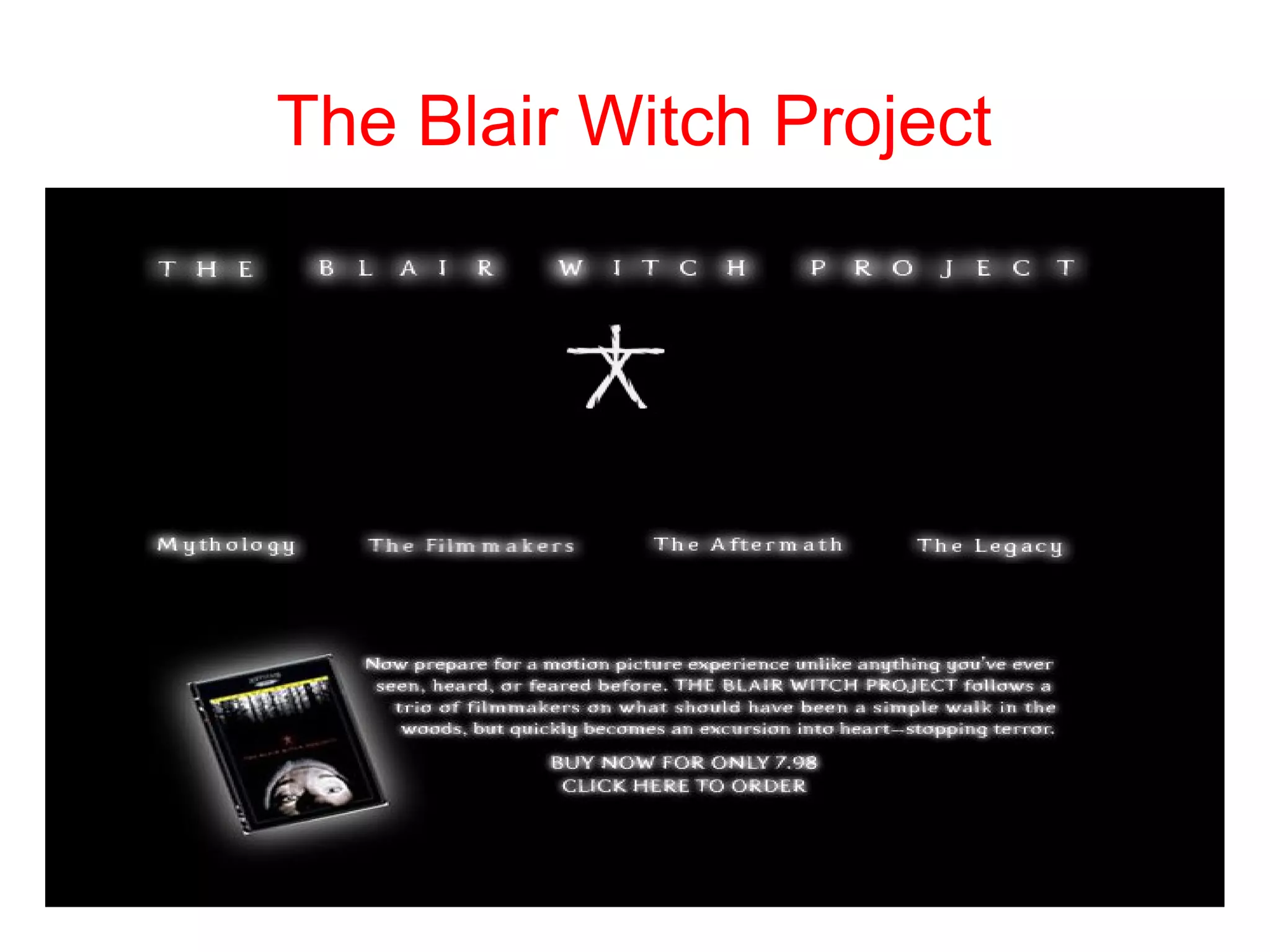
The Blair Witch Project
How is this project transmedia?

Mythology

The 'Missing' Poster

The Film

The Blair Witch book

The Website
“The project was always going to be
transmedia, it was a marketing strategy
and they knew because of the genre
audiences would want to get involved.”
-Velikovsky
An example of a proactive transmedia
text
The term PROACTIVE refers to a text that is created to be
cross media from the beginning.
The Blair Witch Project is an example of this because the success and
release of the story was designed to be distributed across multiple
platforms. The main platform for this narrative is the website which then
led audiences to watch the film.
Additional content relating to the film is also published on the website
such as

Character information

Mythology

Crime scene photos
TIMELINE & RELEASE
The Blair Witch Project:
“The best viral marketing campaign of all time”
-MWP Digital Media
June 1998 – Hexan Films (The Production company owned by Sanchez and Myrick
created the website. www.blairwitchproject.com
January 1999 – The Blair Witch Project featured at the Sundance Film Festival.
Artisan Entertainment bought the rights for 1 Million dollars
July 1999 – Haxan and Artisan collectivity decided that the website was to be the
main marketing platform to make their campaign public. Six months before the films
release it was said that they had spend 1 million dollars on promotion.
During this time content relating to 'recovered footage' and additional information
about the characters is added to the website.
2009 – The website is updated to reflect the 10 year anniversary of the film.
“We had created this whole mythology and I just
kept massaging it and building more details into
it. Really for us, it wasn’t about creating this
whole new way of marketing films – people are
on the web asking about this movie, how else
are we going to get it to them?”
-Eduardo Sanchez
CONSTRUCTED NARRATIVE TIMELINE
Was it a success?

On the films opening weekend it had grossed 1.5 million on 27 full
screenings alone

Although
critics
rated the
movie
itself
poorly the
marketing
campaign
and hype
around
the movie
was
strong
enough to
make a
profit.
Bibliography
Lynn Higley, S, & Andrew Weinstoc, J (eds.) 2004, Nothing that is:
Millennial Cinema and the Blair Witch Controversies, Wayne state
university press, Michigan.
Mathjis, E & Sexton J 2011, 'Fandom and Subculture,' [in] Cult
Cinema, Blackwell Publishing, United Kingdom.
Olivier Godest 2011, 'The Blair Witch Project, a Transmedia
Reference?', Case Study 3rd March, viewed 15th March 2014,
<
http://www.transmedialab.org/en/the-blog-en/case-study-en/the-blair-w
>
Velikovsky, JT 2013, Two Successful Transmedia Case Studies: The
Blair Witch Project (1999) and The Devil Inside (2012).
Bibliography
Lynn Higley, S, & Andrew Weinstoc, J (eds.) 2004, Nothing that is:
Millennial Cinema and the Blair Witch Controversies, Wayne state
university press, Michigan.
Mathjis, E & Sexton J 2011, 'Fandom and Subculture,' [in] Cult
Cinema, Blackwell Publishing, United Kingdom.
Olivier Godest 2011, 'The Blair Witch Project, a Transmedia
Reference?', Case Study 3rd March, viewed 15th March 2014,
<
http://www.transmedialab.org/en/the-blog-en/case-study-en/the-blair-w
>
Velikovsky, JT 2013, Two Successful Transmedia Case Studies: The
Blair Witch Project (1999) and The Devil Inside (2012).

Research project presentation1

  • 1.
  • 2.
    How is thisproject transmedia?  Mythology  The 'Missing' Poster  The Film  The Blair Witch book  The Website “The project was always going to be transmedia, it was a marketing strategy and they knew because of the genre audiences would want to get involved.” -Velikovsky
  • 3.
    An example ofa proactive transmedia text The term PROACTIVE refers to a text that is created to be cross media from the beginning. The Blair Witch Project is an example of this because the success and release of the story was designed to be distributed across multiple platforms. The main platform for this narrative is the website which then led audiences to watch the film. Additional content relating to the film is also published on the website such as  Character information  Mythology  Crime scene photos
  • 4.
    TIMELINE & RELEASE TheBlair Witch Project: “The best viral marketing campaign of all time” -MWP Digital Media June 1998 – Hexan Films (The Production company owned by Sanchez and Myrick created the website. www.blairwitchproject.com January 1999 – The Blair Witch Project featured at the Sundance Film Festival. Artisan Entertainment bought the rights for 1 Million dollars July 1999 – Haxan and Artisan collectivity decided that the website was to be the main marketing platform to make their campaign public. Six months before the films release it was said that they had spend 1 million dollars on promotion. During this time content relating to 'recovered footage' and additional information about the characters is added to the website. 2009 – The website is updated to reflect the 10 year anniversary of the film.
  • 6.
    “We had createdthis whole mythology and I just kept massaging it and building more details into it. Really for us, it wasn’t about creating this whole new way of marketing films – people are on the web asking about this movie, how else are we going to get it to them?” -Eduardo Sanchez
  • 7.
  • 8.
    Was it asuccess?  On the films opening weekend it had grossed 1.5 million on 27 full screenings alone  Although critics rated the movie itself poorly the marketing campaign and hype around the movie was strong enough to make a profit.
  • 9.
    Bibliography Lynn Higley, S,& Andrew Weinstoc, J (eds.) 2004, Nothing that is: Millennial Cinema and the Blair Witch Controversies, Wayne state university press, Michigan. Mathjis, E & Sexton J 2011, 'Fandom and Subculture,' [in] Cult Cinema, Blackwell Publishing, United Kingdom. Olivier Godest 2011, 'The Blair Witch Project, a Transmedia Reference?', Case Study 3rd March, viewed 15th March 2014, < http://www.transmedialab.org/en/the-blog-en/case-study-en/the-blair-w > Velikovsky, JT 2013, Two Successful Transmedia Case Studies: The Blair Witch Project (1999) and The Devil Inside (2012).
  • 10.
    Bibliography Lynn Higley, S,& Andrew Weinstoc, J (eds.) 2004, Nothing that is: Millennial Cinema and the Blair Witch Controversies, Wayne state university press, Michigan. Mathjis, E & Sexton J 2011, 'Fandom and Subculture,' [in] Cult Cinema, Blackwell Publishing, United Kingdom. Olivier Godest 2011, 'The Blair Witch Project, a Transmedia Reference?', Case Study 3rd March, viewed 15th March 2014, < http://www.transmedialab.org/en/the-blog-en/case-study-en/the-blair-w > Velikovsky, JT 2013, Two Successful Transmedia Case Studies: The Blair Witch Project (1999) and The Devil Inside (2012).