STATE LEVEL WORKSHOP
ON
QUALITY RESEARCH AND PUBLICATION IN SOCIAL SCIENCES
ISSUES AND INNOVATIONS
Dr. M. R. Patil
Principal,
Vidya Prabodhini College, Goa
At
NirmalaInstituteOf Education, Altinho, Panaji- Goa.
27th
April, 2019
SESSION 1
Research Process :
Scientific Steps Involved
1. Research Problem
2. Research Title
3. Research Issues
RESEARCH PROCESS
4. Review of Literature
5. Research Questions
6. Statement of Problem
7. Research Assumptions
8. Research Objectives
9. Research Methodology
10. Collection of Data / information
11. Data Classification and tabulation
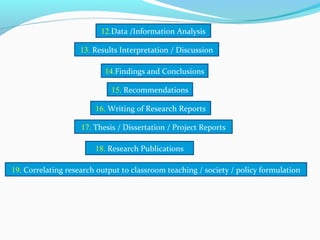
12.Data /Information Analysis
13. Results Interpretation / Discussion
14.Findings and Conclusions
15. Recommendations
16. Writing of Research Reports
17. Thesis / Dissertation / Project Reports
18. Research Publications
19. Correlating research output to classroom teaching / society / policy formulation
EXAMPLE
Research Problem
Quality of Higher Education
Essentials of Good Research Problem
 Relevant and Contemporary (relevant in the present context)
 Adequate and Reliable Data
 Researchable Maturity (Viable)
 Workable and Practicable (Feasible)
 Interdisciplinary in Nature
 Research Scholar’s Choice
 Research output should serve as a base for policy formulation
Research Title
Assessment of Quality of Higher Education in Goa
Field Experience of Stakeholders
Framing of Research Title
Pre-Requisites
 It should be Precise.
 It should be Clear.
 It should be Specific.
 It should be Catchy
 It should be simple
Curriculum Teaching
*Relevance *Creates Interest in students
*Creative *Connects to students
*Flexible *imparts knowledge
*Challenging *imparts skills
*Skill oriented *imparts values
*Industry Oriented *facilitate thinking
*Value Oriented
*Dynamic
*Student Centric
*Knowledge Oriented
Research Issues
EXAMPLE
Learning Evaluation
*students interest in learning *Application of Knowledge /Skills
*Reading Habits *Tests reasoning & logical ability
*Writing Habits *Test memory and reproducing of
*referencing of books / LR Information
*Preparing Own Notes *invites innovative / creative ideas
*Listening *test common sense
*Value Oriented
*Dynamic
*Student Centric
*Knowledge Oriented
Research Issues
EXAMPLE
Curriculum
Is curriculum relevant to meet current needs and expectations?
Is curriculum creative and flexible?
 is curriculum a challenging one?
Is course of study skill oriented?
Is course of study industry oriented?
Is course of study values oriented?
Is curriculum a dynamic one?
Is curriculum a students centric?
Research Questions
EXAMPLE
Teaching
Does teaching create interest in students?
Does teaching connect students?
Does teaching impart knowledge ?
Does teaching impart skill?
Does teaching impart values?
Does teaching invite questions?
Does teaching facilitate thinking?
Research Questions
EXAMPLE
Learning
How is students interest in learning?
How are students reading habits?
How are students writing habits?
How are students referencing skills / habits?
How is listening skill of students?
Do students prepare their own notes?
Research Questions
EXAMPLE
Evaluation
Is an evaluation system providing an opportunity to apply knowledge /
skill?
Does an evaluation system test reasoning and logical thinking ability of
students?
Does it test memory power and information reproducing ability?
Is this system inviting innovative / creative ideas?
Does it test common sense and critical thinking ability?
Research Questions
EXAMPLE
Curriculum
There is no significant interface between stakeholders of Higher
Education and academia with regard to design and development of
curriculum
There is a considerable gap between what curriculum is being taught and
what curriculum is being expected to be taught.
The curriculum is more of academic oriented than industry / practical
oriented.
Curriculum is more syllabus oriented than knowledge and skill oriented
Curriculum is more of rigid and static than flexible, dynamic and
creative
Assumptions / Hypothesis
EXAMPLE
Teaching
Teaching is more of information oriented than knowledge and skill
oriented
Teaching provides more information than invites questions and
facilitates thinking
Learning
Students are more interested in ready made learning resources than
self prepared learning resources
There has been a drastic change in students’ reading and writing habits
Learning is more of examination oriented than knowledge oriented
There has been a declining interest in studies
Students study more through reading than through writing
Assumptions / Hypothesis
EXAMPLE
Evaluation
Evaluation system tests / assesses more of memory power and
information reproducing ability than application ability of an acquired
knowledge / skills
Evaluation system is inviting more of facts and figures than inviting
innovative / creative ideas.
Evaluation system recognizes more referenced / book based information
than out of the box ideas / logical arguments.
Assumptions / Hypothesis
EXAMPLE
The following objectives are set for the study
To study curriculum / course of study of select programmes interms of
their relevance, practicability and flexibility in meeting current needs
and expectations.
To examine classroom teaching and learning methodologies interms of
holding students attention and imparting knowledge, life skills and values
To study students learning interms of interest, reading, writing and
referencing habits leading to acquisition of knowledge and skills.
To assess examination system with regard to extending an opportunity
to apply an acquired knowledge / skills, inviting creative ideas and
encouraging logical self explanation.
Objectives
EXAMPLE
Research Problem
Problems and prospects of Women Entrepreneurs in North Goa District: A Study
To study the Historical Background of Entrepreneurship across the
globe and with particular reference to India
To study the different schemes of Government for Women
Empowerment
Relevant and irrelevant objectives
Research Problem
Jobs satisfaction analysis of Degree College Teachers of Goa
University: A Study
To study literature relating to job satisfaction.
To study the objectives profile and number of Colleges Affiliated to Goa
University
To recommend and suggest administrative reforms and practices to
enhance job satisfaction.
To find out the relevance of hypothesis and achieve objective of the
study
Relevant and irrelevant objectives

Research Process : Scientific Steps Involved - Session 1

  • 1.
    STATE LEVEL WORKSHOP ON QUALITYRESEARCH AND PUBLICATION IN SOCIAL SCIENCES ISSUES AND INNOVATIONS Dr. M. R. Patil Principal, Vidya Prabodhini College, Goa At NirmalaInstituteOf Education, Altinho, Panaji- Goa. 27th April, 2019
  • 2.
    SESSION 1 Research Process: Scientific Steps Involved
  • 3.
    1. Research Problem 2.Research Title 3. Research Issues RESEARCH PROCESS 4. Review of Literature 5. Research Questions 6. Statement of Problem 7. Research Assumptions 8. Research Objectives 9. Research Methodology 10. Collection of Data / information 11. Data Classification and tabulation
  • 4.
    12.Data /Information Analysis 13.Results Interpretation / Discussion 14.Findings and Conclusions 15. Recommendations 16. Writing of Research Reports 17. Thesis / Dissertation / Project Reports 18. Research Publications 19. Correlating research output to classroom teaching / society / policy formulation
  • 5.
    EXAMPLE Research Problem Quality ofHigher Education Essentials of Good Research Problem  Relevant and Contemporary (relevant in the present context)  Adequate and Reliable Data  Researchable Maturity (Viable)  Workable and Practicable (Feasible)  Interdisciplinary in Nature  Research Scholar’s Choice  Research output should serve as a base for policy formulation
  • 6.
    Research Title Assessment ofQuality of Higher Education in Goa Field Experience of Stakeholders Framing of Research Title Pre-Requisites  It should be Precise.  It should be Clear.  It should be Specific.  It should be Catchy  It should be simple
  • 7.
    Curriculum Teaching *Relevance *CreatesInterest in students *Creative *Connects to students *Flexible *imparts knowledge *Challenging *imparts skills *Skill oriented *imparts values *Industry Oriented *facilitate thinking *Value Oriented *Dynamic *Student Centric *Knowledge Oriented Research Issues EXAMPLE
  • 8.
    Learning Evaluation *students interestin learning *Application of Knowledge /Skills *Reading Habits *Tests reasoning & logical ability *Writing Habits *Test memory and reproducing of *referencing of books / LR Information *Preparing Own Notes *invites innovative / creative ideas *Listening *test common sense *Value Oriented *Dynamic *Student Centric *Knowledge Oriented Research Issues EXAMPLE
  • 9.
    Curriculum Is curriculum relevantto meet current needs and expectations? Is curriculum creative and flexible?  is curriculum a challenging one? Is course of study skill oriented? Is course of study industry oriented? Is course of study values oriented? Is curriculum a dynamic one? Is curriculum a students centric? Research Questions EXAMPLE
  • 10.
    Teaching Does teaching createinterest in students? Does teaching connect students? Does teaching impart knowledge ? Does teaching impart skill? Does teaching impart values? Does teaching invite questions? Does teaching facilitate thinking? Research Questions EXAMPLE
  • 11.
    Learning How is studentsinterest in learning? How are students reading habits? How are students writing habits? How are students referencing skills / habits? How is listening skill of students? Do students prepare their own notes? Research Questions EXAMPLE
  • 12.
    Evaluation Is an evaluationsystem providing an opportunity to apply knowledge / skill? Does an evaluation system test reasoning and logical thinking ability of students? Does it test memory power and information reproducing ability? Is this system inviting innovative / creative ideas? Does it test common sense and critical thinking ability? Research Questions EXAMPLE
  • 13.
    Curriculum There is nosignificant interface between stakeholders of Higher Education and academia with regard to design and development of curriculum There is a considerable gap between what curriculum is being taught and what curriculum is being expected to be taught. The curriculum is more of academic oriented than industry / practical oriented. Curriculum is more syllabus oriented than knowledge and skill oriented Curriculum is more of rigid and static than flexible, dynamic and creative Assumptions / Hypothesis EXAMPLE
  • 14.
    Teaching Teaching is moreof information oriented than knowledge and skill oriented Teaching provides more information than invites questions and facilitates thinking Learning Students are more interested in ready made learning resources than self prepared learning resources There has been a drastic change in students’ reading and writing habits Learning is more of examination oriented than knowledge oriented There has been a declining interest in studies Students study more through reading than through writing Assumptions / Hypothesis EXAMPLE
  • 15.
    Evaluation Evaluation system tests/ assesses more of memory power and information reproducing ability than application ability of an acquired knowledge / skills Evaluation system is inviting more of facts and figures than inviting innovative / creative ideas. Evaluation system recognizes more referenced / book based information than out of the box ideas / logical arguments. Assumptions / Hypothesis EXAMPLE
  • 16.
    The following objectivesare set for the study To study curriculum / course of study of select programmes interms of their relevance, practicability and flexibility in meeting current needs and expectations. To examine classroom teaching and learning methodologies interms of holding students attention and imparting knowledge, life skills and values To study students learning interms of interest, reading, writing and referencing habits leading to acquisition of knowledge and skills. To assess examination system with regard to extending an opportunity to apply an acquired knowledge / skills, inviting creative ideas and encouraging logical self explanation. Objectives EXAMPLE
  • 17.
    Research Problem Problems andprospects of Women Entrepreneurs in North Goa District: A Study To study the Historical Background of Entrepreneurship across the globe and with particular reference to India To study the different schemes of Government for Women Empowerment Relevant and irrelevant objectives
  • 18.
    Research Problem Jobs satisfactionanalysis of Degree College Teachers of Goa University: A Study To study literature relating to job satisfaction. To study the objectives profile and number of Colleges Affiliated to Goa University To recommend and suggest administrative reforms and practices to enhance job satisfaction. To find out the relevance of hypothesis and achieve objective of the study Relevant and irrelevant objectives