Jasmine Matevosyan
Geology 103
Permian extinction
• Events
o Formation of Pangaea at the end of the Paleozoic Era
• super continent consisting of all the Earth’s landmasses
o Alleghenian Orogeny
• The central and southern parts of the Appalachian mobile belt folding and moving
toward the craton.
o Hercynian Orogeny
• Greatest deformation along the Hercynian mobile belt from the initial contact
between Laurasia and Gondwana.
- Plants: Gymnosperms diverse and abundant
(Monroe & Wicander, 2015)
Characteristics of Permian Period
• Also known as the Great Dying, the End Permian or the Great Permian
Extinction
• 250 million years ago
• 90-96% of land and marine species went extinct
• No class of life was spared from the devastation. Trees, plants, lizards, proto-
mammals, insects, fish, mollusks, and microbes -- all were nearly wiped out
(NASA, 2002).
Overview
Chart
• 90 percent of the planet's species died
• 70 percent of the land's reptile, amphibian, insect, and plants species went
extinct
• > 5% animal species in the seas survived
• On land less than 1/3 of the large animal species survived.
• Nearly all the trees died
• (Ward, 2001)
Outcome: extinction
Land
Animals
Synapsids
Sauropsids
Marine
Life
Land Animals
• Synapsids:
o skulls with a single temporal opening
o thought to be the lineage that eventually led to
mammals
• Sauropsids
o two skull openings
o the ancestors of the reptiles
Marine life
(Based on Fossils of the shallower coastal waters
around the Pangaea continental shelf)
o Ammonites
o Brachiopods
o Sharks
o Rays
o lobe-finned and spiny fish
Animals
• Sediments containing fossils from
the end of the Permian are rare and
often inaccessible.
• Primarily found in Cape Town,
South Africa, in a scrubland known
as the Karoo.
• Plants were also faced massive
extinction. Evidence of extinct
forests can be seen in the Italian
Alps.
(Hoffman)
Outcome: remains
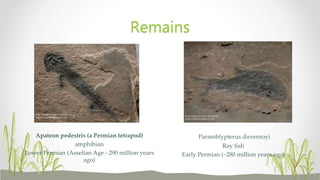
Paramblypterus duvernoyi
Ray fish
Early Permian (~280 million years ago)
Apateon pedestris (a Permian tetrapod)
amphibian
Lower Permian (Asselian Age - 290 million years
ago)
Remains
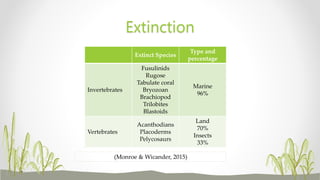
Extinct Species
Type and
percentage
Invertebrates
Fusulinids
Rugose
Tabulate coral
Bryozoan
Brachiopod
Trilobites
Blastoids
Marine
96%
Vertebrates
Acanthodians
Placoderms
Pelycosaurs
Land
70%
Insects
33%
Extinction
(Monroe & Wicander, 2015)
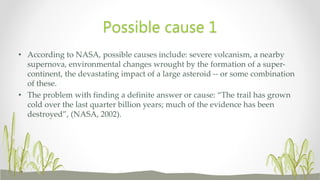
• According to NASA, possible causes include: severe volcanism, a nearby
supernova, environmental changes wrought by the formation of a super-
continent, the devastating impact of a large asteroid -- or some combination
of these.
• The problem with finding a definite answer or cause: ā€œThe trail has grown
cold over the last quarter billion years; much of the evidence has been
destroyedā€, (NASA, 2002).
Possible cause 1
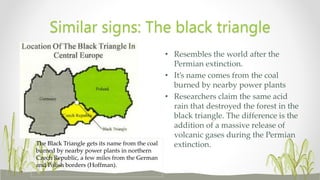
• Resembles the world after the
Permian extinction.
• It’s name comes from the coal
burned by nearby power plants
• Researchers claim the same acid
rain that destroyed the forest in the
black triangle. The difference is the
addition of a massive release of
volcanic gases during the Permian
extinction.
Similar signs: The black triangle
The Black Triangle gets its name from the coal
burned by nearby power plants in northern
Czech Republic, a few miles from the German
and Polish borders (Hoffman).
• Bagley, M. (2014, February 7). Permian Period: Climate, Animals & Plants. Retrieved July 17, 2016,
from http://www.livescience.com/43219-permian-period-climate-animals-plants.html
• Hoffman, H. J. (n.d.). Permian Extinction Article, Mass Extinction Information, Park Tourism Facts
-- National Geographic. Retrieved July 17, 2016, from
http://science.nationalgeographic.com/science/prehistoric-world/permian-extinction/#page=1
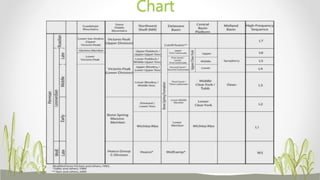
• International Commission on Stratigraphy, 2004, International stratigraphic chart:
http://www.stratigraphy.org/.
• Monroe, J. S. & Wicander, R. (2015). The Changing Earth: Exploring Geology and Evolution 7th ed.
Stamford, CT: Cengage Learning.
• NASA (2002). The Great Dying. Retrieved July 17, 2016, from http://science.nasa.gov/science-
news/science-at-nasa/2002/28jan_extinction/
• Virtual Fossil Museum. (n.d.). Permian Fossils. Retrieved July 17, 2016, from
http://www.fossilmuseum.net/Paleobiology/PermianFossils.htm
• Ward, P. (2001). Permian-Triassic Extinction. Retrieved July 17, 2016, from
http://www.pbs.org/wgbh/evolution/library/03/2/l_032_02.html
References

Research presentation

  • 1.
  • 2.
    • Events o Formationof Pangaea at the end of the Paleozoic Era • super continent consisting of all the Earth’s landmasses o Alleghenian Orogeny • The central and southern parts of the Appalachian mobile belt folding and moving toward the craton. o Hercynian Orogeny • Greatest deformation along the Hercynian mobile belt from the initial contact between Laurasia and Gondwana. - Plants: Gymnosperms diverse and abundant (Monroe & Wicander, 2015) Characteristics of Permian Period
  • 3.
    • Also knownas the Great Dying, the End Permian or the Great Permian Extinction • 250 million years ago • 90-96% of land and marine species went extinct • No class of life was spared from the devastation. Trees, plants, lizards, proto- mammals, insects, fish, mollusks, and microbes -- all were nearly wiped out (NASA, 2002). Overview
  • 4.
  • 5.
    • 90 percentof the planet's species died • 70 percent of the land's reptile, amphibian, insect, and plants species went extinct • > 5% animal species in the seas survived • On land less than 1/3 of the large animal species survived. • Nearly all the trees died • (Ward, 2001) Outcome: extinction
  • 6.
    Land Animals Synapsids Sauropsids Marine Life Land Animals • Synapsids: oskulls with a single temporal opening o thought to be the lineage that eventually led to mammals • Sauropsids o two skull openings o the ancestors of the reptiles Marine life (Based on Fossils of the shallower coastal waters around the Pangaea continental shelf) o Ammonites o Brachiopods o Sharks o Rays o lobe-finned and spiny fish Animals
  • 7.
    • Sediments containingfossils from the end of the Permian are rare and often inaccessible. • Primarily found in Cape Town, South Africa, in a scrubland known as the Karoo. • Plants were also faced massive extinction. Evidence of extinct forests can be seen in the Italian Alps. (Hoffman) Outcome: remains
  • 8.
    Paramblypterus duvernoyi Ray fish EarlyPermian (~280 million years ago) Apateon pedestris (a Permian tetrapod) amphibian Lower Permian (Asselian Age - 290 million years ago) Remains
  • 9.
    Extinct Species Type and percentage Invertebrates Fusulinids Rugose Tabulatecoral Bryozoan Brachiopod Trilobites Blastoids Marine 96% Vertebrates Acanthodians Placoderms Pelycosaurs Land 70% Insects 33% Extinction (Monroe & Wicander, 2015)
  • 10.
    • According toNASA, possible causes include: severe volcanism, a nearby supernova, environmental changes wrought by the formation of a super- continent, the devastating impact of a large asteroid -- or some combination of these. • The problem with finding a definite answer or cause: ā€œThe trail has grown cold over the last quarter billion years; much of the evidence has been destroyedā€, (NASA, 2002). Possible cause 1
  • 11.
    • Resembles theworld after the Permian extinction. • It’s name comes from the coal burned by nearby power plants • Researchers claim the same acid rain that destroyed the forest in the black triangle. The difference is the addition of a massive release of volcanic gases during the Permian extinction. Similar signs: The black triangle The Black Triangle gets its name from the coal burned by nearby power plants in northern Czech Republic, a few miles from the German and Polish borders (Hoffman).
  • 12.
    • Bagley, M.(2014, February 7). Permian Period: Climate, Animals & Plants. Retrieved July 17, 2016, from http://www.livescience.com/43219-permian-period-climate-animals-plants.html • Hoffman, H. J. (n.d.). Permian Extinction Article, Mass Extinction Information, Park Tourism Facts -- National Geographic. Retrieved July 17, 2016, from http://science.nationalgeographic.com/science/prehistoric-world/permian-extinction/#page=1 • International Commission on Stratigraphy, 2004, International stratigraphic chart: http://www.stratigraphy.org/. • Monroe, J. S. & Wicander, R. (2015). The Changing Earth: Exploring Geology and Evolution 7th ed. Stamford, CT: Cengage Learning. • NASA (2002). The Great Dying. Retrieved July 17, 2016, from http://science.nasa.gov/science- news/science-at-nasa/2002/28jan_extinction/ • Virtual Fossil Museum. (n.d.). Permian Fossils. Retrieved July 17, 2016, from http://www.fossilmuseum.net/Paleobiology/PermianFossils.htm • Ward, P. (2001). Permian-Triassic Extinction. Retrieved July 17, 2016, from http://www.pbs.org/wgbh/evolution/library/03/2/l_032_02.html References

Editor's Notes