Research Papers Recommender based
on Digital Repositories Metadata
Ruben Boada, Ricard de la Vega & Ángel Carreño
Big Data Management & Analytics Postgraduate Course (UPC-BarcelonaTech)
September 18, 2015
1. Big Picture
2. Technical validation
3. Results obtained & demo
1. Big Picture
2. Technical validation
3. Results obtained & demo
The objective is to create a
research paper recommender
based on metadata of all the
open access digital repositories
The objective is to create a
research paper recommender
based on metadata of all the
open access digital repositories
PubMed
UPCommons
The objective is to create a
research paper recommender
based on metadata of all the
open access digital repositories
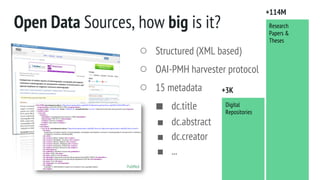
Open Data Sources, how big is it?
○ Structured (XML based)
○ OAI-PMH harvester protocol
○ 15 metadata
■ dc.title
■ dc.abstract
■ dc.creator
■ ...
+3K
+114M
Research
Papers &
Theses
Digital
Repositories
PubMed
Our Approach
● Content recommendation
● All Open Access repositories
● Based on logical distance between
“representative” keywords
(extracted from subject, abstract &
title metadata)
● Multi-thesaurus approach, no
“subject based”
● Amazon, Netflix, Facebook...
● Types: collaborative, content &
híbrid filtering
● Research Papers
○ Repository itself
○ POC vs Production
○ Collaborative and hybrids
(ex. Citations, tags)
○ Subject based (ex. ACM)
Related work
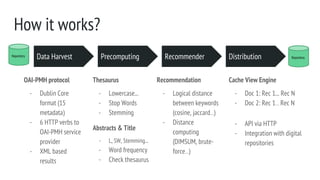
How it works?
Data Harvest
OAI-PMH protocol
- Dublin Core
format (15
metadata)
- 6 HTTP verbs to
OAI-PMH service
provider
- XML based
results
Step 2 Step 3Precomputing Recommender Distribution
Thesaurus
- Lowercase...
- Stop Words
- Stemming
Recommendation
- Logical distance
between keywords
(cosine, jaccard…)
- Distance
computing
(DIMSUM, brute-
force…)
Cache View Engine
- Doc 1: Rec 1... Rec N
- Doc 2: Rec 1… Rec N
- API via HTTP
- Integration with digital
repositories
Repository Repository
Abstracts & Title
- L, SW, Stemming...
- Word frequency
- Check thesaurus
The prototype objective (with 2
repositories) is analyze the
feasibility of multi-repository
recommendations and obtaining
performance metrics to estimate
scalability
The prototype objective (with 2
repositories) is analyze the
feasibility of multi-repository
recommendations and obtaining
performance metrics to estimate
scalability
The prototype objective (with 2
repositories) is analyze the
feasibility of multi-repository
recommendations and obtaining
performance metrics to estimate
scalability
1. Big Picture
2. Technical validation
3. Results obtained & demo
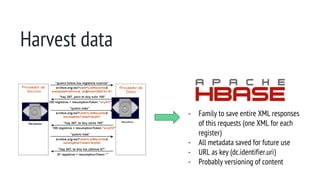
Harvest data
- Family to save entire XML responses
of this requests (one XML for each
register)
- All metadata saved for future use
- URL as key (dc.identifier.uri)
- Probably versioning of content
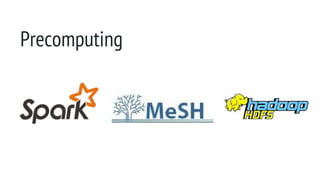
Precomputing
Precomputing
2 Projects
Precomputing MeSH
thesaurus
Precomputing
keywords
Extract descriptors
from XML
Delete stopwords
English / Spanish
Stemming
(PorterStemmer)
Save to HDFS
hdfs://localhost:
9000/hbase/resultats.txt
Load thesaurus from
HDFS
Obtain XML from
HBase newAPIHadoopRDD
Get description and
title from XML
For each word, check if
thesaurus contains it
and count his frequency
Delete stopwords
English / Spanish
Stemming
(PorterStemmer)
Select 10 keywords:
First: thesaurus words
Second: the most frequent
Save to HBase
Keywords family
Precomputing
- Reduce loops to only the
necessary
- Define objects outside principal
iterator
- Use foreachPartition function to
instantiate one connection for
each partition
- Pre-split HBase to exploit
parallelization
- Redefine computing stopwords
(concatenate no stopwords vs
replace stopwords from original
text)
- BufferedMutator vs
HTableInterface
- Many loops
- Too many instances inside
loops
- Many connections to HBase
(one per register)
- Algoritmic problems
(e.g. replaceAll vs concatenate)
Precomputing
Check if thesaurus contains
each word is hard !!!
Recommender
VS
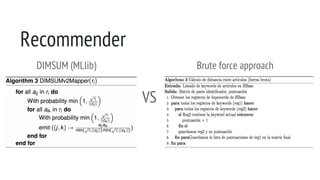
DIMSUM (MLlib) Brute force approach
Distribution
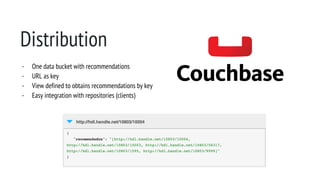
- One data bucket with recommendations
- URL as key
- View defined to obtains recommendations by key
- Easy integration with repositories (clients)
1. Big Picture
2. Technical validation
3. Results obtained & demo
Repository
Data harvest prototype
Data Harvest
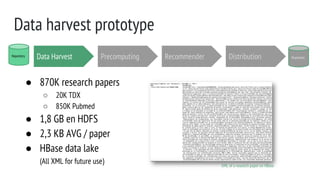
● 870K research papers
○ 20K TDX
○ 850K Pubmed
● 1,8 GB en HDFS
● 2,3 KB AVG / paper
● HBase data lake
(All XML for future use)
Precomputing RecommenderRepository
Distribution
XML of a research paper on HBase
Repository
Data harvest prototype
Data Harvest
● First, XML on FS. Second approach, insert on HBase.
● Fetch XML + insert on HBase
○ Adapt (an existing) harvester module
○ To do a new harvester
● New harvester implementation, effective but not efficient
○ Connection management problems
○ [prototype] manual intervention vs improve connection management
Precomputing RecommenderRepository
Distribution
Repository
Precomputing prototype
Data Harvest
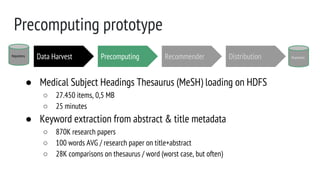
● Medical Subject Headings Thesaurus (MeSH) loading on HDFS
○ 27.450 items, 0,5 MB
○ 25 minutes
● Keyword extraction from abstract & title metadata
○ 870K research papers
○ 100 words AVG / research paper on title+abstract
○ 28K comparisons on thesaurus / word (worst case, but often)
Precomputing RecommenderRepository
Distribution
Repository
Precomputing prototype
Data Harvest Precomputing RecommenderRepository
Distribution
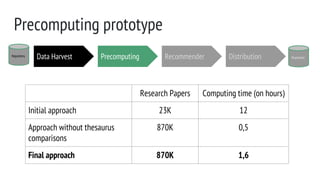
Research Papers Computing time (on hours)
Initial approach 23K 12
Approach without thesaurus
comparisons
870K 0,5
Final approach 870K 1,6
Repository
Recommender prototype
Data Harvest Precomputing RecommenderRepository
Distribution
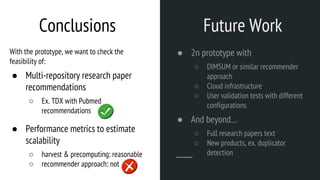
Future Work
● 2n prototype with
○ DIMSUM or similar recommender
approach
○ Cloud infrastructure
○ User validation tests with different
configurations
● And beyond…
○ Full research papers text
○ New products, ex. duplicator
detection
Conclusions
With the prototype, we want to check the
feasibility of:
● Multi-repository research paper
recommendations
○ Ex. TDX with Pubmed
recommendations
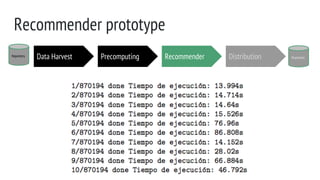
● Performance metrics to estimate
scalability
○ harvest & precomputing: reasonable
○ recommender approach: not
1. Big Picture
2. Technical validation
3. Results obtained & demo
Research Papers Recommender based on Digital Repositories Metadata

Research Papers Recommender based on Digital Repositories Metadata

  • 1.
    Research Papers Recommenderbased on Digital Repositories Metadata Ruben Boada, Ricard de la Vega & Ángel Carreño Big Data Management & Analytics Postgraduate Course (UPC-BarcelonaTech) September 18, 2015
  • 2.
    1. Big Picture 2.Technical validation 3. Results obtained & demo
  • 3.
    1. Big Picture 2.Technical validation 3. Results obtained & demo
  • 4.
    The objective isto create a research paper recommender based on metadata of all the open access digital repositories
  • 5.
    The objective isto create a research paper recommender based on metadata of all the open access digital repositories
  • 6.
  • 7.
    The objective isto create a research paper recommender based on metadata of all the open access digital repositories
  • 8.
    Open Data Sources,how big is it? ○ Structured (XML based) ○ OAI-PMH harvester protocol ○ 15 metadata ■ dc.title ■ dc.abstract ■ dc.creator ■ ... +3K +114M Research Papers & Theses Digital Repositories PubMed
  • 9.
    Our Approach ● Contentrecommendation ● All Open Access repositories ● Based on logical distance between “representative” keywords (extracted from subject, abstract & title metadata) ● Multi-thesaurus approach, no “subject based” ● Amazon, Netflix, Facebook... ● Types: collaborative, content & híbrid filtering ● Research Papers ○ Repository itself ○ POC vs Production ○ Collaborative and hybrids (ex. Citations, tags) ○ Subject based (ex. ACM) Related work
  • 10.
    How it works? DataHarvest OAI-PMH protocol - Dublin Core format (15 metadata) - 6 HTTP verbs to OAI-PMH service provider - XML based results Step 2 Step 3Precomputing Recommender Distribution Thesaurus - Lowercase... - Stop Words - Stemming Recommendation - Logical distance between keywords (cosine, jaccard…) - Distance computing (DIMSUM, brute- force…) Cache View Engine - Doc 1: Rec 1... Rec N - Doc 2: Rec 1… Rec N - API via HTTP - Integration with digital repositories Repository Repository Abstracts & Title - L, SW, Stemming... - Word frequency - Check thesaurus
  • 12.
    The prototype objective(with 2 repositories) is analyze the feasibility of multi-repository recommendations and obtaining performance metrics to estimate scalability
  • 13.
    The prototype objective(with 2 repositories) is analyze the feasibility of multi-repository recommendations and obtaining performance metrics to estimate scalability
  • 14.
    The prototype objective(with 2 repositories) is analyze the feasibility of multi-repository recommendations and obtaining performance metrics to estimate scalability
  • 15.
    1. Big Picture 2.Technical validation 3. Results obtained & demo
  • 17.
    Harvest data - Familyto save entire XML responses of this requests (one XML for each register) - All metadata saved for future use - URL as key (dc.identifier.uri) - Probably versioning of content
  • 18.
  • 19.
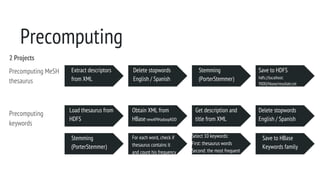
    Precomputing 2 Projects Precomputing MeSH thesaurus Precomputing keywords Extractdescriptors from XML Delete stopwords English / Spanish Stemming (PorterStemmer) Save to HDFS hdfs://localhost: 9000/hbase/resultats.txt Load thesaurus from HDFS Obtain XML from HBase newAPIHadoopRDD Get description and title from XML For each word, check if thesaurus contains it and count his frequency Delete stopwords English / Spanish Stemming (PorterStemmer) Select 10 keywords: First: thesaurus words Second: the most frequent Save to HBase Keywords family
  • 20.
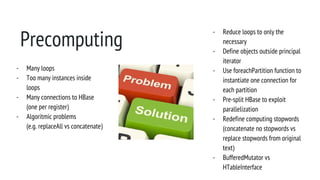
    Precomputing - Reduce loopsto only the necessary - Define objects outside principal iterator - Use foreachPartition function to instantiate one connection for each partition - Pre-split HBase to exploit parallelization - Redefine computing stopwords (concatenate no stopwords vs replace stopwords from original text) - BufferedMutator vs HTableInterface - Many loops - Too many instances inside loops - Many connections to HBase (one per register) - Algoritmic problems (e.g. replaceAll vs concatenate)
  • 21.
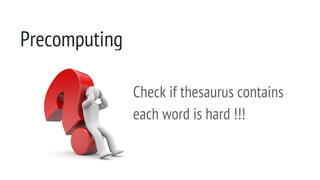
    Precomputing Check if thesauruscontains each word is hard !!!
  • 22.
  • 23.
    Distribution - One databucket with recommendations - URL as key - View defined to obtains recommendations by key - Easy integration with repositories (clients)
  • 24.
    1. Big Picture 2.Technical validation 3. Results obtained & demo
  • 25.
    Repository Data harvest prototype DataHarvest ● 870K research papers ○ 20K TDX ○ 850K Pubmed ● 1,8 GB en HDFS ● 2,3 KB AVG / paper ● HBase data lake (All XML for future use) Precomputing RecommenderRepository Distribution XML of a research paper on HBase
  • 26.
    Repository Data harvest prototype DataHarvest ● First, XML on FS. Second approach, insert on HBase. ● Fetch XML + insert on HBase ○ Adapt (an existing) harvester module ○ To do a new harvester ● New harvester implementation, effective but not efficient ○ Connection management problems ○ [prototype] manual intervention vs improve connection management Precomputing RecommenderRepository Distribution
  • 27.
    Repository Precomputing prototype Data Harvest ●Medical Subject Headings Thesaurus (MeSH) loading on HDFS ○ 27.450 items, 0,5 MB ○ 25 minutes ● Keyword extraction from abstract & title metadata ○ 870K research papers ○ 100 words AVG / research paper on title+abstract ○ 28K comparisons on thesaurus / word (worst case, but often) Precomputing RecommenderRepository Distribution
  • 28.
    Repository Precomputing prototype Data HarvestPrecomputing RecommenderRepository Distribution Research Papers Computing time (on hours) Initial approach 23K 12 Approach without thesaurus comparisons 870K 0,5 Final approach 870K 1,6
  • 29.
    Repository Recommender prototype Data HarvestPrecomputing RecommenderRepository Distribution
  • 31.
    Future Work ● 2nprototype with ○ DIMSUM or similar recommender approach ○ Cloud infrastructure ○ User validation tests with different configurations ● And beyond… ○ Full research papers text ○ New products, ex. duplicator detection Conclusions With the prototype, we want to check the feasibility of: ● Multi-repository research paper recommendations ○ Ex. TDX with Pubmed recommendations ● Performance metrics to estimate scalability ○ harvest & precomputing: reasonable ○ recommender approach: not
  • 32.
    1. Big Picture 2.Technical validation 3. Results obtained & demo