Shashank Shekhar Sahoo et al. Int. Journal of Engineering Research and Applications ww.ijera.com
ISSN: 2248-9622, Vol. 6, Issue 3, (Part - 1) March 2016, pp.74-79
www.ijera.com 74|P a g e
Research on Optimization, Dynamics and Stability of Stair-
climbing Wheelchair
Shashank Shekhar Sahoo*, Himank Kinkar**
*(Department of Powertrain, Magneti Marelli India Pvt. Ltd., Gurgaon-51
** (Department of Powertrain, Magneti Marelli India Pvt. Ltd., Gurgaon-51
ABSTRACT
Since the invention of the wheel, man has always sought to reduce effort to get things done easily. Ultimately, it
has resulted in the invention of the Robot, an Engineering Marvel. Up until now, the major factor that hampers
widespread usage of robots is locomotion and maneuverability. They are not fit enough to conform even to the
most commonplace terrain such as stairs. To overcome this, we are proposing a stair climbing wheelchair robot
that looks a lot like a normal wheelchair but with additional stair-climbing functionality to adjust itself
according to the height of the step The primarily goal of the prescribed manuscript herewith is to analyze the
functional requirements, optimization methods, dynamics and stability during a tracked robotic wheelchair’s
climbing of stairs mechanism. At first, the mechanical structure of the wheelchair is designed and the hardware
composition of its full control system is devised. Secondly, based on the analysis of its stairs‐climbing process,
the dynamical model of stairs‐climbing is established by using the classical mechanics method. Next, through
simulation and experiments, the effectiveness of the dynamical model, its stability evaluation and performance
parameters is verified. Such procedures will help in establishing a strong fundamental foundation steps to design
and develop a standalone semi-autonomous wheelchair that will help and enable a physically challenged person
by leg to climb difficult terrains like staircase and speed-breakers with ease and comfort. This design
encompasses Renesas’s Arduino compatible GR-KAEDE boards, servo motors, high torque DC motors and
various peripheral devices as incorporated in design diagram. We have also extended the application of
wheelchair by integrating collision avoidance mechanism.
Keywords - Robot, Arduino, Climbing Robot, wheelchair, GR-KAEDE boards
I. INTRODUCTION
Modern wheelchairs are available with various
accessories, such as anti-tip bars or wheels, safety
belts, adjustable backrests, tilt and/or recline
features, extra support for limbs or neck, mounts or
carrying devices for crutches, walkers or oxygen
tanks, drink holders, and clothing protectors [1].
Transport wheelchairs are usually light, folding
chairs with four small wheels. These allow for a
broader spectrum of movement. However, very few
have experimented to enable a wheelchair with
stair-climbing maneuverability.
During stairs-climbing, the wheelchair begins by
touching the first step of the stairs through its front
track while its two-sided driving motors
simultaneously push the driving wheels and the
whole wheelchair forward, up to the first step and
then the second step, whereby the entire robot
leaves the ground and completely climbs upwards
on the stairs. The whole process may be divided
into six stages, as shown in Figure 1: a) touch the
first step; b) climb up the first step; c) touch the
second step; d) climb up the second step; e) leave
the ground and then ascend the stairs; (f) leave the
stairs and then access the ground. Here, touching
the step means the track near the robot’s front
approach angle climbing onto the step, while
climbing up the step means the bottom track of the
robot climbing onto the step [2].
Fig. 1
RESEARCH ARTICLE OPEN ACCESS
Shashank Shekhar Sahoo et al. Int. Journal of Engineering Research and Applications ww.ijera.com
ISSN: 2248-9622, Vol. 6, Issue 3, (Part - 1) March 2016, pp.74-79
www.ijera.com 75|P a g e
1.1 PROBLEM STATEMENT
The challenges involved in achieving the
objective have been classified into the following
problem statements to conquer the design in step
by step approach mode.
a. To come up with a strong and robust body
design upon which the entire system can rest
firmly. Also, to custom-make the entire
drive-train mechanism needed to
automatically propel the wheelchair as per
user instruction.
b. To install a set of fore-limbs( a pair of free
wheels in our case) in the direction of stair
climbing which will assist in traversing the
first and subsequent steps with smoothness.
c. To attach a self-adjustable seating platform ,
that will automatically try to adjust the
center of mass of whole system(wheelchair)
as it ascend up the slope. It will do so with
the help of gravity sensor and powerful
servo motor installed in the system
hardware. It can be visualized as a position
control application.
d. To analyze the dynamics and stability of
wheelchair in both normal surface as well as
in inclined planes (stairs.)
e. To implement the collision avoidance
mechanism using ultrasonic sensors and
DPDT switches for controlling various
operation modes of the system.
1.2 SYSTEM COMPONENTS
Our prototype design of a customized wheel-
chair consists of various mechanical and electronic
components that are described as follows :
1.2.1 GR-KAEDE CONTROLLER BOARD
Inputs, Processing & Output
It will receive directional instructions from the
driver of wheelchair via joystick and surrounding
environmental parameters( minimum distance to
objects ) from ultrasonic transceivers.
The GR-KAEDE Controller will process these
inputs and will perform the following operations:-
a. Direction of rotation of DC geared motors
connected to wheels.
b. Driving the servos to balance the sitting
platform for maintaining it horizontal with
respect to ground for providing ease,
comfort and stability to the driver.
c. Detection of nearby objects probable to
cause collision within a distance range preset
and configured in the ultrasonic sensors.
Upon detection, a status LED will glow to
warn the driver. After getting the warning,
there will be two drive-modes set through a
switch provided to the user as follows :
Mode 0(default): The wheelchair will
automatically stop until it receives mode change
request from user by changing the switch to Mode
1 .
Mode 1: To continue driving as per user’s
directional instruction as sometimes one may want
to continue to move keeping the minimum distance
to object in mind.
1.2.2 GRIPPED CONVEYER BELTS WHEELS
The second most important component of our
design is the wheels. The wheels will be grouped
using a pair of conveyer belts. The conveyer belt
will be having grips to provide friction force and
traction force will be generated by the motors
driving the wheels. This combination of mechanics
will empower the chair to traverse and uphold the
inclined plane with ease. A pair of wheels is
projected few inches higher than the rest to assist in
the climbing of stairs.
1.2.3 POWERFUL SERVO MOTORS
These motors will be responsible for adjusting
the center of gravity of whole system by
maintaining the platform horizontal with respect to
ground. All servo motors, regardless of brand or
type consists of four main parts.
The Mechanics : These are the drive gears and the
servo case.
The Motor : This provides the motive force to
drive the output arm.
The Feedback pot : This allows the servo to
measure the actual position of the output arm.
The Amplifier : This is the electronics that hook
all the other bits together to make it work .
The servo motor can be moved to any desired
angular position by sending PWM (Pulse Width
Modulation) signal on the control wire. The servo
understands the language of pulse. A pulse of width
varying from 1ms to 2ms in a repeated time frame
is sent to the servo for around 50 times in a second.
The width of the pulse determines the angular
position.
A pulse of 1ms moves the servo towards 0°, while
a 2ms wide pulse would take it to 180°. The pulse
width for in between angular position can be
interpolated accordingly. A sequence of such
Shashank Shekhar Sahoo et al. Int. Journal of Engineering Research and Applications ww.ijera.com
ISSN: 2248-9622, Vol. 6, Issue 3, (Part - 1) March 2016, pp.74-79
www.ijera.com 76|P a g e
pulses (50 in one second) is required to be passed
to the servo to sustain a particular angular position.
When the servo receives a pulse, it can retain the
corresponding angular position for next 20ms, So, a
pulse in every 20ms time frame must be fed to the
servo.
1.2.4 3-AXIS LINEAR ACCELEROMETER
It will closely monitor the tilt of sitting platform
with respect to ground and will assist in
maintaining a perfect horizontal level as required to
keep the integrity of comfort and stability. The
ADXL335 is a small, thin, low power, complete 3-
axis accelerometer with signal conditioned voltage
outputs. The product measures acceleration with a
minimum full-scale range of ±3 g. It can measure
the static acceleration of gravity in tilt-sensing
applications, as well as dynamic acceleration
resulting from motion, shock, or vibration.
1.2.5 POWER SOURCE
A single 12V rechargeable DC battery to supply
enough current to drive huge inductive loads of
high torque motors and related accessories.
1.2.6 COLLISION AVOIDANCE SENSOR (UV
TRANSCEIVERS)
The sensors will check, detect and inform the
microcontroller about any imminent collision
possible due to any nearby object. The HC-SR04
ultrasonic sensor uses sonar to determine distance
to an object like bats or dolphins do. It offers
excellent non-contact range detection with high
accuracy and stable readings in an easy-to-use
package. From 2cm to 400 cm or 1” to 13 feet. It’s
operation is not affected by sunlight or black
material like Sharp rangefinders are (although
acoustically soft materials like cloth can be difficult
to detect). It comes complete with ultrasonic
transmitter and receiver module.
1.2.7 JOY-STICK
To accept directional instructions from the user.
The 2-Axis Joystick is used to add analog input to
our project. The 2-Axis Joystick contains two
independent potentiometers (one per axis) that can
be used as dual adjustable voltage dividers,
providing 2-Axis analog input in a control stick
form. The modular form-factor allows one to plug
the 2-Axis Joystick directly into a breadboard for
easy prototyping. The 2-Axis Joystick includes
spring auto return to center and a comfortable cup-
type knob which gives the feel of a thumb-stick.
1.2.8 GEARED DC MOTORS
To drive the wheels interlocked with conveyer
belts. These are very high torque powerful motors
with the capability to drive the entire system with
ease and activates upon receiving user input from
joystick.
Other active and passive electronic components
like resistors, LEDs, transistors etc.
II. WORKING PRINCIPLE
The customized wheelchair will take directional
instructions as input from driver and will drive the
wheels accordingly as per processed logic. In the
event of staircase climbing, the driver has to orient
the wheelchair with backside facing the stairs.
Then continue normal traversing until the first step
is covered [2]. In order to maintain stability, the
servo motors will then align the sitting platform
horizontal to ground by rotating through an angle
alpha(α). While undertaking this process, 3 axis-
Accelerometer will continuously monitor the level
change of platform with respect to gravity and will
help in achieving accuracy and stability. With this
configuration, one can climb the further steps with
ease. When the distance to potential colliding
object measured by ultrasonic sensors violate the
threshold preset conditions, an alert will be
displayed on LCD to stop the wheelchair
automatically as per Mode 0 operation and will
wait for next user’s instruction to switch into Mode
1 to continue moving , keeping minimum distance
to detected object in mind.
III. SYSTEM DESIGN SPECIFICATION
3.1 MECHANICAL
The chassis used in the wheelchair is an in-
house custom-made prototype that involves the
combination of an innovative axles, highly stable
metal body, bi-cycle sprocket with gear sets and
screw joints to fix them all together. The axles used
in the project are actually reverse-engineered
version of what we normally see in bicycle, where
a single pedal turn of larger diameter sprocket
results in multiple turns of smaller diameter
sprocket connected to the rear wheels. Similarly,
here also we have mechanically coupled a pair of
wheels with similar axles and installed gear set on
it which will be propelled by high torque powerful
DC motors using driver and driven mechanism.
The sprocket of front and rear axles are coupled
mechanically using chain- links that are usually
found in bi-cycles, and these are customized and
adjusted to fit the design with zero tension and
torsion force. This mechanism is replicated on
other side as well taking into account the other pair
of wheels. The USP of this particular design is that
just by connecting a single high torque DC motor,
one can propel the entire one-half of the system.
So, technically speaking two motors are sufficient
enough in this design to propel the entire four-
wheel drive system with ease and comfort. Four
such combination consisting of sprocket, axle, axle
with gears and chains are formulated in such a
manner to provide high stability to the system [3].
Shashank Shekhar Sahoo et al. Int. Journal of Engineering Research and Applications ww.ijera.com
ISSN: 2248-9622, Vol. 6, Issue 3, (Part - 1) March 2016, pp.74-79
www.ijera.com 77|P a g e
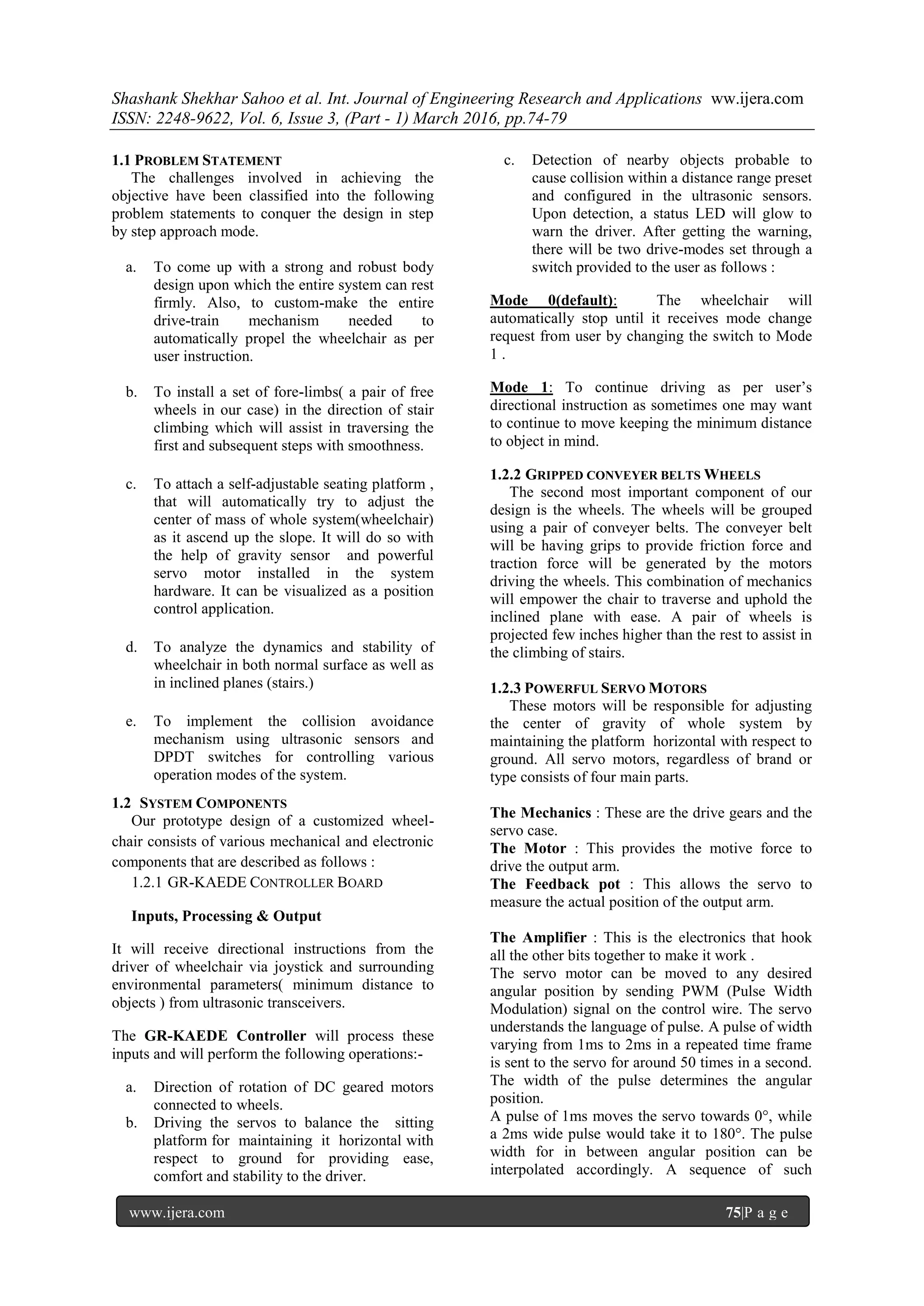
Custom made special slots are provided in the
proximity of two axles to hold the DC motors in
place. The motor shafts are fitted with gear of
smaller number of teeth and it is linked
mechanically with another gear of larger diameter
to multiply the torque received at the wheel end to
drive the system. A good schematic of the custom
design along with its part is given as follows.
Fig. 2
Fig. 3
Fig. 4
3.2 ELECTRICAL
The major challenge faced during the design of
system electrically is to comply with required and
rated value of voltage and current in the entire
circuitry as it involved the usage of huge-current
hungry loads(sinks). We often encountered
problems of sudden voltage surge and current drop
and sometimes vice –versa as well while testing the
system under both actual resistive and inductive
loads . This was handled to the best possible extent
by using calibratable motor drivers and adjustable
power adapters to sync the movement electric parts
with that of mechanical ones. Also, selecting a
perfect motor to drive the wheelchairs with
accurate torque and rpm rating was also not easy.
We have to check it with multiple combination and
have selected one that can sustain the bulky system
not only on level-ground but also on inclined
planes of stairs.
3.3 ELECTRONICS
Electronically, we have interfaced multiple
sensors such as ultrasonic sensor, accelerometer,
joystick and peripheral modules such 16x2 LCD,
that are driven by 5V supply from GR-KAEDE
board itself. So, interfacing all of them together
without inducing delay and without compromising
with the processing capability of the 32-bit Renesas
controller was difficult to handle from software
end. We tried to develop software of our system via
modular development strategy to the best possible
extent. However, due to the constraints of the IDE
and Renesas web compiler, we couldn’t consolidate
the code . The number of code lines could have
been reduced if the entire module of all parts can be
developed separately and deployed independently
of each other. We have followed here a step by step
strategy to focus on single interfacing of sensors
and peripherals at a time and then integrated them
all together to build the system. Doing such also
helped us in debugging the system better in case of
any malfunction. Also, separate power supplies of
5V and 12V are handled in isolation without any
interference.
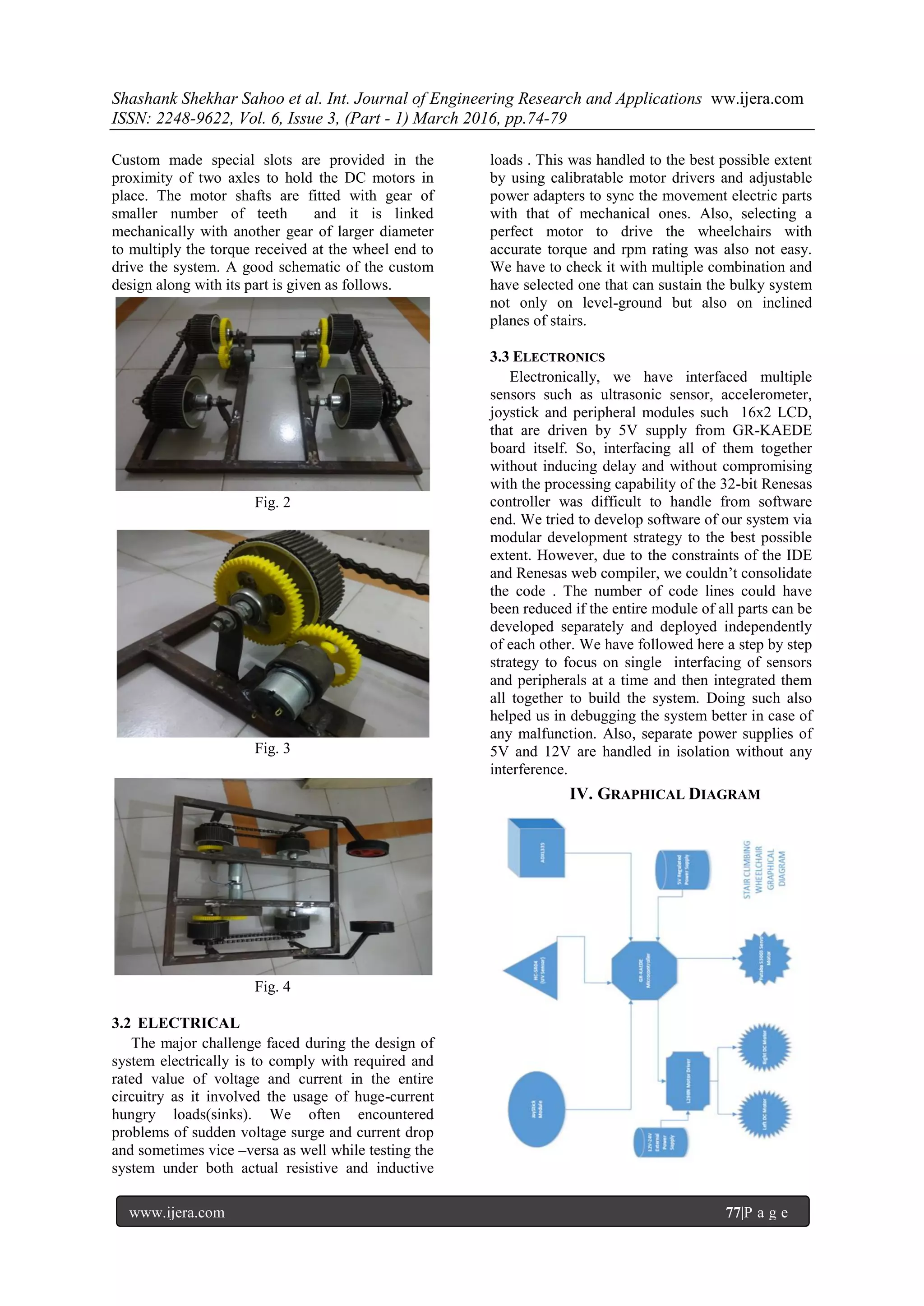
IV. GRAPHICAL DIAGRAM
Shashank Shekhar Sahoo et al. Int. Journal of Engineering Research and Applications ww.ijera.com
ISSN: 2248-9622, Vol. 6, Issue 3, (Part - 1) March 2016, pp.74-79
www.ijera.com 78|P a g e
Fig. 5
IV. IMPLEMENTATION NOTE
It started with chassis design which is a
rectangular frame with compartments for wheel and
driving motors. Then the axle design, that has been
customized out of bi-cycle axles. It has been made
retro fit to accommodate gears and sprocket around
the opposite sides of rim. Four such units were
designed with sprockets on all the four and driving
gears on the rear wheels [4].
We needed to add additional pair of wheels to
enable the wheelchair to climb the stairs . For this a
separate pair of wheels were made to project out of
wheelchair body with marginal lift but in alignment
with other wheels. The main usage was to assist the
wheelchair to climb stair steps with ease. The next
step was to wrap around a set of two conveyer belts
encompassing wheels in phase and alignment.
Doing such made the wheel drive more robust and
it ensured proper movement of wheels in difficult
terrains without losing traction and control off the
road or stairs.
Later on, a stable light weight platform was
attached around the horn of the servo and was
mounted with the help of two center mast from the
central section of chassis. This platform is also
connected mechanically to accelerometer to detect
change in orientation of the platform and to make
the platform parallel to the ground.
As add-on in our custom designed wheelchair we
have also attached an ultrasonic sensor in the
façade of system to detect any nearby object which
might cause imminent collision.
During prototype testing it was observed that the
sprocket chain arrangement was creating a hurdle
while climbing the stairs as the radius of the wheels
chosen wasn’t providing sufficient edge clearance.
So, chain was removed.
All these modules were tested within their
constraints and in compliance with their
specification to meet the required objective over
various load conditions.
V. CIRCUIT DIAGRAM
Fig. 6
VI. SYSTEM TESTING, RESULTS &
DISCUSSION
The wheelchair system is developed in
compliance with modular development strategy.
So, it’s testing is also done in somewhat similar
manner. We have performed multiple unit – testing
of various system parts while they are under
development in order to ensure about the quality,
endurance, stability , robustness and integrity.
Some of the tests performed are as follows :-
a. Test to check proper fitting of wheel cut-set
with that of axle.
b. Test to inhibit back free-movement of
sprocket by welding of sprocket inner body
with that of axle.
c. Test to check and ascertain any relative
motion between gear cut-set and axle , that
might result as consequence of loose bond
between the two parties.
d. Test to ensure ground clearance and stability
of entire system while the installation of all
four wheels is done.
e. Test to observe the behavior of system in
terms of traction control, stability, driving
torque and custom manoeuvrability by just
installing the motors but not the conveyer
belts. Technically, we want to make it
traverse an inclined plane simulating the
same angle of inclination as that of stairs.
f. Next test was to fit the chain-links
encompassing both front and back sprocket
with no tension and with perfect ground and
stair clearance.
g. Test to check whether the wheelchair is able
to climb the very first step or not after fitting
the conveyer belts in their place.
For the purpose of proving the results of the
dynamical model and the stability analysis for
stairs-climbing, we perform a simulation
calculation and experiments on the developed
wheelchair robot. The structural parameters of the
robot are: the radius of the driving wheels is
R=250mm; the radius of the steering wheels and
the fixed wheels are both r=140mm; the length of
the bottom tracks is L=600mm; the front approach
angle is α=40°. The robot has two DC servo motors
with 400 watts power and the total mass of the robot
is m=62kg. The frictional factor between the tracks
and the sharp corner of the steps is 0.2.
According to the defined modes of motion, we
make a simulation calculation of the wheelchair’s
stairs-climbing experiments . In Figure 7, the
stability profile of wheelchair during the course of
its manoeuvre are best depicted in the profile
below :-
Shashank Shekhar Sahoo et al. Int. Journal of Engineering Research and Applications ww.ijera.com
ISSN: 2248-9622, Vol. 6, Issue 3, (Part - 1) March 2016, pp.74-79
www.ijera.com 79|P a g e
Fig.7
The lowest point of stability during the robot’s
stairs-climbing occurs during those moments when
the driving wheels leave the ground and the
robot’s driving wheels roll over the first and
second steps. The main reason is that the driving
wheels are suddenly suspended in the air. This has
the result that the robot’s rolling fulcrum moves
forward substantially and thus it inclines to
tumble backwards more easily. This conclusion is
also proven in the tracked mobile robot’s stairs-
climbing experiments [5].
VII. CONCLUSION
Given a wheelchair the issue of how to ensure
stability in stairs-climbing is an important problem
which needed to be solved. Looking at this
problem, the dynamical model and the question of
stability during wheelchair’s stairs-climbing are
studied based on a mechanics analysis. The
acquired achievements can provide design and
analysis foundations for the wheelchair’ stairs-
climbing and solve the problem, which can be
summarized as follows:
(1) According to the requirement for stairs-
climbing, the mechanical structure of a
tracked mobile robot is designed and the
hardware composition of its control system is
given.
(2) Based on the analysis of the stairs-climbing
process, the dynamics model of the tracked
mobile robot during stairs-climbing is
established, which can provide fundamental
support for the stability analysis.
Fig. 8
The stability conditions for its stairs-climbing are
obtained. A quantitative evaluation method of the
stairs-climbing stability of the tracked mobile robot
is proposed and verified through simulation and
experiments.
This project will solve the issues faced by
physically challenged person through leg in day to
day life such as climbing staircase and having
additional security by averting collisions. This
project can be further extended to incorporate
feature like android application or wireless
technology based emergency message alert and
providing directional input to wheelchairs via icons
displayed in the smartphone screen. The emergency
notification will inform the relatives
instantaneously, thus providing safety and security
to the rider. This design can be used to carry heavy
objects in multistory buildings and military
surveillance purposes. It has the potential to play
active role in disaster management situations also.
References
[1] Hebert M H, Thorpe C E, Stentz A (1997)
Intelligent Unmanned Ground Vehicles.
Boston: Kluwer Academic Press. p. 310.
[2] Figliolini, G., and Ceccarelli, M. (2001).
Climbing stairs with EP-WAR2 biped
robot. IEEE International Conference on
Robotics and Automation, Seoul Korea, 4
4116-4121.
[3] Ben.Tzvi P, Ito S, Goldenberg A A (2007)
Autonomous Stair Climbing with
Reconfigurable Tracked Mobile Robot.
IEEE International Workshop on Robotic
and Sensors Environments, Ottawa,
Canada. pp. 16.
[4] Davids A (2002) Urban Search and
Rescue Robots: From Tragedy to
Technology. Intelligent System of IEEE.
17(2): 81-83.
[5] Birk A, Carpin S (2001) Rescue Robotics
a Crucial Milestone on the Road to
Autonomous Systems.Advanced Robotics
Journal. 20(5): 595-576.

Research on Optimization, Dynamics and Stability of Stairclimbing Wheelchair

  • 1.
    Shashank Shekhar Sahooet al. Int. Journal of Engineering Research and Applications ww.ijera.com ISSN: 2248-9622, Vol. 6, Issue 3, (Part - 1) March 2016, pp.74-79 www.ijera.com 74|P a g e Research on Optimization, Dynamics and Stability of Stair- climbing Wheelchair Shashank Shekhar Sahoo*, Himank Kinkar** *(Department of Powertrain, Magneti Marelli India Pvt. Ltd., Gurgaon-51 ** (Department of Powertrain, Magneti Marelli India Pvt. Ltd., Gurgaon-51 ABSTRACT Since the invention of the wheel, man has always sought to reduce effort to get things done easily. Ultimately, it has resulted in the invention of the Robot, an Engineering Marvel. Up until now, the major factor that hampers widespread usage of robots is locomotion and maneuverability. They are not fit enough to conform even to the most commonplace terrain such as stairs. To overcome this, we are proposing a stair climbing wheelchair robot that looks a lot like a normal wheelchair but with additional stair-climbing functionality to adjust itself according to the height of the step The primarily goal of the prescribed manuscript herewith is to analyze the functional requirements, optimization methods, dynamics and stability during a tracked robotic wheelchair’s climbing of stairs mechanism. At first, the mechanical structure of the wheelchair is designed and the hardware composition of its full control system is devised. Secondly, based on the analysis of its stairs‐climbing process, the dynamical model of stairs‐climbing is established by using the classical mechanics method. Next, through simulation and experiments, the effectiveness of the dynamical model, its stability evaluation and performance parameters is verified. Such procedures will help in establishing a strong fundamental foundation steps to design and develop a standalone semi-autonomous wheelchair that will help and enable a physically challenged person by leg to climb difficult terrains like staircase and speed-breakers with ease and comfort. This design encompasses Renesas’s Arduino compatible GR-KAEDE boards, servo motors, high torque DC motors and various peripheral devices as incorporated in design diagram. We have also extended the application of wheelchair by integrating collision avoidance mechanism. Keywords - Robot, Arduino, Climbing Robot, wheelchair, GR-KAEDE boards I. INTRODUCTION Modern wheelchairs are available with various accessories, such as anti-tip bars or wheels, safety belts, adjustable backrests, tilt and/or recline features, extra support for limbs or neck, mounts or carrying devices for crutches, walkers or oxygen tanks, drink holders, and clothing protectors [1]. Transport wheelchairs are usually light, folding chairs with four small wheels. These allow for a broader spectrum of movement. However, very few have experimented to enable a wheelchair with stair-climbing maneuverability. During stairs-climbing, the wheelchair begins by touching the first step of the stairs through its front track while its two-sided driving motors simultaneously push the driving wheels and the whole wheelchair forward, up to the first step and then the second step, whereby the entire robot leaves the ground and completely climbs upwards on the stairs. The whole process may be divided into six stages, as shown in Figure 1: a) touch the first step; b) climb up the first step; c) touch the second step; d) climb up the second step; e) leave the ground and then ascend the stairs; (f) leave the stairs and then access the ground. Here, touching the step means the track near the robot’s front approach angle climbing onto the step, while climbing up the step means the bottom track of the robot climbing onto the step [2]. Fig. 1 RESEARCH ARTICLE OPEN ACCESS
  • 2.
    Shashank Shekhar Sahooet al. Int. Journal of Engineering Research and Applications ww.ijera.com ISSN: 2248-9622, Vol. 6, Issue 3, (Part - 1) March 2016, pp.74-79 www.ijera.com 75|P a g e 1.1 PROBLEM STATEMENT The challenges involved in achieving the objective have been classified into the following problem statements to conquer the design in step by step approach mode. a. To come up with a strong and robust body design upon which the entire system can rest firmly. Also, to custom-make the entire drive-train mechanism needed to automatically propel the wheelchair as per user instruction. b. To install a set of fore-limbs( a pair of free wheels in our case) in the direction of stair climbing which will assist in traversing the first and subsequent steps with smoothness. c. To attach a self-adjustable seating platform , that will automatically try to adjust the center of mass of whole system(wheelchair) as it ascend up the slope. It will do so with the help of gravity sensor and powerful servo motor installed in the system hardware. It can be visualized as a position control application. d. To analyze the dynamics and stability of wheelchair in both normal surface as well as in inclined planes (stairs.) e. To implement the collision avoidance mechanism using ultrasonic sensors and DPDT switches for controlling various operation modes of the system. 1.2 SYSTEM COMPONENTS Our prototype design of a customized wheel- chair consists of various mechanical and electronic components that are described as follows : 1.2.1 GR-KAEDE CONTROLLER BOARD Inputs, Processing & Output It will receive directional instructions from the driver of wheelchair via joystick and surrounding environmental parameters( minimum distance to objects ) from ultrasonic transceivers. The GR-KAEDE Controller will process these inputs and will perform the following operations:- a. Direction of rotation of DC geared motors connected to wheels. b. Driving the servos to balance the sitting platform for maintaining it horizontal with respect to ground for providing ease, comfort and stability to the driver. c. Detection of nearby objects probable to cause collision within a distance range preset and configured in the ultrasonic sensors. Upon detection, a status LED will glow to warn the driver. After getting the warning, there will be two drive-modes set through a switch provided to the user as follows : Mode 0(default): The wheelchair will automatically stop until it receives mode change request from user by changing the switch to Mode 1 . Mode 1: To continue driving as per user’s directional instruction as sometimes one may want to continue to move keeping the minimum distance to object in mind. 1.2.2 GRIPPED CONVEYER BELTS WHEELS The second most important component of our design is the wheels. The wheels will be grouped using a pair of conveyer belts. The conveyer belt will be having grips to provide friction force and traction force will be generated by the motors driving the wheels. This combination of mechanics will empower the chair to traverse and uphold the inclined plane with ease. A pair of wheels is projected few inches higher than the rest to assist in the climbing of stairs. 1.2.3 POWERFUL SERVO MOTORS These motors will be responsible for adjusting the center of gravity of whole system by maintaining the platform horizontal with respect to ground. All servo motors, regardless of brand or type consists of four main parts. The Mechanics : These are the drive gears and the servo case. The Motor : This provides the motive force to drive the output arm. The Feedback pot : This allows the servo to measure the actual position of the output arm. The Amplifier : This is the electronics that hook all the other bits together to make it work . The servo motor can be moved to any desired angular position by sending PWM (Pulse Width Modulation) signal on the control wire. The servo understands the language of pulse. A pulse of width varying from 1ms to 2ms in a repeated time frame is sent to the servo for around 50 times in a second. The width of the pulse determines the angular position. A pulse of 1ms moves the servo towards 0°, while a 2ms wide pulse would take it to 180°. The pulse width for in between angular position can be interpolated accordingly. A sequence of such
  • 3.
    Shashank Shekhar Sahooet al. Int. Journal of Engineering Research and Applications ww.ijera.com ISSN: 2248-9622, Vol. 6, Issue 3, (Part - 1) March 2016, pp.74-79 www.ijera.com 76|P a g e pulses (50 in one second) is required to be passed to the servo to sustain a particular angular position. When the servo receives a pulse, it can retain the corresponding angular position for next 20ms, So, a pulse in every 20ms time frame must be fed to the servo. 1.2.4 3-AXIS LINEAR ACCELEROMETER It will closely monitor the tilt of sitting platform with respect to ground and will assist in maintaining a perfect horizontal level as required to keep the integrity of comfort and stability. The ADXL335 is a small, thin, low power, complete 3- axis accelerometer with signal conditioned voltage outputs. The product measures acceleration with a minimum full-scale range of ±3 g. It can measure the static acceleration of gravity in tilt-sensing applications, as well as dynamic acceleration resulting from motion, shock, or vibration. 1.2.5 POWER SOURCE A single 12V rechargeable DC battery to supply enough current to drive huge inductive loads of high torque motors and related accessories. 1.2.6 COLLISION AVOIDANCE SENSOR (UV TRANSCEIVERS) The sensors will check, detect and inform the microcontroller about any imminent collision possible due to any nearby object. The HC-SR04 ultrasonic sensor uses sonar to determine distance to an object like bats or dolphins do. It offers excellent non-contact range detection with high accuracy and stable readings in an easy-to-use package. From 2cm to 400 cm or 1” to 13 feet. It’s operation is not affected by sunlight or black material like Sharp rangefinders are (although acoustically soft materials like cloth can be difficult to detect). It comes complete with ultrasonic transmitter and receiver module. 1.2.7 JOY-STICK To accept directional instructions from the user. The 2-Axis Joystick is used to add analog input to our project. The 2-Axis Joystick contains two independent potentiometers (one per axis) that can be used as dual adjustable voltage dividers, providing 2-Axis analog input in a control stick form. The modular form-factor allows one to plug the 2-Axis Joystick directly into a breadboard for easy prototyping. The 2-Axis Joystick includes spring auto return to center and a comfortable cup- type knob which gives the feel of a thumb-stick. 1.2.8 GEARED DC MOTORS To drive the wheels interlocked with conveyer belts. These are very high torque powerful motors with the capability to drive the entire system with ease and activates upon receiving user input from joystick. Other active and passive electronic components like resistors, LEDs, transistors etc. II. WORKING PRINCIPLE The customized wheelchair will take directional instructions as input from driver and will drive the wheels accordingly as per processed logic. In the event of staircase climbing, the driver has to orient the wheelchair with backside facing the stairs. Then continue normal traversing until the first step is covered [2]. In order to maintain stability, the servo motors will then align the sitting platform horizontal to ground by rotating through an angle alpha(α). While undertaking this process, 3 axis- Accelerometer will continuously monitor the level change of platform with respect to gravity and will help in achieving accuracy and stability. With this configuration, one can climb the further steps with ease. When the distance to potential colliding object measured by ultrasonic sensors violate the threshold preset conditions, an alert will be displayed on LCD to stop the wheelchair automatically as per Mode 0 operation and will wait for next user’s instruction to switch into Mode 1 to continue moving , keeping minimum distance to detected object in mind. III. SYSTEM DESIGN SPECIFICATION 3.1 MECHANICAL The chassis used in the wheelchair is an in- house custom-made prototype that involves the combination of an innovative axles, highly stable metal body, bi-cycle sprocket with gear sets and screw joints to fix them all together. The axles used in the project are actually reverse-engineered version of what we normally see in bicycle, where a single pedal turn of larger diameter sprocket results in multiple turns of smaller diameter sprocket connected to the rear wheels. Similarly, here also we have mechanically coupled a pair of wheels with similar axles and installed gear set on it which will be propelled by high torque powerful DC motors using driver and driven mechanism. The sprocket of front and rear axles are coupled mechanically using chain- links that are usually found in bi-cycles, and these are customized and adjusted to fit the design with zero tension and torsion force. This mechanism is replicated on other side as well taking into account the other pair of wheels. The USP of this particular design is that just by connecting a single high torque DC motor, one can propel the entire one-half of the system. So, technically speaking two motors are sufficient enough in this design to propel the entire four- wheel drive system with ease and comfort. Four such combination consisting of sprocket, axle, axle with gears and chains are formulated in such a manner to provide high stability to the system [3].
  • 4.
    Shashank Shekhar Sahooet al. Int. Journal of Engineering Research and Applications ww.ijera.com ISSN: 2248-9622, Vol. 6, Issue 3, (Part - 1) March 2016, pp.74-79 www.ijera.com 77|P a g e Custom made special slots are provided in the proximity of two axles to hold the DC motors in place. The motor shafts are fitted with gear of smaller number of teeth and it is linked mechanically with another gear of larger diameter to multiply the torque received at the wheel end to drive the system. A good schematic of the custom design along with its part is given as follows. Fig. 2 Fig. 3 Fig. 4 3.2 ELECTRICAL The major challenge faced during the design of system electrically is to comply with required and rated value of voltage and current in the entire circuitry as it involved the usage of huge-current hungry loads(sinks). We often encountered problems of sudden voltage surge and current drop and sometimes vice –versa as well while testing the system under both actual resistive and inductive loads . This was handled to the best possible extent by using calibratable motor drivers and adjustable power adapters to sync the movement electric parts with that of mechanical ones. Also, selecting a perfect motor to drive the wheelchairs with accurate torque and rpm rating was also not easy. We have to check it with multiple combination and have selected one that can sustain the bulky system not only on level-ground but also on inclined planes of stairs. 3.3 ELECTRONICS Electronically, we have interfaced multiple sensors such as ultrasonic sensor, accelerometer, joystick and peripheral modules such 16x2 LCD, that are driven by 5V supply from GR-KAEDE board itself. So, interfacing all of them together without inducing delay and without compromising with the processing capability of the 32-bit Renesas controller was difficult to handle from software end. We tried to develop software of our system via modular development strategy to the best possible extent. However, due to the constraints of the IDE and Renesas web compiler, we couldn’t consolidate the code . The number of code lines could have been reduced if the entire module of all parts can be developed separately and deployed independently of each other. We have followed here a step by step strategy to focus on single interfacing of sensors and peripherals at a time and then integrated them all together to build the system. Doing such also helped us in debugging the system better in case of any malfunction. Also, separate power supplies of 5V and 12V are handled in isolation without any interference. IV. GRAPHICAL DIAGRAM
  • 5.
    Shashank Shekhar Sahooet al. Int. Journal of Engineering Research and Applications ww.ijera.com ISSN: 2248-9622, Vol. 6, Issue 3, (Part - 1) March 2016, pp.74-79 www.ijera.com 78|P a g e Fig. 5 IV. IMPLEMENTATION NOTE It started with chassis design which is a rectangular frame with compartments for wheel and driving motors. Then the axle design, that has been customized out of bi-cycle axles. It has been made retro fit to accommodate gears and sprocket around the opposite sides of rim. Four such units were designed with sprockets on all the four and driving gears on the rear wheels [4]. We needed to add additional pair of wheels to enable the wheelchair to climb the stairs . For this a separate pair of wheels were made to project out of wheelchair body with marginal lift but in alignment with other wheels. The main usage was to assist the wheelchair to climb stair steps with ease. The next step was to wrap around a set of two conveyer belts encompassing wheels in phase and alignment. Doing such made the wheel drive more robust and it ensured proper movement of wheels in difficult terrains without losing traction and control off the road or stairs. Later on, a stable light weight platform was attached around the horn of the servo and was mounted with the help of two center mast from the central section of chassis. This platform is also connected mechanically to accelerometer to detect change in orientation of the platform and to make the platform parallel to the ground. As add-on in our custom designed wheelchair we have also attached an ultrasonic sensor in the façade of system to detect any nearby object which might cause imminent collision. During prototype testing it was observed that the sprocket chain arrangement was creating a hurdle while climbing the stairs as the radius of the wheels chosen wasn’t providing sufficient edge clearance. So, chain was removed. All these modules were tested within their constraints and in compliance with their specification to meet the required objective over various load conditions. V. CIRCUIT DIAGRAM Fig. 6 VI. SYSTEM TESTING, RESULTS & DISCUSSION The wheelchair system is developed in compliance with modular development strategy. So, it’s testing is also done in somewhat similar manner. We have performed multiple unit – testing of various system parts while they are under development in order to ensure about the quality, endurance, stability , robustness and integrity. Some of the tests performed are as follows :- a. Test to check proper fitting of wheel cut-set with that of axle. b. Test to inhibit back free-movement of sprocket by welding of sprocket inner body with that of axle. c. Test to check and ascertain any relative motion between gear cut-set and axle , that might result as consequence of loose bond between the two parties. d. Test to ensure ground clearance and stability of entire system while the installation of all four wheels is done. e. Test to observe the behavior of system in terms of traction control, stability, driving torque and custom manoeuvrability by just installing the motors but not the conveyer belts. Technically, we want to make it traverse an inclined plane simulating the same angle of inclination as that of stairs. f. Next test was to fit the chain-links encompassing both front and back sprocket with no tension and with perfect ground and stair clearance. g. Test to check whether the wheelchair is able to climb the very first step or not after fitting the conveyer belts in their place. For the purpose of proving the results of the dynamical model and the stability analysis for stairs-climbing, we perform a simulation calculation and experiments on the developed wheelchair robot. The structural parameters of the robot are: the radius of the driving wheels is R=250mm; the radius of the steering wheels and the fixed wheels are both r=140mm; the length of the bottom tracks is L=600mm; the front approach angle is α=40°. The robot has two DC servo motors with 400 watts power and the total mass of the robot is m=62kg. The frictional factor between the tracks and the sharp corner of the steps is 0.2. According to the defined modes of motion, we make a simulation calculation of the wheelchair’s stairs-climbing experiments . In Figure 7, the stability profile of wheelchair during the course of its manoeuvre are best depicted in the profile below :-
  • 6.
    Shashank Shekhar Sahooet al. Int. Journal of Engineering Research and Applications ww.ijera.com ISSN: 2248-9622, Vol. 6, Issue 3, (Part - 1) March 2016, pp.74-79 www.ijera.com 79|P a g e Fig.7 The lowest point of stability during the robot’s stairs-climbing occurs during those moments when the driving wheels leave the ground and the robot’s driving wheels roll over the first and second steps. The main reason is that the driving wheels are suddenly suspended in the air. This has the result that the robot’s rolling fulcrum moves forward substantially and thus it inclines to tumble backwards more easily. This conclusion is also proven in the tracked mobile robot’s stairs- climbing experiments [5]. VII. CONCLUSION Given a wheelchair the issue of how to ensure stability in stairs-climbing is an important problem which needed to be solved. Looking at this problem, the dynamical model and the question of stability during wheelchair’s stairs-climbing are studied based on a mechanics analysis. The acquired achievements can provide design and analysis foundations for the wheelchair’ stairs- climbing and solve the problem, which can be summarized as follows: (1) According to the requirement for stairs- climbing, the mechanical structure of a tracked mobile robot is designed and the hardware composition of its control system is given. (2) Based on the analysis of the stairs-climbing process, the dynamics model of the tracked mobile robot during stairs-climbing is established, which can provide fundamental support for the stability analysis. Fig. 8 The stability conditions for its stairs-climbing are obtained. A quantitative evaluation method of the stairs-climbing stability of the tracked mobile robot is proposed and verified through simulation and experiments. This project will solve the issues faced by physically challenged person through leg in day to day life such as climbing staircase and having additional security by averting collisions. This project can be further extended to incorporate feature like android application or wireless technology based emergency message alert and providing directional input to wheelchairs via icons displayed in the smartphone screen. The emergency notification will inform the relatives instantaneously, thus providing safety and security to the rider. This design can be used to carry heavy objects in multistory buildings and military surveillance purposes. It has the potential to play active role in disaster management situations also. References [1] Hebert M H, Thorpe C E, Stentz A (1997) Intelligent Unmanned Ground Vehicles. Boston: Kluwer Academic Press. p. 310. [2] Figliolini, G., and Ceccarelli, M. (2001). Climbing stairs with EP-WAR2 biped robot. IEEE International Conference on Robotics and Automation, Seoul Korea, 4 4116-4121. [3] Ben.Tzvi P, Ito S, Goldenberg A A (2007) Autonomous Stair Climbing with Reconfigurable Tracked Mobile Robot. IEEE International Workshop on Robotic and Sensors Environments, Ottawa, Canada. pp. 16. [4] Davids A (2002) Urban Search and Rescue Robots: From Tragedy to Technology. Intelligent System of IEEE. 17(2): 81-83. [5] Birk A, Carpin S (2001) Rescue Robotics a Crucial Milestone on the Road to Autonomous Systems.Advanced Robotics Journal. 20(5): 595-576.