Forensic Watermarking Tech
Research for Live Support
Daniel Kim @ PallyCon team
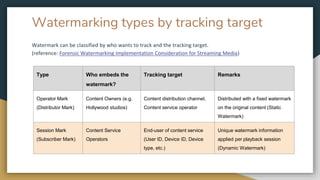
Watermarking types by tracking target
Watermark can be classified by who wants to track and the tracking target.
(reference: Forensic Watermarking Implementation Consideration for Streaming Media)
Type Who embeds the
watermark?
Tracking target Remarks
Operator Mark
(Distributor Mark)
Content Owners (e.g.
Hollywood studios)
Content distribution channel,
Content service operator
Distributed with a fixed watermark
on the original content (Static
Watermark)
Session Mark
(Subscriber Mark)
Content Service
Operators
End-user of content service
(User ID, Device ID, Device
type, etc.)
Unique watermark information
applied per playback session
(Dynamic Watermark)
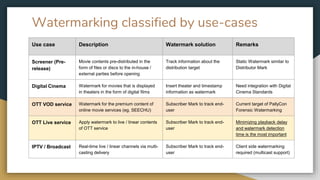
Watermarking classified by use-cases
Use case Description Watermark solution Remarks
Screener (Pre-
release)
Movie contents pre-distributed in the
form of files or discs to the in-house /
external parties before opening
Track information about the
distribution target
Static Watermark similar to
Distributor Mark
Digital Cinema Watermark for movies that is displayed
in theaters in the form of digital films
Insert theater and timestamp
information as watermark
Need integration with Digital
Cinema Standards
OTT VOD service Watermark for the premium content of
online movie services (eg. SEECHU)
Subscriber Mark to track end-
user
Current target of PallyCon
Forensic Watermarking
OTT Live service Apply watermark to live / linear contents
of OTT service
Subscriber Mark to track end-
user
Minimizing playback delay
and watermark detection
time is the most important
IPTV / Broadcast Real-time live / linear channels via multi-
casting delivery
Subscriber Mark to track end-
user
Client side watermarking
required (multicast support)
Subscriber Mark product types by solution
Depending on the difference in watermarking technology, the following types of products are classified:
(reference: FriendMTS whitepaper)
Type Use cases Description Pros Cons
Bitstream
Modification
(Server + Client
solutions)
- VOD
- relatively low usage (only
ContentArmor supports
this type)
- Set position to insert watermark
by preprocessing
- Insert watermarks on CDN edge
or client
None?
(Mixture of pros and cons
of server side and client
side solution)
- Difficult to apply to live because of
long pre-processing time and
watermark detection time
- Higher cost of integration for
server-side infrastructure changes
A/B Variant
(Server side
solution)
- VOD
- lowest commercial
usage (according to
FriendMTS’ whitepaper)
- A / B two watermark versions by
preprocessing
- Stream mixing at playback time
(mainly at CDN edge)
- No client integration
required
- Can support web
browsers (HTML5 player)
- Difficult to apply to live
- High cost of server-side
infrastructure change related to
encoding, storage and CDN
- Robustness issues for attacks
Client side
solution
- Live and VOD
- The most commonly
used method for large-
scale services
- Inserting a watermark in a set-
top box or OTT client app
- Implemented as device firmware
or client SDK
- Suitable for live due to
short playback delay and
detection time
- No change on server
infrastructure (headend)
- For security, it should be linked
with TEE environment of the device,
or application security application is
required for SDK
- Cannot support web browsers
Watermarking products
Company /
Brand
Server
side
Client
side
OTT VOD
OTT Live /
Linear
Broadcast
Distributor
Mark(Static)
Auto-detect
service
Remarks
FriendMTS
ASiD
watermarking
X O O O O O O
Supports
fingerprinting
as well
Nagra
NexGuard
O
(A/B)
O O O X O O
Audio mark,
BroadPeak
CDN Edge
ContentArmor O
(BitStream)
X O X X O X
Audio mark,
Edgeware CDN
solution
Irdeto
TraceMark
O
(A/B)
X O O O O X
Supports live
and broadcast
with server side
Verimatrix
VideoMark
StreamMark
O
(A/B)
O O O O X O
Support Live
with server side
solution as well
MarkAny
Content
TRACKER
O
(A/B)
O O O O O X
Image, audio
watermark also
available
Summary
- Due to the nature of live content, such as sports broadcasts, it is the most important to track and block
illegal streaming as soon as possible before the event ends.
- As a result of industry analysis, all companies providing real-time detection and blocking of live
content support client-based watermarking.
- Server type watermarking can contain only 1 bit of information per segment by A/B Variant. It has
difficulty of detecting watermark in real time, because the video length required for detection is longer
than that of client side watermarking.
- Server-based watermarking can support any player without additional client integration. And it is more
robust than client-side watermarking due to the preprocessing process.

Research of Forensic Watermarking Technologies

  • 1.
    Forensic Watermarking Tech Researchfor Live Support Daniel Kim @ PallyCon team
  • 2.
    Watermarking types bytracking target Watermark can be classified by who wants to track and the tracking target. (reference: Forensic Watermarking Implementation Consideration for Streaming Media) Type Who embeds the watermark? Tracking target Remarks Operator Mark (Distributor Mark) Content Owners (e.g. Hollywood studios) Content distribution channel, Content service operator Distributed with a fixed watermark on the original content (Static Watermark) Session Mark (Subscriber Mark) Content Service Operators End-user of content service (User ID, Device ID, Device type, etc.) Unique watermark information applied per playback session (Dynamic Watermark)
  • 3.
    Watermarking classified byuse-cases Use case Description Watermark solution Remarks Screener (Pre- release) Movie contents pre-distributed in the form of files or discs to the in-house / external parties before opening Track information about the distribution target Static Watermark similar to Distributor Mark Digital Cinema Watermark for movies that is displayed in theaters in the form of digital films Insert theater and timestamp information as watermark Need integration with Digital Cinema Standards OTT VOD service Watermark for the premium content of online movie services (eg. SEECHU) Subscriber Mark to track end- user Current target of PallyCon Forensic Watermarking OTT Live service Apply watermark to live / linear contents of OTT service Subscriber Mark to track end- user Minimizing playback delay and watermark detection time is the most important IPTV / Broadcast Real-time live / linear channels via multi- casting delivery Subscriber Mark to track end- user Client side watermarking required (multicast support)
  • 4.
    Subscriber Mark producttypes by solution Depending on the difference in watermarking technology, the following types of products are classified: (reference: FriendMTS whitepaper) Type Use cases Description Pros Cons Bitstream Modification (Server + Client solutions) - VOD - relatively low usage (only ContentArmor supports this type) - Set position to insert watermark by preprocessing - Insert watermarks on CDN edge or client None? (Mixture of pros and cons of server side and client side solution) - Difficult to apply to live because of long pre-processing time and watermark detection time - Higher cost of integration for server-side infrastructure changes A/B Variant (Server side solution) - VOD - lowest commercial usage (according to FriendMTS’ whitepaper) - A / B two watermark versions by preprocessing - Stream mixing at playback time (mainly at CDN edge) - No client integration required - Can support web browsers (HTML5 player) - Difficult to apply to live - High cost of server-side infrastructure change related to encoding, storage and CDN - Robustness issues for attacks Client side solution - Live and VOD - The most commonly used method for large- scale services - Inserting a watermark in a set- top box or OTT client app - Implemented as device firmware or client SDK - Suitable for live due to short playback delay and detection time - No change on server infrastructure (headend) - For security, it should be linked with TEE environment of the device, or application security application is required for SDK - Cannot support web browsers
  • 5.
    Watermarking products Company / Brand Server side Client side OTTVOD OTT Live / Linear Broadcast Distributor Mark(Static) Auto-detect service Remarks FriendMTS ASiD watermarking X O O O O O O Supports fingerprinting as well Nagra NexGuard O (A/B) O O O X O O Audio mark, BroadPeak CDN Edge ContentArmor O (BitStream) X O X X O X Audio mark, Edgeware CDN solution Irdeto TraceMark O (A/B) X O O O O X Supports live and broadcast with server side Verimatrix VideoMark StreamMark O (A/B) O O O O X O Support Live with server side solution as well MarkAny Content TRACKER O (A/B) O O O O O X Image, audio watermark also available
  • 6.
    Summary - Due tothe nature of live content, such as sports broadcasts, it is the most important to track and block illegal streaming as soon as possible before the event ends. - As a result of industry analysis, all companies providing real-time detection and blocking of live content support client-based watermarking. - Server type watermarking can contain only 1 bit of information per segment by A/B Variant. It has difficulty of detecting watermark in real time, because the video length required for detection is longer than that of client side watermarking. - Server-based watermarking can support any player without additional client integration. And it is more robust than client-side watermarking due to the preprocessing process.