Critical Thinking
and
Creativity
Dr. Manoj Kumar Maharana
School of Electrical Engineering
KIIT University, Bhubaneswar– 24
Dr. MKM School of Electrical Engineering, KIIT University 2
Outline of the Talk
 Critical Thinking and Creativity
Modes of Critical Thinking and Questions
The element of Thought
Level of Thinking
Problem Finding
Thinking Skill
 Examples
 Conclusion
Dr. MKM School of Electrical Engineering, KIIT University 3
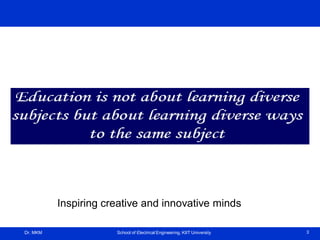
Inspiring creative and innovative minds
Dr. MKM School of Electrical Engineering, KIIT University 4
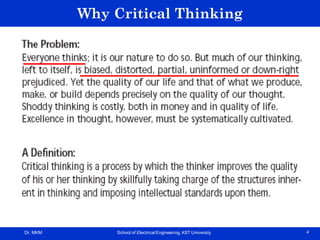
Why Critical Thinking
Dr. MKM School of Electrical Engineering, KIIT University 5
What is Critical Thinking?
Critical thinking is the ability to think clearly and
rationally. It includes the ability to engage in reflective and
independent thinking.
 Someone with critical thinking skills is able to do the
following :
understand the logical connections between ideas
identify, construct and evaluate arguments
detect inconsistencies and common mistakes in reasoning
solve problems systematically
identify the relevance and importance of ideas
reflect on the justification of one's own beliefs and values
Dr. MKM School of Electrical Engineering, KIIT University 6
Modes of Critical Thinking
 There are three mode of thinking people
Strong critical thinkers
 What can the strong critical thinker do (what mental abilities do
they have)
Weak critical thinkers
 Have trouble doing with respect to strong thinker
Borderline
What skill or approaches do the strong critical thinker habitually seem
to exhibit which the weak critical thinkers see not to possess?
Dr. MKM School of Electrical Engineering, KIIT University 7
Mental abilities- Involved in Critical Thinking
According to expert ‘cognitive skill’ being at the very core of
critical thinking are six type
 Interpretation: “to comprehend and express the meaning or significance of a wide
variety of experiences, situations, data, events, judgments, beliefs, rules, procedures or
criteria”
 Analysis: “to identify the intended and actual inferential relationships among
statements, questions, concepts, descriptions or other forms of representation intended to
express belief, experiences, reasons, information or opinions”
 Evaluation: “to assess the credibility of statements or other representations which
are accounts or descriptions of a person’s perception, experience, situation, judgment
belief or opinion; and to assess the logical strength of the actual or intended inferential
relationships among statements, descriptions, questions or other form of representation”
Cont…
Dr. MKM School of Electrical Engineering, KIIT University 8
Mental abilities- Involved in Critical Thinking
 Inference: “to identify & secure elements needed to draw reasonable conclusions;
to consider relevant information, reduce consequences flowing from data, statement,
principles, evidence concepts, descriptions, questions or other form of representation”.
 Explanation: “to state and justify that reasoning in terms of the evidential,
conceptual, methodological and contextual considerations upon which one’s results
were based; present one’s reasoning in the form of cogent argument”.
 Self-Regulation: “to monitor one’s cognitive activities, the elements used in
that, evaluation to one’s own inferential judgments with a view toward questioning,
confirming, validating or correcting either one’s reasoning or one’s result”.
Cont…
Dr. MKM School of Electrical Engineering, KIIT University 9
Questions in Critical Thinking Skills
Based on mental ability certain questions to fire up the (our)
critical thinking skills are given below:
 Interpretation Level
What does this means?
What happening?
How should we understand that (what he or she just said?)
What is the best way to characterize/categorize/classify this?
How can we make sense out of this (experience, feeling,
statement)?
In this context, what was intended by saying/doing that?
Cont…
Dr. MKM School of Electrical Engineering, KIIT University 10
Questions in Critical Thinking Skills
 Analysis Level
Tell us your reasons for making that claim.
What is your conclusion/ you are claiming?
Why do you think that?
What assumptions must we make to accept that conclusion?
What is your basis for saying that?
Cont…
Cont…
Dr. MKM School of Electrical Engineering, KIIT University 11
Questions in Critical Thinking Skills
 Evaluation Level:
How credible is that claim?
Why do we think we can trust what this person claim?
How strong are those arguments?
Do we have our facts right?
How confident can we be in our conclusion, given what we
now know?
Cont…
Cont…
Dr. MKM School of Electrical Engineering, KIIT University 12
Questions in Critical Thinking Skills
 Inference Level
Given what we know so far, what conclusions can we draw?
Given what we know so far, what can we rule out?
If we accepted that assumption, how would things change?
What additional information do we need to resolve this
question?
What are the consequences of doing things that way?
What are some alternatives we haven't yet explored?
Let’s consider each option and see where it takes us.
Cont…
Cont…
Dr. MKM School of Electrical Engineering, KIIT University 13
Questions in Critical Thinking Skills
 Explanation Level:
What were the specific results of the investigation?
Please tell us how you conducted that analysis
How did you come to that interpretation?
Why do you think that (was the right answer/was the
solution)?
How would you explain why this particular decision was
made?
Cont…
Cont…
Dr. MKM School of Electrical Engineering, KIIT University 14
Questions in Critical Thinking Skills
 Self-Regulation Level:
Our position on this issue is still too vague; can we be
more precise?
How good was our methodology, and how well did we
follow it?
How good is our evidence?
Before we correct, what are we missing?
I am finding some of our definitions a little confusing; can
we revisit what we mean by certain things before making
any final decisions?
Cont…
Dr. MKM School of Electrical Engineering, KIIT University 15
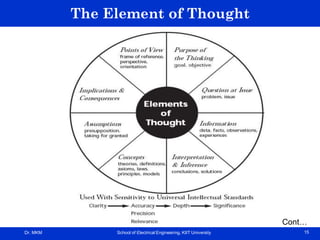
The Element of Thought
Cont…
Dr. MKM School of Electrical Engineering, KIIT University 16
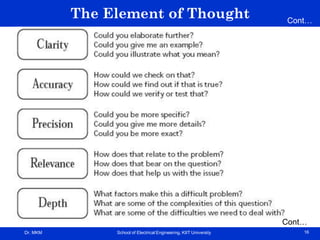
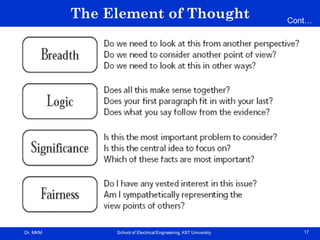
The Element of Thought Cont…
Cont…
Dr. MKM School of Electrical Engineering, KIIT University 17
The Element of Thought Cont…
Dr. MKM School of Electrical Engineering, KIIT University 18
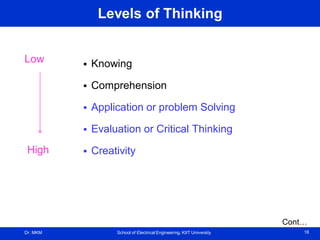
Levels of Thinking
 Knowing
 Comprehension
 Application or problem Solving
 Evaluation or Critical Thinking
 Creativity
Low
High
Cont…
Dr. MKM School of Electrical Engineering, KIIT University 19
Levels of Thinking Cont…
Cont…
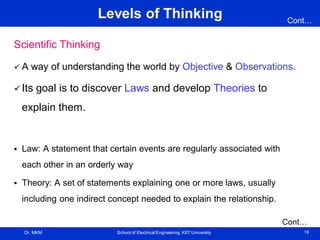
Scientific Thinking
 A way of understanding the world by Objective & Observations.
 Its goal is to discover Laws and develop Theories to
explain them.
 Law: A statement that certain events are regularly associated with
each other in an orderly way
 Theory: A set of statements explaining one or more laws, usually
including one indirect concept needed to explain the relationship.
Dr. MKM School of Electrical Engineering, KIIT University 20
Levels of Thinking
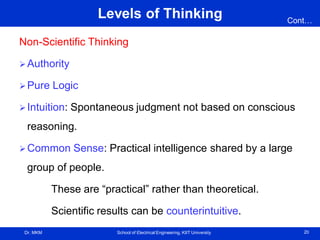
Non-Scientific Thinking
Authority
Pure Logic
Intuition: Spontaneous judgment not based on conscious
reasoning.
Common Sense: Practical intelligence shared by a large
group of people.
These are “practical” rather than theoretical.
Scientific results can be counterintuitive.
Cont…
Dr. MKM School of Electrical Engineering, KIIT University 21
Types of Thinking
 Reproductive: Based on similar problem encountered in the
past, or taught to solve
 Productive: Generates as many alternative approaches as
possible
 Fluent: generates large quantity of ideas
 Flexible: Goes beyond the ordinary and conventional nature of
things.
 Convergent: Proceeds towards a restricted answer to the
solution, e.g. opposite of high?
 Divergent: throws up several alternatives , e.g. what are the
words which mean about the same as low?
 Lateral: Generation of alternatives using a provocative
stimulus during perception stage itself, which is the fist stage
of the thinking process.
Dr. MKM School of Electrical Engineering, KIIT University 22
Strategies of Problem Solving
 Representation
 Logical Thinking
 Division into sub-problems
 Verbalization
Dr. MKM School of Electrical Engineering, KIIT University 23
Techniques of Representation
 Reformulation
 Graph
 Symbolic
 Trees
 Table: List, Matrix
 Venn Diagram
 Other diagram
Dr. MKM School of Electrical Engineering, KIIT University 24
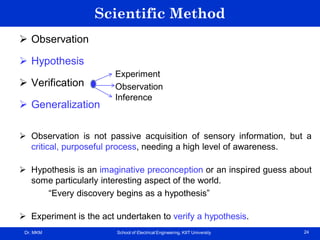
Scientific Method
 Observation
 Hypothesis
 Verification
 Generalization
 Observation is not passive acquisition of sensory information, but a
critical, purposeful process, needing a high level of awareness.
 Hypothesis is an imaginative preconception or an inspired guess about
some particularly interesting aspect of the world.
“Every discovery begins as a hypothesis”
 Experiment is the act undertaken to verify a hypothesis.
Experiment
Observation
Inference
Dr. MKM School of Electrical Engineering, KIIT University 25
Creativity
Dr. MKM School of Electrical Engineering, KIIT University 26
What is Creativity
 Ability to look at the same thing as everyone else and think
something different.
 Ability to take a fresh look at familiar objects and situations,
enriched by past experience, but not constrained by it.
 A creative product is a new and useful combination.
Reason can answer questions, but imagination has to ask them
Imagination is more important than knowledge.
Dr. MKM School of Electrical Engineering, KIIT University 27
What is Creativity: an Example
Creativity in Expression
Advancement due to LED Technology
13,000 150W electric Bulbs replaced by 12WLED
bulbs results in saving of the following over 10 year Period:
$ 5 million and
17,000,000 lbs of CO2
25,000,000 gms of SO2
Planting 2000 acres of forest etc….
Dr. MKM School of Electrical Engineering, KIIT University 28
Creativity: Description of attitude
 Description of attitudes with the help of “Roses and Thorns”
Optimistic Roses
Pessimistic Thorns
Realistic Roses and Thorns
Stoic Roses or Thorns
Humane Roses for you and Roses for me
Selfish Roses for me and Thorns for you
Sadistic Thorns for you and your blood for me
Devine Roses for you and your Thorns for me
Dr. MKM School of Electrical Engineering, KIIT University 29
Problem Solving Vs Problem Finding
 Finding a problem
Is harder than solving it or doing the actual research;
Is often more essential than its solution;
Is as much a scholar’s responsibility as that of the guide.
Only a prepared mind can follow a lead opened by an
observation which is too insignificant to attract the
attention of a common man
A just-found problem is ill-defined. Its formulation as a
well-defined problem is an iterative process, which may
get completed only after thesis writing!!
Dr. MKM School of Electrical Engineering, KIIT University 30
Problem Finding: Mind Preparation
Ideas strikes by chance, but only to a prepared mind
 Do alternate reading and thinking
 Arrange and rearrange what you read or hear, from
different points of view, including your own.
 Do lot of reflection during which –bits and pieces of
disconnected thoughts arrange themselves into a pattern.
 Allow opportunities for cross-fertilization of ideas so as to
generate new problems.
Interaction, discussion, answering doubts, teaching,
explaining
Work or write on problems outside of our own fields or
outside of the areas we are currently learning about.
Set aside time to read in other disciplines, keeping track of
what others are doing that seems original.
Dr. MKM School of Electrical Engineering, KIIT University 31
Problem Finding: Analogies
 An analogy enables a look at a situation as an inter-
related whole.
 Analytical approach on the other hand dismembers a
whole into parts and may destroy the attributes which may
pertain to the phenomenon as a whole.
Electromagnetic wave Matter wave
Solar system Atomic Structure
Brownian motion of dust particles Electrons in a crystal
Dr. MKM School of Electrical Engineering, KIIT University 32
Steps in Finding a Problem
 Identify an area of interest
 Gather information looking for gaps
 Formulate a hypothesis
A problem must spring from a researcher’s mind like a plant
springing from its own seed.
Do not worry too much whether your problem is the best
one to study. Once you go deep, any problem becomes
interesting. The important thing is to get started.
It is better to kill a small problem than to buries a much
larger one.
Dr. MKM School of Electrical Engineering, KIIT University 33
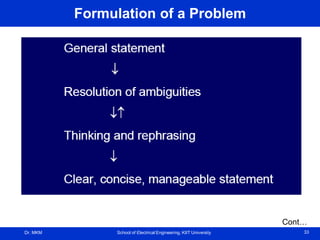
Formulation of a Problem
Cont…
Dr. MKM School of Electrical Engineering, KIIT University 34
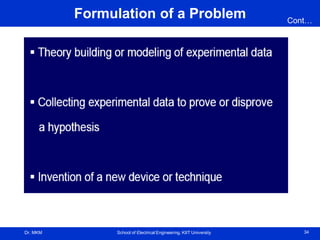
Formulation of a Problem Cont…
Dr. MKM School of Electrical Engineering, KIIT University 35
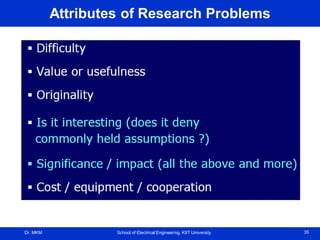
Attributes of Research Problems
Dr. MKM School of Electrical Engineering, KIIT University 36
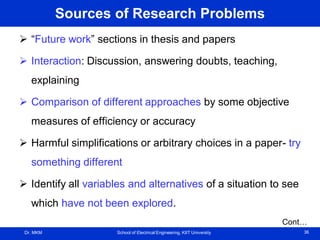
Sources of Research Problems
 “Future work” sections in thesis and papers
 Interaction: Discussion, answering doubts, teaching,
explaining
 Comparison of different approaches by some objective
measures of efficiency or accuracy
 Harmful simplifications or arbitrary choices in a paper- try
something different
 Identify all variables and alternatives of a situation to see
which have not been explored.
Cont…
Dr. MKM School of Electrical Engineering, KIIT University 37
Sources of Research Problems
 Study existing systems/procedures and note what they do
badly at.
 Implement someone else’s work yourself and see the
many problems out there to work on.
 Combine and reorganize existing knowledge structures
Interesting Researches are
Explanation of an anomaly (difference, variance)
Solution of a contradiction
Transplantation of ideas and explanations from one
context to another.
Cont…
Dr. MKM School of Electrical Engineering, KIIT University 38
Thinking Skill
 Is thinking skill inborn or can it be developed
and if so, how?
Creativity is a skill which can be developed by practice.
Conscious application is needed, not the vagaries of
inspiration, in order to achieve a creative output.
Creativity is a matter of organizing one’s basic skills, not
regretting that one was born with a “quick” or “logical”
mind.
Cont…
Dr. MKM School of Electrical Engineering, KIIT University 39
Thinking Skill Cont…
Dr. MKM School of Electrical Engineering, KIIT University 40
An Open/ Flexible Mind…
 Is receptive to alternate points of view, regardless of the
present level of commitment to a belief.
 Acknowledges areas of common ground with those who
hold alternate beliefs and allows dialogue with someone
with opposing views without attacking the proponent of
those views.
 A flexible mind is capable of leaping sideways, upwards
and downwards around a problem before reaching a
solution.
Dr. MKM School of Electrical Engineering, KIIT University 41
Improvement of Thinking
 Observe keenly
 Widen your information base
 Develop the habit of analyzing other creative works.
 Criticize and judge the worth of your own ideas.
 Do mental exercises
 Maintain a note book
 Look at the world in terms of analogies
 Learn different approaches to the same problem.
Dr. MKM School of Electrical Engineering, KIIT University 42
Note Keeping
 Noting ideas as they occur
Helps you to remember them
Speeds up your thinking
Focuses attention on your subject
Stimulates cross-fertilization of ideas
 If you do not record your ideas you will spend all your
metal energy trying to revive old ones.
Cont…
Dr. MKM School of Electrical Engineering, KIIT University 43
Note Keeping
 Record ideas thematically
 Review your notebooks when
You face a problem
You found a solution !
 Sources of ideas
Yourself others
Look for ideas in other fields as well, not just your own
Cont…
Dr. MKM School of Electrical Engineering, KIIT University 44
Different Approaches of Problem Solving
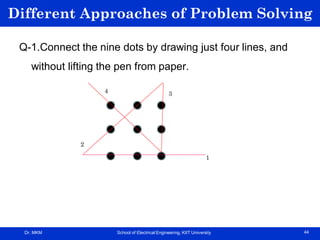
Q-1.Connect the nine dots by drawing just four lines, and
without lifting the pen from paper.
1
2
3
4
Dr. MKM School of Electrical Engineering, KIIT University 45
Example: Proof of Pythagorean Theorem
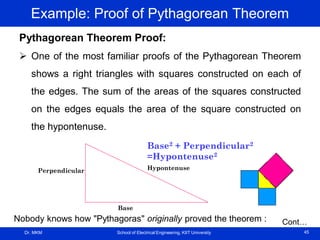
Pythagorean Theorem Proof:
 One of the most familiar proofs of the Pythagorean Theorem
shows a right triangles with squares constructed on each of
the edges. The sum of the areas of the squares constructed
on the edges equals the area of the square constructed on
the hypontenuse.
Cont…
Hypontenuse
Base
Perpendicular
Base2 + Perpendicular2
=Hypontenuse2
Nobody knows how "Pythagoras" originally proved the theorem :
Dr. MKM School of Electrical Engineering, KIIT University 46
Example: Proof of Pythagorean Theorem
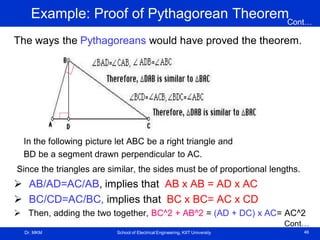
The ways the Pythagoreans would have proved the theorem.
In the following picture let ABC be a right triangle and
BD be a segment drawn perpendicular to AC.
Since the triangles are similar, the sides must be of proportional lengths.
 AB/AD=AC/AB, implies that AB x AB = AD x AC
 BC/CD=AC/BC, implies that BC x BC= AC x CD
 Then, adding the two together, BC^2 + AB^2 = (AD + DC) x AC= AC^2
Cont…
Cont…
Dr. MKM School of Electrical Engineering, KIIT University 47
Example: Proof of Pythagorean Theorem
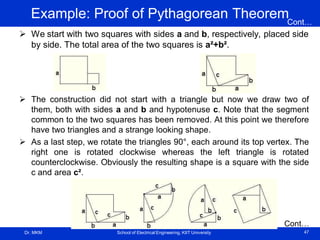
 We start with two squares with sides a and b, respectively, placed side
by side. The total area of the two squares is a²+b².
 The construction did not start with a triangle but now we draw two of
them, both with sides a and b and hypotenuse c. Note that the segment
common to the two squares has been removed. At this point we therefore
have two triangles and a strange looking shape.
 As a last step, we rotate the triangles 90°, each around its top vertex. The
right one is rotated clockwise whereas the left triangle is rotated
counterclockwise. Obviously the resulting shape is a square with the side
c and area c².
Cont…
Cont…
Dr. MKM School of Electrical Engineering, KIIT University 48
Example: Proof of Pythagorean Theorem
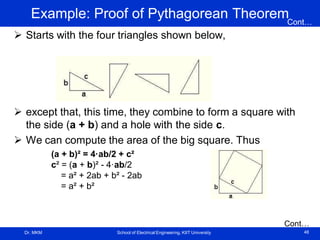
 Starts with the four triangles shown below,
 except that, this time, they combine to form a square with
the side (a + b) and a hole with the side c.
 We can compute the area of the big square. Thus
Cont…
(a + b)² = 4·ab/2 + c²
c² = (a + b)² - 4·ab/2
= a² + 2ab + b² - 2ab
= a² + b²
Cont…
Dr. MKM School of Electrical Engineering, KIIT University 49
Example: Proof of Pythagorean Theorem
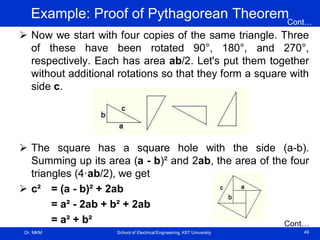
 Now we start with four copies of the same triangle. Three
of these have been rotated 90°, 180°, and 270°,
respectively. Each has area ab/2. Let's put them together
without additional rotations so that they form a square with
side c.
 The square has a square hole with the side (a-b).
Summing up its area (a - b)² and 2ab, the area of the four
triangles (4·ab/2), we get
 c² = (a - b)² + 2ab
= a² - 2ab + b² + 2ab
= a² + b²
Cont…
Cont…
Dr. MKM School of Electrical Engineering, KIIT University 50
Example: Proof of Pythagorean TheoremCont…
Dr. MKM School of Electrical Engineering, KIIT University 51
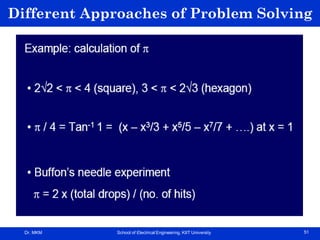
Different Approaches of Problem Solving
Dr. MKM School of Electrical Engineering, KIIT University 52
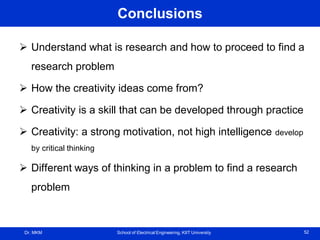
Conclusions
 Understand what is research and how to proceed to find a
research problem
 How the creativity ideas come from?
 Creativity is a skill that can be developed through practice
 Creativity: a strong motivation, not high intelligence develop
by critical thinking
 Different ways of thinking in a problem to find a research
problem
Dr. MKM School of Electrical Engineering, KIIT University 53
Queries?

Research Methodology simple notes for preparations

  • 1.
    Critical Thinking and Creativity Dr. ManojKumar Maharana School of Electrical Engineering KIIT University, Bhubaneswar– 24
  • 2.
    Dr. MKM Schoolof Electrical Engineering, KIIT University 2 Outline of the Talk  Critical Thinking and Creativity Modes of Critical Thinking and Questions The element of Thought Level of Thinking Problem Finding Thinking Skill  Examples  Conclusion
  • 3.
    Dr. MKM Schoolof Electrical Engineering, KIIT University 3 Inspiring creative and innovative minds
  • 4.
    Dr. MKM Schoolof Electrical Engineering, KIIT University 4 Why Critical Thinking
  • 5.
    Dr. MKM Schoolof Electrical Engineering, KIIT University 5 What is Critical Thinking? Critical thinking is the ability to think clearly and rationally. It includes the ability to engage in reflective and independent thinking.  Someone with critical thinking skills is able to do the following : understand the logical connections between ideas identify, construct and evaluate arguments detect inconsistencies and common mistakes in reasoning solve problems systematically identify the relevance and importance of ideas reflect on the justification of one's own beliefs and values
  • 6.
    Dr. MKM Schoolof Electrical Engineering, KIIT University 6 Modes of Critical Thinking  There are three mode of thinking people Strong critical thinkers  What can the strong critical thinker do (what mental abilities do they have) Weak critical thinkers  Have trouble doing with respect to strong thinker Borderline What skill or approaches do the strong critical thinker habitually seem to exhibit which the weak critical thinkers see not to possess?
  • 7.
    Dr. MKM Schoolof Electrical Engineering, KIIT University 7 Mental abilities- Involved in Critical Thinking According to expert ‘cognitive skill’ being at the very core of critical thinking are six type  Interpretation: “to comprehend and express the meaning or significance of a wide variety of experiences, situations, data, events, judgments, beliefs, rules, procedures or criteria”  Analysis: “to identify the intended and actual inferential relationships among statements, questions, concepts, descriptions or other forms of representation intended to express belief, experiences, reasons, information or opinions”  Evaluation: “to assess the credibility of statements or other representations which are accounts or descriptions of a person’s perception, experience, situation, judgment belief or opinion; and to assess the logical strength of the actual or intended inferential relationships among statements, descriptions, questions or other form of representation” Cont…
  • 8.
    Dr. MKM Schoolof Electrical Engineering, KIIT University 8 Mental abilities- Involved in Critical Thinking  Inference: “to identify & secure elements needed to draw reasonable conclusions; to consider relevant information, reduce consequences flowing from data, statement, principles, evidence concepts, descriptions, questions or other form of representation”.  Explanation: “to state and justify that reasoning in terms of the evidential, conceptual, methodological and contextual considerations upon which one’s results were based; present one’s reasoning in the form of cogent argument”.  Self-Regulation: “to monitor one’s cognitive activities, the elements used in that, evaluation to one’s own inferential judgments with a view toward questioning, confirming, validating or correcting either one’s reasoning or one’s result”. Cont…
  • 9.
    Dr. MKM Schoolof Electrical Engineering, KIIT University 9 Questions in Critical Thinking Skills Based on mental ability certain questions to fire up the (our) critical thinking skills are given below:  Interpretation Level What does this means? What happening? How should we understand that (what he or she just said?) What is the best way to characterize/categorize/classify this? How can we make sense out of this (experience, feeling, statement)? In this context, what was intended by saying/doing that? Cont…
  • 10.
    Dr. MKM Schoolof Electrical Engineering, KIIT University 10 Questions in Critical Thinking Skills  Analysis Level Tell us your reasons for making that claim. What is your conclusion/ you are claiming? Why do you think that? What assumptions must we make to accept that conclusion? What is your basis for saying that? Cont… Cont…
  • 11.
    Dr. MKM Schoolof Electrical Engineering, KIIT University 11 Questions in Critical Thinking Skills  Evaluation Level: How credible is that claim? Why do we think we can trust what this person claim? How strong are those arguments? Do we have our facts right? How confident can we be in our conclusion, given what we now know? Cont… Cont…
  • 12.
    Dr. MKM Schoolof Electrical Engineering, KIIT University 12 Questions in Critical Thinking Skills  Inference Level Given what we know so far, what conclusions can we draw? Given what we know so far, what can we rule out? If we accepted that assumption, how would things change? What additional information do we need to resolve this question? What are the consequences of doing things that way? What are some alternatives we haven't yet explored? Let’s consider each option and see where it takes us. Cont… Cont…
  • 13.
    Dr. MKM Schoolof Electrical Engineering, KIIT University 13 Questions in Critical Thinking Skills  Explanation Level: What were the specific results of the investigation? Please tell us how you conducted that analysis How did you come to that interpretation? Why do you think that (was the right answer/was the solution)? How would you explain why this particular decision was made? Cont… Cont…
  • 14.
    Dr. MKM Schoolof Electrical Engineering, KIIT University 14 Questions in Critical Thinking Skills  Self-Regulation Level: Our position on this issue is still too vague; can we be more precise? How good was our methodology, and how well did we follow it? How good is our evidence? Before we correct, what are we missing? I am finding some of our definitions a little confusing; can we revisit what we mean by certain things before making any final decisions? Cont…
  • 15.
    Dr. MKM Schoolof Electrical Engineering, KIIT University 15 The Element of Thought Cont…
  • 16.
    Dr. MKM Schoolof Electrical Engineering, KIIT University 16 The Element of Thought Cont… Cont…
  • 17.
    Dr. MKM Schoolof Electrical Engineering, KIIT University 17 The Element of Thought Cont…
  • 18.
    Dr. MKM Schoolof Electrical Engineering, KIIT University 18 Levels of Thinking  Knowing  Comprehension  Application or problem Solving  Evaluation or Critical Thinking  Creativity Low High Cont…
  • 19.
    Dr. MKM Schoolof Electrical Engineering, KIIT University 19 Levels of Thinking Cont… Cont… Scientific Thinking  A way of understanding the world by Objective & Observations.  Its goal is to discover Laws and develop Theories to explain them.  Law: A statement that certain events are regularly associated with each other in an orderly way  Theory: A set of statements explaining one or more laws, usually including one indirect concept needed to explain the relationship.
  • 20.
    Dr. MKM Schoolof Electrical Engineering, KIIT University 20 Levels of Thinking Non-Scientific Thinking Authority Pure Logic Intuition: Spontaneous judgment not based on conscious reasoning. Common Sense: Practical intelligence shared by a large group of people. These are “practical” rather than theoretical. Scientific results can be counterintuitive. Cont…
  • 21.
    Dr. MKM Schoolof Electrical Engineering, KIIT University 21 Types of Thinking  Reproductive: Based on similar problem encountered in the past, or taught to solve  Productive: Generates as many alternative approaches as possible  Fluent: generates large quantity of ideas  Flexible: Goes beyond the ordinary and conventional nature of things.  Convergent: Proceeds towards a restricted answer to the solution, e.g. opposite of high?  Divergent: throws up several alternatives , e.g. what are the words which mean about the same as low?  Lateral: Generation of alternatives using a provocative stimulus during perception stage itself, which is the fist stage of the thinking process.
  • 22.
    Dr. MKM Schoolof Electrical Engineering, KIIT University 22 Strategies of Problem Solving  Representation  Logical Thinking  Division into sub-problems  Verbalization
  • 23.
    Dr. MKM Schoolof Electrical Engineering, KIIT University 23 Techniques of Representation  Reformulation  Graph  Symbolic  Trees  Table: List, Matrix  Venn Diagram  Other diagram
  • 24.
    Dr. MKM Schoolof Electrical Engineering, KIIT University 24 Scientific Method  Observation  Hypothesis  Verification  Generalization  Observation is not passive acquisition of sensory information, but a critical, purposeful process, needing a high level of awareness.  Hypothesis is an imaginative preconception or an inspired guess about some particularly interesting aspect of the world. “Every discovery begins as a hypothesis”  Experiment is the act undertaken to verify a hypothesis. Experiment Observation Inference
  • 25.
    Dr. MKM Schoolof Electrical Engineering, KIIT University 25 Creativity
  • 26.
    Dr. MKM Schoolof Electrical Engineering, KIIT University 26 What is Creativity  Ability to look at the same thing as everyone else and think something different.  Ability to take a fresh look at familiar objects and situations, enriched by past experience, but not constrained by it.  A creative product is a new and useful combination. Reason can answer questions, but imagination has to ask them Imagination is more important than knowledge.
  • 27.
    Dr. MKM Schoolof Electrical Engineering, KIIT University 27 What is Creativity: an Example Creativity in Expression Advancement due to LED Technology 13,000 150W electric Bulbs replaced by 12WLED bulbs results in saving of the following over 10 year Period: $ 5 million and 17,000,000 lbs of CO2 25,000,000 gms of SO2 Planting 2000 acres of forest etc….
  • 28.
    Dr. MKM Schoolof Electrical Engineering, KIIT University 28 Creativity: Description of attitude  Description of attitudes with the help of “Roses and Thorns” Optimistic Roses Pessimistic Thorns Realistic Roses and Thorns Stoic Roses or Thorns Humane Roses for you and Roses for me Selfish Roses for me and Thorns for you Sadistic Thorns for you and your blood for me Devine Roses for you and your Thorns for me
  • 29.
    Dr. MKM Schoolof Electrical Engineering, KIIT University 29 Problem Solving Vs Problem Finding  Finding a problem Is harder than solving it or doing the actual research; Is often more essential than its solution; Is as much a scholar’s responsibility as that of the guide. Only a prepared mind can follow a lead opened by an observation which is too insignificant to attract the attention of a common man A just-found problem is ill-defined. Its formulation as a well-defined problem is an iterative process, which may get completed only after thesis writing!!
  • 30.
    Dr. MKM Schoolof Electrical Engineering, KIIT University 30 Problem Finding: Mind Preparation Ideas strikes by chance, but only to a prepared mind  Do alternate reading and thinking  Arrange and rearrange what you read or hear, from different points of view, including your own.  Do lot of reflection during which –bits and pieces of disconnected thoughts arrange themselves into a pattern.  Allow opportunities for cross-fertilization of ideas so as to generate new problems. Interaction, discussion, answering doubts, teaching, explaining Work or write on problems outside of our own fields or outside of the areas we are currently learning about. Set aside time to read in other disciplines, keeping track of what others are doing that seems original.
  • 31.
    Dr. MKM Schoolof Electrical Engineering, KIIT University 31 Problem Finding: Analogies  An analogy enables a look at a situation as an inter- related whole.  Analytical approach on the other hand dismembers a whole into parts and may destroy the attributes which may pertain to the phenomenon as a whole. Electromagnetic wave Matter wave Solar system Atomic Structure Brownian motion of dust particles Electrons in a crystal
  • 32.
    Dr. MKM Schoolof Electrical Engineering, KIIT University 32 Steps in Finding a Problem  Identify an area of interest  Gather information looking for gaps  Formulate a hypothesis A problem must spring from a researcher’s mind like a plant springing from its own seed. Do not worry too much whether your problem is the best one to study. Once you go deep, any problem becomes interesting. The important thing is to get started. It is better to kill a small problem than to buries a much larger one.
  • 33.
    Dr. MKM Schoolof Electrical Engineering, KIIT University 33 Formulation of a Problem Cont…
  • 34.
    Dr. MKM Schoolof Electrical Engineering, KIIT University 34 Formulation of a Problem Cont…
  • 35.
    Dr. MKM Schoolof Electrical Engineering, KIIT University 35 Attributes of Research Problems
  • 36.
    Dr. MKM Schoolof Electrical Engineering, KIIT University 36 Sources of Research Problems  “Future work” sections in thesis and papers  Interaction: Discussion, answering doubts, teaching, explaining  Comparison of different approaches by some objective measures of efficiency or accuracy  Harmful simplifications or arbitrary choices in a paper- try something different  Identify all variables and alternatives of a situation to see which have not been explored. Cont…
  • 37.
    Dr. MKM Schoolof Electrical Engineering, KIIT University 37 Sources of Research Problems  Study existing systems/procedures and note what they do badly at.  Implement someone else’s work yourself and see the many problems out there to work on.  Combine and reorganize existing knowledge structures Interesting Researches are Explanation of an anomaly (difference, variance) Solution of a contradiction Transplantation of ideas and explanations from one context to another. Cont…
  • 38.
    Dr. MKM Schoolof Electrical Engineering, KIIT University 38 Thinking Skill  Is thinking skill inborn or can it be developed and if so, how? Creativity is a skill which can be developed by practice. Conscious application is needed, not the vagaries of inspiration, in order to achieve a creative output. Creativity is a matter of organizing one’s basic skills, not regretting that one was born with a “quick” or “logical” mind. Cont…
  • 39.
    Dr. MKM Schoolof Electrical Engineering, KIIT University 39 Thinking Skill Cont…
  • 40.
    Dr. MKM Schoolof Electrical Engineering, KIIT University 40 An Open/ Flexible Mind…  Is receptive to alternate points of view, regardless of the present level of commitment to a belief.  Acknowledges areas of common ground with those who hold alternate beliefs and allows dialogue with someone with opposing views without attacking the proponent of those views.  A flexible mind is capable of leaping sideways, upwards and downwards around a problem before reaching a solution.
  • 41.
    Dr. MKM Schoolof Electrical Engineering, KIIT University 41 Improvement of Thinking  Observe keenly  Widen your information base  Develop the habit of analyzing other creative works.  Criticize and judge the worth of your own ideas.  Do mental exercises  Maintain a note book  Look at the world in terms of analogies  Learn different approaches to the same problem.
  • 42.
    Dr. MKM Schoolof Electrical Engineering, KIIT University 42 Note Keeping  Noting ideas as they occur Helps you to remember them Speeds up your thinking Focuses attention on your subject Stimulates cross-fertilization of ideas  If you do not record your ideas you will spend all your metal energy trying to revive old ones. Cont…
  • 43.
    Dr. MKM Schoolof Electrical Engineering, KIIT University 43 Note Keeping  Record ideas thematically  Review your notebooks when You face a problem You found a solution !  Sources of ideas Yourself others Look for ideas in other fields as well, not just your own Cont…
  • 44.
    Dr. MKM Schoolof Electrical Engineering, KIIT University 44 Different Approaches of Problem Solving Q-1.Connect the nine dots by drawing just four lines, and without lifting the pen from paper. 1 2 3 4
  • 45.
    Dr. MKM Schoolof Electrical Engineering, KIIT University 45 Example: Proof of Pythagorean Theorem Pythagorean Theorem Proof:  One of the most familiar proofs of the Pythagorean Theorem shows a right triangles with squares constructed on each of the edges. The sum of the areas of the squares constructed on the edges equals the area of the square constructed on the hypontenuse. Cont… Hypontenuse Base Perpendicular Base2 + Perpendicular2 =Hypontenuse2 Nobody knows how "Pythagoras" originally proved the theorem :
  • 46.
    Dr. MKM Schoolof Electrical Engineering, KIIT University 46 Example: Proof of Pythagorean Theorem The ways the Pythagoreans would have proved the theorem. In the following picture let ABC be a right triangle and BD be a segment drawn perpendicular to AC. Since the triangles are similar, the sides must be of proportional lengths.  AB/AD=AC/AB, implies that AB x AB = AD x AC  BC/CD=AC/BC, implies that BC x BC= AC x CD  Then, adding the two together, BC^2 + AB^2 = (AD + DC) x AC= AC^2 Cont… Cont…
  • 47.
    Dr. MKM Schoolof Electrical Engineering, KIIT University 47 Example: Proof of Pythagorean Theorem  We start with two squares with sides a and b, respectively, placed side by side. The total area of the two squares is a²+b².  The construction did not start with a triangle but now we draw two of them, both with sides a and b and hypotenuse c. Note that the segment common to the two squares has been removed. At this point we therefore have two triangles and a strange looking shape.  As a last step, we rotate the triangles 90°, each around its top vertex. The right one is rotated clockwise whereas the left triangle is rotated counterclockwise. Obviously the resulting shape is a square with the side c and area c². Cont… Cont…
  • 48.
    Dr. MKM Schoolof Electrical Engineering, KIIT University 48 Example: Proof of Pythagorean Theorem  Starts with the four triangles shown below,  except that, this time, they combine to form a square with the side (a + b) and a hole with the side c.  We can compute the area of the big square. Thus Cont… (a + b)² = 4·ab/2 + c² c² = (a + b)² - 4·ab/2 = a² + 2ab + b² - 2ab = a² + b² Cont…
  • 49.
    Dr. MKM Schoolof Electrical Engineering, KIIT University 49 Example: Proof of Pythagorean Theorem  Now we start with four copies of the same triangle. Three of these have been rotated 90°, 180°, and 270°, respectively. Each has area ab/2. Let's put them together without additional rotations so that they form a square with side c.  The square has a square hole with the side (a-b). Summing up its area (a - b)² and 2ab, the area of the four triangles (4·ab/2), we get  c² = (a - b)² + 2ab = a² - 2ab + b² + 2ab = a² + b² Cont… Cont…
  • 50.
    Dr. MKM Schoolof Electrical Engineering, KIIT University 50 Example: Proof of Pythagorean TheoremCont…
  • 51.
    Dr. MKM Schoolof Electrical Engineering, KIIT University 51 Different Approaches of Problem Solving
  • 52.
    Dr. MKM Schoolof Electrical Engineering, KIIT University 52 Conclusions  Understand what is research and how to proceed to find a research problem  How the creativity ideas come from?  Creativity is a skill that can be developed through practice  Creativity: a strong motivation, not high intelligence develop by critical thinking  Different ways of thinking in a problem to find a research problem
  • 53.
    Dr. MKM Schoolof Electrical Engineering, KIIT University 53 Queries?