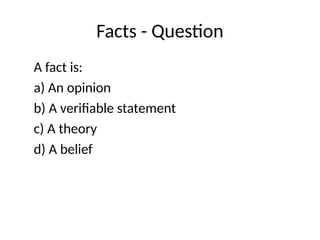
Facts - Question
Whichof the following is an example of a
fact?
a) The Earth is flat.
b) Water boils at 100°C at sea level.
c) Democracy is the best form of government.
d) I like pizza.
Facts - Question
Factsare important in research because:
a) They provide evidence for conclusions
b) They express personal feelings
c) They create uncertainty
d) They cannot be proven
Facts - Question
Whichone is a scientific fact?
a) The moon is beautiful
b) Gravity attracts objects toward the Earth
c) Summer is better than winter
d) Blue is the best color
Facts - Question
Factsdiffer from opinions because:
a) Facts are based on evidence
b) Opinions are always wrong
c) Facts are always positive
d) Opinions are legal documents
Facts - Question
Whichis not a fact?
a) Humans need oxygen to survive
b) The Pacific Ocean is the largest ocean
c) Ice melts at 0°C under standard conditions
d) Jazz music is better than rock music
Concepts - Question
Insocial sciences, concepts help:
a) Frame research questions
b) Eliminate all uncertainty
c) Replace facts
d) Avoid data collection
Concepts - Question
Whichstatement about concepts is correct?
a) Concepts are physical entities
b) Concepts are purely subjective and cannot
be studied
c) Concepts are building blocks of theories
d) Concepts cannot be defined
Concepts - Question
Anexample of a broad concept in sociology is:
a) Social stratification
b) Number of working hours
c) Daily temperature
d) Annual rainfall
Causality - Question
Causalitymeans:
a) One event always follows another
b) One event causes another
c) Two events happen at the same time
d) Events occur randomly
Causality - Question
Inresearch, causality requires:
a) Correlation, temporal precedence, and
elimination of alternative explanations
b) Random guessing
c) A single observation
d) Opinion-based analysis
34.
Causality - Answer
CorrectAnswer: Correlation, temporal
precedence, and elimination of alternative
explanations
35.
Causality - Question
Whichis an example of causality?
a) Ice cream sales increase and sunburn cases
increase in summer
b) Smoking increases the risk of lung cancer
c) People wear jackets in winter
d) Rain is wet
Causality - Question
'Acauses B' means:
a) A is always followed by B
b) A produces a change in B
c) B happens without relation to A
d) A and B are unrelated
Causality - Question
Spuriouscorrelation means:
a) Two variables are linked due to a third
factor
b) A causes B directly
c) B causes A directly
d) There is no relationship at all
Uncertainty - Question
Uncertaintyrefers to:
a) Complete knowledge of an event
b) Lack of complete certainty about outcomes
c) A guaranteed prediction
d) Only past events
Uncertainty - Question
Whichof the following situations shows
uncertainty?
a) Tossing a fair coin
b) The sun rising in the east tomorrow
c) Water boiling at 100°C
d) Earth’s gravitational pull
Uncertainty - Question
Ineconomics, uncertainty is different from
risk because:
a) Risk is measurable, uncertainty is not
b) Risk is unknown, uncertainty is known
c) Both are the same
d) Risk is emotional
Uncertainty - Question
Uncertaintyin decision-making means:
a) Decision-makers have full data
b) Outcomes are partly or wholly unknown
c) All outcomes are equal
d) Outcomes are fixed
Uncertainty - Question
Anexample of uncertainty in business is:
a) Future interest rates in 5 years
b) Today’s temperature
c) Weight of an object measured on a scale
d) Sum of 2+2
Uncertainty - Question
Uncertaintycan be reduced by:
a) Collecting more data and using models
b) Ignoring information
c) Relying only on luck
d) Making no decisions
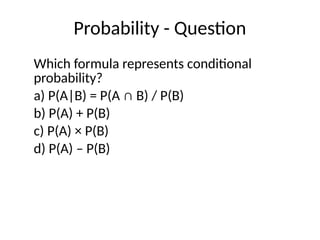
Probability - Question
Probabilitymeasures:
a) The likelihood of an event occurring
b) The number of facts collected
c) The size of an object
d) The certainty of an event
Probability - Question
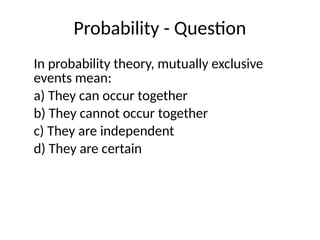
Inprobability theory, mutually exclusive
events mean:
a) They can occur together
b) They cannot occur together
c) They are independent
d) They are certain
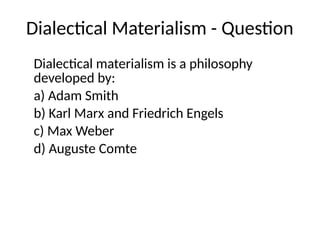
Dialectical Materialism -Question
Dialectical materialism is a philosophy
developed by:
a) Adam Smith
b) Karl Marx and Friedrich Engels
c) Max Weber
d) Auguste Comte
Dialectical Materialism -Question
The term 'dialectics' refers to:
a) Static thinking
b) Change through contradiction
c) Religious doctrine
d) Random events
Dialectical Materialism -Question
In dialectical materialism, material conditions
are considered:
a) Irrelevant to society
b) The basis of social development
c) Fixed and unchangeable
d) Purely ideological
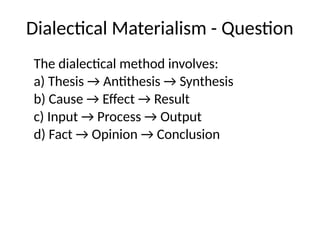
Dialectical Materialism -Question
The dialectical method involves:
a) Thesis → Antithesis → Synthesis
b) Cause → Effect → Result
c) Input → Process → Output
d) Fact → Opinion → Conclusion
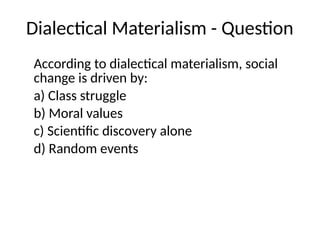
Dialectical Materialism -Question
According to dialectical materialism, social
change is driven by:
a) Class struggle
b) Moral values
c) Scientific discovery alone
d) Random events
Dialectical Materialism -Question
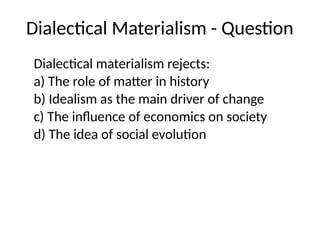
Dialectical materialism rejects:
a) The role of matter in history
b) Idealism as the main driver of change
c) The influence of economics on society
d) The idea of social evolution
Dialectical Materialism -Question
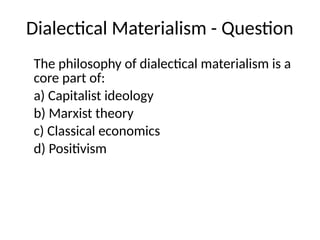
The philosophy of dialectical materialism is a
core part of:
a) Capitalist ideology
b) Marxist theory
c) Classical economics
d) Positivism
Historical Materialism -Question
Historical materialism is a method for
understanding:
a) Changes in art styles
b) Social and historical development
c) Scientific experiments
d) Natural disasters
Historical Materialism -Question
Karl Marx’s historical materialism emphasizes:
a) Religion as the driving force of history
b) Material economic conditions shaping
society
c) Random changes in history
d) Personal morality
Historical Materialism -Question
The primary focus of historical materialism is
on:
a) Modes of production
b) Political parties
c) Weather patterns
d) Individual heroes
Historical Materialism -Question
In historical materialism, history progresses
through:
a) Economic stages
b) Artistic movements
c) Scientific revolutions only
d) Random events
Historical Materialism -Question
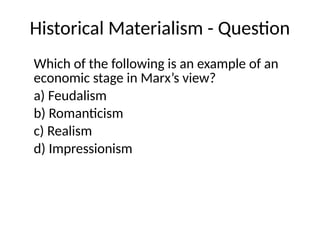
Which of the following is an example of an
economic stage in Marx’s view?
a) Feudalism
b) Romanticism
c) Realism
d) Impressionism
Historical Materialism -Question
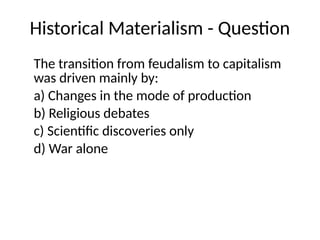
The transition from feudalism to capitalism
was driven mainly by:
a) Changes in the mode of production
b) Religious debates
c) Scientific discoveries only
d) War alone
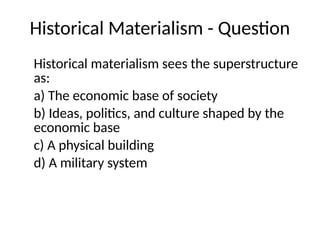
Historical Materialism -Question
Historical materialism sees the superstructure
as:
a) The economic base of society
b) Ideas, politics, and culture shaped by the
economic base
c) A physical building
d) A military system
101.
Historical Materialism -Answer
Correct Answer: Ideas, politics, and culture
shaped by the economic base
102.
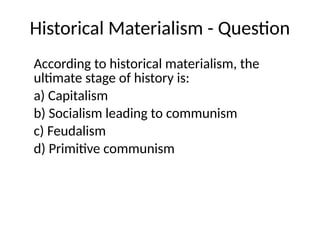
Historical Materialism -Question
According to historical materialism, the
ultimate stage of history is:
a) Capitalism
b) Socialism leading to communism
c) Feudalism
d) Primitive communism