‫لرحيم‬‫ا‬‫لرمحن‬‫ا‬‫اهلل‬‫بسم‬
2
✓ The word “Research” is derived from the French term “recherche”,
which means to go about seeking.
➢ Research is a systematized effort to gain new knowledge
- Redman and Mory.
➢ A broad definition was given by Godwin Colibao (in The broadest
sense of the word) research includes any gathering of data, information
and facts for advancement of knowledge.
➢ Research (WHO Health research methodology, 1992, a guide for
training in research methods): Is a quest for knowledge through diligent
search or investigation or experimentation aimed at the discovery and
interpretation of new knowledge.
Dr. Omar Ahmed Aldossary
3
✓ : an integral part of your practice.
▪ Research is undertaken within most professions. More than a set of
skills, research is a way of thinking; examining critically the various
aspects of your day-to-day professional work; understanding and
formulating guiding principles that govern a particular procedure; and
developing and testing new theories that contribute to the advancement
of your practice and profession. It is a habit of questioning what you
do, and a systematic examination of clinical observations to explain
and find answers for what you perceive, with a view to instituting
appropriate changes for a more effective professional service.
4
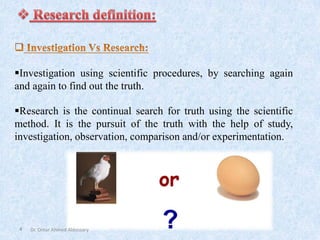
▪Investigation using scientific procedures, by searching again
and again to find out the truth.
▪Research is the continual search for truth using the scientific
method. It is the pursuit of the truth with the help of study,
investigation, observation, comparison and/or experimentation.
Dr. Omar Ahmed Aldossary
5
➢ There are several ways of collecting and understanding information
and finding answers to questions – research is one way.
➢ The difference between research and other ways of obtaining
answers to a questions is that in a process that is classified as
research, you work within a framework of a set of philosophies,
use methods that have been tested for validity and reliability, and
attempt to be unbiased and objective.
➢ The typology of research can be looked at from three perspectives:
application, objectives and the enquiry process.
Dr. Omar Ahmed Aldossary
6
➢ The typology of research can be looked at from three perspectives:
application, objectives and the enquiry process.
❖ From the point of view of the application of research. Most of the
research undertaken in the social sciences is applied, the findings
being designed either for use in understanding a phenomenon/issue
or to bring change in a program/situation.
❖ Pure research is academic in nature and is undertaken in order to
gain knowledge about phenomena that may or may not have
applications in the near future, and to develop new techniques and
procedures that form the body of research methodology.
Dr. Omar Ahmed Aldossary
7
➢ The typology of research can be looked at from three perspectives:
application, objectives and the enquiry process.
❖ A research study can be carried out with four objectives:
✓ to describe a situation, phenomenon, problem or issue
(descriptive research);
✓ to establish or explore a relationship between two or more variables
(correlational research);
✓ to explain why certain things happen the way they do
(explanatory research); and
✓ to examine the feasibility of conducting a study or exploring a
subject area where nothing or little is known
(exploratory research).
8
➢ To increase the scientific knowledge. By finding newer concepts,
techniques and materials.
➢ To improve the dental treatments. E.g. alveolar bone grafting in tr.
of cleft lip & palate. However, because of its disadvantages, the use of
alloplastic grafts was introduced. Then a new tr. Came into being by
combination of autogenous bone with alloplastic bone.
➢ To inform and Educate the public.
➢ For effective planning of available resources.
➢ For commercial success.
Dr. Omar Ahmed Aldossary
9
➢ Thus, research is an integral part of all health sciences, including
dentistry. With the help of research, new knowledge is developed,
thereby improving the health, lifespan and living standards of
people.
➢ Dentistry research is unique as a life science as it
involves materials, clinical techniques , laboratory techniques
and patients care.
Dr. Omar Ahmed Aldossary
➢ For intellectual dependence.
➢ As a partial fulfillment requirement to obtain Master’s Degree and
fulfillment requirement to obtain PhD Degree.
10
✓ Research methodology is a systematic way to solve a
problem. It is a science of studying how research is to be carried
out. The procedure by which researchers go about their work of
describing, explaining and predicting phenomena.
✓ Research methodology is the specific procedures or
techniques used to identify, select, process, and analyze
information about a topic. In a research paper, the
methodology section allows the reader to critically evaluate a
study’s overall validity and reliability.
Dr. Omar Ahmed Aldossary
11
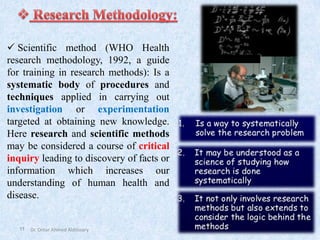
✓ Scientific method (WHO Health
research methodology, 1992, a guide
for training in research methods): Is a
systematic body of procedures and
techniques applied in carrying out
investigation or experimentation
targeted at obtaining new knowledge.
Here research and scientific methods
may be considered a course of critical
inquiry leading to discovery of facts or
information which increases our
understanding of human health and
disease.
Dr. Omar Ahmed Aldossary
12
➢ To provide adequate level of information to plan, conduct,
analyze, interpret and write up research and contribute to
evidence-based medical practice.
➢ To equip with necessary skills to understand, critically evaluate
and interpret the published medical literature.
➢ To guide through necessary resources and resource persons for
conducting research.
➢ To orient to certain skills, literature search and computer
applications.
Dr. Omar Ahmed Aldossary
13
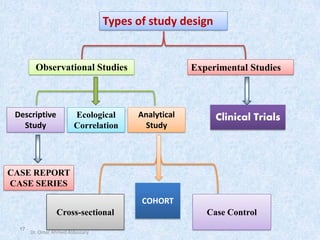
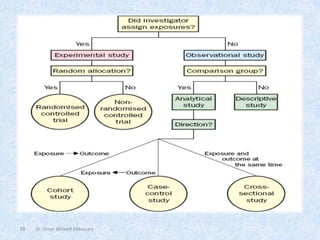
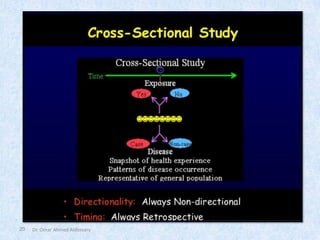
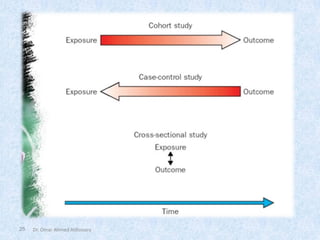
❑ Observational studies:
Are ones where researchers observe the effect of a risk factor,
diagnostic test, treatment or other intervention without trying to
change who is or isn’t exposed to it.
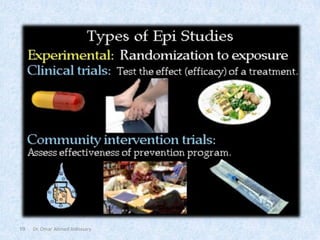
❑ Experimental studies:
Are ones where researchers introduce an intervention and study the
effects. Experimental studies are usually randomized, meaning the
subjects are grouped by chance.
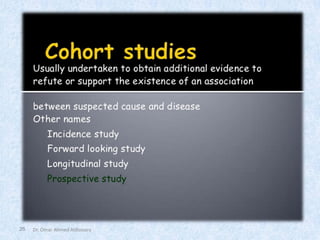
❑ Cohort study:
A cohort is any group of people who are linked in some way. For
instance, a birth cohort includes all people born within a given time frame.
Researchers compare what happens to members of the cohort that have
been exposed to a particular variable to what happens to the other
members who have not been exposed.
Dr. Omar Ahmed Aldossary
14
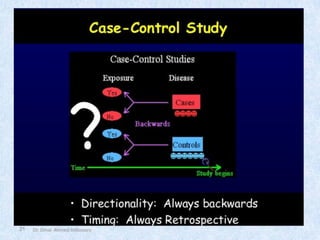
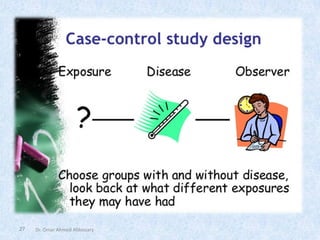
❑ Case control study:
Here researchers identify people with an existing health problem
(“cases”) and a similar group without the problem (“controls”) and then
compare them with respect to unexposure or exposures.
❑ Randomized controlled trial (RCT):
Eligible people are randomly assigned to one of two or more groups.
One group receives the intervention (such as a new drug) while the
control group receives nothing or an inactive placebo. The researchers
then study what happens to people in each group. Any difference in
outcomes can then be linked to the intervention.
❑ Validity:
The quality of being logically or factually sound; soundness or cogency.
Dr. Omar Ahmed Aldossary
15
❑ Bias: systematic errors.
‫نرىق‬
‫يف‬
‫البحث‬
‫املقاييس‬‫و‬
‫عىل‬
‫التدرجي‬
‫تيب‬‫رت‬‫ال‬‫و‬
‫مع‬
‫نتقاد‬‫ا‬
‫املقدمات‬
‫التحفظ‬‫و‬
‫يف‬
‫نتاجئ‬‫ل‬‫ا‬
‫وجنعل‬
‫غرضنا‬
‫يف‬
‫مجيع‬
‫ما‬
‫ئه‬‫ر‬‫تق‬‫نس‬
‫نتصفحه‬‫و‬
‫تعامل‬‫اس‬
‫العدل‬
‫ال‬
‫اتباع‬
‫الهوى‬
‫نتحرى‬‫و‬
‫يف‬
‫سائر‬
‫ما‬
‫ز‬
‫ي‬‫من‬
‫ه‬
‫ننتقده‬‫و‬
‫طلب‬
‫احلق‬
‫ال‬
‫امليل‬
‫مع‬
‫اء‬‫ر‬‫آ‬‫ل‬‫ا‬
”
‫احلسن‬
‫بن‬
‫اهليثم‬
❑ Prospective study:
Studying particular in the future.
❑ Retrospective study:
Looking back on or dealing with past events or situations.
❑ Confounding:
Cause surprise or confusion in (someone), especially by acting against
their expectations.
Dr. Omar Ahmed Aldossary
16 Dr. Omar Ahmed Aldossary
17
Types of study design
Observational Studies Experimental Studies
Clinical Trials
Descriptive
Study
Ecological
Correlation
Analytical
Study
CASE REPORT
CASE SERIES
Cross-sectional Case Control
COHORT
Dr. Omar Ahmed Aldossary
18 Dr. Omar Ahmed Aldossary
19 Dr. Omar Ahmed Aldossary
20 Dr. Omar Ahmed Aldossary
21 Dr. Omar Ahmed Aldossary
22 Dr. Omar Ahmed Aldossary
23
No
Dr. Omar Ahmed Aldossary
24 Dr. Omar Ahmed Aldossary
25 Dr. Omar Ahmed Aldossary
26 Dr. Omar Ahmed Aldossary
27 Dr. Omar Ahmed Aldossary
28
❑ Experimental research: We can manipulate some aspect of the
environment and observe its effects.
E.g. Interdental tissue resection: An experimental study of a
surgical technique which aids in repair of the periodontal tissues to
their original contour and function.
❑ Observational research: We can observe what naturally
happens in the real world without interfering with it.
E.g. study conducted to measure the degree of dental caries in
school relative to age, sex and socio economic characteristics of
children.
Dr. Omar Ahmed Aldossary
29
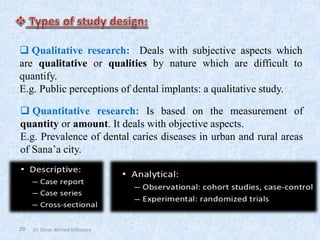
❑ Qualitative research: Deals with subjective aspects which
are qualitative or qualities by nature which are difficult to
quantify.
E.g. Public perceptions of dental implants: a qualitative study.
❑ Quantitative research: Is based on the measurement of
quantity or amount. It deals with objective aspects.
E.g. Prevalence of dental caries diseases in urban and rural areas
of Sana’a city.
Dr. Omar Ahmed Aldossary
30
✓ Research is not a one man/woman show,
You need a team to do good research…
✓ Research is a science,
You need to learn how to do it…
✓ Research is like riding a bicycle,
You need to practice…
✓ Research needs planning,
If you fail to plan, you plan to fail…
Dr. Omar Ahmed Aldossary
31
❖ Considerations to be kept in mind while conducting research:
✓ In any research on human beings, each subject must be
adequately informed of the aim, methods, anticipated benefits and
potential hazards of the study and the discomfort it may entail.
✓ When obtaining informed consent, we should be cautious if the
subject has a dependent relationship to us. No pressure or threat
should be exercised.
✓ Subject should be informed that they are free to abstain or to
withdraw from participation at any time.
32
Research methodology
in dentistry
Dr. Pragati Kaurani
Dr. Nikhil Marwah
Publishers : BlueRose
❖Reference for more information or reading
Dr. Omar Ahmed Aldossary
33 Dr. Omar Ahmed Aldossary

1.Research Method and the way to write proposal

  • 1.
  • 2.
    2 ✓ The word“Research” is derived from the French term “recherche”, which means to go about seeking. ➢ Research is a systematized effort to gain new knowledge - Redman and Mory. ➢ A broad definition was given by Godwin Colibao (in The broadest sense of the word) research includes any gathering of data, information and facts for advancement of knowledge. ➢ Research (WHO Health research methodology, 1992, a guide for training in research methods): Is a quest for knowledge through diligent search or investigation or experimentation aimed at the discovery and interpretation of new knowledge. Dr. Omar Ahmed Aldossary
  • 3.
    Dr. Omar AhmedAldossary 3 ✓ : an integral part of your practice. ▪ Research is undertaken within most professions. More than a set of skills, research is a way of thinking; examining critically the various aspects of your day-to-day professional work; understanding and formulating guiding principles that govern a particular procedure; and developing and testing new theories that contribute to the advancement of your practice and profession. It is a habit of questioning what you do, and a systematic examination of clinical observations to explain and find answers for what you perceive, with a view to instituting appropriate changes for a more effective professional service.
  • 4.
    4 ▪Investigation using scientificprocedures, by searching again and again to find out the truth. ▪Research is the continual search for truth using the scientific method. It is the pursuit of the truth with the help of study, investigation, observation, comparison and/or experimentation. Dr. Omar Ahmed Aldossary
  • 5.
    Dr. Omar AhmedAldossary 5 ➢ There are several ways of collecting and understanding information and finding answers to questions – research is one way. ➢ The difference between research and other ways of obtaining answers to a questions is that in a process that is classified as research, you work within a framework of a set of philosophies, use methods that have been tested for validity and reliability, and attempt to be unbiased and objective. ➢ The typology of research can be looked at from three perspectives: application, objectives and the enquiry process.
  • 6.
    Dr. Omar AhmedAldossary 6 ➢ The typology of research can be looked at from three perspectives: application, objectives and the enquiry process. ❖ From the point of view of the application of research. Most of the research undertaken in the social sciences is applied, the findings being designed either for use in understanding a phenomenon/issue or to bring change in a program/situation. ❖ Pure research is academic in nature and is undertaken in order to gain knowledge about phenomena that may or may not have applications in the near future, and to develop new techniques and procedures that form the body of research methodology.
  • 7.
    Dr. Omar AhmedAldossary 7 ➢ The typology of research can be looked at from three perspectives: application, objectives and the enquiry process. ❖ A research study can be carried out with four objectives: ✓ to describe a situation, phenomenon, problem or issue (descriptive research); ✓ to establish or explore a relationship between two or more variables (correlational research); ✓ to explain why certain things happen the way they do (explanatory research); and ✓ to examine the feasibility of conducting a study or exploring a subject area where nothing or little is known (exploratory research).
  • 8.
    8 ➢ To increasethe scientific knowledge. By finding newer concepts, techniques and materials. ➢ To improve the dental treatments. E.g. alveolar bone grafting in tr. of cleft lip & palate. However, because of its disadvantages, the use of alloplastic grafts was introduced. Then a new tr. Came into being by combination of autogenous bone with alloplastic bone. ➢ To inform and Educate the public. ➢ For effective planning of available resources. ➢ For commercial success. Dr. Omar Ahmed Aldossary
  • 9.
    9 ➢ Thus, researchis an integral part of all health sciences, including dentistry. With the help of research, new knowledge is developed, thereby improving the health, lifespan and living standards of people. ➢ Dentistry research is unique as a life science as it involves materials, clinical techniques , laboratory techniques and patients care. Dr. Omar Ahmed Aldossary ➢ For intellectual dependence. ➢ As a partial fulfillment requirement to obtain Master’s Degree and fulfillment requirement to obtain PhD Degree.
  • 10.
    10 ✓ Research methodologyis a systematic way to solve a problem. It is a science of studying how research is to be carried out. The procedure by which researchers go about their work of describing, explaining and predicting phenomena. ✓ Research methodology is the specific procedures or techniques used to identify, select, process, and analyze information about a topic. In a research paper, the methodology section allows the reader to critically evaluate a study’s overall validity and reliability. Dr. Omar Ahmed Aldossary
  • 11.
    11 ✓ Scientific method(WHO Health research methodology, 1992, a guide for training in research methods): Is a systematic body of procedures and techniques applied in carrying out investigation or experimentation targeted at obtaining new knowledge. Here research and scientific methods may be considered a course of critical inquiry leading to discovery of facts or information which increases our understanding of human health and disease. Dr. Omar Ahmed Aldossary
  • 12.
    12 ➢ To provideadequate level of information to plan, conduct, analyze, interpret and write up research and contribute to evidence-based medical practice. ➢ To equip with necessary skills to understand, critically evaluate and interpret the published medical literature. ➢ To guide through necessary resources and resource persons for conducting research. ➢ To orient to certain skills, literature search and computer applications. Dr. Omar Ahmed Aldossary
  • 13.
    13 ❑ Observational studies: Areones where researchers observe the effect of a risk factor, diagnostic test, treatment or other intervention without trying to change who is or isn’t exposed to it. ❑ Experimental studies: Are ones where researchers introduce an intervention and study the effects. Experimental studies are usually randomized, meaning the subjects are grouped by chance. ❑ Cohort study: A cohort is any group of people who are linked in some way. For instance, a birth cohort includes all people born within a given time frame. Researchers compare what happens to members of the cohort that have been exposed to a particular variable to what happens to the other members who have not been exposed. Dr. Omar Ahmed Aldossary
  • 14.
    14 ❑ Case controlstudy: Here researchers identify people with an existing health problem (“cases”) and a similar group without the problem (“controls”) and then compare them with respect to unexposure or exposures. ❑ Randomized controlled trial (RCT): Eligible people are randomly assigned to one of two or more groups. One group receives the intervention (such as a new drug) while the control group receives nothing or an inactive placebo. The researchers then study what happens to people in each group. Any difference in outcomes can then be linked to the intervention. ❑ Validity: The quality of being logically or factually sound; soundness or cogency. Dr. Omar Ahmed Aldossary
  • 15.
    15 ❑ Bias: systematicerrors. ‫نرىق‬ ‫يف‬ ‫البحث‬ ‫املقاييس‬‫و‬ ‫عىل‬ ‫التدرجي‬ ‫تيب‬‫رت‬‫ال‬‫و‬ ‫مع‬ ‫نتقاد‬‫ا‬ ‫املقدمات‬ ‫التحفظ‬‫و‬ ‫يف‬ ‫نتاجئ‬‫ل‬‫ا‬ ‫وجنعل‬ ‫غرضنا‬ ‫يف‬ ‫مجيع‬ ‫ما‬ ‫ئه‬‫ر‬‫تق‬‫نس‬ ‫نتصفحه‬‫و‬ ‫تعامل‬‫اس‬ ‫العدل‬ ‫ال‬ ‫اتباع‬ ‫الهوى‬ ‫نتحرى‬‫و‬ ‫يف‬ ‫سائر‬ ‫ما‬ ‫ز‬ ‫ي‬‫من‬ ‫ه‬ ‫ننتقده‬‫و‬ ‫طلب‬ ‫احلق‬ ‫ال‬ ‫امليل‬ ‫مع‬ ‫اء‬‫ر‬‫آ‬‫ل‬‫ا‬ ” ‫احلسن‬ ‫بن‬ ‫اهليثم‬ ❑ Prospective study: Studying particular in the future. ❑ Retrospective study: Looking back on or dealing with past events or situations. ❑ Confounding: Cause surprise or confusion in (someone), especially by acting against their expectations. Dr. Omar Ahmed Aldossary
  • 16.
    16 Dr. OmarAhmed Aldossary
  • 17.
    17 Types of studydesign Observational Studies Experimental Studies Clinical Trials Descriptive Study Ecological Correlation Analytical Study CASE REPORT CASE SERIES Cross-sectional Case Control COHORT Dr. Omar Ahmed Aldossary
  • 18.
    18 Dr. OmarAhmed Aldossary
  • 19.
    19 Dr. OmarAhmed Aldossary
  • 20.
    20 Dr. OmarAhmed Aldossary
  • 21.
    21 Dr. OmarAhmed Aldossary
  • 22.
    22 Dr. OmarAhmed Aldossary
  • 23.
  • 24.
    24 Dr. OmarAhmed Aldossary
  • 25.
    25 Dr. OmarAhmed Aldossary
  • 26.
    26 Dr. OmarAhmed Aldossary
  • 27.
    27 Dr. OmarAhmed Aldossary
  • 28.
    28 ❑ Experimental research:We can manipulate some aspect of the environment and observe its effects. E.g. Interdental tissue resection: An experimental study of a surgical technique which aids in repair of the periodontal tissues to their original contour and function. ❑ Observational research: We can observe what naturally happens in the real world without interfering with it. E.g. study conducted to measure the degree of dental caries in school relative to age, sex and socio economic characteristics of children. Dr. Omar Ahmed Aldossary
  • 29.
    29 ❑ Qualitative research:Deals with subjective aspects which are qualitative or qualities by nature which are difficult to quantify. E.g. Public perceptions of dental implants: a qualitative study. ❑ Quantitative research: Is based on the measurement of quantity or amount. It deals with objective aspects. E.g. Prevalence of dental caries diseases in urban and rural areas of Sana’a city. Dr. Omar Ahmed Aldossary
  • 30.
    30 ✓ Research isnot a one man/woman show, You need a team to do good research… ✓ Research is a science, You need to learn how to do it… ✓ Research is like riding a bicycle, You need to practice… ✓ Research needs planning, If you fail to plan, you plan to fail… Dr. Omar Ahmed Aldossary
  • 31.
    Dr. Omar AhmedAldossary 31 ❖ Considerations to be kept in mind while conducting research: ✓ In any research on human beings, each subject must be adequately informed of the aim, methods, anticipated benefits and potential hazards of the study and the discomfort it may entail. ✓ When obtaining informed consent, we should be cautious if the subject has a dependent relationship to us. No pressure or threat should be exercised. ✓ Subject should be informed that they are free to abstain or to withdraw from participation at any time.
  • 32.
    32 Research methodology in dentistry Dr.Pragati Kaurani Dr. Nikhil Marwah Publishers : BlueRose ❖Reference for more information or reading Dr. Omar Ahmed Aldossary
  • 33.
    33 Dr. OmarAhmed Aldossary