Wolaita Sodo University
Graduate Studies Directorate
College of Social Sciences and Humanities
Research Methods in ELT (ELT, 721)
Unit 12: Data Sampling in Qualitative Research, Unit 13: Data Analysis
and Unit 14: Research Software to Analyse Qualitative Data (NIVIVO)
Outlines of Presentation
UNIT 12: DATA SAMPLING IN QUALITATIVE RESEARCH
Steps in Sampling
Criteria of Selecting a Sampling Procedure
Characteristics of a Good Sampling

Types of Sampling
Cont'd…
CHAPTER 13: DATA ANALYSIS
 Processing, Storing and Organizing Qualitative Research
 Analyzing Data from Different Research Tools and Discourse
 Ways of Organizing and Presenting Qualitative Data Analysis
 Systematic Approaches to Data Analysis
 Methodological Tools for Analysing Qualitative Data
 Coding Qualitative Data
Cont'd…
CHAPTER 14: RESEARCH SOFTWARE to ANALYZE QUALITATIVE DATA (NVIVO)
 Creating a Suitable Documents for Nvivo
 Loading Documents
 Creating Codes and Adding Codes to Data
 Prepare for auto coding
 Create a Memo
 Make a Model
 Audio and Video
 Photos and Other Images
 Classifications
 Literature reviews in NVivo
Conclusion
INTRODUCTION
 This presentation is prearranged through three chapters including
chapter 12, 13 and 14.
 These are data sampling, data analysis and research software to
analyze qualitative data respectively.
 Sampling is the procedure the researcher would adopt in selecting
items for the sample.
 The data, after collection, has to be processed and analysed in
accordance with the outline laid down for the purpose at the time
of developing the research plan.
 To analyse the collected data in qualitative research, the software
so called NVivo is recommended as it keeps everything in one
place.
Unit 12: Data Sampling in Qualitative Research
 Sampling refers to the technique or the procedure the researcher would
adopt in selecting items for the sample.
 Sample design may as well lay down the number of items to be included
in the sample i.e., the size of the sample.
 Sample design is determined before data are collected.
 There are many sample designs from which a researcher can choose.
 Some designs are relatively more precise and easier to apply than others.
 Researcher must select/prepare a sample design which should be reliable
and appropriate for his research study.
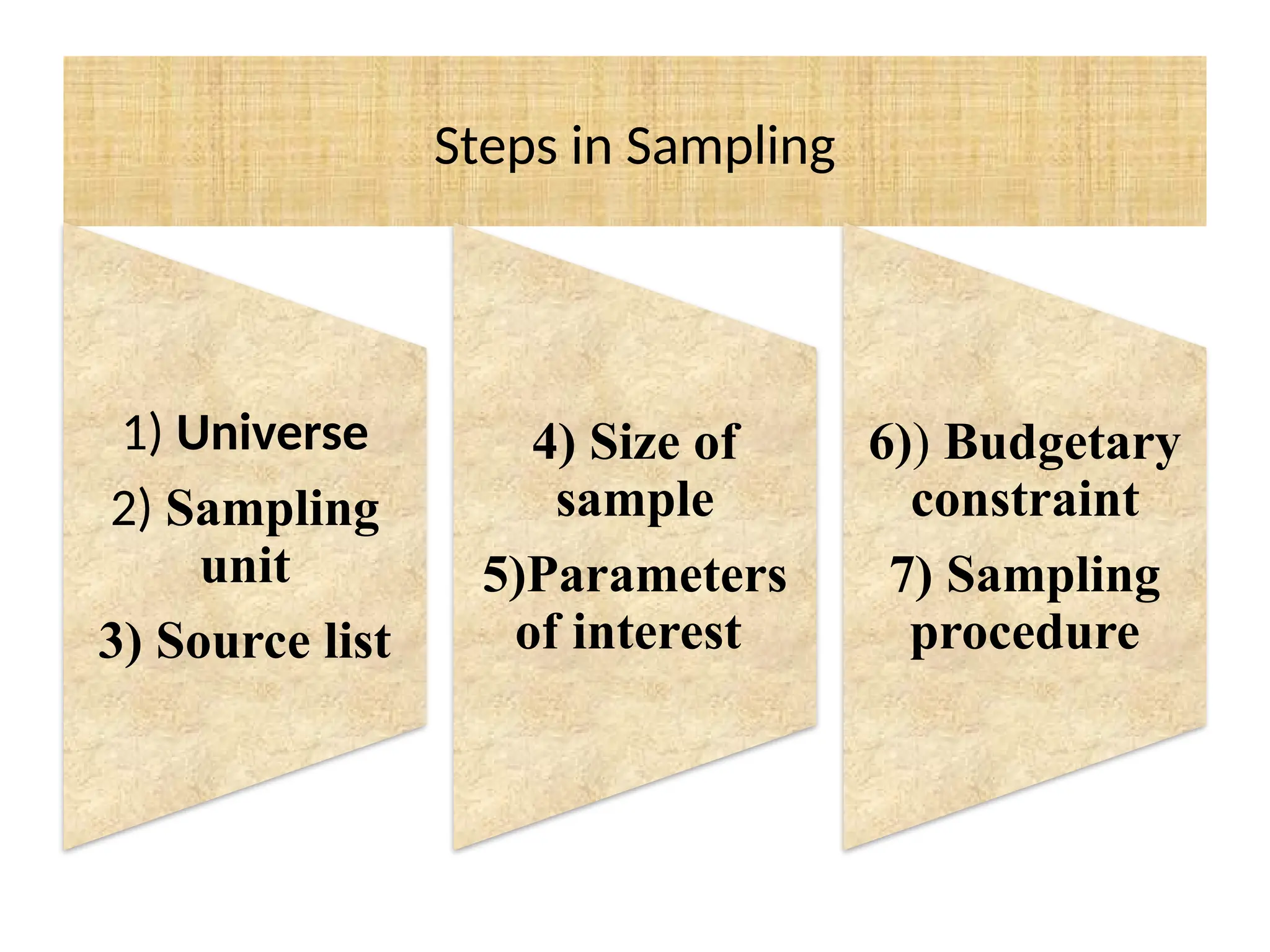
Steps in Sampling
1) Universe
2) Sampling
unit
3) Source list
4) Size of
sample
5)Parameters
of interest
6)) Budgetary
constraint
7) Sampling
procedure
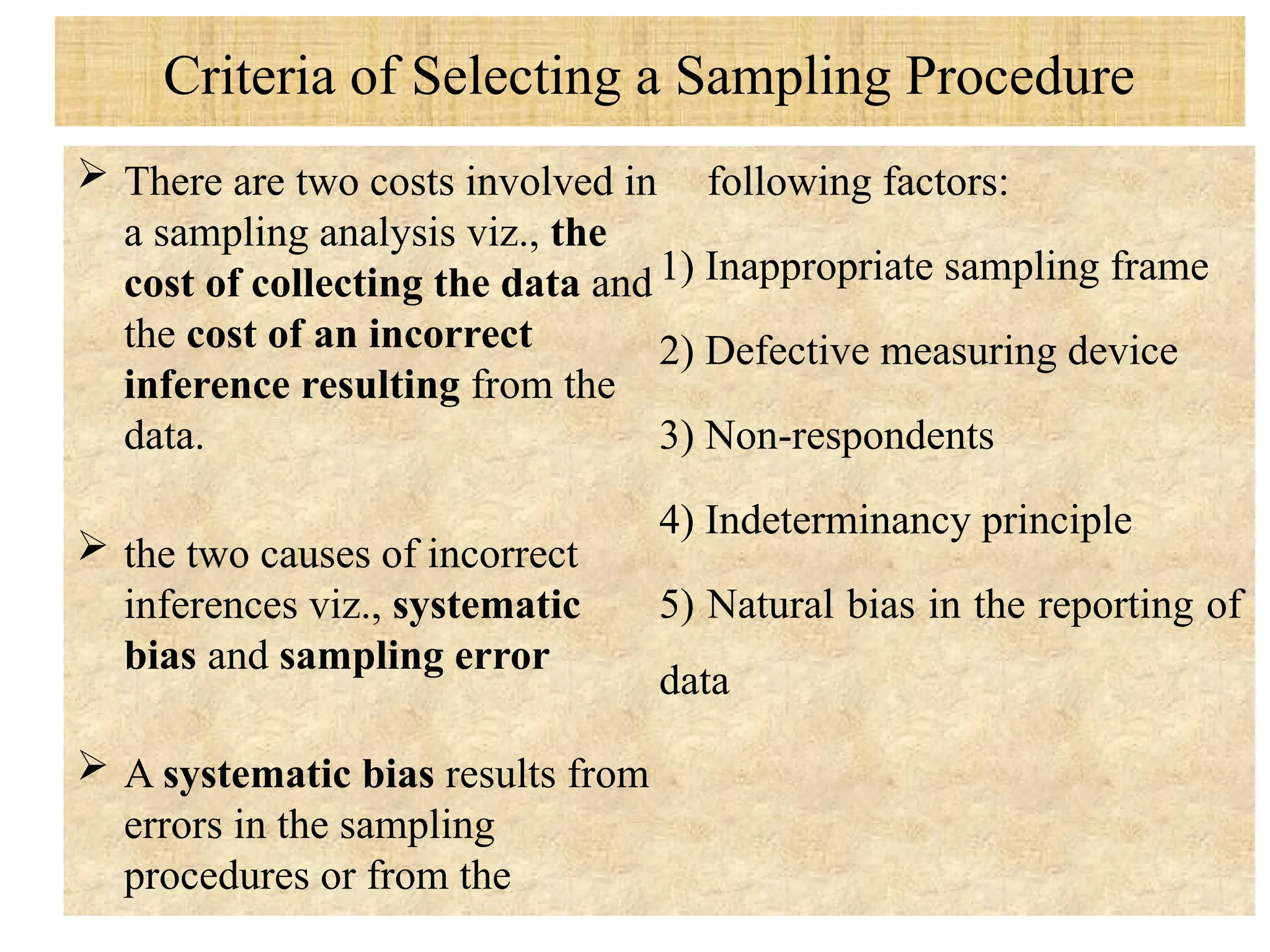
Criteria of Selecting a Sampling Procedure
 There are two costs involved in
a sampling analysis viz., the
cost of collecting the data and
the cost of an incorrect
inference resulting from the
data.
 the two causes of incorrect
inferences viz., systematic
bias and sampling error
 A systematic bias results from
errors in the sampling
procedures or from the
following factors:
1) Inappropriate sampling frame
2) Defective measuring device
3) Non-respondents
4) Indeterminancy principle
5) Natural bias in the reporting of
data
Sampling errors
 Sampling errors are the random variations in the sample estimates around the true
population parameters.
 Since they occur randomly and are equally likely to be in either direction, their
nature happens to be of compensatory type and the expected value of such errors
happens to be equal to zero.
 Sampling error decreases with the increase in the size of the sample, and it happens
to be of a smaller magnitude in case of homogeneous population.
 Sampling error can be measured for a given sample design and size.
 The measurement of sampling error is usually called the ‘precision of the sampling
plan’.
 If we increase the sample size, the precision can be improved.
Characteristics of a Good Sampling
Sample design must:
 result in a truly representative
sample,
 be such which results in a
small sampling error,
 be viable in the context of
funds available for the
research study,
 be such so that systematic bias
can be controlled in a better
way and
 be such that the results of the
sample study can be applied
for the universe.
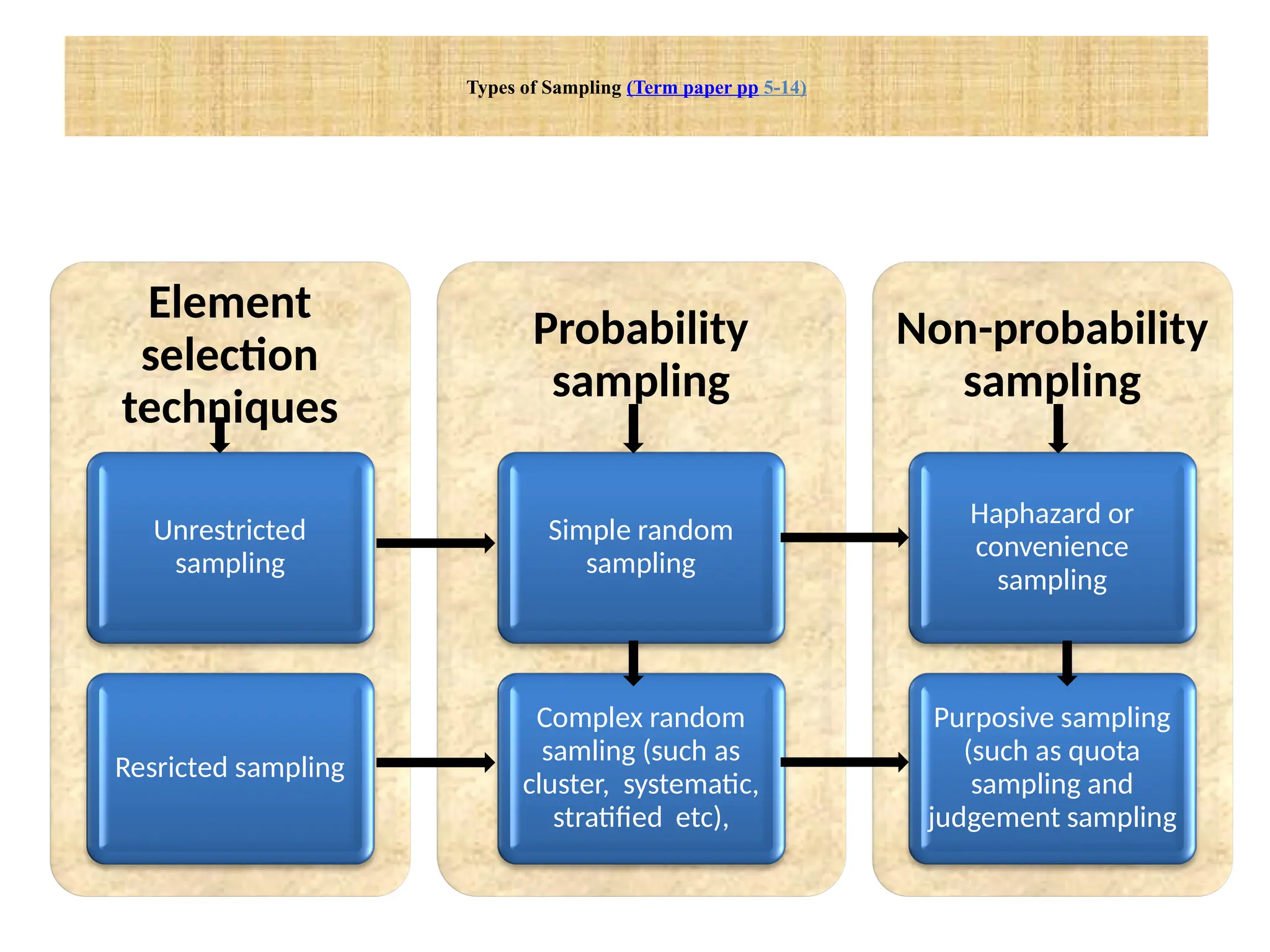
Types of Sampling (Term paper pp 5-14)
Element
selection
techniques
Unrestricted
sampling
Resricted sampling
Probability
sampling
Simple random
sampling
Complex random
samling (such as
cluster, systematic,
stratified etc),
Non-probability
sampling
Haphazard or
convenience
sampling
Purposive sampling
(such as quota
sampling and
judgement sampling
Chapter 13: Data Analysis
 The term analysis refers to the computation of certain measures along
with searching for patterns of relationship that exist among data-groups.
 Thus, the data, after collection, has to be processed and analysed in
accordance with the outline laid down for the purpose at the time of
developing the research plan.
 With this brief introduction concerning the concepts of processing and
analysis, we can now proceed with the explanation of all the processing,
storing and organizing qualitative data in next points.
Processing, Storing and Organizing Qualitative
Research
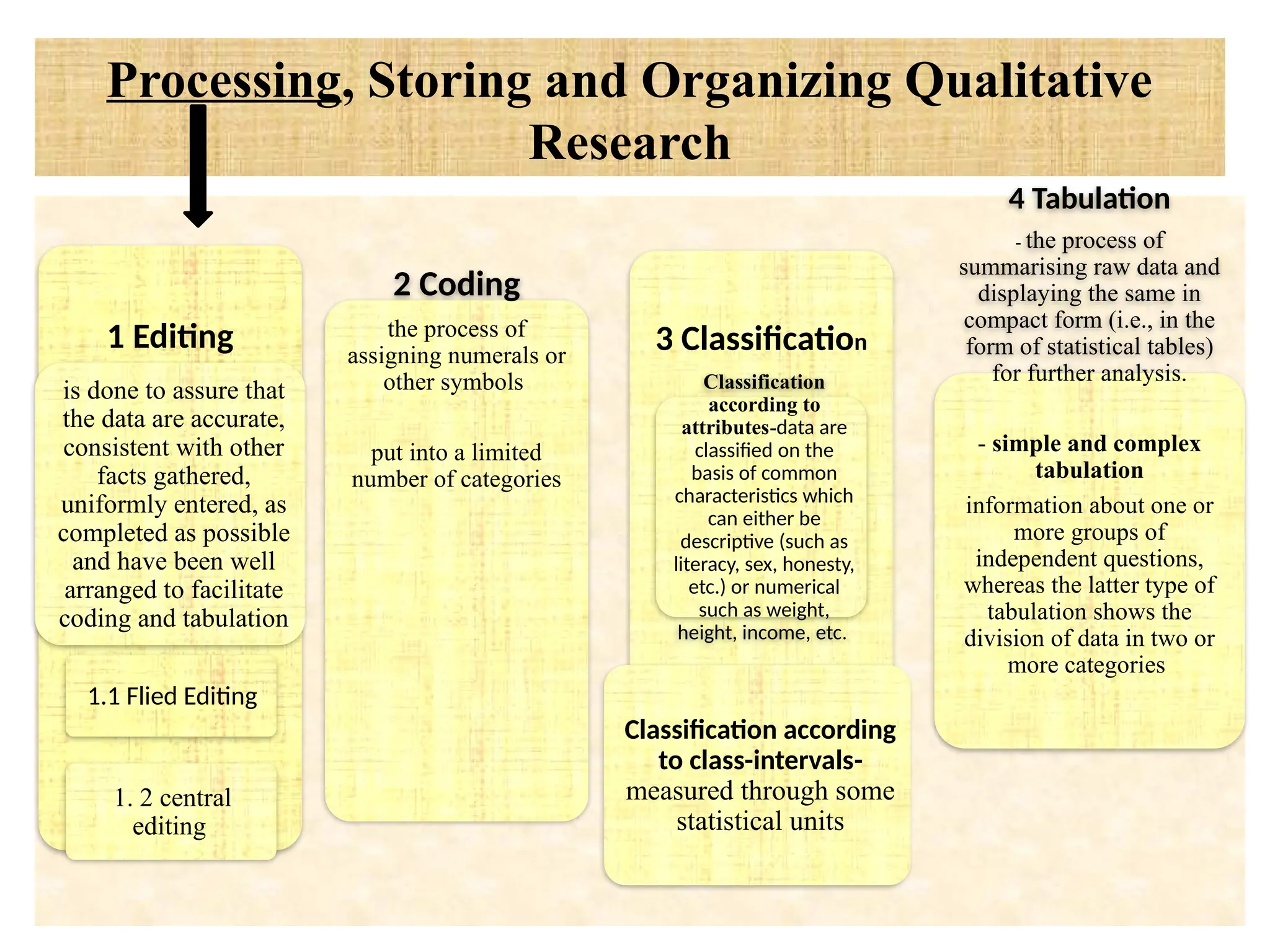
1 Editing
is done to assure that
the data are accurate,
consistent with other
facts gathered,
uniformly entered, as
completed as possible
and have been well
arranged to facilitate
coding and tabulation
1.1 Flied Editing
1. 2 central
editing
2 Coding
the process of
assigning numerals or
other symbols
put into a limited
number of categories
3 Classification
Classification
according to
attributes-data are
classified on the
basis of common
characteristics which
can either be
descriptive (such as
literacy, sex, honesty,
etc.) or numerical
such as weight,
height, income, etc.
Classification according
to class-intervals-
measured through some
statistical units
4 Tabulation
- the process of
summarising raw data and
displaying the same in
compact form (i.e., in the
form of statistical tables)
for further analysis.
- simple and complex
tabulation
information about one or
more groups of
independent questions,
whereas the latter type of
tabulation shows the
division of data in two or
more categories
Analyzing Data from Different Research Tools
and Discourse
Ways of Organizing and Presenting Qualitative Data Analysis
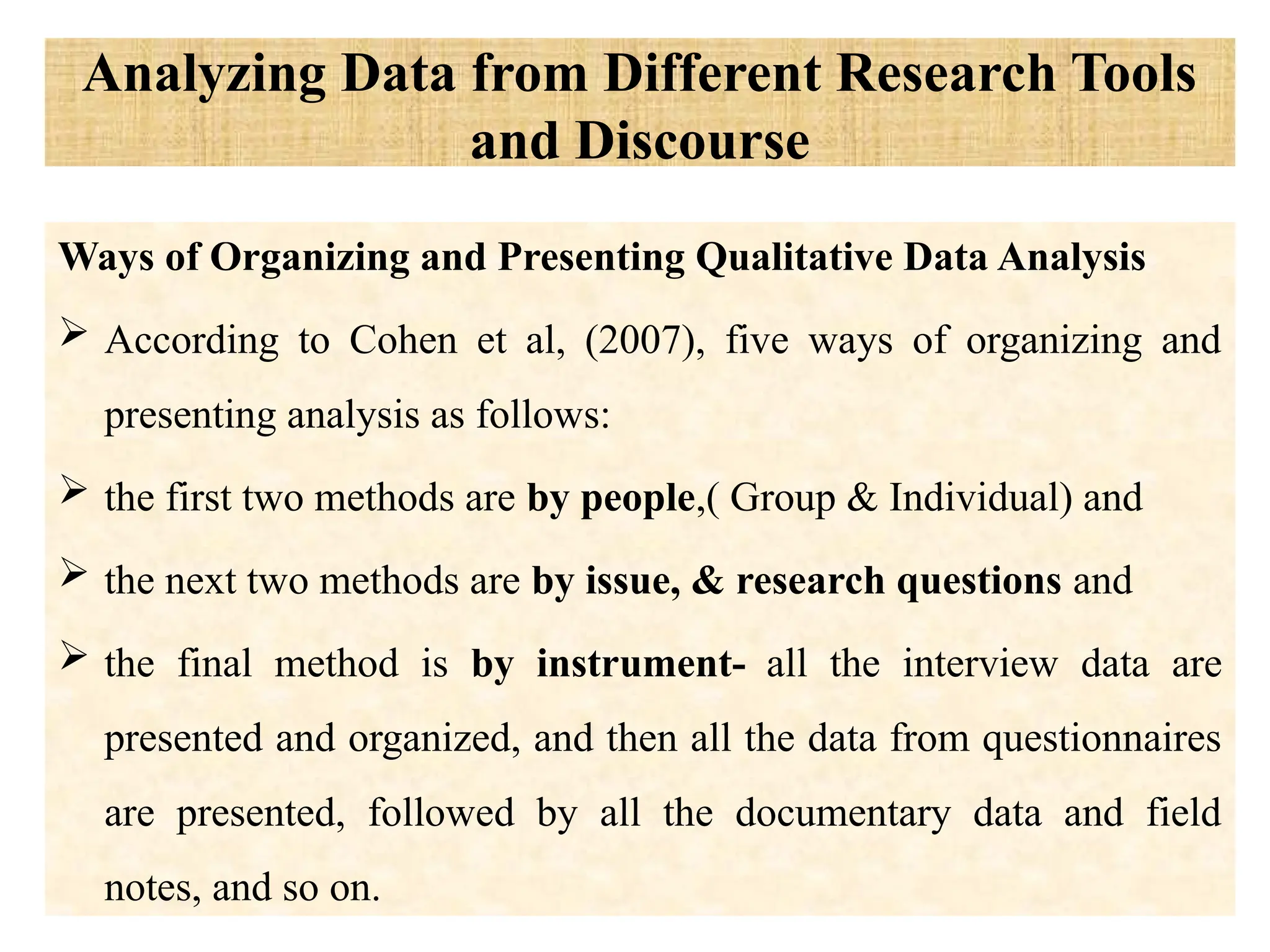
 According to Cohen et al, (2007), five ways of organizing and
presenting analysis as follows:
 the first two methods are by people,( Group & Individual) and
 the next two methods are by issue, & research questions and
 the final method is by instrument- all the interview data are
presented and organized, and then all the data from questionnaires
are presented, followed by all the documentary data and field
notes, and so on.
Coding Qualitative Data
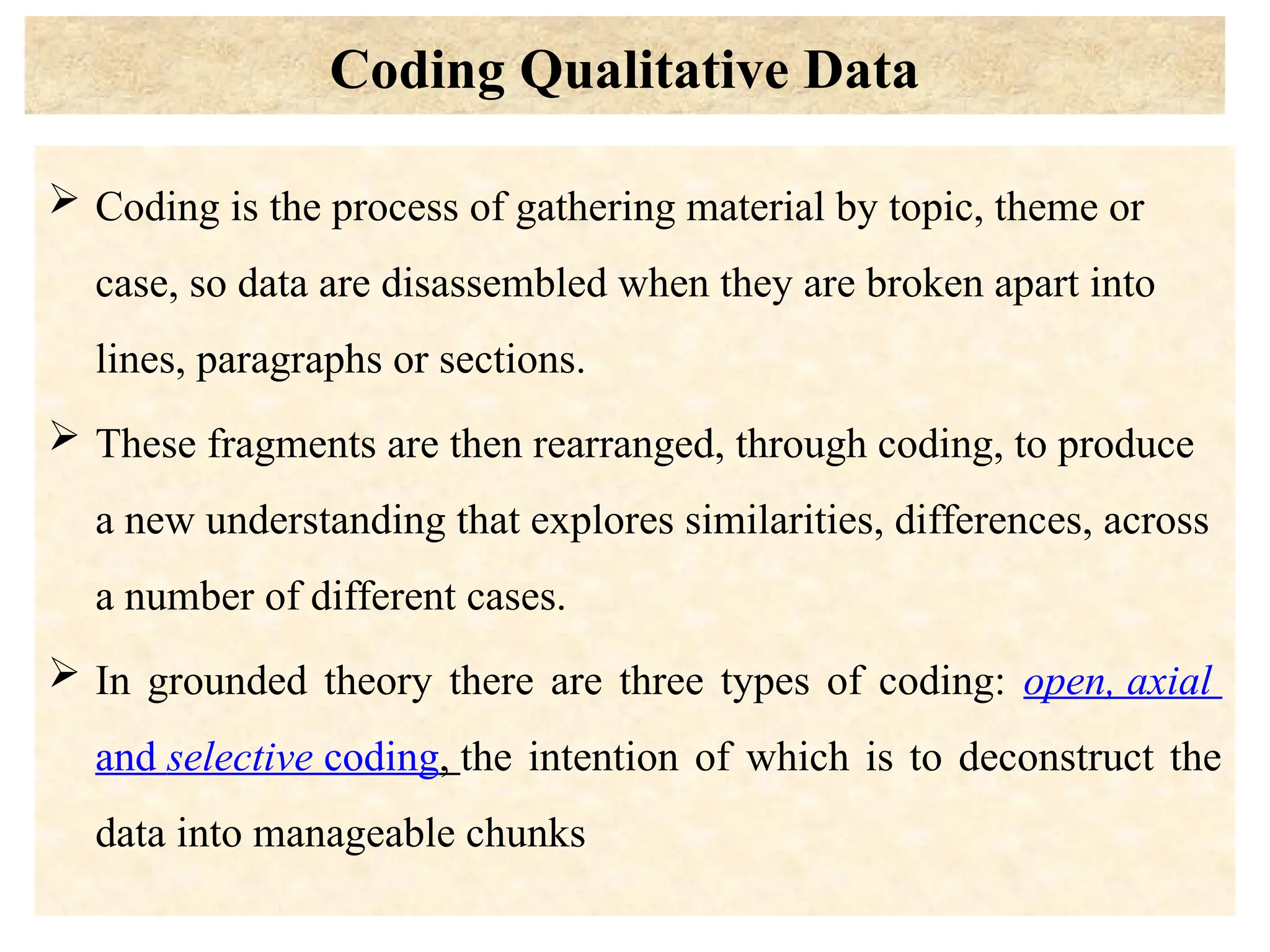
 Coding is the process of gathering material by topic, theme or
case, so data are disassembled when they are broken apart into
lines, paragraphs or sections.
 These fragments are then rearranged, through coding, to produce
a new understanding that explores similarities, differences, across
a number of different cases.
 In grounded theory there are three types of coding: open, axial
and selective coding, the intention of which is to deconstruct the
data into manageable chunks
Types Coding
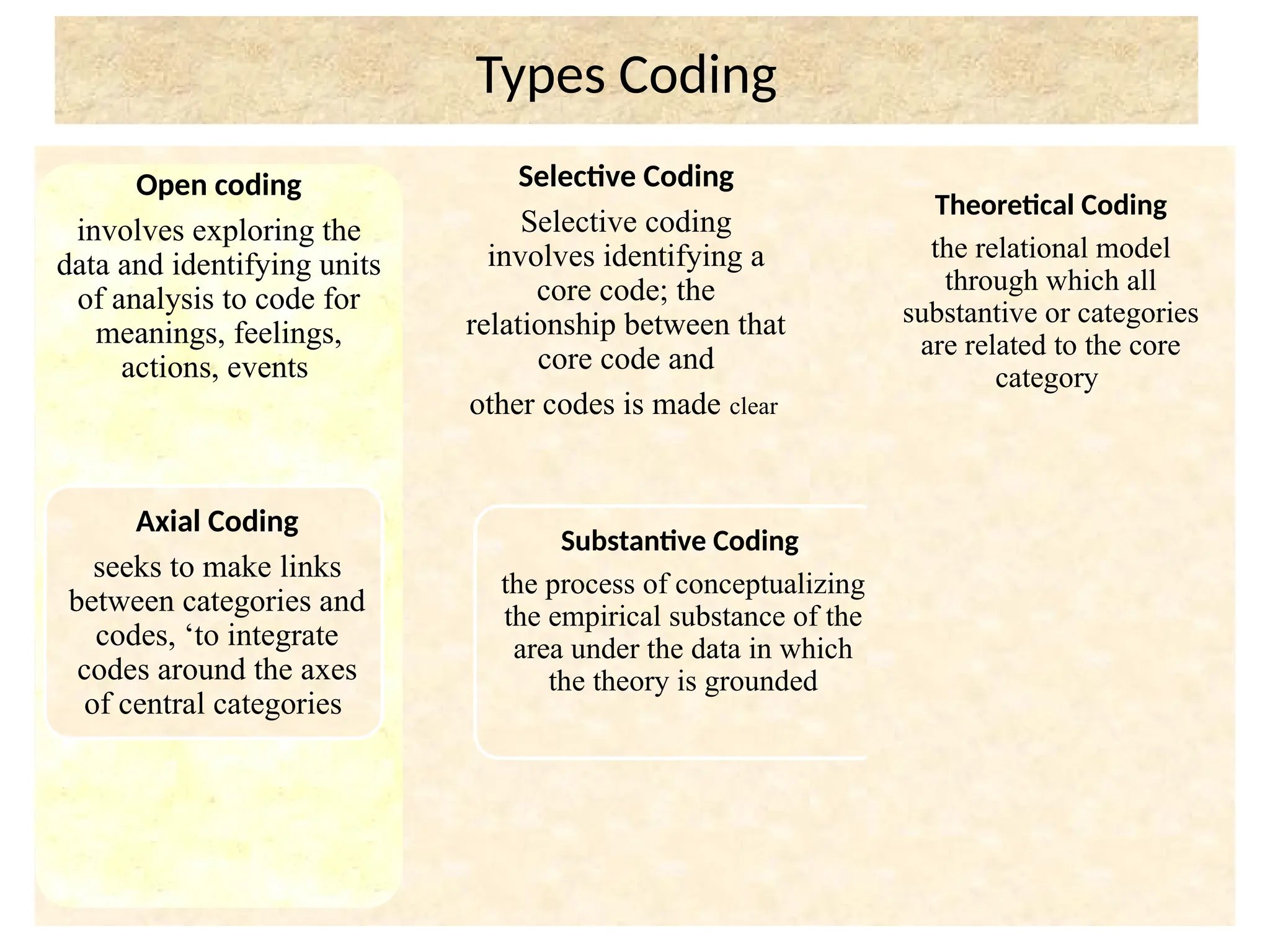
Open coding
involves exploring the
data and identifying units
of analysis to code for
meanings, feelings,
actions, events
Selective Coding
Selective coding
involves identifying a
core code; the
relationship between that
core code and
other codes is made clear
Axial Coding
seeks to make links
between categories and
codes, ‘to integrate
codes around the axes
of central categories
Substantive Coding
the process of conceptualizing
the empirical substance of the
area under the data in which
the theory is grounded
Theoretical Coding
the relational model
through which all
substantive or categories
are related to the core
category
RESEARCH SOFTWARE to ANALYZE
QUALITATIVE DATA (NVIVO)
 NVivo is a software program used to analyse qualitative and
mixed form of research.
 It is used especially for the analyses of unstructured interview
text, audio, video and image data including interview, focus
group, survey, social media and journal articles.
 Its main purpose is that the ability to playback audio, video,
files and social media so that interviews can be transcribed in
it.
Nvivo and Qualitative Research
 Many qualitative researchers are interested in evaluating, interpreting
and explaining social phenomena.
 They analyze unstructured or semi-structured data like interviews,
surveys, field notes, web pages and journal articles.
 While NVivo’s main focus is on qualitative analysis, it does provide
support for researchers who work with mixed methods
 can analyze the open-ended questions in a survey and make
comparisons based on demographic data—and can exchange this
data with applications like Microsoft Excel and IBM SPSS Statistics
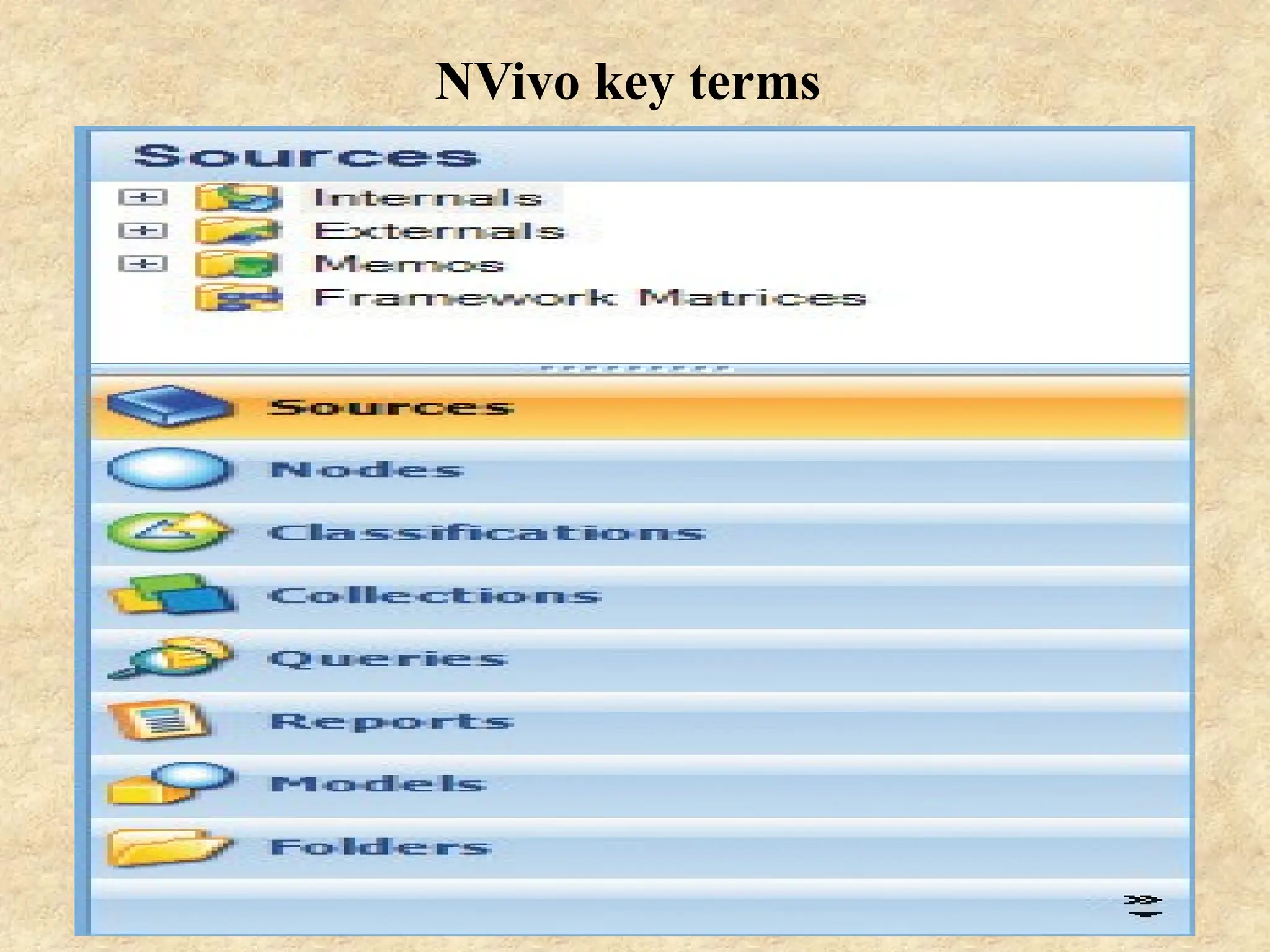
NVivo key terms
NVivo key terms
 Sources are your research materials including documents, PDFs, data sets,
audio, video, pictures, memos and framework matrices.
 Coding is the process of gathering material by topic, theme or case. For
example, selecting a paragraph about water quality and coding it at the node
‘water quality’.
 Nodes are containers for your coding—they let you gather related material in
one place so that you can look for emerging patterns and ideas.
 Source classifications let you record information about your sources—for
example, bibliographical data.
Procedures for using Nivivo
1) Creating a Suitable Documents for Nivivo
1.1 Create a New Project
1. On the NVivo Welcome screen, click New Project. The New Project dialog box opens.
2. Enter a name for this project (and add a description if you want to).
3. Click the Browse button and in the Save as type list, make sure NVivo Projects (*.nvp)
is selected—you can change the default file name and location if you want to.
4. Click Save, and then click OK.
 Open a Project
• Click the File tab, and then click Open.
• The Open Project dialog box opens.
Procedures Cont'd…
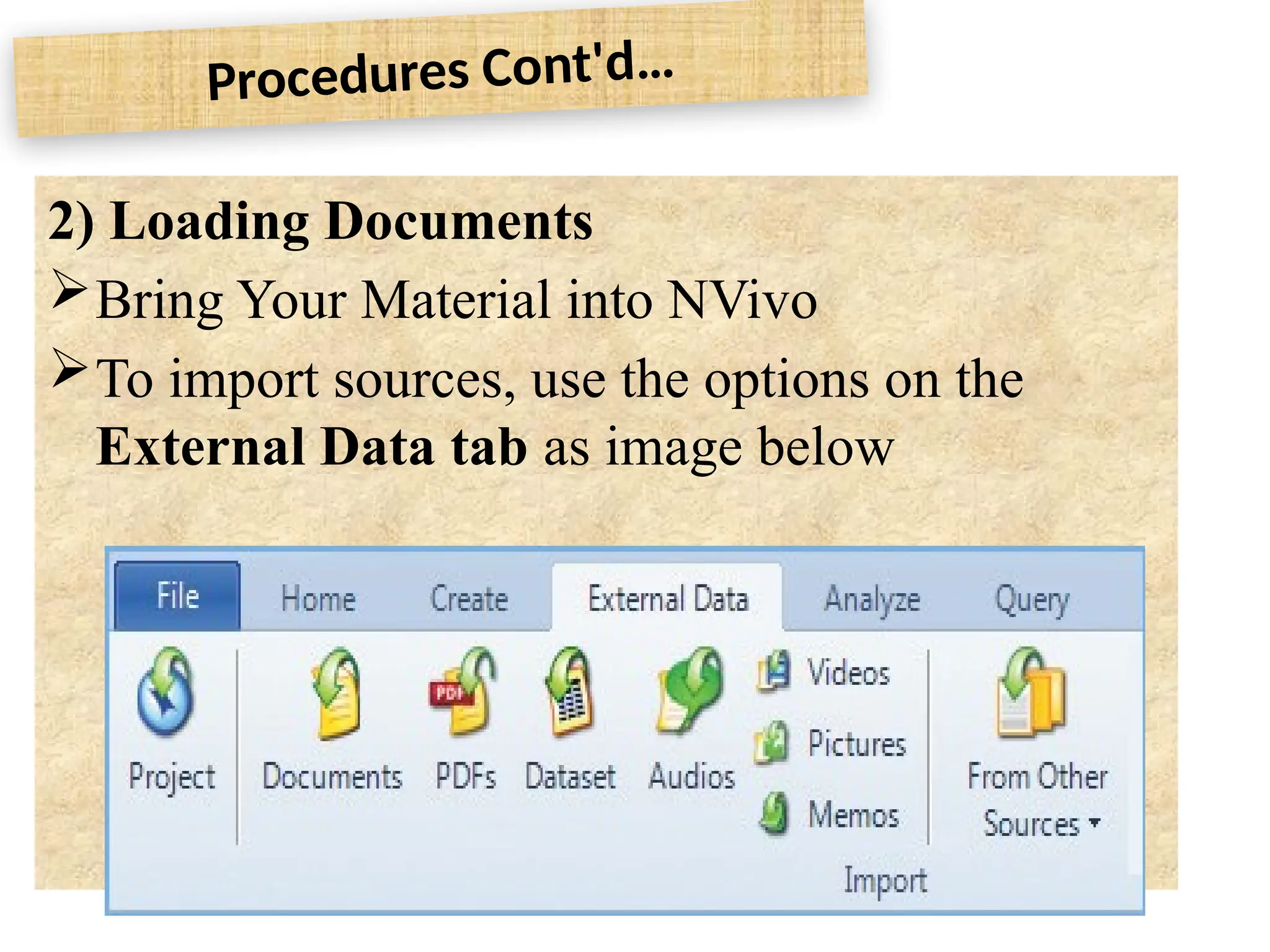
2) Loading Documents
Bring Your Material into NVivo
To import sources, use the options on the
External Data tab as image below
Procedures Cont'd…
3) Creating Codes and Adding Codes to Data
3.1 Interviews, Articles and Other Documents
 To create codes on interview, we should go to file where
original transcript of interview saved.
 Then, we shall shade select the text we want to code and
import this short text to node to code in to NVivo so that the
interview is coded and added to data.
 To do so we should follow the following early steps
Procedures Cont'd…
• Prepare for auto coding
• Create a Memo
• Make a Model
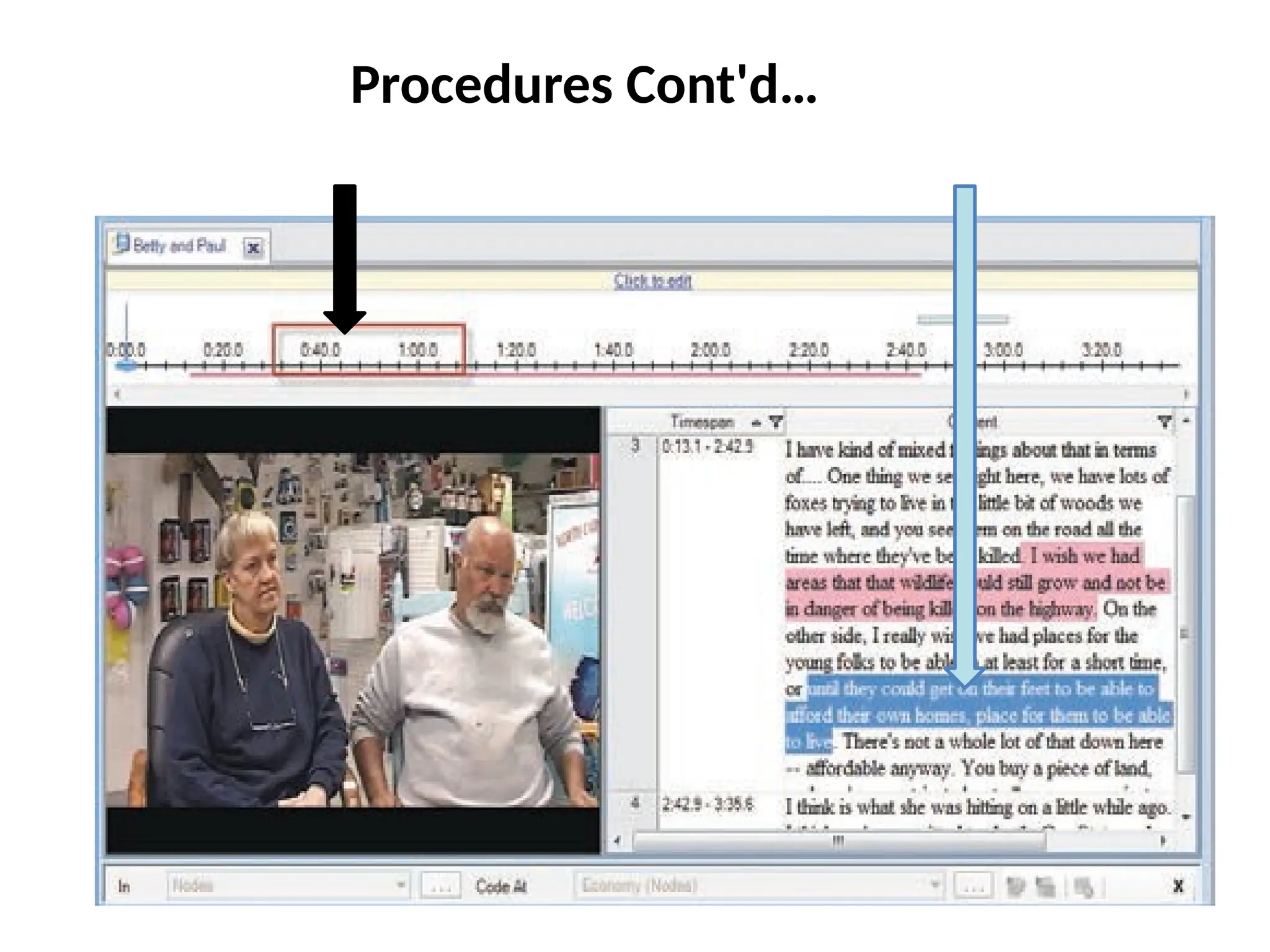
3.2 Audio and Video
• We can import audio and video in a wide range of formats
—refer to the NVivo help for a detailed list.
• We can play and analyze an audio or video source in
detail view:
Procedures Cont'd…
Procedures Cont'd…
3.3) Photos and Other Images
 We can import photos or other images and analyze them in
NVivo—refer to the NVivo Help for a detailed list of
supported image formats.
 First, we create a log to describe the picture (or just selected
regions).
 Then,Code directly on the picture and import it into nodes.
Classifications
 We can also record bibliographical information by
‘classifying’ sources in NVivo—when we are ready to write up
our findings,
 we can export this data to our reference management tool and
use its features to insert citations and format the references.
 Refer to the NVivo help for more information about
classifying sources and working with bibliographical data.
Conclusion
 Sampling is the procedure the researcher would adopt in
selecting items for the sample.
 The data, after collection, has to be processed and analysed in
accordance with the outline laid down for the purpose at the time
of developing the research plan.
 To analyse the collected data in qualitative research, the software
so called NVivo is recommended as it keeps everything in one
place
THANK YOU FOR
LISTENING!

Research method power point of reaserch.pptx

  • 1.
    Wolaita Sodo University GraduateStudies Directorate College of Social Sciences and Humanities Research Methods in ELT (ELT, 721) Unit 12: Data Sampling in Qualitative Research, Unit 13: Data Analysis and Unit 14: Research Software to Analyse Qualitative Data (NIVIVO)
  • 2.
    Outlines of Presentation UNIT12: DATA SAMPLING IN QUALITATIVE RESEARCH Steps in Sampling Criteria of Selecting a Sampling Procedure Characteristics of a Good Sampling  Types of Sampling
  • 3.
    Cont'd… CHAPTER 13: DATAANALYSIS  Processing, Storing and Organizing Qualitative Research  Analyzing Data from Different Research Tools and Discourse  Ways of Organizing and Presenting Qualitative Data Analysis  Systematic Approaches to Data Analysis  Methodological Tools for Analysing Qualitative Data  Coding Qualitative Data
  • 4.
    Cont'd… CHAPTER 14: RESEARCHSOFTWARE to ANALYZE QUALITATIVE DATA (NVIVO)  Creating a Suitable Documents for Nvivo  Loading Documents  Creating Codes and Adding Codes to Data  Prepare for auto coding  Create a Memo  Make a Model  Audio and Video  Photos and Other Images  Classifications  Literature reviews in NVivo Conclusion
  • 5.
    INTRODUCTION  This presentationis prearranged through three chapters including chapter 12, 13 and 14.  These are data sampling, data analysis and research software to analyze qualitative data respectively.  Sampling is the procedure the researcher would adopt in selecting items for the sample.  The data, after collection, has to be processed and analysed in accordance with the outline laid down for the purpose at the time of developing the research plan.  To analyse the collected data in qualitative research, the software so called NVivo is recommended as it keeps everything in one place.
  • 6.
    Unit 12: DataSampling in Qualitative Research  Sampling refers to the technique or the procedure the researcher would adopt in selecting items for the sample.  Sample design may as well lay down the number of items to be included in the sample i.e., the size of the sample.  Sample design is determined before data are collected.  There are many sample designs from which a researcher can choose.  Some designs are relatively more precise and easier to apply than others.  Researcher must select/prepare a sample design which should be reliable and appropriate for his research study.
  • 7.
    Steps in Sampling 1)Universe 2) Sampling unit 3) Source list 4) Size of sample 5)Parameters of interest 6)) Budgetary constraint 7) Sampling procedure
  • 8.
    Criteria of Selectinga Sampling Procedure  There are two costs involved in a sampling analysis viz., the cost of collecting the data and the cost of an incorrect inference resulting from the data.  the two causes of incorrect inferences viz., systematic bias and sampling error  A systematic bias results from errors in the sampling procedures or from the following factors: 1) Inappropriate sampling frame 2) Defective measuring device 3) Non-respondents 4) Indeterminancy principle 5) Natural bias in the reporting of data
  • 9.
    Sampling errors  Samplingerrors are the random variations in the sample estimates around the true population parameters.  Since they occur randomly and are equally likely to be in either direction, their nature happens to be of compensatory type and the expected value of such errors happens to be equal to zero.  Sampling error decreases with the increase in the size of the sample, and it happens to be of a smaller magnitude in case of homogeneous population.  Sampling error can be measured for a given sample design and size.  The measurement of sampling error is usually called the ‘precision of the sampling plan’.  If we increase the sample size, the precision can be improved.
  • 10.
    Characteristics of aGood Sampling Sample design must:  result in a truly representative sample,  be such which results in a small sampling error,  be viable in the context of funds available for the research study,  be such so that systematic bias can be controlled in a better way and  be such that the results of the sample study can be applied for the universe.
  • 11.
    Types of Sampling(Term paper pp 5-14) Element selection techniques Unrestricted sampling Resricted sampling Probability sampling Simple random sampling Complex random samling (such as cluster, systematic, stratified etc), Non-probability sampling Haphazard or convenience sampling Purposive sampling (such as quota sampling and judgement sampling
  • 12.
    Chapter 13: DataAnalysis  The term analysis refers to the computation of certain measures along with searching for patterns of relationship that exist among data-groups.  Thus, the data, after collection, has to be processed and analysed in accordance with the outline laid down for the purpose at the time of developing the research plan.  With this brief introduction concerning the concepts of processing and analysis, we can now proceed with the explanation of all the processing, storing and organizing qualitative data in next points.
  • 13.
    Processing, Storing andOrganizing Qualitative Research 1 Editing is done to assure that the data are accurate, consistent with other facts gathered, uniformly entered, as completed as possible and have been well arranged to facilitate coding and tabulation 1.1 Flied Editing 1. 2 central editing 2 Coding the process of assigning numerals or other symbols put into a limited number of categories 3 Classification Classification according to attributes-data are classified on the basis of common characteristics which can either be descriptive (such as literacy, sex, honesty, etc.) or numerical such as weight, height, income, etc. Classification according to class-intervals- measured through some statistical units 4 Tabulation - the process of summarising raw data and displaying the same in compact form (i.e., in the form of statistical tables) for further analysis. - simple and complex tabulation information about one or more groups of independent questions, whereas the latter type of tabulation shows the division of data in two or more categories
  • 14.
    Analyzing Data fromDifferent Research Tools and Discourse Ways of Organizing and Presenting Qualitative Data Analysis  According to Cohen et al, (2007), five ways of organizing and presenting analysis as follows:  the first two methods are by people,( Group & Individual) and  the next two methods are by issue, & research questions and  the final method is by instrument- all the interview data are presented and organized, and then all the data from questionnaires are presented, followed by all the documentary data and field notes, and so on.
  • 15.
    Coding Qualitative Data Coding is the process of gathering material by topic, theme or case, so data are disassembled when they are broken apart into lines, paragraphs or sections.  These fragments are then rearranged, through coding, to produce a new understanding that explores similarities, differences, across a number of different cases.  In grounded theory there are three types of coding: open, axial and selective coding, the intention of which is to deconstruct the data into manageable chunks
  • 16.
    Types Coding Open coding involvesexploring the data and identifying units of analysis to code for meanings, feelings, actions, events Selective Coding Selective coding involves identifying a core code; the relationship between that core code and other codes is made clear Axial Coding seeks to make links between categories and codes, ‘to integrate codes around the axes of central categories Substantive Coding the process of conceptualizing the empirical substance of the area under the data in which the theory is grounded Theoretical Coding the relational model through which all substantive or categories are related to the core category
  • 17.
    RESEARCH SOFTWARE toANALYZE QUALITATIVE DATA (NVIVO)  NVivo is a software program used to analyse qualitative and mixed form of research.  It is used especially for the analyses of unstructured interview text, audio, video and image data including interview, focus group, survey, social media and journal articles.  Its main purpose is that the ability to playback audio, video, files and social media so that interviews can be transcribed in it.
  • 18.
    Nvivo and QualitativeResearch  Many qualitative researchers are interested in evaluating, interpreting and explaining social phenomena.  They analyze unstructured or semi-structured data like interviews, surveys, field notes, web pages and journal articles.  While NVivo’s main focus is on qualitative analysis, it does provide support for researchers who work with mixed methods  can analyze the open-ended questions in a survey and make comparisons based on demographic data—and can exchange this data with applications like Microsoft Excel and IBM SPSS Statistics
  • 19.
  • 20.
    NVivo key terms Sources are your research materials including documents, PDFs, data sets, audio, video, pictures, memos and framework matrices.  Coding is the process of gathering material by topic, theme or case. For example, selecting a paragraph about water quality and coding it at the node ‘water quality’.  Nodes are containers for your coding—they let you gather related material in one place so that you can look for emerging patterns and ideas.  Source classifications let you record information about your sources—for example, bibliographical data.
  • 21.
    Procedures for usingNivivo 1) Creating a Suitable Documents for Nivivo 1.1 Create a New Project 1. On the NVivo Welcome screen, click New Project. The New Project dialog box opens. 2. Enter a name for this project (and add a description if you want to). 3. Click the Browse button and in the Save as type list, make sure NVivo Projects (*.nvp) is selected—you can change the default file name and location if you want to. 4. Click Save, and then click OK.  Open a Project • Click the File tab, and then click Open. • The Open Project dialog box opens.
  • 22.
    Procedures Cont'd… 2) LoadingDocuments Bring Your Material into NVivo To import sources, use the options on the External Data tab as image below
  • 23.
    Procedures Cont'd… 3) CreatingCodes and Adding Codes to Data 3.1 Interviews, Articles and Other Documents  To create codes on interview, we should go to file where original transcript of interview saved.  Then, we shall shade select the text we want to code and import this short text to node to code in to NVivo so that the interview is coded and added to data.  To do so we should follow the following early steps
  • 24.
    Procedures Cont'd… • Preparefor auto coding • Create a Memo • Make a Model 3.2 Audio and Video • We can import audio and video in a wide range of formats —refer to the NVivo help for a detailed list. • We can play and analyze an audio or video source in detail view:
  • 25.
  • 26.
    Procedures Cont'd… 3.3) Photosand Other Images  We can import photos or other images and analyze them in NVivo—refer to the NVivo Help for a detailed list of supported image formats.  First, we create a log to describe the picture (or just selected regions).  Then,Code directly on the picture and import it into nodes.
  • 27.
    Classifications  We canalso record bibliographical information by ‘classifying’ sources in NVivo—when we are ready to write up our findings,  we can export this data to our reference management tool and use its features to insert citations and format the references.  Refer to the NVivo help for more information about classifying sources and working with bibliographical data.
  • 28.
    Conclusion  Sampling isthe procedure the researcher would adopt in selecting items for the sample.  The data, after collection, has to be processed and analysed in accordance with the outline laid down for the purpose at the time of developing the research plan.  To analyse the collected data in qualitative research, the software so called NVivo is recommended as it keeps everything in one place
  • 29.