GuidetoCodingQualitativeData
RonelD.Gruella,LPT.
Coding in Qualitative Research
Coding qualitative data is an important part of the
analytical process of analyzing qualitative research. When
you generate data from qualitative methods such as semi-
structured interviews, qualitative coding allows you to
interpret, organize, and structure your observations and
interpretations into meaningful theories. Coding in
qualitative research allows you to be reflexive, critical, and
rigorouswithyourfindings.Continuereadingtolearnmore
aboutcodinginresearch.
Qualitative Data Procedures
We all know that qualitative research utilizes non-
numerical methods such as observations, in-depth
interviews, or focus groups, or by analyzing content such
as documents, or records. Analysis deals with words,
meaning,andinterpretation.
There are many qualitative data collection methods,
and eachhasuniqueadvantagesanddisadvantages.You
shouldselectaqualitativemethodologythatisbestsuited
foransweringyourresearchquestions.
Semi-structured interviews
Semi-structured interviews are when the interviewer
prepares a research discussion guide ahead of time to guide
theconversationbutallowsflexibilityintheinterviewtogooff-
script.
This allows for a balance between the structure of
standardized questions while allowing the interviewee to take
theinterviewbeyondthediscussionguide.
In depth interviews
In-depth interviews are when the interviewer prepares a
discussion guide and interviews a series of participants in one-on-
one to explore behaviours, descriptions, and motivations. Interview
coding is a great way to analyze what you find in these interviews.
Focus groups
Focus groups are when you recruit a specific group of a target
audience to participate in a group discussion led by a moderator
. This is
commonly used in market research for gathering feedback on product
launches, marketing campaigns, service designs, or other concepts.
Observations
Observations are when a researcher goes on-site to a
location to directly observe participants’ behaviour
. This
happensinthenaturalenvironmentoftheparticipantgroup.
Ethnographies
It is a qualitative research method involving the
systematic study of people in their natural environment to
understand their way of life, including how they see and
interactwiththeworldaroundthem.
Diary studies
It is a way to collect data about a particular group over a
period of time, to understand their in-context behaviour
,
experiences, and activities. Participants keep a diary log of what’s
happeningintheireverydaylives.
Case studies
It refers to an in-depth research approach to understand
oneparticularpersonorgroupintheirreal-lifecontext.It’soften
usedtounderstandacomplex,multi-facetedphenomenon.
TranscribinganInterview
After conducting an interview, transcription will allow
you to take the contents of the interview and effectively
analyse it. Coding interviews require a transcript. You can
transcribewithvaryinglevelsofspecificity,andutilizevarious
methods from doing it manually, with auto-transcription
software,orbyoutsourcingtotranscriptionservices.
Whentranscribing,choosethetypeoftranscriptionyou
want to do, then listen to audio and type out the
transcription while designating who the speaker is, a
timestamp, and the dialogue contents of the transcription.
Thesetranscriptionsarethefirststepforcodinginterviews.
TypesofTranscriptions
♥ Verbatim transcription: Transcribing every word, pause,
stutter
,andfiller words,suchas“ahs”and“ums”.
♥ Intelligent transcription: Transcribing every word, but
making an interpretation to exclude pauses, status, and
fillerwordsandpotentiallycleaningupthegrammar
.
♥ Edited transcription: An edited transcript is common if you
plantopublishthetranscriptforanaudience.It’scleanedup
and edited to increase readability and clarity. You can edit
grammar
, remove run-on sentences, and potentially
summarizepartsforthesakeofclarity.
Qualitative Coding
It is a process of systematically categorizing excerpts in
your qualitative data in order to find themes and patterns. It
enablesyoutotakeunstructuredorsemi-structureddatasuch
as transcripts from in-depth interviews or focus groups and
structureitintothemesandpatternsforanalysis.
Coding your qualitative data makes your analysis more
systematic and rigorous. It also provides transparency and
reflexivity to both yourself and others. It’ll enable you to find
insights that are truly representative of your data and the
humanstoriesbehindthem.
BenefitsofQualitativeCoding
♥ Increase validity: Qualitative coding provides organization and
structure to data so that you can examine it systematically to
increasethevalidityofyouranalysis.
♥ Decrease bias: Qualitative coding enables you to be aware of
potentialbiasesinthewaydataisanalysed.
♥ Accuratelyrepresentparticipants:Qualitativecodingallowsyouto
evaluate if your analysis represents your participant base, and
helpsyouavoidover-representingonepersonorgroupofpeople.
♥ Enabletransparency:Qualitativecodingenablesotherresearchers
tomethodicallyandsystematicallyreviewyouranalysis.
Howdoyoucode QualitativeData?
Theprocessofcodingqualitativedatavarieswidely dependingon
your research objective. But in general, it involves a process of reading
through your data, applying codes to excerpts, conducting various
rounds of coding, grouping codes according to themes, and then
making interpretations thatleadtoyour ultimateresearchfindings.You
may start with an initial round of coding to summarize or describe
excerpts, and then do a second round of coding that adds your own
interpretivelens.
There’s no right or wrong way to code a set of data, just some
approaches that are more or less appropriate depending on your
researchobjective.Belowarevarioustypesofcoding,whichyoucanmix
andmatchaccordingtowhatworksforyou.
DeductiveandInductiveApproaches
toQualitative Coding
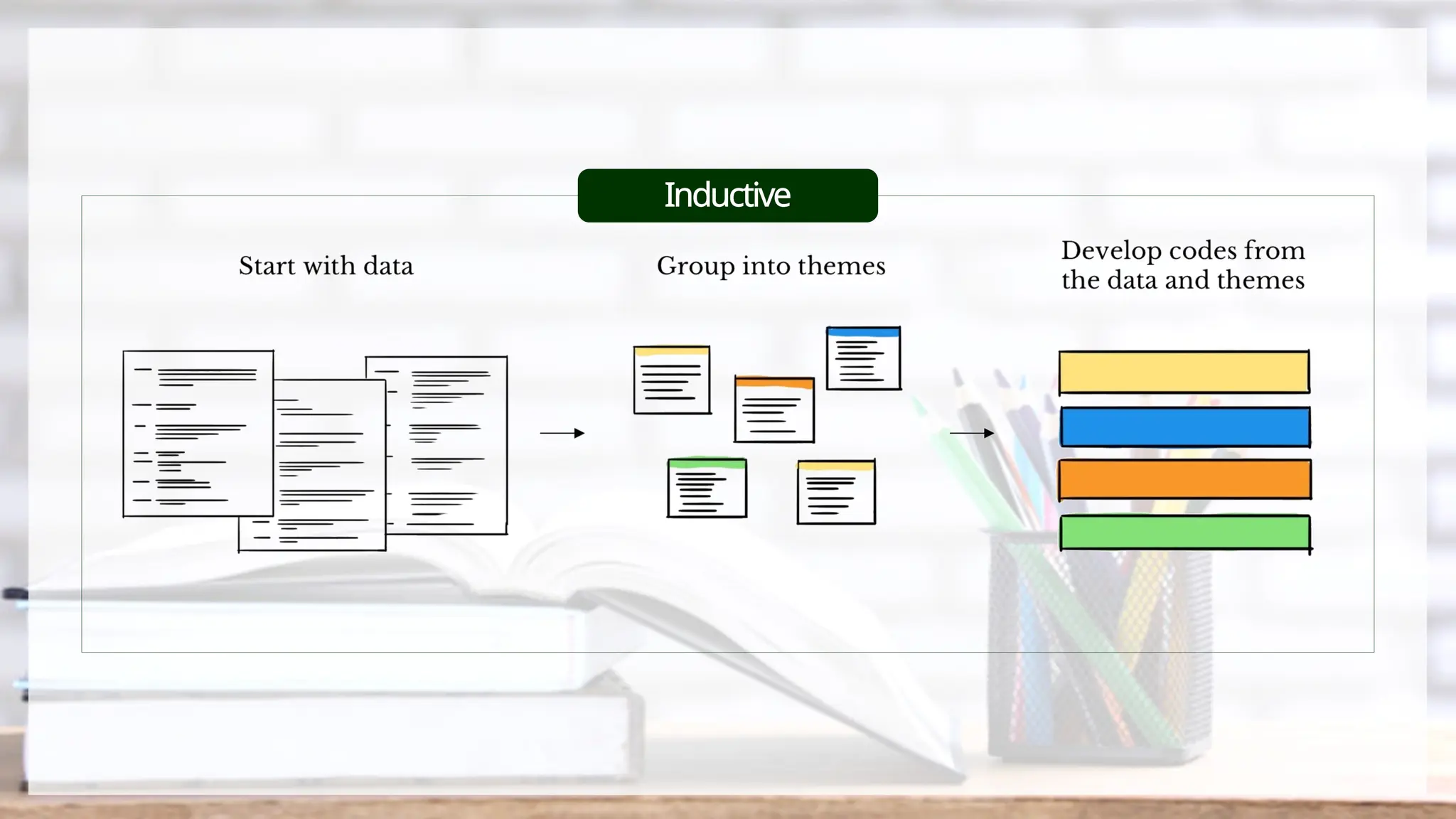
Inductive Coding
It is a bottom-up approach where you derive your codes
from the data. You don’t start with preconceived notions of
what the codes should be, but allow the narrative or theory to
emerge from the raw data itself. This is great for exploratory
research or times when you want to come up with new
theories,ideas,orconcepts.
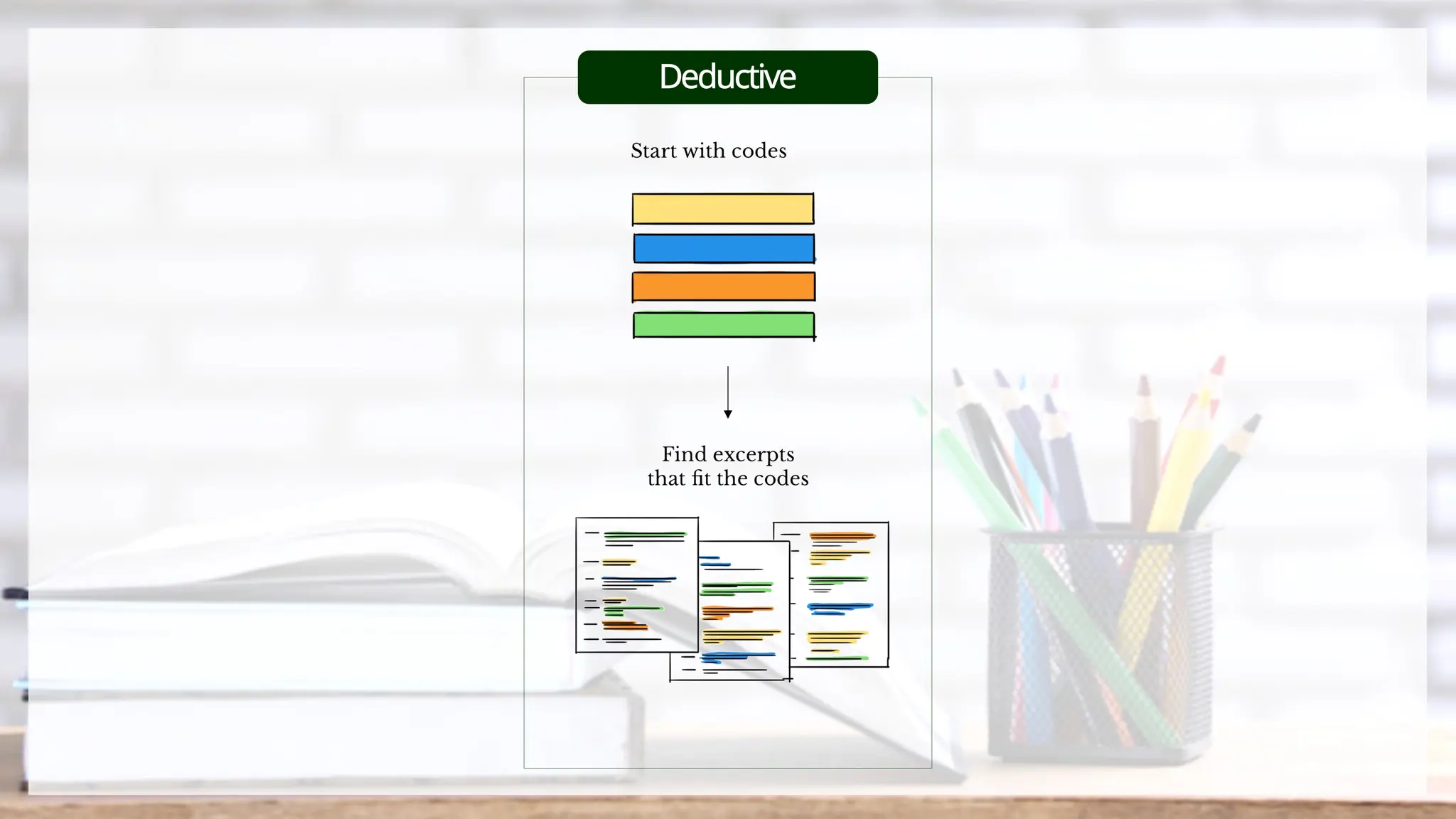
Deductive Coding
Itisatopdownapproachwhereyoustartbydevelopinga
codebookwithyourinitialsetofcodes.Thissetcouldbebased
onyourresearchquestionsoranexistingresearchframework
ortheory.Youthenreadthroughthedataandassignexcerpts
to codes. At the end of your analysis, your codes should still
closelyresemblethecodebookthatyoustartedoffwith.Thisis
good when you have a pre-determined structure for how you
need your final findings to be. For example, program
evaluationstudiesmayutilizeadeductivecodingapproach.
Inductive
Deductive
Inpractice,researchstudiesoftencombine
bothdeductiveandinductiveapproachesto
coding.
Forexample,youcoulddeductivelystartwith
asetofcodes,buttheninductivelycomeupwith
newcodesanditerateonthecodesasyousift
throughyourdata.
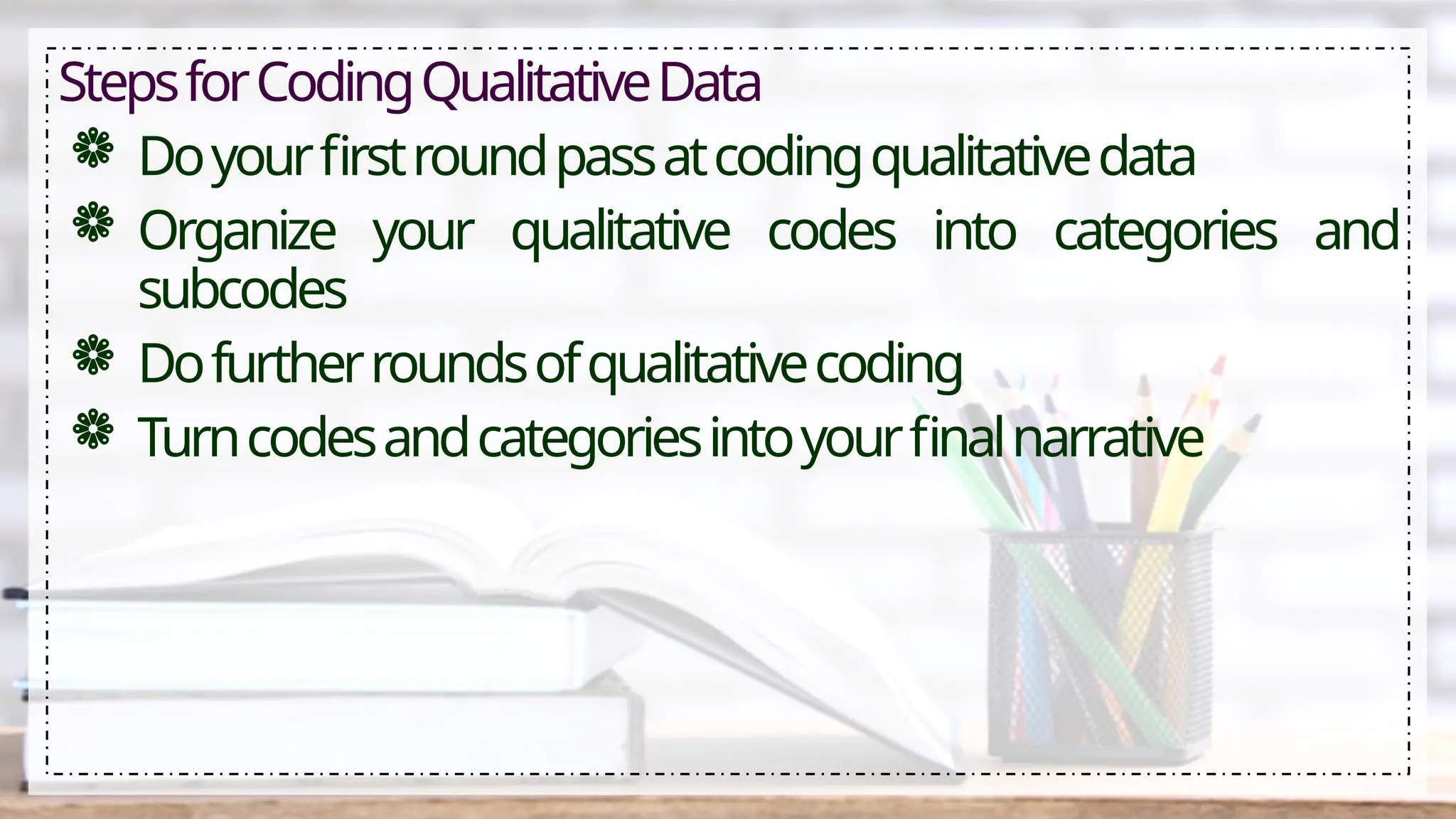
StepsforCodingQualitativeData
 Doyourfirstroundpassatcodingqualitativedata
 Organize your qualitative codes into categories and
subcodes
 Dofurtherroundsofqualitativecoding
 Turncodesandcategoriesintoyourfinalnarrative
Do your first round pass at coding qualitative data
Your first round pass of coding qualitative data involves
reading the data and assigning codes to various excerpts. This
step is fast and loose. Don’t worry so much about creating the
perfectcodessinceyou’llbeiteratingandevolvingthecodesas
yougoontothesecondpassatcoding,andbeyond.
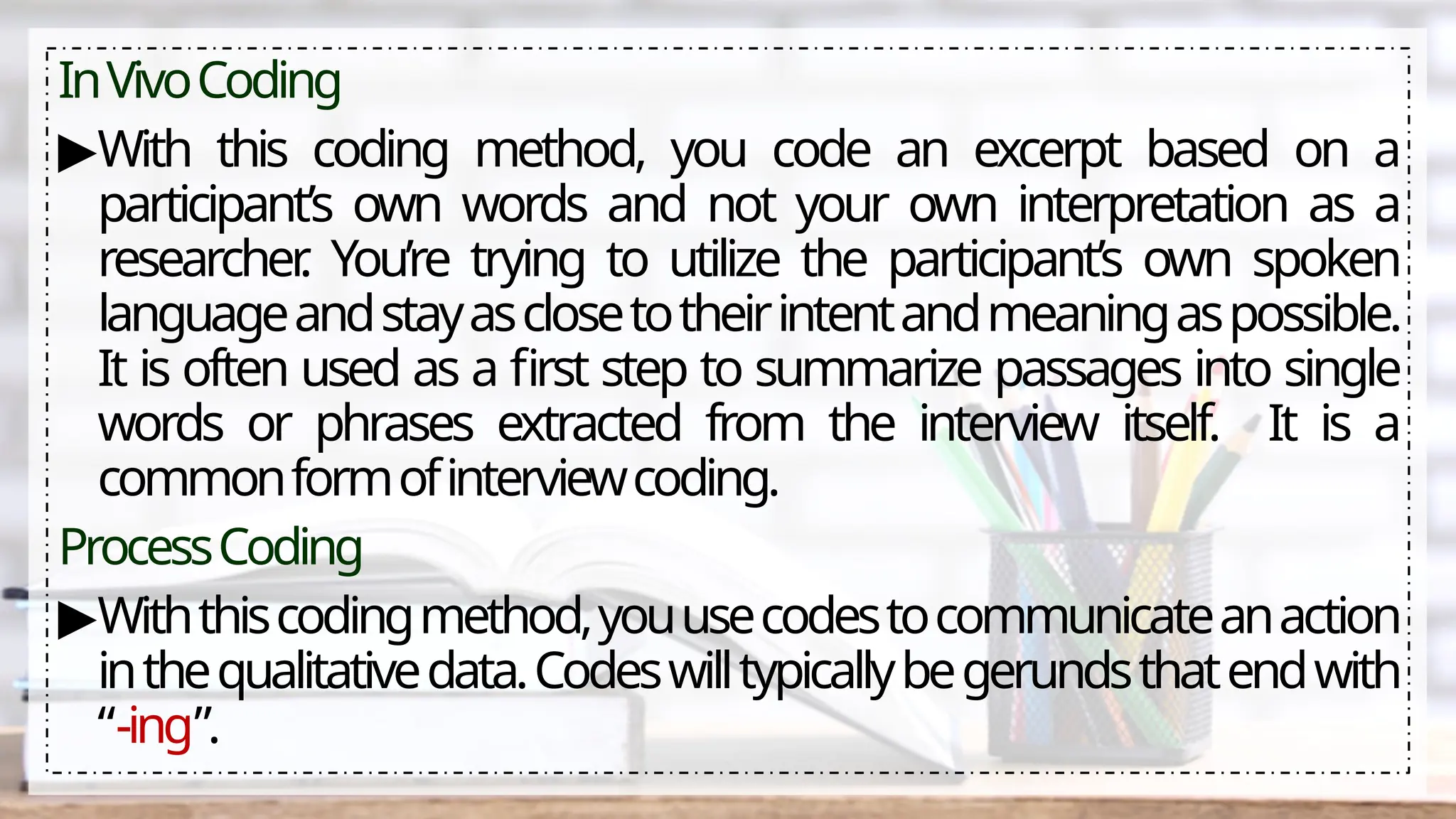
InVivoCoding
▶With this coding method, you code an excerpt based on a
participant’s own words and not your own interpretation as a
researcher
. You’re trying to utilize the participant’s own spoken
languageandstayasclosetotheirintentandmeaningaspossible.
It is often used as a first step to summarize passages into single
words or phrases extracted from the interview itself. It is a
commonformofinterviewcoding.
ProcessCoding
▶Withthiscodingmethod,youusecodestocommunicateanaction
inthequalitativedata.Codeswilltypicallybegerundsthatendwith
“-ing”.
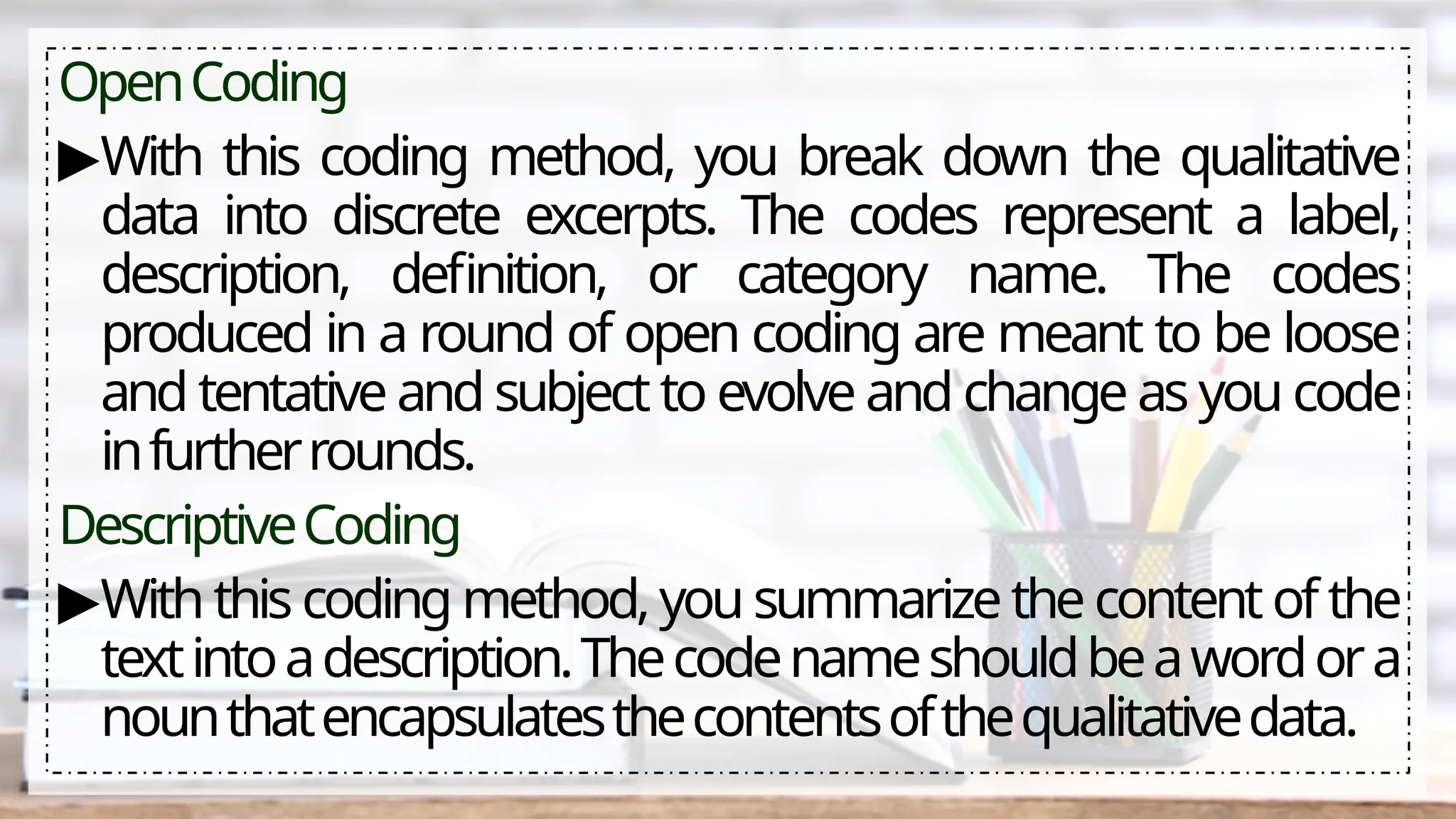
OpenCoding
▶With this coding method, you break down the qualitative
data into discrete excerpts. The codes represent a label,
description, definition, or category name. The codes
produced in a round of open coding are meant to be loose
and tentative and subject to evolve and change as you code
infurtherrounds.
DescriptiveCoding
▶With this coding method, you summarize the content of the
textintoadescription.Thecodenameshouldbeawordora
nounthatencapsulatesthecontentsofthequalitativedata.
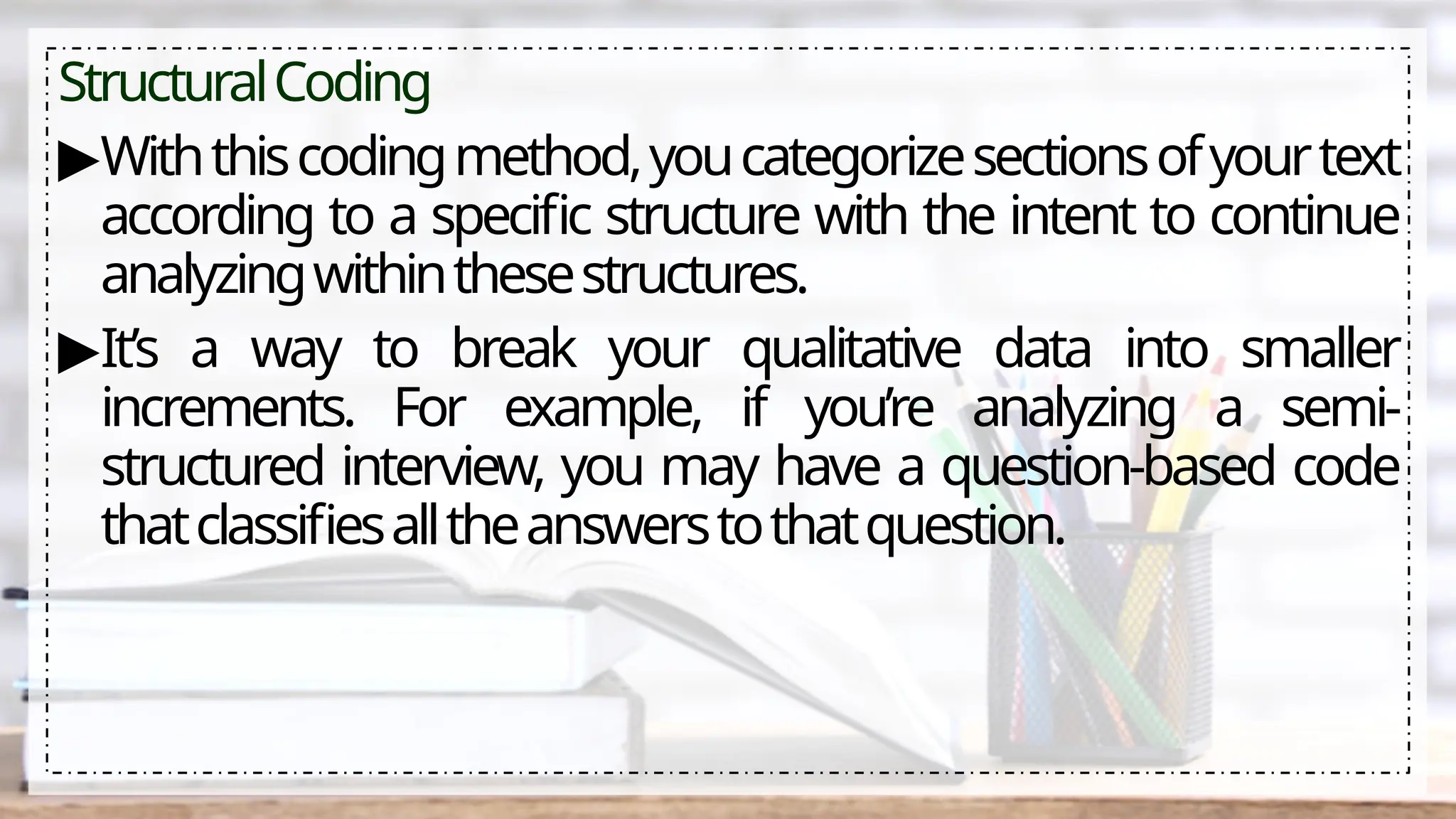
StructuralCoding
▶Withthiscodingmethod,youcategorizesectionsofyourtext
according to a specific structure with the intent to continue
analyzingwithinthesestructures.
▶It’s a way to break your qualitative data into smaller
increments. For example, if you’re analyzing a semi-
structured interview, you may have a question-based code
thatclassifiesalltheanswerstothatquestion.
ValuesCoding
▶With this coding method, you code excerpts that pertain to
theparticipant’svalues,attitudes,andbeliefs.
SimultaneousCoding
▶Itis amethod of qualitativecoding whereasingleexcerptof
qualitativedataiscodedwithmultiplecodes.
Organize your codes into categories and subcodes
After your first round pass at coding qualitative data, you
can begin to group your codes into categories. These
categories can be organized in a variety of ways. Within each
category,youcangrouptogethercodesthataresimilartoeach
other
, or pertain to the same topics or general concept. Iterate
onthesecategoriesandmovethecodesarounduntilyoufind
astructurethatmakessenseforyouranalysis.
Do further rounds of coding qualitative data
Next, do further rounds of coding qualitative data to re-examine
thecodesandcategoriesyou’vecreatedsofar
.Inthisphase,youmayre-
name,re-code,mergecodes,andre-categorizetheworkyou’vedoneso
far
. While the first round pass at coding data was fast and loose, these
rounds of coding are about reanalyzing, finding patterns, and getting
closertodevelopingtheoriesandconcepts.
In general, you should be reducing the number of codes from
your initial round of coding, and actively reflecting on how to best
categorizethecodesyouhave.
ThematicAnalysis
▶It is utilized when you’re looking for themes or patterns
across your qualitative data set. If you find a pattern within
different parts of your qualitative data or see that certain
excerptspointtothesameunderlyingideaormeaning,code
thoseexcerptswithaunifyingcode.
PatternCoding
▶With pattern coding, you group similarly coded excerpts
underoneoverarchingcodetodescribeapattern.
FocusedCoding/SelectiveCoding
▶It is utilized when you create a finalized set of codes and
categoriesfromyourfirstcodingpass(oftenfrom“opencoding”).
You then re-code the qualitative data according to this final code
listwiththeintenttonotdeviatefromit.Incomparisontoaninitial
“open coding” pass which allows for emergent and changing
codes, focused coding is a method where you don’t intend to
changethecodelistanyfurther
.
AxialCoding
▶It is used when you relate codes or categories to one another
.
You’relookingforrelationshipsandlinksbetweenwhatyoufound
inearlierroundsofcoding.
TheoreticalCoding
▶It is utilized when you conceptualize a hypothesis of a
theoretical framework through sorting and organizing
codes.Youstructurethecodesandcategoriesthatemerged
fromqualitativedataintoatheory.
ElaborativeCoding
▶It is utilized when you apply a theory from a previous
research study and observe whether or not your current
codes and categories relate. You can think about it as
elaboratingonpre-existingtheories.
LongitudinalCoding
▶It is utilized when you organize your existing codes and
categories in a way that enables you to compare them over
time.
Content AnalysisCoding
▶It is utilized when you examine and understand the content
of textual data. There are two types of methodological
approachestocontentanalysis:quantitativecontentanalysis
andqualitativecontentanalysis.
Turn codes and categories into your final narrative
Aftertheseroundsofcodingqualitativedata,anddoingvarious
typesofcoding,youtakethosecodesandcategoriesandusethemto
construct your final narrative. Depending on the purpose of your
research, the final outcome of your research can take manyforms:a
theory,asetoffindings,oranarrative.
In this phase, you combine the creativity of structuring a
narrative with the analytical nature of connecting your narrative to
yourcodesandtheoriesgroundedinqualitativedata.Startwritingout
your theory, findings, and narrative, and reference the codes and
categories that were used to inform them. Now, structure these into
yourfinalresearchdeliverable.
Ref: https://delvetool.com/guide

PR1 Q2 - Lesson 1 (Coding Qualitative Data).pptx

  • 1.
  • 2.
    Coding in QualitativeResearch Coding qualitative data is an important part of the analytical process of analyzing qualitative research. When you generate data from qualitative methods such as semi- structured interviews, qualitative coding allows you to interpret, organize, and structure your observations and interpretations into meaningful theories. Coding in qualitative research allows you to be reflexive, critical, and rigorouswithyourfindings.Continuereadingtolearnmore aboutcodinginresearch.
  • 3.
    Qualitative Data Procedures Weall know that qualitative research utilizes non- numerical methods such as observations, in-depth interviews, or focus groups, or by analyzing content such as documents, or records. Analysis deals with words, meaning,andinterpretation. There are many qualitative data collection methods, and eachhasuniqueadvantagesanddisadvantages.You shouldselectaqualitativemethodologythatisbestsuited foransweringyourresearchquestions.
  • 4.
    Semi-structured interviews Semi-structured interviewsare when the interviewer prepares a research discussion guide ahead of time to guide theconversationbutallowsflexibilityintheinterviewtogooff- script. This allows for a balance between the structure of standardized questions while allowing the interviewee to take theinterviewbeyondthediscussionguide.
  • 5.
    In depth interviews In-depthinterviews are when the interviewer prepares a discussion guide and interviews a series of participants in one-on- one to explore behaviours, descriptions, and motivations. Interview coding is a great way to analyze what you find in these interviews. Focus groups Focus groups are when you recruit a specific group of a target audience to participate in a group discussion led by a moderator . This is commonly used in market research for gathering feedback on product launches, marketing campaigns, service designs, or other concepts.
  • 6.
    Observations Observations are whena researcher goes on-site to a location to directly observe participants’ behaviour . This happensinthenaturalenvironmentoftheparticipantgroup. Ethnographies It is a qualitative research method involving the systematic study of people in their natural environment to understand their way of life, including how they see and interactwiththeworldaroundthem.
  • 7.
    Diary studies It isa way to collect data about a particular group over a period of time, to understand their in-context behaviour , experiences, and activities. Participants keep a diary log of what’s happeningintheireverydaylives. Case studies It refers to an in-depth research approach to understand oneparticularpersonorgroupintheirreal-lifecontext.It’soften usedtounderstandacomplex,multi-facetedphenomenon.
  • 8.
  • 9.
    After conducting aninterview, transcription will allow you to take the contents of the interview and effectively analyse it. Coding interviews require a transcript. You can transcribewithvaryinglevelsofspecificity,andutilizevarious methods from doing it manually, with auto-transcription software,orbyoutsourcingtotranscriptionservices. Whentranscribing,choosethetypeoftranscriptionyou want to do, then listen to audio and type out the transcription while designating who the speaker is, a timestamp, and the dialogue contents of the transcription. Thesetranscriptionsarethefirststepforcodinginterviews.
  • 10.
    TypesofTranscriptions ♥ Verbatim transcription:Transcribing every word, pause, stutter ,andfiller words,suchas“ahs”and“ums”. ♥ Intelligent transcription: Transcribing every word, but making an interpretation to exclude pauses, status, and fillerwordsandpotentiallycleaningupthegrammar . ♥ Edited transcription: An edited transcript is common if you plantopublishthetranscriptforanaudience.It’scleanedup and edited to increase readability and clarity. You can edit grammar , remove run-on sentences, and potentially summarizepartsforthesakeofclarity.
  • 11.
    Qualitative Coding It isa process of systematically categorizing excerpts in your qualitative data in order to find themes and patterns. It enablesyoutotakeunstructuredorsemi-structureddatasuch as transcripts from in-depth interviews or focus groups and structureitintothemesandpatternsforanalysis. Coding your qualitative data makes your analysis more systematic and rigorous. It also provides transparency and reflexivity to both yourself and others. It’ll enable you to find insights that are truly representative of your data and the humanstoriesbehindthem.
  • 12.
    BenefitsofQualitativeCoding ♥ Increase validity:Qualitative coding provides organization and structure to data so that you can examine it systematically to increasethevalidityofyouranalysis. ♥ Decrease bias: Qualitative coding enables you to be aware of potentialbiasesinthewaydataisanalysed. ♥ Accuratelyrepresentparticipants:Qualitativecodingallowsyouto evaluate if your analysis represents your participant base, and helpsyouavoidover-representingonepersonorgroupofpeople. ♥ Enabletransparency:Qualitativecodingenablesotherresearchers tomethodicallyandsystematicallyreviewyouranalysis.
  • 13.
    Howdoyoucode QualitativeData? Theprocessofcodingqualitativedatavarieswidely dependingon yourresearch objective. But in general, it involves a process of reading through your data, applying codes to excerpts, conducting various rounds of coding, grouping codes according to themes, and then making interpretations thatleadtoyour ultimateresearchfindings.You may start with an initial round of coding to summarize or describe excerpts, and then do a second round of coding that adds your own interpretivelens. There’s no right or wrong way to code a set of data, just some approaches that are more or less appropriate depending on your researchobjective.Belowarevarioustypesofcoding,whichyoucanmix andmatchaccordingtowhatworksforyou.
  • 14.
  • 15.
    Inductive Coding It isa bottom-up approach where you derive your codes from the data. You don’t start with preconceived notions of what the codes should be, but allow the narrative or theory to emerge from the raw data itself. This is great for exploratory research or times when you want to come up with new theories,ideas,orconcepts.
  • 16.
    Deductive Coding Itisatopdownapproachwhereyoustartbydevelopinga codebookwithyourinitialsetofcodes.Thissetcouldbebased onyourresearchquestionsoranexistingresearchframework ortheory.Youthenreadthroughthedataandassignexcerpts to codes.At the end of your analysis, your codes should still closelyresemblethecodebookthatyoustartedoffwith.Thisis good when you have a pre-determined structure for how you need your final findings to be. For example, program evaluationstudiesmayutilizeadeductivecodingapproach.
  • 17.
  • 18.
  • 19.
  • 20.
    StepsforCodingQualitativeData  Doyourfirstroundpassatcodingqualitativedata  Organizeyour qualitative codes into categories and subcodes  Dofurtherroundsofqualitativecoding  Turncodesandcategoriesintoyourfinalnarrative
  • 21.
    Do your firstround pass at coding qualitative data Your first round pass of coding qualitative data involves reading the data and assigning codes to various excerpts. This step is fast and loose. Don’t worry so much about creating the perfectcodessinceyou’llbeiteratingandevolvingthecodesas yougoontothesecondpassatcoding,andbeyond.
  • 22.
    InVivoCoding ▶With this codingmethod, you code an excerpt based on a participant’s own words and not your own interpretation as a researcher . You’re trying to utilize the participant’s own spoken languageandstayasclosetotheirintentandmeaningaspossible. It is often used as a first step to summarize passages into single words or phrases extracted from the interview itself. It is a commonformofinterviewcoding. ProcessCoding ▶Withthiscodingmethod,youusecodestocommunicateanaction inthequalitativedata.Codeswilltypicallybegerundsthatendwith “-ing”.
  • 23.
    OpenCoding ▶With this codingmethod, you break down the qualitative data into discrete excerpts. The codes represent a label, description, definition, or category name. The codes produced in a round of open coding are meant to be loose and tentative and subject to evolve and change as you code infurtherrounds. DescriptiveCoding ▶With this coding method, you summarize the content of the textintoadescription.Thecodenameshouldbeawordora nounthatencapsulatesthecontentsofthequalitativedata.
  • 24.
    StructuralCoding ▶Withthiscodingmethod,youcategorizesectionsofyourtext according to aspecific structure with the intent to continue analyzingwithinthesestructures. ▶It’s a way to break your qualitative data into smaller increments. For example, if you’re analyzing a semi- structured interview, you may have a question-based code thatclassifiesalltheanswerstothatquestion.
  • 25.
    ValuesCoding ▶With this codingmethod, you code excerpts that pertain to theparticipant’svalues,attitudes,andbeliefs. SimultaneousCoding ▶Itis amethod of qualitativecoding whereasingleexcerptof qualitativedataiscodedwithmultiplecodes.
  • 26.
    Organize your codesinto categories and subcodes After your first round pass at coding qualitative data, you can begin to group your codes into categories. These categories can be organized in a variety of ways. Within each category,youcangrouptogethercodesthataresimilartoeach other , or pertain to the same topics or general concept. Iterate onthesecategoriesandmovethecodesarounduntilyoufind astructurethatmakessenseforyouranalysis.
  • 27.
    Do further roundsof coding qualitative data Next, do further rounds of coding qualitative data to re-examine thecodesandcategoriesyou’vecreatedsofar .Inthisphase,youmayre- name,re-code,mergecodes,andre-categorizetheworkyou’vedoneso far . While the first round pass at coding data was fast and loose, these rounds of coding are about reanalyzing, finding patterns, and getting closertodevelopingtheoriesandconcepts. In general, you should be reducing the number of codes from your initial round of coding, and actively reflecting on how to best categorizethecodesyouhave.
  • 28.
    ThematicAnalysis ▶It is utilizedwhen you’re looking for themes or patterns across your qualitative data set. If you find a pattern within different parts of your qualitative data or see that certain excerptspointtothesameunderlyingideaormeaning,code thoseexcerptswithaunifyingcode. PatternCoding ▶With pattern coding, you group similarly coded excerpts underoneoverarchingcodetodescribeapattern.
  • 29.
    FocusedCoding/SelectiveCoding ▶It is utilizedwhen you create a finalized set of codes and categoriesfromyourfirstcodingpass(oftenfrom“opencoding”). You then re-code the qualitative data according to this final code listwiththeintenttonotdeviatefromit.Incomparisontoaninitial “open coding” pass which allows for emergent and changing codes, focused coding is a method where you don’t intend to changethecodelistanyfurther . AxialCoding ▶It is used when you relate codes or categories to one another . You’relookingforrelationshipsandlinksbetweenwhatyoufound inearlierroundsofcoding.
  • 30.
    TheoreticalCoding ▶It is utilizedwhen you conceptualize a hypothesis of a theoretical framework through sorting and organizing codes.Youstructurethecodesandcategoriesthatemerged fromqualitativedataintoatheory. ElaborativeCoding ▶It is utilized when you apply a theory from a previous research study and observe whether or not your current codes and categories relate. You can think about it as elaboratingonpre-existingtheories.
  • 31.
    LongitudinalCoding ▶It is utilizedwhen you organize your existing codes and categories in a way that enables you to compare them over time. Content AnalysisCoding ▶It is utilized when you examine and understand the content of textual data. There are two types of methodological approachestocontentanalysis:quantitativecontentanalysis andqualitativecontentanalysis.
  • 32.
    Turn codes andcategories into your final narrative Aftertheseroundsofcodingqualitativedata,anddoingvarious typesofcoding,youtakethosecodesandcategoriesandusethemto construct your final narrative. Depending on the purpose of your research, the final outcome of your research can take manyforms:a theory,asetoffindings,oranarrative. In this phase, you combine the creativity of structuring a narrative with the analytical nature of connecting your narrative to yourcodesandtheoriesgroundedinqualitativedata.Startwritingout your theory, findings, and narrative, and reference the codes and categories that were used to inform them. Now, structure these into yourfinalresearchdeliverable. Ref: https://delvetool.com/guide