Unit 2: Initial Skills Audits Term 1: Research Skills
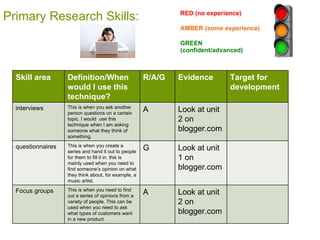
Primary Research Skills: RED (no experience) AMBER (some experience) GREEN (confident/advanced) Skill area Definition/When would I use this technique? R/A/G Evidence Target for development interviews This is when you ask another person questions on a certain topic. I would  use this technique when I am asking someone what they think of something. A Look at unit 2 on blogger.com questionnaires This is when you create a series and hand it out to people for them to fill it in. this is mainly used when you need to find someone’s opinion on what they think about, for example, a music artist. G Look at unit 1 on blogger.com Focus groups This is when you need to find out a series of opinions from a variety of people. This can be used when you need to ask what types of customers want in a new product. A Look at unit 2 on blogger.com
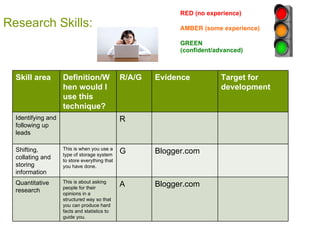
Research Skills: RED (no experience) AMBER (some experience) GREEN (confident/advanced) Skill area Definition/When would I use this technique? R/A/G Evidence Target for development Identifying and following up leads R Shifting, collating and storing information This is when you use a type of storage system to store everything that you have done. G Blogger.com Quantitative research This is about asking people for their opinions in a structured way so that you can produce hard facts and statistics to guide you. A Blogger.com
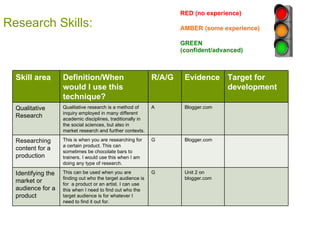
Research Skills: RED (no experience) AMBER (some experience) GREEN (confident/advanced) Skill area Definition/When would I use this technique? R/A/G Evidence Target for development Qualitative Research Qualitative research is a method of inquiry employed in many different academic disciplines, traditionally in the social sciences, but also in market research and further contexts. [ A Blogger.com Researching content for a production This is when you are researching for a certain product. This can sometimes be chocolate bars to trainers. I would use this when I am doing any type of research. G Blogger.com Identifying the market or audience for a product This can be used when you are finding out who the target audience is for  a product or an artist. I can use this when I need to find out who the target audience is for whatever I need to find it out for. G Unit 2 on blogger.com
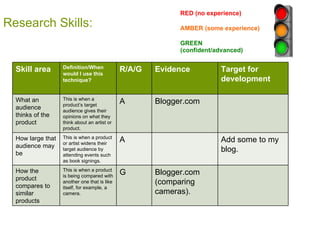
Research Skills: RED (no experience) AMBER (some experience) GREEN (confident/advanced) Skill area Definition/When would I use this technique? R/A/G Evidence Target for development What an audience thinks of the product This is when a product’s target audience gives their opinions on what they think about an artist or product. A Blogger.com How large that audience may be This is when a product or artist widens their  target audience by attending events such as book signings. A Add some to my blog. How the product compares to similar products This is when a product is being compared with another one that is like itself, for example, a camera. G Blogger.com (comparing cameras).
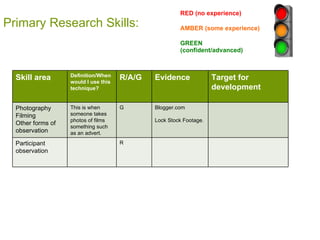
Primary Research Skills: RED (no experience) AMBER (some experience) GREEN (confident/advanced) Skill area Definition/When would I use this technique? R/A/G Evidence Target for development Photography Filming Other forms of observation This is when someone takes photos of films  something such as an advert. G Blogger.com Lock Stock Footage. Participant observation R
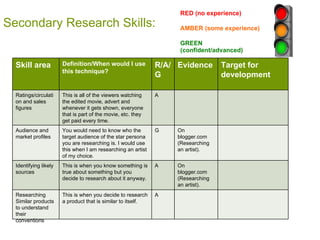
Secondary Research Skills: RED (no experience) AMBER (some experience) GREEN (confident/advanced) Skill area Definition/When would I use this technique? R/A/G Evidence Target for development Ratings/circulation and sales figures This is all of the viewers watching the edited movie, advert and whenever it gets shown, everyone that is part of the movie, etc. they get paid every time. A Audience and market profiles You would need to know who the target audience of the star persona you are researching is. I would use this when I am researching an artist of my choice. G On blogger.com (Researching an artist). Identifying likely sources This is when you know something is true about something but you decide to research about it anyway. A On blogger.com (Researching an artist). Researching Similar products to understand their conventions This is when you decide to research a product that is similar to itself.  A
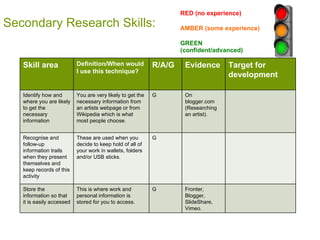
Secondary Research Skills: RED (no experience) AMBER (some experience) GREEN (confident/advanced) Skill area Definition/When would I use this technique? R/A/G Evidence Target for development Identify how and where you are likely to get the necessary information You are very likely to get the necessary information from an artists webpage or from Wikipedia which is what most people choose. G On blogger.com (Researching an artist). Recognise and follow-up information trails when they present themselves and keep records of this activity These are used when you decide to keep hold of all of your work in wallets, folders and/or USB sticks. G Store the information so that it is easily accessed  This is where work and personal information is stored for you to access. G Fronter, Blogger, SlideShare, Vimeo.

Research Audit

  • 1.
    Unit 2: InitialSkills Audits Term 1: Research Skills
  • 2.
    Primary Research Skills:RED (no experience) AMBER (some experience) GREEN (confident/advanced) Skill area Definition/When would I use this technique? R/A/G Evidence Target for development interviews This is when you ask another person questions on a certain topic. I would use this technique when I am asking someone what they think of something. A Look at unit 2 on blogger.com questionnaires This is when you create a series and hand it out to people for them to fill it in. this is mainly used when you need to find someone’s opinion on what they think about, for example, a music artist. G Look at unit 1 on blogger.com Focus groups This is when you need to find out a series of opinions from a variety of people. This can be used when you need to ask what types of customers want in a new product. A Look at unit 2 on blogger.com
  • 3.
    Research Skills: RED(no experience) AMBER (some experience) GREEN (confident/advanced) Skill area Definition/When would I use this technique? R/A/G Evidence Target for development Identifying and following up leads R Shifting, collating and storing information This is when you use a type of storage system to store everything that you have done. G Blogger.com Quantitative research This is about asking people for their opinions in a structured way so that you can produce hard facts and statistics to guide you. A Blogger.com
  • 4.
    Research Skills: RED(no experience) AMBER (some experience) GREEN (confident/advanced) Skill area Definition/When would I use this technique? R/A/G Evidence Target for development Qualitative Research Qualitative research is a method of inquiry employed in many different academic disciplines, traditionally in the social sciences, but also in market research and further contexts. [ A Blogger.com Researching content for a production This is when you are researching for a certain product. This can sometimes be chocolate bars to trainers. I would use this when I am doing any type of research. G Blogger.com Identifying the market or audience for a product This can be used when you are finding out who the target audience is for a product or an artist. I can use this when I need to find out who the target audience is for whatever I need to find it out for. G Unit 2 on blogger.com
  • 5.
    Research Skills: RED(no experience) AMBER (some experience) GREEN (confident/advanced) Skill area Definition/When would I use this technique? R/A/G Evidence Target for development What an audience thinks of the product This is when a product’s target audience gives their opinions on what they think about an artist or product. A Blogger.com How large that audience may be This is when a product or artist widens their target audience by attending events such as book signings. A Add some to my blog. How the product compares to similar products This is when a product is being compared with another one that is like itself, for example, a camera. G Blogger.com (comparing cameras).
  • 6.
    Primary Research Skills:RED (no experience) AMBER (some experience) GREEN (confident/advanced) Skill area Definition/When would I use this technique? R/A/G Evidence Target for development Photography Filming Other forms of observation This is when someone takes photos of films something such as an advert. G Blogger.com Lock Stock Footage. Participant observation R
  • 7.
    Secondary Research Skills:RED (no experience) AMBER (some experience) GREEN (confident/advanced) Skill area Definition/When would I use this technique? R/A/G Evidence Target for development Ratings/circulation and sales figures This is all of the viewers watching the edited movie, advert and whenever it gets shown, everyone that is part of the movie, etc. they get paid every time. A Audience and market profiles You would need to know who the target audience of the star persona you are researching is. I would use this when I am researching an artist of my choice. G On blogger.com (Researching an artist). Identifying likely sources This is when you know something is true about something but you decide to research about it anyway. A On blogger.com (Researching an artist). Researching Similar products to understand their conventions This is when you decide to research a product that is similar to itself. A
  • 8.
    Secondary Research Skills:RED (no experience) AMBER (some experience) GREEN (confident/advanced) Skill area Definition/When would I use this technique? R/A/G Evidence Target for development Identify how and where you are likely to get the necessary information You are very likely to get the necessary information from an artists webpage or from Wikipedia which is what most people choose. G On blogger.com (Researching an artist). Recognise and follow-up information trails when they present themselves and keep records of this activity These are used when you decide to keep hold of all of your work in wallets, folders and/or USB sticks. G Store the information so that it is easily accessed This is where work and personal information is stored for you to access. G Fronter, Blogger, SlideShare, Vimeo.