mypropixel('TYASuite','77106032334ffefe6f989f697174bdc8');
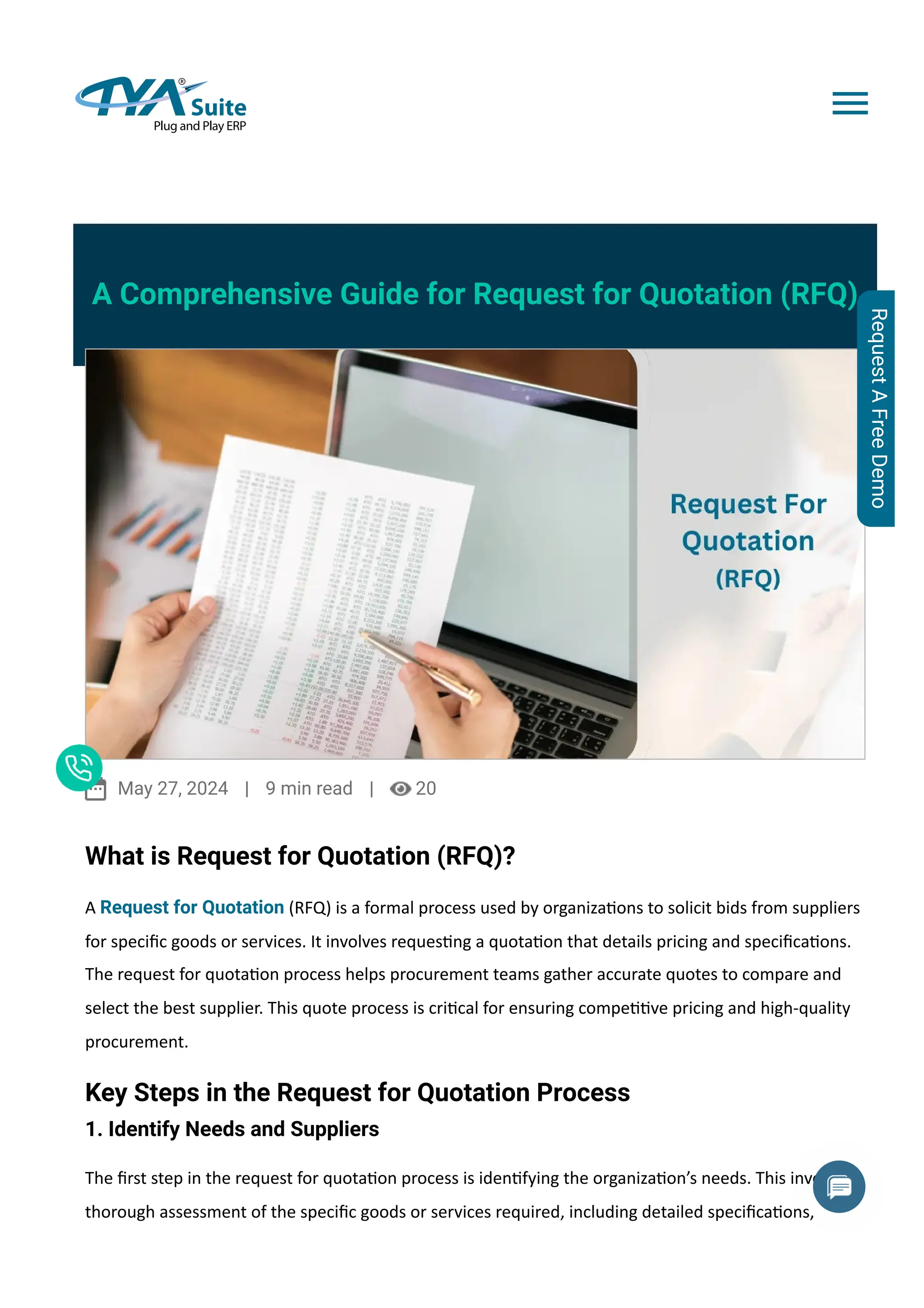
A Comprehensive Guide for Request for Quotation (RFQ)
May 27, 2024 | 9 min read | 20
What is Request for Quotation (RFQ)?
A Request for Quotation (RFQ) is a formal process used by organizations to solicit bids from suppliers
for specific goods or services. It involves requesting a quotation that details pricing and specifications.
The request for quotation process helps procurement teams gather accurate quotes to compare and
select the best supplier. This quote process is critical for ensuring competitive pricing and high-quality
procurement.
Key Steps in the Request for Quotation Process
1. Identify Needs and Suppliers
The first step in the request for quotation process is identifying the organization’s needs. This involves a
thorough assessment of the specific goods or services required, including detailed specifications,
Request
A
Free
Demo
quantities, and delivery timelines. Once the needs are clearly defined, the next step is to identify
potential suppliers. This can be achieved through supplier databases, market research, and industry
connections. Selecting the right suppliers is crucial to ensure that the received quotes are competitive
and meet the organization’s standards.
2. Prepare the RFQ Document
Creating a comprehensive RFQ document is essential for obtaining accurate and comparable quotes.
The document should include all necessary details such as product specifications, quantities, delivery
requirements, payment terms, and evaluation criteria. Providing clear and precise instructions helps
suppliers understand the requirements and submit their best offers. Using standardized templates for
RFQ documents can enhance consistency and simplify the evaluation process.
3. Distribute the RFQ
Once the RFQ document is prepared, it needs to be distributed to the selected suppliers. Ensuring that
all potential suppliers receive the RFQ simultaneously is important to maintain fairness. Utilizing
procurement software or platforms can automate this process, making it more efficient. These tools
can also help track responses and ensure that all submissions are received by the specified deadline.
4. Evaluate Quotes
After receiving the quotes, the procurement team must evaluate them against the predefined criteria.
This involves comparing prices, quality, delivery terms, and supplier reliability. The evaluation process
should be thorough and objective to identify the best offer. It's important to document the evaluation
process to maintain transparency and for future reference.
5. Negotiate and Select Suppliers
Depending on the initial quotes received, there may be room for negotiation on pricing, terms, or
conditions. Effective negotiation can help secure better deals and additional value for the organization.
Once negotiations are complete, the final step is to select the most suitable supplier. Clear
communication is essential during this stage to ensure that all parties are aligned on expectations and
deliverables.
Benefits of Quote Automation in the RFQ Process
Efficiency
Quote automation significantly reduces manual effort and time spent on repetitive tasks involved in
the request for quotation process, such as distributing RFQs, collecting responses, and managing
documentation. By automating these tasks, procurement teams can focus their efforts on strategic
activities, leading to increased productivity and faster turnaround times for procurement projects.
Accuracy
Automation minimizes the risk of human error that may occur during manual data entry or processing.
With automated systems, there is greater consistency and accuracy in capturing and analyzing RFQ
data, ensuring that all quotes are evaluated based on the same criteria. This leads to more reliable
decision-making and reduces the likelihood of costly mistakes.
Transparency
Quote automation promotes transparency throughout the RFQ process by providing real-time
visibility into the status of RFQs, responses, and evaluations. Stakeholders can easily track the progress
of procurement projects and access relevant information, enhancing collaboration and communication
across the procurement team and with suppliers.
Cost Savings
By streamlining the request for quotation process and reducing manual labor, quote automation helps
organizations save costs associated with time, labor, and resources. Additionally, automation enables
better negotiation with suppliers, leading to more competitive pricing and favorable terms, ultimately
driving down procurement costs.
Enhanced Supplier Relationships
Quote automation facilitates seamless communication and collaboration with suppliers throughout the
request for quotation process. Automated systems can send automated reminders, updates, and
notifications to suppliers, ensuring timely responses and maintaining positive relationships. This fosters
a collaborative environment and encourages suppliers to submit competitive quotes, ultimately leading
to better value for the organization.
Scalability
Automated systems are scalable and can accommodate varying volumes of RFQs and supplier
responses without compromising efficiency or quality. Whether handling a small-scale procurement
project or a large-scale enterprise-wide initiative, quote automation adapts to the organization's needs,
ensuring consistent performance and outcomes.
Compliance
Quote automation helps ensure compliance with internal procurement policies, industry regulations,
and contractual obligations. Automated systems can enforce standardized processes, capture audit
trails, and generate comprehensive reports, facilitating compliance management and reducing the
risk of non-compliance penalties or legal issues.
Data-driven Insights
Automated systems capture and analyze vast amounts of RFQ data, generating valuable insights that
inform decision-making and procurement strategies. By leveraging data analytics and reporting
capabilities, organizations can identify trends, benchmark performance, and optimize their RFQ
processes for continuous improvement.
Best Practices for an Effective Request for Quotation (RFQ)
A Request for Quotation is a crucial document in procurement processes, serving as a formal
invitation for suppliers to submit their pricing and proposals for specific goods or services. Crafting an
effective RFQ can significantly impact the outcome of procurement activities. Here are some best
practices to consider when drafting an RFQ:
Clear and Concise Specifications
Provide detailed specifications for the required goods or services, including quantity, quality standards,
and any specific requirements. Ensure clarity to avoid confusion and ensure accurate quotes.
Include Technical Requirements
If applicable, outline technical specifications, such as dimensions, materials, or performance criteria.
This helps suppliers understand the exact specifications they need to meet.
Submission Deadline
Clearly indicate when quotations must be submitted. This allows suppliers to plan their resources and
ensures timely responses.
Instructions for Submission
Provide clear instructions on how suppliers should format and submit their quotations. This may
include preferred file formats, delivery methods, and contact details for inquiries.
Evaluation Criteria
Define the criteria that will be used to evaluate quotations, such as price, quality, delivery time, and
past performance. This helps suppliers understand the basis for selection and ensures fairness in the
evaluation process.
1.
2.
Terms and Conditions
Include relevant terms and conditions, such as payment terms, delivery requirements, warranties, and
any applicable legal or regulatory requirements. This helps manage expectations and avoids
misunderstandings later on.
Request for Additional Information
Encourage suppliers to provide additional information that may be relevant to their quotation, such as
references, certifications, or samples. This helps in assessing supplier capabilities and credibility.
Confidentiality and Non-Disclosure
Include provisions for confidentiality and non-disclosure to protect sensitive information shared by
both parties during the procurement process.
Communication Protocol
Specify the point of contact for inquiries and clarify the communication protocol throughout the
procurement process. This ensures efficient communication and minimizes confusion.
Flexibility for Negotiation
Leave room for negotiation by indicating that the RFQ is not binding and that discussions may be held
to refine quotations or terms.
Review and Approval Process
Outline the process for reviewing and approving quotations, including any internal approvals required
before awarding the contract.
Feedback Mechanism
Provide a mechanism for suppliers to seek clarification or provide feedback on the request for
quotation process. This promotes transparency and continuous improvement.
The Importance of the Request for Quotation Process in
Procurement
The request for quotation process in procurement is vital for obtaining competitive pricing and
high-quality goods or services.
Request a quotation allows organizations to solicit bids from suppliers, fostering transparency
and competitiveness.
3.
4.
5.
6.
7.
8.
9.
10.
Quote automation streamlines the RFQ process, enhancing efficiency and accuracy.
Request for quotation process ensures that organizations receive accurate and comparable
quotes from suppliers.
Procurement quotation is a key aspect of the RFQ process, enabling organizations to evaluate
supplier offers.
The request for quotation process in procurement involves requesting quotes from suppliers and
evaluating them based on predefined criteria.
Quote process facilitates communication between buyers and suppliers, leading to mutually
beneficial agreements.
Request a quote from multiple suppliers allows organizations to identify the best value
proposition.
Quote automation tools automate repetitive tasks in the request for quotation process, saving
time and resources.
RFQ is an essential step in the procurement process, guiding decision-making and negotiations.
How TYASuite Procurement Software Simplifies the RFQ Process?
TYASuite Procurement Software streamlines the Request for Quotation (RFQ) process, making it
more efficient and manageable. With its user-friendly interface, businesses can quickly generate and
send RFQs to multiple suppliers, ensuring competitive pricing and better terms. The software allows for
easy tracking and comparison of received quotes, facilitating informed decision-making. Automated
reminders and follow-ups help maintain timely responses from suppliers, reducing delays. Additionally,
TYASuite's centralized platform keeps all RFQ-related documents and communications organized,
enhancing transparency and accountability. By simplifying the RFQ process, TYASuite Procurement
Software helps businesses save time, reduce costs, and improve supplier relationships.
Conclusion
The Request for Quotation (RFQ) process is a fundamental element of effective procurement
management. By following best practices and leveraging quote automation, organizations can
streamline their procurement activities, secure competitivpe pricing, and build strong supplier
relationships. Understanding and mastering the RFQ process is essential for procurement professionals
aiming to enhance operational efficiency and drive value for their organizations. As businesses
continue to evolve, a robust request for quotation process will remain integral to achieving
procurement success. With TYASuite innovative solutions, procurement professionals can further
enhance operational efficiency and drive value for their organizations, ensuring sustained success in
the ever-changing marketplace.
TYASuite
A revolutionary ERP software meticulously crafted to help industries grow
without burning a hole in their pockets. TYASuite is a one-stop solution for
your company which can be implemented just within a few days.
New Comment
Full Name *
Email Id *
Enter your comments here... *
Comment
Comments
TYASuite Software Solutions Pvt. Ltd.
R.K Complex, 2nd Floor, 152, KHB Colony, 5th Block, Koramangala, Bengaluru, Karnataka 560095.
Mail us: info@tyasuite.com
Products
Procurement Software
Project Management
Compliance Management
Vendor Management
Inventory Management
Sales Order Management
Asset Management
Cloud ERP Software
E-Invoicing
Manufacturing ERP
Company
About Us
Partners
Career
News
Contact
Other Links
Home
Blog
Pricing
Ebook
Whitepaper
Privacy Policy
Subscribe To Our Newsletter
Connect With Us
Enter Email Address *
© Copyright 2024 All rights reserved to TYASuite Software Solutions Pvt. Ltd.

Request for Quotation (RFQ): Comprehensive Guide

  • 1.
    mypropixel('TYASuite','77106032334ffefe6f989f697174bdc8'); A Comprehensive Guidefor Request for Quotation (RFQ) May 27, 2024 | 9 min read | 20 What is Request for Quotation (RFQ)? A Request for Quotation (RFQ) is a formal process used by organizations to solicit bids from suppliers for specific goods or services. It involves requesting a quotation that details pricing and specifications. The request for quotation process helps procurement teams gather accurate quotes to compare and select the best supplier. This quote process is critical for ensuring competitive pricing and high-quality procurement. Key Steps in the Request for Quotation Process 1. Identify Needs and Suppliers The first step in the request for quotation process is identifying the organization’s needs. This involves a thorough assessment of the specific goods or services required, including detailed specifications, Request A Free Demo
  • 2.
    quantities, and deliverytimelines. Once the needs are clearly defined, the next step is to identify potential suppliers. This can be achieved through supplier databases, market research, and industry connections. Selecting the right suppliers is crucial to ensure that the received quotes are competitive and meet the organization’s standards. 2. Prepare the RFQ Document Creating a comprehensive RFQ document is essential for obtaining accurate and comparable quotes. The document should include all necessary details such as product specifications, quantities, delivery requirements, payment terms, and evaluation criteria. Providing clear and precise instructions helps suppliers understand the requirements and submit their best offers. Using standardized templates for RFQ documents can enhance consistency and simplify the evaluation process. 3. Distribute the RFQ Once the RFQ document is prepared, it needs to be distributed to the selected suppliers. Ensuring that all potential suppliers receive the RFQ simultaneously is important to maintain fairness. Utilizing procurement software or platforms can automate this process, making it more efficient. These tools can also help track responses and ensure that all submissions are received by the specified deadline. 4. Evaluate Quotes After receiving the quotes, the procurement team must evaluate them against the predefined criteria. This involves comparing prices, quality, delivery terms, and supplier reliability. The evaluation process should be thorough and objective to identify the best offer. It's important to document the evaluation process to maintain transparency and for future reference. 5. Negotiate and Select Suppliers Depending on the initial quotes received, there may be room for negotiation on pricing, terms, or conditions. Effective negotiation can help secure better deals and additional value for the organization. Once negotiations are complete, the final step is to select the most suitable supplier. Clear communication is essential during this stage to ensure that all parties are aligned on expectations and deliverables. Benefits of Quote Automation in the RFQ Process Efficiency Quote automation significantly reduces manual effort and time spent on repetitive tasks involved in the request for quotation process, such as distributing RFQs, collecting responses, and managing documentation. By automating these tasks, procurement teams can focus their efforts on strategic
  • 3.
    activities, leading toincreased productivity and faster turnaround times for procurement projects. Accuracy Automation minimizes the risk of human error that may occur during manual data entry or processing. With automated systems, there is greater consistency and accuracy in capturing and analyzing RFQ data, ensuring that all quotes are evaluated based on the same criteria. This leads to more reliable decision-making and reduces the likelihood of costly mistakes. Transparency Quote automation promotes transparency throughout the RFQ process by providing real-time visibility into the status of RFQs, responses, and evaluations. Stakeholders can easily track the progress of procurement projects and access relevant information, enhancing collaboration and communication across the procurement team and with suppliers. Cost Savings By streamlining the request for quotation process and reducing manual labor, quote automation helps organizations save costs associated with time, labor, and resources. Additionally, automation enables better negotiation with suppliers, leading to more competitive pricing and favorable terms, ultimately driving down procurement costs. Enhanced Supplier Relationships Quote automation facilitates seamless communication and collaboration with suppliers throughout the request for quotation process. Automated systems can send automated reminders, updates, and notifications to suppliers, ensuring timely responses and maintaining positive relationships. This fosters a collaborative environment and encourages suppliers to submit competitive quotes, ultimately leading to better value for the organization. Scalability Automated systems are scalable and can accommodate varying volumes of RFQs and supplier responses without compromising efficiency or quality. Whether handling a small-scale procurement project or a large-scale enterprise-wide initiative, quote automation adapts to the organization's needs, ensuring consistent performance and outcomes. Compliance Quote automation helps ensure compliance with internal procurement policies, industry regulations, and contractual obligations. Automated systems can enforce standardized processes, capture audit
  • 4.
    trails, and generatecomprehensive reports, facilitating compliance management and reducing the risk of non-compliance penalties or legal issues. Data-driven Insights Automated systems capture and analyze vast amounts of RFQ data, generating valuable insights that inform decision-making and procurement strategies. By leveraging data analytics and reporting capabilities, organizations can identify trends, benchmark performance, and optimize their RFQ processes for continuous improvement. Best Practices for an Effective Request for Quotation (RFQ) A Request for Quotation is a crucial document in procurement processes, serving as a formal invitation for suppliers to submit their pricing and proposals for specific goods or services. Crafting an effective RFQ can significantly impact the outcome of procurement activities. Here are some best practices to consider when drafting an RFQ: Clear and Concise Specifications Provide detailed specifications for the required goods or services, including quantity, quality standards, and any specific requirements. Ensure clarity to avoid confusion and ensure accurate quotes. Include Technical Requirements If applicable, outline technical specifications, such as dimensions, materials, or performance criteria. This helps suppliers understand the exact specifications they need to meet. Submission Deadline Clearly indicate when quotations must be submitted. This allows suppliers to plan their resources and ensures timely responses. Instructions for Submission Provide clear instructions on how suppliers should format and submit their quotations. This may include preferred file formats, delivery methods, and contact details for inquiries. Evaluation Criteria Define the criteria that will be used to evaluate quotations, such as price, quality, delivery time, and past performance. This helps suppliers understand the basis for selection and ensures fairness in the evaluation process.
  • 5.
    1. 2. Terms and Conditions Includerelevant terms and conditions, such as payment terms, delivery requirements, warranties, and any applicable legal or regulatory requirements. This helps manage expectations and avoids misunderstandings later on. Request for Additional Information Encourage suppliers to provide additional information that may be relevant to their quotation, such as references, certifications, or samples. This helps in assessing supplier capabilities and credibility. Confidentiality and Non-Disclosure Include provisions for confidentiality and non-disclosure to protect sensitive information shared by both parties during the procurement process. Communication Protocol Specify the point of contact for inquiries and clarify the communication protocol throughout the procurement process. This ensures efficient communication and minimizes confusion. Flexibility for Negotiation Leave room for negotiation by indicating that the RFQ is not binding and that discussions may be held to refine quotations or terms. Review and Approval Process Outline the process for reviewing and approving quotations, including any internal approvals required before awarding the contract. Feedback Mechanism Provide a mechanism for suppliers to seek clarification or provide feedback on the request for quotation process. This promotes transparency and continuous improvement. The Importance of the Request for Quotation Process in Procurement The request for quotation process in procurement is vital for obtaining competitive pricing and high-quality goods or services. Request a quotation allows organizations to solicit bids from suppliers, fostering transparency and competitiveness.
  • 6.
    3. 4. 5. 6. 7. 8. 9. 10. Quote automation streamlinesthe RFQ process, enhancing efficiency and accuracy. Request for quotation process ensures that organizations receive accurate and comparable quotes from suppliers. Procurement quotation is a key aspect of the RFQ process, enabling organizations to evaluate supplier offers. The request for quotation process in procurement involves requesting quotes from suppliers and evaluating them based on predefined criteria. Quote process facilitates communication between buyers and suppliers, leading to mutually beneficial agreements. Request a quote from multiple suppliers allows organizations to identify the best value proposition. Quote automation tools automate repetitive tasks in the request for quotation process, saving time and resources. RFQ is an essential step in the procurement process, guiding decision-making and negotiations. How TYASuite Procurement Software Simplifies the RFQ Process? TYASuite Procurement Software streamlines the Request for Quotation (RFQ) process, making it more efficient and manageable. With its user-friendly interface, businesses can quickly generate and send RFQs to multiple suppliers, ensuring competitive pricing and better terms. The software allows for easy tracking and comparison of received quotes, facilitating informed decision-making. Automated reminders and follow-ups help maintain timely responses from suppliers, reducing delays. Additionally, TYASuite's centralized platform keeps all RFQ-related documents and communications organized, enhancing transparency and accountability. By simplifying the RFQ process, TYASuite Procurement Software helps businesses save time, reduce costs, and improve supplier relationships. Conclusion The Request for Quotation (RFQ) process is a fundamental element of effective procurement management. By following best practices and leveraging quote automation, organizations can streamline their procurement activities, secure competitivpe pricing, and build strong supplier relationships. Understanding and mastering the RFQ process is essential for procurement professionals aiming to enhance operational efficiency and drive value for their organizations. As businesses
  • 7.
    continue to evolve,a robust request for quotation process will remain integral to achieving procurement success. With TYASuite innovative solutions, procurement professionals can further enhance operational efficiency and drive value for their organizations, ensuring sustained success in the ever-changing marketplace. TYASuite A revolutionary ERP software meticulously crafted to help industries grow without burning a hole in their pockets. TYASuite is a one-stop solution for your company which can be implemented just within a few days. New Comment Full Name * Email Id * Enter your comments here... * Comment Comments TYASuite Software Solutions Pvt. Ltd. R.K Complex, 2nd Floor, 152, KHB Colony, 5th Block, Koramangala, Bengaluru, Karnataka 560095. Mail us: info@tyasuite.com
  • 8.
    Products Procurement Software Project Management ComplianceManagement Vendor Management Inventory Management Sales Order Management Asset Management Cloud ERP Software E-Invoicing Manufacturing ERP Company About Us Partners Career News Contact Other Links Home Blog Pricing Ebook Whitepaper Privacy Policy Subscribe To Our Newsletter Connect With Us Enter Email Address * © Copyright 2024 All rights reserved to TYASuite Software Solutions Pvt. Ltd.