Representation Case Study
Beyonce - Formation :
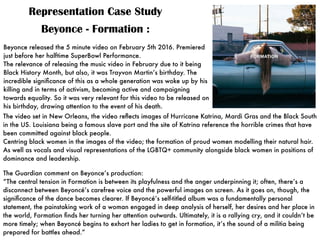
The video set in New Orleans, the video reflects images of Hurricane Katrina, Mardi Gras and the Black South
in the US. Louisiana being a famous slave port and the site of Katrina reference the horrible crimes that have
been committed against black people.
Centring black women in the images of the video; the formation of proud women modelling their natural hair.
As well as vocals and visual representations of the LGBTQ+ community alongside black women in positions of
dominance and leadership.
The Guardian comment on Beyonce’s production:
“The central tension in Formation is between its playfulness and the anger underpinning it; often, there’s a
disconnect between Beyoncé’s carefree voice and the powerful images on screen. As it goes on, though, the
significance of the dance becomes clearer. If Beyoncé’s self-titled album was a fundamentally personal
statement, the painstaking work of a woman engaged in deep analysis of herself, her desires and her place in
the world, Formation finds her turning her attention outwards. Ultimately, it is a rallying cry, and it couldn’t be
more timely; when Beyoncé begins to exhort her ladies to get in formation, it’s the sound of a militia being
prepared for battles ahead.”
Beyonce released the 5 minute video on February 5th 2016. Premiered
just before her halftime SuperBowl Performance.
The relevance of releasing the music video in February due to it being
Black History Month, but also, it was Trayvon Martin’s birthday. The
incredible significance of this as a whole generation was woke up by his
killing and in terms of activism, becoming active and campaigning
towards equality. So it was very relevant for this video to be released on
his birthday, drawing attention to the event of his death.
Representation - Gender :
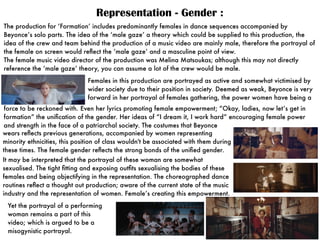
The production for ‘Formation’ includes predominantly females in dance sequences accompanied by
Beyonce’s solo parts. The idea of the ‘male gaze’ a theory which could be supplied to this production, the
idea of the crew and team behind the production of a music video are mainly male, therefore the portrayal of
the female on screen would reflect the ‘male gaze’ and a masculine point of view.
The female music video director of the production was Melina Matsoukas; although this may not directly
reference the ‘male gaze’ theory, you can assume a lot of the crew would be male.
Females in this production are portrayed as active and somewhat victimised by
wider society due to their position in society. Deemed as weak, Beyonce is very
forward in her portrayal of females gathering, the power women have being a
It may be interpreted that the portrayal of these woman are somewhat
sexualised. The tight fitting and exposing outfits sexualising the bodies of these
females and being objectifying in the representation. The choreographed dance
routines reflect a thought out production; aware of the current state of the music
industry and the representation of women. Female’s creating this empowerment.
force to be reckoned with. Even her lyrics promoting female empowerment; “Okay, ladies, now let’s get in
formation” the unification of the gender. Her ideas of “I dream it, I work hard” encouraging female power
and strength in the face of a patriarchal society. The costumes that Beyonce
wears reflects previous generations, accompanied by women representing
minority ethnicities, this position of class wouldn't be associated with them during
these times. The female gender reflects the strong bonds of the unified gender.
Yet the portrayal of a performing
woman remains a part of this
video; which is argued to be a
misogynistic portrayal.
Representation - Ethnicity :
In Beyonce’s music video; ethnicity is a very central topic in the political statement and representation she
tackles in the production. A deliberate issue she has chosen to reflect in her portrayal of her own culture.
Portraying radical self-love for her history and identity. Her declaration; “I like my negro nose with Jackson 5
nostrils,” is along the lyrics which are also illustrated in the scenes with black women showing their pride and
lack of apology over their acceptance of their culture.
The use of hyper-specific lyrics shows her lack of interest in universality,
alienating a wider audience and this is targeted at a specific audience, a
definite link to her African-American heritage. With symbolic figures like
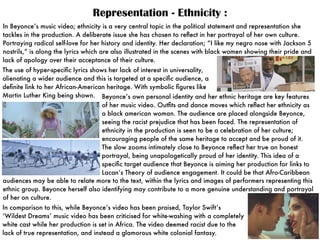
Martin Luther King being shown. Beyonce’s own personal identity and her ethnic heritage are key features
of her music video. Outfits and dance moves which reflect her ethnicity as
a black american woman. The audience are placed alongside Beyonce,
seeing the racist prejudice that has been faced. The representation of
ethnicity in the production is seen to be a celebration of her culture;
encouraging people of the same heritage to accept and be proud of it.
The slow zooms intimately close to Beyonce reflect her true an honest
portrayal, being unapologetically proud of her identity. This idea of a
specific target audience that Beyonce is aiming her production for links to
Lacan’s Theory of audience engagement. It could be that Afro-Caribbean
audiences may be able to relate more to the text, within the lyrics and images of performers representing this
ethnic group. Beyonce herself also identifying may contribute to a more genuine understanding and portrayal
of her on culture.
In comparison to this, while Beyonce’s video has been praised, Taylor Swift’s
‘Wildest Dreams’ music video has been criticised for white-washing with a completely
white cast while her production is set in Africa. The video deemed racist due to the
lack of true representation, and instead a glamorous white colonial fantasy.
Representation - Status :
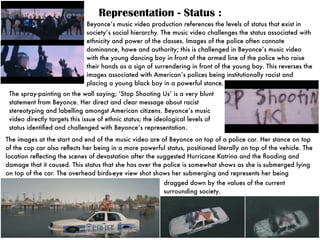
Beyonce’s music video production references the levels of status that exist in
society’s social hierarchy. The music video challenges the status associated with
ethnicity and power of the classes. Images of the police often connote
dominance, howe and authority; this is challenged in Beyonce’s music video
with the young dancing boy in front of the armed line of the police who raise
their hands as a sign of surrendering in front of the young boy. This reverses the
images associated with American’s polices being institutionally racist and
placing a young black boy in a powerful stance.
The images at the start and end of the music video are of Beyonce on top of a police car. Her stance on top
of the cop car also reflects her being in a more powerful status, positioned literally on top of the vehicle. The
location reflecting the scenes of devastation after the suggested Hurricane Katrina and the flooding and
damage that it caused. This status that she has over the police is somewhat shows as she is submerged lying
on top of the car. The overhead birds-eye view shot shows her submerging and represents her being
The spray-painting on the wall saying; ‘Stop Shooting Us’ is a very blunt
statement from Beyonce. Her direct and clear message about racist
stereotyping and labelling amongst American citizens. Beyonce’s music
video directly targets this issue of ethnic status; the ideological levels of
status identified and challenged with Beyonce’s representation.
dragged down by the values of the current
surrounding society.
Representation - Culture :
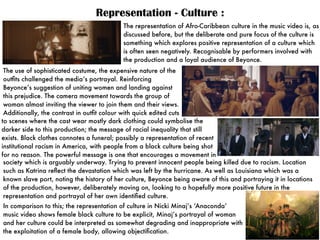
The representation of Afro-Caribbean culture in the music video is, as
discussed before, but the deliberate and pure focus of the culture is
something which explores positive representation of a culture which
is often seen negatively. Recognisable by performers involved with
the production and a loyal audience of Beyonce.
In comparison to this; the representation of culture in Nicki Minaj’s ‘Anaconda’
music video shows female black culture to be explicit, Minaj’s portrayal of woman
and her culture could be interpreted as somewhat degrading and inappropriate with
the exploitation of a female body, allowing objectification.
The use of sophisticated costume, the expensive nature of the
outfits challenged the media’s portrayal. Reinforcing
Beyonce’s suggestion of uniting women and landing against
this prejudice. The camera movement towards the group of
woman almost inviting the viewer to join them and their views.
Additionally, the contrast in outfit colour with quick edited cuts
to scenes where the cast wear mostly dark clothing could symbolise the
darker side to this production; the message of racial inequality that still
exists. Black clothes connotes a funeral; possibly a representation of recent
institutional racism in America, with people from a black culture being shot
for no reason. The powerful message is one that encourages a movement in
society which is arguably underway. Trying to prevent innocent people being killed due to racism. Location
such as Katrina reflect the devastation which was left by the hurricane. As well as Louisiana which was a
known slave port, noting the history of her culture, Beyonce being aware of this and portraying it in locations
of the production, however, deliberately moving on, looking to a hopefully more positive future in the
representation and portrayal of her own identified culture.
Representation - Youth :
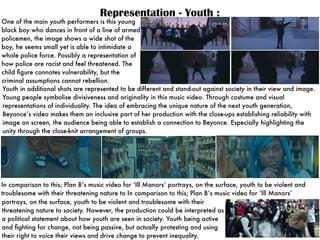
One of the main youth performers is this young
black boy who dances in front of a line of armed
policemen, the image shows a wide shot of the
boy, he seems small yet is able to intimidate a
whole police force. Possibly a representation of
how police are racist and feel threatened. The
child figure connotes vulnerability, but the
criminal assumptions cannot rebellion.
portrays, on the surface, youth to be violent and troublesome with their
threatening nature to society. However, the production could be interpreted as
a political statement about how youth are seen in society. Youth being active
and fighting for change, not being passive, but actually protesting and using
their right to voice their views and drive change to prevent inequality.
In comparison to this; Plan B’s music video for ‘Ill Manors’ portrays, on the surface, youth to be violent and
troublesome with their threatening nature to In comparison to this; Plan B’s music video for ‘Ill Manors’
Youth in additional shots are represented to be different and stand-out against society in their view and image.
Young people symbolise divisiveness and originality in this music video. Through costume and visual
representations of individuality. The idea of embracing the unique nature of the next youth generation,
Beyonce’s video makes them an inclusive part of her production with the close-ups establishing reliability with
image on screen, the audience being able to establish a connection to Beyonce. Especially highlighting the
unity through the close-knit arrangement of groups.
Representation - In my Production :
Gender:
The representation of gender in my production is solely focused around females as this is the only portrayal in
my music video production. My female character seen to be an adventurous and complex character, the
portrayal of traveling throughout multiple different locations reflects her quest to identify and form and
become her own identity.
Age:
The main character throughout my production is of a young age, it turn this makes my music video more
relatable to a younger audience demographic. But the representation of youth in my production is a positive
portrayal; my teenage female travelling all around trying to identify, reflecting the period of youth where
individuals may be trying to discover their identity and trying to create an identity. The transition between
youth and late adulthood is reflected in a quick transition, suggesting that although time has moved on, the
sapling has grown into a tree, as well as the woman’s personality growing.
Ethnicity:
The representation of ethnicity in my own music video production isn't something that I focused on in the pre-
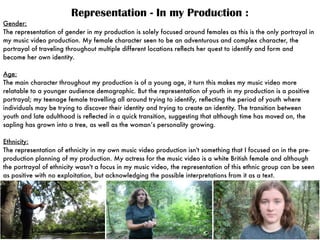
production planning of my production. My actress for the music video is a white British female and although
the portrayal of ethnicity wasn't a focus in my music video, the representation of this ethnic group can be seen
as positive with no exploitation, but acknowledging the possible interpretations from it as a text.

Representation Case Study

  • 1.
    Representation Case Study Beyonce- Formation : The video set in New Orleans, the video reflects images of Hurricane Katrina, Mardi Gras and the Black South in the US. Louisiana being a famous slave port and the site of Katrina reference the horrible crimes that have been committed against black people. Centring black women in the images of the video; the formation of proud women modelling their natural hair. As well as vocals and visual representations of the LGBTQ+ community alongside black women in positions of dominance and leadership. The Guardian comment on Beyonce’s production: “The central tension in Formation is between its playfulness and the anger underpinning it; often, there’s a disconnect between Beyoncé’s carefree voice and the powerful images on screen. As it goes on, though, the significance of the dance becomes clearer. If Beyoncé’s self-titled album was a fundamentally personal statement, the painstaking work of a woman engaged in deep analysis of herself, her desires and her place in the world, Formation finds her turning her attention outwards. Ultimately, it is a rallying cry, and it couldn’t be more timely; when Beyoncé begins to exhort her ladies to get in formation, it’s the sound of a militia being prepared for battles ahead.” Beyonce released the 5 minute video on February 5th 2016. Premiered just before her halftime SuperBowl Performance. The relevance of releasing the music video in February due to it being Black History Month, but also, it was Trayvon Martin’s birthday. The incredible significance of this as a whole generation was woke up by his killing and in terms of activism, becoming active and campaigning towards equality. So it was very relevant for this video to be released on his birthday, drawing attention to the event of his death.
  • 2.
    Representation - Gender: The production for ‘Formation’ includes predominantly females in dance sequences accompanied by Beyonce’s solo parts. The idea of the ‘male gaze’ a theory which could be supplied to this production, the idea of the crew and team behind the production of a music video are mainly male, therefore the portrayal of the female on screen would reflect the ‘male gaze’ and a masculine point of view. The female music video director of the production was Melina Matsoukas; although this may not directly reference the ‘male gaze’ theory, you can assume a lot of the crew would be male. Females in this production are portrayed as active and somewhat victimised by wider society due to their position in society. Deemed as weak, Beyonce is very forward in her portrayal of females gathering, the power women have being a It may be interpreted that the portrayal of these woman are somewhat sexualised. The tight fitting and exposing outfits sexualising the bodies of these females and being objectifying in the representation. The choreographed dance routines reflect a thought out production; aware of the current state of the music industry and the representation of women. Female’s creating this empowerment. force to be reckoned with. Even her lyrics promoting female empowerment; “Okay, ladies, now let’s get in formation” the unification of the gender. Her ideas of “I dream it, I work hard” encouraging female power and strength in the face of a patriarchal society. The costumes that Beyonce wears reflects previous generations, accompanied by women representing minority ethnicities, this position of class wouldn't be associated with them during these times. The female gender reflects the strong bonds of the unified gender. Yet the portrayal of a performing woman remains a part of this video; which is argued to be a misogynistic portrayal.
  • 3.
    Representation - Ethnicity: In Beyonce’s music video; ethnicity is a very central topic in the political statement and representation she tackles in the production. A deliberate issue she has chosen to reflect in her portrayal of her own culture. Portraying radical self-love for her history and identity. Her declaration; “I like my negro nose with Jackson 5 nostrils,” is along the lyrics which are also illustrated in the scenes with black women showing their pride and lack of apology over their acceptance of their culture. The use of hyper-specific lyrics shows her lack of interest in universality, alienating a wider audience and this is targeted at a specific audience, a definite link to her African-American heritage. With symbolic figures like Martin Luther King being shown. Beyonce’s own personal identity and her ethnic heritage are key features of her music video. Outfits and dance moves which reflect her ethnicity as a black american woman. The audience are placed alongside Beyonce, seeing the racist prejudice that has been faced. The representation of ethnicity in the production is seen to be a celebration of her culture; encouraging people of the same heritage to accept and be proud of it. The slow zooms intimately close to Beyonce reflect her true an honest portrayal, being unapologetically proud of her identity. This idea of a specific target audience that Beyonce is aiming her production for links to Lacan’s Theory of audience engagement. It could be that Afro-Caribbean audiences may be able to relate more to the text, within the lyrics and images of performers representing this ethnic group. Beyonce herself also identifying may contribute to a more genuine understanding and portrayal of her on culture. In comparison to this, while Beyonce’s video has been praised, Taylor Swift’s ‘Wildest Dreams’ music video has been criticised for white-washing with a completely white cast while her production is set in Africa. The video deemed racist due to the lack of true representation, and instead a glamorous white colonial fantasy.
  • 4.
    Representation - Status: Beyonce’s music video production references the levels of status that exist in society’s social hierarchy. The music video challenges the status associated with ethnicity and power of the classes. Images of the police often connote dominance, howe and authority; this is challenged in Beyonce’s music video with the young dancing boy in front of the armed line of the police who raise their hands as a sign of surrendering in front of the young boy. This reverses the images associated with American’s polices being institutionally racist and placing a young black boy in a powerful stance. The images at the start and end of the music video are of Beyonce on top of a police car. Her stance on top of the cop car also reflects her being in a more powerful status, positioned literally on top of the vehicle. The location reflecting the scenes of devastation after the suggested Hurricane Katrina and the flooding and damage that it caused. This status that she has over the police is somewhat shows as she is submerged lying on top of the car. The overhead birds-eye view shot shows her submerging and represents her being The spray-painting on the wall saying; ‘Stop Shooting Us’ is a very blunt statement from Beyonce. Her direct and clear message about racist stereotyping and labelling amongst American citizens. Beyonce’s music video directly targets this issue of ethnic status; the ideological levels of status identified and challenged with Beyonce’s representation. dragged down by the values of the current surrounding society.
  • 5.
    Representation - Culture: The representation of Afro-Caribbean culture in the music video is, as discussed before, but the deliberate and pure focus of the culture is something which explores positive representation of a culture which is often seen negatively. Recognisable by performers involved with the production and a loyal audience of Beyonce. In comparison to this; the representation of culture in Nicki Minaj’s ‘Anaconda’ music video shows female black culture to be explicit, Minaj’s portrayal of woman and her culture could be interpreted as somewhat degrading and inappropriate with the exploitation of a female body, allowing objectification. The use of sophisticated costume, the expensive nature of the outfits challenged the media’s portrayal. Reinforcing Beyonce’s suggestion of uniting women and landing against this prejudice. The camera movement towards the group of woman almost inviting the viewer to join them and their views. Additionally, the contrast in outfit colour with quick edited cuts to scenes where the cast wear mostly dark clothing could symbolise the darker side to this production; the message of racial inequality that still exists. Black clothes connotes a funeral; possibly a representation of recent institutional racism in America, with people from a black culture being shot for no reason. The powerful message is one that encourages a movement in society which is arguably underway. Trying to prevent innocent people being killed due to racism. Location such as Katrina reflect the devastation which was left by the hurricane. As well as Louisiana which was a known slave port, noting the history of her culture, Beyonce being aware of this and portraying it in locations of the production, however, deliberately moving on, looking to a hopefully more positive future in the representation and portrayal of her own identified culture.
  • 6.
    Representation - Youth: One of the main youth performers is this young black boy who dances in front of a line of armed policemen, the image shows a wide shot of the boy, he seems small yet is able to intimidate a whole police force. Possibly a representation of how police are racist and feel threatened. The child figure connotes vulnerability, but the criminal assumptions cannot rebellion. portrays, on the surface, youth to be violent and troublesome with their threatening nature to society. However, the production could be interpreted as a political statement about how youth are seen in society. Youth being active and fighting for change, not being passive, but actually protesting and using their right to voice their views and drive change to prevent inequality. In comparison to this; Plan B’s music video for ‘Ill Manors’ portrays, on the surface, youth to be violent and troublesome with their threatening nature to In comparison to this; Plan B’s music video for ‘Ill Manors’ Youth in additional shots are represented to be different and stand-out against society in their view and image. Young people symbolise divisiveness and originality in this music video. Through costume and visual representations of individuality. The idea of embracing the unique nature of the next youth generation, Beyonce’s video makes them an inclusive part of her production with the close-ups establishing reliability with image on screen, the audience being able to establish a connection to Beyonce. Especially highlighting the unity through the close-knit arrangement of groups.
  • 7.
    Representation - Inmy Production : Gender: The representation of gender in my production is solely focused around females as this is the only portrayal in my music video production. My female character seen to be an adventurous and complex character, the portrayal of traveling throughout multiple different locations reflects her quest to identify and form and become her own identity. Age: The main character throughout my production is of a young age, it turn this makes my music video more relatable to a younger audience demographic. But the representation of youth in my production is a positive portrayal; my teenage female travelling all around trying to identify, reflecting the period of youth where individuals may be trying to discover their identity and trying to create an identity. The transition between youth and late adulthood is reflected in a quick transition, suggesting that although time has moved on, the sapling has grown into a tree, as well as the woman’s personality growing. Ethnicity: The representation of ethnicity in my own music video production isn't something that I focused on in the pre- production planning of my production. My actress for the music video is a white British female and although the portrayal of ethnicity wasn't a focus in my music video, the representation of this ethnic group can be seen as positive with no exploitation, but acknowledging the possible interpretations from it as a text.