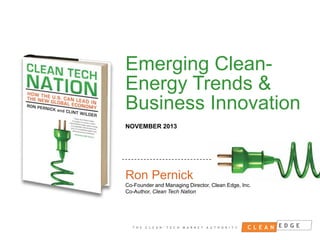
Emerging CleanEnergy Trends &
Business Innovation
NOVEMBER 2013

Ron Pernick
Co-Founder and Managing Director, Clean Edge, Inc.
Co-Author, Clean Tech Nation

CONFIDENTIAL
NOT FOR DISTRIBUTION
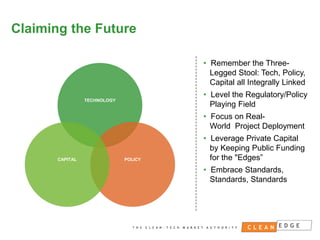
Claiming the Future
• Remember the ThreeLegged Stool: Tech, Policy,
Capital all Integrally Linked
• Level the Regulatory/Policy
Playing Field

TECHNOLOGY

• Focus on RealWorld Project Deployment

CAPITAL

POLICY

• Leverage Private Capital
by Keeping Public Funding
for the "Edges”

• Embrace Standards,
Standards, Standards

CONFIDENTIAL
NOT FOR DISTRIBUTION
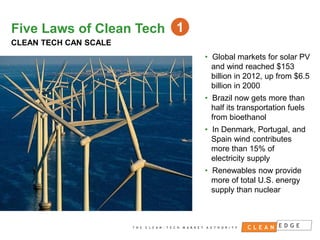
Five Laws of Clean Tech 1
CLEAN TECH CAN SCALE
• Global markets for solar PV
and wind reached $153
billion in 2012, up from $6.5
billion in 2000
• Brazil now gets more than
half its transportation fuels
from bioethanol
• In Denmark, Portugal, and
Spain wind contributes
more than 15% of
electricity supply
• Renewables now provide
more of total U.S. energy
supply than nuclear

CONFIDENTIAL
NOT FOR DISTRIBUTION
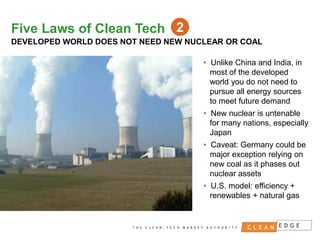
Five Laws of Clean Tech 2
DEVELOPED WORLD DOES NOT NEED NEW NUCLEAR OR COAL
• Unlike China and India, in
most of the developed
world you do not need to
pursue all energy sources
to meet future demand
• New nuclear is untenable
for many nations, especially
Japan
• Caveat: Germany could be
major exception relying on
new coal as it phases out
nuclear assets
• U.S. model: efficiency +
renewables + natural gas

CONFIDENTIAL
NOT FOR DISTRIBUTION
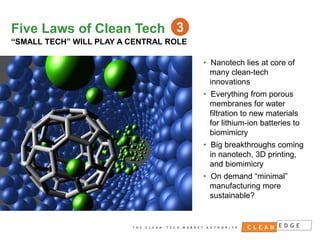
Five Laws of Clean Tech 3
“SMALL TECH” WILL PLAY A CENTRAL ROLE
• Nanotech lies at core of
many clean-tech
innovations

• Everything from porous
membranes for water
filtration to new materials
for lithium-ion batteries to
biomimicry
• Big breakthroughs coming
in nanotech, 3D printing,
and biomimicry

• On demand “minimal”
manufacturing more
sustainable?

CONFIDENTIAL
NOT FOR DISTRIBUTION
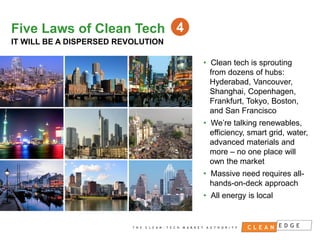
Five Laws of Clean Tech 4
IT WILL BE A DISPERSED REVOLUTION
• Clean tech is sprouting
from dozens of hubs:
Hyderabad, Vancouver,
Shanghai, Copenhagen,
Frankfurt, Tokyo, Boston,
and San Francisco
• We’re talking renewables,
efficiency, smart grid, water,
advanced materials and
more – no one place will
own the market
• Massive need requires allhands-on-deck approach
• All energy is local

CONFIDENTIAL
NOT FOR DISTRIBUTION
Five Laws of Clean Tech 5
ENERGY TRANSITIONS TAKE DECADES
• We are in the midst of the
de-carbonization of energy
• Stakeholders must
embrace “long view”
• Long-term policy and
business planning required:
− China 5-year plans
− Japan corporate 50100 year plans
− U.S. Northwest 5-year
conservation and
electric power plans

CONFIDENTIAL
NOT FOR DISTRIBUTION
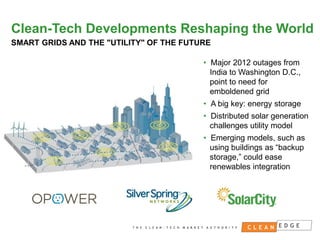
Clean-Tech Developments Reshaping the World
SMART GRIDS AND THE "UTILITY" OF THE FUTURE
• Major 2012 outages from
India to Washington D.C.,
point to need for
emboldened grid
• A big key: energy storage
• Distributed solar generation
challenges utility model

• Emerging models, such as
using buildings as “backup
storage,” could ease
renewables integration

CONFIDENTIAL
NOT FOR DISTRIBUTION
Clean-Tech Developments Reshaping the World
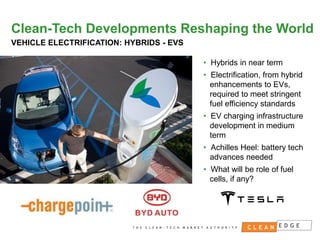
VEHICLE ELECTRIFICATION: HYBRIDS - EVS
• Hybrids in near term
• Electrification, from hybrid
enhancements to EVs,
required to meet stringent
fuel efficiency standards
• EV charging infrastructure
development in medium
term
• Achilles Heel: battery tech
advances needed
• What will be role of fuel
cells, if any?

CONFIDENTIAL
NOT FOR DISTRIBUTION
Clean-Tech Developments Reshaping the World
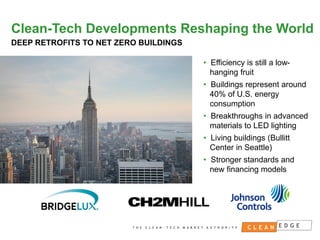
DEEP RETROFITS TO NET ZERO BUILDINGS
• Efficiency is still a lowhanging fruit
• Buildings represent around
40% of U.S. energy
consumption
• Breakthroughs in advanced
materials to LED lighting

• Living buildings (Bullitt
Center in Seattle)
• Stronger standards and
new financing models

CONFIDENTIAL
NOT FOR DISTRIBUTION
Clean-Tech Developments Reshaping the World
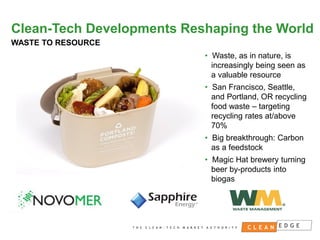
WASTE TO RESOURCE
• Waste, as in nature, is
increasingly being seen as
a valuable resource
• San Francisco, Seattle,
and Portland, OR recycling
food waste – targeting
recycling rates at/above
70%
• Big breakthrough: Carbon
as a feedstock
• Magic Hat brewery turning
beer by-products into
biogas

CONFIDENTIAL
NOT FOR DISTRIBUTION
U.S. Markets: State of Clean-Tech Industry
Overview
• Renewable energy accounted for 49 percent of new electricity capacity in 2012 –
its largest share ever. Largely a story of renewables, efficiency, and abundant,
low-cost natural gas
• Clean-tech deployment in the U.S. is largely being driven by state and metro-level
activity: Feds are mired in partisanship and budgets have been decimated
• Leadership at state and metro levels
integrally linked.
• Expiration of incentives (wind and solar)
loom large
• Key challenges to measures like RPS have
failed across the country. But other battles
rage on (like net metering in AZ)
• Valley of death issues for clean-tech
startups with VC retreat from early-stage
deals
CONFIDENTIAL
NOT FOR DISTRIBUTION
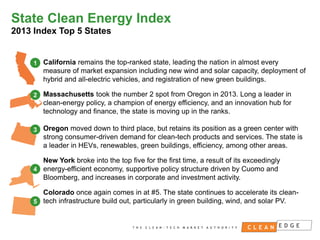
State Clean Energy Index
2013 Index Top 5 States

1

California remains the top-ranked state, leading the nation in almost every
measure of market expansion including new wind and solar capacity, deployment of
hybrid and all-electric vehicles, and registration of new green buildings.

2

Massachusetts took the number 2 spot from Oregon in 2013. Long a leader in
clean-energy policy, a champion of energy efficiency, and an innovation hub for
technology and finance, the state is moving up in the ranks.

3

Oregon moved down to third place, but retains its position as a green center with
strong consumer-driven demand for clean-tech products and services. The state is
a leader in HEVs, renewables, green buildings, efficiency, among other areas.

New York broke into the top five for the first time, a result of its exceedingly
4 energy-efficient economy, supportive policy structure driven by Cuomo and
Bloomberg, and increases in corporate and investment activity.
Colorado once again comes in at #5. The state continues to accelerate its clean5 tech infrastructure build out, particularly in green building, wind, and solar PV.
CONFIDENTIAL
NOT FOR DISTRIBUTION
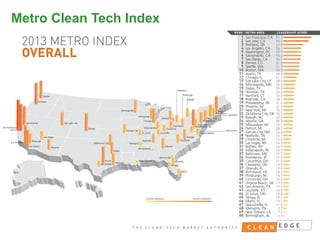
Metro Clean Tech Index

CONFIDENTIAL
NOT FOR DISTRIBUTION
U.S. Markets: Beyond RPS - New State & City
Level Financing/Policy Models
•

Commercial PACE – After complications with residential PACE programs, attention has
shifted to the commercial PACE model to finance energy efficiency improvements.
Programs have sprung up in dozens of states including CA, CT, FL, NY, and TX.

•

State-Level Green Banks – As the nation’s first “green bank,” Connecticut’s Clean
Energy Finance and Investment Authority (CEFIA) is working to finance large-scale
clean energy and efficiency projects across the state. New York has just launched its
own Green Bank, and with $1 Billion in backing should have even greater impact.

•

Metro-Level Built Environment – Chicago Mayor Rahm Emmanuel’s Commercial
Buildings Initiative is conducting extensive energy retrofits to some of the city’s biggest
and most recognizable buildings. Public-private NYCEEC doing similar in New York City.

•

Energy storage standards and rulings, namely in CA, position distributed assets for
further growth. Companies like newcomer Stem and solar-provider SolarCity looking to
enable leasing of energy storage systems.

CONFIDENTIAL
NOT FOR DISTRIBUTION
Tools for Enabling Clean Energy Innovation
1

Establish Aggressive Targets for Renewable Electricity and Energy Storage

2

Create and Fund Smart Infrastructure Banks (city, regional, national)

3

Leverage Proven Investment Tools from other Sectors (MLPs, REITs, AssetBacked Securities, etc.)

4

Phase Out All Energy Subsidies within 10 Years – Starting with Fossil Fuels

5

Establish and Streamline Open Standards (Building Codes, Charging Stations,
PV Installations, etc.)

6

Unleash Crowd Sourcing for Innovative Ideas and Capital

7

Enable New Utility Models like Green Tariffs and Third Party Competition
CONFIDENTIAL
NOT FOR DISTRIBUTION
Thank You.
Ron Pernick
Co-Founder and Managing Director
Clean Edge, Inc.
Co-Author, Clean Tech Nation
pernick@cleanedge.com

www.cleanedge.com

CONFIDENTIAL
NOT FOR DISTRIBUTION
Copyright and
Disclaimer
This publication is the copyright of
Clean Edge, Inc. No portion of this
document may be photocopied,
reproduced, scanned into an electronic
system, transmitted, forwarded, or
distributed in any way without the prior
consent of Clean Edge.
Information contained in this document
is not intended to be investment advice
or used as a guide to investing.

www.cleanedge.com

CONFIDENTIAL
NOT FOR DISTRIBUTION

19Nov-EG1-Pernick ron

  • 1.
    Emerging CleanEnergy Trends& Business Innovation NOVEMBER 2013 Ron Pernick Co-Founder and Managing Director, Clean Edge, Inc. Co-Author, Clean Tech Nation CONFIDENTIAL NOT FOR DISTRIBUTION
  • 2.
    Claiming the Future •Remember the ThreeLegged Stool: Tech, Policy, Capital all Integrally Linked • Level the Regulatory/Policy Playing Field TECHNOLOGY • Focus on RealWorld Project Deployment CAPITAL POLICY • Leverage Private Capital by Keeping Public Funding for the "Edges” • Embrace Standards, Standards, Standards CONFIDENTIAL NOT FOR DISTRIBUTION
  • 3.
    Five Laws ofClean Tech 1 CLEAN TECH CAN SCALE • Global markets for solar PV and wind reached $153 billion in 2012, up from $6.5 billion in 2000 • Brazil now gets more than half its transportation fuels from bioethanol • In Denmark, Portugal, and Spain wind contributes more than 15% of electricity supply • Renewables now provide more of total U.S. energy supply than nuclear CONFIDENTIAL NOT FOR DISTRIBUTION
  • 4.
    Five Laws ofClean Tech 2 DEVELOPED WORLD DOES NOT NEED NEW NUCLEAR OR COAL • Unlike China and India, in most of the developed world you do not need to pursue all energy sources to meet future demand • New nuclear is untenable for many nations, especially Japan • Caveat: Germany could be major exception relying on new coal as it phases out nuclear assets • U.S. model: efficiency + renewables + natural gas CONFIDENTIAL NOT FOR DISTRIBUTION
  • 5.
    Five Laws ofClean Tech 3 “SMALL TECH” WILL PLAY A CENTRAL ROLE • Nanotech lies at core of many clean-tech innovations • Everything from porous membranes for water filtration to new materials for lithium-ion batteries to biomimicry • Big breakthroughs coming in nanotech, 3D printing, and biomimicry • On demand “minimal” manufacturing more sustainable? CONFIDENTIAL NOT FOR DISTRIBUTION
  • 6.
    Five Laws ofClean Tech 4 IT WILL BE A DISPERSED REVOLUTION • Clean tech is sprouting from dozens of hubs: Hyderabad, Vancouver, Shanghai, Copenhagen, Frankfurt, Tokyo, Boston, and San Francisco • We’re talking renewables, efficiency, smart grid, water, advanced materials and more – no one place will own the market • Massive need requires allhands-on-deck approach • All energy is local CONFIDENTIAL NOT FOR DISTRIBUTION
  • 7.
    Five Laws ofClean Tech 5 ENERGY TRANSITIONS TAKE DECADES • We are in the midst of the de-carbonization of energy • Stakeholders must embrace “long view” • Long-term policy and business planning required: − China 5-year plans − Japan corporate 50100 year plans − U.S. Northwest 5-year conservation and electric power plans CONFIDENTIAL NOT FOR DISTRIBUTION
  • 8.
    Clean-Tech Developments Reshapingthe World SMART GRIDS AND THE "UTILITY" OF THE FUTURE • Major 2012 outages from India to Washington D.C., point to need for emboldened grid • A big key: energy storage • Distributed solar generation challenges utility model • Emerging models, such as using buildings as “backup storage,” could ease renewables integration CONFIDENTIAL NOT FOR DISTRIBUTION
  • 9.
    Clean-Tech Developments Reshapingthe World VEHICLE ELECTRIFICATION: HYBRIDS - EVS • Hybrids in near term • Electrification, from hybrid enhancements to EVs, required to meet stringent fuel efficiency standards • EV charging infrastructure development in medium term • Achilles Heel: battery tech advances needed • What will be role of fuel cells, if any? CONFIDENTIAL NOT FOR DISTRIBUTION
  • 10.
    Clean-Tech Developments Reshapingthe World DEEP RETROFITS TO NET ZERO BUILDINGS • Efficiency is still a lowhanging fruit • Buildings represent around 40% of U.S. energy consumption • Breakthroughs in advanced materials to LED lighting • Living buildings (Bullitt Center in Seattle) • Stronger standards and new financing models CONFIDENTIAL NOT FOR DISTRIBUTION
  • 11.
    Clean-Tech Developments Reshapingthe World WASTE TO RESOURCE • Waste, as in nature, is increasingly being seen as a valuable resource • San Francisco, Seattle, and Portland, OR recycling food waste – targeting recycling rates at/above 70% • Big breakthrough: Carbon as a feedstock • Magic Hat brewery turning beer by-products into biogas CONFIDENTIAL NOT FOR DISTRIBUTION
  • 12.
    U.S. Markets: Stateof Clean-Tech Industry Overview • Renewable energy accounted for 49 percent of new electricity capacity in 2012 – its largest share ever. Largely a story of renewables, efficiency, and abundant, low-cost natural gas • Clean-tech deployment in the U.S. is largely being driven by state and metro-level activity: Feds are mired in partisanship and budgets have been decimated • Leadership at state and metro levels integrally linked. • Expiration of incentives (wind and solar) loom large • Key challenges to measures like RPS have failed across the country. But other battles rage on (like net metering in AZ) • Valley of death issues for clean-tech startups with VC retreat from early-stage deals CONFIDENTIAL NOT FOR DISTRIBUTION
  • 13.
    State Clean EnergyIndex 2013 Index Top 5 States 1 California remains the top-ranked state, leading the nation in almost every measure of market expansion including new wind and solar capacity, deployment of hybrid and all-electric vehicles, and registration of new green buildings. 2 Massachusetts took the number 2 spot from Oregon in 2013. Long a leader in clean-energy policy, a champion of energy efficiency, and an innovation hub for technology and finance, the state is moving up in the ranks. 3 Oregon moved down to third place, but retains its position as a green center with strong consumer-driven demand for clean-tech products and services. The state is a leader in HEVs, renewables, green buildings, efficiency, among other areas. New York broke into the top five for the first time, a result of its exceedingly 4 energy-efficient economy, supportive policy structure driven by Cuomo and Bloomberg, and increases in corporate and investment activity. Colorado once again comes in at #5. The state continues to accelerate its clean5 tech infrastructure build out, particularly in green building, wind, and solar PV. CONFIDENTIAL NOT FOR DISTRIBUTION
  • 14.
    Metro Clean TechIndex CONFIDENTIAL NOT FOR DISTRIBUTION
  • 15.
    U.S. Markets: BeyondRPS - New State & City Level Financing/Policy Models • Commercial PACE – After complications with residential PACE programs, attention has shifted to the commercial PACE model to finance energy efficiency improvements. Programs have sprung up in dozens of states including CA, CT, FL, NY, and TX. • State-Level Green Banks – As the nation’s first “green bank,” Connecticut’s Clean Energy Finance and Investment Authority (CEFIA) is working to finance large-scale clean energy and efficiency projects across the state. New York has just launched its own Green Bank, and with $1 Billion in backing should have even greater impact. • Metro-Level Built Environment – Chicago Mayor Rahm Emmanuel’s Commercial Buildings Initiative is conducting extensive energy retrofits to some of the city’s biggest and most recognizable buildings. Public-private NYCEEC doing similar in New York City. • Energy storage standards and rulings, namely in CA, position distributed assets for further growth. Companies like newcomer Stem and solar-provider SolarCity looking to enable leasing of energy storage systems. CONFIDENTIAL NOT FOR DISTRIBUTION
  • 16.
    Tools for EnablingClean Energy Innovation 1 Establish Aggressive Targets for Renewable Electricity and Energy Storage 2 Create and Fund Smart Infrastructure Banks (city, regional, national) 3 Leverage Proven Investment Tools from other Sectors (MLPs, REITs, AssetBacked Securities, etc.) 4 Phase Out All Energy Subsidies within 10 Years – Starting with Fossil Fuels 5 Establish and Streamline Open Standards (Building Codes, Charging Stations, PV Installations, etc.) 6 Unleash Crowd Sourcing for Innovative Ideas and Capital 7 Enable New Utility Models like Green Tariffs and Third Party Competition CONFIDENTIAL NOT FOR DISTRIBUTION
  • 17.
    Thank You. Ron Pernick Co-Founderand Managing Director Clean Edge, Inc. Co-Author, Clean Tech Nation pernick@cleanedge.com www.cleanedge.com CONFIDENTIAL NOT FOR DISTRIBUTION
  • 18.
    Copyright and Disclaimer This publicationis the copyright of Clean Edge, Inc. No portion of this document may be photocopied, reproduced, scanned into an electronic system, transmitted, forwarded, or distributed in any way without the prior consent of Clean Edge. Information contained in this document is not intended to be investment advice or used as a guide to investing. www.cleanedge.com CONFIDENTIAL NOT FOR DISTRIBUTION