REPORTED SPEECH
COMMANDS AND
REQUESTS
Direct speech Reported speech
He said: "March!" He told him to march.
A command (order) is when somebody tells you to do something and you have no choice, you have to do
it. It is not usually polite. It is a "command".
We usually introduce reported orders with the verb "tell". Look at the following example:
Reporting commands and requests is one form of reported speech. For non-native
English speakers is considered to be easier than reporting statements and questions.
subject + told + noun / pronoun + to
infinitive
Because we use the infinitive there is no need to change the tense.
But be careful! we may need to change pronouns, time and place, just like we do in
reported statements and questions.
The structure is very simple:
• The fireman told the woman to leave
the house.
• The teacher told us to submit the
homework.
Direct order Reported order
Dad said: "Eat your food!” He told the boy to eat his food.
The doctor said: “Take these pills 3
times a day“
The doctor told the patient to take
those pills 3 times a day.
She said “Buy some milk in your way
home”
She told her husband to buy some milk
in his way home.
Some examples:
Aim well,
soldier!
The captain told the
soldier to aim well.
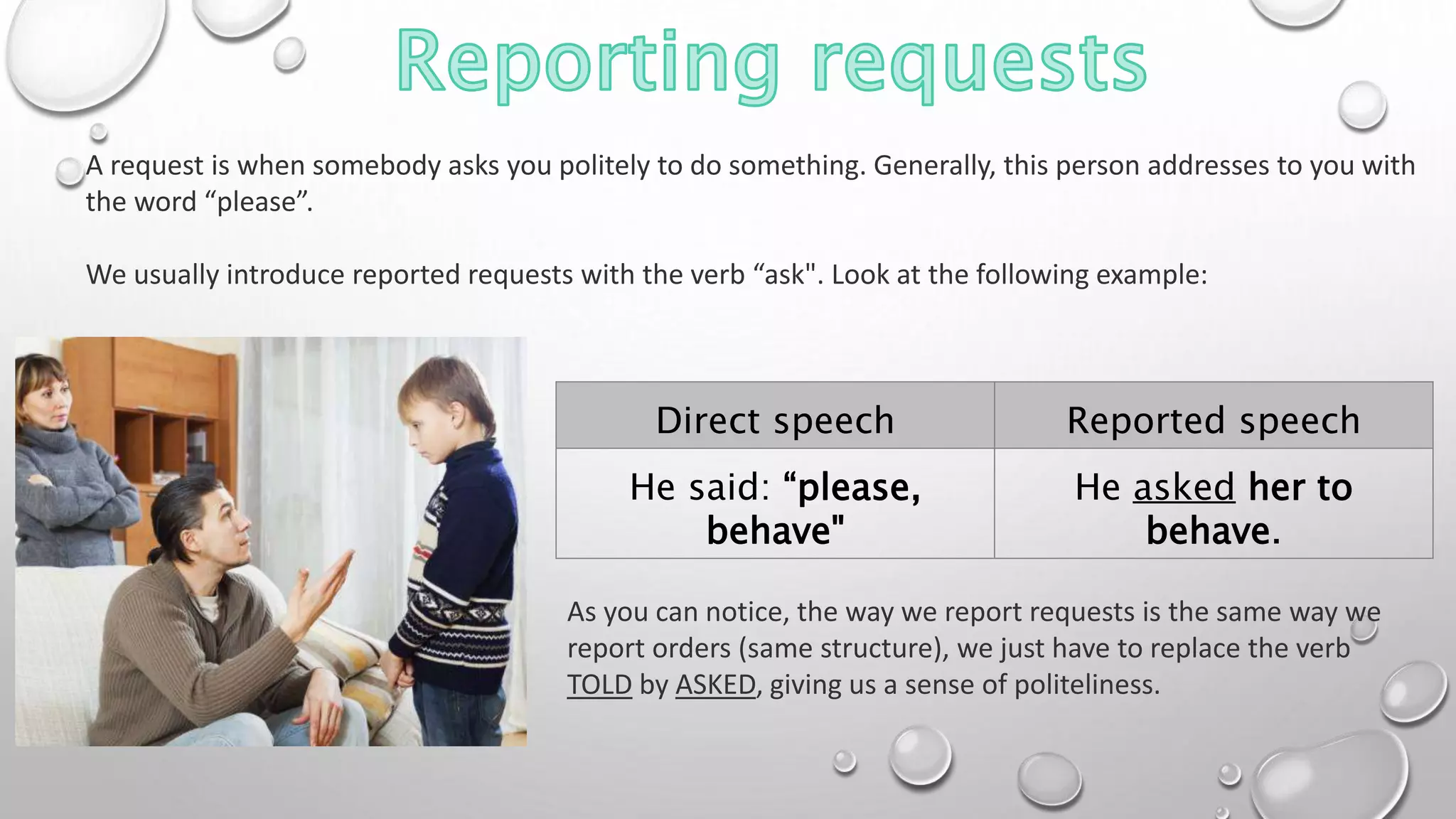
Direct speech Reported speech
He said: “please,
behave"
He asked her to
behave.
A request is when somebody asks you politely to do something. Generally, this person addresses to you with
the word “please”.
We usually introduce reported requests with the verb “ask". Look at the following example:
As you can notice, the way we report requests is the same way we
report orders (same structure), we just have to replace the verb
TOLD by ASKED, giving us a sense of politeliness.
Direct request Reported request
The nurse said: "Eat your food, please!” She asked the boy to eat his food.
George said “please call me at 7“ George asked me to call him at 7.
She said “turn off the TV, please” She asked her son to turn off the TV.
Some examples:
The police officer
asked the driver to
show him his
license.
Show me your
license,
please.
subject + told /asked + noun / pronoun + NOT to
infinitive
IMPORTANT NOTE:
When the order or request is negative, the structure is the following one:
• Sonia asked her husband NOT TO go
out.
• The teacher told the students NOT TO
cheat during the exam.
Kirsten asked her
friend not to
smoke.
Don’t smoke,
please!
The father told
his son to go to
his room.
Go to your
room!
The doctor
asked her to
breath deeply.
Please, breath
deeply.
Snowball told
everyone not to
eat his carrot.
Don’t eat my
carrot!
The advertisement
asked people not
to feed the
animals.
He told him to
help his mother.
Help your
mother!
Do not kiss my
hand!
The Pope told the
woman not to kiss
his hand.

reported-speech-commands-requests-flashcards-worksheet-templates-layouts_124733.pptx

  • 1.
  • 2.
    Direct speech Reportedspeech He said: "March!" He told him to march. A command (order) is when somebody tells you to do something and you have no choice, you have to do it. It is not usually polite. It is a "command". We usually introduce reported orders with the verb "tell". Look at the following example: Reporting commands and requests is one form of reported speech. For non-native English speakers is considered to be easier than reporting statements and questions.
  • 3.
    subject + told+ noun / pronoun + to infinitive Because we use the infinitive there is no need to change the tense. But be careful! we may need to change pronouns, time and place, just like we do in reported statements and questions. The structure is very simple: • The fireman told the woman to leave the house. • The teacher told us to submit the homework.
  • 4.
    Direct order Reportedorder Dad said: "Eat your food!” He told the boy to eat his food. The doctor said: “Take these pills 3 times a day“ The doctor told the patient to take those pills 3 times a day. She said “Buy some milk in your way home” She told her husband to buy some milk in his way home. Some examples:
  • 5.
    Aim well, soldier! The captaintold the soldier to aim well.
  • 6.
    Direct speech Reportedspeech He said: “please, behave" He asked her to behave. A request is when somebody asks you politely to do something. Generally, this person addresses to you with the word “please”. We usually introduce reported requests with the verb “ask". Look at the following example: As you can notice, the way we report requests is the same way we report orders (same structure), we just have to replace the verb TOLD by ASKED, giving us a sense of politeliness.
  • 7.
    Direct request Reportedrequest The nurse said: "Eat your food, please!” She asked the boy to eat his food. George said “please call me at 7“ George asked me to call him at 7. She said “turn off the TV, please” She asked her son to turn off the TV. Some examples:
  • 8.
    The police officer askedthe driver to show him his license. Show me your license, please.
  • 9.
    subject + told/asked + noun / pronoun + NOT to infinitive IMPORTANT NOTE: When the order or request is negative, the structure is the following one: • Sonia asked her husband NOT TO go out. • The teacher told the students NOT TO cheat during the exam.
  • 10.
    Kirsten asked her friendnot to smoke. Don’t smoke, please!
  • 11.
    The father told hisson to go to his room. Go to your room!
  • 12.
    The doctor asked herto breath deeply. Please, breath deeply.
  • 13.
    Snowball told everyone notto eat his carrot. Don’t eat my carrot!
  • 14.
    The advertisement asked peoplenot to feed the animals.
  • 15.
    He told himto help his mother. Help your mother!
  • 16.
    Do not kissmy hand! The Pope told the woman not to kiss his hand.