QUANTIFIERS (7) 
Countable vs. Uncountable (01) 
In context 
2 min 
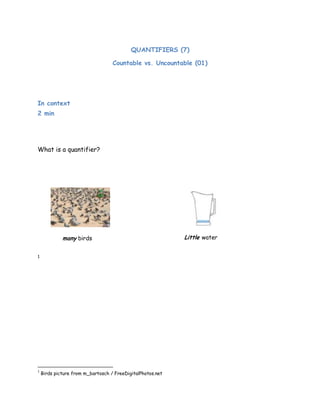
What is a quantifier? 
1 
many birds Little water 
1 Birds picture from m_bartosch / FreeDigitalPhotos.net
Types of Quantifiers 
10 min 
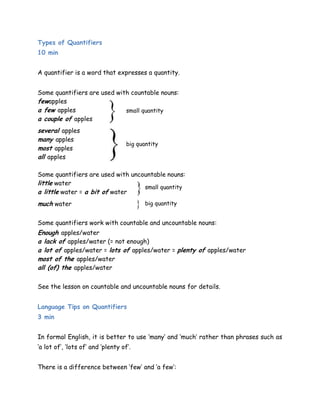
A quantifier is a word that expresses a quantity. 
Some quantifiers are used with countable nouns: 
fewapples 
a few apples 
small quantity 
a couple of apples 
several apples 
many apples 
big quantity 
most apples 
all apples 
Some quantifiers are used with uncountable nouns: 
little water 
small quantity 
a little water = a bit of water 
much water 
big quantity 
Some quantifiers work with countable and uncountable nouns: 
Enough apples/water 
a lack of apples/water (= not enough) 
a lot of apples/water = lots of apples/water = plenty of apples/water 
most of the apples/water 
all (of) the apples/water 
See the lesson on countable and uncountable nouns for details. 
Language Tips on Quantifiers 
3 min 
In formal English, it is better to use „many‟ and „much‟ rather than phrases such as 
„a lot of‟, „lots of‟ and „plenty of‟. 
There is a difference between „few‟ and „a few‟:
Examples: 
Few flowers= not many flowers 
a few flowers = some flowers 
There is the same difference between „little‟ and „a little‟: 
Examples: 
little time = not a lot of time 
a little time = some time 
Writing Exercise 
5 min 
Complete the sentences with: few / a few / little / a little. 
1. Could we have __________ Champagne, please? 
2. They live in a very small flat because they have __________ money. 
3. Very __________ people can speak 5 languages. 
4. This plant needs __________ water and it is very handy. 
5. They have already been to Africa__________ times. 
6. We have __________ time before our flight. 
7. He speaks German very well but sometimes he makes __________ mistakes. 
8. I am happy she has __________ problems in her life. 
9. Would you like __________ candies? 
10. I know __________ about this subject.
Writing Exercise 
5 min 
Complete the sentences with ‘much’ or ‘many’. 
1. I have __________ friends in Europe. 
2. I don‟t drink __________ coffee. 
3. How __________ children do you have? 
4. How __________ does this bag cost? 
5. How __________ rice do you need? 
6. How __________ is this shirt? 
7. We don‟t have __________ time. 
8. I went to Minnesota __________ times last year. 
9. There is not __________ sand in the car. 
10. Jim works on __________ different projects. 
Reading Exercise 
5 min 
Read the sentences and find a synonym for the quantifier. 
Example: 
I have many shoes. 
Synonym: I have a lot of shoes. 
1. The children have plenty of toys. 
2. Would you like a little champagne? 
3. He spends the majority of his time on the computer. 
4. I sent lots of emails. 
5. There is a bit of water on the floor. 
Speaking Exercise with the Teacher (LOC-GR7-01–Si1) 
5 min 
Listen to the teacher’s questions. Then, answer. 
1. How many children do you have? 
2. Do you have lots of friends? 
3. Do you have little patience? 
4. Do you spend plenty of money on clothes? 
5. How much does gas cost in your country? (at the gas station)
Speaking Exercise with the Teacher 
5 min 
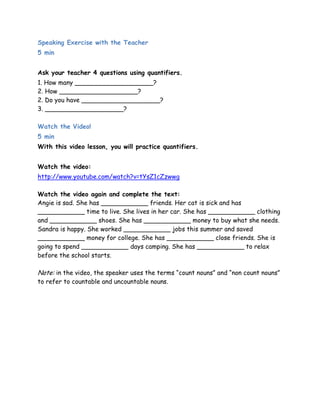
Ask your teacher 4 questions using quantifiers. 
1. How many ____________________? 
2. How ____________________? 
2. Do you have ____________________? 
3. ____________________? 
Watch the Video! 
5 min 
With this video lesson, you will practice quantifiers. 
Watch the video: 
http://www.youtube.com/watch?v=tYsZ1cZzwwg 
Watch the video again and complete the text: 
Angie is sad. She has ____________ friends. Her cat is sick and has 
____________ time to live. She lives in her car. She has ____________ clothing 
and ____________ shoes. She has ____________ money to buy what she needs. 
Sandra is happy. She worked ____________ jobs this summer and saved 
____________ money for college. She has ____________ close friends. She is 
going to spend ____________ days camping. She has ____________ to relax 
before the school starts. 
Note: in the video, the speaker uses the terms “count nouns” and “non count nouns” 
to refer to countable and uncountable nouns.
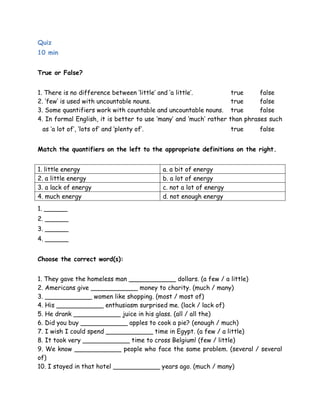
Quiz 
10 min 
True or False? 
1. There is no difference between „little‟ and „a little‟. true false 
2. „few‟ is used with uncountable nouns. true false 
3. Some quantifiers work with countable and uncountable nouns. true false 
4. In formal English, it is better to use „many‟ and „much‟ rather than phrases such 
as „a lot of‟, „lots of‟ and „plenty of‟. true false 
Match the quantifiers on the left to the appropriate definitions on the right. 
1. little energy a. a bit of energy 
2. a little energy b. a lot of energy 
3. a lack of energy c. not a lot of energy 
4. much energy d. not enough energy 
1. ______ 
2. ______ 
3. ______ 
4. ______ 
Choose the correct word(s): 
1. They gave the homeless man ____________ dollars. (a few / a little) 
2. Americans give ____________ money to charity. (much / many) 
3. ____________ women like shopping. (most / most of) 
4. His ____________ enthusiasm surprised me. (lack / lack of) 
5. He drank ____________ juice in his glass. (all / all the) 
6. Did you buy ____________ apples to cook a pie? (enough / much) 
7. I wish I could spend ____________ time in Egypt. (a few / a little) 
8. It took very ____________ time to cross Belgium! (few / little) 
9. We know ____________ people who face the same problem. (several / several 
of) 
10. I stayed in that hotel ____________ years ago. (much / many)

07 english grammar quantifiers - 01 countable vs uncountable pdf

  • 1.
    QUANTIFIERS (7) Countablevs. Uncountable (01) In context 2 min What is a quantifier? 1 many birds Little water 1 Birds picture from m_bartosch / FreeDigitalPhotos.net
  • 2.
    Types of Quantifiers 10 min A quantifier is a word that expresses a quantity. Some quantifiers are used with countable nouns: fewapples a few apples small quantity a couple of apples several apples many apples big quantity most apples all apples Some quantifiers are used with uncountable nouns: little water small quantity a little water = a bit of water much water big quantity Some quantifiers work with countable and uncountable nouns: Enough apples/water a lack of apples/water (= not enough) a lot of apples/water = lots of apples/water = plenty of apples/water most of the apples/water all (of) the apples/water See the lesson on countable and uncountable nouns for details. Language Tips on Quantifiers 3 min In formal English, it is better to use „many‟ and „much‟ rather than phrases such as „a lot of‟, „lots of‟ and „plenty of‟. There is a difference between „few‟ and „a few‟:
  • 3.
    Examples: Few flowers=not many flowers a few flowers = some flowers There is the same difference between „little‟ and „a little‟: Examples: little time = not a lot of time a little time = some time Writing Exercise 5 min Complete the sentences with: few / a few / little / a little. 1. Could we have __________ Champagne, please? 2. They live in a very small flat because they have __________ money. 3. Very __________ people can speak 5 languages. 4. This plant needs __________ water and it is very handy. 5. They have already been to Africa__________ times. 6. We have __________ time before our flight. 7. He speaks German very well but sometimes he makes __________ mistakes. 8. I am happy she has __________ problems in her life. 9. Would you like __________ candies? 10. I know __________ about this subject.
  • 4.
    Writing Exercise 5min Complete the sentences with ‘much’ or ‘many’. 1. I have __________ friends in Europe. 2. I don‟t drink __________ coffee. 3. How __________ children do you have? 4. How __________ does this bag cost? 5. How __________ rice do you need? 6. How __________ is this shirt? 7. We don‟t have __________ time. 8. I went to Minnesota __________ times last year. 9. There is not __________ sand in the car. 10. Jim works on __________ different projects. Reading Exercise 5 min Read the sentences and find a synonym for the quantifier. Example: I have many shoes. Synonym: I have a lot of shoes. 1. The children have plenty of toys. 2. Would you like a little champagne? 3. He spends the majority of his time on the computer. 4. I sent lots of emails. 5. There is a bit of water on the floor. Speaking Exercise with the Teacher (LOC-GR7-01–Si1) 5 min Listen to the teacher’s questions. Then, answer. 1. How many children do you have? 2. Do you have lots of friends? 3. Do you have little patience? 4. Do you spend plenty of money on clothes? 5. How much does gas cost in your country? (at the gas station)
  • 5.
    Speaking Exercise withthe Teacher 5 min Ask your teacher 4 questions using quantifiers. 1. How many ____________________? 2. How ____________________? 2. Do you have ____________________? 3. ____________________? Watch the Video! 5 min With this video lesson, you will practice quantifiers. Watch the video: http://www.youtube.com/watch?v=tYsZ1cZzwwg Watch the video again and complete the text: Angie is sad. She has ____________ friends. Her cat is sick and has ____________ time to live. She lives in her car. She has ____________ clothing and ____________ shoes. She has ____________ money to buy what she needs. Sandra is happy. She worked ____________ jobs this summer and saved ____________ money for college. She has ____________ close friends. She is going to spend ____________ days camping. She has ____________ to relax before the school starts. Note: in the video, the speaker uses the terms “count nouns” and “non count nouns” to refer to countable and uncountable nouns.
  • 6.
    Quiz 10 min True or False? 1. There is no difference between „little‟ and „a little‟. true false 2. „few‟ is used with uncountable nouns. true false 3. Some quantifiers work with countable and uncountable nouns. true false 4. In formal English, it is better to use „many‟ and „much‟ rather than phrases such as „a lot of‟, „lots of‟ and „plenty of‟. true false Match the quantifiers on the left to the appropriate definitions on the right. 1. little energy a. a bit of energy 2. a little energy b. a lot of energy 3. a lack of energy c. not a lot of energy 4. much energy d. not enough energy 1. ______ 2. ______ 3. ______ 4. ______ Choose the correct word(s): 1. They gave the homeless man ____________ dollars. (a few / a little) 2. Americans give ____________ money to charity. (much / many) 3. ____________ women like shopping. (most / most of) 4. His ____________ enthusiasm surprised me. (lack / lack of) 5. He drank ____________ juice in his glass. (all / all the) 6. Did you buy ____________ apples to cook a pie? (enough / much) 7. I wish I could spend ____________ time in Egypt. (a few / a little) 8. It took very ____________ time to cross Belgium! (few / little) 9. We know ____________ people who face the same problem. (several / several of) 10. I stayed in that hotel ____________ years ago. (much / many)